It’s good to have goals; even better to achieve them.
For the past 12 years, my July’s have been defined by my goal to ride 1,000 kilometres in the month.
I came up short in 2009, a sweltering July, and in 2014, for some unknown reason.
But otherwise, it’s been pretty achievable.
Especially as I tend to take two weeks off to get up early to watch the Tour de France then, suitably inspired, spend the rest of the day riding my own bike.
In 2008 I must have been particularly inspired, as I achieved 1,600 km, including 608 in one incredible week!
Eight days ago, my beloved 1,000 seemed out of reach.
The demise of my newspaper meant I’d seen the last of my six weeks’ annual vacation that I’d toiled 20 years to attain. In fact, the beginning of a new job meant no vacation at all.
But two unexpected gift rides last week, and a favourable calendar with a long weekend to close the month, opened the door to the possibility of reaching that 1,000. Good legs, recovered from the gruelling Triple Crown, put me over the top.
To ride those 1,095 km took me 44 hours and 53 minutes; that’s like a full work week plus half a day of overtime!
A handy bit of cycling infrastructure at Port Moody’s Rocky Point Park; a bike repair stand with tools and an excellent air pump. Not that there was anything wrong with Lapierre.
Saluting the goat, any the achievement of my annual July riding goal.
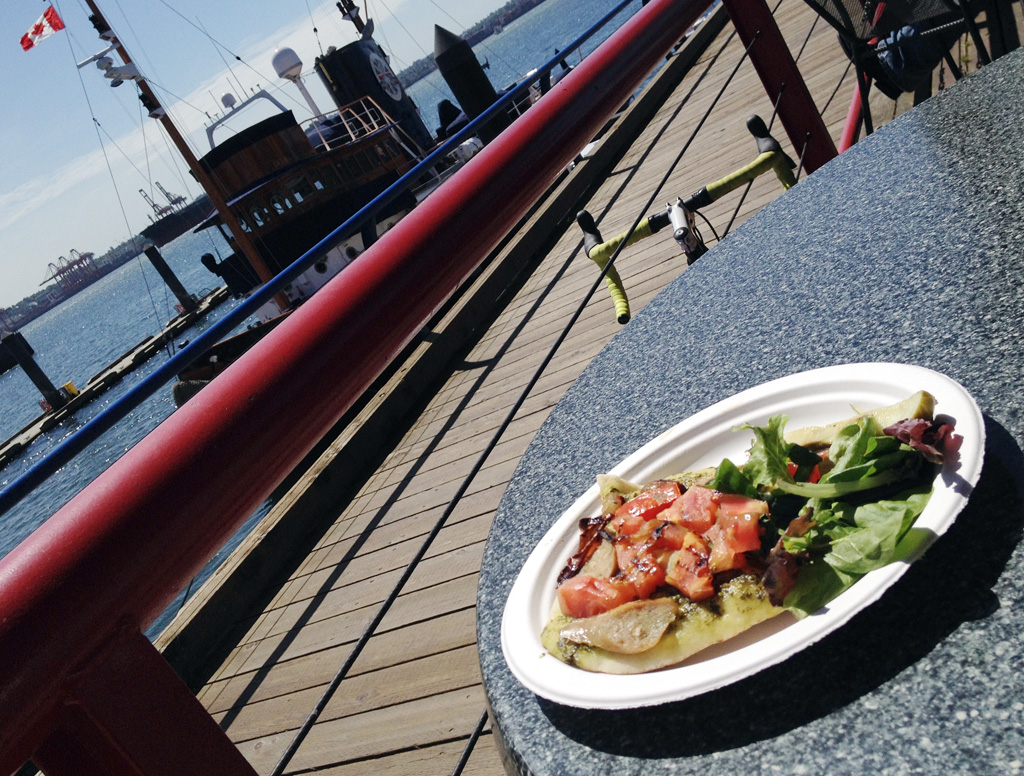
Fuel for a busy long weekend riding included this tasty Mexican dish of roasted pepper stuffed with quinoa, beans, roasted corn and green onions.
Saturday’s bonus ride was into a strong headwind.
Beware the dismay of a Fuggitivi denied his first Lunch Doctor experience!
Of course in the Strava universe, 1,000 km in a month is but a molehill. The month’s distance champion was a woman from Florida, who clocked more than 11,000 km! That means she rode more than 370 km a day, 12 hours of every day of the month!
My legs wilt just at the thought.
As does my brain. Because she did her rides covering laps of the same 20 km circuit, over and over and over again. I can only imagine the mental fatigue and boredom of watching the same countryside roll past hour after hour, day after day, week after week.
Her Strava profile says she has a goal to set a new record for ultra marathon cycling. To achieve that, she’ll have to ride more than 122,432 km by next July 1. Because this was the first month of her challenge.
When Princess of Pavement asked me two days running, “aren’t you going for a ride?” the nature of her enquiry and the way she asked it implied encouragement.
I hadn’t planned to ride.
On Sunday I was scheduled to work on a special project so I was resigned to missing the weekly FRF ride. Instead I went for a solo roll on Friday. When I reminded PofP after her ride query Saturday night, she suggested I could head out early, before I had to work.
Hmmmmmm, free kilometres!? Yes please!
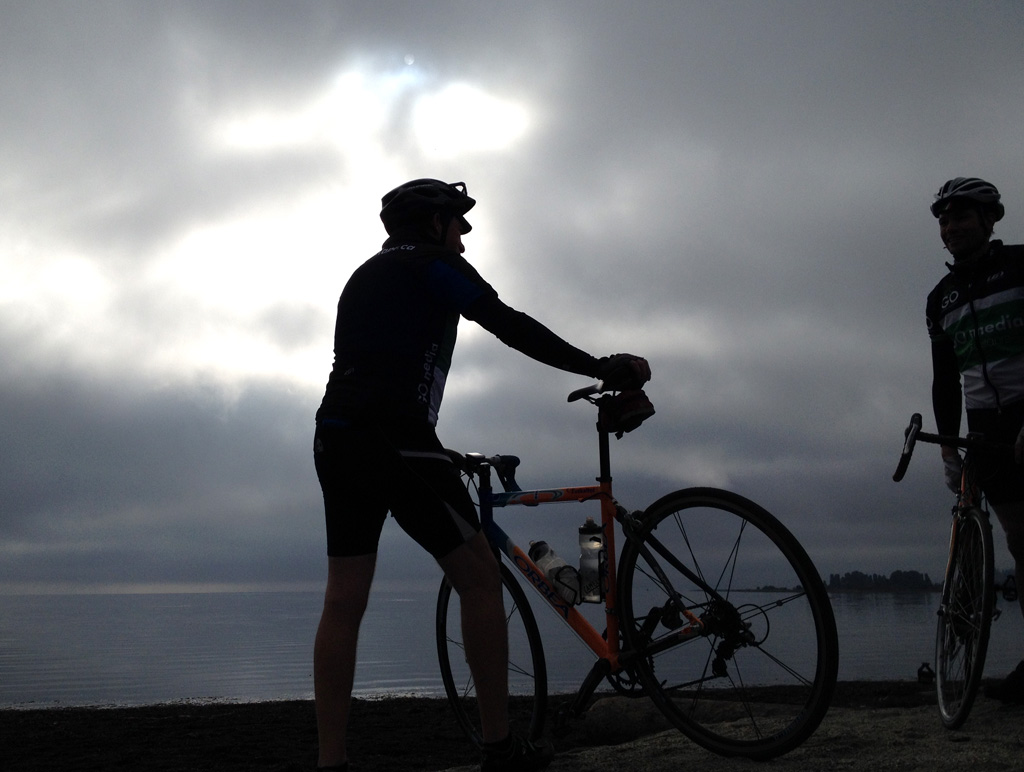
Morning roll-out by dawn’s early light.
Living in an open loft presents challenges for any early or late activities. There’s no door to close to muffle the noise. And while Little Ring has a separate room with a doorway, his senses seem to roust at first light and await any cue that the day is set to begin, especially if that cue indicates breakfast is being prepared.
“Is it morning yet?” he’ll cry out. “I’m hungry.”
So an early-morning ride requires meticulous preparation the night before. That means placing the bike by the door, hanging kit in the bathroom for changing, placing shoes, helmet, gloves and emergency kit somewhere clear of creaking floor boards, honing muscle memory to avoid those noisy floor boards, putting out breakfast utensils and dishes to minimize drawer and cupboard opening, rounding up breakfast ingredients to limit the number of times the fridge has to be opened and closed.
Free kilometres usually mean flat kilometres to maximize their impact on my mileage goals.
The pressure is enormous. One false step, one moment’s inattention could disturb the pre-dawn silence.
The unexpected evening ride, however, usually comes with a peace dividend. It seems Little Ring is more amenable to sticking to his bedtime script when there’s only one of us around; it’s as if he has an innate sense there’s no “good cop” around who will accede to his various nighttime stalling games just to keep the peace.
So when Princess of Pavement asked again on Monday whether I was going for a ride, I was gifted another great big mozza ball of free kilometres.
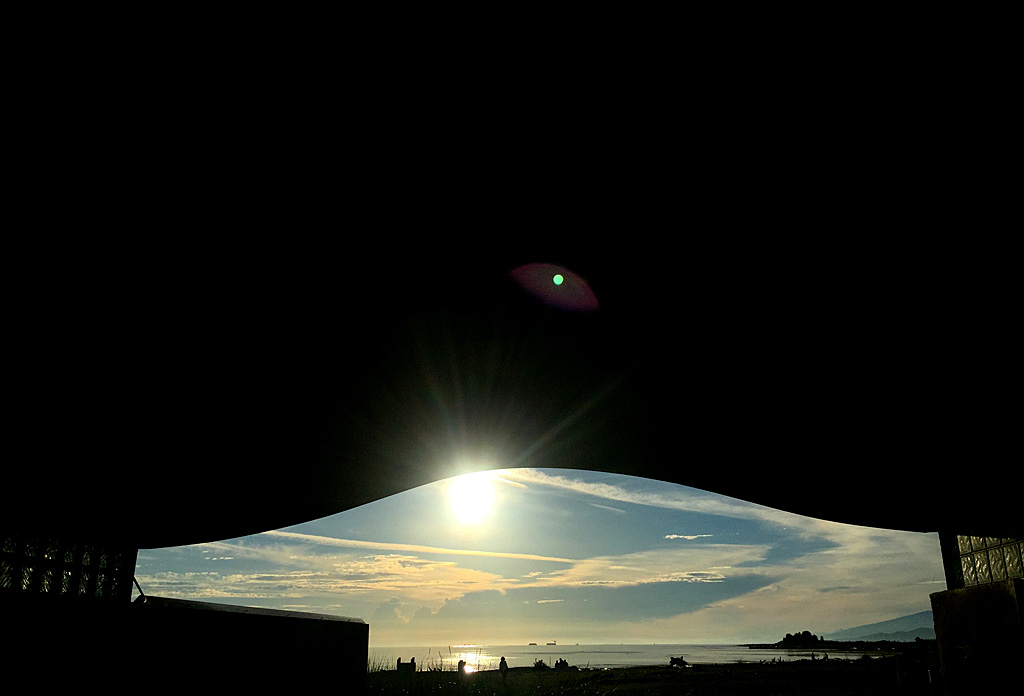
The sun begins to set at Iona Beach
And while they’ll help get me a little closer to my usual July goal of 1,000 kilometres for the month, I’m resigned that I likely won’t attain it this year. Working at a new job and not having my traditional two weeks holiday during the Tour de France to pile on the rides has been the Yoko Ono to my Strava goals.
Friday’s PoCo Grand Prix transformed Port Coquitlam’s historic downtown into a high speed circuit of lythe, powerful cyclists, carbon fibre, lycra and a whole lot of excitement.
The inaugural Grand Prix is part of BC Superweek, a week-long festival of bike racing in communities around Metro Vancouver that attracts top female and male pro cyclists from across North America and as far away as Australia. In Port Coquitlam, they raced a twisting 1.3 km circuit that circumnavigated the downtown and City Hall.
But the event was more than just a bike race. It was a day-long celebration of cycling with live entertainment, a beer garden, a kids zone, business and cycling expo as well a support races for kids, junior racers, amateurs and corporate teams.
I was hired by the Tri-City News to cover the evening’s feature races as well as capture some of the collateral fun.
MARIO BARTEL PHOTO Gary Mauris, the president of Dominion Lending Centres, fires the starters pistol to start the men’s race at Friday’s PoCo Grand Prix.
MARIO BARTEL PHOTO Justin Williams celebrates his win in the men’s race.
MARIO BARTEL PHOTO The women’s peloton speeds along McAllister Avenue towards the PoCo Court House in Friday’s PoCo Grand Prix.
MARIO BARTEL PHOTO Spectators along the barriers on Shaugnessy Street cheer on the riders in the women’s race at Friday’s PoCo Grand Prix.
MARIO BARTEL PHOTO The women’s race is underway at Friday’s PoCo Grand Prix, part of the Superweek series of races around Metro Vancouver that attracts top pro riders from around North America and as far away as Australia.
MARIO BARTEL PHOTO Women’s race winner Kendelle Jackson celebrates on the podium.
MARIO BARTEL PHOTO The women’s race speeds past the historic railroad mural on Elgin Avenue.
MARIO BARTEL PHOTO The men’s race lines up on Shaunessy Street.
MARIO BARTEL PHOTO Doreen Speers cheers on the riders in the women’s race at Friday’s PoCo Grand Prix.
MARIO BARTEL PHOTO A racer reflects on the start of the women’s race at Friday’s PoCo Grand Prix.
MARIO BARTEL PHOTO The women’s race speeds along Elgin Avenue.
MARIO BARTEL PHOTO American Justin Williams celebrates his win in the men’s race with fans along Shaugnessy Street.
MARIO BARTEL PHOTO Sara Bergen speeds down the main stretch at Friday’s PoCo Grand Prix.
MARIO BARTEL PHOTO A rider’s elaborate nails prior to the start of the women’s race at Friday’s PoCo Grand Prix.
MARIO BARTEL PHOTO The men’s peloton is strung along Shaugnessy Street.
MARIO BARTEL PHOTO The Sean Michael Trio performs on the Phoenix Entertainment Stage at Friday’s PoCo Grand Prix.
MARIO BARTEL PHOTO The bowlers seem to have lost their exclusive parking privileges during Friday’s PoCo Grand Prix.
MARIO BARTEL PHOTO The men’s peloton prepares to turn onto Shaughnessy Street.
MARIO BARTEL PHOTO The PoCo Grand Prix kids zone provides future racers a chance to hone their skills.
MARIO BARTEL PHOTO Riders speed through the corner of Donald Street and McAllister Avenue during the women’s race at the PoCo Grand Prix on Friday.
MARIO BARTEL PHOTO Aaron Paddon, 6, concentrates as he negotiates the trials course in the Kids Zone at Friday’s PoCo Grand Prix.
MARIO BARTEL PHOTO The men’s race speeds on McAllister Avenue at Friday’s PoCo Grand Prix.
MARIO BARTEL PHOTO Heidi Ujfalusi rings the bell to signal a “Prime” lap in which riders race to the finish line to claim a cash prize.
MARIO BARTEL PHOTO Wheels are lined up for the start of the women’s race at Friday’s PoCo Grand Prix.
MARIO BARTEL PHOTO Kendelle Hodges celebrates her win in the women’s race at Friday’s PoCo Grand Prix.
After every ride, I dutifully download the data from my Garmin GPS to the social site that connects riders from around the world who break down their routes into bite-sized segments. Comparing my performance with previous rides can give me an idea of improvements in my own fitness, as well as affirm the sensations in my legs; feeling strong during a climb up Burnaby Mountain isn’t just in my imagination when Strava awards me a Personal Best trophy icon.
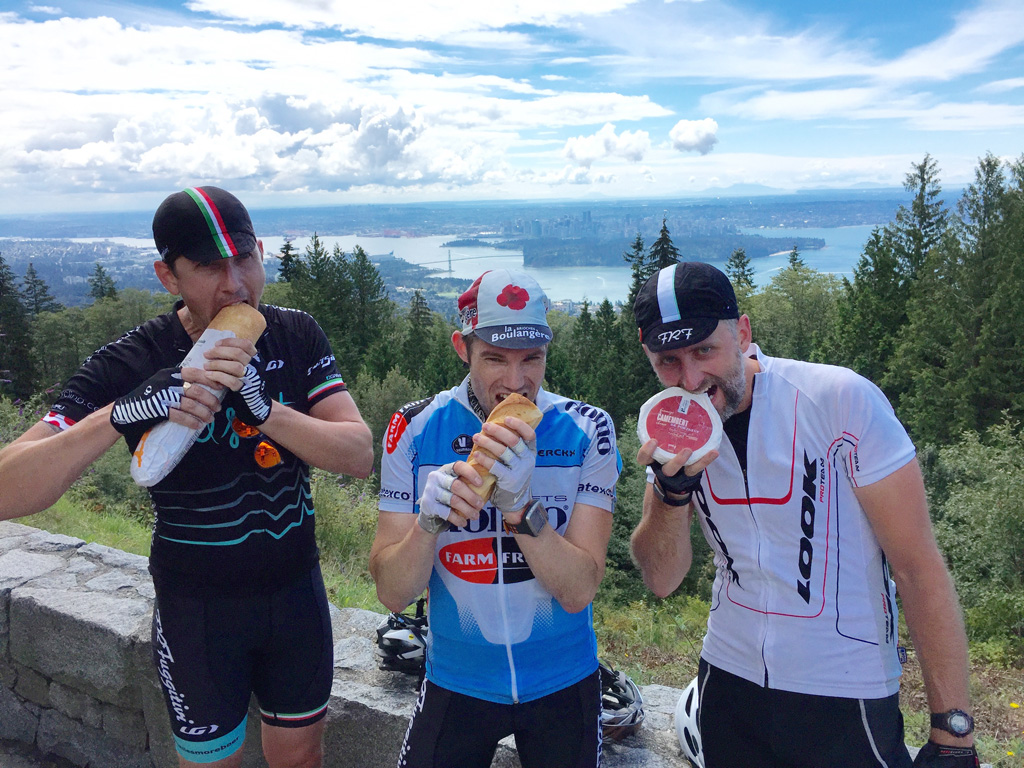
Enjoying a baguette and brie on the annual FRF Bastille Day ride.
Earning those little trophies is addictive.
Strava has more than 1.5 million active users. They include cyclists and runners. Logging their activities into the site provides real-time tracking of their performance improvements over segments created by fellow users.
Those segments are also the measure upon which cyclists and runners can compare their performance with others, a sort of giant ongoing virtual race.
Sometimes those virtual competitions can get pretty intense. Setting a new KOM can be conversation fodder in the FRF peloton, a throw-down to other riders.
What’s a celebration of French cycling without baguette and brie?
Not that I ever have to worry about setting or regaining a coveted KOM.
In the Strava world I am famously mediocre. My modest achievements are neither great nor terrible. Inevitably a personal best that I worked hard to attain will end up ranked solidly somewhere in the middle of the pack of all riders who’ve ridden the same segment.
Except for descents. Apparently I can be pretty decent at those; I’ve even managed to crack the top 10 on some, even if briefly.
This Saturday I’ve signed on for the Triple Crown, a challenging ride up Vancouver’s three major mountains, Seymour, Grouse and Cypress. I’ve done all three separately, never on the same day. The route covers 75km with around 2000 metres of climbing.
I’m confident I’ll be able to do it. I’m certain I’ll be slow. I’m scared of the effort it’s going to take.
So instead, I’m going to think of it as three fast and fun descents. Because what goes up, has to come down. Before it can go up again…
The clouds of doom began gathering as soon as the destination for Sunday’s FRF ride was announced.
As we embarked on our ill-fated adventure into cycling’s Heart of Darkness, Delta, they thickened, became more menacing.
Barely over the Bridge of Lost Souls that transports unwitting victims into her lair, never to be seen again, the trouble began. Mike, an FRF newbie on his inaugural ride, flattened. By the time the day was done, the fierce headwind was no longer the topic of our peloton’s consternation; it was Mike’s unprecedented FOUR flats!
An all too familiar scene; the FRF gather around as a flat tire is changed.
Delta is where cyclists get lost, and tires go to die.
The city’s bike routes are deplorable. Not only is their signage inconsistent and often illogical, the lanes are poorly maintained.
It is July, the thick of riding and bike commuting season, and the bike routes are as dirty with gravel and debris as if it was mid-March after a harsh winter of snowplowing and sanding. the sharp stones bite into tires, ricochet into unsuspecting shins, ping off shiny carbon fibre frames and even catapult off passing vehicles. Riding in Delta, especially along busy routes like River Road, is a dangerous game of waving and weaving through a moonscape disguised as a bike lane.
Gravel and stones no the marked bike lane is an invitation to trouble. Routes need to be swept.
Making roads and routes safe for cyclists involves more than just painting white stencils on shoulders. Those lanes should be swept regularly to clear them of the debris and detritus strewn by cars and trucks. A sharp stone squeezed out by a tire at 120psi becomes a missile, capable of gashing shins, chipping paint, flattening tires. Just ask Mike, whom we last saw humping his bike back down the Bridge of Lost Souls, his patience and our peloton’s supply of inner tube and CO2 cartridges exhausted.
Four flats on a single ride is terribly bad luck. In Delta, it’s inevitable.
With apologies to the Eagles, there’s a new kit in town.
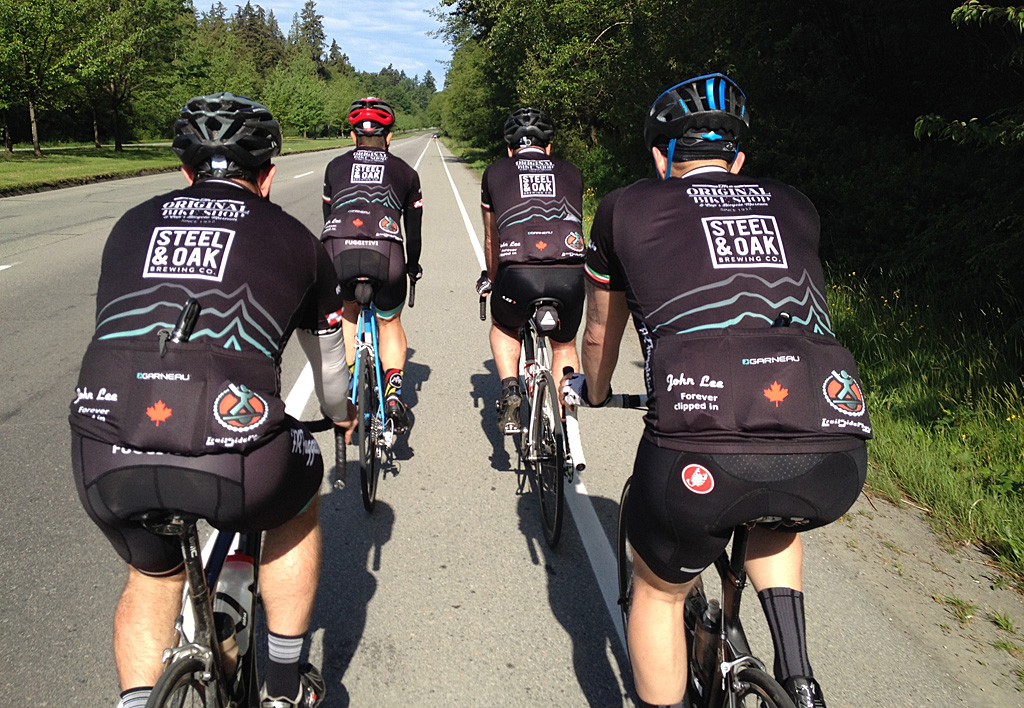
Actually, the Fraser River Fuggitivi road bike group has been rolling up and down the hills of New Westminster and beyond for about five years. But this spring the squadron has achieved a milestone coveted by every collective of roadie riders; they’ve got kit.
That’s cycling speak for fancy custom-designed jerseys and shorts emblazoned with the team’s name as well as the logos of various local sponsors. They’re not just riders anymore; they’re rolling billboards for an elite selection of supportive businesses. They’re also ambassadors for the city (minus the talent competition or commitment to wave from a parade float).
The Fuggitivi was formed by New Westminster roadie and New Zealand expat Guy Wilson-Roberts. He lives along the Quay and he got tired of trudging up the city’s interminable hills and rolling all the way into Vancouver to join a peloton of like-minded weekend athletes. By the time he got there, he was already pooped and of a mind to head back home.
So he put out a call on social media for fellow riders to come to him.
A few did. Those early pelotons were pretty modest; sometimes Wilson-Roberts’ group ride was just him.
But his persistence paid off; the group is growing.
This year there are about about 20 Fuggitivi (it’s the Italian word for fugitive) escaping the responsibility of their everyday lives twice a week for a few hours of freedom on the road; the group does a long ride of about 80-100 km every Sunday morning and a shorter, more intense climbing ride on Tuesday evenings.
There’s plenty of advantages to riding with a collegial group:
1. Camaraderie
In a group, you never ride alone. Unless you’re off the back early on a major ascent like Mt. Seymour. Then you’re left to the bears.
Actually, a good group ride will often splinter into smaller pelotons to accommodate different paces. And confuse the bears by giving them too many options.
In the Tour de France, the last rider in the pelton is known as the Laterne Rouge. On an FRF group ride up Mt. Seymour, he’s called bear kibble.
2. Beer
The FRF’s official hashtag is #moremilesmorebeer. And more refreshing than the Wayans’ brothers’ movie Mo’ Money.
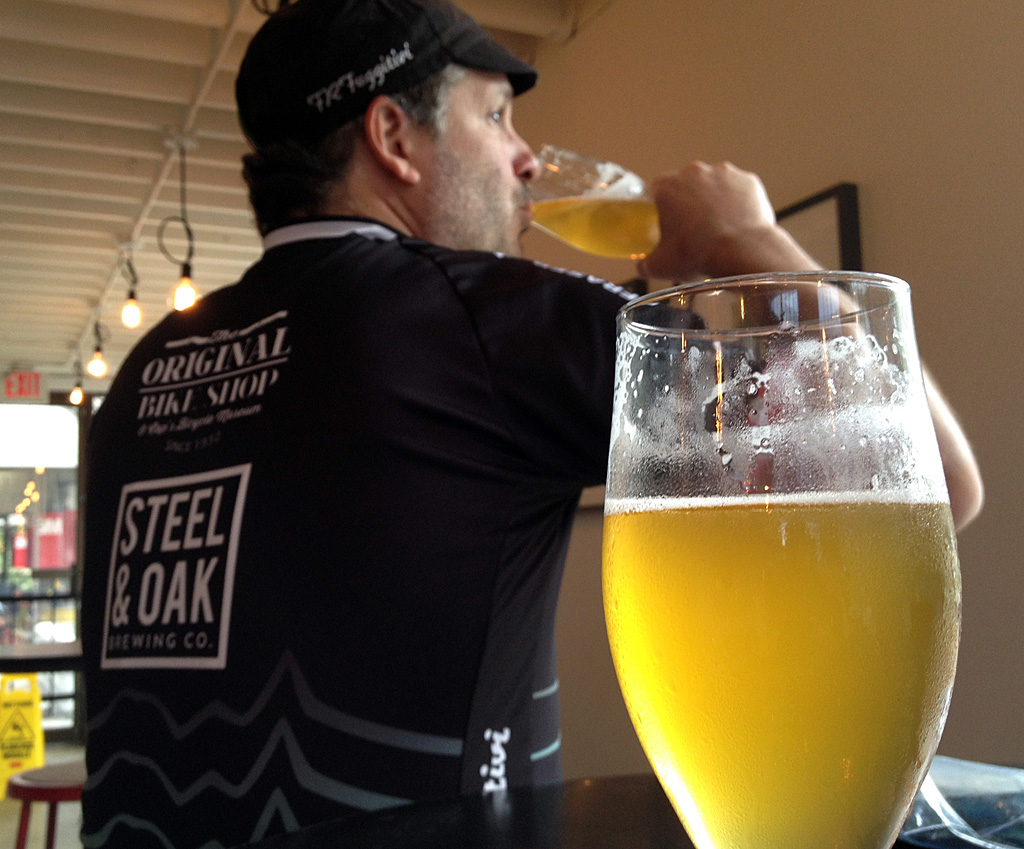
Beer!
3. Mechanical assistance
See how the group pitches in to help a fellow cyclist who’s flatted get back on the road as quickly and cleanly as possible. Face it, best to leave the complicated repairs to the expert wrenches at The Original Bike Shop (shameless sponsor plug #1)
It’s all hands on handlebars when an FRF rider has to repair a flat.
4. Beer
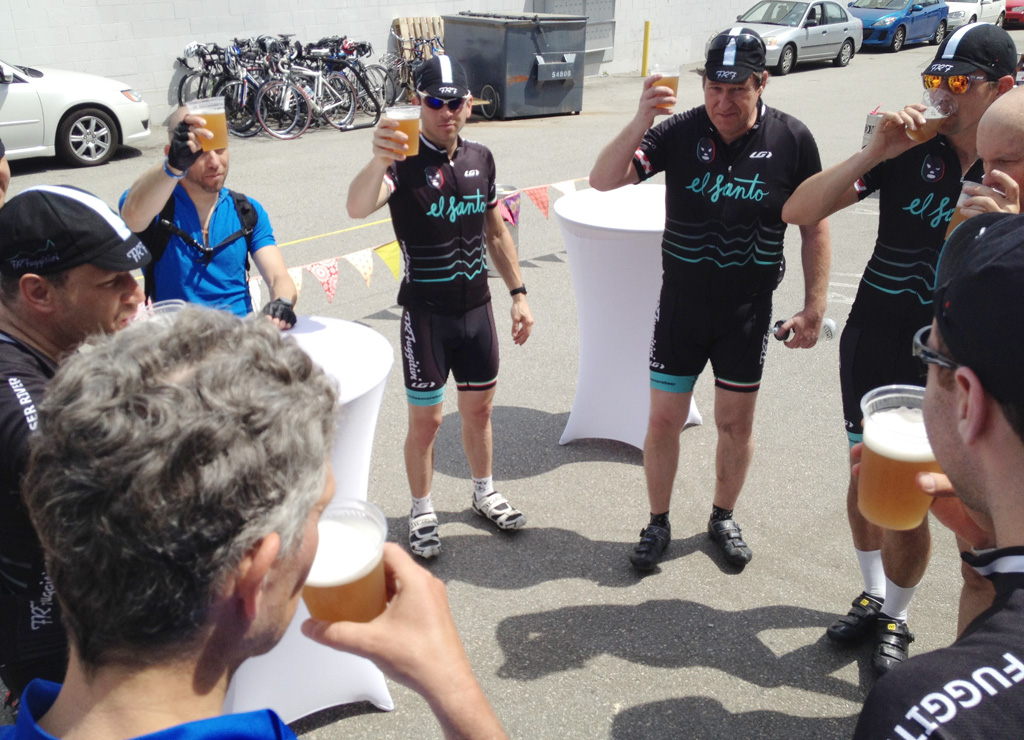
Yes, some FRF rides make pitstops at craft breweries. Heck one of the group’s sponsors is a brewery! It’s in our DNA.
Beer.
5. Aerodynamics
Riding into a cool headwind, it’s actually an advantage to be off the back. Because that’s where you’ll be able to take advantage of the rest of the group slicing a path for you through the breeze. You can conserve about 30 per cent of your energy that way, giving you more endurance to bend your elbows for no. 6. Some group’s call such opportunists a “wheel suck;” in the FRF, that’s just smart riding.
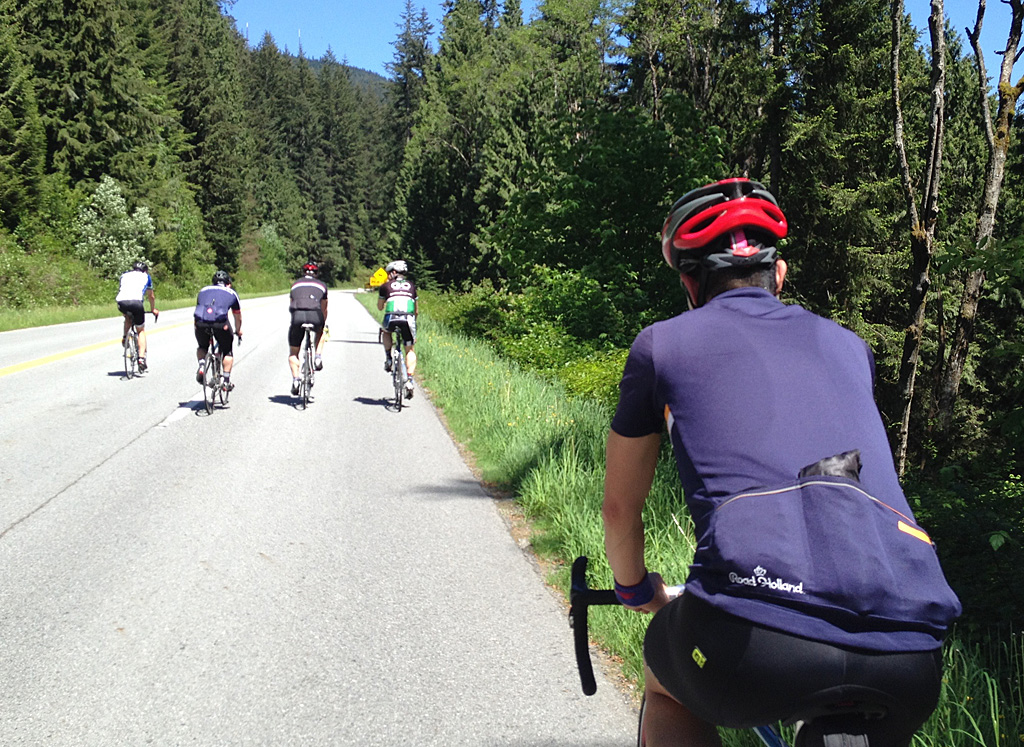
This is how to stay out of the wind and conserve energy on a group ride.
6. Beer
Really, it’s just a four-letter word for carbo-loading.
Beer!
7. Sightseeing
Every week a new captain is responsible for the ride’s route. That means discovering new ways to reach familiar destinations. And sometimes subjecting your lithe road bike to knee-rattling gravel. That’s called channeling your inner Flandrian.
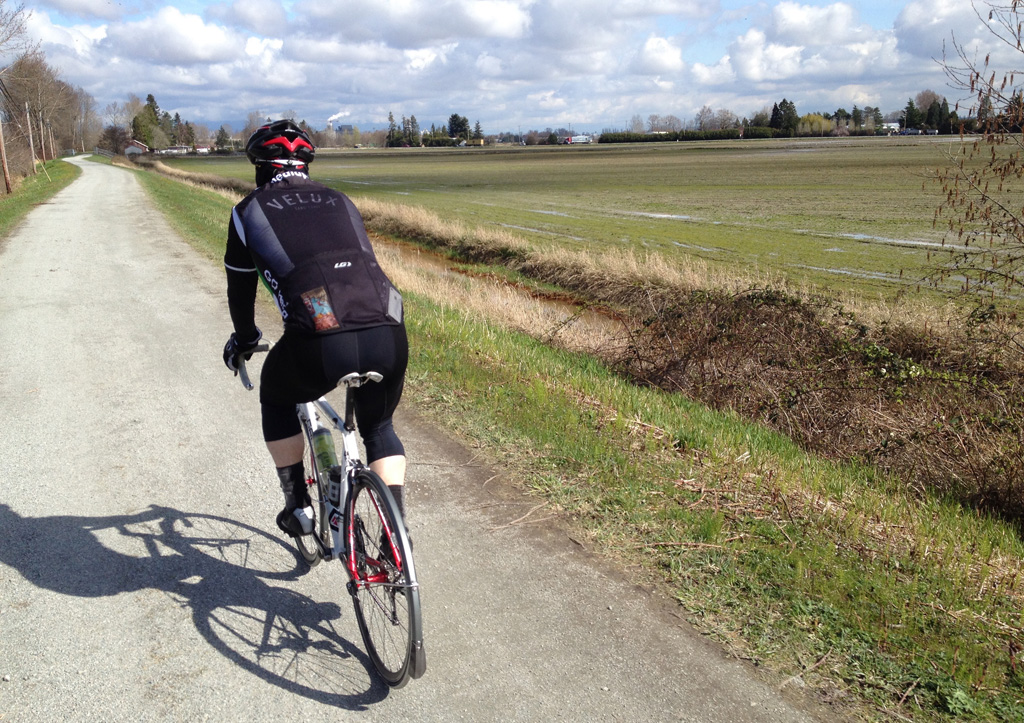
Channeling our inner Paris-Roubaix on a stretch of gravel in Richmond.
8. Um, beer
A traditional post-ride beverage favoured by cyclists is a radler. It’s a refreshing mix of beer and fizzy lemonade. It originated in Bavaria, where the drink was called a radlermass, which means “cyclist mass.” Lore has it an innkeeper just outside Munich was running low on beer during a cycling party, so he extended his dwindling kegs by mixing in lemon soda. BTW, Steel & Oak mixes a killer radler (shameless sponsor plug #2).
Radler!
9. Food
Cycling burns calories. We know this because our Garmin computers tell us so. Ride 100 km with your buddies and eat whatever you want the rest of the day. Especially if you crave delicious tacos at El Santo (shameless sponsor plug #3).
The lunch break or snack stop is a key highlight of the group ride.
10. Yup, beer
According to Bicycling Magazine, beer is an excellent natural source of folic acid, which helps reduce the chances of developing a cramp as you ride. If you stay cramp free, you’re less likely to try to ride through it and risk injury because your suffering body wasn’t up to the challenge. Unfortunately that means you won’t need to be taking advantage of the excellent rehab care at Trailside Physio anytime soon (shameless sponsor plug #4).
Beer!
11. Cool swag
Cyclists were wearing cycling caps long before it was cool to wear cycling caps. FRF’s cycling caps are amongst the coolest around. They’re even made by one of the group’s own members, Richard Lee of Red Dots Cycling (shameless sponsor plug #5). Richard also designed the FRF’s stylish new kit.
Oh yeah, you’ll also likely appear in cool photos like this at some point.
12. Navigation
When you ride with the FRF, you never get lost. Especially in Delta, the Bermuda Triangle of Cycling. Nobody gets lost in Delta. Ever.
To cyclists, Delta is the Bermuda Triangle that swallows whole groups whole and never releases them.
13. Beer
You’ve read this far; you’ve earned a beer. Then, oil the chain on your road bike, join the FRF and enjoy more beer.
And….beer!
To learn more about the Fraser River Fuggitivi, check their website or follow their Twitter feed @frfuggitivi. Cap’s The Original Bike Shop also conducts group rides on various days.
Not even a week off the bike and Strava has already forgotten about me.
The following article was first published on The Big Ring
Strava has forgotten who I am.
It’s six days into June and I’ve yet to throw a leg over the Lapierre. And already my mileage barometer has forsaken me.
I’m working again. That means trying rediscover a balance between working, riding and life.
A new job means adjusting to new routines that have a ripple effect on other aspects of our busy lives, like getting Little Ring to and from daycare, when to get groceries, managing household chores, finding time to binge-watch Silicon Valley. Too frequently in the past few weeks, it’s been the riding that’s been left behind.
My mileage on the bike is taking a hit.
In the months after my newspaper closed, I settled into a pretty simple routine; I still got up at 5:30 a.m. to shower and prepare breakfast for the family, get the household going. Once their days were established, I put time into scanning job sites, targeting possibilities, preparing resumés, drafting cover letters as well as crafted stories for my various blogs and freelance accounts to maintain my writing and social media chops. If there weren’t any other pressing errands, I was then free to ride.
Minus the niggling little problem of no income to replenish a dwindling bank account, it was a good routine that kept the household in order, my spirits up, my legs fit and my Strava account active.
While searching for new employment, I kept an eye out for opportunities that might allow me to commute by bike. As a journalist, I’d been denied that chance my entire career because we’re pretty much on the job once we step out the door, and during the drives around town or on the way home. That meant packing along the camera gear in case I was diverted to some sort of breaking news story or last-minute assignment. Or just scheduled to cover something on my way in or from the office because it was convenient.
A number of FRF members are regular bike commuters. I look at their Strava accounts with envy; those 20 km pedals to and from work really add up. And inevitably they’re the guys off the front during our weekly recreational rides.
I did manage to join one of the Tuesday climbing rides. But I thought that meant pedaling up and down hills, not riding elevators!
My new gig is a 400 metre walk from home! Which is awesome! But doesn’t afford me the chance to join the bike commuting culture.
I’m four weeks into the new position and I’m still getting my legs under me. Now I just have to figure out how to get those legs pedalling more frequently.
Jesse Cahill doesn’t think he’s “weird enough” to be mentioned in the same breath as David Byrne.
But the New Westminster drummer and the Talking Heads’ frontman known for his herky-jerky dancing and shock of white hair share a similar passion for bicycles.
Byrne expresses his love for two-wheeled transport in prose; he authored a book about his experiences riding his folding commuter bike between gigs around the world. Cahill uses a medium-format film camera to photograph bikes he’s encountered while traveling through Europe, Asia, and the Americas with his rockabilly band, Cousin Harley. In June, an exhibition of eight of his photos will be on display at the New Westminster Public Library in conjunction with Bike Month.
Miniature Escape Plan
New Westminster Escape Plane
Chicago Escape Plan
Cahill, 40, says he’s been commuting by bicycle for as long as he can remember; to school as a kid, to McGill University where he studied music, to his job in Downtown Vancouver where he teaches at the VSO School of Music.
He never really considered his bike as more than a cheap way to get around until he started photographing other bikes he saw during road trips with his band. In places like Belgium and the Netherlands, where the bike is essential transportation, he regarded bicycles as the solution for moving lots of people in a small space.
“Everybody has one,” says Cahill. “They’re utilitarian and egalitarian.”
They can also be stylish, with flourishes to their form that give them a timeless quality and bely their function to convey people or parcels or often both.
“They have a certain style to them,” says Cahill. “When it’s all over, there will be nothing left but cockroaches and old steel bikes.”
Cahill’s bike photography became a serious project a few years ago. He sets aside time at every stop while on tour to seek out distinctive or unique bikes leaning against walls, locked to trees, chained to fences. He tries to photograph them in isolation, standing apart from the hustle and bustle of a car-centric world.
“I want people to consider the possibilities of cycling,” says Cahill, who often builds narratives in his head about the owners of the bikes he photographs but rarely encounters them. “It can be transformative. It can be an escape. You can ride for the pure joy of it. You can be yourself.”
Cahill’s exhibition of bike photographs, Escape Plan, is on display in the upstairs gallery at the New Westminster Public Library through the month of June.
The following piece was originally published on The Big Ring
The peloton giveth. And the peloton taketh away.
The most well-attended FRF ride thus far rolled out from River Market powered by 13 pairs of legs. Over the course of the planned 85 km route, we were joined by four more, bringing our peloton to 17. But it’s the 18th rider who wasn’t there that brought us all together for a special Saturday outing.
It’s the one-year anniversary of the passing of John Lee, our peloton’s missing man.
John was a devoted family man who made it one of his life’s missions to instil his love for cycling into his daughter.
He brought her along to local races to share with her the excitement of the pack rounding a corner at speed, pedals and spokes whirring, the breeze generated by its passing blowing hair and hats askew.
During our group rides John told us of his cycling adventures with his daughter. Often, if our planned route was a long one, he’d veer off and head for home for an afternoon ride with her.
When word spread through our peloton last year of his sudden passing, we were all in disbelief; John seemed fit, a strong rider whose calves tirelessly pumped like pistons up hills, through the countryside, along the urban bike routes.
Sometimes the clock of life operates on its own schedule.
John made our group stronger in its formative seasons; he was ready to ride in all weather. He wasn’t caught up in cycling’s fickle fashion foibles; he loved his classic steel bicycle and eschewed modern clipless pedals for old-timey toe clips and leather straps wrapped snugly around his vintage lace-up shoes.
But he’d be proud of the group’s growing dynamic and the new kit that turned heads as we rode into the turf of other established groups like Glottman-Simpson on their traditional riding day. It was as if the FRF was announcing its official arrival on the local road riding scene.
It’s fitting then, that our John Lee Memorial Ride was also a bit of a coming out celebration for the Fraser River Fuggitivi.
An impressive group of bikes at Dageraad Brewery.
By midway through Saturday’s ride, the number of cyclists had swelled to 17.
The Fraser River Fuggitivi prepares to roll for a rare Saturday ride to honour its missing man, John Lee.
The FRF peloton will also be losing its cap man, Richard, as he heads east to open an Ottawa branch.
Raising a toast at Dageraad Brewery to the FRF’s missing man.
Saturday’s ride was also a bit of a coming out for the FRF, as we rolled into the turf of other groups that traditionally do their big group rides on Saturdays
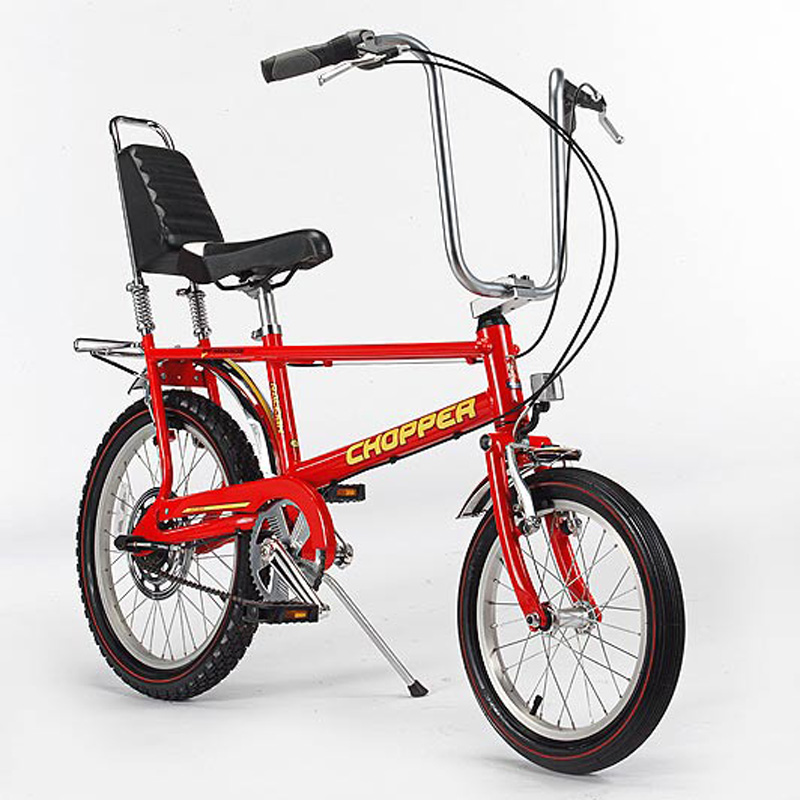
A Chopper bike from Canadian Tire that looked a lot like this one, was my first memorable ride.
Cyclists can define the stages of their lives by their bikes.
The first significant bike I remember was an orange Chopper-style bike from Canadian Tire that arrived under the Christmas tree when I was 7 or 8 years-old. It was a sweet, tricked out ride, with an elongated black seat supported by a low-rise “sissy bar,” a three-speed “stick” shifter mounted on the wide top tube and, of course, the obligatory hi-rise handlebars which I occasionally adorned with streamers. It was a bad-ass ride; apparently I liked to channel my inner Easy Rider when I was a kid.
When I outgrew that, I convinced my parents to spend $89 on a Shields road bike from the Consumers Distributing catalogue store with proper curved handlebars and a four-speed internal hub gear system. It weighed a ton; I think the tubes were cast from iron. But it took me on adventures to distant parks, gave me my first taste of freedom on the road.
In high school, I started to get more serious about my cycling endeavours. I saved my allowance money and eventually accumulated enough to purchase a real Peugeot road bike from a real bike shop. The grey steel frame was accented with chromed forks. The downtube shifters connected to a bonafide 10-speed derailleur. It weighed about a third of the clunky Shields, but it was no thoroughbred by any means.
When I caught the occasional glimpse of the Tour de France highlights on TV, hosted by John Tesh, I cheered for the riders on Peugeots.
I rode far, and tried to go fast on that bike.
In university I kicked my bike game up another notch.
A chance visit to a local Italian bike shop to kill time while getting new tires put on my dad’s car introduced me to a beautiful Rossi stallion. It’s chromed Columbus Aelle tubing glinted in the sunlight. The Campagnolo Nuovo Record group sounded exotic, but was renowned for its simplicity and durability. The Mavic wheelset gave it racing cred, although I had no intentions of testing my legs in that way.
The $900 price tag was a major kick to my meager student finances; but I was in love. The next Saturday, she was mine.
Astride the Rossi, I was a “serious” cyclist. She took me on epic 100 km rides. She carried me on cycling dates. I upgraded parts, affixed a fancy set of red Look clipless pedals.
She was my ride and joy for about 10 years, although I hung onto her long after she was retired. Her lithe silhouette had a place of honour in my bachelor apartment, a piece of gleaming chromed kinetic sculpture leaned against a living room wall.
When I moved west, the Rossi and my Kona mountain bike mounted on the Thule roof rack upon my red Toyota Tercel, I rewarded my assurance of a new job by heading to the nearest high-end bike shop. I picked out a sweet Cramerotti frame with a red, white and blue fade paint job on the Columbus SLX tubes and, of course, chromed stays and fork. I cherry-picked the groupset, brakes and wheelset to build her up. She was practically a custom bike, my dream machine.
The Cramerotti carried me up and down the local mountains with ease. She took me out to the countryside and navigated busy city streets. And when I signed on for a cycling tour to accompany the 2003 Tour de France, she was to transport me through the streets of Paris, up the legendary Pyreénean climbs of Col d’Aspin and Luz Ardiden.
That was the plan, at least; until a fateful detour after a visit to the bike shop to get her pedals removed in preparation for packing her into a travel box took me under an overhang that was too low for the Cramerotti mounted on the roof rack of my car. The thud was sickening, the damage heartbreaking. And terminal. My flight departed in 36 hours!
A panicked visit to the bike shop set me up with a Specialized Allez Comp. Not my first choice, especially the wild and crazy zebra-stripe livery; but it fit, and the shop could have it set up for me by the end of the day.
The Allez performed admirably in France, turned heads even. My attachment to her stiff, responsive ride and assured ascending grew. But ours was an ill-fated relationship; a week after returning from France I was hit by a car turning left and the bike was bent out of alignment.
Insurance set me up with my next ride, a bright orange and blue Orbea.
I was enamoured with the Spanish brand after watching their bikes perform for the small Basque team, Euskaltel-Euskadi. They were a plucky bunch, scrapping their way up mountainsides amongst the best climbers, then faltering miserably against the time trialing machines like US Postal and ONCE. They were a regional outfit playing in the same sandbox as multinational big boys. And Orbea is a co-op, where the workers each own an equal share in their employer.
The Orbea’s bright colours caught admiring glances, her unusual brand sparked conversations. Her light aluminum frame climbed like a demon and she descended on a rail.
Orbea and I spent more than 32,000 kms together. I knew her every quirk, her every squeak and squeal. She carried me to my wedding. She was my ride of choice on my first Gran Fondo.
She would have been my forever bike, until my heart was stolen by a sassy French Lapierre.
Each of my bikes (well, I’m not so sure about the clunky Shields department store bike), or at least parts of them, went on to another life. The Cramerotti’s pedals were ported over to the Specialized. When it’s short life ended, it’s components were installed on the Orbea, which is still being ridden by a friend.
The beloved Rossi, after years of collecting dust interrupted by occasional service as a winter trainer bike, became a throw-in when I sold an old mountain bike to another buddy; it sparked another’s love for the road.
The chainring of life…
My Cramerotti looked much like this one, but with a red/blue fade at the tube junctions and marble blue bar tape.
The Orbea was beloved, and it is still loved by another cyclist.
Imagine this sleek Rossi frame with proper curved drop bars, downtube shifters, brakes and a 10-speed drivetrain.
The Specialized Allez Comp saw a lot in its short life.
My Peugeot was grey, but it shared this model’s chromed fork and stays, a must-have feature that followed me through two subsequent bikes.
















 MARIO BARTEL