For cyclists that can mean waking in the pre-dawn gloom to hunt down streaming feeds from bike races around the world because Eddy Merckx knows we don’t get those on mainstream TV. Or exchanging quips about the results from the latest World Cup cyclocross race.
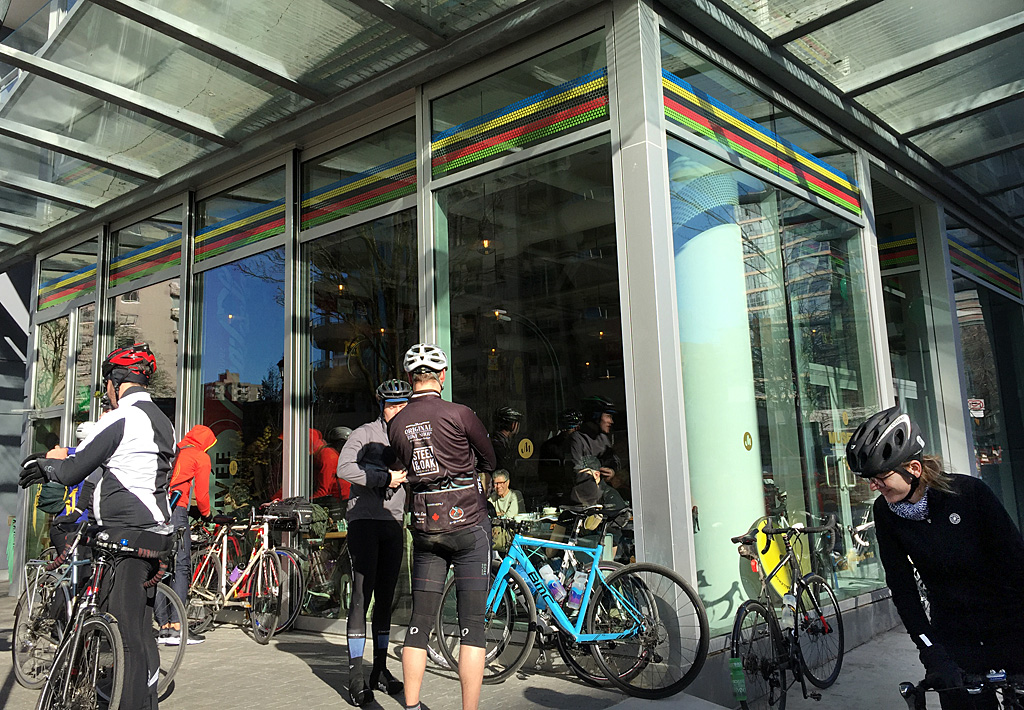
There’s still lingering snow on the ground as the FRF prepares to head out for a special holiday Monday ride to The Musette Caffé.
Around here, some serious geek jones can be fulfilled by a ride to The Musette Caffé.
I’ve written about The Musette before. But that was when Vancouver’s favourite cyclists’ coffee shop was a hole-in-the-wall tucked into a back alley off a bike route.
In January, The Musette emerged from its secret spot to a highly-visible location on one of the main thoroughfares for bikes and cars into the downtown peninsula. It had been closed more than a year after the old site was bulldozed for a gleaming new condo tower, and the owners built out the new café. The wait was worth it.
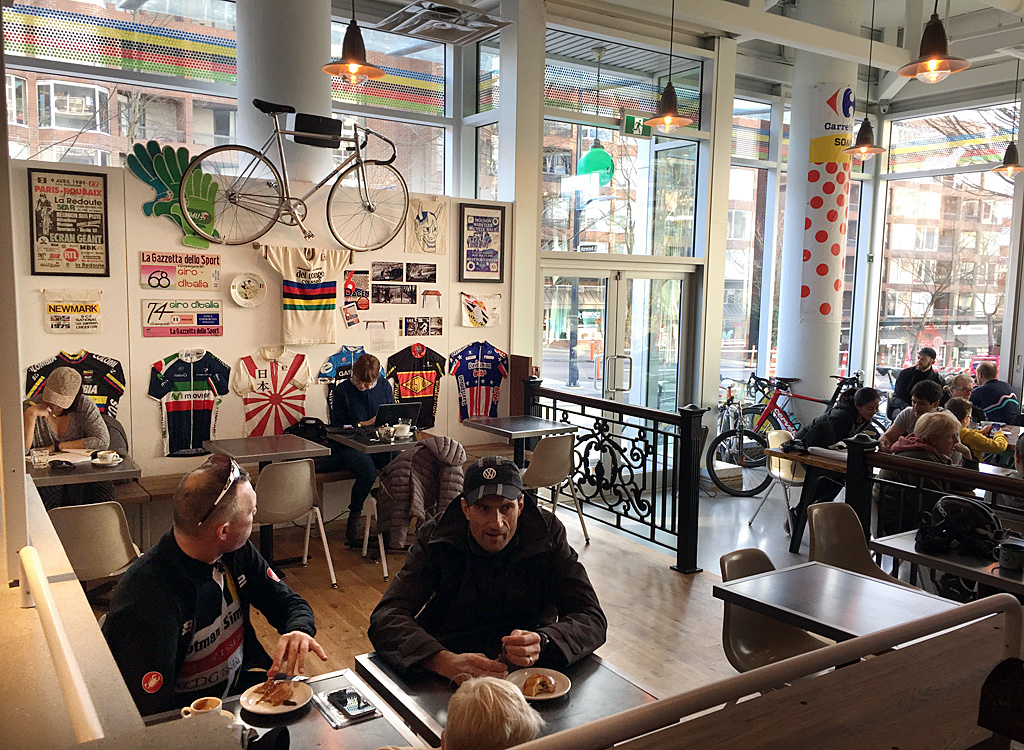
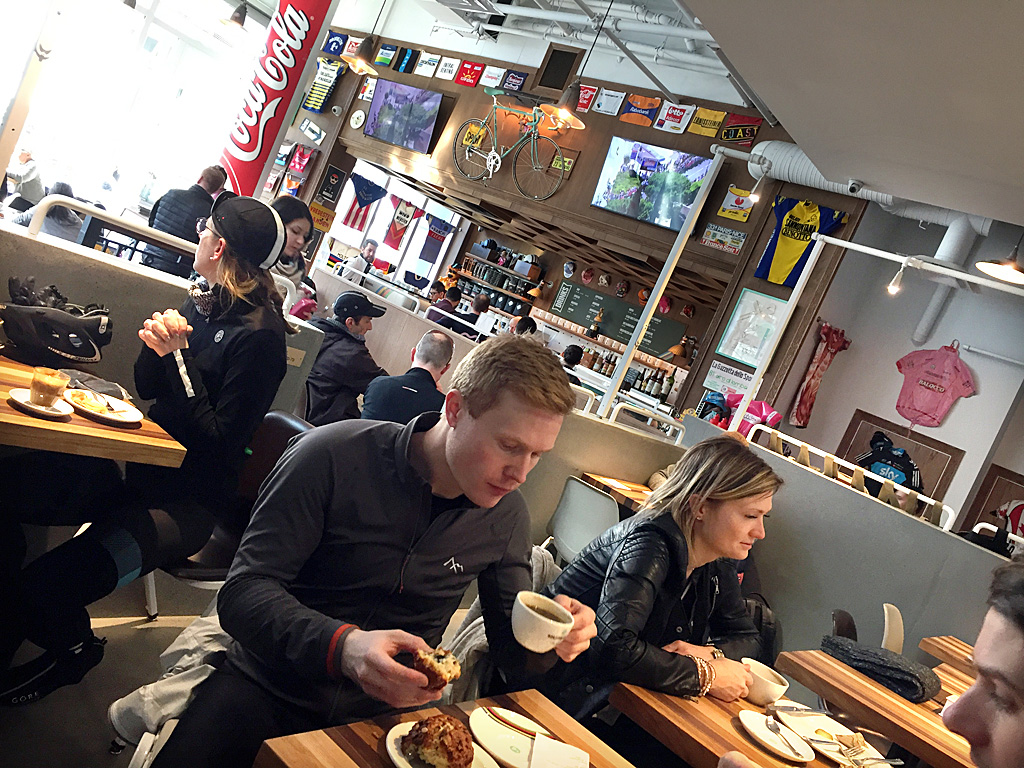
The Musette has been a destination for Vancouver’s cycling community from the day it opened. The snacks are tasty and healthful, perfect fuel at mid-ride or as a post-ride treat. The walls are adorned with all manner of cycling bric-a-brac and memorabilia, from classic steel bikes to a collection of cloth musettes from various pro teams, to autographed pro team jerseys to route markers collected at the Tour de France and the Giro. There’s even bike racks inside the café so cyclists never have to be out of sight of their ride.
The Musette Caffé has a shiny new home for its impressive collection of cycling memorabilia.
The new location takes that cycling geek chic to a whole new level. The memorabilia is still plentiful, with new discoveries to be made every visit. But the café now offers a full immersion experience into cycling lore and legend. The outdoor patio is constructed of cobbles. The communal tables inside are made of wood reclaimed from an old velodrome track in Antwerp, Belgium. The banquette overlooking the main floor area is modeled after the open concrete showers at the Roubaix velodrome in France where the Paris-Roubaix spring classic race concludes every April; the race’s winners are commemorated on little brass plaques affixed to each “stall.”
The banquette area at The Musette is an homage to the historic Roubaix velodrome with concrete shower “stalls” surrounding the seating area. The light fixtures are modeled after shower heads.
The attention to detail is stunning. Interior pillars are wrapped with ad banners from the roadside of the Tour de France. Order number stands are modeled after number plates affixed to bikes at the Tour and the Giro. The impressive espresso machine has been painted with World Champion stripes.
Stepping into The Musette is like walking into cycling, and everything that is great and colourful and historic about the sport. And yes, there’s still racks to park your bike inside. Although it was so busy on our holiday Monday FRF pilgrimage, we had to lean our bikes amongst the dozen or so already parked outside.
This post originally appeared on my cycling blog, The Big Ring.
This week dozens of experienced, dedicated and skilled journalists across the country will be walking out of their newsrooms for the last time as the latest round of Postmedia buyouts (aka cost cutting) takes effect. This time they’re chipping deep into journalism’s quick.
The bylines departing are some of the most recognizable in their markets. They’re the pillars of their papers who’ve been telling the stories and taking the photos in their communities for decades. They know every nook and cranny of their beat, they know exactly who to call, where to dig. They are trusted, by sources and by readers.
But for the corporation that employs them, they are a drag on the bottom line that is plummeting further and further towards the abyss. They are senior staffers, and that means they’re expensive. It’s much cheaper to fill the ever-shrinking spaces between the fewer and fewer ads with quick-hit stories pumped out by disposable J-school grads who will also find themselves cast aside when they’re deemed too expensive. That is, if their papers even last that long.
Because as much as newspaper publishers like to think their august front page banner is their brand, the relationship with readers and advertisers is forged by the reporters, photographers and editors who toil for that banner. Diminish them, you diminish the brand, weaken your connection to the community. Until one day readers wake up and decide they’re not getting much for their subscription dollar anymore. And advertisers realize they’re being sold empty promises.
Almost to a fault, the departing journalists are putting a hopeful face on the future. They’re writing all the right things about an industry turned upside-down, struggling to figure out a way to turn itself around, trying new things, forging new paths to retain their relevance.
Their colleagues who left before them wrote similar words. So did those in the round of buyouts before that, and so on.
Yet here we are, with no end to the cost-cutting in sight. Until there’s no-one left to cut.
This round of names I grew up with, bylines I sometimes encountered on the job during my own 31-year career as a journalist that was truncated by the closure of my paper, is feeling perilously close to that end.
Good luck to everyone walking out of their newsroom for the last time. You dedicated yourself to telling stories that might not otherwise get told. You informed and enriched your communities. You made us smile and wrenched our hearts. Thank you!
Keeping your head down on the bike is how you power through rough weather, or a bonk on the third mountain climb of the day.
This winter, it’s a matter of survival.
It’s been an extraordinary off-season. After a run of virtually snowless winters, we were hit hard in early December by three consecutive storms. The thaws that usually wash those snows away never really happened. Instead we descended into a weeks-long deep freeze that iced the land and roads and bike paths.
Now that temperatures have moderated, and most of the snow and ice has melted away, we’re finally able to safely get back on our bikes. But keep your head down and your eyes on the pavement ahead!
Blue skies and warmer temperatures have afforded some welcome opportunities to get back on the bike.
Because the consequence of our wintry weather is streets and bike lanes cratered with crumbling asphalt, gaping potholes, yawning sinkholes. A moment’s inattention can collapse a front wheel, pitch a daydreaming rider over the handlebars, destroy a season.
The work crews are out there, doing what they can to patch the pocked pavement. But they can’t keep up with the structural failings. The repeating cycle of freezes, brief thaws and subsequent deep-freezes expanded cracks into fissures, pocks into potholes. And with more cold temperatures forecast, it’s only going to get worse.
Still, a couple of weeks of warmer weather has afforded some chances to ride. The legs are still feeling the effects of the season’s sloth, so the routes have been conservatively flat, the pace languid. But the air filling the lungs feels good, the muscled fatigue is welcome. Because it means we’re actually out there, turning the pedals, keeping our heads down. Dodging divots.
One of the special things about working in community journalism is being able to cover stories at a very intimate level, jumping in before they capture the attention of bigger, regional media.
In November, 2008, Kyle Turris was a young NHL prospect trying to earn a regular place on a team coached by the legendary Wayne Gretzky.
But the NewsLeader had been telling Turris’ story for years. We were there when he led his junior team, the Burnaby Express, to a national championship. We were with him when he packed up his bedroom in his family’s New Westminster home to embark on a collegiate career at the University of Wisconsin. We covered his selection to a team of Canadian all-stars to play a series of games against a team of Russian all-stars. We held the paper so we could get the story of his selection in the 2007 NHL Entry Draft by the Phoenix Coyotes; he was selected third overall, the highest position in the draft ever achieved by a graduate of a Tier II Junior A hockey league.
Turris played a year of collegiate hockey, then turned pro in the spring of 2008.
When the NHL released its 2008-09 schedule that summer, NewsLeader reporter Grant Granger and I circled Nov. 6 when the Coyotes would visit the Vancouver Canucks and Turris would be able to play his first game as an NHLer in front of his friends and family. It would be, we thought, a triumphant, feel-good story of a hometown hero making it big.
The Coyotes were in town a day early for their Thursday night game so Granger and I headed down to the team’s Wednesday morning practice; it would be a chance for him to talk to Turris in a more relaxed setting and for me to be able to get a folio of photos we could use for years to come, including some of him interacting with Gretzky, who had championed his selection by the Coyotes.
Game night, we worked the plaza outside GM Place, talked to some of Turris’ old high school buddies who were there to cheer on their former classmate.
Inside the arena, Granger ascended to the press box while I headed rinkside to get a few closeup photos of Turris warming up during the pre-game skate. As the players left the ice, I went to my accredited position at the mezzanine level to prepare for the game.
But when the lights dimmed and the teams returned to skate a few laps before the opening face off, Turris was not among them. He had been scratched from the Coyotes’ lineup. He would not get a chance to play for his friends and family. And our triumphant story took a dark turn.
Over the cellphone, Granger and I plotted our next move. We would connect partway through the first period, then head downstairs to see if we could find Turris and get some comment.
I half-heartedly shot a few frames of game action (after all, I didn’t get many chances to shoot NHL hockey in good light) but a mid-season game between Vancouver and Phoenix wasn’t my story.
As Granger and I descended a stairwell, heading to the dressing room area, we bumped into Kyle. He was wearing civvies and a heavy black overcoat. He clutched a sandwich in plastic wrap. He looked very sad, almost near tears.
Turris said he was going to look for his dad and graciously allowed us to tag along. Granger asked some questions, I shot a few photos. None of us was feeling particularly good about the situation.
When Turris found his dad in the concourse, they embraced. I shot a few frames and then retreated. For a kid on a winning streak of hockey success for most of his young life, this was a kick to the gut.
Sunday, Kyle Turris played his 500th NHL game. Most of them have been with the Ottawa Senators, where he was traded just over three years after that sad night in Vancouver.
New Westminster’s Kyle Turris is embraced by his dad, Bruce, after he was scratched from what would have been his hometown debut as an NHLer Nov. 6, 2008.
New Westminster’s Kyle Turris takes the pre-game skate at GM Place prior to his scheduled hometown debut as an NHLer Nov. 6, 2008.
New Westminster’s Kyle Turris listens to Phoenix Coyotes’ coach Wayne Gretzky during a practice at GM Place the day before he was to make his hometown debut as an NHLer against the Vancouver Canucks. This is the photo we ran on the front page.
New Westminster’s Kyle Turris takes a break during practice at GM Place, the day before he was to make his hometown debut as an NHLer with the Phoenix Coyotes in November, 2008.
Scratched from the lineup at the last minute, New Westminster’s Kyle Turris searches for his dad on the concourse of GM Place.
Friends of New Westminster’s Kyle Turris prepare to cheer him on at his hometown NHL debut at GM Place Nov. 6, 2008.
New Westminster’s Kyle Turris is in a relaxed mood during practice at GM Place, the day before he was to make his hometown debut as an NHLer with the Phoenix Coyotes in November, 2008.
New Westminster’s Kyle Turris takes a break during practice at GM Place, the day before he was to make his hometown debut as an NHLer with the Phoenix Coyotes in November, 2008.
New Westminster’s Kyle Turris takes a break during practice at GM Place, the day before he was to make his hometown debut as an NHLer with the Phoenix Coyotes in November, 2008.
Hometown fans cheer the NHL debut of New Westminster’s Kyle Turris during the pre-game skate at GM Place Nov. 6, 2008.
New Westminster’s Kyle Turris during practice at GM Place, the day before he was to make his hometown debut as an NHLer with the Phoenix Coyotes in November, 2008.
New Westminster’s Kyle Turris takes a break during practice at GM Place, the day before he was to make his hometown debut as an NHLer with the Phoenix Coyotes in November, 2008.
Not even the novelty of a new home court was enough to fire the roadsters up for the second half of the season.
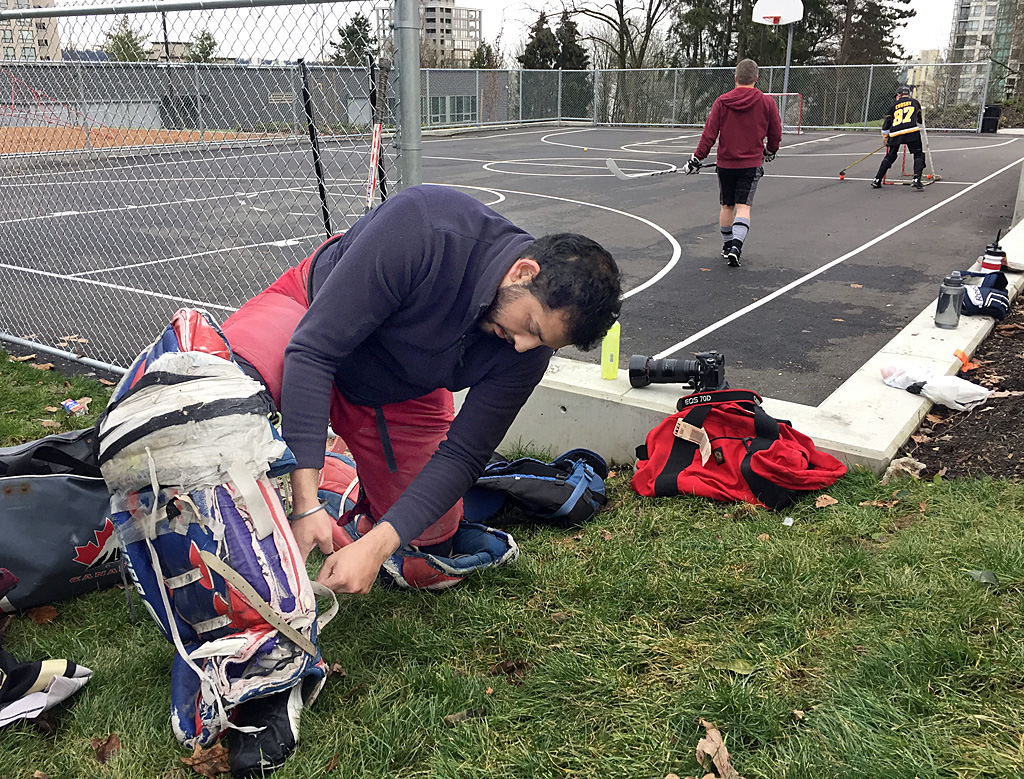
Only five players reported Sunday to the converted basketball court that was one of the few outdoor facilities completely clear of the snow and ice that has kept the road hockey season frozen for the past seven weeks. A week of warmer temperatures and heavy rain diminished the glacial sheet a bit, but the roadsters may be banished from their traditional home court for another week or two until the tundra has melted entirely.
In fact, conditions are so bad at the road hockey courts, they’ve been secured by bright yellow caution tape.
Colonel said the unfamiliarity of the new venue may have tempered the ardour of some of the roadsters to get their game in gear after the extended layoff.
“I think people like what’s normal and comfortable for them,” said the veteran centreman. “I’d say our guys aren’t super good at being outside their comfort zone.”
Nouvelle Guy, who supplied the nets that converted the basketball court to a hockey venue, said he was discouraged by the ambivalence of his fellow roadsters.
“It’s pretty disappointing,” said the versatile veteran. “I expected there would be more people out here, but it is what it is.”
The new facility presented some challenges. While it’s mostly enclosed, the surrounding fence is much lower, allowing more balls to escape play. And the fencing doesn’t quite reach the ground so low rollers had a tendency to slip beyond the game.
But, said the Colonel, it was a more than adequate alternative.
“It’s a nice clear court,” said the feisty forward. “The surface is smooth. It’s a lot of fun running around here today.”
That exercise was a major motivator for Nouvelle Guy.
“It’s been really tough,” said the power forward. “I’ve been wanting to get out on the court. It’s one of the things I love to do.”
The mid-season break that has now stretched to seven weeks for some roadsters is unprecedented. And that could have serious implications as players begin to gear their game for the climactic Stanley Stick championship series in April.
“People are fatter,” said Colonel of the season’s slothful pause. “People don’t quite grasp it’s a lot easier to put a few pounds on than to take a few pounds off.”
Playing consistently keeps players sharp, hones their timing and playmaking, said the veteran. Those skills diminish quickly.
“You lose your hands, you lose your ball skills,” said Colonel, who struggled with some of his deke moves during Sunday’s half-court scrimmage. “It’s best for everyone to be out playing the game.”
The previous story was first published on my weekly road hockey blog, roadhockey.net
Twizzler scored four times to become the first, and most unlikely, winner of the inaugural Shrimp Ring Shootout on Sunday.
The shotstopping stalwart was given a rare reprieve from his armour of heavy leg pads as the competition required only one goalie; he took full advantage, ripping bullets past his rearguard rival, Joker, high into the top corner, over his glove and through the five hole. It was a remarkable offensive effort against some of the game’s top snipers including Doo, Lak Attack and Scooby, who was making his first appearance at the courts in more than a year.
That the Shootout occurred at all was a testimony of the roadsters’ resolve to restart the season after a five week hiatus brought on by extended wintry weather.
“This is the week we were going to get back to playing hockey and you have to take a stand that you’re not going to let anything stand in your way,” said Doo during a break from the arduous effort to chip and shovel away more than a foot of hardened, compacted snow and ice.
It may have been the worst conditions the roadsters have ever encountered at the concrete courts said Lak Attack. A snowfall early in December wasn’t cleared before a thaw and subsequent freeze encased the concrete surface in ice and frozen slush. More snow piled on over the holiday hiatus that was compacted when the neighbouring school reopened.
“This is something we’ve never seen,” said the veteran who’s participated in numerous shovel brigades over his long career. “The amount of snow, and the ice underneath; there’s a lot of challenges.”
But the roadsters wered undeterred. Every chunk of snow or block of ice heaved to the side felt like a victory, said Doo.
“They’re doing something impossible. It’s back-breaking labour for a game that we’re probably not even going to be able to play.”
That realization was apparent more than an hour into the clearing effort as the accumulated snow had been removed from only a third of the court, and a thick layer of hard ice still remained.
The shoot out contest may not have had the competitive fire of a regular game, but for the roadsters who survived Sunday’s shovelling brigade it still felt like victory.
“It’s great to see,” said Doo. “This is probably helpful for people’s fitness.”
“This is a building block of how badly the guys want to play,” said Lak Attack. “It builds character for the guys… and that’s good for the rest of the season.”
After five weeks off, nothing was going to stop the roadsters from launching the second half of their season with the annual Shrimp Ring Bowl.
A shovel is an early casualty of the hardened snow and ice that have covered the road hockey courts since early December.
Lak Attack enjoys the reward of the roadsters’ hard work!
Lak Attack heaves heavy snow from the road hockey courts so some semblance of a game could be played on Sunday.
Joker makes a save on Doo during Sunday’s snowy Shrimp Ring Shootout.
Twizzler and Lak Attack dig out the road hockey courts from more than a foot of hardened snow and ice.
This story was originally published in my road hockey blog, roadhockey.net
Shooting sports successfully usually demands some level of vague familiarity with the rules and flow of play. Knowing how a sport works can help you anticipate the action, point your lens at the right area of the field, stand in the proper place.
But what if a sport exists entirely in fiction?
Quidditch is a sport played by some of the characters in the Harry Potter novels. It’s a fantastical amalgam of tag, capture the flag, soccer and rugby played in mid-air by wizards flying magical broomsticks.
Some enthusiasts, mostly from university campuses, have brought the game down to earth and compete in actual leagues and championship tournaments.
In the spring of 2015, the Canadian Quidditch championship landed in Burnaby.
While I’ve seen the Harry Potter movies, I really had no idea what to expect of this real-life version of the fictional sport. Let alone how to shoot it.
But once I got over the odd sight of athletes running around with a “broomstick” between their legs, the patterns and purpose of the players quickly became clear. So did their passion.
And that’s always a recipe for good photos. Even when you have no idea what is going on.
An SFU player dives to try to catch the “snitch” to score 30 points.
The Vancouver Vipertooths gather for a pre-game cheer prior to their opening round match against McGill Quidditch at the first Canadian national quidditch championships, Saturday at Swangard Stadium.
An official checks that players are properly attired and equipped prior to their match.
A snow day in the big city can be magical. Even more so in Vancouver, where they’re so rare. This is what it was like to be in downtown Vancouver last Sunday as the flakes fell.
Snow and ice put the winter back into Saturday’s final Winter Farmer’s Market of 2016. But Jason, at Gary’s Kettle Corn, wasn’t feeling the frosty temperatures.
In fact, he was so comfortable he was wearing just a t-shirt as he hovered over the propane burners heating the 80-quart kettle where the kernels are popped full of sweet and salty flavour.
“I definitely have the warmest spot on the block,” he chuckled as his shivering assistant served a customer just outside their booth’s heat zone.
Since moving uptown and outside last year, the Royal City Winter Farmer’s Market has been anything but wintery. Oh sure, there’s been plenty of rainy and cold market days, but Saturday’s setting of snow and ice was a first for many of the vendors. And they were doing everything they could think of to stay warm.
Like Tara at Roasters Hot Sauce; she was thinking about enjoying a hot toddy in her warm apartment to take the icy edge off that her six layers of shirts and sweaters couldn’t.
Layering is the key, said Michelle and Kathryn at Kiki’s Kitchen. They each topped a half-dozen layers of undershirts and cashmere with matching orange puffy jackets. Experience helps too, said Kathryn. She’s originally from Montreal so she spent plenty of time having a good time in the snow and cold.
“You’ve got to dance around, keep moving,” she said as the pair bopped around a propane space heater at the back of their booth.
Over at A Bread Affair, Cierra’s dancing was more like rocking back and forth from foot to foot. But her kiosk is closest to the Tim Horton’s so she was able to steal away for a hot coffee and a few moments of thawing out whenever traffic slowed.
“This is better than rain,” she said, optimistically.
Many of the vendors had the cold well in hand. They had chemical warming packets stuffed into gloves and socks.
“I love that we’re all in this together,” said Amanda at Honey Bee Zen.
But for Aaron at Ossome Acres, the frigid temperatures presented a new and unexpected challenge.
“We have to keep our eggs in the coolers to keep them from freezing,” he said.
The hot sauces at Roasters may warm the insides, but Tara is relying on six layers and Hot Pockets to keep her outsides toasty at Saturday’s chilly Winter Farmer’s Market.
Matching puffy orange jackets and a propane space heater keep Michelle and Kathryn toasty in the Kiki Kitchen kiosk.
Snow, ice and sub-zero temperatures help put the winter into the Royal City Winter Farmer’s Market on Saturday.
Cierra, of A Bread Affair, is bundled up to her eyeballs.
Amanda tries to stay warm at ther Honey Bee Zen kiosk.
A t-shirt is all Jason needs to stay warm as he works the giant kettle at Garry’s Kettle Corn.
Ron scrapes the frost from the coolers at Wild West Coast Seafoods.
Chemical warming packets are the key to staying warm at Saturday’s Winter Farmers Market say many of the vendors.
Aaron pours a steaming mug of tea to stay warm in the Ossome Acres booth.
A rack of hand-knit sweaters is an enticement to shoppers trying to stay warm at Saturday’s chilly Royal City Winter Farmer’s Market.
This week’s $40 haul was all about indulgence. After all, ’tis the season:
• 2 pieces of strudel, 2 Schrippen buns and 3 poppyseed buns from Gesundheit Bakery – $10
• box of mixed cookies, that will be used as a Christmas gift, from Sweet Thea Bakery – $10 (These market fixtures have hit a bit of a financial speed bump, so they’ve started a gofundme page to help them weather the storm and ensure they can keep baking)
• tuna loin from our favourite fish guy, Ron, at Wild West Coast Seafood – $20
The next Royal City Winter Farmer’s Market will be Jan. 7. So enjoy the holiday, and the treats from this week’s chilly market!
I love history, and telling historical stories. This one, about an airman’s lifelong dedication to his fellow crewmen that perished in a crash during WWII, fell into my lap in time for Remembrance Day a couple of years ago.
John Knight just wanted a few moments’ peace to smoke a cigarette.
The 26-year-old retired to one of the dome blisters along the fuselage of the RCAF Canso bomber in which he was a flight engineer and machine gun operator.
The aircraft was part of a squadron that patrolled the North Sea between Iceland and Scotland during the Second World War, on alert for German submarines.
Knight and his seven crew mates had just returned to their base in Reykjavik from a couple weeks’ rest back home in Canada.
It was their first patrol of their three-flight rotation out of Tain, in the Scottish Highlands, before they’d return to Iceland.
It was stormy and foggy that afternoon of July 29,1944. So foggy Knight couldn’t see the end of the plane’s wings from his perch in the glass bubble.
At some point along their 58-mile flight to Wick, the bomber was instructed to fly instead to Stornoway, in the Outer Hebrides of Scotland.
But the heading they were given was faulty and sent them on a course towards Foula, one of the remote Shetland Islands off Scotland’s north coast.
Foula’s barren landscape is dominated by Hamnafield Hill, an 1,100-foot high bump of rock and moss. The Canso’s altimeter was at 920 ft. when it slammed into the hill.
The aircraft burst into flames, fuel tanks and ammunition exploded. Wreckage tumbled down the mountain.
Knight was knocked unconscious by the impact. When he came to, he was able to push open the blister and drop to the ground where he crawled behind a rock to shield himself from the flames and flying shrapnel.
He was the only survivor.
Family knew little of father’s crash
Growing up in Winnipeg, Joe Knight and his three brothers heard little of their father’s wartime experiences. They knew he was the lone survivor of a plane crash somewhere in Scotland, and they knew he didn’t wear shorts or short-sleeved shirts because of scars from his injuries.
John Knight belonged to the Royal Canadian Legion, but he didn’t participate in parades or other activities.
“He didn’t complain, he didn’t brag about himself,” said Joe of his father. “He wouldn’t be drawing attention to himself.”
In fact, it was only after John Knight passed away in 2006 that the full story of his survival and life-long dedication to his fallen crewmates began to emerge.
Foula far removed from war
The island of Foula was far removed from most of the madness that had engulfed the rest of Europe during the Second World War.
A Norwegian naval unit based at another port in the Shetland Islands escorted fishing vessels and transported refugees. A few of the islands’ lighthouses had suffered air strikes.
But otherwise, the war barely registered in the daily life of Foula’s 23 residents.
It was afternoon tea time when Knight’s Canso bomber crashed into Hamnafield Hill with a dull thump.
Three locals, David Gear, Foula’s postmaster Peter Gear, and a senior who had stopped at the island’s post office to retrieve his pension cheque hiked up the mossy hillside, dodging wreckage and burning fuel.
They found John Knight badly injured. His pelvis was broken, his arms and legs seared from the flames. The men loaded the airman onto a stretcher and descended the steep hill as gently as they could.
As they reached the bottom of the hill, David Gear’s daughter Vida offered Knight a bottle of water.
Mysterious photo had special meaning
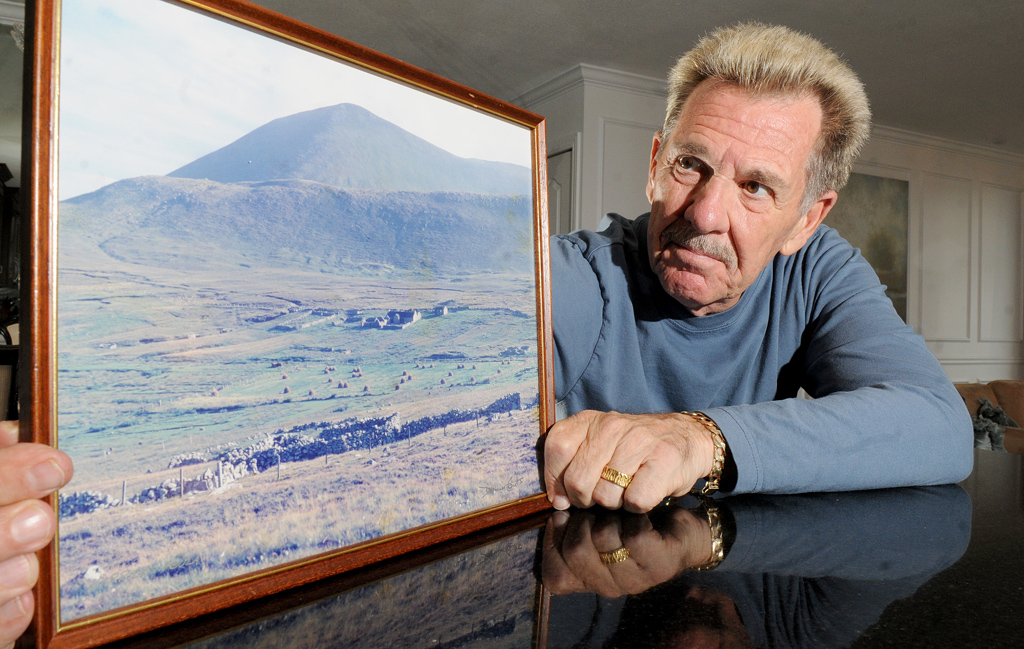
More than 60 years later, after John Knight’s funeral, Joe Knight was bequeathed his father’s framed photo of Foula Island and the barren Hamnafield Hill.
Joe hung it in the den of his New Westminster home where’s he’s lived the past 26 years, unaware of the photo’s significance.
The family had always assumed the fading colour photo was a souvenir of a trip their parents took to Scotland-though they never understood why anyone would travel to such a stark landscape.
He found himself wondering why that cliff of rock and moss meant so much to his dad.
“I’d look at it up on the wall and think about it,” said Joe.
Getting on with life, but never forgetting
John Knight spent most of the next year recovering from his injuries at various hospitals in England and Canada. At one point doctors thought they would have to amputate one of his arms, but a chance visit by the King of England’s doctor got him the care he needed to save the limb.
John and his wife, Vina, had five more children after he returned from the war, adding to the one boy they’d had before the conflict started. Two children died in childhood.
During his post-war career, Knight worked with the Department of Veterans Affairs for 22 years, and another 11 on hydro projects in Northern Manitoba and Newfoundland, helping First Nations’ locals land jobs at the sites. He was an elected councillor.
He never forgot his fallen crewmates.
“I now think Dad felt he had to pay back for the fact he survived and his comrades didn’t,” said Joe of his father’s public service.
In 1989, Knight received a letter from the government records branch of the National Archives of Canada advising him they’d been contacted by a man named John Henry, asking about the plane crash’s sole survivor.
Henry’s wife was Vida Gear, the young girl who’d helped quench a stricken soldier’s thirst all those years ago. He was researching the story of the plane crash; it had been part of Shetland Islands’ lore for decades.
Within a week, Knight penned a long letter to Henry. He recounted his memories of the crash and told of his life since then.
Their correspondence continued through the years, and they exchanged family photos and Christmas cards.
In 1995 John and Vina travelled to Scotland to pay their respects to the fallen aircrew who were all buried at the Commonwealth Cemetery in Lerwick. They also visited John Henry, who gave his Canadian friend the framed colour photo of Foula.
“It will be kept in a place of prominence in our home,” wrote Knight in a thank-you letter.
Meantime, Joe and his brothers had been curious about their parents’ choice of holiday destination but didn’t probe.
“Their visit to Lerwick was a bit of a surprise to our family,” said Joe. “We didn’t think to question Dad on why Lerwick, why now? It should have been a bit of a clue, but we missed the boat.”
The mystery begins to reveal itself
The pieces of the puzzle started to fall into place a few years after John’s death. A friend of Joe’s brother, Bob, discovered a website about the crash that had been created by a nephew of one of its victims. He sent the link to the family.
“Then we really started to think this wasn’t a garden variety crash,” said Joe.
As Joe learned the story of his dad’s survival, about the people who helped him, and about his friends who perished in the crash, he vowed to find a way to honour them.
In September, Knight and his two surviving brothers, along with their wives, travelled to Lerwick to meet the man with whom their father had struck up a long-distance friendship.
Henry, now well into his 80s, had saved most of their correspondence. When Knight read some of the letters, he swelled with emotion.
“He was a young man, full of life, caught up in a big adventure,” said Knight of his dad.
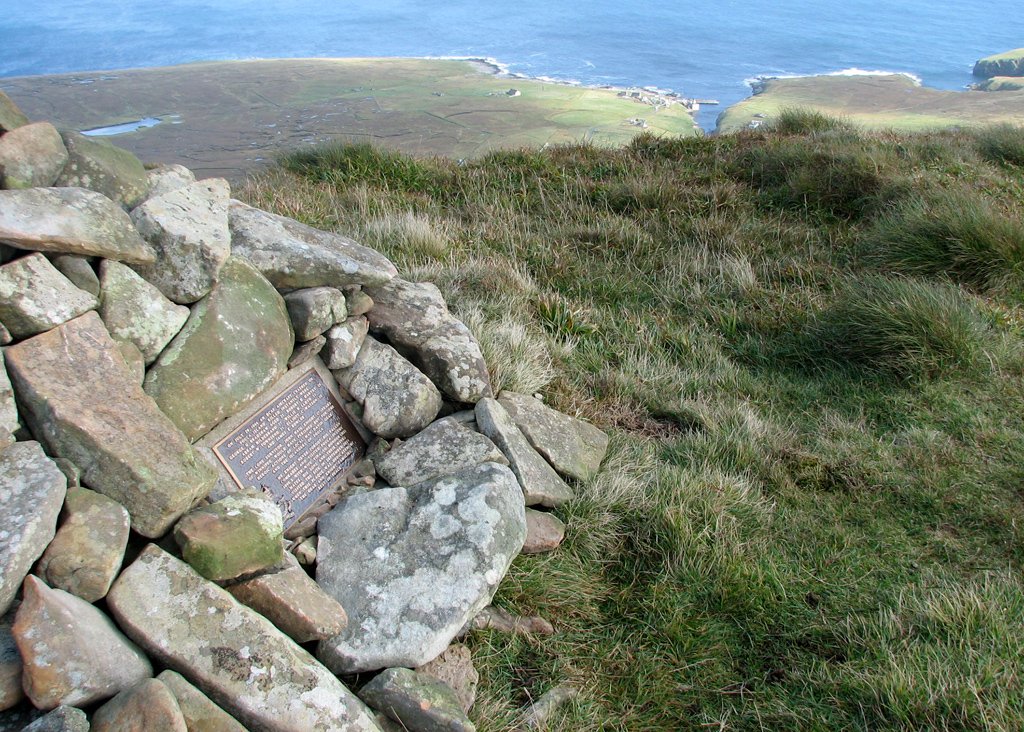
The family had commissioned a brass plaque memorializing the crash and the heroics of Foula citizens to save John’s life.
They hoped to place it on a cairn atop Hamnafield Hill.
But with only one weekly flight to the remote island because its airfield didn’t have a fire warden, and a local boat tour operator shut down for a family emergency, the timing didn’t work out.
Instead, David Gear’s daughter-in-law, Sheila, ascended the trail to the hilltop on a sunny Wednesday at the beginning of October and mounted the plaque on the cairn.
The cairn and plaque placed atop Hamnafield Hill on Foula Island to commemorate the crash of WWII bomber that claimed all but one of its crew.
“It’s a great comfort to our family knowing it’s there,” said Joe.
“Our father and his comrades are together, once again and forever.”





 MARIO BARTEL