When we were kids (again)

This story originally appeared on Tenth to the Fraser

This fall, Sunday Morning Road Hockey will celebrate its 25th anniversary.

I was there when it started, back in 1991.

That’s when I rounded up a few buddies in the local media business to rekindle our childhood passion for road hockey.

We gathered on the old tennis courts in New Westminster’s Queen’s Park, put down some spare boots and jackets for goalposts and had at it. Just like when we were kids.

Because as much as ice hockey is our national obsession, the street game is our national pastime.

Pretty much every kid who grew up in Canada has played road hockey. They know the sting of the evil orange ball on a cold day. They understand the unique skill of shooting that ball with a plastic “Superblade” worn down by the hardtop to the thickness of a toothpick. They’ve scowled at insensitive drivers with the temerity to drive through their game to get home. They’ve delayed dinner just to play a little longer. They’ve played out the thrill of winning a Stanley Cup between the curbs.

It’s that spirit we wanted to renew with our little impromptu pickup game.

Our one-off game was a lot of fun. So we played again the next week. And then the week after that. Friends invited friends. Soon enough someone acquired proper nets.

Tired of always chasing balls on the expansive courts, we eventually moved the game to a lacrosse box next to Cariboo Secondary School in Burnaby.

But when the New West school district rebuilt Herbert Spencer elementary with two enclosed hockey courts and a basketball court atop its underground parkade, we quickly repatriated the game to its hometown. We claimed the middle court and never left.

By now the founding media contingent was outnumbered by teachers, engineers, students, a social worker. Some of them shared the same first name, so we started doling out distinguishing nicknames, a tradition of old-time hockey that’s largely been lost as the game and the media that cover it has become more professional.

Every week the game started with the same routine; everyone threw their sticks into a pile at centre court and someone was designated to randomly divide it into the two teams that would compete.

Equipment was haphazard at best; one legendary goalie eschewed protective leg pads for years, relying on fearlessness and quick reflexes instead to make dazzling saves.

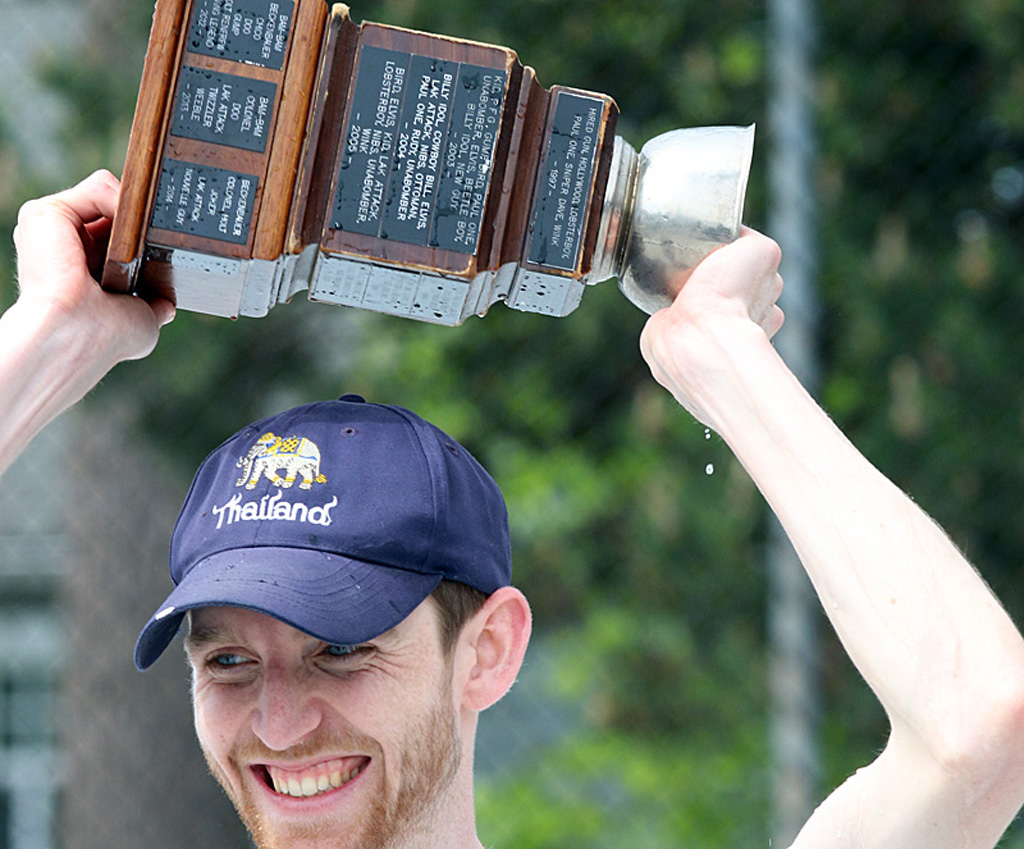
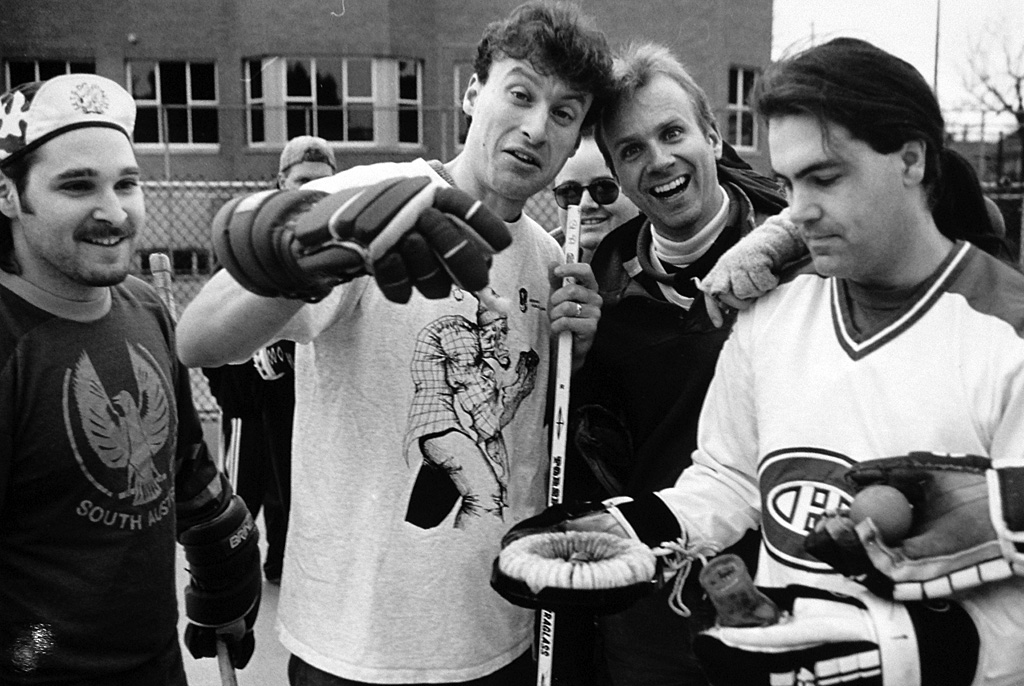
One spring someone showed up with a broken hockey sticked wrapped in tinfoil and declared it the prize for the season’s final game, the Stanley Stick. Eventually it became a proper trophy with a bowl for chugging champagne.

Other traditions evolved; the Shrimp Ring Bowl to welcome the new year, a midsummer game to renew acquaintances during the off-season.

The early games were chronicled in a photocopied newsletter, then a rudimentary website on Geocities, then finally a proper website with its own domain. After all, isn’t it the dream of every Canadian kid to see their hockey exploits documented in print?

Over the years generations of players have come and gone. Some succumbed to time pressures from growing family obligations. Some lost interest or invested their energy in other sports. Some moved away to pursue their education or new job opportunities: the legendary goalie is now a sports reporter for the Association Press in Buffalo; another charter player, Sweater Vest, is the communications director for the Mayor of Los Angeles; a more recent recruit was elected to Parliament in the last federal election.

Some years attendance has been better than others. When the commitment of players flags doubt creeps in about the game’s continued existence. But then a new recruit shows up; he tells a couple of friends and renewed life has been breathed back into Sunday mornings.

It’s hard to say how many people have played Sunday Morning Road Hockey over the years; some stopped by just once and moved on before they could ever be bestowed a nickname, a few have been chasing the evil orange plastic ball for two decades or more. Most all of them found at least a momentary connection back to their childhood, a brief escape from the responsibilities and expectations of adulthood.

When we were kings

Twenty-five years ago, I became a British Columbian.

Of course I didn’t realize it at the time.

On May 2, 1991 I was just a young news photographer looking for work. A recession had displaced me six years into my first full-time gig at Oshawa-Whitby This Week, a large tri-weekly that was part of TorStar’s Metroland chain in Southern Ontario. I’d had a good run: I covered two Memorial Cup national junior hockey championships as well as the frenzy around a young hockey wunderkind named Eric Lindros; I shot several elections, some big fires, car racing in Toronto and Montreal, Rick Hansen’s epic roll through town.

But I felt I still had a lot of great photos in me and I was willing, and  able, to go anywhere to have the opportunity to shoot those photos.

A connection through the Canadian News Photographers Association recommended I talk to Craig Hodge, the chief photographer of the Metrovalley News Group, a burgeoning chain of community papers in Vancouver’s suburbs. I called him; there was no internet then, no email. He happened to be headed to Ontario to speak at a conference, he said. A few weeks later we met; he reviewed my portfolio and told me there was work out west, although he couldn’t make any guarantees it would lead to permanent employment.

In the early 1990s newspapers still ruled the media landscape. Getting a staff photographer gig at one was like winning a lottery; many tried but very few succeeded. Usually it was shooters with the fortitude and persistence to hang around picking up freelance or scrap shifts, or to chase ambulance in the middle of the night, who were eventually rewarded with a business card and a steady paycheque.

But the poor economy had diminished even those opportunities in Ontario. And when the occasional morsel of a newspaper shift did become available, it was immediately besieged by any number of talented, more experienced freelancers and displaced staffers hungry for work.

So at the end of April I loaded some clothes, provisions and camera gear into my trusty red Toyota Tercel, mounted my road and mountain bikes in the Thule rack on the roof and headed west. Other than a family friend who’d offered to let me couch surf for awhile, I had no idea what the future held.

Mario Bartel storyteller photographer journalist communicator blog
Looking pensive as I wear my stylish vintage camera that didn’t really work, but looked oh so cool!

The Metrovalley News Group was comprised of papers from Burnaby to Chilliwack. Many started as independents and then came into the Hacker Press fold until the whole lot was acquired by a large British publisher, Trinity, whose flagship paper was in Liverpool. They also owned the Red Deer Advocate, a small daily in Alberta.

Trinity was a big, rich company, and the situation I walked into was on par with many small or medium dailies elsewhere in the country. Our staff of four photographers, a chief photographer and an office administrator/darkroom tech, plus an assortment of freelancers as assignments demanded, covered seven communities out of a central office.

We were connected with two-way radios and pagers (!). We had a full colour darkroom, a B&W darkroom with three enlargers, a film processing room, a studio with lights and a cove wall.

Mario Bartel storyteller communicator photographer journalist blog
When the studio wasn’t in use, it became a table hockey arena.

It was a tight crew, always pushing each other to do better as we gathered at the light table at shift’s end to review negs then shared stories of the road in the red glow of the darkroom safelight. Like the time one of our photographers, a former university football player, got into a punch up with a clown who was giving him a hard time at a routine assignment. Or when our chief was thrown into the back of an RCMP cruiser to prevent him from working the perimeter of a police takedown at the end of a car chase.

The communal coverage ensured most everything in the communities we served got attention; if assignments were light in one area, the photographer could be moved over to help out where it was busier. And when big news happened it was all hands on deck to get the story, then get film back to the darkroom so editors could start building pages.

The papers may have published only twice a week, but we operated, and thought, like a daily.

We got to travel out of town occasionally to provide coverage for the chain of regional events like high school sports championships, provincial summer and winter games, the Canada Summer Games, even the Commonwealth Games when they were in Victoria. We covered local racers participating in big time events like the Molson Indy and I was sent to cover the debut of one racer, the late Greg Moore, when he first climbed into an Indy Car in Florida.

Mario Bartel storyteller communicator journalist blog photographer
In the 90s we were able to cover some pretty big stories, including the emergence of local racer Greg Moore to Indy Car.

There was professional development. The company paid for us to attend conferences; when the National Press Photographers Association’s old Flying Short Course alighted in Spokane a group of shooters from around the chain were flown down in a chartered plane. We were the only attendees who could boast at lunch that we couldn’t stick around for happy hour because our plane was warming up on the runway!

The communities responded; the papers were thick with ads and flyers; classified ads comprised 10 or 12 pages at the back of some editions. There was space for extended photo features.

Of course there were complaints; we wouldn’t be journalists if we didn’t gripe after all. The hours were long, the volume of assignments could be overwhelming, the driving between communities was arduous, the constant blurting of instructions from the two-way radios could get annoying, destroying some few moments of peace and solitude between the fund-raising tea at the seniors centre and the high school football game across town.

We didn’t appreciate it at the time but it was a bit of a golden age.

It didn’t last.

Frustrated by Canadian media ownership laws that prevented it from acquiring even more papers, Trinity decided to get out, selling its holdings to David Black, a regional publishing baron who cut his teeth in the hinterlands of the province’s interior and on Vancouver Island. We feared his spendthrift reputation, but for the most part not much changed; the Lower Mainland was a competitive environment with rival papers in every market that demanded we at least keep pace.

The first cracks appeared when editors, tired of having to deal with a remote office to vet photo assignments, lobbied successfully to have their own photographer, assigned exclusively to their newsroom. The department was broken up, some jobs were lost, the ranks of freelancers thinned.

And while the move did improve lines of communication between the newsrooms and the photographers, the camaraderie of the team was diminished, as was the commitment to ensure everything was covered.

Meanwhile, a little thing called the Internet was starting to get some attention; imagine being able to log onto a desktop computer to get news from anywhere in the world, mostly for free!

In those early, naive days, access to the web in most newsrooms was restricted to one computer. Nobody thought it important for the papers to have a website, and when we all finally got one, they were seen as a way to build a following for the printed paper. Some editors were reluctant to post stories before they appeared in print.

Little did we know…

A quarter-century later most of the photographers who worked the community scene in the 90s are out of the business, many not by their own choice. Papers have amalgamated or closed altogether, newsrooms have been downsized. The classified ads at the back of papers now barely fill two pages.

The job of photojournalist is almost extinct; we now have to prove ourselves as “multimedia journalists,” able to shoot photos, produce video and write stories, often all at the same time. And the quality of photos we used to sweat over at the light table before presenting them to editors has been diminished to “at least it’s in focus.”

Lost and found in Vancouver’s bike network

This post originally appears on my cycling blog, The Big Ring

To say Princess of Pavement is directionally challenged would be an understatement.

Over the course of our relationship, I’ve spent hours on the phone trying to guide her to a destination, navigate her way through stress and tears.

So when she declared she wanted to do some bike rides during her two-week break between school semesters with an eye to learning some new routes she could eventually do solo, I knew I had to keep things simple.

Mario Bartel storyteller blogger cyclist photographer
The Princess of Pavement takes a break in Ocean View cemetery in Burnaby.

Considering I’m still learning the quirks and nauances of Vancouver’s extensive bike network, that can be easier said than done.

Since joining a cycling group and connecting with other cyclists who are veterans of the peaceable routes that bisect and criss cross Metro Vancouver’s suburbs and the city’s diverse neighbourhoods, I’ve come to appreciate their slower, safer pace away from the road ragers that often pollute busy thoroughfares. But sometimes I get lost.

The cycling network in the suburbs can be a bit of a gong show; designated routes lead nowhere, signage is sporadic or they’re poorly positioned along roads already busy with speeding, impatient motorists.

Vancouver’s network is much more established, better refined. But sometimes it befuddles me.

The twists and turns a route takes to traverse a busy traffic route can be confusing; why does the Ridgeway route on 37th Avenue suddenly take me to 38th Avenue?

Signage is sometimes lacking or ambiguous, especially at the junctions where multiple routes converge or cross.

The names of some routes don’t always correspond to the street names they mostly follow.

So it was with some trepidation the Princess and I set out to find some routes she could navigate for a couple of hours without getting lost, that offered some identifiable landmarks she could use to reassure herself she was on course.

Alas, I got us lost.

The route I followed was one I’d ridden plenty of times. But that was always west to east; going the opposite way it looked different, the ascents were now descents, the landmarks I was used to seeing on my right were now on my left.

Fortunately getting lost along a bike route isn’t entirely unpleasant; there are new discoveries to make, different houses to appreciate or scorn, unknown neighbourhood parks to see.

Mario Bartel storyteller blogger cyclist photographer
Homeward bound and all smiles.

A few twists, turns and feeble excuses and we were back on track. And I was a little humbled..


Doo gets it done in Stanley Stick finale

Sunday Morning Road Hockey finished its 24th year with a climactic battle for the championship

Doo capped a season he’d rather forget with a memorable performance to lead his team to a 20-13 victory Sunday and a two-game sweep of the Stanley Stick championship series.

The speedy centreman scored a handful of goals, many of them spectacular individual efforts of footwork and persistence, to earn the Conn Stick award as the series most valuable player. He was the unanimous choice by the underdogs who were repeatedly victimized by Doo’s slippery moves and stickwork just as they seemed poised to get back into the series.

It was a stunning return to form for the lanky scorer who struggled to find the net at times during the regular season as he dealt with injury and personal issues.

“I had to make a commitment to play,” said Doo. “I’m proud I was able to do that.”

After romping to a relatively easy 20-6 win in last week’s series’ opener, Doo and his mates knew they’d be in for a tougher battle from their opponents in Sunday’s decider, as they were bolstered by the addition of two players, Ohio and Nouvelle Guy.

“There were definitely times we were under siege,” said Doo. “But I think we were pretty consistent all game.”

In fact the game seemed poised to get away from them entirely after the underdogs got to within one, 6-5; but a three-goal outburst reestablished their advantage and seemed to clip the underdogs’ growing confidence.

“That was a key point where we elevated our game,” said Doo. “Once you pull away like that you’ve got to keep your foot on the pedal.”

Joker said the trio of successive goals reversed the game’s tide back into their favour.

“We were losing momentum at that point and that was the catalyst we needed to hold the lead for the rest of the game.”

“That was kind of a backbreaker,” said Wink. “It gave us momentum and a cushion so we could give up a goal and not be too worried.”

The winners never trailed in the series, but that doesn’t mean their victory was easy. It took the solid execution of a defensive game plan to stifle the dangerous tandem of Cleveland and Ohio.

“Everybody knew the job they had to do; shut down their big shooters,” said Joker.

“I thought we had a really solid game plan and we stuck to it,” said Doo.

“There was a lot more battle,” said Wink, whose side added Holt and Coach to its lineup.
That gave them two full lines of players. And a challenge to establish chemistry quickly.

“The camaraderie we built on this team over two games was second to none,” said Joker.

“I think we found some chemistry and that will take you a long way,” said Doo, who settled into an effective combination with wily veterans Lak Attack and Wink after some initial line rolling.

“You don’t panic, you know you’re going to be able to complete passes,” he said of working with his senior wingers. “It really was a team win.”

Brew day

This photo story originally appeared on Tenth to the Fraser

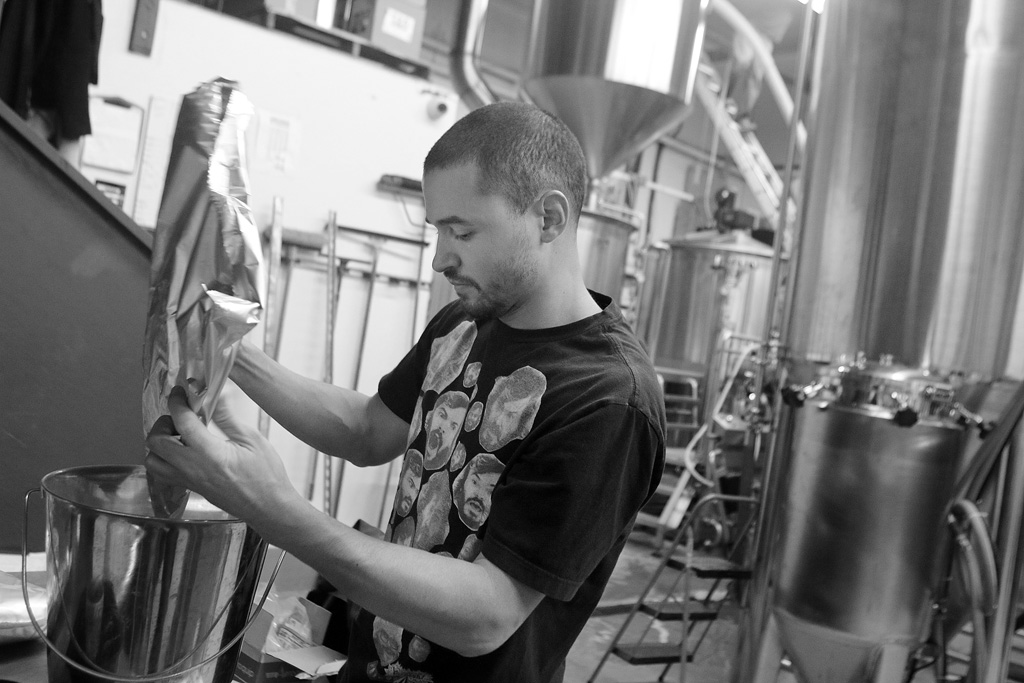
Brewing beer at Steel & Oak is part science, part art and a whole lot of toil.

Since opening in the summer of 2014, the craft brewery next to the Third Avenue overpass has already expanded its beer making capacity to 270,000 litres and added a bottling line. The tasting room has become a community gathering place; even baby momma groups meet there on some afternoons, their strollers parked akimbo amidst the tall industrial steel stools and wooden tables.


But it’s in the back where the magic happens.

In 18 months, brewmaster Peter Schulz has concocted 23 different beers, including new pilot beers every four-six weeks. The explosion of craft brewers in Metro Vancouver has made it a very competitive business said Schulz. The pressure is on for brewmasters to offer unique recipes.

Brew day at Steel & Oak is controlled chaos. Hoses are detached and reattached. Temperatures, sugar content and clarity are checked and checked again. Hops are weighed and added to the giant 1,700 litre brewhouse tanks. Water spills and sprays, running down the gently-sloped concrete floor to a trough amidst the forest of seven tall stainless steel vessels.

Schulz said making beer is very water-intensive; about seven litres is used for every one litre of beer that is produced.

It takes Schulz and his crew four weeks to brew ales, six weeks to produce a lager. That’s longer than most breweries, said Schulz. But the wait is worth it. His beers have won numerous awards, including best amber/dark ale at the 2015 BC Beer Awards last November.

Steel & Oak is located at 1319 Third Ave.

Panama Papers a moral crisis that could spark change says UBC ethics expert

piles-of-money

Story by Mario Bartel

April 19, 2016, Vancouver

An expert on business ethics says the release of the Panama Papers could be the spark that ignites social movements to close the wealth gap between rich and poor.

David Silver, the  chair in Business and Professional Ethics at the University of British Columbia’s Sauder School of Business, says the millions of documents that detail some of the ways corporations and individuals shelter wealth in off-shore tax havens represent a moral crisis that is “corrosive of democratic society.”

“Just because something is legal, doesn’t mean that it is moral,” says Silver, who’s also the director of the W. Maurice Young Centre for Applied Ethics that is comprised of social scientists and philosophers studying the ethics of business and professional procedures, new technology, healthcare and environmental practices.

The Panama Papers consist of more than 11 million files leaked from the database of Mossack Fonseca. The world’s fourth-largest offshore law firm specializes in creating shell companies where the elite can hide their wealth from tax collectors or other legal obligations like lawsuits or divorce settlements.

The documents were obtained by a German newspaper last year. Since then a consortium of investigative journalists from around the world have been sifting through them to uncover a shadowy world of some 200,000 companies that exist largely in name only to anonymously hold bank accounts and property in tropical tax havens like the British Virgin Islands, the Bahamas and Panama.

So far 12 world leaders are among 143 politicians, their families and close associates who have been implicated in using the tax havens. They include Russian president Vladimir Putin, the prime ministers of Pakistan, Nawaz Sharif, and Iceland, Sigmundur David Gunnlaugsson.

The latter resigned when the documents revealed he and his wife hid substantial assets in an offshore shell company even as Iceland faced a financial crisis that forced the country to seek bailout loans and impose currency controls.

Silver says while hiding wealth offshore isn’t illegal, it’s gotten worse in recent decades. He says that’s contributed to the growing gap between the rich and everyone else.

“There is less available to pay for essential public services like health, education and retirement security,” says Silver, a former philosophy professor whose research into issues like corporate taxes and offshore shelters precipitated his transition into business ethics. “Every citizen has an obligation to honestly declare all wealth and income, and to pay the taxes that their fellow citizens have democratically decided upon.”

Silver says seeing that activity documented in black and white confirms “the suspicion that the game is rigged; there are wealthy people and politicians in ‘corrupt’ countries that squirrel away money in ‘clean’ countries that are all too happy to accept it.”

While only one Canadian bank, RBC, has been linked to the Panama Papers, Silver says that’s enough to question whether the banks have been as forthcoming about offshore activities as leading corporate citizens should. Prime Minister Justin Trudeau recently called for more transparency in global financial transactions.

While the full scope of the documents has yet to be revealed, and the implications of the leak are just beginning to play out, Silver says “at the very least, “it provides fuel for anger at the unjustness of it all.”

Filmmaker’s opportunity comes with a price

Mario Bartel storyteller communicator multimedia
Photo by Mario Bartel The short film Alex Farah made as his graduation thesis at Emily Carr was nominated for five Leo Awards. Now he’s hoping to take his filmmaking aspirations to the next level by attending the American Film Institute in Hollywood.

This story was done for Tenth to the Fraser, a community news blog in New Westminster.

Alex Farah knows the transformative power of film.

Now the Queensborough resident is hoping a financial challenge won’t trip up his transformation into a filmmaker on the cusp of a breakthrough.

Farah, 24, has been accepted into the Director’s Conservatory at the prestigious American Film Institute in Hollywood. It’s a huge step forward in the budding career of the Emily Carr grad whose student thesis short film, Sahar, was nominated last year for five Leo Awards, the top honour for films produced in British Columbia.

Sahar سحر from Alexander Farah on Vimeo.

But it comes with a cost; more than $200,000 calculates Farah. That’s to cover tuition, living expenses and incidentals through the course of the two-year program that’s produced notable alumni like David Lynch, Darren Aronofsky and Terrence Malick.

Farah’s path to filmmaking started while he was studying sciences at UBC; he took a couple of film courses out of interest and discovered a medium that could allow him to explore some of the cultural challenges of being an Afghan immigrant. He shifted gears and enrolled at Emily Carr, where he learned every aspect of his new passion, from writing to cinematography to editing.

Farah also ran headlong into the expense of becoming a filmmaker.

His student short, which was based on the real-life Shafia honour killings in 2009 of three teenage sisters and their step mother whose bodies were found in a car in the Rideau Canal in Kingston, cost $5,000. He assembled the money from six years of making lattes at Starbucks. It debuted at the Toronto International Film Festival.

Getting a film seen on the festival circuit also costs money, for submission fees, shipping, promotion, even travel to the festival if filmmakers want to take full advantage of its networking opportunities.

“You’re never really making back the money you put into your film,” said Farah.

So many young filmmakers take advantage of the internet, submitting their projects to websites like Short of the Week. That’s what Farah did, which led to greater exposure as a Staff Pick on the streaming video portal Vimeo as well as a number of film blogs.

“Online status is turning into a thing, which website will host your film first,” said Farah. “It’s huge for North American filmmakers.”

Earlier this month Sahar was presented at the Moov film festival in Brugge, Belgium.

But that achievement pales in comparison to the effort Farah put into his application to AFI, which involved an interview, writing four essays as well as scripting, producing and directing a five-minute short on the theme of surprise.

The process took about a month, including two weeks dedicated to the film, which he shot in an audition studio at a Vancouver talent agency where he’s currently interning.

Farah said the opportunity to attend AFI is a chance to make connections in the film industry and develop his filmmaking skills with some of the brightest young talent from around the world; only about 100 students are accepted into the school every year, which also has academies for scriptwriting and cinematography.

“You have top-of-the-line crews. The films are watched by members of the Directors’ Guild,” said Farah. “It’s like a fast track to Hollywood.”

Shortly after Farah learned he was accepted earlier this month, the financial reality hit him.

“It’s super overwhelming,” said Farah.

Since then he’s reached out to his connections from Emily Carr and the local film community, explored student financial aid, arts grants, even met with loan officers from banks and credit unions. But all those sources still leave him short of his needs.

Farah said he’s thought about crowdfunding, but he’d rather save that step for when he’s prepared to make his next film.

Which he’s hoping he’ll be able to do.

“It’s hard to find Afghan-Canadian filmmakers, there’s a diaspora I can tap into,” said Farah. “I feel like I have something to offer the world.”

Winners wear down overmatched opponents

Mario Bartel storyteller photographer multimedia content writing road hockey
Lak Attack looks the worse for wear after he was clipped by a stick early in Sunday’s Stanley Stick opener.

For 24 years I’ve journeyed back to the carefree days of my youth by playing road hockey every Sunday morning from October to May. The stories and photos of those games are chronicled in my weekly blog roadhockey.net

The only thing gorier than the bloody cut suffered by Lak Attack in Sunday’s Stanley Stick opener was the final score.

The versatile veteran shook off the high stick that clipped his left eyebrow to lead his team to a dominating 20-6 win in the first game of the two-game championship finale.

After a tight first half in which the underdogs got to within three goals, 8-5, fatigue and heat took their toll and the winners outscored their beleaguered opponents 10-1 after the break.

Having an extra player to sub off tired legs certainly worked to their advantage in the balmy conditions, said Colonel.

“it was a warm day and any time a team doesn’t have a sub at all, it just allows the team with a sub to stay fresh and go hard every shift.”

But to take full advantage, the winners had to strike quickly. Which is exactly what they did despite being outplayed in the early going, said Doo.

“They were generating chances,” said the speedy centerman. “But that was classic offence from defence for us from the beginning of the game.”

Joker also stood tall in the net, rebuffing Bam Bam and Cleveland in close.

Mario Bartel storyteller photography multimedia blog content writer road hockey
Joker wipes the sweat from his brow as Sunday’s Stanley Stick opener was also the warmest game of the season.

“He did well to be there when we needed him,” said Colonel of his veteran goalie. “It’s a big boost because you know you can take a few more chances offensively.”

They executed their game plan perfectly.

“They got a couple of quick goals and the momentum was always on their side,” said Bam Bam.

A brief flurry and some fortuitous bounces got the underdogs close early in the second period. But Doo said his side kept its cool.
“We had a lot of veteran presence on our team… so we didn’t panic.”

Which is what the underdogs will have to remember if they’re to win Sunday’s second game to force a deciding sudden death mini game.

“All you need is one win to send it to the mini game,” said Bam Bam. “We’ve got to create more offense, take more shots, keep it simple.”

Despite Sunday’s lopsided score, the leaders aren’t taking anything for granted.

“I don’t think we got the other team’s best game this week,” said Colonel. “Next week they’re going to come out hard, feel rejuvenated. It’s going to be a whole other game.”

Doo said his side’s experience will serve them well to maintain an even keel.

“When you’ve been around enough Stanley Sticks, you know each game is completely different. We’ll have to rely on our veteran experience and patience next week.”

Five years into our affair, Lapierre still moves me

This anniversary ode to my bike was originally published on my cycling blog, The Big Ring

Mario Bartel storyteller writer multimedia communicator blog cycling cyclist bike
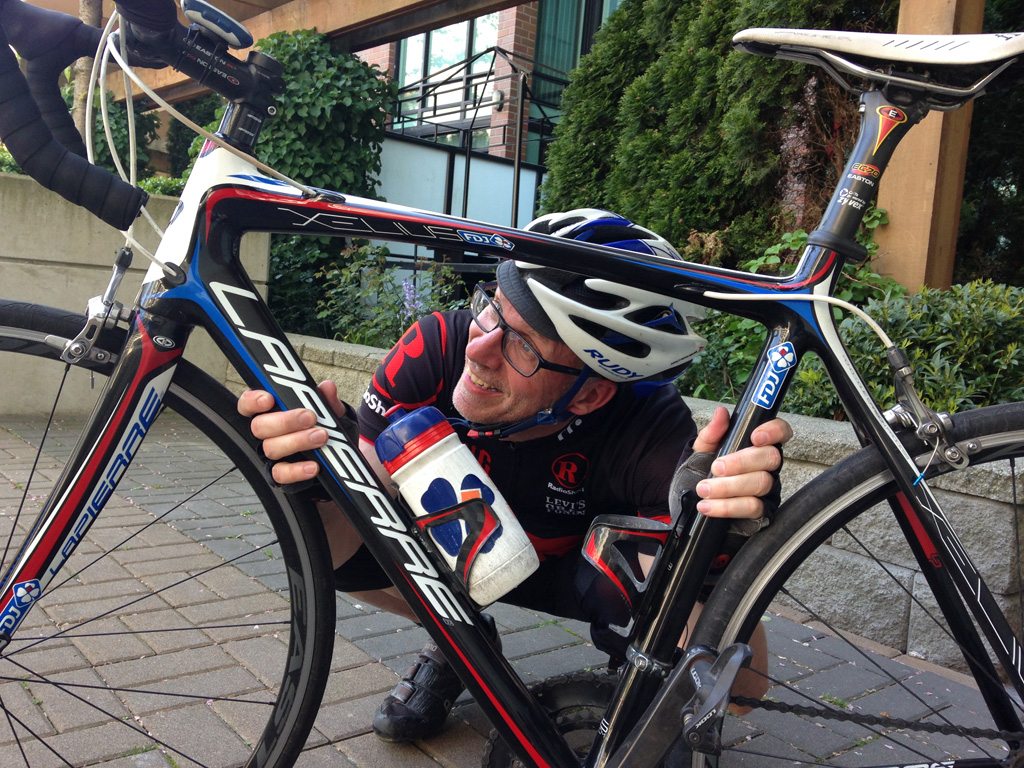
Five years after my first ride on my Lapierre road bike, we are still in love!

Five years ago, Lapierre and I consummated our affair.

Ours had been a whirlwind courtship conducted from afar, loving glances at images of her in action.

Her supple curves and quiet confidence set her apart from the others, like the wispy, colourful Italians, the brash Americans, the functional yet unattainable Germans, the socially conscious Spanish. She had surprises, unexpected touches of endearing and exciting flare; the thumbprint of her creator, the racing rooster tattooed on one of her lithe limbs.

When finally we were in each other’s company, we knew ours was a relationship of destiny. Our first forays into the world as a couple were greeted with sideways glances, probing questions: Who is this Lapierre? How did you meet? What are your plans?

It’s funny to think back on the innocence of those early days when being together was all that mattered. Five years, and more than 20,000 kms on, we are still inseparable, still bonded.

Lapierre moves me when I’m mired in inertia. She challenges me when the road ahead rises up, protects me and wraps me in comforting confidence when it pitches down.

When we are together I want to travel as quickly as she will allow me, yet slow to enjoy our every moment.

I glow with pride when others give an approving nod, make a passing compliment.

While others succumb to fashion’s fickle trends, Lapierre’s beauty is timeless; there is no fluo in her wardrobe.

Some have questioned the future of our passion; will we stay together? They point to other seductive temptresses with their electronic baubles and more advanced bangles. They say just as Lapierre usurped my ardour for Orbea, a new love will catch my eye, tickle my desire, grip my heart.

Perhaps that will happen. You know what they say at the bike shop; once a wanderer, always a wanderer.

But in the warm spring sunshine, as Lapierre and I move as one, it’s hard to imagine…

Closing newspapers means losing community connections

BNWN101231_A

This article originally appeared in Tenth to the Fraser, a community blog in New Westminster where I am a contributing writer and photographer

My first connection to New Westminster was the local newspaper.

I worked for it.

When the 1990 recession punted me from my job in Ontario, I headed west where, I was assured, there was plenty of opportunity in the burgeoning community newspapers around the Lower Mainland.

I’d been to Vancouver, for Expo 86, and I knew of the senior lacrosse teams from New Westminster and Coquitlam, who perennially battled for the Mann Cup against the Brooklin Redmen, one of the teams I covered while working at a paper in nearby Oshawa.
But I really had no concept of what a New Westminster, or a Burnaby or a Richmond or a Port Moody was.

So when one of my first assignments with the Metrovalley group of papers sent me to New West to shoot a story about backyard trampolining, I spent a little time exploring. I was immediately enchanted by the old homes and leafy streets of Queen’s Park, the bustling uptown where a giant hole would become a new urban mall, the waterfront. I had a good feeling about this burgh.

Between subsequent assignments in New West, I drove around looking for vacancy signs in front of apartment buildings. I scanned the classifieds for rentals.

To learn a little more about what made New West tick, what the community offered, I read the stories written by my colleagues. And, of course, I covered some of them myself. I quickly learned about the good parts of town, the areas to avoid.

A couple weeks later, I paid a deposit on a one-bedroom apartment in a little walk-up on the edge of Queen’s Park. I stayed there 18 years before moving to the Quay.

160211Connection2
Raymond Marsolais reminisces about 42 years running his own barber shop in Sapperton.

The local newspaper introduces readers to characters who give a community character, like Ray Marsolais, who cut hair in Sapperton for 42 years.

In October, the New West NewsLeader closed, another casualty in the malaise that is gutting newsrooms and shuttering papers across North America. In fact about 30 newspapers have closed in British Columbia since 2010, according to a running count being kept by a web producer at Global News. More are likely imminent.

The media landscape is shifting.

The consolidation and closure of newspapers used to be the subject for government commissions. Now they’re greeted by shrugged shoulders. And then everyone turns back to their Facebook feed on their smartphone.

Much of the newspaper industry’s current pain is self-inflicted. Ownership got complacent on fat profit margins, on being the only game in town. They didn’t want to, or were incapable of, coming to terms with the digital revolution, with Google and Craigslist and eBay.

Nobody’s holding tag days for closed newspapers. (Although in Guelph loyal subscribers of the city’s daily, The Mercury, did gather to hug the paper’s building when its closure was announced) Some say our demise is just part of the evolution of how we consume information; nobody wants to read yesterday’s news printed on dead trees anymore when the instant gratification of a Twitter feed is a few finger taps away.
But we should worry.

160211Connection3
Western Forest Products’ final message to workers at its Queensborough mill, as they leave the mill for the last time.

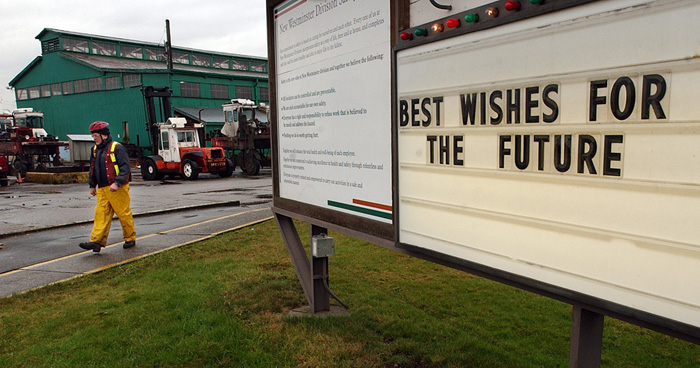
The local newspaper is a living archive that chronicles a community’s evolution as its happening, like the closure of lumber mills and the loss of industrial employers in Queensborough.

Newspapers, for all their diminished resources and cumbersome delivery model are still the primary source for much of the information we consume about our community. Day in, day out, week in, week out, they do the grunt work of covering local government and calling the cop shop. They’re our eyes and ears when we can’t be everywhere. A good newspaper not only tells the community it covers what is going on but also provides context; why should we care? who will be affected? Its pages are a barometer of what’s important to a community.

A newspaper reflects the elements of community we value, the events that bring us together, how we respond when the going gets tough. It celebrates a community’s heroes and everyday champions. It introduces us to the characters who give character to a community. It gives voice to those who might not otherwise be heard.

160211Connection4
In 24.5 years, I covered virtually every community event in New Westminster. Many of them multiple times.

The local newspaper takes readers into places in their own community they might not otherwise know about, like a private train collection that is housed in a Braid Street warehouse and includes the restored locomotive of a passenger train that was involved in a tragic collision in Hinton, Alberta.

A newspaper can bring us into parts of the community we might not see. Its stories connect us to our neighbours down the street or on the other side of town.
An illuminating quote, a lovely photo can make us smile. A provocative editorial can spark conversation.

Even the ads are a snapshot of a community’s economic vitality. Or lack of it.

A community’s newspaper is its organic, real-time story. Who prints out and saves articles from a website? But clippings of stories and photos from the newspaper are likely taped and pinned to refrigerators and bulletin boards. They’re pasted into scrapbooks. Sometimes they’re sent to grandma.

To read a newspaper regularly is to experience a community’s evolution as it’s happening, its changing landscape, economy, identity.

A newspaper is our connection to the community in which we live, work, play. It gives the community a dimension beyond just the people we interact with, the places we frequent. It’s one we can count on, moreso than a fickle Twitter hashtag or gossipy Facebook group.
So next time we yawn at the news another community has lost its newspaper, we must consider what else is being lost beyond jobs and one less bundle to carry out for recycling.