Steinbier is German for stone beer. It’s a traditional method of brewing beer in Bavaria and parts of Scandinavia that uses super-heated granite stones to boil the wort.
The quick caramelization when the rocks are dropped into wort, or the wort poured over the hot rocks, creates a smokey, slightly sweet and malty beer.
German brewmaster Sebastian Sauer, of Freigeist Bierkultur in Cologne, recently visited Steel & Oak Brewing Co. in New Westminster, to share this old-world brewing technique.
For three years, the FR Fuggitivi has pulled the curtain down on its summer riding season with a climactic, epic ride. We call it the Fondon’t.
It has all the perks of a Fondo – camaraderie, timed intervals, snacks, beer, big mileage – but none of the expense.
The first Fondon’t was the Tour de Huit Ponts.
Last year we climbed Mt. Baker, the biggest rideable mountain in the Pacific Northwest.
This year our ride patron took us on some familiar roads but with fresh and fun new twists, not the least of which was a gravel climb that forced more than a few riders to unclip and portage the loose stones and rocks.
Since last year’s smokey ride up Baker, the Fuggitivi has evolved into a proper, official group. We’re registered, we have directors, sponsors and pro kit. We have numbers; 17 riders took the start although one quickly abandoned because of a recurred leg injury.
Of course, big numbers bring bigger aspirations; we can no longer just slap the Fondon’t label on a long year-end ride and call it an epic day. Sunday, the epic bar reached a new level.
The day started with a national anthem singer and only got better.
The 140 km route traversed seven gravel sectors, including the 800 metre 11 per cent gravel climb.
It included three fast and flowing descents, one of which had never been ridden by most of the FRF, two sprint and four tough King of the Mountain competitions marked by signs, a lunch stop with reservations, a close encounter with a family of deer and even a champagne surprise.
It also included one total tire blowout, a couple of flats, and a shower of rain.
Most cyclists know what to expect on a long ride. It’s the unexpected that can turn a familiar route into an epic day out.
The Fondon’t has all the trappings of a Fondo, including an anthem singer, but none of the expense.
Anticipation keeps the gathering Fuggitive warm as an air of mystery surrounds the planned route for Sunday’s third annual Fondon”t
A long ride doesn’t achieve epic lore without a few mechanical challenges along the way.
To the King, or Queen, of the Mountain go the rewards.
An epic day out deserves an epic reward; champagne secreted away in a farmer’s field along the road.
The reward is even sweeter at the top of a difficult climb.
Good food and good company also contribute to the epic vibe.
Familiar countryside takes on a new colour when riding amidst the peloton.
Climbing 800 metres of loose gravel at 11 per cent can challenge even the most seasoned roadie.
The FR Fuggitivi has grown to a proper peloton as the group prepares to ride its third annual Fondon’t.
No this isn’t the south of France in July; it’s Pitt Meadows in August.
Grey skies above, grey gravel below for Sunday’s third annual Fondon’t.
It’s good to have goals; even better to achieve them.
For the past 12 years, my July’s have been defined by my goal to ride 1,000 kilometres in the month.
I came up short in 2009, a sweltering July, and in 2014, for some unknown reason.
But otherwise, it’s been pretty achievable.
Especially as I tend to take two weeks off to get up early to watch the Tour de France then, suitably inspired, spend the rest of the day riding my own bike.
In 2008 I must have been particularly inspired, as I achieved 1,600 km, including 608 in one incredible week!
Eight days ago, my beloved 1,000 seemed out of reach.
The demise of my newspaper meant I’d seen the last of my six weeks’ annual vacation that I’d toiled 20 years to attain. In fact, the beginning of a new job meant no vacation at all.
But two unexpected gift rides last week, and a favourable calendar with a long weekend to close the month, opened the door to the possibility of reaching that 1,000. Good legs, recovered from the gruelling Triple Crown, put me over the top.
To ride those 1,095 km took me 44 hours and 53 minutes; that’s like a full work week plus half a day of overtime!
Fuel for a busy long weekend riding included this tasty Mexican dish of roasted pepper stuffed with quinoa, beans, roasted corn and green onions.
A handy bit of cycling infrastructure at Port Moody’s Rocky Point Park; a bike repair stand with tools and an excellent air pump. Not that there was anything wrong with Lapierre.
Saturday’s bonus ride was into a strong headwind.
Beware the dismay of a Fuggitivi denied his first Lunch Doctor experience!
Saluting the goat, any the achievement of my annual July riding goal.
Of course in the Strava universe, 1,000 km in a month is but a molehill. The month’s distance champion was a woman from Florida, who clocked more than 11,000 km! That means she rode more than 370 km a day, 12 hours of every day of the month!
My legs wilt just at the thought.
As does my brain. Because she did her rides covering laps of the same 20 km circuit, over and over and over again. I can only imagine the mental fatigue and boredom of watching the same countryside roll past hour after hour, day after day, week after week.
Her Strava profile says she has a goal to set a new record for ultra marathon cycling. To achieve that, she’ll have to ride more than 122,432 km by next July 1. Because this was the first month of her challenge.
When Princess of Pavement asked me two days running, “aren’t you going for a ride?” the nature of her enquiry and the way she asked it implied encouragement.
I hadn’t planned to ride.
On Sunday I was scheduled to work on a special project so I was resigned to missing the weekly FRF ride. Instead I went for a solo roll on Friday. When I reminded PofP after her ride query Saturday night, she suggested I could head out early, before I had to work.
Hmmmmmm, free kilometres!? Yes please!
Morning roll-out by dawn’s early light.
Living in an open loft presents challenges for any early or late activities. There’s no door to close to muffle the noise. And while Little Ring has a separate room with a doorway, his senses seem to roust at first light and await any cue that the day is set to begin, especially if that cue indicates breakfast is being prepared.
“Is it morning yet?” he’ll cry out. “I’m hungry.”
So an early-morning ride requires meticulous preparation the night before. That means placing the bike by the door, hanging kit in the bathroom for changing, placing shoes, helmet, gloves and emergency kit somewhere clear of creaking floor boards, honing muscle memory to avoid those noisy floor boards, putting out breakfast utensils and dishes to minimize drawer and cupboard opening, rounding up breakfast ingredients to limit the number of times the fridge has to be opened and closed.
Free kilometres usually mean flat kilometres to maximize their impact on my mileage goals.
The pressure is enormous. One false step, one moment’s inattention could disturb the pre-dawn silence.
The unexpected evening ride, however, usually comes with a peace dividend. It seems Little Ring is more amenable to sticking to his bedtime script when there’s only one of us around; it’s as if he has an innate sense there’s no “good cop” around who will accede to his various nighttime stalling games just to keep the peace.
So when Princess of Pavement asked again on Monday whether I was going for a ride, I was gifted another great big mozza ball of free kilometres.
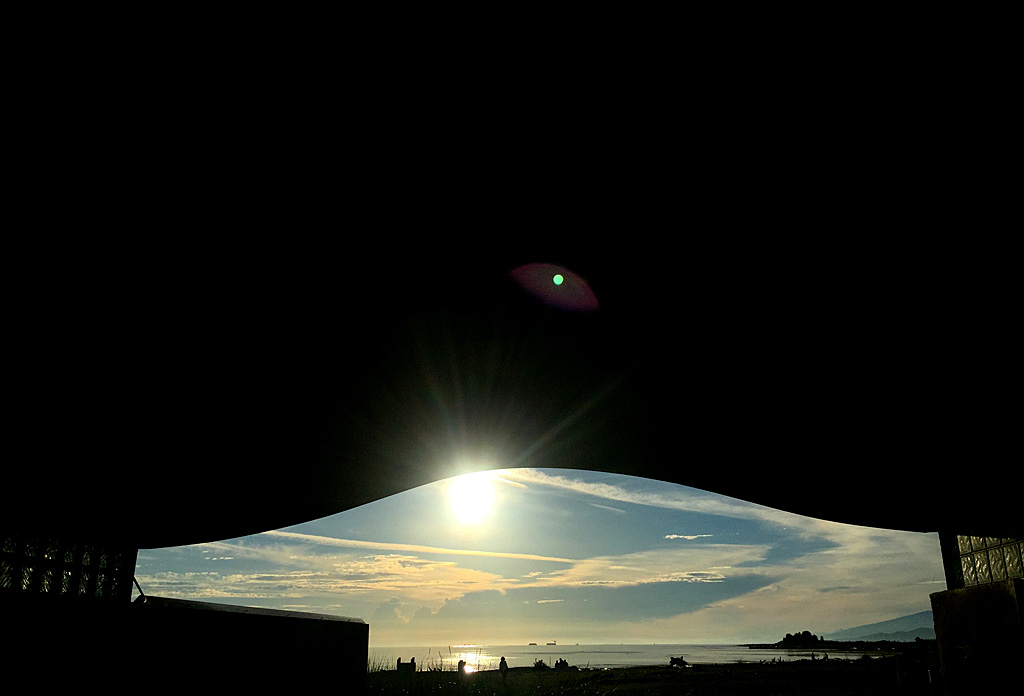
The sun begins to set at Iona Beach
And while they’ll help get me a little closer to my usual July goal of 1,000 kilometres for the month, I’m resigned that I likely won’t attain it this year. Working at a new job and not having my traditional two weeks holiday during the Tour de France to pile on the rides has been the Yoko Ono to my Strava goals.
Friday’s PoCo Grand Prix transformed Port Coquitlam’s historic downtown into a high speed circuit of lythe, powerful cyclists, carbon fibre, lycra and a whole lot of excitement.
The inaugural Grand Prix is part of BC Superweek, a week-long festival of bike racing in communities around Metro Vancouver that attracts top female and male pro cyclists from across North America and as far away as Australia. In Port Coquitlam, they raced a twisting 1.3 km circuit that circumnavigated the downtown and City Hall.
But the event was more than just a bike race. It was a day-long celebration of cycling with live entertainment, a beer garden, a kids zone, business and cycling expo as well a support races for kids, junior racers, amateurs and corporate teams.
I was hired by the Tri-City News to cover the evening’s feature races as well as capture some of the collateral fun.
MARIO BARTEL PHOTO The PoCo Grand Prix kids zone provides future racers a chance to hone their skills.
MARIO BARTEL PHOTO The women’s race is underway at Friday’s PoCo Grand Prix, part of the Superweek series of races around Metro Vancouver that attracts top pro riders from around North America and as far away as Australia.
MARIO BARTEL PHOTO The women’s peloton speeds along McAllister Avenue towards the PoCo Court House in Friday’s PoCo Grand Prix.
MARIO BARTEL PHOTO Sara Bergen speeds down the main stretch at Friday’s PoCo Grand Prix.
MARIO BARTEL PHOTO The men’s peloton is strung along Shaugnessy Street.
MARIO BARTEL PHOTO Doreen Speers cheers on the riders in the women’s race at Friday’s PoCo Grand Prix.
MARIO BARTEL PHOTO Justin Williams celebrates his win in the men’s race.
MARIO BARTEL PHOTO The bowlers seem to have lost their exclusive parking privileges during Friday’s PoCo Grand Prix.
MARIO BARTEL PHOTO The women’s race speeds along Elgin Avenue.
MARIO BARTEL PHOTO A racer reflects on the start of the women’s race at Friday’s PoCo Grand Prix.
MARIO BARTEL PHOTO Riders speed through the corner of Donald Street and McAllister Avenue during the women’s race at the PoCo Grand Prix on Friday.
MARIO BARTEL PHOTO Spectators along the barriers on Shaugnessy Street cheer on the riders in the women’s race at Friday’s PoCo Grand Prix.
MARIO BARTEL PHOTO Kendelle Hodges celebrates her win in the women’s race at Friday’s PoCo Grand Prix.
MARIO BARTEL PHOTO The men’s race speeds on McAllister Avenue at Friday’s PoCo Grand Prix.
MARIO BARTEL PHOTO The women’s race speeds past the historic railroad mural on Elgin Avenue.
MARIO BARTEL PHOTO A rider’s elaborate nails prior to the start of the women’s race at Friday’s PoCo Grand Prix.
MARIO BARTEL PHOTO The men’s peloton prepares to turn onto Shaughnessy Street.
MARIO BARTEL PHOTO Gary Mauris, the president of Dominion Lending Centres, fires the starters pistol to start the men’s race at Friday’s PoCo Grand Prix.
MARIO BARTEL PHOTO Wheels are lined up for the start of the women’s race at Friday’s PoCo Grand Prix.
MARIO BARTEL PHOTO The Sean Michael Trio performs on the Phoenix Entertainment Stage at Friday’s PoCo Grand Prix.
MARIO BARTEL PHOTO American Justin Williams celebrates his win in the men’s race with fans along Shaugnessy Street.
MARIO BARTEL PHOTO The men’s race lines up on Shaunessy Street.
MARIO BARTEL PHOTO Heidi Ujfalusi rings the bell to signal a “Prime” lap in which riders race to the finish line to claim a cash prize.
MARIO BARTEL PHOTO Women’s race winner Kendelle Jackson celebrates on the podium.
MARIO BARTEL PHOTO Aaron Paddon, 6, concentrates as he negotiates the trials course in the Kids Zone at Friday’s PoCo Grand Prix.
After every ride, I dutifully download the data from my Garmin GPS to the social site that connects riders from around the world who break down their routes into bite-sized segments. Comparing my performance with previous rides can give me an idea of improvements in my own fitness, as well as affirm the sensations in my legs; feeling strong during a climb up Burnaby Mountain isn’t just in my imagination when Strava awards me a Personal Best trophy icon.
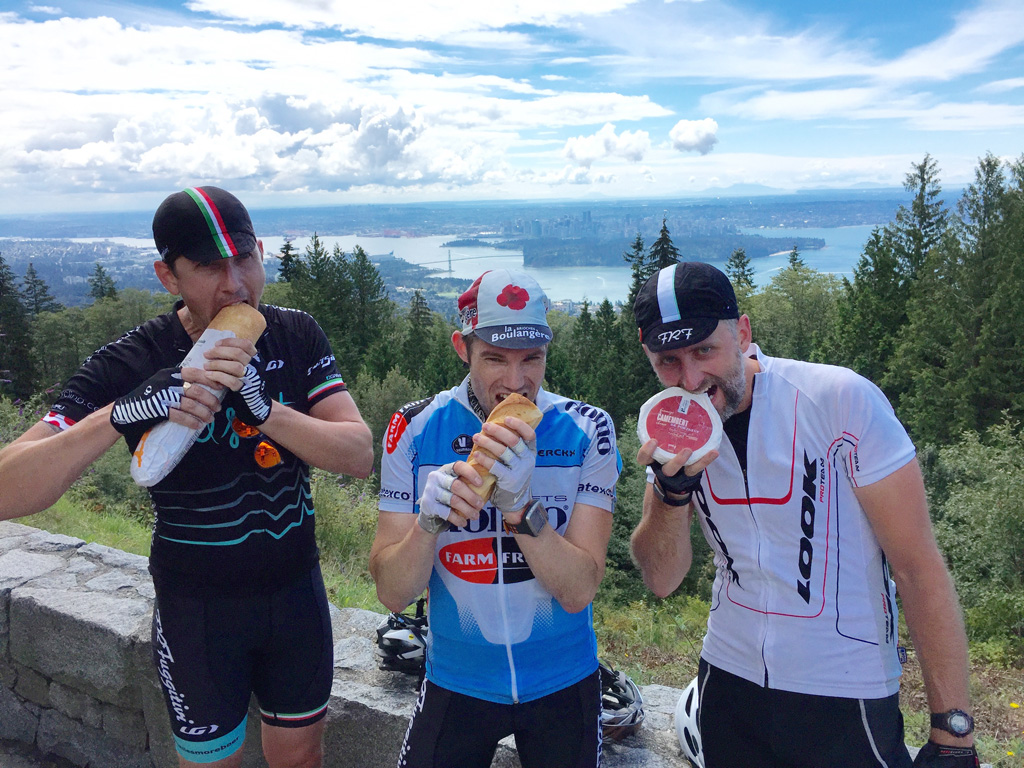
Enjoying a baguette and brie on the annual FRF Bastille Day ride.
Earning those little trophies is addictive.
Strava has more than 1.5 million active users. They include cyclists and runners. Logging their activities into the site provides real-time tracking of their performance improvements over segments created by fellow users.
Those segments are also the measure upon which cyclists and runners can compare their performance with others, a sort of giant ongoing virtual race.
Sometimes those virtual competitions can get pretty intense. Setting a new KOM can be conversation fodder in the FRF peloton, a throw-down to other riders.
What’s a celebration of French cycling without baguette and brie?
Not that I ever have to worry about setting or regaining a coveted KOM.
In the Strava world I am famously mediocre. My modest achievements are neither great nor terrible. Inevitably a personal best that I worked hard to attain will end up ranked solidly somewhere in the middle of the pack of all riders who’ve ridden the same segment.
Except for descents. Apparently I can be pretty decent at those; I’ve even managed to crack the top 10 on some, even if briefly.
This Saturday I’ve signed on for the Triple Crown, a challenging ride up Vancouver’s three major mountains, Seymour, Grouse and Cypress. I’ve done all three separately, never on the same day. The route covers 75km with around 2000 metres of climbing.
I’m confident I’ll be able to do it. I’m certain I’ll be slow. I’m scared of the effort it’s going to take.
So instead, I’m going to think of it as three fast and fun descents. Because what goes up, has to come down. Before it can go up again…
The clouds of doom began gathering as soon as the destination for Sunday’s FRF ride was announced.
As we embarked on our ill-fated adventure into cycling’s Heart of Darkness, Delta, they thickened, became more menacing.
Barely over the Bridge of Lost Souls that transports unwitting victims into her lair, never to be seen again, the trouble began. Mike, an FRF newbie on his inaugural ride, flattened. By the time the day was done, the fierce headwind was no longer the topic of our peloton’s consternation; it was Mike’s unprecedented FOUR flats!
An all too familiar scene; the FRF gather around as a flat tire is changed.
Delta is where cyclists get lost, and tires go to die.
The city’s bike routes are deplorable. Not only is their signage inconsistent and often illogical, the lanes are poorly maintained.
It is July, the thick of riding and bike commuting season, and the bike routes are as dirty with gravel and debris as if it was mid-March after a harsh winter of snowplowing and sanding. the sharp stones bite into tires, ricochet into unsuspecting shins, ping off shiny carbon fibre frames and even catapult off passing vehicles. Riding in Delta, especially along busy routes like River Road, is a dangerous game of waving and weaving through a moonscape disguised as a bike lane.
Gravel and stones no the marked bike lane is an invitation to trouble. Routes need to be swept.
Making roads and routes safe for cyclists involves more than just painting white stencils on shoulders. Those lanes should be swept regularly to clear them of the debris and detritus strewn by cars and trucks. A sharp stone squeezed out by a tire at 120psi becomes a missile, capable of gashing shins, chipping paint, flattening tires. Just ask Mike, whom we last saw humping his bike back down the Bridge of Lost Souls, his patience and our peloton’s supply of inner tube and CO2 cartridges exhausted.
Four flats on a single ride is terribly bad luck. In Delta, it’s inevitable.
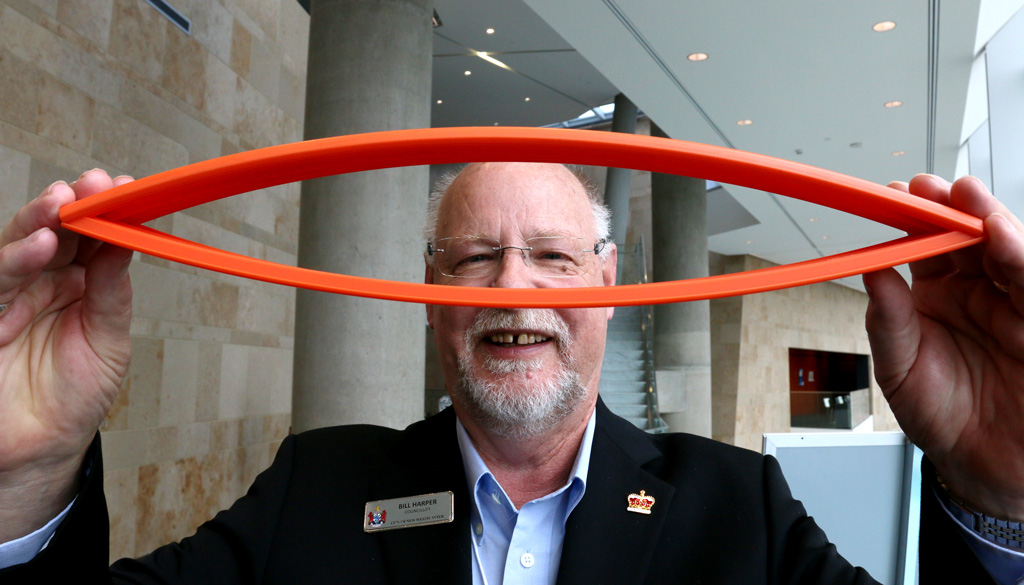
Photo by Mario Bartel Coun. Bill Harper, the co-chair of the City of New Westminster’s Intelligent City Advisory Committee, examines a section of plastic conduit that will house high-speed fibre optic cable to be installed throughout the city over the next two years. The city will operate its new BridgeNet network as a utility, leasing capacity to private Innternet Service Providers which will then sell connections to business and residential customers.
New Westminster is getting a new highway.
But this one won’t pour even more vehicles off and on the ageing Pattullo Bridge.
This highway moves data.
And, it’s hoped, move British Columbia’s oldest city well into the future.
Tuesday, the City of New Westminster launched its new BridgeNet fibre optic network. When it’s completed in five years, the network of fibre optic cable encased in bright orange plastic conduits buried in the ground will bring gigabit internet to businesses, agencies, industries and residents from Queensborough to Sapperton.
The initiative is the backbone of New Westminster’s “intelligent city” strategy to drive its economic growth over the next 20 years, said Bill Harper, the co-chair of the task force that developed the program in consultation with business, industry and residents.
“You’re going to have to have an intelligent city if you’re going to survive in the modern world,” said Harper.
Gigabit internet capability over fibre optic cable means data can be downloaded at speeds up to 940 megabits per second; conventional internet speeds over existing copper cables range from 10-50 Mbps.
That means more than being able to watch Orange is the New Black on Netflix without pixellating or participating in a multi-player video game without buffering, said Harper. “It’s a process of getting to the next stage of economic development.”
That development will bring new knowledge-based jobs to the city in health care, high tech, innovation and even the film industry.
Nicholas Boughen has been champing at the gigabit since he opened his CG Masters School of 3D Animation and VFX in the Shops at Westminster Station four years ago. Creating digital effects for film, television and games takes a lot of computer power; a single frame of an explosion can take 1,000 gigabytes of data. Moving that amount of data over existing copper cables to massive “rendering farms” where stacks of thousands of powerful computers transform digital ones and zeros into orange balls of flame and roiling smoke is impractical. So Boughen built his own rendering hobby garden of 80 computers in house. Still, rendering a student project can take days.
Having a high-speed connection to the remote rendering farms will “mean our training program becomes more capable,” said Boughen. And that’s attractive to VFX giants like Sony Pictures, Imageworks and Industrial Light & Magic, who he foresees could one day occupy the empty floors of the Anvil Centre’s office tower.
That’s not just fanciful thinking said Alvin Chok, BridgeNet’s Chief Information Officer.
As young workers that drive the technology industries get priced out of the Vancouver housing market, they’re looking to more affordable cities like New West that also offer the big city amenities they value like access to transit and walkability. So are their employers.
“They want to stay connected to the world,” said Chok. “Their big motivators are rents and affordable real estate compared to Yaletown.”
The City will build and operate BridgeNet as a utility. It will install, maintain and own the network, leasing capacity to private Internet Service Providers that will then provide access to business and residential customers; to date four ISPs have signed on.
The network’s backbone will be completed in two phases; the first will connect Uptown, Downtown and Sapperton and next year’s second phase will extend to the West End and Queensborough. The ISPs will then connect businesses and multi-family residential complexes to the backbone. The ISP’s at Tuesday’s launch event, like UrbanFibre, were advertising Gigabit internet connections for residential customers for $79 a month.
But it’s in the business sector the city hopes BridgeNet will really connect. High speed fibre will be an allure for upcoming developments at Sapperton Green, the Brewery District and Queensborough, as well as existing office space Downtown and Uptown, said Chok.
“We’ll have enough capacity so we can scale up,” said Chok. “We can accommodate future needs.”
Including the demands of a redeveloped and expanded Royal Columbian Hospital which will rely on high speed internet to move vast amounts of data like hi-res X-Rays, MRIs and even remote robotic operations.
“Jobs are being created in technology,” said Harper. “The innovation curve is huge; it’s going straight up.”
For more information about BridgeNet, including an interactive map of where and when it will be available, go to www.bridgenetnw.ca
I was recently commissioned to shoot some product photos for Steel & Oak Brewing Co., to be used on their various social media feeds. They’re a small craft brewery located about 400 meters from our condo. Needless to say, I’m fairly familiar with their products…











 MARIO BARTEL