Twizzler scored four times to become the first, and most unlikely, winner of the inaugural Shrimp Ring Shootout on Sunday.
The shotstopping stalwart was given a rare reprieve from his armour of heavy leg pads as the competition required only one goalie; he took full advantage, ripping bullets past his rearguard rival, Joker, high into the top corner, over his glove and through the five hole. It was a remarkable offensive effort against some of the game’s top snipers including Doo, Lak Attack and Scooby, who was making his first appearance at the courts in more than a year.
That the Shootout occurred at all was a testimony of the roadsters’ resolve to restart the season after a five week hiatus brought on by extended wintry weather.
“This is the week we were going to get back to playing hockey and you have to take a stand that you’re not going to let anything stand in your way,” said Doo during a break from the arduous effort to chip and shovel away more than a foot of hardened, compacted snow and ice.
It may have been the worst conditions the roadsters have ever encountered at the concrete courts said Lak Attack. A snowfall early in December wasn’t cleared before a thaw and subsequent freeze encased the concrete surface in ice and frozen slush. More snow piled on over the holiday hiatus that was compacted when the neighbouring school reopened.
“This is something we’ve never seen,” said the veteran who’s participated in numerous shovel brigades over his long career. “The amount of snow, and the ice underneath; there’s a lot of challenges.”
But the roadsters wered undeterred. Every chunk of snow or block of ice heaved to the side felt like a victory, said Doo.
“They’re doing something impossible. It’s back-breaking labour for a game that we’re probably not even going to be able to play.”
That realization was apparent more than an hour into the clearing effort as the accumulated snow had been removed from only a third of the court, and a thick layer of hard ice still remained.
The shoot out contest may not have had the competitive fire of a regular game, but for the roadsters who survived Sunday’s shovelling brigade it still felt like victory.
“It’s great to see,” said Doo. “This is probably helpful for people’s fitness.”
“This is a building block of how badly the guys want to play,” said Lak Attack. “It builds character for the guys… and that’s good for the rest of the season.”
Lak Attack enjoys the reward of the roadsters’ hard work!
Twizzler and Lak Attack dig out the road hockey courts from more than a foot of hardened snow and ice.
After five weeks off, nothing was going to stop the roadsters from launching the second half of their season with the annual Shrimp Ring Bowl.
A shovel is an early casualty of the hardened snow and ice that have covered the road hockey courts since early December.
Joker makes a save on Doo during Sunday’s snowy Shrimp Ring Shootout.
Lak Attack heaves heavy snow from the road hockey courts so some semblance of a game could be played on Sunday.
This story was originally published in my road hockey blog, roadhockey.net
Shooting sports successfully usually demands some level of vague familiarity with the rules and flow of play. Knowing how a sport works can help you anticipate the action, point your lens at the right area of the field, stand in the proper place.
But what if a sport exists entirely in fiction?
Quidditch is a sport played by some of the characters in the Harry Potter novels. It’s a fantastical amalgam of tag, capture the flag, soccer and rugby played in mid-air by wizards flying magical broomsticks.
Some enthusiasts, mostly from university campuses, have brought the game down to earth and compete in actual leagues and championship tournaments.
In the spring of 2015, the Canadian Quidditch championship landed in Burnaby.
While I’ve seen the Harry Potter movies, I really had no idea what to expect of this real-life version of the fictional sport. Let alone how to shoot it.
But once I got over the odd sight of athletes running around with a “broomstick” between their legs, the patterns and purpose of the players quickly became clear. So did their passion.
And that’s always a recipe for good photos. Even when you have no idea what is going on.
An SFU player dives to try to catch the “snitch” to score 30 points.
An official checks that players are properly attired and equipped prior to their match.
An official adjusts one of the goal hoops.
The Vancouver Vipertooths gather for a pre-game cheer prior to their opening round match against McGill Quidditch at the first Canadian national quidditch championships, Saturday at Swangard Stadium.
This lament was originally published on my cycling blog, The Big Ring.
Dearest Lapierre,
I’d like to introduce myself; I’m Big Ring.
We spent 6,019 kilometres together this year. But it’s been awhile since we’ve hung out; 37 days as a matter of fact. So I can’t really blame you if you’ve forgotten about me.
It’s been a nasty run of weather and circumstance. Almost two straight months of rainy days, followed by three weeks of cold and snow and ice.
While others forge on with their knobby-tired, all-weather commuter bikes, or slip the studded rubber onto their mountain bikes, we can only gaze out the window forlornly as the clouds roll in yet again, and the roads are slicked with rain and snow and slush. I guess we just don’t have the Right Stuff to count ourselves amongst the dedicated, the stubborn, the foolhardy who pedal on no matter the conditions. We’re built for sunny days, dry roads.
The last two years we’ve lived a charmed life. But for the briefest of interludes, the pavement stayed undamped, the skies clear. We were able to stay acquainted.
Five weeks is a long time to be apart, sweet Lapierre. Too long, as the flakes fall yet again, and the roads are clogged with a viscous slop of dirty slush and ice. The forecast isn’t promising either; a brief spell of milder air with perhaps a glimpse of sunshine – just enough to tantalize us. Then the cold and snow descend once again. The annual FRF New Year’s ride may be in peril.
But you are never far from my thoughts Lapierre. Plans are in motion to give you new environs as you rest, to bring back elements of the former bike room from which you were usurped by the arrival on the scene of Little Ring more than four years ago. But as with anything home reno related, that may take me awhile.
In the meantime, we shall commune at the work stand, keeping you clean and fit should the roads ever clear…
A snow day in the big city can be magical. Even more so in Vancouver, where they’re so rare. This is what it was like to be in downtown Vancouver last Sunday as the flakes fell.
Snow and ice put the winter back into Saturday’s final Winter Farmer’s Market of 2016. But Jason, at Gary’s Kettle Corn, wasn’t feeling the frosty temperatures.
In fact, he was so comfortable he was wearing just a t-shirt as he hovered over the propane burners heating the 80-quart kettle where the kernels are popped full of sweet and salty flavour.
“I definitely have the warmest spot on the block,” he chuckled as his shivering assistant served a customer just outside their booth’s heat zone.
Since moving uptown and outside last year, the Royal City Winter Farmer’s Market has been anything but wintery. Oh sure, there’s been plenty of rainy and cold market days, but Saturday’s setting of snow and ice was a first for many of the vendors. And they were doing everything they could think of to stay warm.
Like Tara at Roasters Hot Sauce; she was thinking about enjoying a hot toddy in her warm apartment to take the icy edge off that her six layers of shirts and sweaters couldn’t.
Layering is the key, said Michelle and Kathryn at Kiki’s Kitchen. They each topped a half-dozen layers of undershirts and cashmere with matching orange puffy jackets. Experience helps too, said Kathryn. She’s originally from Montreal so she spent plenty of time having a good time in the snow and cold.
“You’ve got to dance around, keep moving,” she said as the pair bopped around a propane space heater at the back of their booth.
Over at A Bread Affair, Cierra’s dancing was more like rocking back and forth from foot to foot. But her kiosk is closest to the Tim Horton’s so she was able to steal away for a hot coffee and a few moments of thawing out whenever traffic slowed.
“This is better than rain,” she said, optimistically.
Many of the vendors had the cold well in hand. They had chemical warming packets stuffed into gloves and socks.
“I love that we’re all in this together,” said Amanda at Honey Bee Zen.
But for Aaron at Ossome Acres, the frigid temperatures presented a new and unexpected challenge.
“We have to keep our eggs in the coolers to keep them from freezing,” he said.
The hot sauces at Roasters may warm the insides, but Tara is relying on six layers and Hot Pockets to keep her outsides toasty at Saturday’s chilly Winter Farmer’s Market.
Chemical warming packets are the key to staying warm at Saturday’s Winter Farmers Market say many of the vendors.
Amanda tries to stay warm at ther Honey Bee Zen kiosk.
Ron scrapes the frost from the coolers at Wild West Coast Seafoods.
A t-shirt is all Jason needs to stay warm as he works the giant kettle at Garry’s Kettle Corn.
Cierra, of A Bread Affair, is bundled up to her eyeballs.
Snow, ice and sub-zero temperatures help put the winter into the Royal City Winter Farmer’s Market on Saturday.
Matching puffy orange jackets and a propane space heater keep Michelle and Kathryn toasty in the Kiki Kitchen kiosk.
A rack of hand-knit sweaters is an enticement to shoppers trying to stay warm at Saturday’s chilly Royal City Winter Farmer’s Market.
Aaron pours a steaming mug of tea to stay warm in the Ossome Acres booth.
This week’s $40 haul was all about indulgence. After all, ’tis the season:
• 2 pieces of strudel, 2 Schrippen buns and 3 poppyseed buns from Gesundheit Bakery – $10
• box of mixed cookies, that will be used as a Christmas gift, from Sweet Thea Bakery – $10 (These market fixtures have hit a bit of a financial speed bump, so they’ve started a gofundme page to help them weather the storm and ensure they can keep baking)
• tuna loin from our favourite fish guy, Ron, at Wild West Coast Seafood – $20
The next Royal City Winter Farmer’s Market will be Jan. 7. So enjoy the holiday, and the treats from this week’s chilly market!
I love history, and telling historical stories. This one, about an airman’s lifelong dedication to his fellow crewmen that perished in a crash during WWII, fell into my lap in time for Remembrance Day a couple of years ago.
John Knight just wanted a few moments’ peace to smoke a cigarette.
The 26-year-old retired to one of the dome blisters along the fuselage of the RCAF Canso bomber in which he was a flight engineer and machine gun operator.
The aircraft was part of a squadron that patrolled the North Sea between Iceland and Scotland during the Second World War, on alert for German submarines.
Knight and his seven crew mates had just returned to their base in Reykjavik from a couple weeks’ rest back home in Canada.
It was their first patrol of their three-flight rotation out of Tain, in the Scottish Highlands, before they’d return to Iceland.
It was stormy and foggy that afternoon of July 29,1944. So foggy Knight couldn’t see the end of the plane’s wings from his perch in the glass bubble.
At some point along their 58-mile flight to Wick, the bomber was instructed to fly instead to Stornoway, in the Outer Hebrides of Scotland.
But the heading they were given was faulty and sent them on a course towards Foula, one of the remote Shetland Islands off Scotland’s north coast.
Foula’s barren landscape is dominated by Hamnafield Hill, an 1,100-foot high bump of rock and moss. The Canso’s altimeter was at 920 ft. when it slammed into the hill.
The aircraft burst into flames, fuel tanks and ammunition exploded. Wreckage tumbled down the mountain.
Knight was knocked unconscious by the impact. When he came to, he was able to push open the blister and drop to the ground where he crawled behind a rock to shield himself from the flames and flying shrapnel.
He was the only survivor.
Family knew little of father’s crash
Growing up in Winnipeg, Joe Knight and his three brothers heard little of their father’s wartime experiences. They knew he was the lone survivor of a plane crash somewhere in Scotland, and they knew he didn’t wear shorts or short-sleeved shirts because of scars from his injuries.
John Knight belonged to the Royal Canadian Legion, but he didn’t participate in parades or other activities.
“He didn’t complain, he didn’t brag about himself,” said Joe of his father. “He wouldn’t be drawing attention to himself.”
In fact, it was only after John Knight passed away in 2006 that the full story of his survival and life-long dedication to his fallen crewmates began to emerge.
Foula far removed from war
The island of Foula was far removed from most of the madness that had engulfed the rest of Europe during the Second World War.
A Norwegian naval unit based at another port in the Shetland Islands escorted fishing vessels and transported refugees. A few of the islands’ lighthouses had suffered air strikes.
But otherwise, the war barely registered in the daily life of Foula’s 23 residents.
It was afternoon tea time when Knight’s Canso bomber crashed into Hamnafield Hill with a dull thump.
Three locals, David Gear, Foula’s postmaster Peter Gear, and a senior who had stopped at the island’s post office to retrieve his pension cheque hiked up the mossy hillside, dodging wreckage and burning fuel.
They found John Knight badly injured. His pelvis was broken, his arms and legs seared from the flames. The men loaded the airman onto a stretcher and descended the steep hill as gently as they could.
As they reached the bottom of the hill, David Gear’s daughter Vida offered Knight a bottle of water.
Mysterious photo had special meaning
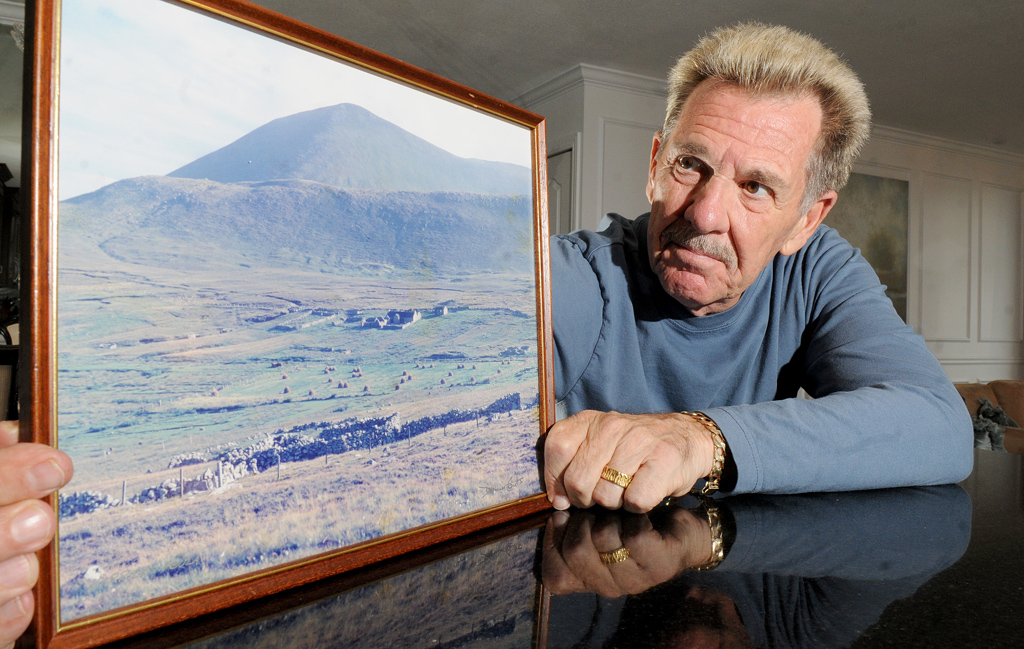
More than 60 years later, after John Knight’s funeral, Joe Knight was bequeathed his father’s framed photo of Foula Island and the barren Hamnafield Hill.
Joe hung it in the den of his New Westminster home where’s he’s lived the past 26 years, unaware of the photo’s significance.
The family had always assumed the fading colour photo was a souvenir of a trip their parents took to Scotland-though they never understood why anyone would travel to such a stark landscape.
He found himself wondering why that cliff of rock and moss meant so much to his dad.
“I’d look at it up on the wall and think about it,” said Joe.
Getting on with life, but never forgetting
John Knight spent most of the next year recovering from his injuries at various hospitals in England and Canada. At one point doctors thought they would have to amputate one of his arms, but a chance visit by the King of England’s doctor got him the care he needed to save the limb.
John and his wife, Vina, had five more children after he returned from the war, adding to the one boy they’d had before the conflict started. Two children died in childhood.
During his post-war career, Knight worked with the Department of Veterans Affairs for 22 years, and another 11 on hydro projects in Northern Manitoba and Newfoundland, helping First Nations’ locals land jobs at the sites. He was an elected councillor.
He never forgot his fallen crewmates.
“I now think Dad felt he had to pay back for the fact he survived and his comrades didn’t,” said Joe of his father’s public service.
In 1989, Knight received a letter from the government records branch of the National Archives of Canada advising him they’d been contacted by a man named John Henry, asking about the plane crash’s sole survivor.
Henry’s wife was Vida Gear, the young girl who’d helped quench a stricken soldier’s thirst all those years ago. He was researching the story of the plane crash; it had been part of Shetland Islands’ lore for decades.
Within a week, Knight penned a long letter to Henry. He recounted his memories of the crash and told of his life since then.
Their correspondence continued through the years, and they exchanged family photos and Christmas cards.
In 1995 John and Vina travelled to Scotland to pay their respects to the fallen aircrew who were all buried at the Commonwealth Cemetery in Lerwick. They also visited John Henry, who gave his Canadian friend the framed colour photo of Foula.
“It will be kept in a place of prominence in our home,” wrote Knight in a thank-you letter.
Meantime, Joe and his brothers had been curious about their parents’ choice of holiday destination but didn’t probe.
“Their visit to Lerwick was a bit of a surprise to our family,” said Joe. “We didn’t think to question Dad on why Lerwick, why now? It should have been a bit of a clue, but we missed the boat.”
The mystery begins to reveal itself
The pieces of the puzzle started to fall into place a few years after John’s death. A friend of Joe’s brother, Bob, discovered a website about the crash that had been created by a nephew of one of its victims. He sent the link to the family.
“Then we really started to think this wasn’t a garden variety crash,” said Joe.
As Joe learned the story of his dad’s survival, about the people who helped him, and about his friends who perished in the crash, he vowed to find a way to honour them.
In September, Knight and his two surviving brothers, along with their wives, travelled to Lerwick to meet the man with whom their father had struck up a long-distance friendship.
Henry, now well into his 80s, had saved most of their correspondence. When Knight read some of the letters, he swelled with emotion.
“He was a young man, full of life, caught up in a big adventure,” said Knight of his dad.
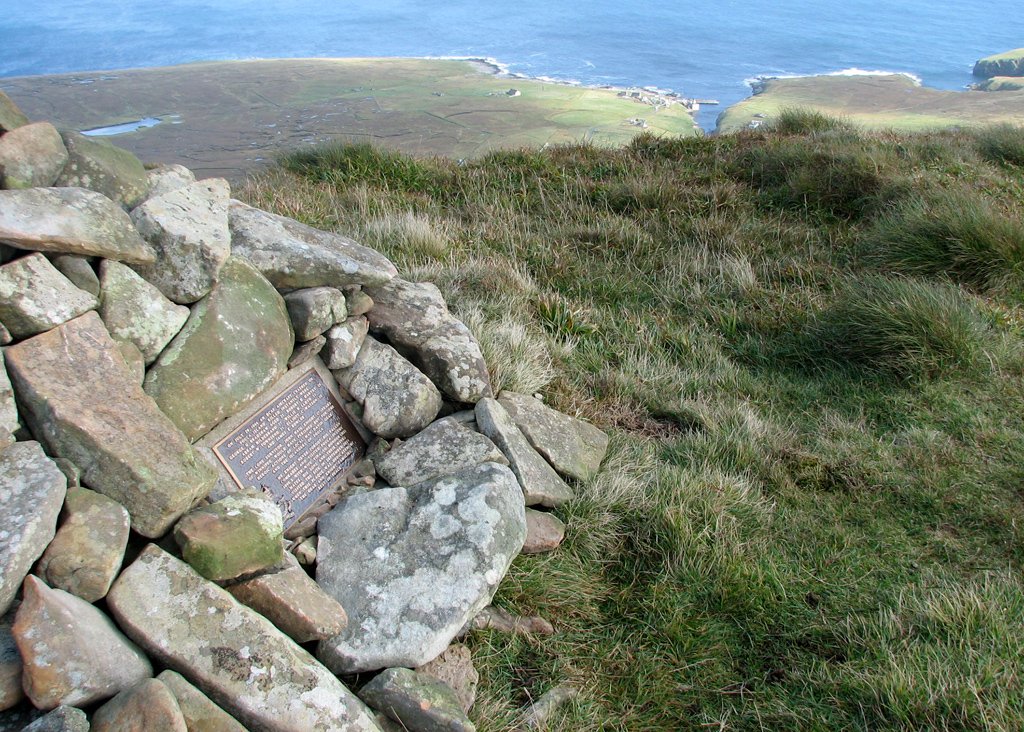
The family had commissioned a brass plaque memorializing the crash and the heroics of Foula citizens to save John’s life.
They hoped to place it on a cairn atop Hamnafield Hill.
But with only one weekly flight to the remote island because its airfield didn’t have a fire warden, and a local boat tour operator shut down for a family emergency, the timing didn’t work out.
Instead, David Gear’s daughter-in-law, Sheila, ascended the trail to the hilltop on a sunny Wednesday at the beginning of October and mounted the plaque on the cairn.
The cairn and plaque placed atop Hamnafield Hill on Foula Island to commemorate the crash of WWII bomber that claimed all but one of its crew.
“It’s a great comfort to our family knowing it’s there,” said Joe.
“Our father and his comrades are together, once again and forever.”
Tuesday’s announcement by the federal government that it has granted conditional approval for the Kinder Morgan company to expand its Trans Mountain pipeline to carry bitumen from Northern Alberta to the Westridge terminal in North Burnaby brought back memories of covering weeks of protests against the project in 2014.
Opponents of the project include First Nations, environmentalists, academics and local politicians.
In late October-November, 2014, these disparate voices gathered at Burnaby Mountain to draw a line in the sand around a drilling project by a survey company to take soil samples in anticipation of the pipeline’s construction through the mountain.
What started as peaceful community rallies soon escalated to an encampment to court injunctions to mass arrests. By the time the protest camp was dismantled by the RCMP, hundreds of protesters, including prominent First Nations’ leaders, had been arrested.
Opponents of the project have vowed to muster their forces anew, with even greater vigour, now that it has been given the go-ahead.
This look back at those weeks of rallies and protest on Burnaby Mountain may be a portent of events to come.
MARIO BARTEL/NEWSLEADER Sinclair Brown keeps a very soggy vigil outside the Kinder Morgan work area on Centennial Way on Monday.
MARIO BARTEL/NEWSLEADER Protestor George Khossil wedges himself under a vehicle on Ridgeview Drive as a member of Kinder Morgan’s survey crew returns equipment to the back seat. The crew was chased from beginning its geotechnical surveying work at one of two bore holes on Burnaby Mountain Wednesday morning by protestors.
MARIO BARTEL/NEWSLEADER A protestor who only wanted to be called Earl leads a sing-a-long at an encampment along Discovery Way on Wednesday. The protestors are hoping to prevent surveying crews from the Kinder Morgan pipeline company from doing their work to determine if an expanded Trans-Mountain pipeline can be drilled through the mountain.
MARIO BARTEL/NEWSLEADER Protesters march up Centennial Way to the injunction zone protecting survey crews from Kinder Morgan drilling soil and rock samples on Burnaby Mountain. The procession from Burnaby Mountain Parkway has become a daily routine since Burnaby RCMP began enforcing a court injunction on Thursday that came into effect last Monday.
MARIO BARTEL/NEWSLEADER A protester is led away by police after crossing into the injunction zone on Centennial Way on Saturday.
MARIO BARTEL/NEWSLEADER Pipeline protesters, including two children, set up a picnic at the edge of the injunction zone on Saturday.
MARIO BARTEL/NEWSLEADER Three days of heavy rain have turned the hillside just outside the injunction zone on Centennial Way into a muddy bog.
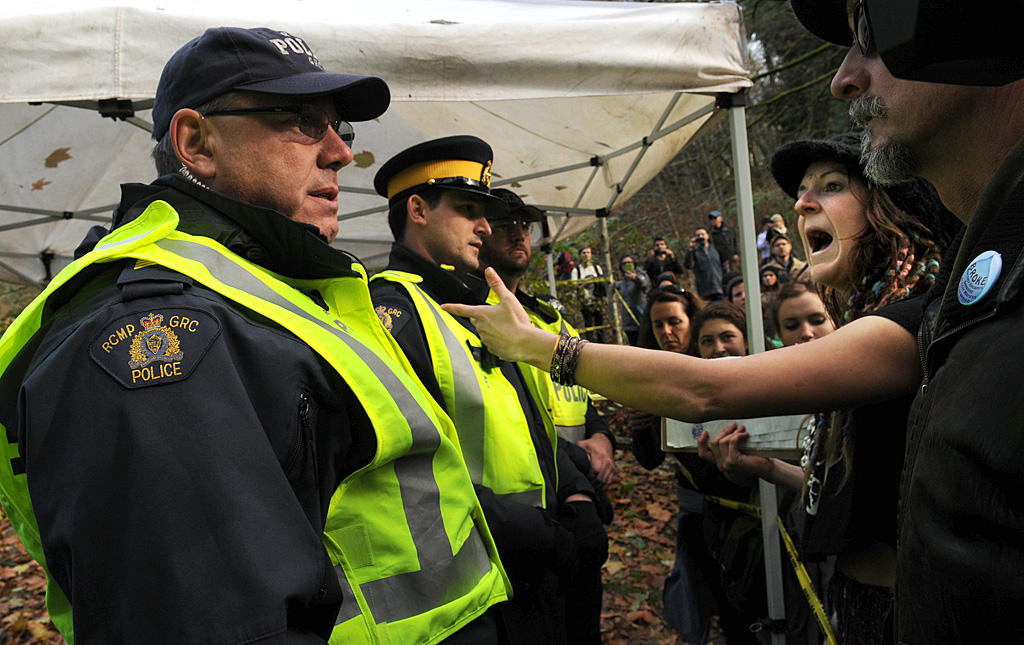
MARIO BARTEL/NEWSLEADER An anti-pipeline protester yells at police at the line signifying the injunction area on Centennial Way on Saturday. Another 16 protesters were arrested after a march to the Kinder Morgan work site, bringing the three-day total to 53 arrests.
MARIO BARTEL/NEWSLEADER Sqamish elder Sut’Lut is escorted into the injunction zone by Burnaby RCMP so she can tend to the sacred fire that has been allowed to burn near the Kinder Morgan worksite on Burnaby Mountain.
MARIO BARTEL/NEWSLEADER Singer Holly Arntzen performs at a rally held Saturday on Burnaby Mountain for protestors of the Kinder Morgan pipeline proposal.
MARIO BARTEL/NEWSLEADER Protestors hike through the woods on the side of Burnaby Mountain to one of Kinder Morgan’s two bore hole sites in hopes of preventing surveying crews from the pipeline company from doing their work.
MARIO BARTEL/BLACK PRESS Grand Chief Stewart Phillip, the president of the B.C. Union of Indian Chiefs, is escorted away by RCMP after he crossed into the injunction area around Kinder Morgan’s remaining active borehole on Burnaby Mountain Thursday morning. He was one of 23 people arrested Thursday to bring the total number of protesters arrested for defying a court injunction protecting the worksites to 125.
MARIO BARTEL/NEWSLEADER Anti-pipeline protesters celebrate their “victory” at a rally Saturday for First Nations and Indigenous supporters of the weeks-long effort to prevent Kinder Morgan from completing its geotechnical survey work on Burnaby Mountain. The company removed its equipment from the mountain on Friday after it lost a request to extend its injunction protecting its worksites to Dec. 12.
MARIO BARTEL/NEWSLEADER A lone protester keeps vigil on the hillside across from the Kinder Morgan worksite on Centennial Way on Monday.
MARIO BARTEL/NEWSLEADER Burnaby RCMP keep a watch over protestors on Burnaby Mountain awaiting the arrival of surveying crews from the Kinder Morgan pipeline company on Wednesday.
MARIO BARTEL/NEWSLEADER A protestor at the anti-pipeline encampment on Burnaby Mountain wraps himself in a blanket to keep out the morning cold on Tuesday. The camp, has been built up for months along Centennial Way to prevent survey crews from Kinder Morgan from completing geotechnical studies to determine if the company can bore its planned pipeline expansion through the mountain. But on Friday a BC Supreme Court judge granted the company an injunction to remove the protestors by 4 p.m. Monday.
The 20 colourfully iced cakes lined up on the island in Sheila Comer’s kitchen told her it was time to start her own business.
But the prospect of taking her cake baking out of her home kitchen and into a storefront was daunting. She already had a job she loved.
But she loved baking and decorating cakes even more.
So she made the leap.
“My customers were getting to the point where they wanted to sit down and have consultations,” says Comer. “They wanted to come and try what I had to offer.”
Comer signed a three-year lease in a new commercial space at the base of a condo tower on Sixth Street.
But even as the ink of her signature was drying, she says she had no idea what she was getting herself into.
There are more than 3,800 open business licenses in New Westminster; 3,344 can be considered small businesses with fewer than 50 employees, and 2812 of those have less than five employees.
“Having a diversity of businesses is important for the economic health of the city,” says Blair Fryer, New Westminster’s communications and economic development manager.
Providing the resources and knowledge to ensure those businesses survive and thrive is in the community’s best interest, says Fryer. “Residents continue to show strong support for small, local businesses and are proud of the unique character and offerings they bring to New Westminster.”
The road to success often starts with the city’s licensing coordinator, who can work with business owners to ensure their plan and proposed location conforms to zoning regulations. The licensing coordinator can also work with various city departments to help move a business application through the licensing process.
Another valuable resource is the Self-Employment Program at Douglas College.
Since the program was launched 20 years ago at the college’s New Westminster campus, and then added at its Coquitlam location, it has helped 4,000 individuals gain the skills they need to develop a sound business plan and implement marketing strategies.
“The program forces you to think about things you may not have thought of,” says Travis Moss, an instructor in the program and an experienced business consultant. “It forces you to think before you buy inventory or even register your company name.”
Comer already had a name for her bakery, Pink Ribbon, in honour of her grandmother’s battle with breast cancer and her own commitment to pledge a portion of her sales to breast cancer research.
But that’s about as far as her business acumen went.
“I just decided to go ahead and do it,” says Comer.
She did research on YouTube. Conversations with Fraser Health enlightened her about the health and safety requirements for her bakery, like the need to install three sinks. She had meetings with people from the city’s licensing and planning office to learn about city regulations and bylaws.
“I didn’t even know I needed a business license,” says Comer. “Everybody that I dealt with was extremely helpful, willing to give me any info they could.”
The City of New Westminster’s newly redesigned website offers a wealth of resources for prospective business owners including demographic and employment statistics, economic indicators and snapshots as well as links to the licenses required by various types of businesses, online application and renewal forms and even information about bylaws governing signage.
Fryer says his department is also available to help by improving processes, finding solutions and making connections with potential resources and partners.
Moss says launching a successful business starts with researching and writing a good business plan.
“(It) gets you to think about potential pitfalls, have a road map to follow.”
In their excitement and enthusiasm to launch their own business, Moss says many entrepreneurs neglect important considerations like time management and hidden costs like printing business cards, developing a marketing plan that will generate a steady flow of revenue, hiring staff.
“You can spend a lot of time on the operational end but neglect key things to get your business out there, make sure you’re developing a client base,” says Moss.
For the first few months on her own, Comer was a one-woman band; she baked and decorated all the cakes, closed up the storefront to do deliveries, even slept on a mattress in the back.
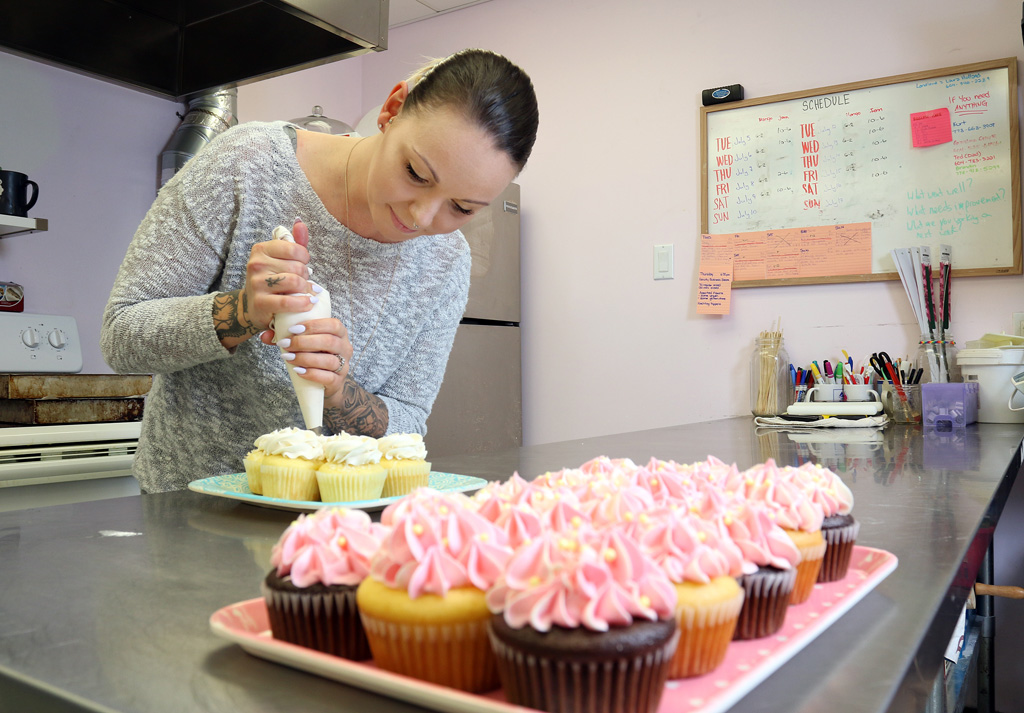
PHOTO BY MARIO BARTEL Sheila Comer decorates cupcakes in the kitchen of her Pink Ribbon Bakery. Her creations have found their way to celebrities like Matt Damon as well as a number of musical acts as they pass through Metro Vancouver.
“Everything was pretty in the moment,” says Comer. “Everything was just about baking cakes.”
In addition to giving entrepreneurs the tools they need so they won’t be overwhelmed by the challenge they’ve taken on, the 48-week program at Douglas College also connects independent business people to coaches and mentors. They check in regularly as projects are actually launched.
“We give them the tools, but it is the confidence and commitment to execute on it that leads to success,” says Moss.
And having successful small businesses in the city breeds even more economic success, says Fryer.
“A variety of retail and commercial services allows residents to meet their day-to-day needs,” he says. “(It’s) also important for employers who consider the provision and type of services for their employees when they consider locating their businesses.”
Comer says a major turning point on her path to entrepreneurial success came when she started hiring staff.
“My biggest fear was letting go of some control,” she says. “I was worried about bringing someone into my world that I had so independently grown. But I know you can’t have a successful business without a successful team.”
Comer now has three employees working for her. That’s freed her up to spend more time with her young daughter.
And think about new ways to grow her business beyond New West.
About 400 cyclists converged on Stanley Park Saturday to remember a fellow roadie who had been mowed down head on by a car two weeks ago along a popular riding route. Five of his companions, including the one of the left in black, were injured.
Two weeks ago, on my way home from road hockey, the radio traffic update reported River Road in Richmond was closed for a “police investigation.”
My blood ran cold, my heart sank.
River Road is a popular cycling route along the Fraser River, especially on weekends. It’s flat, there are few feeder streets, not many residents and no traffic lights or stop signs. It’s a major west-east conduit for group rides. It’s essentially a rural road on the edge of the big city.
That Sunday morning was dry and mild; after nearly a solid month of rainy days, groups and individual cyclists were sure to be out in force.
So when the traffic report said the road was closed, my immediate thought was “cyclist down.”
When I got home, I started checking on the Strava feeds of various FRFers. I knew they were out that day and likely would have traversed River Road at some point; they were all checked in safely.
A quick browse of local news sites reported the worst news possible; a car had plowed into a group of six cyclists. Two were badly hurt. One had been killed.
The rural character of River Road that attracts so many cyclists also makes it dangerous. The pavement is narrow with virtually no shoulder. One side is flanked by a water-filled ditch, the opposite by the Fraser River. Cars and trucks trying to avoid more congested routes often travel too fast.
As scant details about the tragedy trickled out on the internet through the afternoon and then on the evening TV news, its true horror gripped the cycling community; the riders had been hit head on, mowed down like bowling pins when an oncoming car drifted out of its lane for whatever reason.
That could have been any one of us.
The rain stopped but the roads were still wet when the FRF contingent departed for Saturday’s memorial ride in honour of a fallen cyclist
Whenever we throw one leg over the top tube and clip into our pedals, we know there’s a chance we may not make it home. Most of us try to do whatever we can to mitigate that risk: we follow the rules of the road; we stick to designated bike routes.
But it just takes a moment of inattention or carelessness by a motorist or cyclist to tip that delicate balance of risk vs. reward against us.
The full story of what happened that Sunday morning have yet to be revealed; police are “still investigating.” But their official statement quoted in the media that day was quick to point out the motorist “remained at the scene and is cooperating” (Yay for him!), and the “cyclists were all wearing helmets (like that will make a difference when you’re smashed by 2,000 pounds of speeding metal). The police spokesman quoted at the scene also felt it necessary to remind cyclists to “ride in single file.”
It almost felt like he was blaming the victims, somehow implying they may not have been riding safely.
These kind of throwaway statements appear all too frequently in media reports of car vs. cyclist collisions. The police may think of them as necessary rejoinders that reassure the public the roads aren’t filled with crazed hit-and-run maniacs, but they just serve to reinforce the narrative that the roads are built for cars, and cyclists are just guests who should feel privileged to be allowed to share their space. It’s as if the onus is on us not to get hit.
That sentiment was further inflamed when a Richmond city councilor was quoted that one consideration to make River Road safer for cyclists would be to ban cyclists from using that road altogether. He happens to also own a trucking company.
On Saturday, about 400 cyclists gathered in Stanley Park to remember the fallen 33-year-old rider and his injured companions with a mass loop through the park; it’s one of their favourite routes. I didn’t know him. Likely many in the throng didn’t either. But we are all him.
Cyclists from around Metro Vancouver rode around Stanley Park on Saturday to remember one of their own who had been killed by a car two weeks ago.
Cyclists from around Metro Vancouver gather in Stanley Park to remember a fallen roadie before heading out on a slow loop through the park.
The weather was supposed to be rainy, cold and windy. By the time our group of FRFers gathered to ride into the Stan, the rain had stopped. Along the way, the sun started to fight its way through the clouds. It was, it turned out, a good day to ride. It was a good day to be alive. RIP Brad Dean.
Cyclists do everything we can to ensure every ride can end as we ended Saturday’s memorial, enjoying a beer and good company at our favourite craft brewery.
The following story first appeared in Invest New West, an economic development magazine produced for the City of New Westminster.
MARIO BARTEL/NEWSLEADER Some vintage bicycle manufacturers like Hetchins, distinguished themselves from their competitors by designing unique components such as curved chainstays.
MARIO BARTEL/NEWSLEADER Much of bike technology is timeless, like this vintage front suspension system that predates pneumatic suspension forks that are popular on contemporary mountain bikes.
MARIO BARTEL/NEWSLEADER Sinuous curves have been a part of bicycle design long before carbon fibre.
The bikes on the floor at Gord Hobbis’ Sapperton shop are made of the latest high-tech materials like carbon fibre and hydroformed aluminum.
But to sell those bikes Hobbis relies on the values and acumen developed by his father, Cap, who first opened his neighbourhood bike shop in 1932.
Having one foot planted firmly in the past while stepping boldly into the future is one aspect of New Westminster’s business community that sets it apart from its neighbours.
The business of heritage is good business, says Eric Pattison, a local architect who’s helped restore a number of the city’s historic commercial buildings and homes.
“You want a place that’s been there for a while, survived the ups and down. Seeing buildings from every decade into the past reinforces that sense of place,” says Pattison.
New Westminster is British Columbia’s oldest city, founded in 1858. For eight years it was even the provincial capital. Until the first decade of the 20th century, it was also the province’s largest city.
“We’ve always been an important city, right from the start,” says Julie Schueck, New Westminster’s heritage planner. “We didn’t grow up as an add-on to another city. We are a city, we have a downtown. Our past is important to us.”
That historic commercial core distinguishes the city, says Pattison.
“Residential heritage is all well and good, and creates a lifestyle. But it’s more of a challenge to have your community branded as heritage without a historic downtown.”
A historic downtown is made up of more than just old buildings, says Pattison. It’s character is also determined by the width of streets, the lanes and alleys that connect those streets, the pocket squares that allow people to gather and create a neighbourhood vibe.
The walkable nature of historic commercial districts and the varied services that reside there is becoming increasingly attractive to enterprising businesses that are turning their backs on generic suburban industrial parks. They’re seeking to offer employees more than just a cubicle experience.
“Our strongest takeaway from our work in historic districts is the strength of the area will come from the passion and commitment of the business owners we work with,” says Robert Fung, president of The Salient Group that recently completed redevelopment of the historic Trapp + Holbrook blocks on Columbia Street into modern condos with commercial spaces at street level.
Still, preserving heritage takes constant care and attention.
“You have to overcome the impression that the infrastructure is dated as well,” says Schueck. “Old buildings can be rehabilitated and have all the new services and modern technology put into them.”
“It’s an education,” says Pattison. “You have to be willing to take risks, and some of those risks might involve saving the building and repurposing it.”
“You have to get people to see that heritage is not a hindrance,” says Schueck.
That was the case with the Trapp + Holbrook project, says Fung.
After languishing as an empty shell for years as various redevelopment proposals by a series of owners came and went, Salient Group painstakingly preserved the block’s historic facade while constructing a sleek, modern condo tower behind it. It’s a model the company successfully implemented in Vancouver’s historic Gastown district that sparked its resurgence from a tacky tourist backwater to a lively urban neighbourhood of stylish boutiques, trendy restaurants and bistros and upscale condos.
Fung says a similar revitalization is underway in New West.
“We believe that Trapp + Holbrook is a model for the evolution of Downtown New Westminster.”
Pattison says as more owners realize the potential of preserving heritage, it gains momentum.
“You can’t take heritage for granted. You have to work as hard or harder than other communities that don’t have the heritage resources we have.”
The payoff goes far beyond just having a nice collection of old commercial buildings, says Hobbis.
“A key part to a business being successful is consistency. Having that keeps you on pace, you don’t chase the trends.”
Schueck says the city’s current initiatives to reclaim its historic waterfront which include the construction of Pier Park, the partial demolition of the Front Street parkade, a relic from the car-centric 1950s, and the reconfiguring of the newly opened streetscape into a pedestrian-friendly mews will further enhance New Westminster as a commercial centre with more to offer than just glass and steel.
“Our access to the river is one of the reasons the city was put here in the first place,” says Schueck. “There’s a real interest in getting back to that connection.”
Giving businesses, their employees and their customers an opportunity to connect with their roots can forge a strong bond.
“In this age of relentless digital communication, it’s almost too scattered a lifestyle for many people, so they’re grasping for authenticity,” says Pattison. “Everything has to resonate with legitimacy and character, and heritage has that in spades.”
Hobbis couldn’t agree more. Above the lithe carbon fibre road bikes and huge shock-absorbing downhill mountain bikes on the sales floor of his bike shop hangs his father’s collection of more than three dozen vintage bikes from as far back as 1869.
“If we expose our heritage to people, show them where we’ve come from, what we’re doing, it becomes a real strength,” says Hobbis. “It gives us a deep well of knowledge to feed new ideas.”









 MARIO BARTEL