One of the (rare) perks of being a journalist is being able to share some stories that are so cool, you’re walking on Cloud 9 when you leave the assignment.
One of my newsroom colleagues heard about a retired Italian engineer, who also ran a Ferrari and Lambourghini car dealership for several years, with a passion for painting reproductions of masterworks by the likes of Da Vinci, Rembrandt, Michelangelo, Gaugin, Renoir. We made arrangements to meet, but nothing could prepare us for the splendour in Cosimo Gericatano’s house.
Every wall, and even some of the ceilings, were hung with precise duplications of renowned paintings that adorn the best museums in the world. Mona Lisa, The Girl with the Pearl Earring, The Creation of Adam, Allegory of the Planets and Continents were all there, every brushstroke and subtle hue recreated over hundreds of hours of exacting work.
Hanging with Cosimo was like spending a couple of hours with the Italian gentleman we all aspire to be, from his crisp cotton shirt and pressed trousers, as well as his trimmed grey hair to his encyclopedic knowledge of the paintings and artists he’s reproduced, gleaned from hours of research on the internet and visits to the museums where the originals are displayed. Not to mention the red Testarossa parked in his pristine garage.
Here’s the link to our story. And here’s the photos I shot.
MARIO BARTEL/THE TRI-CITY NEWS Cosimo Geracitano uses posters or high resolution images as his guide to recreating paintings by the master.
MARIO BARTEL/THE TRI-CITY NEWS The living room of Cosimo Geracitano’s Coquitlam home is decorated with paintings by some of the world’s greatest masters. But they’re all reproductions the retired engineer painted himself.
MARIO BARTEL/THE TRI-CITY NEWS A detail from Cosimo Geracitano’s reproduction of The Gotthard Post, by Rudolf Koller.
MARIO BARTEL/THE TRI-CITY NEWS Paul Vermeer’s The Milkmaid, as painted by Coquitlam artist Cosimo Geracitano.
MARIO BARTEL/THE TRI-CITY NEWS Cosimo Geracitano paints the name of each master painter he’s recreated on the leaves of an artificial tree in the basement of his Coquitlam home.
MARIO BARTEL/THE TRI-CITY NEWS Geracitano not only paints reproductions of master works on canvas, he also sculpts in marble and jade in a converted garage in his Coquitlam home.
MARIO BARTEL/THE TRI-CITY NEWS Retired engineer Cosimo Geracitano has surrounded himself with paintings in his Coquitlam home by some of the world’s great masters, including Da Vinci, Renoir, Van Gogh and John Constable. But he’s not fabulously wealthy. He’s meticulously painted the reproductions himself.
MARIO BARTEL/THE TRI-CITY NEWS A detail from Seaport with the Embarkation of Saint Ursula, painted in 1641 by Glaude Gallée and reproduced by retired engineer Cosimo Geracitano in his Coquitlam home.
MARIO BARTEL/THE TRI-CITY NEWS A detail of Allegory of the Planets and Continents that was painted by Giovanni Battista Tiepolo in 1752 and is being meticulously reproduced by retired Coquitlam engineer Cosimo Geracitano so he can hang it on the ceiling of his dining room. He says it will be his last painting as he’s run out of room in his house.
MARIO BARTEL/THE TRI-CITY NEWS Gericatano is in the final stages of completing his last painting, a fresco he will hand on the ceiling in the dining room of his Coquitlam home. He says he’s run out of space for new works.
MARIO BARTEL/THE TRI-CITY NEWS Gericatano spends hundreds of hours recreating master paintings from high-res images he finds on the internet and high quality posters he keeps filed in a storage room in the basement of his Coquitlam home.
MARIO BARTEL/THE TRI-CITY NEWS When Cosimo Geracitano wakes up every mornng in his Coquitlam home, the first thing he sees is his reproduction of Auguste Renoir’s The Large Bathers.
MARIO BARTEL/THE TRI-CITY NEWS Geracitano paints the name of all the master painters whose works he’s reproduced on the leaves of an artificial tree in his Coquitlam home. He still has a lot of leaves to fill.
While the major rainstorm that was forecast held off, dozens of riders still got down and dirty at Saturday’s annual Donkey Cross cyclocross race in Port Coquitlam’s Castle Park.
The race was the first of seven that comprise the Lower Mainland Cyclocross series.
Cyclocross is like steeplechase racing on two wheels. Riders navigate a winding, undulating course for several laps that includes obstacles, a metres-long “beach” of soft sand, and even a stretch of snow from a local arena dumped into a corner. The sport originated as a form of off-season training for road cyclists in Northern Europe who would often challenge each other to get to the coffee shop in the next village the quickest. Often, that meant traversing farmers’ fields and hopping fences and hedges, elements that are still honoured in modern cyclocross racing.
A version of this article appeared in The Tri-City News in 2019.
It’s one thing to build a multi-use path, quite another to get walkers and cyclists to use it.
Port Moody accomplished the former with its $4.627-million upgrade of Gatensbury Avenue to make the steep, winding connector between it and the city and Coquitlam safer for motorists and add a $285,000 multi-use path (MUP) along its western flank for pedestrians and people on bikes.
The project was identified as an early priority in Port Moody’s master transportation plan, which was endorsed by council in March 2017. That plan will see the city invest more than $31 million over the next 20 years to make it easier to get around the city, and encourage more sustainable modes of transportation, like walking and cycling.
Ascending Gatensbury, though, remains a test of fortitude, leg strength and lung capacity.
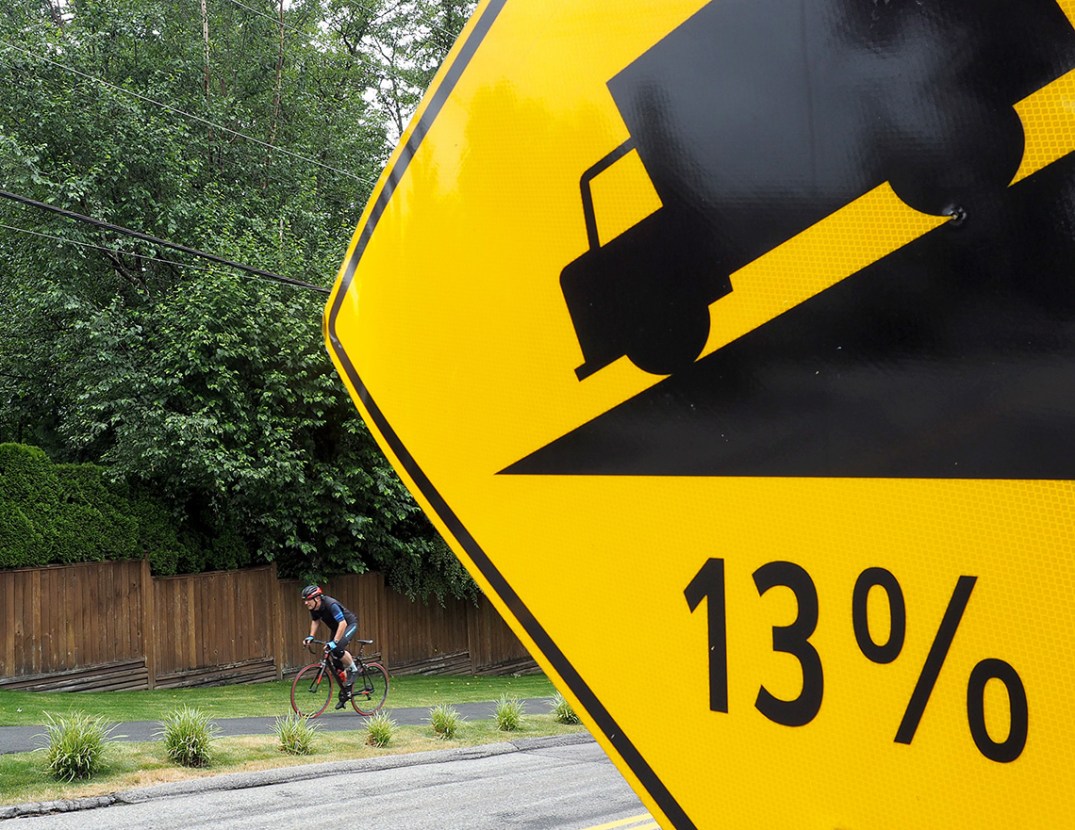
Already the climb to the top has been dubbed the “Gatensbury Gasp” on social media by some pedestrians who have ascended its 12% average pitch over 1.1 kilometres since it reopened to traffic at the end of May.
But what does that mean for cyclists?
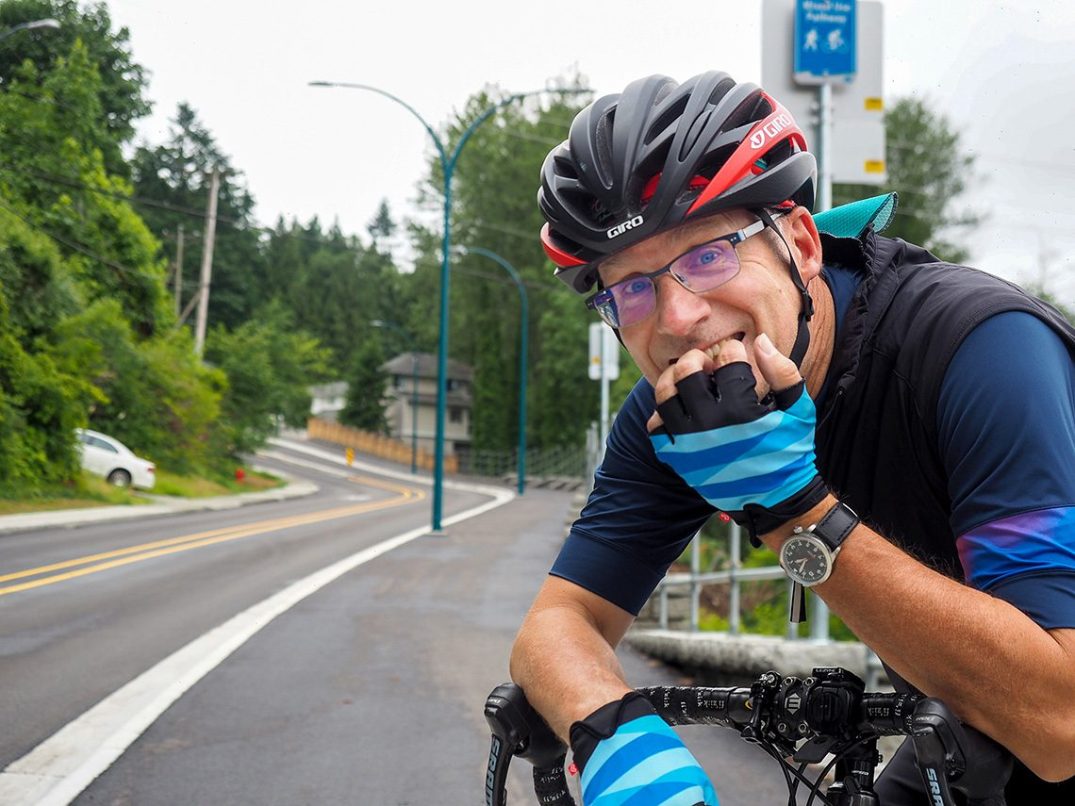
Always up for a good bike story, I set out to find out.
I’m not a climber. Descending is more my jam.
I ride up hills and mountains because I have to get to the top so I can turn around and speed back down.
For the most part, cyclists have avoided Gatensbury for years because of its narrow lanes that lacked a shoulder and its pocked pavement that made it unsafe at worst, uncomfortable at best.
Oh yeah, there’s also its perilous steepness, which ranges from 11.1% at the bottom to 18.3% in its final rise.
The climb averages 12% over its 1.1 km total length, but there are sections that exceed 18%.
By comparison, Mont Ventoux, one of the iconic climbs of the Tour de France, peaks at 12% and the Muur van Geraardsbergen in Belgium, that has been a decisive climb in big-time professional bike races like the Tour of Flanders, rises an average of 9.3% over its 1,075 metres over bumpy, tire-eating cobbles that can rattle the fillings from your teeth.
The pavement on Gatensbury’s new MUP is smooth tarmac, not yet heaved by straying tree roots or ravaged by winter freezes and thaws.
The path is also wide — maybe not wide enough to allow teetering cyclists to weave their own switchbacks to stay upright, but certainly wide enough for pedestrians and riders going uphill to pass each other easily.
According to Strava, an online app that allows cyclists and runners to upload data from their GPS devices, 43 cyclists have completed the segment called “Todds Gatensbury climb,” which is .94 km from the base of the hill at Henry and Grant streets to Bartlett Avenue at the top, this year. The fastest was Matthew Cox, a Port Moody cyclist who made it to the top in four minutes, four seconds. That’s an average speed of 13.9 km/h and well off the all-time record of 17.7 km/h by Brett Wakefield back in 2015, when the road was in much worse shape and there was no MUP. Some notable athletes have also tackled Gatensbury, including Canadian Olympic triathlete Simon Whitfield — he did it in 3:49 in 2013.
At the start of the MUP, after a warmup pedal from The Tri-City News’ office in Port Coquitlam, I could only dream of such blinding uphill speed. In fact, I just wanted to survive without my knees, or heart, exploding.
The climbing starts at a modest 3.9% at Henry and Moody streets but by the time it hits its first switchback, it touches 17%. It’s about then I realize I’m still in second gear. I veer into a driveway to change gears because doing so under high torque in a difficult climb can blow apart a derailleur.
The second switchback is consistently around 15% but goes as steep as 18.2%.
But the nastiness is just getting started.
Looking ahead, the road straightens, the gradient moderates slightly and the end seems in sight. The bike computer says I’m doing 6.6 km/h but, gasping for breath and rocking side-to-side, it feels like I’m standing still.
Then, the road veers left to reveal its cruelest twist: more climbing, some of it is as steep as 17.3%.
I reach Bartlett Avenue 7:09 after I started the climb, the 25th-fastest — or 18th slowest — ascent of the segment recorded on Strava so far this year.
As I turn to cross the road and collect my reward — a speedy descent on Gatensbury’s smooth, new pavement — a cyclist on an electric-assist bike with fat, cushy tires, cruises nonchalantly by on the uphill side. He’s smiling, with barely a bead of sweat on his brow.
We all have mentors. They’re the people who show us the way, whether they know it or not. Mine was Ron Kuzyk. He was a steelworker and a hell of a photojournalist who worked the weekend shift we came to share for a stretch at the Burlington Post, where I started my career. Ron passed away this week.
In 1984, I was just out of journalism school and determined to use a camera as my storytelling tool of choice. Circumstances that summer connected me to George Tansley, then the chief photographer at the Post. He said he could offer me some shifts to relieve his weekend guy who spent his weekdays working at Stelco and sometimes needed a break from the grind.
That guy was Ron.
We probably first met in the studio/darkroom one of those weekends; he was likely passing through to collect something, and I was probably trying to figure out how I too could get some of the great shots that were printed and hung on the walls of the studio and down the hall outside it. I particularly remember a colour wintry silhouette of a kid balancing on a fence, arms and leg splayed out; I loved that photo.
My friend, and mentor, Ron Kuzyk, was the king of the silhouette. He loved shooting them, even as editors told him they needed to see faces in the newspaper. Of course, when Ron came back from an assignment with one of his beautiful silhouettes, it inevitably ran in the paper, usually on the front page.
Of course it, and many of the others, was shot by Ron.
Especially the sports.
I knew I wanted to be able to shoot sports like Ron.
He could capture peak action like nobody’s business, but he also had a keen eye for those quiet moments, like the kid stealing a glance back at his coach, the consoling hand on a player’s shoulder, the goofiness of 5 year-old t-ballers.
And, amazingly, he didn’t need big time pro athletes or glorious bright arena lighting to get his great sports photos. He made them in dark high school gyms, dusty sandlot baseball diamonds and pocked minor soccer pitches.
Over the course of that summer, as Ron and I crossed paths, we became buddies. He encouraged me, talked me through the frustrations of learning how to shoot with the Hasselblad because the big colour transparencies made for better front page colour reproduction. But mostly he showed me the way with his eye and his instincts.
Whenever I had the chance, I studied his contact sheets, checked out his prints, paid attention to his byline (although, by the second week I was already pretty good at spotting a Ron shot in the paper), and when my shooting shifts came, I distilled what I learned to get in the right position for a good baseball shot, look all around at a spot news scene to find that storytelling moment, seek out a fun juxtaposition at a community event.
When I happened to be in the darkroom and he popped by for a studio shot, I studied how he set up the lights and, more importantly, how he made his subjects feel at ease, joked with them, broke through their guard to find something that captured the story they were there to tell.
Ron was the most natural, instinctual photojournalist I ever met. More importantly, he was also the most fun. Because as much as we liked to bitch about shooting pet of the week or real estate features, as much as the repetitiveness of shooting the same cycle of community events year after year wore down your creativity, he really got a kick out of his job, and that joy came through in every one of his frames (well maybe not the photos of used cars for dealer ads).
The next summer, all the lessons I’d absorbed from Ron paid off when I landed a full-time gig at Oshawa This Week.
On the weekends I wasn’t working, I often came back to Burlington to visit my family and hang with Ron. Usually over beers, we kibitzed and kvetched as professional colleagues. We also complained, because that’s what journalists do when we get together (oh, if only we knew then what was coming for our industry, for our profession…)
But when Ron finally made the decision to cut his ties — and the big paycheque — to Stelco, he was over the moon with delight, thrilled to be working full-time at his passion even if it meant keeping his heap blue car that smelled like an ashtray on the road a little longer.
There were often adventures on those weekends, usually involving Post sports reporters Kevin Nagel, Dave Rashford and Tim Whitnell as well; road hockey in the back parking lot on New Street, some ice hockey games, the annual Metroland slo-pitch tournament, a concert or two.
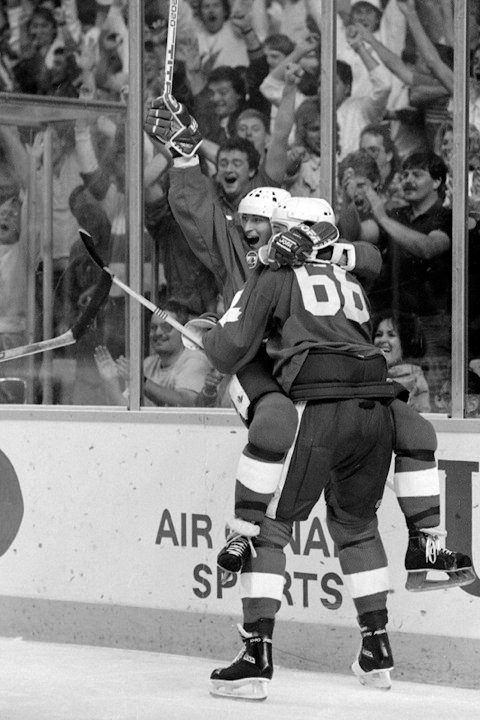
When a group of us bought a tournament package for the 1987 Canada Cup series, Ron somehow managed to get photo accreditation for the climactic final so when Mario Lemieux and Wayne Gretzky and the rest of that amazing Canadian team were celebrating their victory on the ice at Copp’s Coliseum, we were peering through our binoculars from the upper deck at Ron sliding around working the scrums. Oh yeah, he scored an amazing photo of the two superstars celebrating, jumping into each other’s arms behind the net in his corner. Like I said, Ron had great instincts for timing.
Ron Kuzyk and a great love, and eye, for shooting sports. He also had that innate instinct for being in the right place at the right time with the right lens. Oh yeah, and also for securing accreditation for big-time events even though he worked for a community paper.
When I headed west in 1991, our contact became more sporadic.
He came out once, riding shotgun in his brother’s big rig. I drove him around, showing him my new turf, including a bar or two that may or may not have had a brass pole. I think the motel in Port Coquitlam where he stayed burned down shortly after his visit.
Again with the timing.
When I was home for a visit, we’d go for beers or lunch and shoot the shit about old times, compare notes about our current situations.
But I’ve always felt Ron’s guiding hand, tried to follow his eye, even as I forged my own path as a community photojournalist.
I know the changes to our industry weren’t easy for Ron. He was old-school, driven to get the shot and to hell with all the bullshit of the business.
After he left the Post, we caught up a few times on my visits back to Ontario. I think one of those times I managed to tell him how much impact he’d had on my own career, how those early exchanges in the Post studio set me on my path.
We also tried connecting on social media, but Ron was never one for the Facebook, unless he was trading/peddling his vinyl records. I think he Tweetered about 12 times.
But even as our contact waned, Ron was often in my thoughts. He’s the reason I park myself about three metres back of first base at a baseball game so I can reach second base for a steal or double play, but also can grab a close play at first. He’s the reason I sit instead of stand at the touchline of a soccer match because that means a cleaner background. He’s the reason I keep my eye on the bench near the end of a big game as much as on the playing arena. He’s the reason I’m still trying to emulate that great wintry silhouette of a kid balancing on a fence.
While their friends have been soaking up the sunshine and catching their breath for the final push to the end of the school year, a dozen students from SD43 high schools spent the first half of their spring break learning the challenges of being a firefighter.
The pulled heavy hoses and rolled them up. They compressed the chest of a dummy while practising CPR. They cut open a car with high-power tools. They dangled from the end of ropes, rappelling from the four-storey training tower at the main Coquitlam fire hall.
The students were participating in Coquitlam Fire and Rescue’s first Junior Firefighting program that wrapped up Friday with a showcase for parents and family members of the skills they learned through the eight days prior.
And those weren’t inconsiderable, said deputy fire chief Rod Gill, who helped organize the program.
“They’re packing about eight weeks of the recruit program into eight straight days,” he said, adding the participants weren’t given a weekend break so they wouldn’t forget some of the things they were taught.
Gill said the program is a bit of a sampler of everything a firefighter might be expected to do, from routine tasks to adrenalin-pumping high-angle rescues.
“It’s about giving the students a chance to see what it’s like to be a firefighter.”
Gill said the students invited to participate had to first pass a rigorous application process that included letters of reference, a transcript of their school marks and volunteer activities, as well as an interview.
“We want to see they’re motivated,” he said.
And while one of the goals of the program is to help attract a more diverse population to a firefighting career, Gill said only time will tell if this inaugural cohort that included several young women, will follow through.
“It’s kind of a jumping-off point,” he said. “This is a perfect opportunity to see if this is something they want to do.”
MARIO BARTEL/THE TRI-CITY NEWS The junior firefighters get introduced to the harnesses and equipment they’ll wear during high angle rescue training.
MARIO BARTEL/THE TRI-CITY NEWS The squad walks to the training tower where they’ll spend the afternoon learning how to tie special knots and set up safety and main lines so they can rappel back down to the ground.
MARIO BARTEL/THE TRI-CITY NEWS Callum Borden, a 17-year-old student at Dr. Charles Best secondary school, gets help fitting his harness from instructor Scott Norrington.
MARIO BARTEL/THE TRI-CITY NEWS Abbie Robinson, a student at Riverside secondary, struggles to get her helmet fitted just right.
MARIO BARTEL/THE TRI-CITY NEWS Atop the tower, the students pay close attention to the details of tying knots that will secure safety lines for their descent.
MARIO BARTEL/THE TRI-CITY NEWS The Junior Firefighters pay close attention because when descending from the four storey training tower, their lives depend on it.
MARIO BARTEL/THE TRI-CITY NEWS A properly tied knot can be the difference between life and death when rapelling from a perch during a high-angle rescue.
MARIO BARTEL/THE TRI-CITY NEWS For the high school students enrolled in the Junior Firefighters camp put on by the Coquitlam Fire and Rescue, that first step off the training tower is a doozy.
MARIO BARTEL/THE TRI-CITY NEWS The safety crew works the ropes.
MARIO BARTEL/THE TRI-CITY NEWS Zach Hamed, a 17-year-old student at Heritage Woods secondary school, begins his descent from the training tower.
MARIO BARTEL/THE TRI-CITY NEWS Brendan McLaughlin, 17, keeps a close eye on the caribeners that keep him secured to the safety line as he begins his descent from the training tower.
MARIO BARTEL/THE TRI-CITY NEWS One of the junior firefighters prepares to rappel from the training tower.
MARIO BARTEL/THE TRI-CITY NEWS Elliot Heath and Callum Borden, both students at Dr. Charles Best secondary school, celebrate their successful descent from the training tower.
MARIO BARTEL/THE TRI-CITY NEWS Callum Borden gets debriefed after he reaches the ground.
The local junior hockey team recently scheduled an afternoon game on a weekday to accommodate a promotion to attract school kids and seniors to the arena.
I could have gone and just shot a period of action and been done with it. But this presented a rare opportunity to do a little more storytelling. So I arranged for all-access about an hour before game time so I could tell the story of what goes on in that hour leading up to the opening face-off.
MARIO BARTEL/THE TRI-CITY NEWS Coquitlam Express forward Dallas Farrell gets his stick ready for Wednesday’s game against the Langley Rivermen.
MARIO BARTEL/THE TRI-CITY NEWS Couqitlam Express trainer Russ Maceluch carefully stacks pucks the team’s players will use during their pre-game warmup.
MARIO BARTEL/THE TRI-CITY NEWS Express starting goalie for the game, Kolby Matthews, takes a quiet moment prior to the team skating onto the ice.
MARIO BARTEL/THE TRI-CITY NEWS Coquitlam Express forward Danny Pearson and Langley Rivermen defenceman Alec Capstick collide as they battle for a loose puck in the first period of their BC Hockey League game, Wednesday at the Poirier Sports and Leisure Complex.
MARIO BARTEL/THE TRI-CITY NEWS Langley Rivermen forward Tanner Versluis gets checked into the Coquitlam Express bench by Chase Danol in the first period of their BC Hockey League game, Wednesday at the Poirier Sports and Leisure Complex.
MARIO BARTEL/THE TRI-CITY NEWS Coquitlam Express trainer Ross Maceluch lays out uniforms and equipment for the players before their arrival for Wednesday’s midday game against the Langley Rivermen.
MARIO BARTEL/THE TRI-CITY NEWS The visiting Langley Rivermen are a blur of motion as they warm up at the Poirier Sports and Leisure Complex prior to their midday game against the Coquitlam Express on Wednesday.
MARIO BARTEL/THE TRI-CITY NEWS Longtime Express broadcaster Eddie Gregory does some last-minute preparation in his booth at center ice. He’s been with the team since it’s first season.
MARIO BARTEL/THE TRI-CITY NEWS Hockey gloves dry in a rack.
MARIO BARTEL/THE TRI-CITY NEWS Express head coach Jason Fortier heads out of his office to address the team prior to the start of their game on Wednesday against the Langley Rivermen.
MARIO BARTEL/THE TRI-CITY NEWS Express forward Christian Sanda takes a quiet moment in the stands prior to the team’s midday game against the Langley Rivermen on Wednesday. He said he uses the time to visualize the game ahead before he gets dressed to play.
MARIO BARTEL/THE TRI-CITY NEWS Volunteer ticket seller Yvonne Kiraly counts tickets prior to the doors opening for Wednesday’s midday game against the Langley Rivermen. She said she’s been helping out since last year.
MARIO BARTEL/THE TRI-CITY NEWS Team chiropractor Harrison Wagner and trainer Russ Maceluch deliver the players’ sticks to the bench.
MARIO BARTEL/THE TRI-CITY NEWS Coquitlam Express forward Chase Danol waits as the team’s trainer, Ross Maceluch, lays out some snacks prior to the team’s midday game against the Langley Rivermen on Wednesday.
MARIO BARTEL/THE TRI-CITY NEWS Even with a midday start, some fans showed up an hour early for Wednesday’s game between the Coquitlam Express and Langley Rivermen.
MARIO BARTEL/THE TRI-CITY NEWS Concession attendant Sonya Folster begins loading up bags of popcorn in anticipation of a crowd of young people as students from several schools are expected to attend Wednesday’s midday game.
The local high school football season ended Saturday.
What was supposed to be a titanic rematch between opponents from last year’s provincial championship game, that was decided on the last play of the game, turned into a bit of a dud, as the defending champions earned the opportunity to defend their title by defeating their challengers, 33-0, in the semi-final.
Here’s how the game looked.
MARIO BARTEL/THE TRI-CITY NEWS A tough night for the Terry Fox Ravens and their coaching staff after the team lost its BC Secondary School Football Association AAA Subway Bowl semi-final to the New Westminster Hyacks on Saturday, 33-0.
MARIO BARTEL/THE TRI-CITY NEWS Terry Fox Ravens Chaz Marshall watches his team’s season end as the Ravens loose Saturday’s BC Secondary Schools Football Association AAA Subway Bowl semi-final, 33-0, to the New Westminster Hyacks.
MARIO BARTEL/THE TRI-CITY NEWS New Westminster Hyacks running back Greyson Planinsic heads for the end zone in their BC Secondary Schools Football Association AAA Subway Bowl semi-final against the Terry Fox Ravens, Saturday at BC Place Stadium. New Westminster won the game, 33-0.
MARIO BARTEL/THE TRI-CITY NEWS Terry Fox Ravens quarterback Key’Shaun Dorsey tries to escape from New Westminster Hyacks tacklers Kinsale Phillip and Evan Nolli in their BC Secondary Schools Football Association AAA semi-final, Saturday at BC Place Stadium. New Westminster won the game, 33-0.
MARIO BARTEL/THE TRI-CITY NEWS New Westminster Hyacks ball carrier Broxx Comia slips the grasp of Terry Fox Ravens tackler Cade Cote in their BC Secondary Schools Football Association AAA Subway Bowl semi-final, Saturday at BC Place Stadium. New Westminster won the game, 33-0.
MARIO BARTEL/THE TRI-CITY NEWS Terry Fox Ravens running back Cade Cote fumbles the football as he’s hit by New Westminster Hyacks tackler Greyson Planinsic late in their BC Secondary Schools Football Association AAA Subway Bowl semi-final, Saturday at BC Place Stadium. New Westminster won the game, 33-0.
MARIO BARTEL/THE TRI-CITY NEWS Terry Fox Ravens running back Ethan Shuen tries to get away from New Westminster Hyacks tackler Greyson Planinsic in the second half of their BC Secondary Schools Football Association AAA Subway Bowl semi-final, Saturday at BC Place Stadium. New Westminster won the game, 33-0.
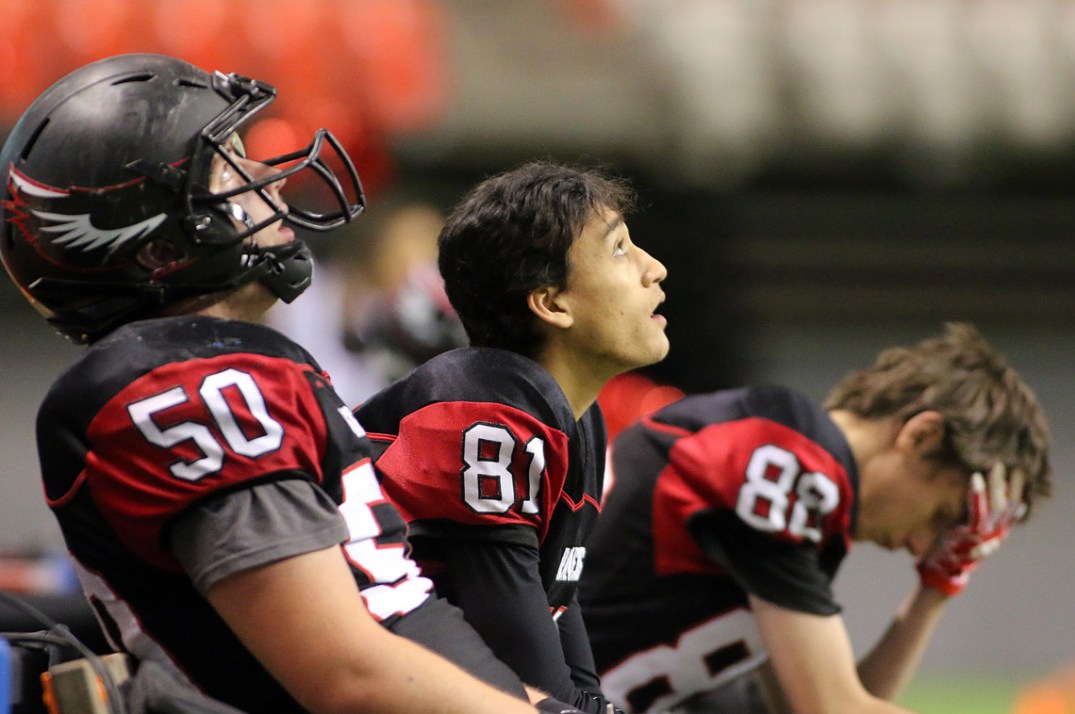
MARIO BARTEL/THE TRI-CITY NEWS The reaility of their 33-0 loss to the New Westminster Hyacks in Saturday’s Subway Bowl AAA semi-final sinks in for Liam Stewart, Joshua Morris and Jake McEwan of the Terry Fox Ravens.
MARIO BARTEL/THE TRI-CITY NEWS New Westminster Hyacks wide receiver Ajay Choi tries to break the tackler of Terry Fox Ravens safety Kyle Huish in their BC Secondary Schools Football Association AAA Subway Bowl semi-final, Saturday at BC Place Stadium. New Westminster won the game, 33-0.
MARIO BARTEL/THE TRI-CITY NEWS Terry Fox Ravens full back Liam Cumarasamy leaps over a New Westminster Hyacks tackler in their BC Secondary Schools Football Association AAA Subway Bowl semi-final, Saturday at BC Place Stadium. New Westminster won the game, 33-0.
MARIO BARTEL/THE TRI-CITY NEWS Terry Fox Ravens running back Cade Cote can’t escape the clutches of New Westminster Hyacks tackler Matthew Lalim in their BC Secondary Schools Football Association AAA Subway Bowl semi-final, Saturday at BC Place Stadium. New Westminster won the game, 33-0.
MARIO BARTEL/THE TRI-CITY NEWS Terry Fox Ravens running back Ethan Shuen is caught by a New Westminster Hyacks tackler in their BC Secondary Schools Football Association AAA Subway Bowl semi-final, Saturday at BC Place Stadium. New Westminster won the game, 33-0.
MARIO BARTEL/THE TRI-CITY NEWS New Westminster Hyacks wide receiver Matthew Lalim (#9) celebrates his touchdown with teammate Arjun Bal late in the team’s 33-0 win over the Terry Fox Ravens in Saturday’s BC Secondary Schools Football Association AAA Subway Bowl semi-final at BC Place Stadium.
MARIO BARTEL/THE TRI-CITY NEWS New Westminster Hyacks quarterback Kinsale Phillip looks to throw the ball as he’s caught by Terry Fox Ravens tackler Steven Jiang early in their BC Secondary Schools Football Association AAA Subway Bowl semi-final, Saturday at BC Place Stadium. New Westminster won the game, 33-0.
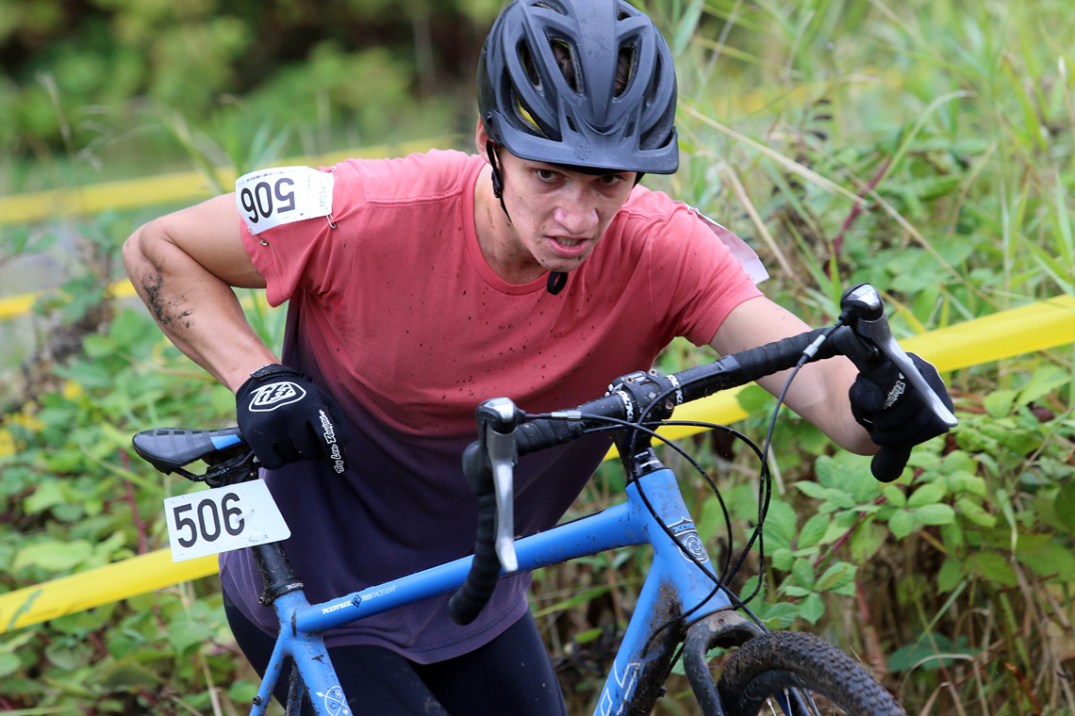
I love shooting cyclocross. Especially if the weather is bleak. That just makes the muck much more epic.
Leaden skies and rain might mean the end of summer. But for cyclocross racers, the fun is just beginning.
The Vancouver Cyclocross coalition kicked off its season of nine races in the Lower Mainland Saturday with the annual Donkey Cross at Castle Park in Port Coquitlam.
Cyclocross is where road riders go to wallow in the mud.
It was started in the early 1900s in northern Europe as a way for road racers to stay fit as their summer season wound down. The cyclists would challenge each other to race to the next town or village in Belgium, France or the Netherlands and they were allowed any route to achieve their destination. That often meant traversing muddy farmer’s fields, skittering along narrow dirt trails, hopping fences.
By 1924, cyclocross had become a recognized cycling discipline when the sport’s first international competition, Le Criterium International de Cross-Country Cyclo-Pédestre, was held in Paris. But the sport wasn’t officially sanctioned by cycling’s governing authority, the Union Cycliste Internationale until the 1940s and the first world championship was staged in Paris in 1950.
A cyclocross race is usually contested on a tight, twisty route that includes several obstacles and challenges that forces participants to carry their bikes, over a barrier or up a steep, slippery hill. Saturday’s event included races for kids, youth, novices, masters and elite men and women.
BC Superweek is Canada’s largest, most prestigious series of pro bike races. Over the course of a week, riders from as far away as Germany and New Zealand converge in Metro Vancouver for nine races, most of them criteriums around tight, fast city courses.
This year’s PoCo Grand Prix was the first time the racers did their thing in the fading light of twilight and, for the men’s race, darkness.
The Friday-night party vibe around the course and the city’s central square was unrivaled, and the racers put on a great show, even if it was hard to see in the growing gloom.
MARIO BARTEL/THE TRI-CITY NEWS A replay of the women’s race plays on the monitor as the men await the start of their race at Friday’s PoCo Grand Prix.
MARIO BARTEL/THE TRI-CITY NEWS The entertainment doesn’t stop even as the bike race begins at Friday’s PoCo Grand Prix.
MARIO BARTEL/THE TRI-CITY NEWS A commissaire keeps track of the laps at Friday’s PoCo Grand Prix.
MARIO BARTEL/THE TRI-CITY NEWS Bikes can even create art.
MARIO BARTEL/THE TRI-CITY NEWS The women round a corner in fading daylight at Friday’s Poco Grand Prix.
MARIO BARTEL/THE TRI-CITY NEWS The women race past a photographer along the course.
MARIO BARTEL/THE TRI-CITY NEWS Kendall Ryan, of Team TIBCO, pops the champagne bottle to celebrate her victory in the pro women’s race at Firday’s third annual PoCo Grand Prix.
MARIO BARTEL/THE TRI-CITY NEWS The pro men’s race speeds around the darkened streets of downtown Port Coquitlam at Friday’s Poco Grand Prix.
MARIO BARTEL/THE TRI-CITY NEWS Mitch Kettler, right, pips Florenz Knauer on the finish line to win the men’s professional race at Friday’s PoCo Grand Prix. The third annual race was the first in BC Superweek history to be held under the streetlights.
MARIO BARTEL/THE TRI-CITY NEWS The pro women’s race sets off in twilight.
MARIO BARTEL/THE TRI-CITY NEWS The early laps of the pro men’s race at the PoCo Grand Prix are held in dwindling twilight.
MARIO BARTEL/THE TRI-CITY NEWS Canadian criterium champion Sara Bergen, right, chats with her Rally Cycling teammates before the start of the pro women’s race at Friday’s PoCo Grand Prix.
MARIO BARTEL/THE TRI-CITY NEWS The next generation of racers test their skills at the Kids Zone.
Apparently some people like wandering onto mudflats when the tide is out. It’s not a good idea. Here’s the story and photos I filed for The Tri-City News of rescue training on the mudflats of Port Moody Inlet by the Port Moody Fire Department.
It took just three steps for Rob Suzukovich to become hopelessly, and helplessly, stuck in the mudflats at the eastern end of Port Moody Inlet.
Fortunately, he’s a Port Moody fire captain who was taking part in a training exercise Thursday to give the city’s firefighters some practice extricating people who’ve wandered off the shoreline and into the heavy muck at low tide.
Port Moody fire chief Ron Coulson said that happens about twice a year.
He said the easy access to the flats from nearby trails, and the proximity of lots of residents and visitors to the city who may not be aware of the dangers of the mudflats make it imperative his crews keep their skills fresh.
He said the mudflats can be deceiving because when the tide is low they look no different than a soggy beach. But the mud is heavy with organic material and so saturated with water it creates an instant vacuum when unwary visitors step into it. That’s when the trouble starts.
“The harder you work to get out, you just sink deeper,” said Coulson of the process called liquefaction.
He said anyone who gets stuck in the ooze should stay calm until help arrives.
That help includes firefighters equipped with special plastic overshoes they strap onto their boots that allows them to walk on top of the muddy surface. They’ll also carry a spare pair of the overshoes for their victim, as well as a spinal board to provide a solid surface once that victim is extricated.
A high-power water pressure gun attached to 1.25-inch hoseline allows the firefighters to blast muck away from the victims legs, replacing it with water so they can be pulled out easier.
Suzokovich said the suction was immediate and overpowering.
“It’s very deceiving,” he said.
Coulson said visitors need to respect the signs warning them to stay off the mudflats at low tide.
“They don’t realize the danger,” he said. “And if the tide comes in, it can quickly turn tragic.”
MARIO BARTEL/THE TRI-CITY NEWS Wearing special overshoes that allow them to walk on the mud, Port Moody firefighters Darren Penner and Jason Webster head out to rescue their trapped colleague.
MARIO BARTEL/THE TRI-CITY NEWS Port Moody fire chief Ron Coulson says his department can expect to rescue a couple of people a year who don’t heed the warning signs and get stuck in the mudflats at the eastern end of Port Moody Inlet.
MARIO BARTEL/THE TRI-CITY NEWS A Port Moody firefighter deploys a 1.25-inch hose attached to a high-pressure spray gun that can be used to loosen the mud around a victim trapped in the mudflats at the eastern end of Port Moody Inlet.
MARIO BARTEL/THE TRI-CITY NEWS It’s a dirty job getting people out of the mudflats if they become stuck.
MARIO BARTEL/THE TRI-CITY NEWS Wearing special overshoes that allow them to walk on the mud, Port Moody firefighters Darren Penner and Jason Webster head out to rescue their trapped colleague.
MARIO BARTEL/THE TRI-CITY NEWS Port Moody firefighters strap on special plastic overshoes that allow them to walk on the surface of the mudflats to rescue people stuck in the muck.
MARIO BARTEL/THE TRI-CITY NEWS Port Moody firefighters use a high-pressure spray gun to loosen the mud around their “victim” so he can be pulled to a spinal board to strap on special overshoes that will allow him to walk back to firmer terrain.
MARIO BARTEL/THE TRI-CITY NEWS After hiking across the mudflat in their special overshoes, Port Moody firefighters Darren Penner and Jason Webster arrive at their stuck colleague, Rob Suzukovich.
MARIO BARTEL/THE TRI-CITY NEWS Firefighters wearing backpacks containing specialized equipment walk towards the mudflats at the eastern end of Port Moody Inlet to practise rescuing a colleague who’s been sucked into the thick, heavy muck at low tide. Port Moody fire chief Ron Coulson says the easy access to the flats from nearby trails makes them alluring to visitors who may not know what they’re getting themselves into.
MARIO BARTEL/THE TRI-CITY NEWS The designated “victim” for the exercise, Port Moody fire captain Ron Suzukovich, walks toward his doom in the mudflats off the Old Mill site on the north shore of Port Moody Inlet. Fire chief Ron Coulson says the easy access to the flats from shoreline trails and the proximity of many residents means his crews usually get called out twice a year to pluck people from the heavy muck.
MARIO BARTEL/THE TRI-CITY NEWS Wearing special overshoes that allow them to walk on the mud, Port Moody firefighters Darren Penner and Jason Webster head out to rescue their trapped colleague.
MARIO BARTEL/THE TRI-CITY NEWS Port Moody fire caption Rob Suzukovich gets some help back on his feet from his “rescuers,” firefighters Darren Penner and Jason Webster, during a training exercise to extricate people trapped in the mudflats at the east end of Port Moody Inlet.
MARIO BARTEL/THE TRI-CITY NEWS Muddy but otherwise unhurt, Ron Suzukovich heads for solid ground after serving as the “victim” in a training exercise to help Port Moody firefighters rescue people trapped in the mudflats at the eastern end of Port Moody Inlet.









 MARIO BARTEL