Like cycling? Like beer? A Port Coquitlam enthusiast of both has created a community for cyclists and beer lovers to get together

This story first appeared in the Tri-City News on April 10, 2022

A Port Coquitlam cyclist is creating a community of like-minded individuals who share his passions for exploring the Tri-Cities and beyond by bike, followed by a refreshing beer at one of the local craft breweries.

He’s finding no shortage of takers.

Since starting Tri-City Bikes and Brews on Facebook last fall, Bill Jones has registered more than 320 members.

He said they’re in all shapes, sizes, ages and levels of cycling experience, from neophytes who’ve just acquired an e-bike to help them get active to enthusiasts on hybrid or gravel bikes looking for new routes and beers to sample.

All are united in their belief that there’s no greater reward for an afternoon of spinning the pedals than a stein of stout or a thistle of ale.

Jones said in his native Manchester, England, a stop at the pub is a common goal of any exercise, whether it’s a ride, run or walk.

“Earners and burners,” he said it’s called.

But since moving to Port Coquitlam two years ago, Jones said it’s been difficult to connect with other cyclists to learn the safe routes around the Tri-Cities, as the established road groups are a little too hardcore for his recreational aspirations.

Then, while enjoying a refreshing beverage at Coquitlam’s Mariner Brewing, an idea popped into Jones’ head.

“It’s a pretty easy sell,” he said of the bikes and beer combination.

It’s made all the easier with the preponderance of craft breweries in the Tri-Cities, many of them located right along or nearby established cycling routes.

Most of them also have bike racks.

Jones said the group is focused more on social interaction than Strava segments.

Apart from sharing beer news and riding routes online, there’s a regular group ride on Thursdays that he’s rechristened “Thirstday.”

Routes range from 10 to 30 km, always along designated cycleways or trails to help bolster the confidence of cyclists who might be nervous navigating roads busy with traffic.

“I want it to be accessible,” Jones said, adding future plans include longer rides to breweries further afield, like Burnaby and maybe even Langley, as well as monthly challenges to help boost everyone’s fitness.

As for the perfect post-pedalling pint, Jones said a “good wheat ale is my go-to.”

But with so many varieties of beer on offer from Moody Ales in the west to Tinhouse in the east that could easily change with a serendipitous discovery.

“You’re never short on options,” Jones said.
Port Moody inventor makes it easy to get your beer home by bike

This story first appeared in the Tri-City News on Nov. 21, 2021

For Nathan Thomson, necessity was indeed the mother of invention.

Along with a thirst for craft beer.

The 26-year-old criminology graduate who works in government said he’s never designed or built anything, nor had any entrepreneurial inclinations.

But riding his Kona bike two blocks from his Port Moody home to the city’s renowned Brewers Row to meet friends and enjoy the latest offerings at its five craft breweries changed that.

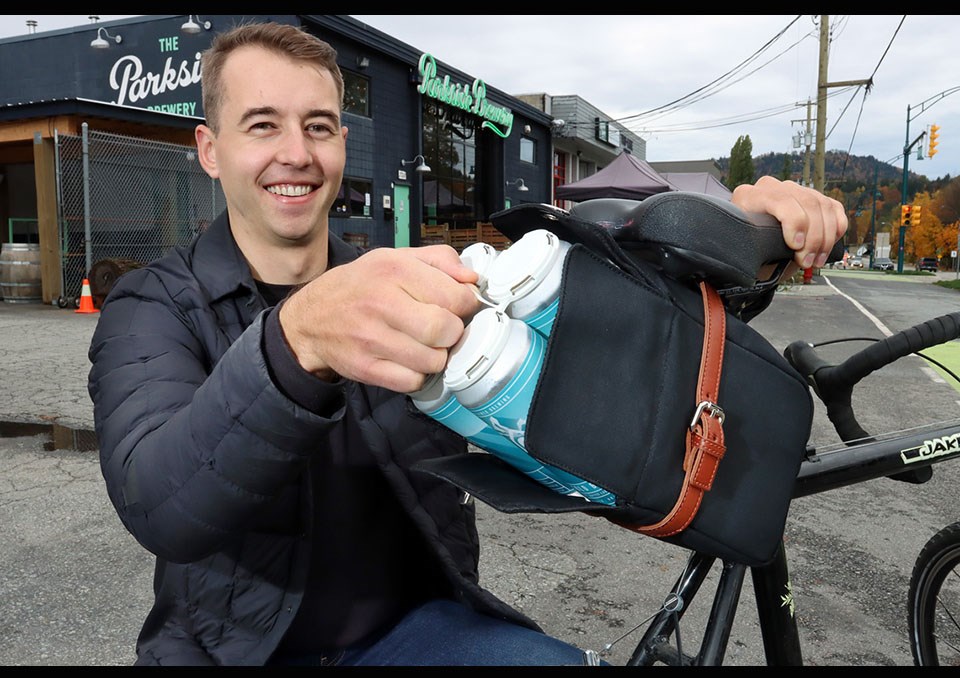
Frustrated by the challenge and inconvenience of toting a pack of a newly discovered beer he really liked home on his bike, Thomson developed the To Go bag. It’s a canvas cube-shaped sack that tucks underneath the saddle of his Jake the Snake bike and is large enough to accommodate four tall cans.

It sounds like an obvious idea, but after Thomson had his light-bulb moment last spring, he discovered no such saddle bag existed.

So he started sketching out ideas and sampling materials to build a prototype.

Creating a beer conveyance for cyclists, it turns out, isn’t as easy as it sounds at first blush.

Thomson said the bag had to be large enough to hold the four cans, but not too bulky to be an annoyance on the bike. It had to be strong, but not overly heavy.

And it had to be easy to use, without complicated flaps or straps, but still secure.

“I didn’t want it to throw you off balance,” he said.

Using mock-ups Thomson created out of cardboard, friends were enlisted to try his designs and provide feedback.

Angle proved to be the key factor.

Thomson said by finding the right pitch to suspend the bag, it wouldn’t sway from side-to-side or interfere with the cyclist’s pedalling motion.

Material was another challenge. Nylon was too flimsy, leather too heavy and expensive.

Instead, a canvas exterior with nylon lining offered the optimal combination of strength, durability, weight and insulation. The straps that secure the bag to the seat rails and seat post are made of synthetic leather.

Thomson said the development process took several months, but by July, he’d enlisted a manufacturer and was ready to go to market.

Online sales have placed Thomson’s bags under bums across Canada and into New York State and Minnesota. They’re also on the swag shelves of a couple of Metro Vancouver craft breweries: Container in East Vancouver and Five Roads in Langley.

He said he’s had discussions with others, even explored co-branding opportunities.

Thomson said he’s continuing work on more refinements, like adding side pockets and more colours.

He said there seems to be a natural connection between cycling and beer that makes his ToGo bag the right product at the right time.

And considering its genesis on Port Moody’s Brewers Row, the right place as well.

Port Moody cycling studio helps cyclists go Zwifter

This story first appeared in the Tri-City News on April 12, 2019

At 70 years-old, Frank Quigg’s dreams of racing his bike in the peloton at the Tour de France are long behind him.

But, Quigg discovered, he can get a flavour of that experience by plugging his indoor trainer into one of several virtual training apps that can plant a cyclist in the midst of a group ride through French countryside, up and down the Dolomite mountains in Italy or around the roads of Central Park in New York City.

And now the retired auto importer has turned his winter training regime into the Lower Mainland’s first virtual cycling studio in a loft area above a fitness gym on Port Moody’s Spring Street.

Quigg’s endeavour, Zwift Cycling Club, features four Tacx Neo 2 smart trainers that are each paired with a virtual training app by Zwift and connected to individual 40-inch monitors. Each station even has a remote-controlled fan that simulates a cooling breeze out on the road.

Cyclists can bring their own bike to mount on the trainer, or use one of the Specialized bikes Quigg has available.

A leap ahead

Quigg took up cycling when he was 59 to improve his health and fitness and now logs more than 8,000 kms on the road a year. He said the virtual riding experience is a leap ahead from the mental drudgery of grinding out hours of spinning parked in front of a TV watching Vancouver Canucks’ hockey games or binging on episodes of House of Cards on Netflix.

Instead, the app can plop Quigg on one of several fictional courses in a mystical land called Watopia, where the roads are always closed to car traffic, or other routes modelled after the 2012 Olympic circuit in London, England, the 2015 world championship course in Richmond, West Virginia, or even the weekend warrior mayhem of New York’s Central Park.

Other apps like Sufferfest incorporate workouts into licensed footage from famous cycling stage races like the Tour de France, Giro d’Italia and one-day events like Milan-San Remo or Paris-Roubaix.

Like a video game

Quigg said Zwift’s virtual world is like bringing his bike into a computerized video game where he can just ride to explore the course and scenery, or elevate his heart rate by racing for personal training goals or against other cyclists hooked into the program from all over the world. The trainer alters the pedalling resistance according to the terrain on the screen, so it gets harder to climb hills and easier to glide down the other side, while the monitor tracks his effort and gives him an idea of how he’s doing compared to the other virtual cyclists on the course.

Quigg, who suffered a bad crash two years ago while riding in a pack along Marine Drive in Vancouver, said virtual training apps also offer a safe environment for riding in a group without the fear of touching wheels with a neighbouring cyclist or crashing into obstacles like barriers and signs that can be hard to spot when in the midst of a fast-moving peloton. Even the social aspect of group rides is preserved, as cyclists signed into the app can communicate with others on the digital road, set up challenges like sprints or organize events like races with their friends.

About the only thing missing is the traditional mid-ride coffee stop, although Port Moody’s Brewery Row is only a short coast away.

Busy year ’round

Quigg said while indoor riding is usually a winter activity cyclists use to maintain their conditioning, he anticipates his stations will be kept busy during the summer months by riders following a structured training regime to prepare for a specific event like a race, gran fondo or triathlon. Groups of friends can also challenge each other in a social setting.

And while it’s possible to get a virtual cycling experience at home, a proper station can cost more than $3,000 — not including the bike — plus the space to leave it set up.

“You get to live out some of your Walter Mitty fantasies,” Quigg said, adding several European and North American pros like Roman Bardet, Mark Cavendish, Michael Woods and Evelyn Stevens have been known to sign in to a Zwift ride.

Legendary Port Coquitlam cyclist remembered as a ‘tough old guy’

This story first appeared in the Tri-City News on Jan. 15, 2021

Dan McGuire was small in stature; but in British Columbia’s quirky community of long distance cyclists, the longtime Port Coquitlam resident was larger than life.

McGuire died Dec. 12 at the Lakeshore Care Centre in Coquitlam. He was 88.

His daughter, Tara, posted on social media that he died from COVID-19 — only three days after he was diagnosed.

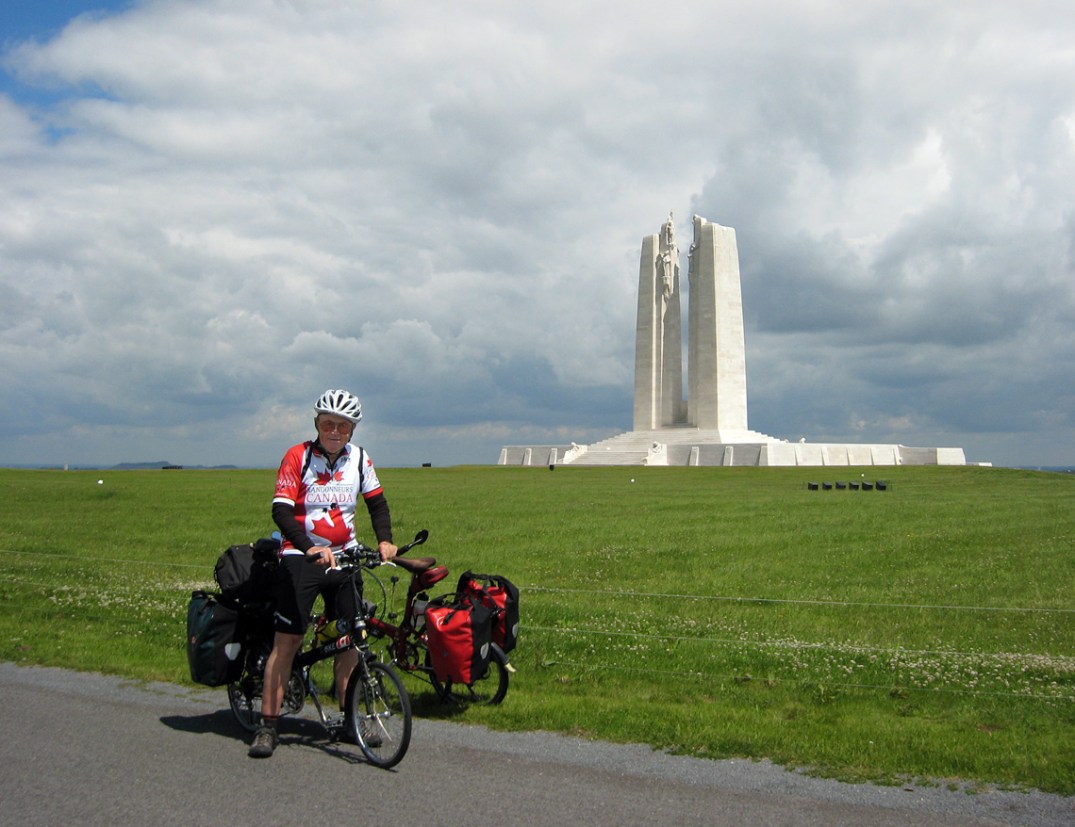
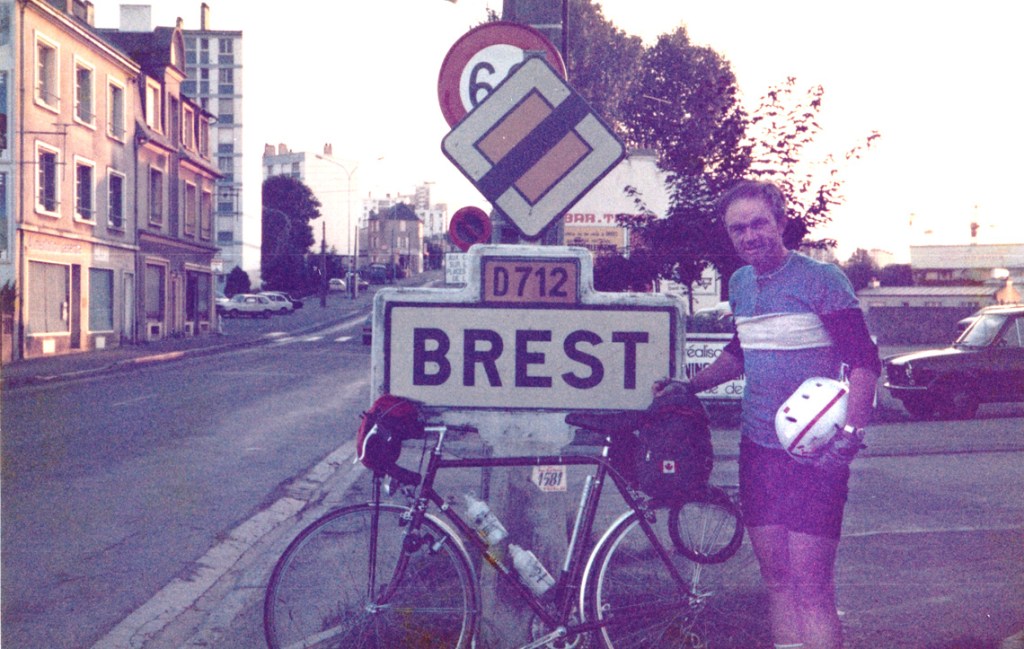
Born in Saskatchewan, McGuire was one of the founding members of the BC Randonneurs, a group of cyclists dedicated to logging long days on two — and sometimes three — wheels. He was part of a contingent of riders that organized a series of long-distance events ranging from 200 to 1,000 km in 1979 that would qualify them to participate in the famed Paris-Brest-Paris brevet, a 1,200-km endurance event in France that is held every four years.

B.C. RANDONNEURS
Dan McGuire helped form the B.C. Randonneurs cycling club so he and like-minded cyclists could prepare to take on the 1,200 km Paris-Brest-Paris brevet that is held once every four years.. He went on to complete the event three times.

McGuire went on to ride it three times. He also travelled to the event on several more occasions to support other riders from the club.

Garry Pareja, a member of the old Vancouver Bicycle Club that spun off the collection of hard-core riders that became the BC Randonneurs, said the group prepared by riding to Mt. Baker and back, or completing ascents of Cypress Bowl, Mt. Seymour and Burnaby Mountain all in one day.

“This branch of the club became the ‘Hard Riders,’” Pareja wrote on the BC Randonneur’s historical timeline.

But it was McGuire’s determination to keep pedalling even after his mobility diminished because of Parkinson’s disease that really cemented his status among the sport’s giants as well as an inspiration to show others living with the degenerative affliction what’s possible.

McGuire, who discovered cycling when he was about 40, had ridden across Canada a few times.

But at the age of 80, and coping with various ailments like arthritic knees and hands, scoliosis in his spine, macular degeneration in his eyes and the onset of Parkinson’s, he decided he wanted to pedal his bike to the four corners of the country — a journey of about 10,000 km.

By then, wrote Tara in a blog post, the disease and medication had so diminished her father, when he’d occasionally fall asleep at the dinner table “he’d look very much like a skinny grieving question mark.”

There was no questioning his determination to realize his cycling dream, though.

“Dan could focus intensely on an idea and the tasks that lay ahead,” wrote Leo Boon, another of the sport’s pioneers in B.C., in a memoriam on the Randonneurs’ website.

“He was just so stubborn,” Tara said.
McGuire’s journey to Canada’s most westerly, northerly, southerly and easterly points took him two years, with a break in between to rest his ailing back.

When he resumed in the summer of 2014, he’d switched from a two-wheeled bicycle to a three-wheeled recumbent to ease some of the aches of his aging body and keep him from tipping over.

As well, Tara said, it allowed him to pull to the side of the road whenever he pleased to just bow his head for a bit of a snooze. He had no organized support team, no motorhome to which he could retire when he wearied.

Instead, Tara said, her father relied on the kindness of strangers to look out for him.

“Dad’s confidence in the positivity, general all-around goodness of the human race, was a gamble he was willing and pleased to take.”

That spirit was infectious.

Fellow randonneur Ralph Maundrell wrote in tribute, “Dan had the ability to install confidence in people,” adding McGuire inspired his own pursuits in long-distance cycling and even marathon running.

“We have lost a wonderful human being, a tough old guy, a great cyclist,” said Boon.

“He could be gruff, but he was also very generous,” said fellow cyclist Deirdre Arscott.

Tara said it’s been heartwarming to hear the impact her father had on so many cyclists.

“He really worked hard to get people cycling,” she said. “We were always kind of impressed with his accomplishments.”

Climate change challenges Tri-Cities’ mountain bike community

This story first appeared in the Tri-City News on Nov. 17, 2022

Extended droughts that dry out trails, atmospheric rivers that wash them away and intense windstorms that blow down trees are among the climate change challenges facing the local mountain biking community.

So members of the Tri-Cities Off Road Cycling Association (TORCA) are adapting the way they build and maintain trails, as well as how they ride them.

Karaleen Gioia, a director of the group that comprises more than 750 members, said a typical trail on Burke Mountain that 10 years ago was little more than a dirt path — snaking through the towering trees — must now be armoured with logs and rocks, bridged with hand-built wooden spans to allow for drainage in heavy rains, and contoured with little rolling hills to slow riders who could otherwise speed erosion.

“It’s not just getting out and shredding the trails anymore,” Gioia said. “Climate change is another factor to consider.”

Drought followed by big rainstorms can be especially damaging to trails.

Gioia said the former strips all the moisture from the ground that binds the trail beds, threatening their structural integrity, while the latter results in washouts as rainfall in unprecedented volumes is forced to travel in unfamiliar places.

Having both in quick succession can be disastrous.

“The result is that more work is required to make trails sustainable,” Gioia said. “More labour up front means less work in the long run.”

Most of that labour is supplied by a corps of dedicated volunteers over the course of several organized “trail days” throughout the year, as well as individual privateer efforts to stay on top of repairs.

“We’re pretty proactive.”

Gioia said most local mountain bikers are tuned into the privileged position they enjoy with so many trails so close to home. Many file trail reports to document any problems or areas of concern they identify as they roll up or down the mountains.

Gioia said keeping the trails in good shape benefits all users, including hikers, dog walkers and trail runners. That’s been especially important since the advent of the COVID-19 pandemic that sent more people outdoors for their recreational pursuits as activity helped reduce their stress and kept them healthier.

Gioia said education of proper trail use etiquette and trail building technique is an ongoing process. TORCA liaises frequently with other user groups, as well as land managers, to devise solutions to problems as they arise.

“We’re learning as we go,” she said.

In fact, a report conducted for Parks Canada by the Calgary-based Miistakis Institute that looked at the ecological impacts of mountain biking said that’s the case for most user groups, as there’s been very little empirical research.

“Specific effects associated with mountain biking activity and infrastructure characteristic of the other types of use have emerged as a considerable gap in the research literature,” concluded the review.

Gioia said land managers and user groups are gaining a greater appreciation that bolstering trails will help keep mountain biking viable even as weather extremes intensify.

“It makes it enjoyable for all the users,” she said.


How this former Coquitlam resident found herself on an epic bike ride in Canada’s far north

This story first appeared in the Tri-City News on Feb. 22, 2024

Some cyclists find fitness. Others find their destination.

Mahshid Hadi found herself.

The young Iranian woman who lived in Coquitlam for a year after fleeing her homeland has documented her search for identity aboard a bike in a short film, Escape and Embrace, that premieres Saturday, Feb. 24, at the Vancouver International Mountain Film Festival (VIMFF24).

Hadi, 32, said cycling adventures were a forbidden pleasure when she was a girl growing up in the central Iranian city of Isfahan.

While Hadi was able to taste freedom on two wheels when she was very young, she said once she turned nine, everything changed. That’s when Iranian law and religious rules begin to treat girls as women and their lives become very restricted.

Hadi could be as free and animated as she liked within the confines of her own family’s home, but once she walked out the door every aspect of her life and interactions with other people were dictated. She had to sit and walk a certain way, wear certain clothes, talk to boys in only very defined circumstances.

And though there was no specific rule forbidding her from riding her bike, authorities made it clear it wasn’t an acceptable activity.

Hadi’s life, once so free and adventurous, suddenly became very confining.

“I wanted to be a free-spirited girl, I wanted to do everything I had the potential to do as a girl,” she said. “I couldn’t be who I wanted to be.”

The trauma within her built up.

So, at 19, Hadi got out, secreted away by friends and associates to Türkiye (formerly known as Turkey).

There, Hadi said, she had freedom but not comfort. She couldn’t work officially, so she cobbled together a living teaching English to other refugees.

With the money Hadi was able to save, she bought a bike to be able to visit students in other refugee camps.

“Bit by bit, I left all my traumas on the road,” she said.

When Hadi’s application to immigrate to Canada was accepted, her love for cycling came with her.

In her new home, Hadi rode everywhere, Partly because she didn’t have a car, partly as an expression of her newfound liberty.

“It was a dream come true,” she said. “I felt this is a road and nobody can stop me from riding it. I don’t have to explain my riding.”

Iranian-Canadian filmmaker Mahshid Hadi has been on a journey of self-discovery with her bike since she arrived in Canada after fleeing her homeland to a refugee camp in Türkiye when she was 19 years old. MAHSHID HADI/INSTAGRAM

Last fall, Hadi said she felt a pull to push her cycling journey of self-discovery to a higher level and to share her story. She knew it needed to be a difficult trip, where the obstacles were not societal rules and religious edicts but the weather and terrain.

“I needed to feel vulnerable,” Hadi said. “But I wanted it to be my choice.”

Hadi pedalled the Dempster Highway from Dawson City towards Inuvik, about as far north as you can go on rubber tires.

And while a storm prevented her from reaching the road’s terminus, Hadi said the journey gave her a sense of finality to her past.

“This was the end of the road from all those restrictions I felt in Iran,” she said. “It was just me and the land.”

Hadi said the four-day trip may be over, but her journey toward self-discovery aboard her bike continues, She said her LIV gravel bike is her buddy, her port in the storm of life’s twists, turns and uncertainties.

“Any difficult time I go through, I know I can get on my bike and just let everything go.”

Hadi’s film, which documents the meaning of her ride along the Dempster Highway, is part of Bike Night at VIMFF24 where it will be screened with six other cycling films at Centennial Theatre in North Vancouver.

Spry seniors pilot Big Bike for charity

As the Tri-City News’ ad-hoc cycling reporter, pretty much any story on two wheels gets sent my way. But not all bikes have just two wheels. Or one rider.

You may not be able to teach an old dog new tricks, but you can get him on a bike every couple of years.
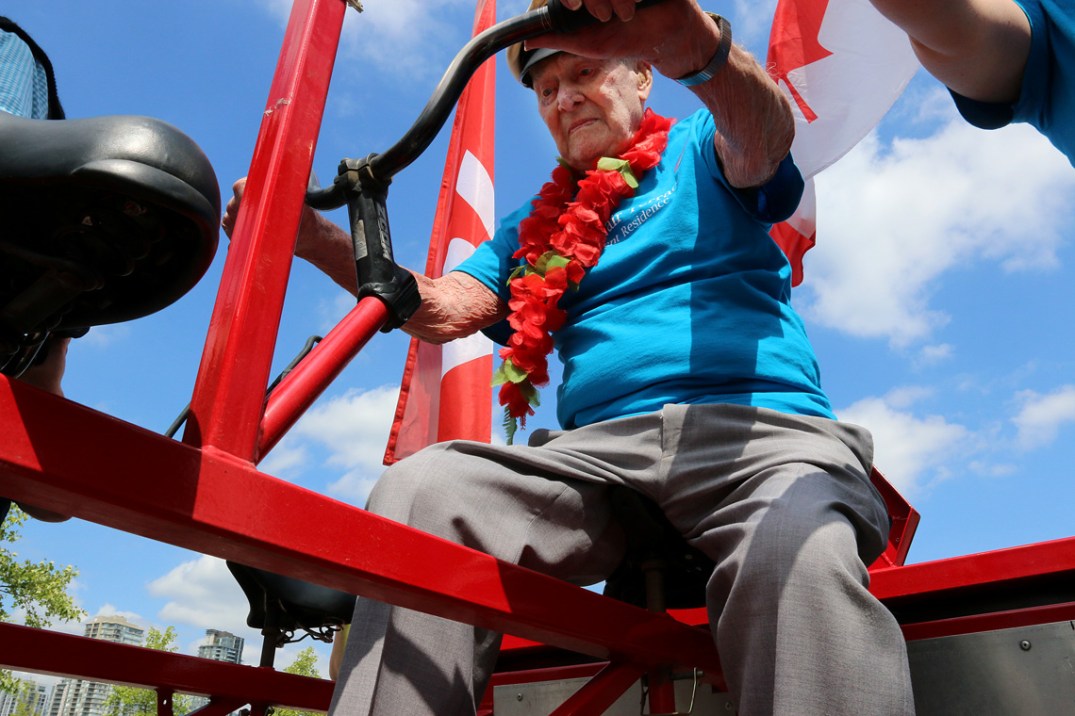
At 106 years, Don Simpson certainly qualifies as old. In fact, according to Phil Reist, the driver of the Heart and Stroke Foundation’s “Big Bike,” he’s likely the oldest participant to ever ride the 29-passenger behemoth bicycle that helps raise money and awareness to prevent heart disease.
Simpson was the captain of a contingent of spry seniors from the Mayfair Terrace retirement home in Port Coquitlam who took the Big Bike for a 20-minute spin on the roads around Coquitlam Centre last Friday. It wasn’t his first rodeo, though.
Simpson cycled the Big Bike when he was much younger — two years ago when he was 104. But he also remembers riding his bike as a boy around Vancouver’s Stanley Park and attending the six-day bike races at the old China Creek velodrome.
“That was our stomping ground,” he said.
So when it came time to climb aboard the gargantuan single-geared machine, Simpson knew exactly where he wanted to be. He ignored the requests of a photographer and cameraman to mount an outboard seat so they could get a clear shot of him pedalling, and instead scrambled — slowly, and with a bit of help — to the middle row at the very back. After all, who’s going to argue with someone his age?
And with a few last-minute instructions from Reist, a shake of the maracas and other noisemakers to ensure passersby notice the big bike — like they’re going to miss it? — they were off.


There will be mud

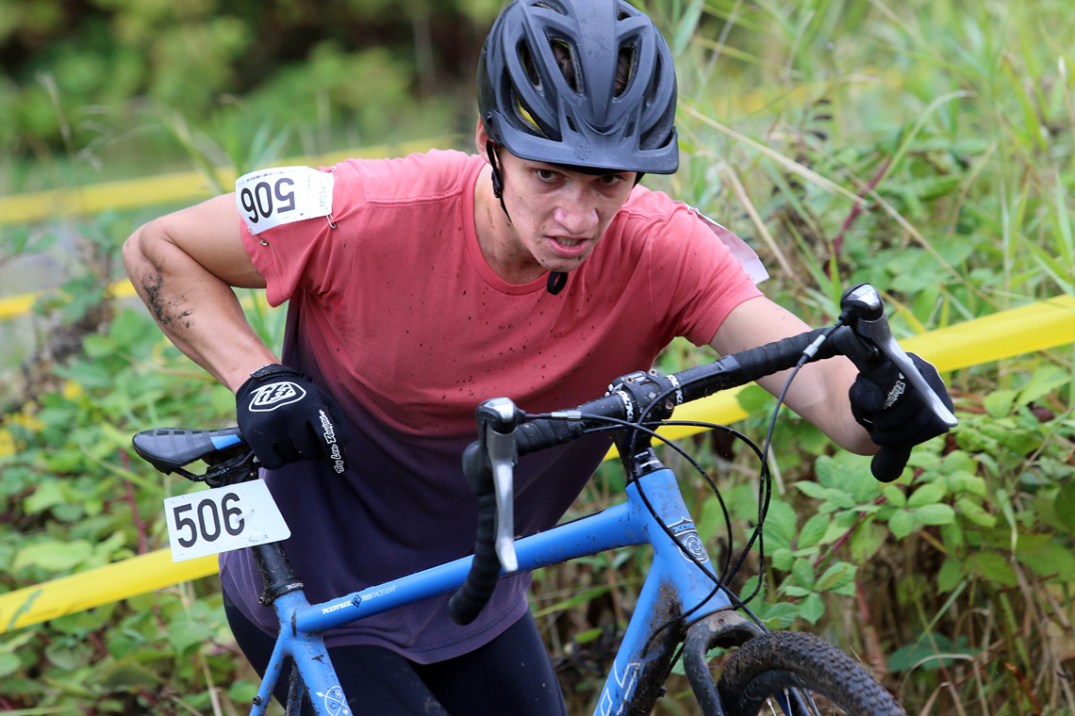
While the major rainstorm that was forecast held off, dozens of riders still got down and dirty at Saturday’s annual Donkey Cross cyclocross race in Port Coquitlam’s Castle Park.
The race was the first of seven that comprise the Lower Mainland Cyclocross series.
Cyclocross is like steeplechase racing on two wheels. Riders navigate a winding, undulating course for several laps that includes obstacles, a metres-long “beach” of soft sand, and even a stretch of snow from a local arena dumped into a corner. The sport originated as a form of off-season training for road cyclists in Northern Europe who would often challenge each other to get to the coffee shop in the next village the quickest. Often, that meant traversing farmers’ fields and hopping fences and hedges, elements that are still honoured in modern cyclocross racing.

It they built it, will they climb?

A version of this article appeared in The Tri-City News in 2019.

It’s one thing to build a multi-use path, quite another to get walkers and cyclists to use it.

Port Moody accomplished the former with its $4.627-million upgrade of Gatensbury Avenue to make the steep, winding connector between it and the city and Coquitlam safer for motorists and add a $285,000 multi-use path (MUP) along its western flank for pedestrians and people on bikes.

The project was identified as an early priority in Port Moody’s master transportation plan, which was endorsed by council in March 2017. That plan will see the city invest more than $31 million over the next 20 years to make it easier to get around the city, and encourage more sustainable modes of transportation, like walking and cycling.

Ascending Gatensbury, though, remains a test of fortitude, leg strength and lung capacity.

Already the climb to the top has been dubbed the “Gatensbury Gasp” on social media by some pedestrians who have ascended its 12% average pitch over 1.1 kilometres since it reopened to traffic at the end of May.

But what does that mean for cyclists?

Always up for a good bike story, I set out to find out.

I’m not a climber. Descending is more my jam.

I ride up hills and mountains because I have to get to the top so I can turn around and speed back down.

For the most part, cyclists have avoided Gatensbury for years because of its narrow lanes that lacked a shoulder and its pocked pavement that made it unsafe at worst, uncomfortable at best.

Oh yeah, there’s also its perilous steepness, which ranges from 11.1% at the bottom to 18.3% in its final rise.

Gatensbury climb
The climb averages 12% over its 1.1 km total length, but there are sections that exceed 18%.

By comparison, Mont Ventoux, one of the iconic climbs of the Tour de France, peaks at 12% and the Muur van Geraardsbergen in Belgium, that has been a decisive climb in big-time professional bike races like the Tour of Flanders, rises an average of 9.3% over its 1,075 metres over bumpy, tire-eating cobbles that can rattle the fillings from your teeth.

The pavement on Gatensbury’s new MUP is smooth tarmac, not yet heaved by straying tree roots or ravaged by winter freezes and thaws.

The path is also wide — maybe not wide enough to allow teetering cyclists to weave their own switchbacks to stay upright, but certainly wide enough for pedestrians and riders going uphill to pass each other easily.

According to Strava, an online app that allows cyclists and runners to upload data from their GPS devices, 43 cyclists have completed the segment called “Todds Gatensbury climb,” which is .94 km from the base of the hill at Henry and Grant streets to Bartlett Avenue at the top, this year. The fastest was Matthew Cox, a Port Moody cyclist who made it to the top in four minutes, four seconds. That’s an average speed of 13.9 km/h and well off the all-time record of 17.7 km/h by Brett Wakefield back in 2015, when the road was in much worse shape and there was no MUP. Some notable athletes have also tackled Gatensbury, including Canadian Olympic triathlete Simon Whitfield — he did it in 3:49 in 2013.

At the start of the MUP, after a warmup pedal from The Tri-City News’ office in Port Coquitlam, I could only dream of such blinding uphill speed. In fact, I just wanted to survive without my knees, or heart, exploding.

The climbing starts at a modest 3.9% at Henry and Moody streets but by the time it hits its first switchback, it touches 17%. It’s about then I realize I’m still in second gear. I veer into a driveway to change gears because doing so under high torque in a difficult climb can blow apart a derailleur.

The second switchback is consistently around 15% but goes as steep as 18.2%.

But the nastiness is just getting started.

Looking ahead, the road straightens, the gradient moderates slightly and the end seems in sight. The bike computer says I’m doing 6.6 km/h but, gasping for breath and rocking side-to-side, it feels like I’m standing still.

Then, the road veers left to reveal its cruelest twist: more climbing, some of it is as steep as 17.3%.

I reach Bartlett Avenue 7:09 after I started the climb, the 25th-fastest — or 18th slowest — ascent of the segment recorded on Strava so far this year.

As I turn to  cross the road and collect my reward — a speedy descent on Gatensbury’s smooth, new pavement — a cyclist on an electric-assist bike with fat, cushy tires, cruises nonchalantly by on the uphill side. He’s smiling, with barely a bead of sweat on his brow.

Maybe he has the right idea.

Ride for mud & glory

I love shooting cyclocross. Especially if the weather is bleak. That just makes the muck much more epic.

Leaden skies and rain might mean the end of summer. But for cyclocross racers, the fun is just beginning.
The Vancouver Cyclocross coalition kicked off its season of nine races in the Lower Mainland Saturday with the annual Donkey Cross at Castle Park in Port Coquitlam.
Cyclocross is where road riders go to wallow in the mud.
It was started in the early 1900s in northern Europe as a way for road racers to stay fit as their summer season wound down. The cyclists would challenge each other to race to the next town or village in Belgium, France or the Netherlands and they were allowed any route to achieve their destination. That often meant traversing muddy farmer’s fields, skittering along narrow dirt trails, hopping fences.
By 1924, cyclocross had become a recognized cycling discipline when the sport’s first international competition, Le Criterium International de Cross-Country Cyclo-Pédestre, was held in Paris. But the sport wasn’t officially sanctioned by cycling’s governing authority, the Union Cycliste Internationale until the 1940s and the first world championship was staged in Paris in 1950.
A cyclocross race is usually contested on a tight, twisty route that includes several obstacles and challenges that forces participants to carry their bikes, over a barrier or up a steep, slippery hill. Saturday’s event included races for kids, youth, novices, masters and elite men and women.