Helping small business score success

The 20 colourfully iced cakes lined up on the island in Sheila Comer’s kitchen told her it was time to start her own business.

But the prospect of taking her cake baking out of her home kitchen and into a storefront was daunting. She already had a job she loved.

But she loved baking and decorating cakes even more.

So she made the leap.

“My customers were getting to the point where they wanted to sit down and have consultations,” says Comer. “They wanted to come and try what I had to offer.”

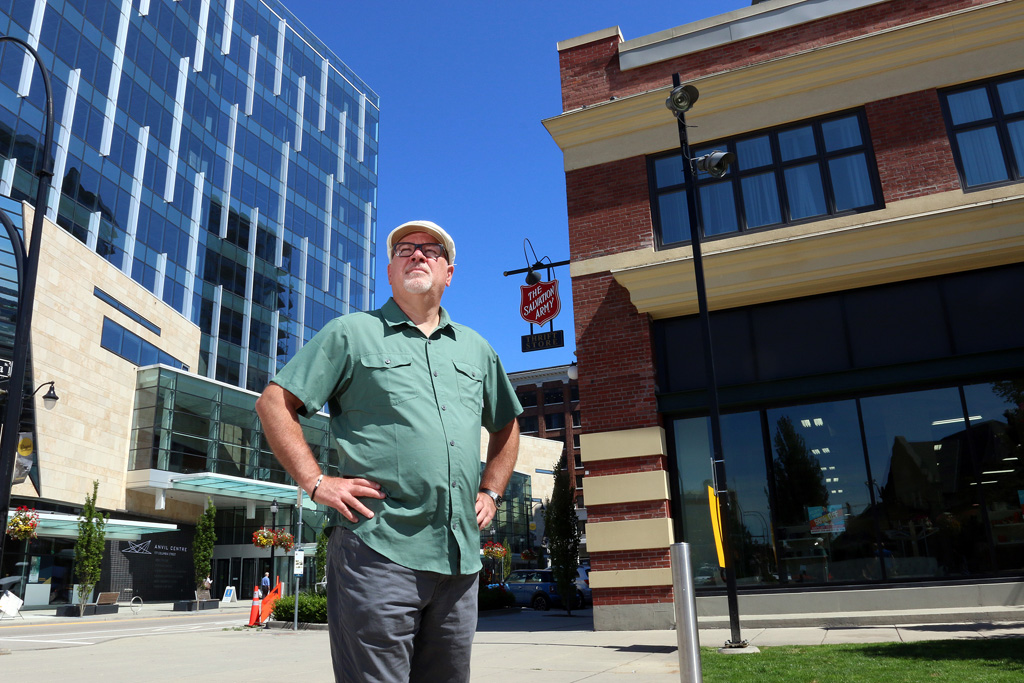
Comer signed a three-year lease in a new commercial space at the base of a condo tower on Sixth Street.

But even as the ink of her signature was drying, she says she had no idea what she was getting herself into.

There are more than 3,800 open business licenses in New Westminster; 3,344 can be considered small businesses with fewer than 50 employees, and 2812 of those have less than five employees.

“Having a diversity of businesses is important for the economic health of the city,” says Blair Fryer, New Westminster’s communications and economic development manager.

Providing the resources and knowledge to ensure those businesses survive and thrive is in the community’s best interest, says Fryer. “Residents continue to show strong support for small, local businesses and are proud of the unique character and offerings they bring to New Westminster.”

The road to success often starts with the city’s licensing coordinator, who can work with business owners to ensure their plan and proposed location conforms to zoning regulations. The licensing coordinator can also work with various city departments to help move a business application through the licensing process.

Another valuable resource is the Self-Employment Program at Douglas College.

Since the program was launched 20 years ago at the college’s New Westminster campus, and then added at its Coquitlam location, it has helped 4,000 individuals gain the skills they need to develop a sound business plan and implement marketing strategies.

“The program forces you to think about things you may not have thought of,” says Travis Moss, an instructor in the program and an experienced business consultant. “It forces you to think before you buy inventory or even register your company name.”

Comer already had a name for her bakery, Pink Ribbon, in honour of her grandmother’s battle with breast cancer and her own commitment to pledge a portion of her sales to breast cancer research.

But that’s about as far as her business acumen went.

“I just decided to go ahead and do it,” says Comer.

She did research on YouTube. Conversations with Fraser Health enlightened her about the health and safety requirements for her bakery, like the need to install three sinks. She had meetings with people from the city’s licensing and planning office to learn about city regulations and bylaws.

“I didn’t even know I needed a business license,” says Comer. “Everybody that I dealt with was extremely helpful, willing to give me any info they could.”

The City of New Westminster’s newly redesigned website offers a wealth of resources for prospective business owners including demographic and employment statistics, economic indicators and snapshots as well as links to the licenses required by various types of businesses, online application and renewal forms and even information about bylaws governing signage.

Fryer says his department is also available to help by improving processes, finding solutions and making connections with potential resources and partners.

Moss says launching a successful business starts with researching and writing a good business plan.

“(It) gets you to think about potential pitfalls, have a road map to follow.”

In their excitement and enthusiasm to launch their own business, Moss says many entrepreneurs neglect important considerations like time management and hidden costs like printing business cards, developing a marketing plan that will generate a steady flow of revenue, hiring staff.

“You can spend a lot of time on the operational end but neglect key things to get your business out there, make sure you’re developing a client base,” says Moss.

For the first few months on her own, Comer was a one-woman band; she baked and decorated all the cakes, closed up the storefront to do deliveries, even slept on a mattress in the back.
pinkribbon2b
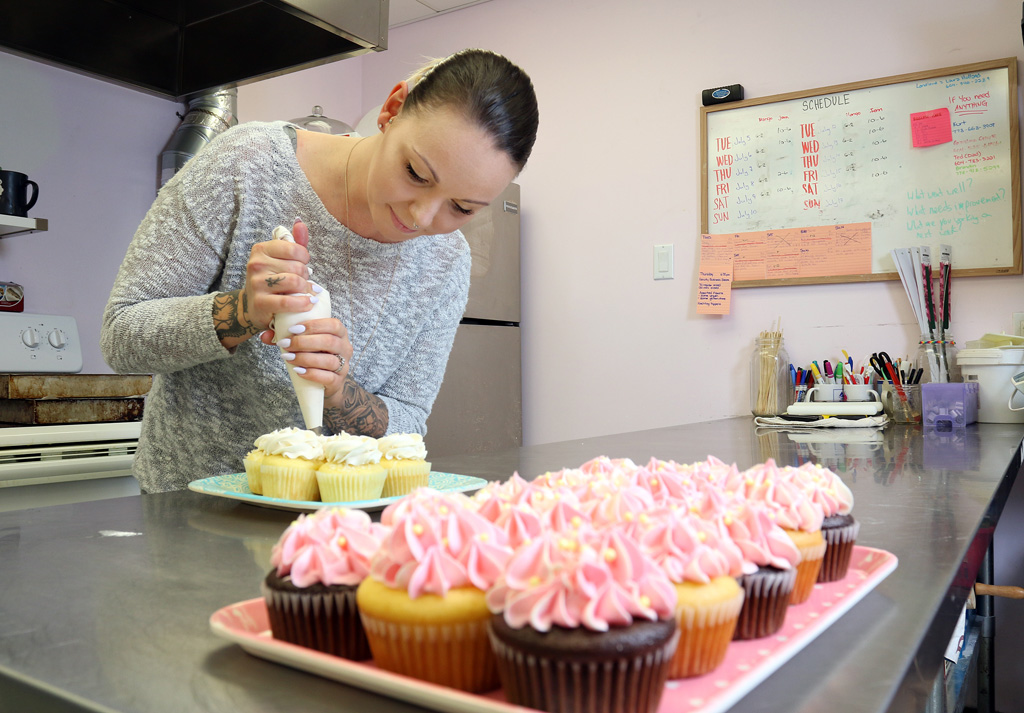
PHOTO BY MARIO BARTEL Sheila Comer decorates cupcakes in the kitchen of her Pink Ribbon Bakery. Her creations have found their way to celebrities like Matt Damon as well as a number of musical acts as they pass through Metro Vancouver.

“Everything was pretty in the moment,” says Comer. “Everything was just about baking cakes.”

In addition to giving entrepreneurs the tools they need so they won’t be overwhelmed by the challenge they’ve taken on, the 48-week program at Douglas College also connects independent business people to coaches and mentors. They check in regularly as projects are actually launched.

“We give them the tools, but it is the confidence and commitment to execute on it that leads to success,” says Moss.

And having successful small businesses in the city breeds even more economic success, says Fryer.

“A variety of retail and commercial services allows residents to meet their day-to-day needs,” he says. “(It’s) also important for employers who consider the provision and type of services for their employees when they consider locating their businesses.”

Comer says a major turning point on her path to entrepreneurial success came when she started hiring staff.

“My biggest fear was letting go of some control,” she says. “I was worried about bringing someone into my world that I had so independently grown. But I know you can’t have a successful business without a successful team.”

Comer now has three employees working for her. That’s freed her up to spend more time with her young daughter.

And think about new ways to grow her business beyond New West.

A ride to remember

We ride because we love it.

Saturday, we rode in solidarity.

Mario Bartel storyteller blogger cyclist photojournalist
About 400 cyclists converged on Stanley Park Saturday to remember a fellow roadie who had been mowed down head on by a car two weeks ago along a popular riding route. Five of his companions, including the one of the left in black, were injured.

Two weeks ago, on my way home from road hockey, the radio traffic update reported River Road in Richmond was closed for a “police investigation.”

My blood ran cold, my heart sank.

River Road is a popular cycling route along the Fraser River, especially on weekends. It’s flat, there are few feeder streets, not many residents and no traffic lights or stop signs. It’s a major west-east conduit for group rides. It’s essentially a rural road on the edge of the big city.

That Sunday morning was dry and mild; after nearly a solid month of rainy days, groups and individual cyclists were sure to be out in force.

So when the traffic report said the road was closed, my immediate thought was “cyclist down.”

When I got home, I started checking on the Strava feeds of various FRFers. I knew they were out that day and likely would have traversed River Road at some point; they were all checked in safely.

A quick browse of local news sites reported the worst news possible; a car had plowed into a group of six cyclists. Two were badly hurt. One had been killed.

The rural character of River Road that attracts so many cyclists also makes it dangerous. The pavement is narrow with virtually no shoulder. One side is flanked by a water-filled ditch, the opposite by the Fraser River. Cars and trucks trying to avoid more congested routes often travel too fast.

As scant details about the tragedy trickled out on the internet through the afternoon and then on the evening TV news, its true horror gripped the cycling community; the riders had been hit head on, mowed down like bowling pins when an oncoming car drifted out of its lane for whatever reason.

That could have been any one of us.

Mario Bartel storyteller blogger cyclist photojournalist
The rain stopped but the roads were still wet when the FRF contingent departed for Saturday’s memorial ride in honour of a fallen cyclist

Whenever we throw one leg over the top tube and clip into our pedals, we know there’s a chance we may not make it home. Most of us try to do whatever we can to mitigate that risk: we follow the rules of the road; we stick to designated bike routes.

But it just takes a moment of inattention or carelessness by a motorist or cyclist to tip that delicate balance of risk vs. reward against us.

The full story of what happened that Sunday morning have yet to be revealed; police are “still investigating.” But their official statement quoted in the media that day was quick to point out the motorist “remained at the scene and is cooperating” (Yay for him!), and the “cyclists were all wearing helmets (like that will make a difference when you’re smashed by 2,000 pounds of speeding metal). The police spokesman quoted at the scene also felt it necessary to remind cyclists to “ride in single file.”

It almost felt like he was blaming the victims, somehow implying they may not have been riding safely.

These kind of throwaway statements appear all too frequently in media reports of car vs. cyclist collisions. The police may think of them as necessary rejoinders that reassure the public the roads aren’t filled with crazed hit-and-run maniacs, but they just serve to reinforce the narrative that the roads are built for cars, and cyclists are just guests who should feel privileged to be allowed to share their space. It’s as if the onus is on us not to get hit.

That sentiment was further inflamed when a Richmond city councilor was quoted that one consideration to make River Road safer for cyclists would be to ban cyclists from using that road altogether. He happens to also own a trucking company.

On Saturday, about 400 cyclists gathered in Stanley Park to remember the fallen 33-year-old rider and his injured companions with a mass loop through the park; it’s one of their favourite routes. I didn’t know him. Likely many in the throng didn’t either. But we are all him.


The weather was supposed to be rainy, cold and windy. By the time our group of FRFers gathered to ride into the Stan, the rain had stopped. Along the way, the sun started to fight its way through the clouds. It was, it turned out, a good day to ride. It was a good day to be alive. RIP Brad Dean.

Mario Bartel storyteller blogger cyclist photojournalist
Cyclists do everything we can to ensure every ride can end as we ended Saturday’s memorial, enjoying a beer and good company at our favourite craft brewery.

The business of heritage is good business in New West

The following story first appeared in Invest New West, an economic development magazine produced for the City of New Westminster.

The bikes on the floor at Gord Hobbis’ Sapperton shop are made of the latest high-tech materials like carbon fibre and hydroformed aluminum.
But to sell those bikes Hobbis relies on the values and acumen developed by his father, Cap, who first opened his neighbourhood bike shop in 1932.
Having one foot planted firmly in the past while stepping boldly into the future is one aspect of New Westminster’s business community that sets it apart from its neighbours.
The business of heritage is good business, says Eric Pattison, a local architect who’s helped restore a number of the city’s historic commercial buildings and homes.

ericpattison1b
“You want a place that’s been there for a while, survived the ups and down. Seeing buildings from every decade into the past reinforces that sense of place,” says Pattison.
New Westminster is British Columbia’s oldest city, founded in 1858. For eight years it was even the provincial capital. Until the first decade of the 20th century, it was also the province’s largest city.
“We’ve always been an important city, right from the start,” says Julie Schueck, New Westminster’s heritage planner. “We didn’t grow up as an add-on to another city. We are a city, we have a downtown. Our past is important to us.”
That historic commercial core distinguishes the city, says Pattison.
“Residential heritage is all well and good, and creates a lifestyle. But it’s more of a challenge to have your community branded as heritage without a historic downtown.”
A historic downtown is made up of more than just old buildings, says Pattison. It’s character is also determined by the width of streets, the lanes and alleys that connect those streets, the pocket squares that allow people to gather and create a neighbourhood vibe.
The walkable nature of historic commercial districts and the varied services that reside there is becoming increasingly attractive to enterprising businesses that are turning their backs on generic suburban industrial parks. They’re seeking to offer employees more than just a cubicle experience.
“Our strongest takeaway from our work in historic districts is the strength of the area will come from the passion and commitment of the business owners we work with,” says Robert Fung, president of The Salient Group that recently completed redevelopment of the historic Trapp + Holbrook blocks on Columbia Street into modern condos with commercial spaces at street level.

trappblock1b
Still, preserving heritage takes constant care and attention.
“You have to overcome the impression that the infrastructure is dated as well,” says Schueck. “Old buildings can be rehabilitated and have all the new services and modern technology put into them.”
“It’s an education,” says Pattison. “You have to be willing to take risks, and some of those risks might involve saving the building and repurposing it.”
“You have to get people to see that heritage is not a hindrance,” says Schueck.
That was the case with the Trapp + Holbrook project, says Fung.
After languishing as an empty shell for years as various redevelopment proposals by a series of owners came and went, Salient Group painstakingly preserved the block’s historic facade while constructing a sleek, modern condo tower behind it. It’s a model the company successfully implemented in Vancouver’s historic Gastown district that sparked its resurgence from a tacky tourist backwater to a lively urban neighbourhood of stylish boutiques, trendy restaurants and bistros and upscale condos.

businessofheritage3
Fung says a similar revitalization is underway in New West.
“We believe that Trapp + Holbrook is a model for the evolution of Downtown New Westminster.”
Pattison says as more owners realize the potential of preserving heritage, it gains momentum.
“You can’t take heritage for granted. You have to work as hard or harder than other communities that don’t have the heritage resources we have.”
The payoff goes far beyond just having a nice collection of old commercial buildings, says Hobbis.
“A key part to a business being successful is consistency. Having that keeps you on pace, you don’t chase the trends.”
Schueck says the city’s current initiatives to reclaim its historic waterfront which include the construction of Pier Park, the partial demolition of the Front Street parkade, a relic from the car-centric 1950s, and the reconfiguring of the newly opened streetscape into a pedestrian-friendly mews will further enhance New Westminster as a commercial centre with more to offer than just glass and steel.

julieschueck2b
“Our access to the river is one of the reasons the city was put here in the first place,” says Schueck. “There’s a real interest in getting back to that connection.”
Giving businesses, their employees and their customers an opportunity to connect with their roots can forge a strong bond.
“In this age of relentless digital communication, it’s almost too scattered a lifestyle for many people, so they’re grasping for authenticity,” says Pattison. “Everything has to resonate with legitimacy and character, and heritage has that in spades.”
Hobbis couldn’t agree more. Above the lithe carbon fibre road bikes and huge shock-absorbing downhill mountain bikes on the sales floor of his bike shop hangs his father’s collection of more than three dozen vintage bikes from as far back as 1869.
“If we expose our heritage to people, show them where we’ve come from, what we’re doing, it becomes a real strength,” says Hobbis. “It gives us a deep well of knowledge to feed new ideas.”


Royals fail to defend PacWest soccer crown

On Saturday I was on assignment for the Royal City Record at the PacWest women’s soccer final between the Douglas Royals and Vancouver Island University Mariners. The lighting at most local outdoor sports fields is pretty dismal; this was my first real test of the Canon 70D’s low-light capabilities. By the end of the evening match, I had pushed the camera’s ISO to 8,000, a far cry from the old film days when 3,200 ASA was stretching the medium’s capabilities to its limit.

Fat Paint Company a big success

A version of the following story was originally published in Invest New West, a magazine about the city’s economic development.

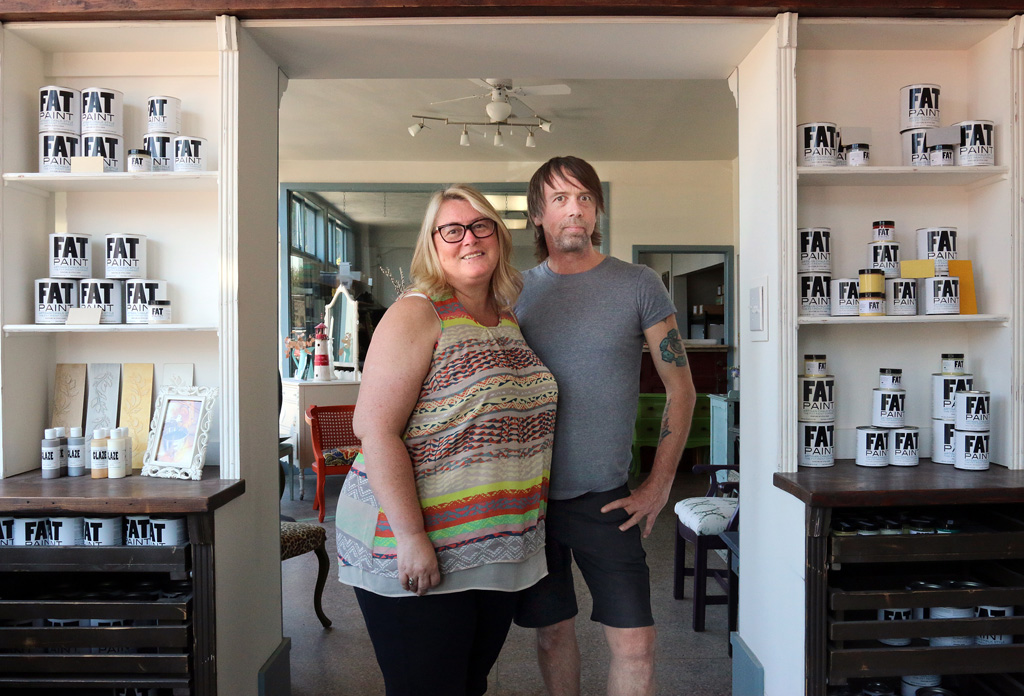
The FAT Paint Company is a New Westminster success story.

It started on a kitchen counter when Victoria Lambert and her brother, Bradford, were refinishing some furniture pieces.

Bradford worked in the film industry and he was familiar with a technique of mixing paint and chalk used by set decorators to give wood a weathered, authentic look. The chalk paint, known in the biz as “fat paint,” was versatile, easy to work with, dried quickly.
The refinished furniture pieces were a hit. The siblings decided to can their paint, and share their technique.

Today the Lamberts and their staff develop, mix, can and market their FAT Paint from a 3,065-square-foot production facility in a converted auto repair garage at the foot of 11th Street. More than 100 retailers across North America, from St. John’s, Newfoundland to San Antonio, Texas to Fort Nelson, British Columbia, sold 357,359 cans of their paint last year.

FAT Paint is available in nine provinces and 14 states, with plans to expand overseas in 2017.

But much of the work to make FAT Paint is still done by hand.

Until a recent move to automate the mixing process, the chalk and paint were combined in an old, repurposed industrial bread mixer.

Pouring the paint into 1-litre cans, sealing the lids and affixing the brand’s distinctive black and white labels gets the human touch.

Confidence and customer service

This story was first published on my cycling blog, The Big Ring.

Confidence is the cornerstone of athletic achievement.

Gold medals aren’t won by the timid or meek.

When an athlete steps up to the starting line, climbs on the block, straps into their seat, clips into their pedals, they have to believe in their ability to compete with their rivals, to win.

They also have to have confidence in their equipment, that it will perform as they’ve come to expect, that it will hold up to the most vigorous demands, that it will enable their best performance rather than disable it. In fact, their confidence in their equipment has to be so strong, they don’t even question its capability.

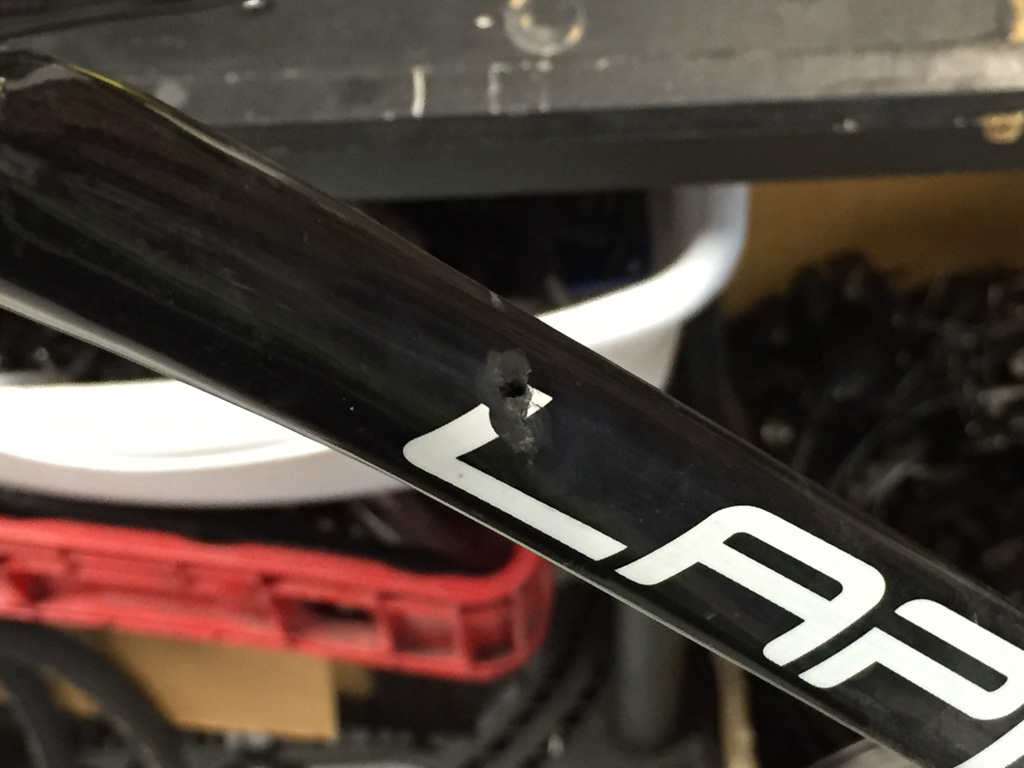
At the end of August, when a spoke on my rear wheel snapped during a speedy descent the damage went beyond the wobbly wheel and the carbon fibre stay that had been pierced by the flailing spoke. My confidence in my equipment had been compromised.

Mario Bartel cyclist storyteller photographer blogger communicator
Damage to carbon fibre like a crack or puncture can be fatal. Repairing it is specialized work.

The spoke was quickly replaced.

And thanks to the specialized craftsmanship of Robert Mulder of Roberts Composites in North Vancouver, the stay looks as good as new, even if it is missing a Lapierre decal.

Mario Bartel cyclist storyteller photographer blogger
If it wasn’t for the missing decal, it would be hard to discern the chain stay had ever been damaged.

Mulder guarantees his work. His reputation for excellence has been built on years of minor miracle repairs to shattered frames, broken seat posts and well as custom building handlebars, rudders for sailboats, oars for paddlers.

The wheel was a longer journey.

When I was researching the Easton EA70s as a possible replacement for my worn Fulcrum 5s, I came across a few posts in forums and reviews that detailed dismay about broken and popped spokes. But almost all of those were from four or five years ago. The current model, according to the shop where I bought them, and Easton’s website, is a new design.

I laid down my credit card. With confidence.

And frankly, until the spoke issue first presented itself , the wheels had performed admirably. They rolled smoothly. They were relatively light. They seemed strong.

But the spoke failure shook my faith. Perhaps the wheels had something to do with the frequent flats I endured this season? Would other spokes fail? Could I count on the wheels to hold up during speedy descents?

My ears listened for every tell-tale click or pop that might indicate another spoke exploding.

To its credit, Easton stood behind its product.

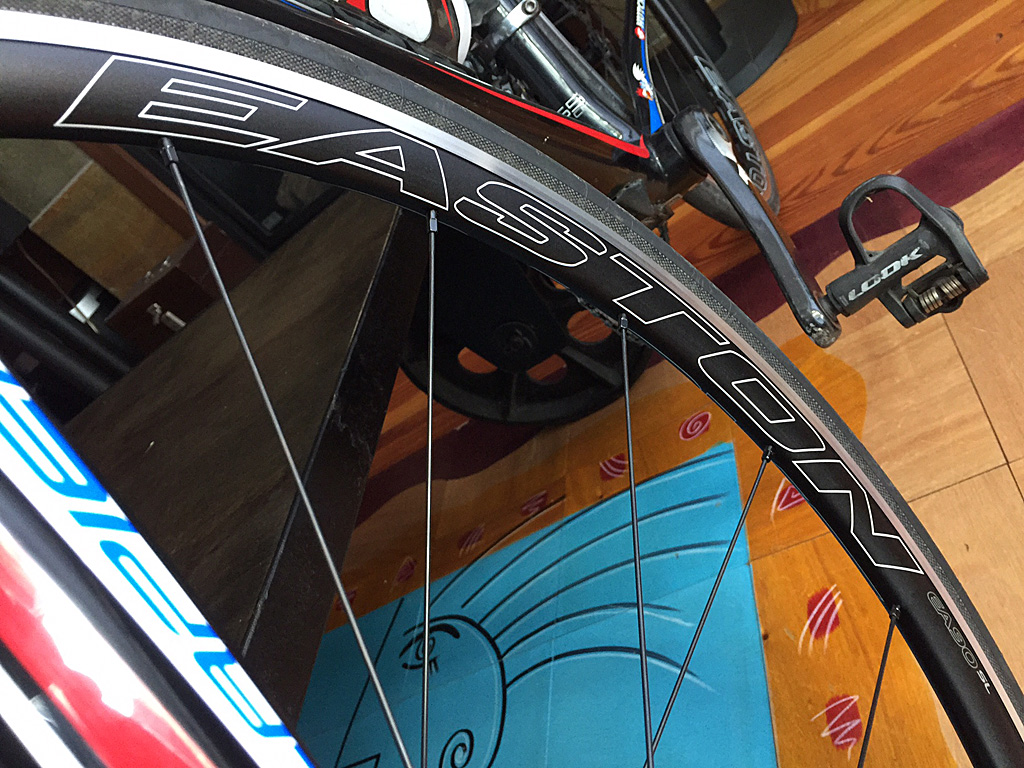
Shortly after I posted my story of the Fondon’t failure, and promoted it on social media, they reached out and offered a deal I’d be hard-pressed to refuse; send back my EA70s, plus a little money, and they’d upgrade me to their top aluminum wheelset, EA90SLs.

The new wheels are a revelation. They’re extremely quiet and beautifully smooth. Their lightness, 200 grams less than the 70s, was immediately apparent the first time I hoisted the Lapierre.  That seemed to translate to the road as well.

Mario Bartel cyclist storyteller photographer communicator blogger
New wheels and renewed confidence in my equipment.

As for their durability; only time will tell. For now my confidence in my equipment has been fully restored.

Of course now that Easton customer service has whetted my appetite for $1200 wheels, my upgrade path just got a whole lot more complicated. And expensive. First World problems…

Celebrating a life’s milestone

Not a lot of life’s milestones achieve 25 years anymore. Jobs at the same employer rarely endure that long, let alone careers. People rarely live in the same apartment, same home for a quarter of a century. And fewer couples are attaining their silver wedding anniversary.
So I’m pretty proud that the little pick-up road hockey game I started with some buddies one fall morning 25 years ago is still going on. In fact, it may rank as one of my life’s achievements.
Over the years, generations of players have come and gone; only two of us remain from that inaugural match.
We’ve played through all kinds of weather. We’ve survived injuries, bad feelings, spells of complacency, goalie crises, shoddy equipment, no equipment and even the occasional locked-up court.
Through it all, we’ve been driven by the game’s spirit of camaraderie, the joy of competition without consequence, the connection we forge with the changing seasons and passing years, the pursuit of lasting youth.
Most of the games have been documented by renowned road hockey beat reporter and photographer Jay Suburb; first in a photocopied handout, The Road Hockey News, then on a Geocities website, Road Hockey Illustrated, and for the past 13 years on the blog, roadhockey.net.
Sunday, we officially opened Sunday Morning Road Hockey’s silver anniversary season.

Mario Bartel road hockey photojournalist storyteller communicator
Colonel tries to beat Joker with a wrap-around late in Sunday’s regluar season opener.

Quick shots a victorious recipe for undermanned team in season opener

Colonel’s languid attempt to wrap a shot around from the back of the net past Joker’s outstretched pad late in the game may have been the longest anyone on his team possessed the ball Sunday.

And while he didn’t score on that play, the wily veteran and his mates used quick crisp passes and timely shots to overwhelm their opponents 15-10 in Sunday’s regular season opener.

Playing without the benefit of a spare player to shift off for refreshed legs, Colonel and his mates kept the pressure on all game by keeping the evil orange plastic ball moving, even if their feet weren’t. That kept their opponents on the run, and Joker on his heels.

“Our passes were a little crisper, our shots were a little faster,” said Colonel. “Sometimes all you need is that extra split second and they go in as opposed to not going in.”

Joker admitted he had trouble tracking the ball at times as it moved quickly back and forth between the opposition’s stick blades.

“They were one-timing shots, and we were taking our time.”

The up-tempo playmaking was rewarded by a quick 5-2 advantage. But Colonel and his mates were wary to keep the pressure on.

“We came out pretty fast, but we learned pretty quick the game would go on for a while,” said the veteran centreman. “We had to keep our noses down and take chances when there were opportunities.”

Joker said his side’s man advantage may have kept their legs fitter but dulled their mental sharpness. Knowing they might be able to outlast their opponents in a longer game, played hung onto the ball, made the extra pass, moved the ball around the court more before taking a shot.

“We were taking our time,” said Joker. “We were accepting the pass and then setting up to shoot as opposed to shooting right away.”

That gave Lak Attack ample time to set up for saves. And, but for a brief lull in the second period, he was equal to the task.

That lull coincided with the underdog’s renewed effort sparked by Joker’s temper tirade  after successive goals stretched the lead even further. Kid, Bam Bam and even a pair by the Living Legend pulled the underdogs to within a goal, 10-9, at the second break.

But that was as close as they got.

Of mud and glory

What happens when you cross a bike race with a mud bog?

Queens Cross.

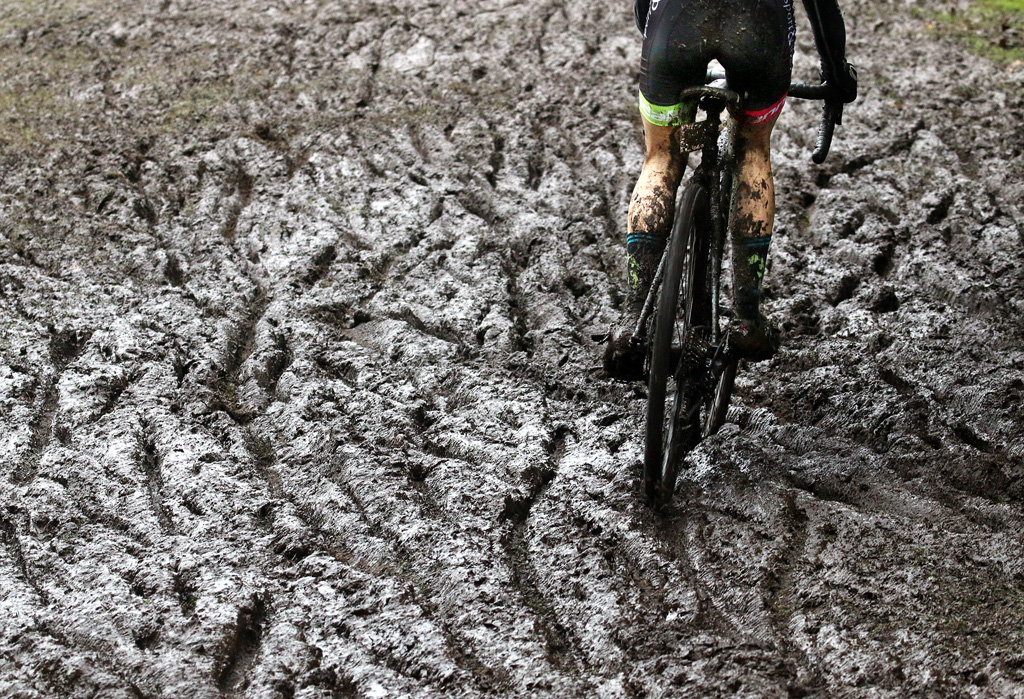
Saturday’s driving rainstorm may have deterred all but the hardiest spectators, but dozens of riders from beginners to elite men and women relished the chance to battle each other and the elements at New Westminster’s Queen’s Park in the fifth race of the eight-race Vancouver Cyclocross Coalition’s series.

Cyclocross is an off-road version of a road cycling criterium race in which riders lap a number of circuits on a two or three kilometre course comprised of dirt trails, grassy meadows, over barriers and across creeks or gullies. It evolved in Belgium and Northern France in the early 1900s as a way for road cyclists to stay fit during the fall and winter off-season. Sometimes getting to the warmth and shelter of the nearest café or brasserie meant cutting across farmer’s fields and through forests; cyclocross replicates that experience.

Saturday’s cold torrential downpour was worthy of the worst weather of the Ardennes and turned most of the course at the west end of Queen’s Park into a track of thick, viscous muck. At the end of each event, the line at the hose station was 20-30 muddy cyclists deep. Even through their exhaustion, many managed a smile. After all, there’s often a rainbow at the end of a rainstorm.

Full results

One year out; post journalism reflections

A year ago I walked out of a newsroom for the last time.

Oh sure, there have been social visits to other newsrooms, even a couple of freelance gigs. But when the new owners of the Burnaby and New Westminster NewsLeaders decided to pull the plug and end the illusion of competition with their established papers they’d maintained for six months, I knew my 31-year run as a newspaper journalist was done.

160929oneyear1
Before there was the internet and we didn’t have to shoot and edit video nobody watches, write stories, produce podcasts, Tweet and Facebook, we actually had some time to have fun.

It’s been happening everywhere in our industry. As readers and advertisers abandon newspapers that can’t decide whether they want to be newspapers or low-rent TV stations because owners have no idea how to harness the internet, reporters, photographers and editors are being kicked to the curb by closures, layoffs and buyouts. Many of us are senior, experienced leaders in our newsrooms with years of institutional knowledge, deep connections in the communities we cover. Management regards that as a burden on their bottom line. For readers and advertisers it’s a tragedy, as they lose voices they’ve come to trust and appreciate. And so the swirl down the drain accelerates.

Mario Bartel storyteller photographer journalist communicator
Blowing off steam between assignments in the studio.

Journalists don’t just wear their journalism jacket when they’re on the clock. You live and breathe it 24/7; when you watch the evening news, surf the web, read the work of other journalists, you do it through the prism of journalism. You have an appreciation and respect for the work it took to tell a story.

Mario Bartel storyteller photographer journalist communicator
Remember when journalists smoked in the newsroom, kept a mickey of Scotch squirreled in a desk drawer? This guy, John Wawrow, is one of the best old-school reporters I’ve worked with. He’s still hanging on, covering sports for AP in Buffalo.

As a photographer my head was always on a swivel as I drove around town, keeping an eye out for something new or different that might be newsworthy or could make a good photo.

I still do that.

As recently as five years ago, I could never have imagined myself not being employed as a journalist. But as the dominoes of our industry began falling all around and parties for parting colleagues became more frequent, the possibility became more and more real.

Still, we forged on, the stress of uncertainty roiling our bellies even as we put out good papers with fewer resources and increasing demands on our time to feed the internet beast even if it never reciprocated our attention to its insatiable demands; of the hundreds of crappy videos our newsroom produced for our websites, I don’t recall ever seeing one second of advertising pre-roll.

When the hammer dropped, it fell with a thud of inevitability.

Not that that made it any easier. Denial is a powerful coping mechanism. It’s also extremely exhausting. When our fate was sealed, it was as liberating as it was frightening.

As far as I know, most of my NewsLeader colleagues are working again. Some of us are still finding our legs in new professions, learning new skills. We’re moving forward, instead of hanging on for dear life.

All steamed up

Steinbier is German for stone beer. It’s a traditional method of brewing beer in Bavaria and parts of Scandinavia that uses super-heated granite stones to boil the wort.

The quick caramelization when the rocks are dropped into wort, or the wort poured over the hot rocks, creates a smokey, slightly sweet and malty beer.

German brewmaster Sebastian Sauer, of Freigeist Bierkultur in Cologne, recently visited Steel & Oak Brewing Co. in New Westminster, to share this old-world brewing technique.