Brewing beer at Steel & Oak is part science, part art and a whole lot of toil.
Since opening in the summer of 2014, the craft brewery next to the Third Avenue overpass has already expanded its beer making capacity to 270,000 litres and added a bottling line. The tasting room has become a community gathering place; even baby momma groups meet there on some afternoons, their strollers parked akimbo amidst the tall industrial steel stools and wooden tables.
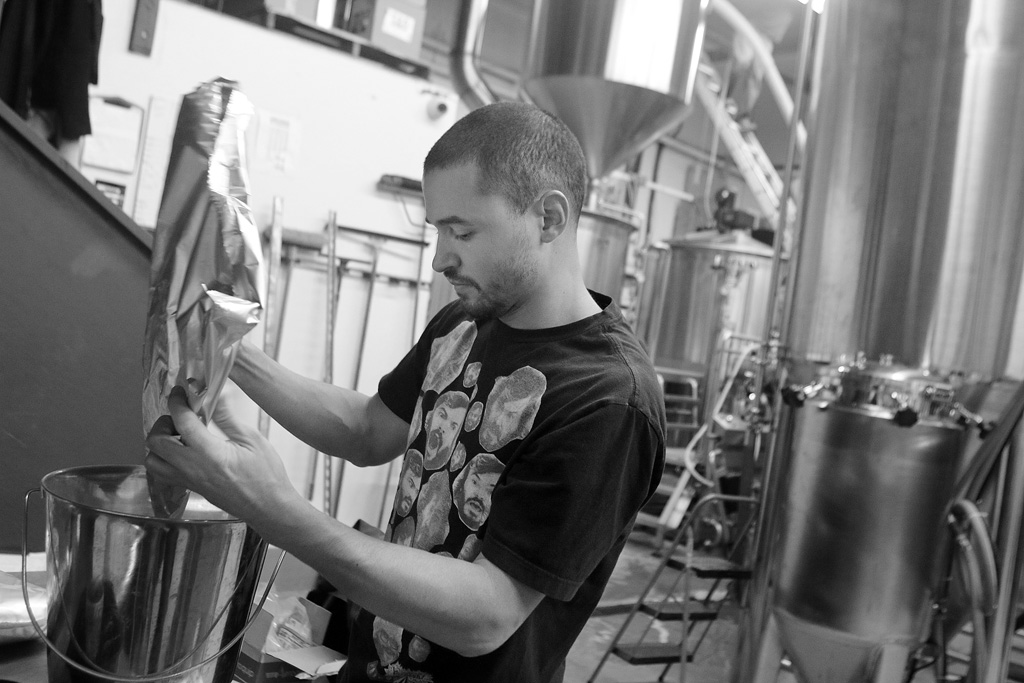
Wong weighs Perle hop pellets that will be added to one of the 1,700 litre brewhouse tanks.
Brew day is a frenetic dance of multitasking as beer is brewed, empty tanks are cleaned and kegs are filled for shipment. Wong refuels with a banana.
About 250-300 kilograms of malt is used for every 1,700 litres of beer brewed at Steel & Oak.
A bucket of hops is ready to be poured into a brewhouse tank. Steel & Oak uses about 5,000 pounds of hops, in 50 different varieties, in a year.
Brewmaster Peter Schulz ponders the day’s batch of red pilsner.
Wong checks the progress of the beer brewing in one of two 1,700 litre brewhouse tanks.
Steel & Oak has seven beer tanks that can hold a total of 270,000 litres of beer.
The used mash is gathered in big 369 kilogram bins and shipped to a farm in Aldergrove where it’s used for feed.
Jordan “Chardonnay” Wong fills a cask amidst the towering 3,000 litre stainless steel tanks.
Wong retrieves a storage vessel that will be filled with used mash.
Some of the beer ages in steel casks, while others are finished in oak barrels, hence the brewery’s name.
Wong checks the sugar content of the day’s brew, to ensure it’s ready for the next stage.
But it’s in the back where the magic happens.
In 18 months, brewmaster Peter Schulz has concocted 23 different beers, including new pilot beers every four-six weeks. The explosion of craft brewers in Metro Vancouver has made it a very competitive business said Schulz. The pressure is on for brewmasters to offer unique recipes.
Brew day at Steel & Oak is controlled chaos. Hoses are detached and reattached. Temperatures, sugar content and clarity are checked and checked again. Hops are weighed and added to the giant 1,700 litre brewhouse tanks. Water spills and sprays, running down the gently-sloped concrete floor to a trough amidst the forest of seven tall stainless steel vessels.
Schulz said making beer is very water-intensive; about seven litres is used for every one litre of beer that is produced.
It takes Schulz and his crew four weeks to brew ales, six weeks to produce a lager. That’s longer than most breweries, said Schulz. But the wait is worth it. His beers have won numerous awards, including best amber/dark ale at the 2015 BC Beer Awards last November.
An expert on business ethics says the release of the Panama Papers could be the spark that ignites social movements to close the wealth gap between rich and poor.
David Silver, the chair in Business and Professional Ethics at the University of British Columbia’s Sauder School of Business, says the millions of documents that detail some of the ways corporations and individuals shelter wealth in off-shore tax havens represent a moral crisis that is “corrosive of democratic society.”
“Just because something is legal, doesn’t mean that it is moral,” says Silver, who’s also the director of the W. Maurice Young Centre for Applied Ethics that is comprised of social scientists and philosophers studying the ethics of business and professional procedures, new technology, healthcare and environmental practices.
The Panama Papers consist of more than 11 million files leaked from the database of Mossack Fonseca. The world’s fourth-largest offshore law firm specializes in creating shell companies where the elite can hide their wealth from tax collectors or other legal obligations like lawsuits or divorce settlements.
The documents were obtained by a German newspaper last year. Since then a consortium of investigative journalists from around the world have been sifting through them to uncover a shadowy world of some 200,000 companies that exist largely in name only to anonymously hold bank accounts and property in tropical tax havens like the British Virgin Islands, the Bahamas and Panama.
So far 12 world leaders are among 143 politicians, their families and close associates who have been implicated in using the tax havens. They include Russian president Vladimir Putin, the prime ministers of Pakistan, Nawaz Sharif, and Iceland, Sigmundur David Gunnlaugsson.
The latter resigned when the documents revealed he and his wife hid substantial assets in an offshore shell company even as Iceland faced a financial crisis that forced the country to seek bailout loans and impose currency controls.
Silver says while hiding wealth offshore isn’t illegal, it’s gotten worse in recent decades. He says that’s contributed to the growing gap between the rich and everyone else.
“There is less available to pay for essential public services like health, education and retirement security,” says Silver, a former philosophy professor whose research into issues like corporate taxes and offshore shelters precipitated his transition into business ethics. “Every citizen has an obligation to honestly declare all wealth and income, and to pay the taxes that their fellow citizens have democratically decided upon.”
Silver says seeing that activity documented in black and white confirms “the suspicion that the game is rigged; there are wealthy people and politicians in ‘corrupt’ countries that squirrel away money in ‘clean’ countries that are all too happy to accept it.”
While only one Canadian bank, RBC, has been linked to the Panama Papers, Silver says that’s enough to question whether the banks have been as forthcoming about offshore activities as leading corporate citizens should. Prime Minister Justin Trudeau recently called for more transparency in global financial transactions.
While the full scope of the documents has yet to be revealed, and the implications of the leak are just beginning to play out, Silver says “at the very least, “it provides fuel for anger at the unjustness of it all.”
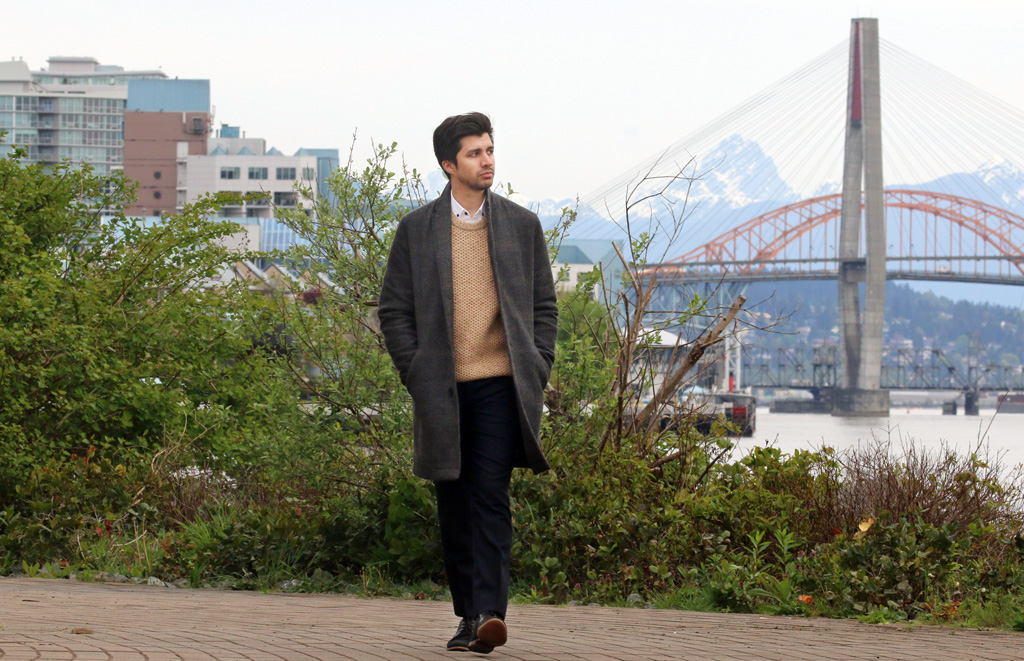
Photo by Mario Bartel The short film Alex Farah made as his graduation thesis at Emily Carr was nominated for five Leo Awards. Now he’s hoping to take his filmmaking aspirations to the next level by attending the American Film Institute in Hollywood.
This story was done for Tenth to the Fraser, a community news blog in New Westminster.
Alex Farah knows the transformative power of film.
Now the Queensborough resident is hoping a financial challenge won’t trip up his transformation into a filmmaker on the cusp of a breakthrough.
Farah, 24, has been accepted into the Director’s Conservatory at the prestigious American Film Institute in Hollywood. It’s a huge step forward in the budding career of the Emily Carr grad whose student thesis short film, Sahar, was nominated last year for five Leo Awards, the top honour for films produced in British Columbia.
But it comes with a cost; more than $200,000 calculates Farah. That’s to cover tuition, living expenses and incidentals through the course of the two-year program that’s produced notable alumni like David Lynch, Darren Aronofsky and Terrence Malick.
Farah’s path to filmmaking started while he was studying sciences at UBC; he took a couple of film courses out of interest and discovered a medium that could allow him to explore some of the cultural challenges of being an Afghan immigrant. He shifted gears and enrolled at Emily Carr, where he learned every aspect of his new passion, from writing to cinematography to editing.
Farah also ran headlong into the expense of becoming a filmmaker.
His student short, which was based on the real-life Shafia honour killings in 2009 of three teenage sisters and their step mother whose bodies were found in a car in the Rideau Canal in Kingston, cost $5,000. He assembled the money from six years of making lattes at Starbucks. It debuted at the Toronto International Film Festival.
Getting a film seen on the festival circuit also costs money, for submission fees, shipping, promotion, even travel to the festival if filmmakers want to take full advantage of its networking opportunities.
“You’re never really making back the money you put into your film,” said Farah.
So many young filmmakers take advantage of the internet, submitting their projects to websites like Short of the Week. That’s what Farah did, which led to greater exposure as a Staff Pick on the streaming video portal Vimeo as well as a number of film blogs.
“Online status is turning into a thing, which website will host your film first,” said Farah. “It’s huge for North American filmmakers.”
Earlier this month Sahar was presented at the Moov film festival in Brugge, Belgium.
But that achievement pales in comparison to the effort Farah put into his application to AFI, which involved an interview, writing four essays as well as scripting, producing and directing a five-minute short on the theme of surprise.
The process took about a month, including two weeks dedicated to the film, which he shot in an audition studio at a Vancouver talent agency where he’s currently interning.
Farah said the opportunity to attend AFI is a chance to make connections in the film industry and develop his filmmaking skills with some of the brightest young talent from around the world; only about 100 students are accepted into the school every year, which also has academies for scriptwriting and cinematography.
“You have top-of-the-line crews. The films are watched by members of the Directors’ Guild,” said Farah. “It’s like a fast track to Hollywood.”
Shortly after Farah learned he was accepted earlier this month, the financial reality hit him.
“It’s super overwhelming,” said Farah.
Since then he’s reached out to his connections from Emily Carr and the local film community, explored student financial aid, arts grants, even met with loan officers from banks and credit unions. But all those sources still leave him short of his needs.
Farah said he’s thought about crowdfunding, but he’d rather save that step for when he’s prepared to make his next film.
Which he’s hoping he’ll be able to do.
“It’s hard to find Afghan-Canadian filmmakers, there’s a diaspora I can tap into,” said Farah. “I feel like I have something to offer the world.”
Lak Attack looks the worse for wear after he was clipped by a stick early in Sunday’s Stanley Stick opener.
For 24 years I’ve journeyed back to the carefree days of my youth by playing road hockey every Sunday morning from October to May. The stories and photos of those games are chronicled in my weekly blog roadhockey.net
The only thing gorier than the bloody cut suffered by Lak Attack in Sunday’s Stanley Stick opener was the final score.
The versatile veteran shook off the high stick that clipped his left eyebrow to lead his team to a dominating 20-6 win in the first game of the two-game championship finale.
After a tight first half in which the underdogs got to within three goals, 8-5, fatigue and heat took their toll and the winners outscored their beleaguered opponents 10-1 after the break.
Having an extra player to sub off tired legs certainly worked to their advantage in the balmy conditions, said Colonel.
“it was a warm day and any time a team doesn’t have a sub at all, it just allows the team with a sub to stay fresh and go hard every shift.”
But to take full advantage, the winners had to strike quickly. Which is exactly what they did despite being outplayed in the early going, said Doo.
“They were generating chances,” said the speedy centerman. “But that was classic offence from defence for us from the beginning of the game.”
Joker also stood tall in the net, rebuffing Bam Bam and Cleveland in close.
Joker wipes the sweat from his brow as Sunday’s Stanley Stick opener was also the warmest game of the season.
“He did well to be there when we needed him,” said Colonel of his veteran goalie. “It’s a big boost because you know you can take a few more chances offensively.”
They executed their game plan perfectly.
“They got a couple of quick goals and the momentum was always on their side,” said Bam Bam.
A brief flurry and some fortuitous bounces got the underdogs close early in the second period. But Doo said his side kept its cool.
“We had a lot of veteran presence on our team… so we didn’t panic.”
Which is what the underdogs will have to remember if they’re to win Sunday’s second game to force a deciding sudden death mini game.
“All you need is one win to send it to the mini game,” said Bam Bam. “We’ve got to create more offense, take more shots, keep it simple.”
Despite Sunday’s lopsided score, the leaders aren’t taking anything for granted.
“I don’t think we got the other team’s best game this week,” said Colonel. “Next week they’re going to come out hard, feel rejuvenated. It’s going to be a whole other game.”
Doo said his side’s experience will serve them well to maintain an even keel.
“When you’ve been around enough Stanley Sticks, you know each game is completely different. We’ll have to rely on our veteran experience and patience next week.”
This anniversary ode to my bike was originally published on my cycling blog, The Big Ring
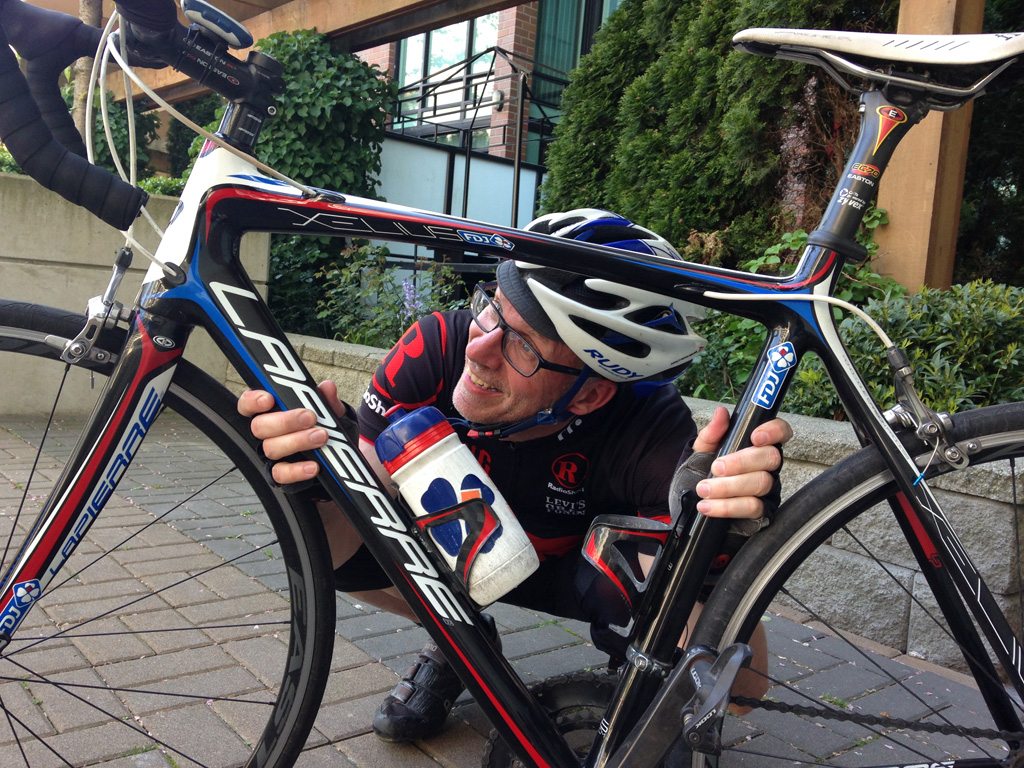
Five years after my first ride on my Lapierre road bike, we are still in love!
Five years ago, Lapierre and I consummated our affair.
Ours had been a whirlwind courtship conducted from afar, loving glances at images of her in action.
Her supple curves and quiet confidence set her apart from the others, like the wispy, colourful Italians, the brash Americans, the functional yet unattainable Germans, the socially conscious Spanish. She had surprises, unexpected touches of endearing and exciting flare; the thumbprint of her creator, the racing rooster tattooed on one of her lithe limbs.
When finally we were in each other’s company, we knew ours was a relationship of destiny. Our first forays into the world as a couple were greeted with sideways glances, probing questions: Who is this Lapierre? How did you meet? What are your plans?
It’s funny to think back on the innocence of those early days when being together was all that mattered. Five years, and more than 20,000 kms on, we are still inseparable, still bonded.
Lapierre moves me when I’m mired in inertia. She challenges me when the road ahead rises up, protects me and wraps me in comforting confidence when it pitches down.
When we are together I want to travel as quickly as she will allow me, yet slow to enjoy our every moment.
I glow with pride when others give an approving nod, make a passing compliment.
While others succumb to fashion’s fickle trends, Lapierre’s beauty is timeless; there is no fluo in her wardrobe.
Some have questioned the future of our passion; will we stay together? They point to other seductive temptresses with their electronic baubles and more advanced bangles. They say just as Lapierre usurped my ardour for Orbea, a new love will catch my eye, tickle my desire, grip my heart.
Perhaps that will happen. You know what they say at the bike shop; once a wanderer, always a wanderer.
But in the warm spring sunshine, as Lapierre and I move as one, it’s hard to imagine…





 MARIO BARTEL