Telling stories in a pandemic

The past four months have been: exhausting, exhilarating, challenging, frustrating, frightening, disorienting, illuminating and rewarding. They’ve also been frantic, difficult in many ways, actually easier in others. There have been days fuelled by adrenaline, others bogged by drudgery.

I guess that’s what it’s like to cover the biggest story of our lifetime, the COVID-19 pandemic.

Initially, it seemed so remote as our newsroom localized stories of the respiratory virus sweeping through faraway cruise ships by chasing down family members of some of those trapped in seagoing quarantines.

Then, suddenly, it was upon us and we were being advised to prepare to begin working from home.

Those initial days were a blur of feeding constant updates to our website of postponements, then outright cancellations and closures. Like waves, they kept coming. We were telling the story of the dismantling of virtually aspect of our lives that we’ve come to take for granted. Every five minutes the news just seemed to get worse.

Along the way, we lost colleagues — our longtime editor and most senior reporter — as the pandemic also became an economic catastrophe. None of us were in the newsroom to say goodbye.

When we were first dispatched to our ad hoc home offices, most of us thought it would be for no more than a month, maybe six weeks. We cobbled together new systems for copy flow, dug out earbuds from desk drawers to be able to conduct all of our interviews by phone as well as hear each other during virtual editorial meetings. I tried to limit my own excursions out into the community shoot photos to an afternoon or morning a week.
Freebie stock photos became our visual tool of necessity, as much as that pained me as a photojournalist who’s felt the sting of our profession’s devaluation over the last decade.

0409-Blossoms 1ww
MARIO BARTEL/THE TRI-CITY NEWS The blossoms are in full bloom at Coquitlam’s Town Centre park, bringing the hopefullness of spring amidst the anxiety of the public health and economic crisis brought on by the COVID-19 pandemic.

Once everything had been cancelled or closed, we shifted our coverage to tell the stories of coping: businesses finding new ways to serve their customers; educators and students navigating the unfamiliar world of remote learning; gyms going virtual; breweries doing deliveries; artists and musicians stretching their creative inclinations in unexpected directions; people figuring out ways to stay connected in a world of self-isolation.

The innovation, determination and resilience we encountered in the community every day was invigorating, a balm that countered the daily dose of bad news about infection rates, deaths and a grim prognosis for the future.

Now, as the smothering blanket of the public health emergency begins to slowly, carefully lift, we are telling the stories of what the new normal is going to look like for the next while: what it’s like to get a haircut; go out for a meal; participate in civic affairs; get a library book; visit a park. Every aspect of the communities we cover, the routines of daily life must now be viewed through the prism of the pandemic, which makes pretty much everything newsworthy.

It’s simultaneously daunting and energizing.

It’s introducing us to people and corners of our communities that we might not otherwise have ever known about. It’s challenging us to tell stories in new ways. It’s opening our minds to possibilities. It might even be wiping some of the jaundice from eyes that have seen so much over the years they’d become numb.

Over the next little while, I’ll be reprising some of my favourite stories of the past several months, a moment in our time, and my career, unlike any other.

Looking back at 2019

Photos are the soul of a newspaper, our windows into the communities we cover and the stories we tell.

What might take a writer several sentences or paragraphs to tell, a photo has to capture in a mere glance. And getting to that storytelling moment isn’t just a matter of holding up the camera and saying, “OK, now it’s time to take a photo.”

A good photo isn’t “taken.” It’s made.

Good photography can seem effortless. But into each photo goes a multitude of decisions, all of which must inform how the push of the shutter button will serve the story, whether it’s on our website or in our weekly print edition.

At a time when pretty much everyone can take a photo by reaching into their pocket and pulling out their smart phone, news photos have to be something more than just a record that somebody showed up and did just that.

Here, then, is our retrospective of some of the photos we made in 2019, along with a bit of information about the thought processes and technical considerations that went into them.

Despite personal loss, Clay keeps winning

This story originally appeared in The Tri-City News.

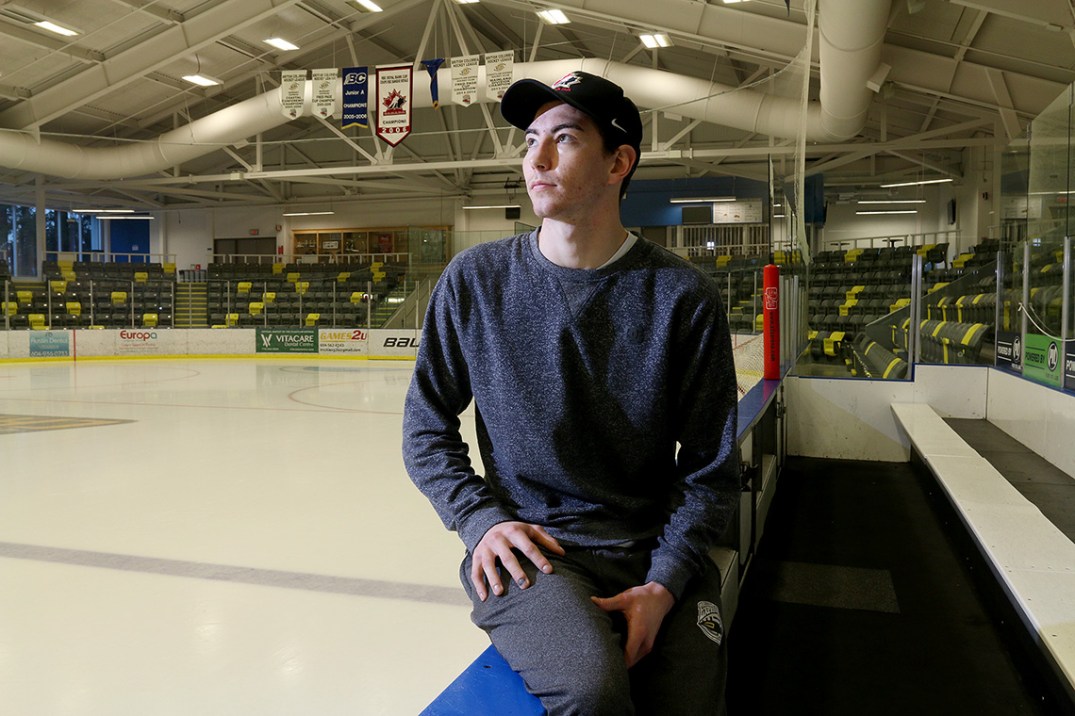
Clay Stevenson knew everything was going to be alright when he made 39 saves and shut out the Surrey Eagles 3-0. It was his first game of the BC Hockey League season, and the second for his Coquitlam Express.

It was also his first time strapping on his goalie equipment since his mom, Holly, died by suicide just 10 days earlier.

Stevenson, in his third year with the Express, said that moment has helped propel him to the best season of his career. And his team has followed, all the way to the top of the league standings.

A middle child between two sisters, Stevenson grew up in Alberta and British Columbia after his parents split up when he was a toddler.

At 16, Stevenson finally made the decision to move in with his mom, who was living in Chilliwack at the time, as the Lower Mainland offered more opportunities and access to better coaching to pursue his hockey ambitions.

Stevenson said his mom was always supportive, even as she endured personal struggles with her sexual identity and navigated a challenging career change from dental assistant to paramedic.

When Stevenson left for 100 Mile House to play Junior B, his mom arranged to be posted in that community’s ambulance station so she could support her son and even catch some of his games between shifts.

Stevenson said her sacrifices to ensure he always had the right equipment and to get up at four in the morning so he could get to practice left an indelible mark.

“I wanted to do my best to show her that it was going to pay off.”

It wasn’t always easy, though.

After playing 25 games for the 100 Mile House Wranglers, where he posted a 3.12 goals-against average, Stevenson joined the Express for the 2017/’18 season. He won only four of the 23 games he played, and his GA average ballooned to 3.89.

Still, Stevenson said the foundations of fortitude and perseverance he learned from his mom pushed him forward.

“Everything she did, she wanted to do to the best of her capabilities,” he said. “That rubbed off on me.”

The next season, Stevenson won 14 games and cut more than half a goal from his average. The congratulatory texts from his mom and the proud postings on her Facebook page became more frequent.

“Honestly, it was a bit embarrassing, but that’s what she loved to do.”

TRAGIC NEWS

Stevenson learned of his mom’s death after a practice.

He was watching TV with his “billet brother” at the Coquitlam home where he stays during the season when his younger sister, Brie, showed up at the front door.

Stevenson said he knew his mom had been having a difficult year, struggling with her mental health, but he never expected the news his sister delivered.

It hit him hard.

The next days were a whirlwind as family came to town and a funeral had to be arranged.

Stevenson missed a pre-season game. But on Sept. 7, he attended the Express’ regular season opener, watching his teammates from the stands.

“Going to the rink takes your mind off things,” Stevenson said. “When I come here, I know it’s going to be a normal day. Just go out there and play hockey.”

Express coach Jason Fortier said creating that sense of normalcy was key to helping Stevenson and his teammates get through the tragedy.

“We’re here to support the players in any way we can,” he said.

By Sept. 10, Stevenson said he was ready to play, saying it’s what his mom would have wanted.

“My mom loved hockey,” he said. “She wouldn’t want me to mope around.”

COURAGE & RESOLVE

Stevenson said he was nervous about how he would get through his first game knowing he would never see his mom smiling up in the stands again or receive one of her texts after a good performance. He pulled a chain through one of her rings that she often wore to twist away her anxiety and wore it around his neck.

Stevenson said that first game back after her death got easier as it went on.

“After the first period, I knew I had to be clear and present, and knowing what I had to do out there.”

He was all that and more. His shutout earned him recognition as the game’s first star. More importantly, he set an example for his team that has reverberated through the season.

“The way I was able to handle myself in that situation was a symbol of strength for my team,” he said. “We can get through anything and come out on top.”

Fortier said Stevenson’s courage and resolve to get through his first game became a bit of a rallying point for the whole team.

“It built confidence in themselves at how good they can be to help their teammate achieve something special,” he said.

The clarity Stevenson achieved in that first game hasn’t waned. He has posted 22 wins and just two losses. He has three shutouts and his goals-against average is a miserly 1.45. He was the league’s player of the month for November.

1226-StevensonFile 1ww
MARIO BARTEL/THE TRI-CITY NEWS Coquitlam Express goalie Clay Stevenson stops Penticton Vees forward David Silye in tight in the second period of their BC Hockey League game, Wednesday at the Poirier Sport and Leisure Complex.

And while his mom may not be physically present at the rink or on the phone to share his success, Stevenson said he still feels her presence.

“I don’t know if I’m a spiritual guy, but I like to think she’s looking down and watching me when I’m playing,” he said, adding she may even have a hand when a shot he’s missed hits the post behind him.

“I want to keep making her proud.”

The hoop heard ’round the internet means so much more at Port Moody school

There’s few things more aggravating to a newspaper journalist than getting beat to a story by TV. That’s especially true today, in this post-literal-all-social-media-all-the-time age when too many people get their immediate news high from quick-hit, superficial digital media; why bother taking the time to read a well-crafted story with context and nuance when you can absorb the big bits in a 30-second clip from YouTube?
Last week I got burned twice, in 24 hours.
The first story is one I’ve been sitting on for months, holding off because I was asked to due to its sensitivity. I was confident I would eventually get it, but I was also respectful of the situation.
Then, it showed up on TV.
The other was one of those viral moments that newscasts like to feature because they make people smile or gasp and absolves them of having a reporter or video journalist on the payroll who could otherwise fill that 30-second time slot.
Usually I dismiss such stories, as they tend to flare up and then burn out quickly; such is the half-life of electronic news these days. But this one happened right in our backyard, and I sensed there was likely more layers to the story than the post on Twitter that lit the fuse could summarize in 140 characters.
In such an instance, you’re playing catch-up right out of the gate. That the story caught fire late on a Friday and we don’t work weekends made it doubly difficult.
Should I even bother? I wondered. After all, such stories inevitably become about the number of views the viral video got because viewers love that kind of data and it doesn’t require a lot of manpower or time to tell.
But as the weekend went on, I burned to know the rest of the story. Driving to the office, I resigned to playing catch-up but I was determined to tell the story better, and in a way that would hopefully resonate with our own community.

1205-BasketballHero 2ww

Reid Demelo was excited to get the opportunity to take a shot in a high school basketball game.

But the Grade 12 student at Heritage Woods secondary school in Port Moody never imagined his moment of sporting glory would be seen by hundreds of thousands of viewers around the world on social media platforms like Twitter and Facebook. That it would capture the attention of local TV stations and national Canadian and American networks — including CBC’s The National and CBS Sports. That it would spark an effort by his schoolmates to get him on the Ellen DeGeneres Show.

Demelo’s shot, arcing through the air just as time ran out in the Kodiaks’ opening game of their own ninth annual Kodiak Klassic senior boys’ basketball tournament last Thursday wasn’t a winner. (Heritage Woods beat the Kitsilano Blues handily, 79-45.)

It wasn’t Demelo’s only basket of the game — he had sunk another shot about 20 seconds earlier.

It wasn’t even the first time Demelo had come off the bench from his usual role as team manager to get a chance to play — he’d had a similar opportunity last season.

But that shot was so much more than all of the attention it’s getting.

It was, said Heritage Woods principal Todd Clerkson, a celebration of the power of acceptance and inclusion amongst young people.

“Reid knows everybody,” he said. “He brings people together.”

Demelo has Down syndrome.

His life revolves around sports. In addition to playing basketball, he swims competitively, participates in track and field and ultimate, and he’s on the Team BC Special Olympics training squad for speed skating. He also fills water bottles for his younger brother’s academy hockey team at Burnaby Winter Club.

Last year, Demelo took on a similar role with the Kodiaks senior boys’ basketball team.

In addition to keeping the players hydrated or handing them a towel to dab their sweaty brows, he’s also a tireless booster, said Kodiaks coach Greg Schellenberg.

“Reid is such a positive individual,” he said. “He’s got such a great spirit about him.”

So when the throng of more than 1,000 students that traditionally fills the bleachers for the home school’s lunchtime opener began chanting “We want Reid! We want Reid!” in the game’s waning moments, Schellenberg knew what he had to do.

He affirmed his notion with co-coach Roj Johal, then called a timeout with 35 seconds on the clock to talk to the Kitsilano coach, Sylvester Noel, who gave his blessing.

Demelo got the nod but, as a team manager, he doesn’t have a jersey.

So teammate Morgan Liski loaned him his #11, which Demelo pulled on over his maroon “We are Kodiaks” t-shirt.

Demelo, a point guard who has been playing basketball with the Tri-City Youth Basketball Association — where his mom, Jana Demelo, is also a coach — since he was in Grade 2 and takes every opportunity to shoot hoops with his high school colleagues during practice and at home in his driveway, said he was excited and nervous to get on the court.

“I came out flying,” he said.

Demelo got his first touch of the ball after Heritage Woods regained possession from the Blues on a rebound. He scored.

A few moments later, the Kodiaks were able to wrest the ball away again. Viktor Glogovac made a pass behind his back to Demelo, who corralled it then planted his feet just beyond the three-point line. As players from both sides watched in anticipation, he launched a perfect rainbow. The game-ending buzzer sounded just as the ball crested.

And then, bedlam.

The bleachers emptied in a wild celebration. Demelo’s teammates chased him to the opposite end of the court, where they embraced their manager in a bouncing, roiling dance of unbridled joy.

“That was the best moment,” Demelo said, adding he was thinking of his best buddy, former Kodiak star Zach Hamed, who’s sitting out his first year of basketball eligibility at the University of Victoria this season and was in the crowd at Heritage Woods last Thursday. And he said he thought of the Golden State Warriors’ Steph Curry, the NBA superstar he’d like to meet someday.

Clerkson said it was an apt moment because everybody at the school knows and loves Demelo.

“Reid is just so genuine. He supports all the events at the school and the kids appreciate that,” he said, adding Demelo was presented a special Spirit of the Kodiak award last year for his positive contributions to Heritage Woods and his fellow students.

“Nobody embodies that spirit better,” Clerkson said.

“It was an incredible moment to be there and experience it,” Schellenberg said. “It showcases what a great community we have at Heritage Woods that’s so supportive.”

1205-BasketballHero 3ww

Monday, with the principal handling a steady stream of media requests, Demelo was free to accept the smiles, high-fives and hugs of nearly everyone he passed in the halls between classes.

It’s “awesome,” he said, but the team has a game at the Langley Events Centre in the Howard Tsumura Invitational tournament on Wednesday, and he needs a ride.

When friends open a brewery

There has been more than a few beer stories in these pages. But this latest one has a bit of a twist.

These newly-minted brewers are friends; they ride in our cycling group. Or, at least they did, until they decided to open a brewery.

Actually, their new venture is been brewing for more than a couple of years. But as any entrepreneur knows, getting a new enterprise successfully off the ground all comes down to crunch time.

Thankfully, they were able to take a few moments out of their hectic days leading up to their grand opening to allow me to help tell their story.

Spry seniors pilot Big Bike for charity

As the Tri-City News’ ad-hoc cycling reporter, pretty much any story on two wheels gets sent my way. But not all bikes have just two wheels. Or one rider.

You may not be able to teach an old dog new tricks, but you can get him on a bike every couple of years.
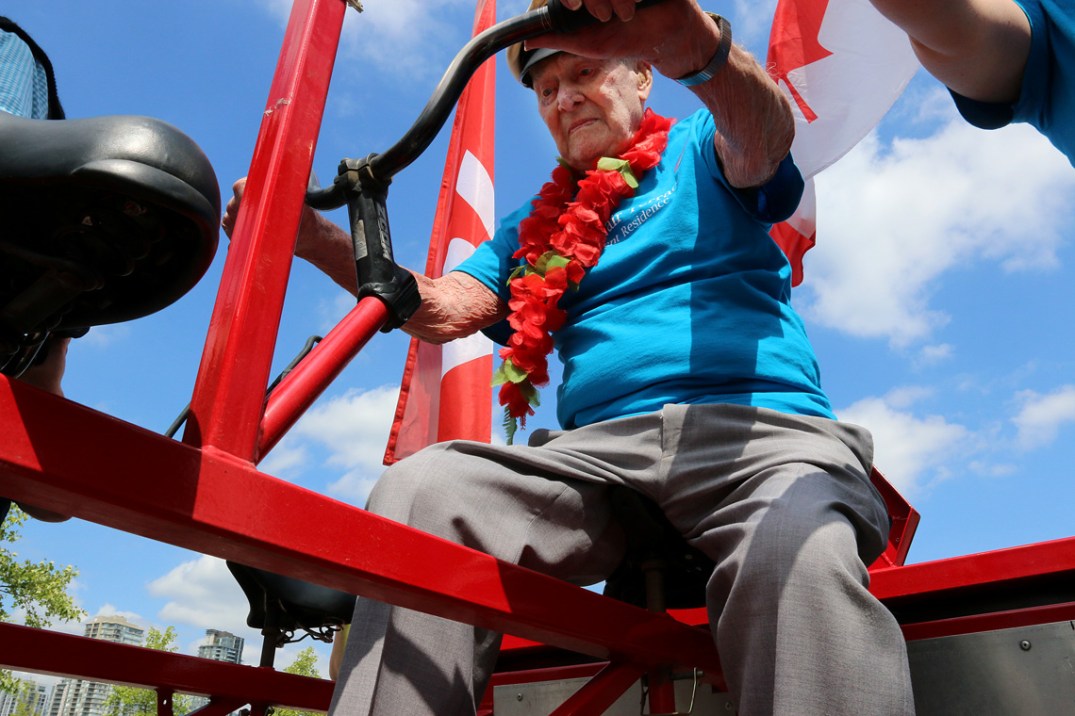
At 106 years, Don Simpson certainly qualifies as old. In fact, according to Phil Reist, the driver of the Heart and Stroke Foundation’s “Big Bike,” he’s likely the oldest participant to ever ride the 29-passenger behemoth bicycle that helps raise money and awareness to prevent heart disease.
Simpson was the captain of a contingent of spry seniors from the Mayfair Terrace retirement home in Port Coquitlam who took the Big Bike for a 20-minute spin on the roads around Coquitlam Centre last Friday. It wasn’t his first rodeo, though.
Simpson cycled the Big Bike when he was much younger — two years ago when he was 104. But he also remembers riding his bike as a boy around Vancouver’s Stanley Park and attending the six-day bike races at the old China Creek velodrome.
“That was our stomping ground,” he said.
So when it came time to climb aboard the gargantuan single-geared machine, Simpson knew exactly where he wanted to be. He ignored the requests of a photographer and cameraman to mount an outboard seat so they could get a clear shot of him pedalling, and instead scrambled — slowly, and with a bit of help — to the middle row at the very back. After all, who’s going to argue with someone his age?
And with a few last-minute instructions from Reist, a shake of the maracas and other noisemakers to ensure passersby notice the big bike — like they’re going to miss it? — they were off.


Beer brings new moms together for support

This story appeared originally in The Tri-City News

Alex Turner was a new mom when she ran headlong into postpartum depression.
She didn’t have it. But the former television reporter felt deeply connected to the news coverage of a young Burnaby mother who’d gone missing for three weeks until her body was found near Bowen Island.
In a heart-wrenching post on Facebook, the woman’s husband said she had been struggling with breastfeeding her newborn son, but without a community of moms around her to provide support and reassurance, she gave into her feelings of guilt and anxiety.
“I could feel her struggle,” said Turner, whose own son was about the same age as the woman’s child. “You have a new person you have to care for, yet you can feel you’re so alone.”
So when Turner became pregnant with her second child, she was determined not to let herself become isolated by creating her own community of new moms who could lean on and learn from each other, who would appreciate the opportunity to just get out of the house.
A year later, Turner’s Tri-Cities Moms Monthly “Meeting” group has more than 500 members from New Westminster to Maple Ridge, several dozen of whom gathered with their infants and toddlers for their regular assembly Thursday at the outdoor patio behind Yellow Dog Brewery in Port Moody.
Turner said while social media like Facebook and Instagram might provide a refuge for new moms, digital connections aren’t a substitute for real, personal interaction.
“You need to come together face-to-face,” she said.
And what better place to do that than the family-friendly environs of one of Port Moody’s craft breweries where moms can have adult conversations while their babies and toddler roll around on blankets spread on the soft wood chip ground of the expansive and shaded back outdoor patio?
“We’re in this together,” Turner said.

The passion of Cosimo Gericatano

One of the (rare) perks of being a journalist is being able to share some stories that are so cool, you’re walking on Cloud 9 when you leave the assignment.
One of my newsroom colleagues heard about a retired Italian engineer, who also ran a Ferrari and Lambourghini car dealership for several years, with a passion for painting reproductions of masterworks by the likes of Da Vinci, Rembrandt, Michelangelo, Gaugin, Renoir. We made arrangements to meet, but nothing could prepare us for the splendour in Cosimo Gericatano’s house.
Every wall, and even some of the ceilings, were hung with precise duplications of renowned paintings that adorn the best museums in the world. Mona Lisa, The Girl with the Pearl Earring, The Creation of Adam, Allegory of the Planets and Continents were all there, every brushstroke and subtle hue recreated over hundreds of hours of exacting work.
Hanging with Cosimo was like spending a couple of hours with the Italian gentleman we all aspire to be, from his crisp cotton shirt and pressed trousers, as well as his trimmed grey hair to his encyclopedic knowledge of the paintings and artists he’s reproduced, gleaned from hours of research on the internet and visits to the museums where the originals are displayed. Not to mention the red Testarossa parked in his pristine garage.
Here’s the link to our story. And here’s the photos I shot.

There will be mud

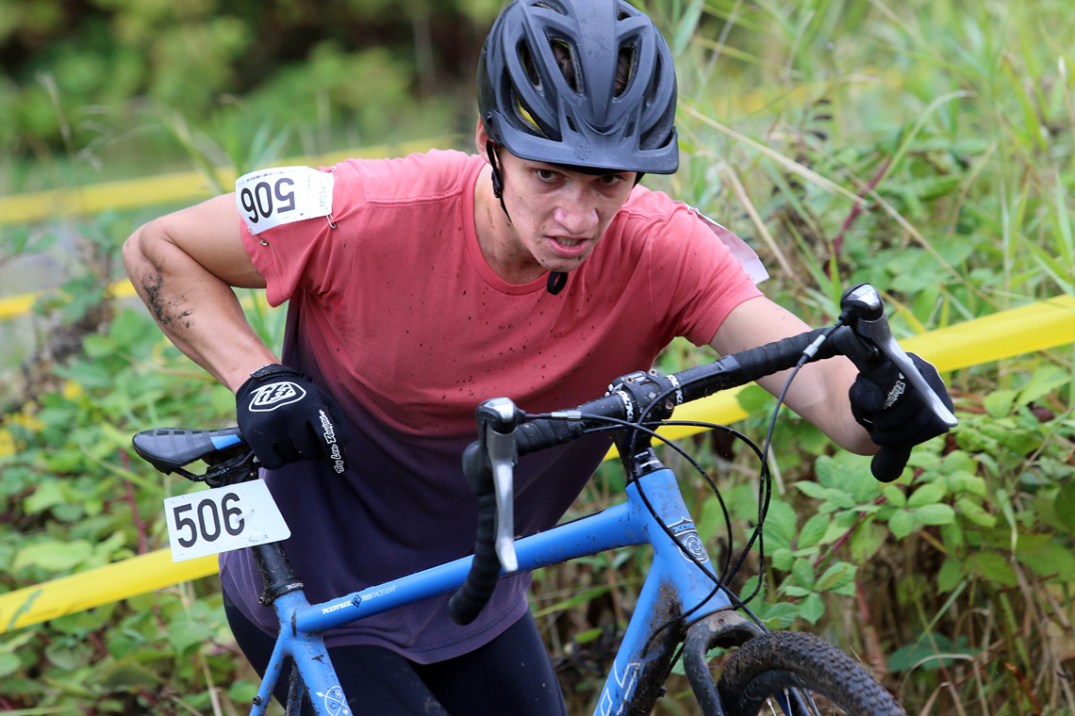
While the major rainstorm that was forecast held off, dozens of riders still got down and dirty at Saturday’s annual Donkey Cross cyclocross race in Port Coquitlam’s Castle Park.
The race was the first of seven that comprise the Lower Mainland Cyclocross series.
Cyclocross is like steeplechase racing on two wheels. Riders navigate a winding, undulating course for several laps that includes obstacles, a metres-long “beach” of soft sand, and even a stretch of snow from a local arena dumped into a corner. The sport originated as a form of off-season training for road cyclists in Northern Europe who would often challenge each other to get to the coffee shop in the next village the quickest. Often, that meant traversing farmers’ fields and hopping fences and hedges, elements that are still honoured in modern cyclocross racing.

It they built it, will they climb?

A version of this article appeared in The Tri-City News in 2019.

It’s one thing to build a multi-use path, quite another to get walkers and cyclists to use it.

Port Moody accomplished the former with its $4.627-million upgrade of Gatensbury Avenue to make the steep, winding connector between it and the city and Coquitlam safer for motorists and add a $285,000 multi-use path (MUP) along its western flank for pedestrians and people on bikes.

The project was identified as an early priority in Port Moody’s master transportation plan, which was endorsed by council in March 2017. That plan will see the city invest more than $31 million over the next 20 years to make it easier to get around the city, and encourage more sustainable modes of transportation, like walking and cycling.

Ascending Gatensbury, though, remains a test of fortitude, leg strength and lung capacity.

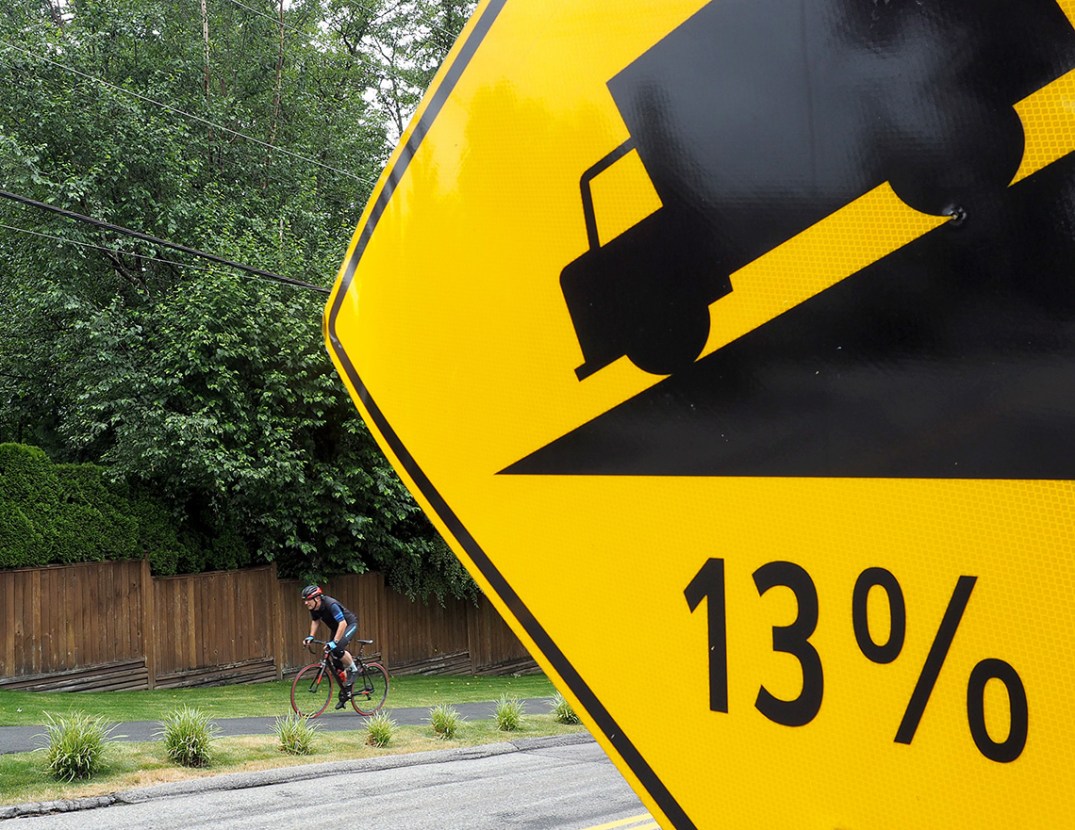
Already the climb to the top has been dubbed the “Gatensbury Gasp” on social media by some pedestrians who have ascended its 12% average pitch over 1.1 kilometres since it reopened to traffic at the end of May.

But what does that mean for cyclists?

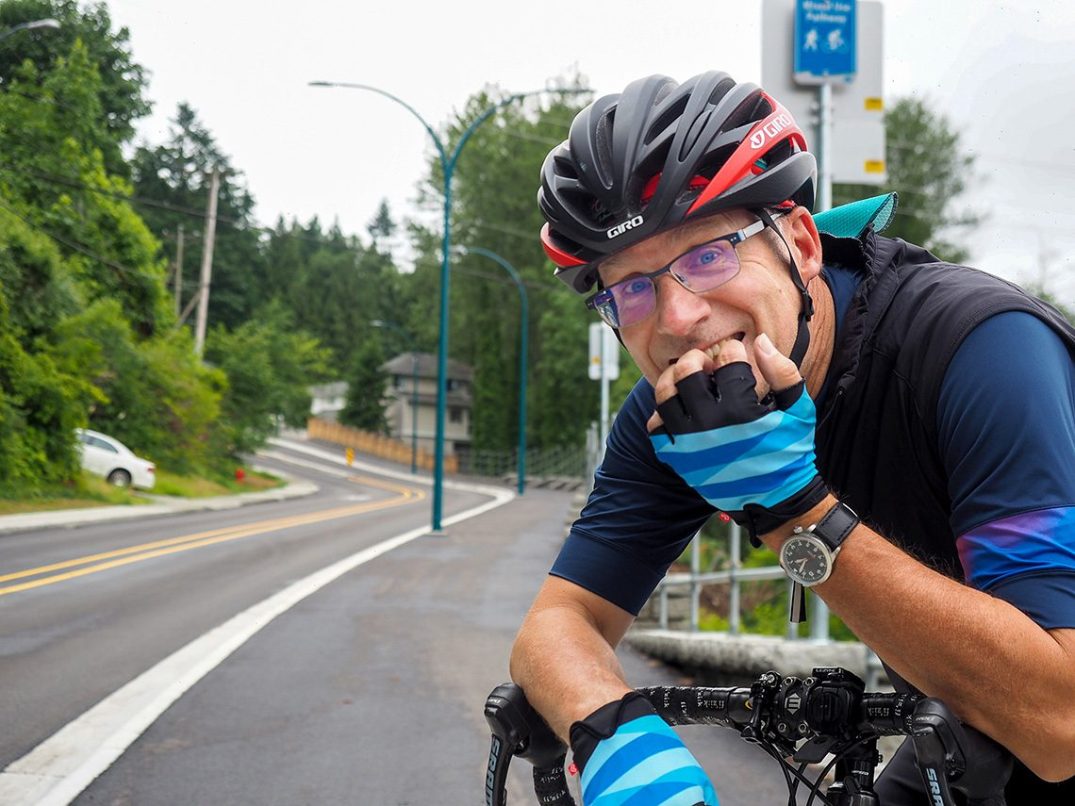
Always up for a good bike story, I set out to find out.

I’m not a climber. Descending is more my jam.

I ride up hills and mountains because I have to get to the top so I can turn around and speed back down.

For the most part, cyclists have avoided Gatensbury for years because of its narrow lanes that lacked a shoulder and its pocked pavement that made it unsafe at worst, uncomfortable at best.

Oh yeah, there’s also its perilous steepness, which ranges from 11.1% at the bottom to 18.3% in its final rise.

Gatensbury climb
The climb averages 12% over its 1.1 km total length, but there are sections that exceed 18%.

By comparison, Mont Ventoux, one of the iconic climbs of the Tour de France, peaks at 12% and the Muur van Geraardsbergen in Belgium, that has been a decisive climb in big-time professional bike races like the Tour of Flanders, rises an average of 9.3% over its 1,075 metres over bumpy, tire-eating cobbles that can rattle the fillings from your teeth.

The pavement on Gatensbury’s new MUP is smooth tarmac, not yet heaved by straying tree roots or ravaged by winter freezes and thaws.

The path is also wide — maybe not wide enough to allow teetering cyclists to weave their own switchbacks to stay upright, but certainly wide enough for pedestrians and riders going uphill to pass each other easily.

According to Strava, an online app that allows cyclists and runners to upload data from their GPS devices, 43 cyclists have completed the segment called “Todds Gatensbury climb,” which is .94 km from the base of the hill at Henry and Grant streets to Bartlett Avenue at the top, this year. The fastest was Matthew Cox, a Port Moody cyclist who made it to the top in four minutes, four seconds. That’s an average speed of 13.9 km/h and well off the all-time record of 17.7 km/h by Brett Wakefield back in 2015, when the road was in much worse shape and there was no MUP. Some notable athletes have also tackled Gatensbury, including Canadian Olympic triathlete Simon Whitfield — he did it in 3:49 in 2013.

At the start of the MUP, after a warmup pedal from The Tri-City News’ office in Port Coquitlam, I could only dream of such blinding uphill speed. In fact, I just wanted to survive without my knees, or heart, exploding.

The climbing starts at a modest 3.9% at Henry and Moody streets but by the time it hits its first switchback, it touches 17%. It’s about then I realize I’m still in second gear. I veer into a driveway to change gears because doing so under high torque in a difficult climb can blow apart a derailleur.

The second switchback is consistently around 15% but goes as steep as 18.2%.

But the nastiness is just getting started.

Looking ahead, the road straightens, the gradient moderates slightly and the end seems in sight. The bike computer says I’m doing 6.6 km/h but, gasping for breath and rocking side-to-side, it feels like I’m standing still.

Then, the road veers left to reveal its cruelest twist: more climbing, some of it is as steep as 17.3%.

I reach Bartlett Avenue 7:09 after I started the climb, the 25th-fastest — or 18th slowest — ascent of the segment recorded on Strava so far this year.

As I turn to  cross the road and collect my reward — a speedy descent on Gatensbury’s smooth, new pavement — a cyclist on an electric-assist bike with fat, cushy tires, cruises nonchalantly by on the uphill side. He’s smiling, with barely a bead of sweat on his brow.

Maybe he has the right idea.