This story first appeared in the Tri-City News on May 29, 2023
Deft thumbs at the video game controller has steered a Coquitlam man to one of the most storied car races in the world at one of the sport’s most famous tracks.
Ryan Dingle parlayed a childhood passion for the Gran Turismo video racing game to a career as a race engineer, first in Japan and now in Europe, where he’ll lead Toyota Gazoo Racing’s World Endurance Championship (WEC) Hypercar team at the 100th running of the 24-Hours of Le Mans, June 10–11.
It’s a daunting responsibility, said Dingle in an email interview. In addition to managing the team of engineers and technicians charged with preparing Toyota’s GR010 Hybrid Hypercar for race weekend and then keep it performing optimally for qualifying and 24 straight hours of racing at Le Mans, Toyota is the five-time defending champion at the event. And this year it will be up against an expanded grid that also includes new factory efforts from Porsche, Ferrari, Cadillac and Peugeot.
There’s “a lot of pressure now,” said Dingle, who’s in his first season in the WEC where most races are six to 24 hours long after cutting his teeth in the smaller Super Formula and Super GT race series in Japan.
“It is my first experience outside of Japan so most of the circuits are new to me,” Dingle said. “Working in a much larger team with more well-defined roles can also be challenging.”
PHOTO SUBMITTED Coquitlam’s Ryan Dingle started his career as a race engineer in Japan.
Dingle, a graduate of Dr. Charles Best Secondary School, headed to Japan after obtaining his engineering degree at the University of British Columbia and post-graduate studies in motorsport engineering at Oxford Brookes University in the UK.
Fuelled by his childhood love for Gran Turismo that evolved into an obsessive interest in Formula 1 and Endurance racing, Dingle identified Japan as his best opportunity to get work in the industry.
Trial by fire
With only one beginner class in Japanese at UBC, and the support of his family and his future wife — who happens to be from Japan — Dingle landed a gig in the all-Japan Formula 3 open wheel racing series.
It was, Dingle said, a bit of a trial by fire.
“The working style in Japan is quite different from the west, as is communication in general,” he said. “People often get frustrated and give up. I got frustrated too, but I guess I had the determination.”
Over the course of his nine-year career in Japan, Dingle managed to work for both Toyota and Honda, fierce competitors at the track and in consumer showrooms.
He said while such vacillation between Japan’s two car giants might be frowned upon in the country’s corporate world, it’s more accepted in motorsport.
“I think it’s been advantageous for me to see how both companies work,” Dingle said. “I like to approach each new place with an open mind and try to learn.”
Driven to succeed
No matter the badge on the car, though, the drive to succeed is universal.
“It’s not a career path where you feel at ease often,” Dingle said. “But when you get it right, you see the fruits of your labour rather quickly and it’s satisfying.”
Now that he’s based in Europe, Dingle said he’s excited to work at some of the race circuits, like Spa-Francochamps in Belgium and Monza in Italy, that he revered back in his video game racing days and when he was studying in England. But being able to compete at Le Mans is special.
“It means a lot to be a competitor in one of the most famous races in the world, and the 100th year,” he said.
“In a way, it’s a validation of the choices that got me to here. It’s a good feeling.”
A union that represents journalists at several British Columbia media outlets says the provincial government needs to do more to prevent the spreading of news deserts as publications are closed.
Lana Payne, the national president of Unifor, and its western regional director, Gavin McGarrigle, said in a letter to B.C. Premier David Eby that great swaths of the country are being left without a local news source, hurting democracy.
They’re urging Eby to help reverse that trend by committing a portion of the provincial government’s advertising budget to support local news.
Last summer, Ontario Premier Doug Ford directed crown corporations like the Liquor Control Board of Ontario and the Ontario Lottery and Gaming Corporation to spend at least 25 per cent of their advertising budgets at news outlets based in that province.
Since 2021, New York City has required its agencies to direct 50 per cent of their advertising budgets to community and multicultural media outlets, including print, digital, radio and television.
Losing ‘scarce’ ad dollars
In their letter, Payne and McGarrigle said a similar directive by the provincial government “would immediately get badly needed revenue to news businesses who are losing scarce ad dollars to American and Chinese Big Tech firms” without spending additional taxpayer dollars.
In February, 2024, Eby called out “corporate vampires” for overseeing “the crapification of local news by laying off journalists” during an announcement in Coquitlam hours after Bell Media announced job cuts and the cancellation of several local newscasts.
Eby said media companies have a “corporate responsibility” to “ensure people get accurate, reliable information in this age of social media craziness.”
On April 17, Glacier Media — now called Lodestar Media — closed the Tri-City News, Burnaby Now and New Westminster Record, leaving more than 600,000 people without a robust, trustworthy source of local news.
Publisher Lara Graham said the publications, that had informed their communities for more than 40 years, were no longer sustainable due to “the industry’s ongoing financial challenges.”
The closures came 20 months after all three publications ceased their weekly print editions to exist only online.
Two days earlier, Port Moody council approved an expenditure of $50,000 this year and an $85,000 budget item next year to bolster its communications resources to help fill the growing “information gap” in the community and counter disinformation spread on social media channels.
Cross-Canada closures
According to the Public Policy Forum, more than 340 communities across Canada have lost local news providers since 2008.
An annual injection of $100 million for each of the next five years from online search engine Google as a result of Canada’s Online News Act that was passed in June, 2023, by the federal Liberal government with support from the NDP hasn’t done much to prevent closures either.
Two weeks after Glacier Media’s closed its three publications, the Canadian Journalism Collective that is responsible for disbursing the funds announced the company had received an instalment of almost $400,000 based upon the number of staff dedicated to the production of news it had on its payroll in 2023. Metroland Media Group in Ontario received more than $1.9 million despite filing for bankruptcy protection in Sept., 2023, and ceasing production of all 70 of its weekly community newspapers to move them exclusively online; 605 employees lost their jobs.
During a visit to Port Moody campaigning for April’s federal election, former NDP leader Jagmeet Singh conceded the Online News Act could use further refinement.
The legislation “did not have the teeth” to prevent more media closures, said Singh. “I want to see more protections in place against web giants that are taking up all the space.”
Unifor, which represents workers at Glacier’s recently shuttered publications, said B.C.’s Extended Producer Responsibility fees that make producers of plastics and packaging pay for their recycling also stacks the deck against local news outlets.
“The only catch is that newspapers are not packaging,” said Payne and McGarrigle in their letter to Eby. “They are the product — an important product that is already the most widely and most successful recycling material.”
The union said B.C. should follow the lead of Ontario, which exempted newspapers from the fee in 2022.
“The extra burden of this program on newspaper publishers will only create costs that cannot be afforded by an industry already stretched and facing so many obstacles,” said Payne and McGarrigle.
This story was originally published in the Tri-City News Nov. 10, 2024
Frances Stone had never lived in a home that requires a security fob or a building that has an elevator.
Recently, she and her teenage daughter moved into a gleaming two-bedroom-plus-den condo in Anthem Properties’ new SOCO project just off North Road in Coquitlam.
How Stone got there is a study in transformational importance of securing safe, affordable housing.
Stone and her daughter were living in a walk-up rental building in uptown New Westminster when her landlord informed her she needed to move so a family member could move in.
Stone, an addictions counsellor, considered uprooting to Alberta where the provincial government is offering financial incentives to newcomers and rents are much cheaper.
Then a friend told her about a partnership between the Affordable Housing Society and Vancouver-based developer Anthem Properties that would make 18 rental homes in two new condo towers in Coquitlam available at rates geared to tenants’ income.
According to the Canada Mortgage and Housing Corp.(CMHC), that means a tenant pays 30 per cent or less of their gross income for rent.
Secure future
Stone said since moving into her new home in August, it’s the first time in her adult life she’s felt secure about her future.
So much so, Stone said she’s in the final stages of adopting a rescue dog to add to her family, something she’s wanted to do for years but failed to pursue because of her ongoing housing uncertainty.
That’s music to the ears of Stephen Bennett, CEO of the Affordable Housing Society.
He said being able to live in a safe, affordable home impacts every aspect of a person’s life.
“We don’t understand what a lack of choice means for people,” he said. “Because it’s so unaffordable out there, people are stuck.”
Best interests of the community
As municipalities across B.C. strive to attain housing targets recently mandated by the provincial government, they’re also wrestling with the challenge of ensuring those homes can be accessed by a broad spectrum of residents.
“We still have to predicate all of our decisions based on what is in the best interest of our community as a whole,” said Port Moody Mayor Meghan Lahti about the pressure to approve the construction of more homes.
Bennett said affordability can only be achieved when all levels of government work together to provide necessary funding because the cost of constructing homes has spiralled so high. He said without subsidies and grants from programs through agencies like BC Housing, BC Builds and CMHC, rent for apartments could be as much as $5,000 a month.
‘It can often be a tightrope’
Melissa Howey, Anthem’s vice-president of development, said companies like hers are feeling the pressure as well, as they look to deliver housing stock that meets communities’ needs.
“It is balancing the costs, the availability of density,” she said. “It can often be a tightrope to walk.”
Howey said inflationary pressures and constraints on capital are making that tightrope even tauter.
Inclusionary zoning policies and negotiations for additional density can help spur developers to find creative solutions that will allow them to include affordable units in their projects, but the long process to get approvals means the landscape is always shifting.
“Every municipality operates differently,” Howey said, adding the navigation of those varying procedures comes with more layers of expense.
“It can be a challenge to deliver the other forms of housing in a project at somewhat affordable rates.”
In fact, Anthem recently had to scale back a plan to designate half the 128 units in a rental building its seeking to build in Port Moody to just 13. The company said its original intent proved “financially unviable.”
Complicated process
Bennett said his society is always working to devise new models to help fund affordable units, sometimes pooling financial contributions from several agencies.
But, he said, “to pull all those pieces together is exceedingly complicated and it takes a lot of work.”
Stone said she’s keenly aware of the challenge to provide enough affordable housing.
Prior to losing her apartment in New Westminster, she’d been on the BC Housing waiting list for five years. She said she’d also applied to every co-op in Metro Vancouver but “nothing was available.”
“It was pretty hopeless,” Stone said.
Now that she’s settled in her new home, though, Stone is starting to take advantage of her building’s host of luxurious amenities, like its indoor basketball/badminton court, the games and community room that features a full kitchen, a gym and yoga studio as well as an outdoor garden atop the parkade with seating areas, play structures and several gas barbecues. She said she’s keen to start a podcast that she can record in the building’s special sound room as well.
It’s a lifestyle Stone never imagined for herself.
“I would never have been able to work hard enough to live in a building like this,” she said. “It changes your perception of yourself.”
This story originally appeared in the Tri-City News June 4, 2024
A former member of the Coquitlam Express will be part of the Florida Panthers’ effort to win the Stanley Cup when their final series against the Edmonton Oilers begins Saturday, June 8 — by making sure every seat in the team’s Amerant Bank Arena is filled.
But Taralynn Reburn won’t be electrifying the packed house with ice-length rushes or thundering hits on Oilers’ superstar Connor McDavid.
As the Panthers’ vice president of ticket sales and service, Reburn relies on good customer service and building relationships with new fans to help grow hockey culture in South Florida. It’s a tall order in a part of the world where most people’s connection to ice is to keep their margaritas cold.
Fickle market
“This market can be quite fickle,” Reburn said. “Fans traditionally go in the direction of the team who’s winning.”
Fortunately for the BCIT grad who started her career as the director of sales and marketing for the Express from 2009-12, the Panthers have been doing a lot of that; this is the team’s second straight appearance in the Stanley Cup finals and they follow a run of three straight by Florida’s other NHL team, the Tampa Bay Lightning.
“We’re proving to the NHL that this is a hockey state with competitive teams and we’re a destination franchise that players want to be with,” Reburn said.
Following her stint with the Express, Reburn spent almost two years in sales roles with the Vancouver Whitecaps soccer team and more than eight years with the Vancouver Canucks. She said connections she made within the industry led her to Florida in 2022 even though she’d never been there before.
“I took a leap of faith and it has been great ever since,” Reburn said.
It’s also been a lot of work.
Engaging fans
Reburn said engaging fans in Florida requires a constant commitment to make them feel like they’re a valued part of the team’s success with perks like access to the Panthers’ new practice facility in downtown Fort Lauderdale and the organization’s involvement in youth hockey.
“Once people get into the building and see a game for the first time, they’re hooked and love the speed of the game compared to other sports,” she said.
Two consecutive years of Stanley Cup finals has also energized the market, Reburn said.
Panthers’ flags are draped on condo balconies, signs are planted on front lawns, restaurants and bars are tuning in their TV’s to the games.
“There’s a visible increased interest in the team,” Reburn said. “I overhear more conversations in the grocery store now about the Panthers than I ever have before.”
Even though Florida’s opponent is from north of the border, the ex-pat Canadian said she’s all-in to see the Cup remain in America, where it’s been ensconced since 1994.
“I’m 100 per cent Panthers on this one and have even converted a few from the west coast to cheer us on, too,” Reburn said.
But what if the cards had fallen slightly differently and it was her former employer, the Vancouver Canucks, that prevailed in the seventh game of its quarter-final series against the Oilers and then defeated the Dallas Stars?
“I was hoping for a Florida-Vancouver final,” Reburn said. “It would have been an exciting and unique opportunity. It’s just the beginning for this new core of the Canucks and their time will come.”
This story first appeared in the Tri-City News on Oct. 6, 2023
A Port Moody man is proof you’re never too old to chase a dream.
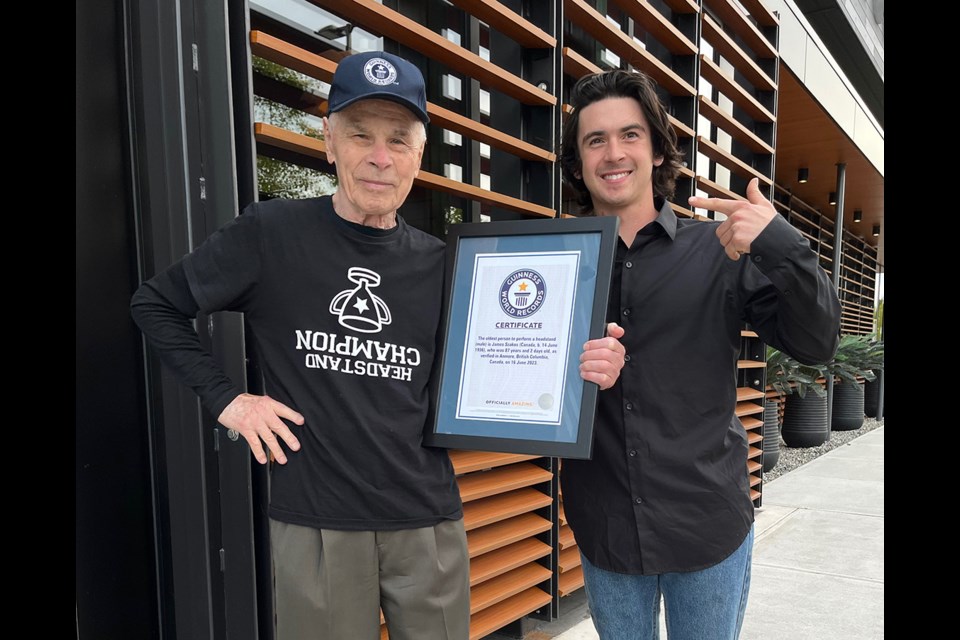
James Szakos is the oldest person to achieve a headstand. He’s 87, and he recently received confirmation of his status from the Guinness Book of World Records.
It’s not an accomplishment Szakos’ daughter, Andrea, ever imagined for her father, who hurt his back while removing a tree from the yard of the family’s home more than 40 years ago and was told by his doctor he’ll “never be the same.”
But it was just that dour prognosis that set Szakos on his journey to Guinness fame.
Andrea Szakos said her father took it as a challenge and when a physiotherapist recommended a rigorous regime of daily exercise might move him back to full health, he embraced it fully.
“He really believes in daily exercise every morning,” she said. “He’s in incredible shape.”
James Szakos said he didn’t feel he had any other choice.
He walks everywhere, cycles, swims and does exercises on the floor of his Suter Brook home.
He’s also pretty good at executing headstands, Andrea said. In fact, he’s even done them on a paddleboard in the water —when he was 80 years old.
So when a family friend noticed an online article about an 86-year-old senior who’d just claimed the world record for oldest headstander, James was enthralled.
“You know I can do it,” he said. “I want to set the world record.”
Szakos, who came to Canada after fleeing the Hungarian revolution in 1956 and built his family in Ontario before heading west four years ago, trained for two months while Andrea researched the process and procedures for claiming a world record.
She discovered her father would have to refine his technique, supporting his headstand with the palms of his hands rather than his fingertips as he’d been doing for so many years. He’d also have to hold his legs straighter.
When the big day came June 16, a crew of independent witnesses gathered in an Anmore home to document Szakos’ attempt. A yoga instructor was on hand to verify his technique, a phys-ed teacher was enlisted to operate the stopwatch and even a police officer was invited to add an air of authority to the proceeding, that was also recorded and photographed.
“It was very exciting,” Andrea said. “We knew he could do it.”
In fact, Szakos crushed it.
While Guinness required a successful headstand to last only 15 seconds, he held his for one minute and 13 seconds because he doesn’t want to see his feat eclipsed by some upstart 90-year-old.
“I could have gone longer,” Szakos said. “But my daughter said that was enough. She thought I was going to get dizzy or something.”
Andrea said her father is always trying to set a good example for his children and grandchildren.
“He encourages people to be their best,” she said.
Szakos recently received his certificate from Guinness authenticating his record, more than three months after Andrea had submitted all the required documentation. He said opening the envelope brought tears to his eyes. He treated his whole family to a celebratory dinner.
“I would never have dreamed I would be in the World Book of Records,” Szakos said. “This is a great feeling.”
But not just for him, added Andrea.
“At 87 to set a goal and work towards it, we’re very proud of him,” she said. “He’s like a local celebrity now.”
This is an update of a story first published in the Tri-City News on Oct. 15, 2021
A former Terry Fox Ravens soccer player has signed his first pro contract — with the Toronto Argonauts of the Canadian Football League.
The Argonauts announced Monday, May 5, it’s signed kicker and punter Dawson Hodge, who recently completed a successful collegiate career with the Wilfrid Laurier Golden Hawks that culminated with the school’s appearance in the USports Vanier Cup national championship last December.
Hodge will report to the Argos’ spring rookie training camp on Tuesday.
Hodge didn’t put on a football helmet and shoulder pads until his senior year of high school. And then only after he was coaxed by his twin brother, Brandon.
But after a few good practice kicks Dawson tried out and made the Ravens football team, helping Terry Fox reach the semi-finals of the 2018 Subway Bowl provincial championships, where they were defeated by the New Westminster Hyacks, 33-0.
Sitting in the locker room at BC Place afterward, Hodge said he realized he didn’t want his brief dalliance with football to be over.
As it happens, former BC Lions kicker Lui Passaglia is a neighbour.
Hodge worked with him to find his form, then headed to a high performance kicking camp in the United States to refine it. He won the field goal competition there, and finished second in kick-offs among some of the best high school kickers in America.
“This motivated me to pursue football and master the craft of kicking,” Hodge said.
More experience
Looking to gain more experience before taking a run at possibly being recruited by a post-secondary program, Hodge enrolled in an additional year of high school at a football academy in Toronto that plays exclusively against top American teams.
“They were really good teams, full of college prospects, so the tough competition made us better,” Hodge said, adding the experience of playing under the lights on Friday nights in packed little stadiums south of the border was enthralling.
The seasoning of his game paid off. A half dozen Ontario universities plus Simon Fraser University in Burnaby enquired about joining their programs.
After touring each, Hodge said he was attracted to Wilfrid Laurier in Waterloo that’s produced kickers who’ve gone on to play in the Canadian Football League in the past, including Ronnie Pfeffer, who won Grey Cups with the Argonauts and Ottawa Redblacks and also played for the Calgary Stampeders.
“I knew the team would utilize the kicking game,” Hodge said. “If I could prove myself, I’d have a good chance to be a starter in my rookie year.”
Pandemic pause
Alas, the COVID-19 pandemic kicked that dream to the curb.
Instead of lifting punts into the crisp fall Ontario air, Hodge worked out in a gym his parents set up in the garage of their Coquitlam home and studied Geography on his computer. Twice a week he ventured over to Town Centre Stadium to boot balls through the uprights, recording his workouts for online reviews with his coach in Waterloo, Darcy Segin.
Still, Hodge said, staying sharp was a challenge.
“The best way to stay motivated was being optimistic,” he said. “Knowing that one day we will get back out on the field encouraged me to keep kicking and working out.”
Hodge’s dedication paid off.
In four seasons with the Golden Hawks, he was successful n 63 of his 68 field goal attempts and his 255 punts sailed an average 41.3 yards.
Hodge was also Laurier’s rookie of the year in 2021 and he was named an Ontario University Athletics all-star and second team All-Canadian in 2022.
Hodge said his soccer background helped his success on the football field.
According to Hockey Canada, only one in 4,000 kids playing hockey in this country will ever have a career in the National Hockey League. That’s .025%. Port Coquitlam’s Brady Leavold was on the cusp of beating those odds. But childhood demons and addiction snuffed his dream and sent him spiralling to the streets and petty crime.
Brady Leavold has been in the Tri-City News before.
But the gritty forward from Port Coquitlam wasn’t featured as he became a fan favourite with the Swift Current Broncos in the Western Hockey League, or in a front page story covering his hoped-for triumphant first NHL game.
In 2016 Leavold was in the court blotter, after he was sentenced in Vancouver to 21 months in jail for theft, possession of stolen property, resisting a peace officer and several other charges.
Four years later, he’s trying to atone for that, maybe even help others wrung out by a sport that values players more as a commodity than as human beings.
Now 33, Leavold is living in Morrisburg, Ont., and running a skate-sharpening business. He’s slowly putting his life back together again and launching a podcast to shine a light in some of hockey’s darkest corners.
He’s trying to come to terms with a system that recognized his talent and ambition but didn’t see the demons that drove him to excel on the ice. Or maybe didn’t want to see.
In love with hockey
Leavold grew up in Port Coquitlam’s south side, where he attended Kilmer Elementary and then Citadel Heights Middle schools. He played hockey in the PoCo Pirates minor system, often on teams with boys older than him because he was so good and played “with an edge.”
SUBMITTED PHOTO Brady Leavold, right, chases down an opponent in a minor hockey game in Port Coquitlam in 1993.
Leavold said he couldn’t get enough of the game. When his firefighter dad, Brian, was coaching other teams, he’d spend hours in the corner of the old Blue Rink at PoCo Rec — where the nets were stored — knocking a ball or puck around with his stick. He dreamed of someday playing in the Pirates’ annual spring bantam tournament.
After hockey season was over, Leavold and his buddies, including Zach Hamill who went on to a pro career in the NHL and Europe, would rollerblade down to Ikea in Coquitlam and play two-on-two ball hockey in the expansive parking lot until the wee hours of the morning.
“That was our life,” Leavold said. “We had such a good group of guys playing hockey.”
But his friends didn’t know Leavold had a secret.
He said his all-consuming love for hockey was an escape from childhood sexual abuse that filled him with anger and shame every waking moment.
“I just wanted to be accepted, I wanted to be sure of myself,” Leavold said. “Hockey did that for me.”
Sabotaging success
As good as Leavold was, though, every tryout was fraught with anxiety that he’d get cut, that he wasn’t good enough.
Once, when he had a chance to make an elite team, he attended a skating session then faked an illness. He said he wanted to control his own destiny.
“Every good thing in my life, I’ve sabotaged it,” Leavold said.
Still, coaches wanted him on their teams, his energy on the ice. So they’d give him a second or even third chance.
When Leavold was 16, he played a game for the Western Hockey League’s Broncos, then was the team’s rookie of the year the following season.
Off the ice, though, Leavold struggled. He experimented with drugs like ecstasy. Then, seven games into his sophomore season in Swift Current, he walked away from the Broncos and returned to Port Coquitlam to live with his dad and attend Riverside Secondary.
Quickly Leavold discovered his hockey pedigree — flaunted by wearing his Broncos jacket everywhere — shielded him from accountability. He said he didn’t have to work as hard in school as other students to get a passing grade. He’s convinced he passed his driver’s test because the examiner was a fan and talked more about hockey than noting his mistakes.
When the Broncos traded Leavold to the Everett Silvertips, he didn’t report.
Instead, he signed with the nearby Burnaby Express of the BC Hockey League, where he scored nine points in his first three games playing on a line with future NHLer Kyle Turris.
But away from Copeland Arena, Leavold continued to party. He showed up for games with little sleep, if he showed at all.
The team got him counselling, tested him for drugs.
For a time, it worked.
Then Leavold hurt his Achilles tendon and he stopped going to the rink.
Weary of his erratic behaviour, Leavold’s dad kicked him out of the house. His girlfriend’s family took him in, made him feel at home, afforded some stability.
Another chance
That summer, Leavold called his old coach in Swift Current, Dean Chynoweth, and asked for another chance.
He got it.
But his life away off the ice continued to be a mess. He got a local girl pregnant. He started missing practices. The Broncos wanted to suspend him, but teammates came to his support. They said they needed him for the playoffs.
When the team was eliminated by the Regina Pats, Leavold headed back to Port Coquitlam, leaving his pregnant girlfriend to figure things out for herself.
Leavold said that decision was a tipping point.
“I was scared,” he said. “Maybe it was just going to go away.”
Back home, Leavold reunited with his old girlfriend. But when he got her pregnant too, she gave him an ultimatum to choose who he wanted to be with. He stayed put.
“I knew it was wrong,” he said of turning his back on his girlfriend and unborn child in Saskatchewan. “I knew it was going to affect me.”
Traded away
Hoping to dodge a roiling scandal in the small Prairie city, the Broncos sent Leavold to the Kelowna Rockets early in the next season.
But the new environs didn’t offer much of an escape for the 20-year-old player. During the Rockets first visit to Swift Current, an angry friend of his Saskatchewan girlfriend chased him in the arena’s lobby and his teammates had to hustle him onto the team bus with no idea what was going on.
On the ice, though, things were going much better.
Paired with future NHLer Jamie Benn, Leavold was the Rockets’ second leading scorer with 70 points and led the team in fights and penalty minutes.
NHL scouts took notice.
Leavold was signed as a free agent to the farm team of the Tampa Bay Lightning and he was invited to the big team’s prospect camp later that summer. With some money in his pocket for the off-season and his future looking bright, he got his own place in PoCo. His NHL dream was tantalizingly close.
At the Lightning’s prospect camp in Traverse City, Mich., Leavold was pencilled in to skate on a line with the league’s first overall draft pick, Steve Stamkos.
But poor choices in roommates and friends in the summer of 2008 put Leavold back on a self-destructive path.
Instead of getting into shape for the camp, Leavold said he binged on cocaine. The night before his big chance, he smoked pot and snorted coke.
Having blown his NHL opportunity, Leavold tried to cobble together a career in the backwaters of minor pro hockey: He lasted four games with the Lightning’s top minor league team in Norfolk, Va., then was sent down a rung to the ECHL’s Victoria Salmon Kings. He signed a contract with a team in the Netherlands but lasted only two games there before returning to Victoria where he played two more games then fell off hockey’s map for more than two years.
Hooked on opioids
Adrift and dealing with pain from hockey injuries, Leavold got hooked on Oxycontin, a powerful painkiller.
“It felt like a hug from my mom,” he said of the opioid.
At one point, Leavold tried to get clean at a rehab facility in Maple Ridge. He signed a contract with a team in Wichita, KS, but didn’t show up, then got another chance in Texas, with the Rio Grande Valley Killer Bees in the Central Hockey League. He scored 18 points in 22 games, accumulated 91 minutes in penalties. It’s the last line on his pro hockey résumé.
Back home in the Lower Mainland for the off season, Leavold fell back into a familiar pattern. He started injecting heroin. To pay for his addiction he held up liquor stores. He even stole a cab that resulted in his face showing up on a Crime Stoppers notice.
Eventually Leavold ended up on the streets of Vancouver’s Downtown Eastside. That’s where the police caught up to him and he was sent to jail, including a stretch at the North Fraser Pre-Trial Centre in Port Coquitlam, just down the street from his childhood hockey haunt.
But again, Leavold’s hockey background got him favoured treatment.
“You get away with everything,” he said. “There was a time I couldn’t get it out of my mouth fast enough that I was a hockey player and the benefits would come my way.”
A fresh start in Ontario
Upon his release, Leavold headed to Ontario to gain distance from his past and get clean again. He landed in Orillia, got a job. But when he was caught trying to drive a stolen truck on his way out of town to Vancouver, he was returned to jail.
Leavold hit bottom, his options had run out.
Until he happened to answer a phone call meant for another inmate.
The voice on the other end eventually became his girlfriend and his reason to straighten out his life.
“I knew I needed something to drive me and keep me going,” said Leavold, who moved in with his new partner in the basement of her parents’ home when he was released.
A new adventure
With nothing but time on his hands as they rode out the early weeks of the COVID-19 shutdown last spring, Leavold decided to share his story.
He got a microphone, plugged it into a borrowed laptop computer and started talking. He invited his best friend growing up, Kevin Pedersen, who’s now a scout for the Arizona Coyotes, to join him for his first stab at creating a podcast.
Leavold said Pedersen’s support meant the world.
“I didn’t have a plan. When he agreed to do that, it was a huge reason my life turned around.”
Leavold’s now more than 60 episodes into his new adventure that he calls Hockey 2 Hell and Back . Some of his guests are from his own hockey past. Many have skirted the sport’s fringes, like himself. A few, like Theo Fleury, Brent Sopel and Sheldon Kennedy, overcame their own challenges to achieve success.
Leavold said the podcast has reconnected him with the hockey community that promised him much as a player but delivered him little as a young man. But for one or two exceptions, most adults he’d dealt with in his time in the sport opted to kick his problems down the road by trading him elsewhere or cutting him outright rather than facilitating he get the help he needed.
Leavold said he hopes the stories he shares might help affect change in hockey’s culture.
“There’s a lot that can be done off the ice that can make it better for the kids,” he said. “It can give them mental training, training for life, coaching them to be the best human beings they can be.”
SUBMITTED PHOTO Former NHL prospect, Brady Leavold, began his journey back to hockey by working as a skate sharpener.
Supporting others
Recently, Leavold created Puck Support, a foundation to provide resources for players and coaches dealing with mental health and addiction issues. Several — from all levels of hockey — have been enlisted as ambassadors. They include former Detroit Red Wing Darren McCarty; Dody Wood, who played with the San Jose Sharks and New Jersey Devils; and Canadian national sledge hockey team player Paul Rosen.
“It’s given me purpose,” Leavold said of the new initiative.
Personally, Leavold said he’s in a much better place. He’s been clean for 11 months. His dad has been a guest on his podcast.
Though estranged from his child in Saskatchewan, he hopes to mend some fences so he can be in the lives of the two children he fathered with his Port Coquitlam girlfriend.
On Oct. 15, Leavold and his current partner became parents to little Vada.
Back on the ice
Leavold’s also back on the ice for the first time in eight years, playing on the fourth line of the Maxville Mustangs, a senior A men’s team in Eastern Ontario.
It’s not an achievement that’s likely to get noted by Leavold’s hometown paper, but, he said, he’s okay with that.
“I’m so out of shape, but I’m going to push through it,” Leavold said. “Everything bad happened for a reason to get me to this point.”
An independent review says a technical study commissioned by developer Icona Properties underestimates the impact the company’s proposal to build 2,200 new homes on 150 acres of property it owns in south Anmore will have on traffic along Ioco and East roads.
The study, by Vancouver-based Bunt & Associates, is one of several technical reports recently submitted by Icona as part of its application for amendments to Anmore’s official community plan (OCP) bylaw that would be required for the project, that could triple the village’s population, to proceed.
Alon Weinberger, the founder and principal of Port Coquitlam transportation engineering company Evolve, said Icona’s development proposal could generate up to 1,328 vehicle trips during peak hours on weekday afternoons. That compares to an estimate of 750-850 new vehicle trips in the Bunt & Associates’ study.
Weinberger completed his review on behalf of the Anmore Neighbours Community Association that was recently formed to reflect “a desire for residents to have a clear, coordinated voice” in the future of the village. The group is hosting its own town hall about Icona’s development proposal on Thursday, May 8, from 6 to 8 p.m., at Anmore Elementary School (30 Elementary Rd.).
Weinberger said Bunt’s study also doesn’t account for high traffic volumes on warm summer weekends when visitors flock to Buntzen Lake and Belcarra Regional Park nor does it consider the increased number of cars using East Road on weekday afternoons when parents pick up their kids from Eagle Mountain Middle and Heritage Woods Secondary schools at Anmore’s border with Port Moody.
Active transportation options unrealistic
Weinberger said an assumption by Bunt’s report that some of the increased traffic generated by Icona’s proposed development could be eased with better active transportation options is overly optimistic.
Weinberger said while Bunt’s study claims peak weekend traffic volumes along Bedwell Bay Road occur in the fall, a previous count completed in 2020 for the City of Port Moody and Metro Vancouver indicates the connector from Ioco Road to Belcarra Regional Park and Sunnyside Road on to Buntzen Lake is busiest on Saturdays and Sundays in June, July and August, with as many as 11,700 vehicles travelling between Crystal Creek Drive and White Pine Beach Road on August Sundays. The count was part of a study examining congestion, parking violations and safety concerns along the narrow, winding route.
A report presented to Port Moody council in June, 2022, recommended construction of a separated multi-use path along one side of Bedwell Bay Road and First Avenue, converting the intersection at White Pine Beach into a mini-roundabout as well as the implementation of a small on-street parking area with pedestrian access to the floatwalk across Sasamat Lake and dedicated parking for emergency vehicles.
According to the report, the improvements would cost about $10 million. They’ve yet to be built.
In his review, Weinberger said the lack of safe pedestrian facilities, Anmore’s hilly topography and size, along with the village’s remoteness and absence of street lighting make it unlikely active transportation options would mitigate vehicle use by much.
“I do not agree that any vehicle trip reduction made for active transportation will be achievable in Anmore,” he said, adding a small reduction of about 10 per cent might occur as some residents stay local to take advantage of amenities like a small commercial strip and new recreation centre that are part of Icona’s development proposal.
Roads not used equally
Weinberger said the traffic report submitted by Icona also assumes an equal distribution of vehicles using Ioco and East roads to get to and from Anmore.
But with the former the most direct and quickest route to Port Moody’s services, shopping and mass transit connections, that’s also largely free of stop signs and speed bumps, Weinberger said a 75-25 split at peak hours is more realistic.
“East Road provides the best access to the middle and high schools, as well as destinations in the northeast area of Coquitlam, but is a slower route from the development to Port Moody,” Weinberger said, adding the eastern-most route is busiest during the school pick-up period between 2-3 p.m. on weekdays and would only get busier as Anmore’s population grows.
In his review, Weinberger said evacuation procedures should also be examined in a separate traffic impact assessment as the forested environs of Anmore, Belcarra, Sasamat and Buntzen lakes are “prone to wildfires with very limited access.”
The village hosted an open house on April 24 to give Anmore residents a chance to review the latest iteration of Icona’s development proposal, as well as its accompanying technical studies on traffic, water and sewage infrastructure, environmental and economic impacts.
A community survey on the development’s preferred land use components is also open to residents until May 4.
May 26 public hearing
A public hearing is scheduled for May 26 and could be extended to the following night if there’s demand, prior to council’s consideration of third reading of the OCP bylaw amendments.
But one Anmore councillor criticized the timeline when it was adopted on April 1.
Doug Richardson said it seemed needlessly accelerated, especially as Icona’s technical reports weren’t available for public scrutiny until days later.
“If this takes until December, who cares,” he said.
“I’ve always said we look forward to broader regional development, but what about hearing from Port Moody about the traffic impacts to Anmore of its development,” said Anmore Mayor John McEwen, adding representatives from the neighbouring community were free to attend the open house or provide an official response during the public hearing.
Added Coun. Kim Trowbridge of Port Moody’s request, “They seem to be getting overly involved in Anmore’s business.”
This story is an amalgam of stories that appeared on consecutive days in December, 2023, after the collapse of a shoring wall at a Coquitlam construction site was caught on video and posted to social media.
An engineering professor says insufficient engineering or sloppy workmanship could have been responsible for the collapse of a temporary shoring wall at a Coquitlam construction site.
But the company building the 41-storey condo project at the corner of Foster Avenue and North Road says it followed proper protocols.
Nobody was injured when the wall cracked and gave way last Wednesday, Nov. 29, sending a torrent of soil and rock cascading into the deep excavation.
Dr. Perry Adebar, a professor of structural engineering at UBC’s department of civil engineering, said he noted the lack of a welded wire mesh that’s used to reinforce such temporary walls when he viewed a video of the failure that was captured by a witness and posted to social media the next day.
Adebar said the shotcrete, which is a form of concrete that’s sprayed into place, may also have been too thin or applied poorly.
Shoring walls are common
Adebar added temporary shoring walls are common at large excavations as they prevent the soil on the sides from collapsing inward.
Stepan Vdovine, the vice-president of executive operations for Vancouver-based developer Amacon, said the shotcrete was supported by a standard eight—guage wire mesh.
He said all the work at the site was done “with appropriate permits, consistent oversight and monitoring,” adding, “the contractors on this project are some of the most experiences trades and engineers in the regions who oversee the vast majority of large scale residential projects.”
Adebar said shoring walls are typically built in stages.
“You excavate a certain depth hole with straight sides and then you work off the ground within the hole to build the shoring walls around the sides of the excavation,” he said.
“Then, you excavate further and repeat. Eventually you have a deep excavation.”
Soil anchors drilled into walls
Adebar said the shoring wall is stabilized by soil anchors, known as “tiebacks” or “soil nails,” that are drilled into the sides of the excavation.
Adebar said a light wire mesh is used to keep the sprayed shotcrete in place against the soil while it’s still wet and steel plates anchor the tiebacks to the shotcrete. He said the apparent lack of such a mesh allowed chunks of concrete to peel off the wall, releasing a large amount of soil into the excavation.
Adebar said at the end of the video, the visible tiebacks still seem to in place, so it’s unlikely the collapse is a result of their failure. He said observations of the first cracks in the wall by workers who were onsite that day may provide clues why it broke away.
WorkSafeBC said its officers attended the site and are conducting an investigation.
Last Friday, Dec. 1, the city of Coquitlam said it’s also requiring the developer hire a third-party geotechnical engineer to supervise repairs.
No more nightly repairs
Monday, the city announced those repairs would no longer continue through the night, although Foster Avenue remains closed between North Road and Whiting Way to allow heavy trucks and equipment to come and go. The 157 transit bus has also been rerouted.
Further alerts for local residents are being posted to a special website the city has launched.
Doug Vance, Coquitlam’s building permits manager, said the city relies on developers to take the lead on issues related to their construction sites.
As well, the construction of temporary shoring walls is not regulated by the BC Building Code.
Engineers and Geoscientists BC (EGBC), the profession’s regulatory body in the province, said it sets standards for the ethical conduct and practices of professional engineers, geoscientists and engineering companies.
If an investigation determines those standards have not been met, said EGBC spokesperson Megan Archibald, the regulator could take action through its own investigation and discipline process.
Sanctions can include suspension of an engineer’s EGBC registration that allows them to practice in the province, a requirement to complete educational courses and a review of their professional practice. Egregious violations can be punished with outright cancellation of EGBC registration along with fines.
UBC’s Adebar said as repairs continue at the site, a geotechnical engineer will be able to estimate how much additional movement of soil could occur and how that might impact nearby properties.
On Friday, city works crews were called in to stop water leaks at the site.
This story first appeared in the Tri-City News Aug. 24, 2024
The “heart and soul” of the Port Moody Panthers doesn’t score game-winning goals or throw thundering checks that have opposing forwards looking over their shoulder.
But, says Panthers’ general manager Brian Wiebe, Reid Demelo’s tireless work ethic, enthusiasm and dedication to his teammates make him vital to the success of the junior “A” hockey team.
Demelo is the Panthers’ equipment manager.
Wiebe said the 23-year-old’s attention to detail laundering jerseys and socks then hanging them neatly in players’ stalls, collecting and sorting sticks, gathering pucks and water bottles, along with a multitude of other tasks, ensure the team’s focus is entirely on what they need to accomplish on the ice, whether in a game or even just at practice.
“He’s such an important part of the team,” Wiebe said.
So much so, the Panthers recently announced it had signed Demelo to a 10-year contract extension.
🚨 NEW SIGNING 🚨
The Panthers have re-signed Equipment Manager Reid Demelo to a 10-year contract!
— Port Moody Panthers Junior A Hockey Club (@PJHLPanthers) August 10, 2024
The move was more of a social media stunt, Wiebe said. But the almost 4,000 views the announcement has generated on the team’s X (formerly known as Twitter) and Instagram accounts is about eight times more than a routine post about a player signing or game result might generate.
“Everyone knows Reid,” Wiebe said.
Demelo lives for sports.
He’s an accomplished Special Olympian who competes in basketball, soccer, swimming, track and field, softball, golf, speed skating and fitness. He was active in athletics at Heritage Woods Secondary School, helping out with varsity programs like basketball. He said he probably spends more time at the Port Moody Recreation Centre, either working out in the gym or working with the Panthers, than he does at home.
“I just love being here,” Demelo said.
Demelo’s relationship with the Panthers began when the team’s head athletic trainer invited him to help out. Along with his duties in the dressing room, he works as a timekeeper during games and mans the gate at warmups to ensure players get off the ice promptly.
Demelo is also the Panthers’ biggest cheerleader — not always an easy task as the team routinely finishes at or near the bottom of the Pacific Junior Hockey League (PJHL) standings.
Demelo said he tries not to let the losses get him down, as the players need all the support they can get.
“It’s my hometown,” Demelo said, adding he’s become friends with several players over the years.
Wiebe said Demelo’s positivity is infectious.
“It rubs off on our players, parents and fans.”
More importantly, Demelo’s role with the Panthers teaches everyone in the organization lessons about acceptance, perseverance and the pay off that comes from working hard.
It’s hard to put a price on that, Wiebe said.
“They see how big a part of the team Reid is. He’s our heart and soul.”









 MARIO BARTEL