I learned this morning a photo I’d shot last year was recognized by the Canadian Community Newspapers Association as the top feature photo of 2023. Normally I don’t pay much heed to such things. At the behest of my editor, I dutifully compile some possible entries, submit the required information and then forget about them. But this one hit a bit differently. Not only did this photo involve one of my favourite people, Chris Wilson, whom I’ve covered at different stages of his career since I first arrived at the Tri-City News in 1991 when he was an Olympic wrestler, then as a Coquitlam city councillor and now an advocate for youth sports, but it’s also a bit of a swan song for our existence as a print newspaper. How the various community newspaper associations manage their annual awards programs as more and more newspapers move exclusively online is still a bit of an unknown. But as so many papers have closed, and staffs diminished, so has the level of competitiveness to win awards. Especially when it comes to photos. There’s now so few full-time photographers still employed at newspapers, the cream quickly rises to the top. And while there’s still some decent photos captured by reporters doing double duty, the quality of entries across the board is not like it was when there were so many more photojournalists plying their trade at chains like Metroland in Ontario, Black Press and Postmedia in the Lower Mainland as well as pockets of larger community papers in Alberta and Quebec. The shift of papers to digital has also widened the gulf. As much as the digital realm can bring advantages like immediacy and opportunities for engagement, most news websites don’t do photos well. Templated designs tend to demand uniform sizes and formats for photos; RIP the vertical photo. There’s also so many stories crowded onto home pages, photos run small; a thumbnail just doesn’t have the same impact as a five column image across the top of a story. And linear photo galleries completely dismiss the role editing and design play in visual storytelling. It wasn’t supposed to be like this. In the early 2000s, I can remember many conversations over beers with my colleagues during which we mused the internet would be our time to shine. We were already doing most of our editing and production work on the computer and our photos looked great on a Mac monitor. Plus who doesn’t like looking at good photos and with the unlimited capacity of the web, we could share so much more of our takes with readers. Design programs like Macromedia Flash also made it possible to add music, commentary and other visual elements to a photo presentation to create true multimedia storytelling. But such efforts are labour-intensive, something our declining industry says it can no longer afford. The Toronto Star’s visually-rich tablet-based Touch initiative died less than a year after it was launched, a victim of its high cost to produce. Even giants like the New York Times and the Washington Post have reduced the volume and sophistication of their online visual storytelling in the time I’ve been a subscriber. And with fewer photojournalists flying the flag for quality photos, editors are only too happy to run poor-quality submitted photos or — worse — generic stock photos, just so long as stories get posted online as quickly as possible. It’s a death spiral that further diminishes our connection to our communities and lowers the standard of the product we provide. And flies in the face of what awards are supposed to represent.
We all have mentors. They’re the people who show us the way, whether they know it or not. Mine was Ron Kuzyk. He was a steelworker and a hell of a photojournalist who worked the weekend shift we came to share for a stretch at the Burlington Post, where I started my career. Ron passed away this week.
In 1984, I was just out of journalism school and determined to use a camera as my storytelling tool of choice. Circumstances that summer connected me to George Tansley, then the chief photographer at the Post. He said he could offer me some shifts to relieve his weekend guy who spent his weekdays working at Stelco and sometimes needed a break from the grind.
That guy was Ron.
We probably first met in the studio/darkroom one of those weekends; he was likely passing through to collect something, and I was probably trying to figure out how I too could get some of the great shots that were printed and hung on the walls of the studio and down the hall outside it. I particularly remember a colour wintry silhouette of a kid balancing on a fence, arms and leg splayed out; I loved that photo.
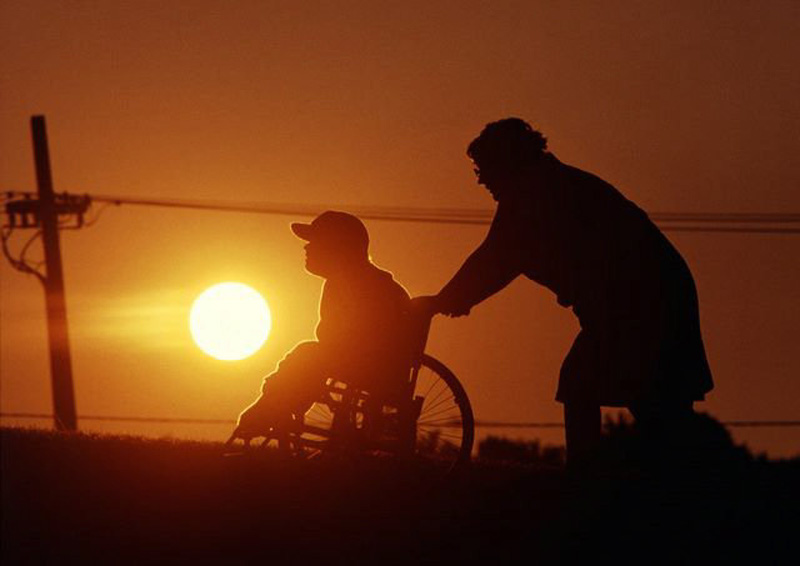
My friend, and mentor, Ron Kuzyk, was the king of the silhouette. He loved shooting them, even as editors told him they needed to see faces in the newspaper. Of course, when Ron came back from an assignment with one of his beautiful silhouettes, it inevitably ran in the paper, usually on the front page.
Of course it, and many of the others, was shot by Ron.
Especially the sports.
I knew I wanted to be able to shoot sports like Ron.
He could capture peak action like nobody’s business, but he also had a keen eye for those quiet moments, like the kid stealing a glance back at his coach, the consoling hand on a player’s shoulder, the goofiness of 5 year-old t-ballers.
And, amazingly, he didn’t need big time pro athletes or glorious bright arena lighting to get his great sports photos. He made them in dark high school gyms, dusty sandlot baseball diamonds and pocked minor soccer pitches.
Over the course of that summer, as Ron and I crossed paths, we became buddies. He encouraged me, talked me through the frustrations of learning how to shoot with the Hasselblad because the big colour transparencies made for better front page colour reproduction. But mostly he showed me the way with his eye and his instincts.
Whenever I had the chance, I studied his contact sheets, checked out his prints, paid attention to his byline (although, by the second week I was already pretty good at spotting a Ron shot in the paper), and when my shooting shifts came, I distilled what I learned to get in the right position for a good baseball shot, look all around at a spot news scene to find that storytelling moment, seek out a fun juxtaposition at a community event.
When I happened to be in the darkroom and he popped by for a studio shot, I studied how he set up the lights and, more importantly, how he made his subjects feel at ease, joked with them, broke through their guard to find something that captured the story they were there to tell.
Ron was the most natural, instinctual photojournalist I ever met. More importantly, he was also the most fun. Because as much as we liked to bitch about shooting pet of the week or real estate features, as much as the repetitiveness of shooting the same cycle of community events year after year wore down your creativity, he really got a kick out of his job, and that joy came through in every one of his frames (well maybe not the photos of used cars for dealer ads).
The next summer, all the lessons I’d absorbed from Ron paid off when I landed a full-time gig at Oshawa This Week.
On the weekends I wasn’t working, I often came back to Burlington to visit my family and hang with Ron. Usually over beers, we kibitzed and kvetched as professional colleagues. We also complained, because that’s what journalists do when we get together (oh, if only we knew then what was coming for our industry, for our profession…)
But when Ron finally made the decision to cut his ties — and the big paycheque — to Stelco, he was over the moon with delight, thrilled to be working full-time at his passion even if it meant keeping his heap blue car that smelled like an ashtray on the road a little longer.
There were often adventures on those weekends, usually involving Post sports reporters Kevin Nagel, Dave Rashford and Tim Whitnell as well; road hockey in the back parking lot on New Street, some ice hockey games, the annual Metroland slo-pitch tournament, a concert or two.
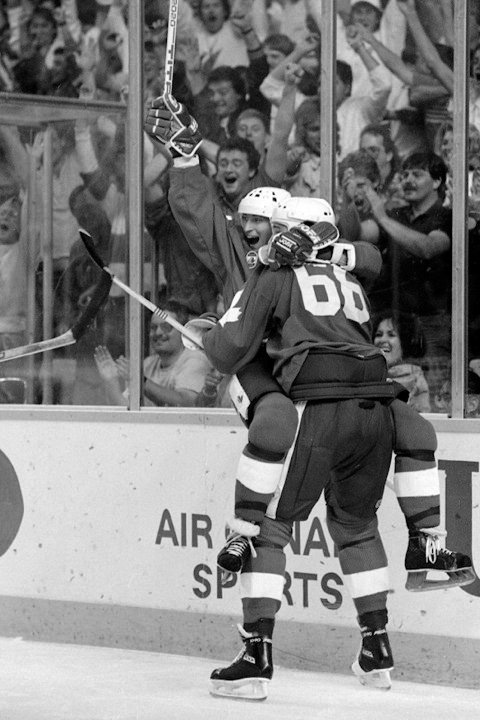
When a group of us bought a tournament package for the 1987 Canada Cup series, Ron somehow managed to get photo accreditation for the climactic final so when Mario Lemieux and Wayne Gretzky and the rest of that amazing Canadian team were celebrating their victory on the ice at Copp’s Coliseum, we were peering through our binoculars from the upper deck at Ron sliding around working the scrums. Oh yeah, he scored an amazing photo of the two superstars celebrating, jumping into each other’s arms behind the net in his corner. Like I said, Ron had great instincts for timing.
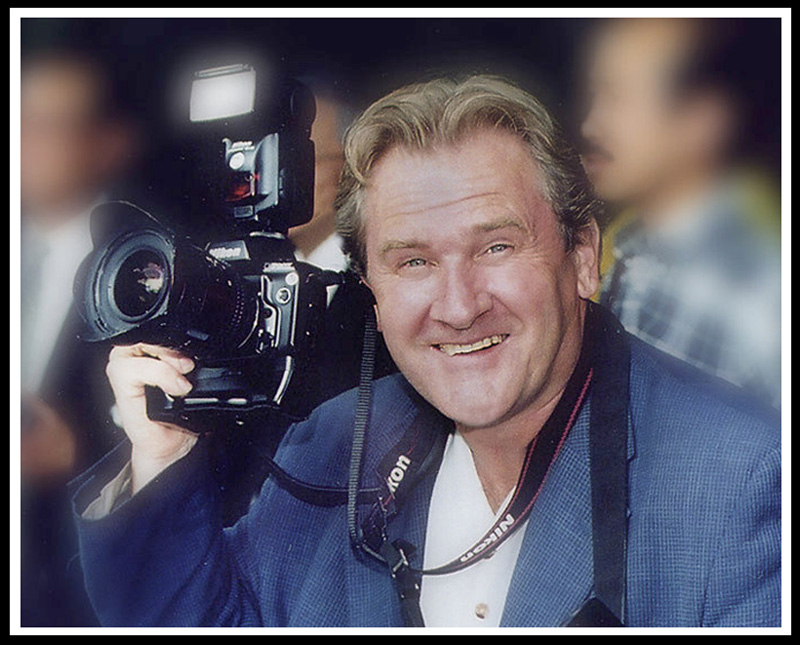
Ron Kuzyk and a great love, and eye, for shooting sports. He also had that innate instinct for being in the right place at the right time with the right lens. Oh yeah, and also for securing accreditation for big-time events even though he worked for a community paper.
When I headed west in 1991, our contact became more sporadic.
He came out once, riding shotgun in his brother’s big rig. I drove him around, showing him my new turf, including a bar or two that may or may not have had a brass pole. I think the motel in Port Coquitlam where he stayed burned down shortly after his visit.
Again with the timing.
When I was home for a visit, we’d go for beers or lunch and shoot the shit about old times, compare notes about our current situations.
But I’ve always felt Ron’s guiding hand, tried to follow his eye, even as I forged my own path as a community photojournalist.
I know the changes to our industry weren’t easy for Ron. He was old-school, driven to get the shot and to hell with all the bullshit of the business.
After he left the Post, we caught up a few times on my visits back to Ontario. I think one of those times I managed to tell him how much impact he’d had on my own career, how those early exchanges in the Post studio set me on my path.
We also tried connecting on social media, but Ron was never one for the Facebook, unless he was trading/peddling his vinyl records. I think he Tweetered about 12 times.
But even as our contact waned, Ron was often in my thoughts. He’s the reason I park myself about three metres back of first base at a baseball game so I can reach second base for a steal or double play, but also can grab a close play at first. He’s the reason I sit instead of stand at the touchline of a soccer match because that means a cleaner background. He’s the reason I keep my eye on the bench near the end of a big game as much as on the playing arena. He’s the reason I’m still trying to emulate that great wintry silhouette of a kid balancing on a fence.

 MARIO BARTEL