This story first appeared in the Tri-City News on Nov. 23, 2023
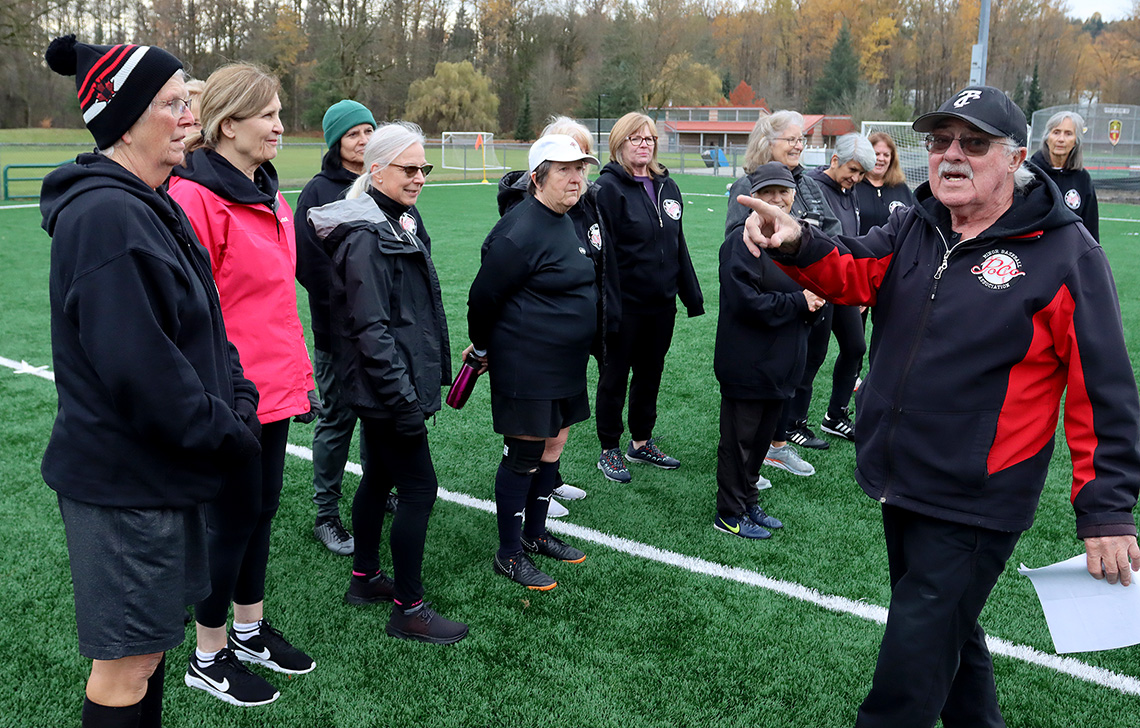
The Tri-City Walking Soccer Club is proof in the pudding: you can take the players out of soccer, but you’ll never take the soccer out of the players.
The club started several years ago as an adjunct to the Dartmen, an affiliation of weekend warriors who’ve grown old together playing sports like traditional running soccer as well as baseball and hockey.
As members started to hit their mid-50s, many realized they were losing their stride. But instead of giving up sport altogether, they just decided to slow it down.
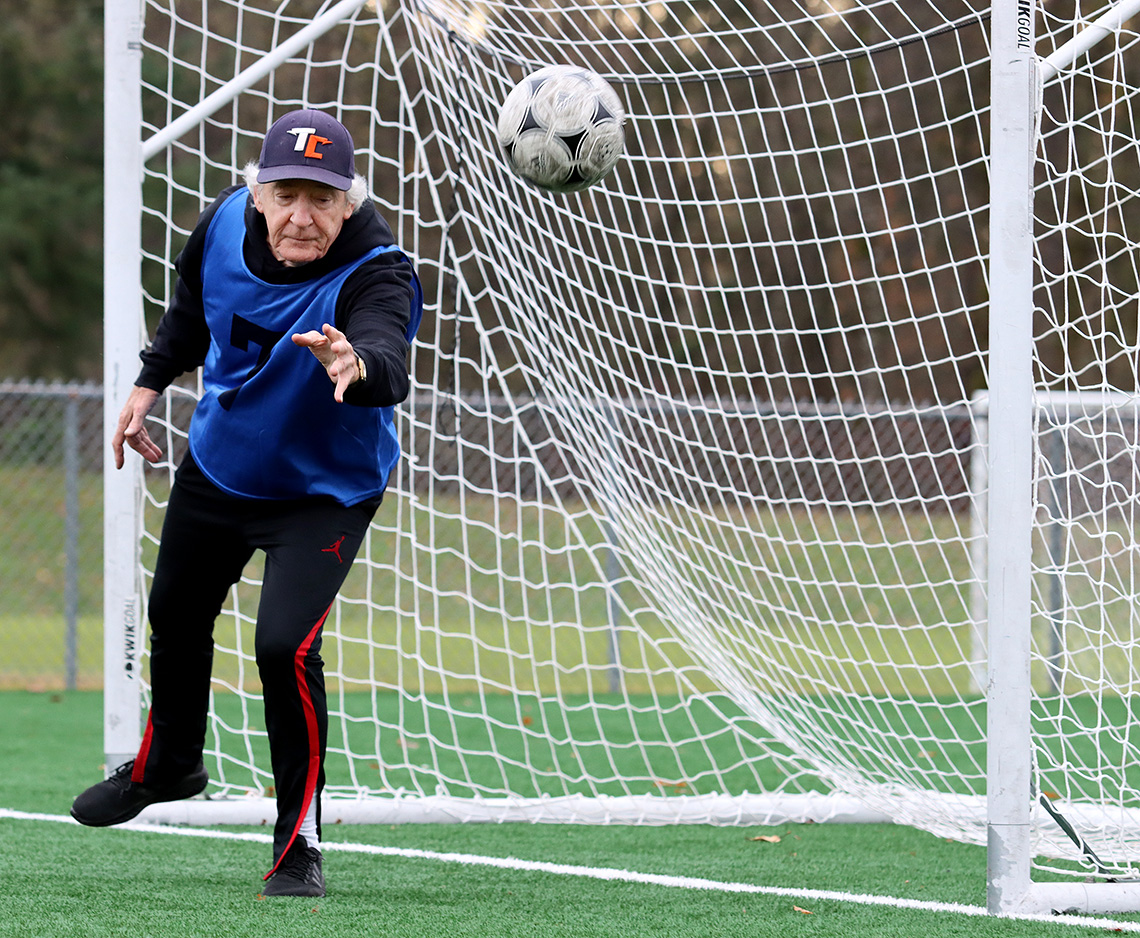
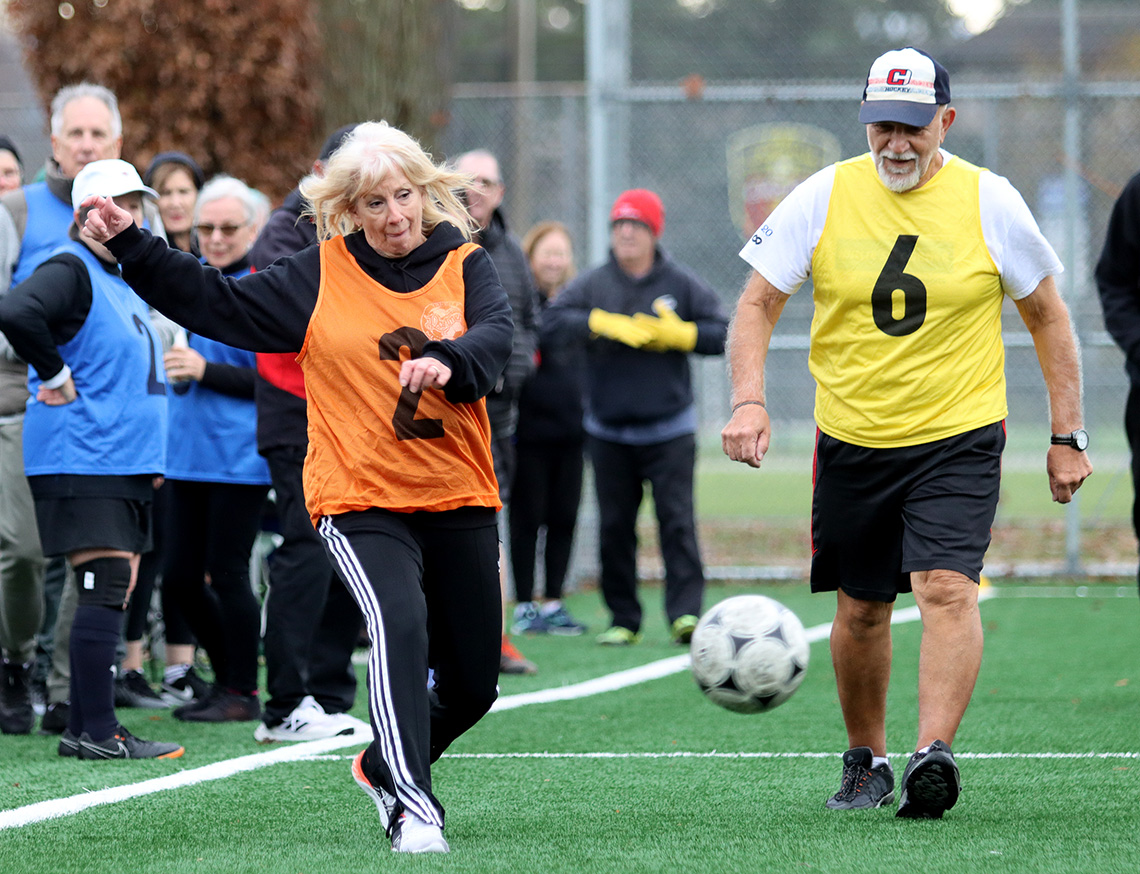
Walking soccer is just like it sounds, a modified version of “the beautiful game” without contact and played at a pace more comfortable for aging knees and joints.
It’s also played seven-aside on a smaller pitch — about half the size of a regular soccer field — at Port Coquitlam’s Gates Park.
Making new friends
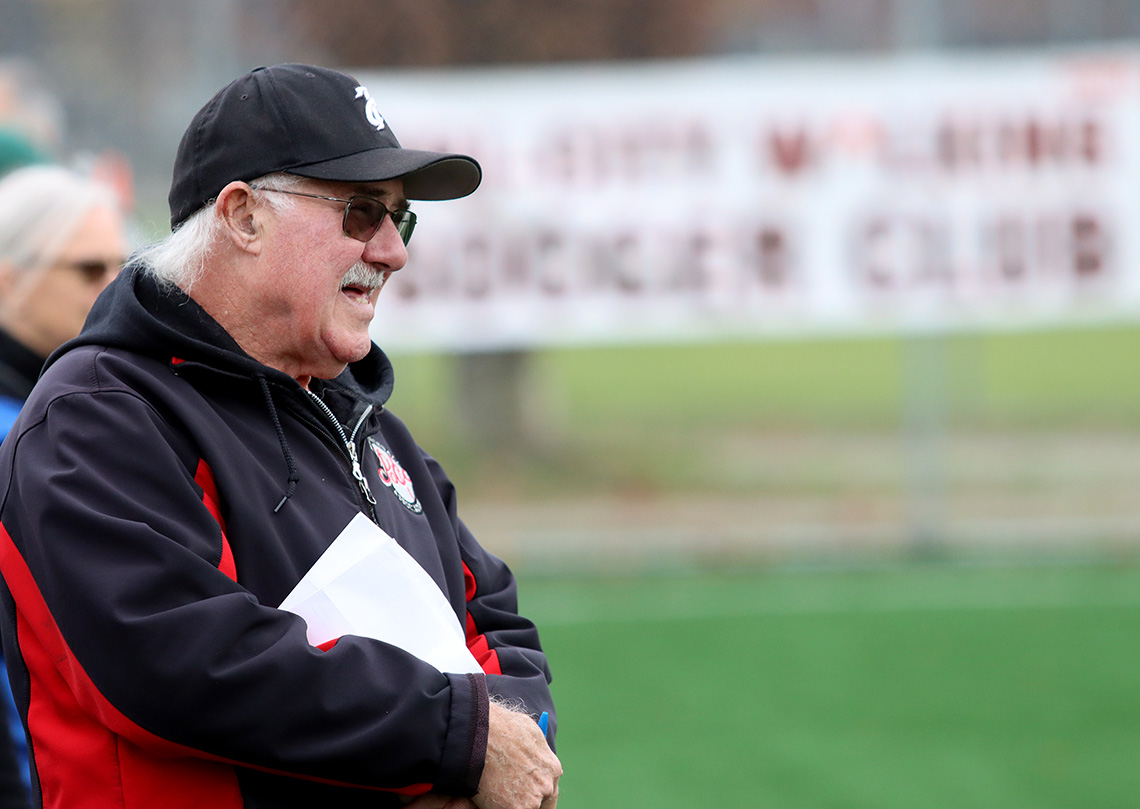
Jim Swelander, who started the Dartmen in Burnaby back in 1969, said as the group has embraced their golden years, the social aspect of their sporting endeavours has taken precedence over competition.
“It’s about making new friends and staying in contact with old ones,” he said.
When the group, which ranges in age from 55 to over 70, invited women to start playing in their soccer matches the camaraderie and post-game revelry kicked up a notch with organized get-togethers every week at the Cat & Fiddle pub and other social events.
Denise Spletzer, 68, said she first attended a walking soccer match as a spectator but quickly decided the club needed a female touch even though she’d never played soccer before.
“I like to get exercise,” she said.
Spletzer invited some of her friends from her fitness class and from an initial contingent of seven just a couple of years ago, there’s now 43 women participating in the club’s mixed division alongside its male membership of 93, some of whom stick around for the more competitive men’s division afterwards.
Swelander said not everyone in the club comes out at once, of course.
Players come and go for the regular Tuesday matches that run year round (the league heads indoors to a facility in New Westminster during December and January) and new teams of seven players are created every week from those who do show up to play in the 25-minute halves.
Stoke competitive fire
Sue McInnes said the soccer matches are a way to bring back some of the competitive fire she last felt when she used to play field hockey in her younger days. But it’s the new friendships she treasures most.
“It’s fun,” she said. “The social aspect is the best.”
Swelander, who leads all the players through various warm-up exercises and skill drills for about an hour before the matches begin and then coaches from the sidelines once the opening whistle blows, said it can be a bit of a challenge keeping everyone on the straight and narrow given the wide range of soccer experience and ability on the pitch.
“It’s okay, as long as you have patience,” he said. “You’ve just got to remember you’re here for fun.”
This story first appeared in the Tri-City News on June 5, 2022
Paul Carter beamed with more than just pride when his sons, Adam and Matthew, recently received rescue awards of merit from the Lifesaving Society.
The life they saved was his.
The Carters, along with his wife, Andrea, and their younger son, Daniel, 12, were with family friends enjoying a day at the beach at Haywire Bay in Powell Lake near Powell River on Aug. 1, 2021, when the boys decided to swim out about 100 metres to explore a nearby island.
Adam, who’s now 16, had recently received his National Lifeguarding certification and swims competitively with the Coquitlam Sharks. Matthew, 14, and Daniel also belong to the Sharks. So for them, the distance and cold water presented little challenge.
Left all alone on the hot beach, as his wife wandered off elsewhere, Paul could see across the bay to the island where his boys, their friends and dad seemed to be having a lot of fun.
“Why am I here all by myself?” he thought before wading into the water to begin the swim to join them.
Who’s at risk from drowning?
According to the Lifesaving Society, there’s an average 458 deaths by drowning every year in Canada. A quarter of them are between the ages of 50 and 64, almost 80 per cent are male, 34 per cent occur in lakes or ponds and two-thirds take place between the months of May and September.
Carter was right in the statistical wheelhouse. He just didn’t know it. Yet.
Halfway to the island, Carter began to realize the distance and cold water were more than his 50-year-old body and recreational swimming ability could handle. He’d gone out too fast and now he was paying for his hubris.
Carter paused to catch his breath, treading water for a minute or so.
Determined to reach the island, he resumed swimming. But 10 metres later he was exhausted.
‘I started panicking’
Carter tried to make up his mind whether he should continue going forward or turn back when a wave hit him square in the face. He swallowed a mouthful of water and began coughing violently, further depleting his waning energy.
Carter’s breathing quickened. His arms and legs slowed.
“That’s when I started panicking,” he recalled. “I did the calculation that I wouldn’t be able to get anywhere where I was safe.”
The eldest boy, who attends Heritage Woods Secondary School in Port Moody, said he just happened to be on the beach on the island’s leeward side when he heard his dad call out. While his friend’s father thought Carter was just messing around, Adam said his dad’s shout had a tone “I’ve never heard used before.”
In trouble
When Adam looked across the water, he could see Carter wasn’t moving much.
The instinctive drowning response, in which humans close to drowning focus all their attention on keeping their mouth above water to the exclusion of any useful effort to save themselves or attract attention, had taken over.
“I knew deep down he was in trouble,” Adam said of his father.
He jumped into the water and let his lifeguard training take over.
Reaching his dad, Adam rolled him onto his back and used his chest to elevate Carter out of the water. He told his dad he was going to be OK, implored him to kick his feet to help propel them back toward the safety of the beach.
By then, Matthew was also in the water.
‘We’ve got to do this’
“I knew it was an emergency,” he said.
When Matthew reached his dad and brother, Adam told him, “We’ve got to do this.”
He wrapped Carter’s arm around his shoulder and the three paddled to shore.
Carter said the whole incident took about five minutes to play out, but “in the moment it seemed a lot longer.”
Back on land, coughing out more of the water he’d swallowed, Carter became a parent again and checked on his boys.
They “looked exhausted,” he said. “You feel bad about the situation you put your kids in.”
Andrea, who was now back on the scene after being alerted by others about what was going on, transported the trio to the hospital to make sure they were OK.
The good scenario
It was during the drive Adam started to come to grips with what had just transpired.
“We just saved our dad from dying,” he said, adding he thought about all the different scenarios that could have happened, but “we got the good one.”
Carter said he was thankful he and his wife had encouraged their boys to take up swimming at a young age.
“You never know when it’s going to be important,” he said.
Young Daniel, who’d watched the whole event play out before him, said, “It’s just a good thing for everyone to learn.”
Since then, Carter said, the family’s often reflected on what happened. Sometimes, he said, he’s wracked with guilt.
“What if my family had lost me?” he said. “How tragic would that have been.”
Adam’s take is a little more pragmatic. “It felt like it was something I should have done.”
Daniel’s nonplussed.
“It could have been the worst day of my life, but now it was just a thing that happened.”
Still, Carter said, there are valuable lessons to be learned, especially as summer approaches and people begin heading to beaches to cool off.
“I made a few bad decisions,” he said. “Drowning doesn’t look like when you see it on TV.”
This story first appeared in the Tri-City News on March 15, 2024
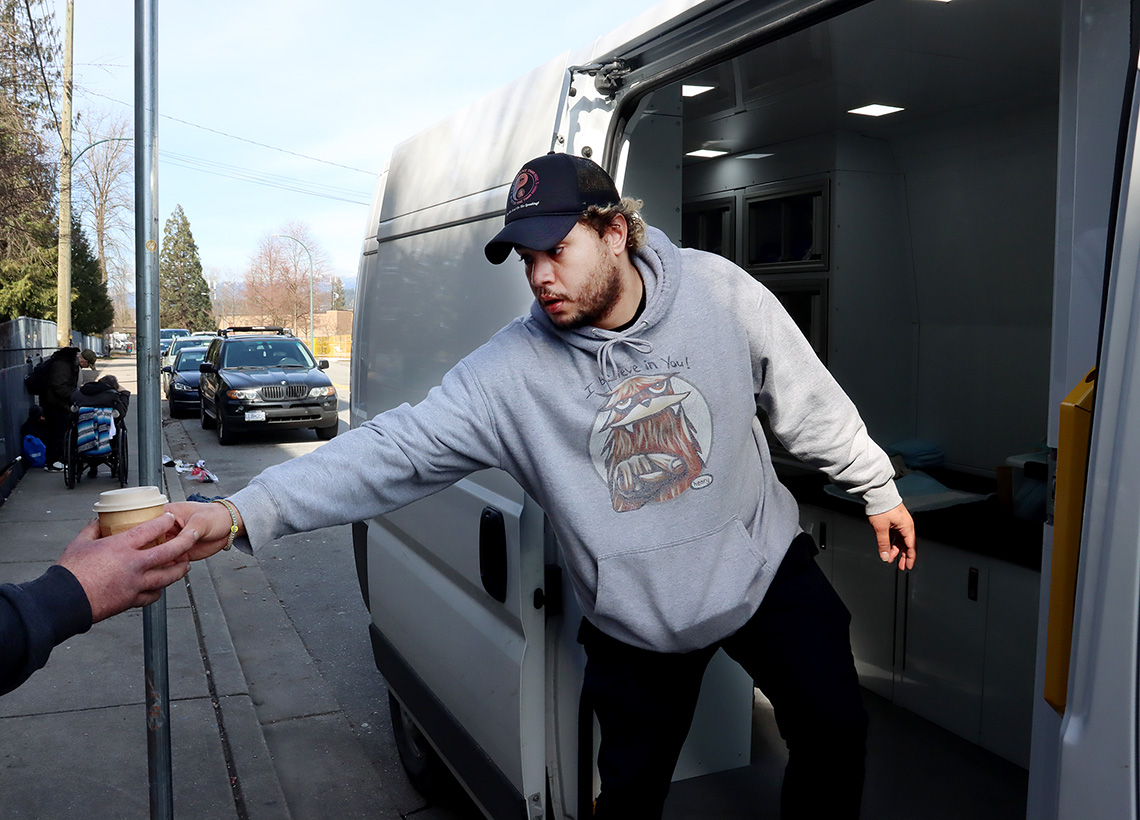
A nondescript white panel van is delivering relief to homeless populations in the Tri-Cities, Burnaby, New Westminster and Maple Ridge.
Sometimes it even helps save a life.
During a recent visit to the 3030 Gordon shelter in Coquitlam, medical professionals from the Integrated Homelessness Action Response Team (IHART) mobilized when a man overdosed on the sidewalk.
As his worried street buddies gathered round and coaxed the man to wake up, registered and practical nurses administered naloxone and notified emergency services. After several tense moments he was responsive and sitting up. Minutes later he walked away, getting on with his day as if nothing unusual had occurred.
While the IHART program has been operating since 2022, it’s been bringing its suite of health care, mental health and outreach services to the streets in a van since January.
Lower barriers
The program’s co-ordinator, Paolo Palomar, said the idea is to lower barriers to obtaining health care for a population that would otherwise have none.
The mobile team that functions five days a week is comprised of nurses, clinicians, as well as peer support, outreach and social workers.
“We’re able to give wrap-around support,” Palomar said.
Sometimes that means distributing requisitions for blood work.
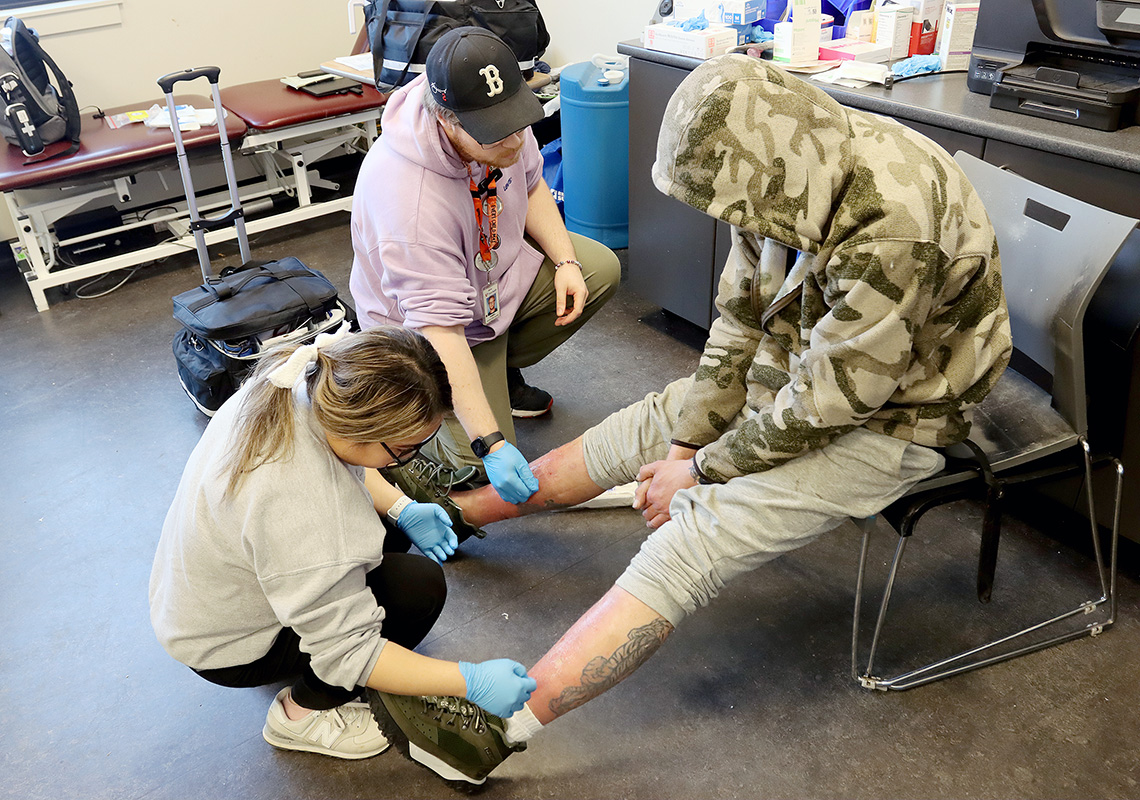
Sometimes it requires cleaning and dressing infections or providing counselling. Sometimes it’s just handing out a cup of warm coffee.
“We try not to say ‘no’ to anyone who needs help,” Palomar said.
The IHART team travels to homeless encampments, shelters and church parking lots across the northern communities of the Fraser Health district while a second team helps out in eastern communities like Abbotsford, Mission, Chilliwack, Agassiz and Hope. The service is also being extended to Surrey.
Relationship of trust
The vans follow a regular schedule so clients can anticipate their visits, Palomar said.
It also helps them build a relationship of trust, he added.
Twice a month the team offers special foot care clinics as homeless populations often have to deal with a condition called “street feet” because their shoes and socks are wet from the rain and snow.
The frontline care can help alleviate the chronic nature of health disparities the homeless population experience, said Fraser Health clinical operations director Sherif Amara.
“The vans provide an additional tool to bring care further into these remote, often secluded, settings.”
Palomar said it can also be the stepping stone to more comprehensive care and possibly even the start of a journey off the streets.
This story originally appeared in the Tri-City News on March 5, 2025
Stephanie Ibbott says she wasn’t about to let a court delay deter her and about 30 supporters from expressing their frustration with the justice system in its handling of the murder of her cousin-in-law, Trina Hunt.
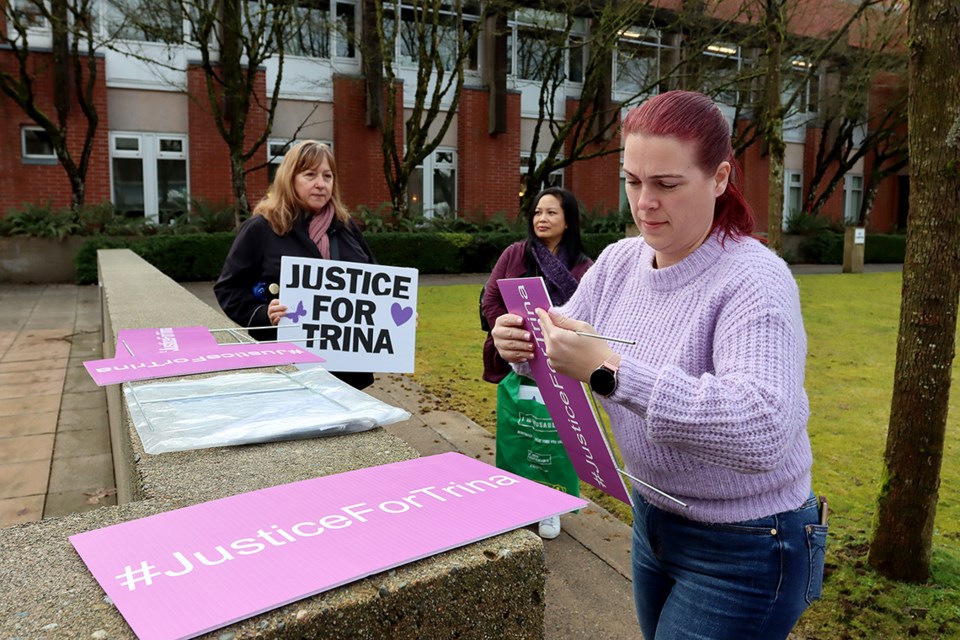
Wednesday morning, March 5, the group gathered on the lower steps in front of BC Provincial Court in Port Coquitlam, despite a last-minute delay in court proceedings to April 23 for Hunt’s husband, Iain, who’s been charged with indignity to human remains in connecting with her death in January 2021.
Many of the group held hand-drawn signs or professionally printed placards, calling for the justice system to do better or for the Integrated Homicide Investigation Team (IHIT) to persist a pursuit for more serious charges. Some clutched bunches of purple tulips, Ibbott said were Trina Hunt’s favourite flowers in her favourite colour.
“It’s been four years, we’ve been waiting patiently,” she said, adding the charge laid against Iain Hunt after four years of intense investigation is “not justice.”
“It’s just baffling, infuriating and devastating,” Ibbott said.
Iain Hunt, 52, was charged on Feb. 4, more than four years after he’d reported his wife missing from their Port Moody home on Jan. 18, 2021.
An intense search by police, friends, family, community volunteers and even Coquitlam Search and Rescue, failed to find her until human remains were located near Hope on March 29, 2021, then positively identified as Trina Hunt a month later.
Shortly thereafter, IHIT executed search warrants on two homes, in Port Moody and Mission, and in June, 2022 a man was arrested but later released without charges.
Ibbott said the years since Trina Hunt’s disappearance — which have included the announcement of a $50,000 reward for information about her murder, public vigils and annual reminders from investigators about their efforts to bring charges — have been difficult.
“You hope the justice system will do people right,” she said. “It’s not enough.”
Marla Clark, who organized Wednesday’s rally, said it was important for friends, family, neighbours and co-workers to show their support for Trina Hunt.
“We are going to be here for Trina,” Clark said of her late friend whom she first met when they worked together in 1995.
Clark said the display is also a call to bring attention to the often hidden issue of domestic violence and femicide — the killing of women, usually committed by men.
I first alighted at the Tri-City News 34 years ago almost to the day, a refugee from the 1990 Ontario recession that had cost my job of five years as a photojournalist at a paper in Oshawa.
An industry contact told me to talk to Craig Hodge and happenstance brought him to a conference in Toronto.
He told me if I came west, there would be work.
So I turned down an offer at a paper in Sydney, Nova Scotia, and pointed my red Toyota in the opposite direction.
The Tri-City News in 1991 was as close to a daily paper you could get without publishing six or seven days a week.
Under the guidance of Hodge, we were a department of six photographers, an office manager and assorted freelancers. The newsroom upstairs was similarly staffed.
We had a studio, full colour darkroom and we were all connected with pagers (!) and two-way radios. We covered stories seven days a week from 8 a.m. to 10 p.m., from Boundary Road to eastern Maple Ridge.
Travel budget
Occasionally, there was budget to go out of town, to the BC Winter and Summer Games, the Canada Summer Games in Kamloops, the Commonwealth Games in Victoria, to Miami to cover the IndyCar debut of local racer Greg Moore. During provincial elections, someone was sent into Vancouver to cover the big celebration for the winning party.
MARIO BARTEL/TRI-CITY NEWS Greg Moore heads home from the track at Homestead, Florida, at the end of IndyCar spring training in 1996.
One year, the company chartered a plane to fly several of us to Spokane, Wash., for a photojournalism conference. We took great delight in telling others we had to cut out of Happy Hour because our plane was warming up its engines at the airport.
Around the light table where we gathered at the end of every shift to edit our negatives and debrief the day, we speculated it was only a matter of time we’d become a daily. The news was out there, the papers were robust, filled with ads and flyers.
On April 17, the Tri-City News went dark after more than 40 years, although it was already diminished from its former self in August, 2023, when the decision was made to end the actual print publication to exist solely online.
The plummet of local news has been precipitous and painful.
While organizational changes had sent me to the Burnaby and New Westminster NewsLeader for 15 years until they were closed in 2015, I remained connected to the Tri-City News, occasionally sending stories that might be of interest, often sharing photos when a team or athlete from Coquitlam, Port Coquitlam or Port Moody was playing in a tournament or provincial championship at the Burnaby Lake Sports Complex, Copeland or Queen’s Park arenas.
When former TCN editor Richard Dal Monte had an opening in 2017, I jumped at it after 18 months wandering the wilds of freelancing, riding my bike and producing digital content for a realtor. You can take the boy out of the News, but you’ll never take the News out of the boy.
I came back with eyes wide open; our industry has been precarious for years.
Stories to be told
But there were still so many stories to be told.
So we put our heads down and forged ahead, even as we went from publishing twice a week to just once. Even as newsroom vacancies started to go unfilled. Even as the COVID-19 pandemic scattered us to our homes, conducting interviews over the phone or making arrangements to meet in open spaces like parks, driving deserted streets looking for photos that captured the weird vibe of that extraordinary time.
Heading to an assignment with a few minutes to spare; I searched for a shot that would somehow capture the feelings of isolation many were enduring during the first weeks of the COVID-19 pandemic as businesses closed and people stayed apart.
Our coverage of those early months of fear and uncertainty was some of the best I’d ever been a part of. Along with keeping up with the frenetic pace of event cancellations and societal changes brought on by the public health crisis, we found unique features of people persevering: the Shriners band playing for isolated seniors; an Elvis impersonator giving drive-by concerts; businesses trying new ideas to keep money coming in when their customers were staying home; the challenges faced by young student athletes with no sports to play.
It took a pandemic to revive Elvis. Darren Lee reignited his career as an Elvis tribute performer by driving to various neighbourhoods to entertain people shut in by the COVID-19 pandemic.
But even as we put in long hours in trying conditions to keep readers informed of all that was changing during the pandemic, the die was being cast for our ultimate demise.
Businesses trying to hang onto every penny to stay afloat themselves stopped advertising; many never came back. Readers’ habits changed, perhaps conditioned by hours of doomscrolling on social media platforms to keep up with the moment-by-moment developments during the pandemic.
Even going online exclusively, sparing the expenses of newsprint, ink, distribution and, eventually, a physical office, couldn’t turn the tide.
Tough times
The months since that decision haven’t been easy. Spending hours covering a contentious council debate about a major development proposal that barely registers a couple of hundred page views while a five-minute effort to recast a press release about a new donut shop coming to town goes off the scale can be dispiriting.
So can watching editors churn and colleagues depart.
But through it all we’ve tried to keep our communities informed and connected by sharing their stories.
I guess the void ahead will be the true test of whether that even matters anymore in an age when the first thing people do in the morning is scroll their Facebook feed rather than open the local paper and algorithms direct people into a perpetual feedback loop affirming their darkest inclinations.
It’s truly has been the best of times. It is the worst of times.
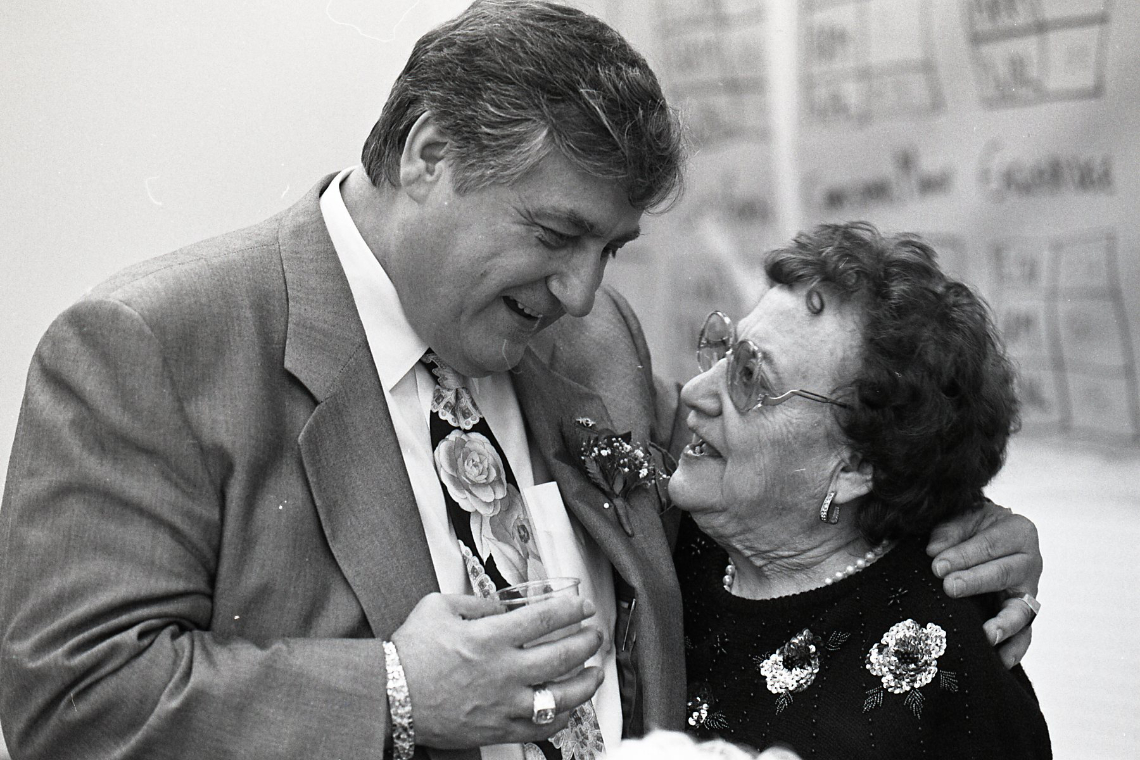
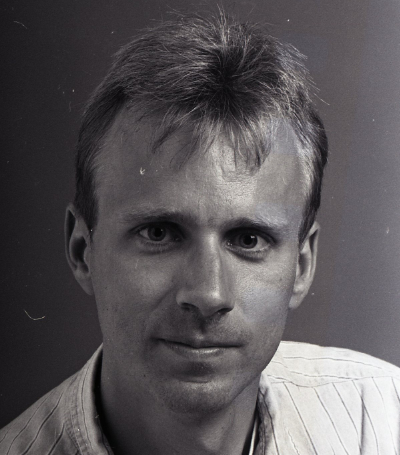
A selection of photos I’d shot in my first couple of years working in the photo department at the Tri-City News. They, and many more, have been carefully preserved and digitized by the City of Coquitlam Archives.
In 2023, my former colleague at the Tri-City News, Diane Strandberg, launched a weekly history feature that could easily plug a hole in the back pages of the paper and generate some traffic to our website. Headlines from the Past looks back at stories we’d covered in the publication’s 40 years. When Strandberg retired in Sept., 2023, she asked if I wanted to continue the feature. I’d launched a similar retrospective series in the final years of the Burnaby and New Westminster NewsLeader before it was closed in 2015, so I enthusiastically picked up the mantle. The stories aren’t just a fun opportunity to leaf through yellowing back issues of the paper and remember some of the stories I’d covered as a photographer, they’re also a reminder of the breadth of features and news we were able to bring to readers when we had the resources. As well, they highlight the important role newspapers play in documenting change and evolution in their communities, along with some of the quirky and remarkable happenings. Many thanks to the staff at Coquitlam Archives who’ve taken on the task of preserving back issues of the Tri-City News, as well as thousands of negatives and photos. Here is a small collection of some of my favourite Headlines from the Past features.
Wild times come to an end at this notorious Port Coquitlam inn
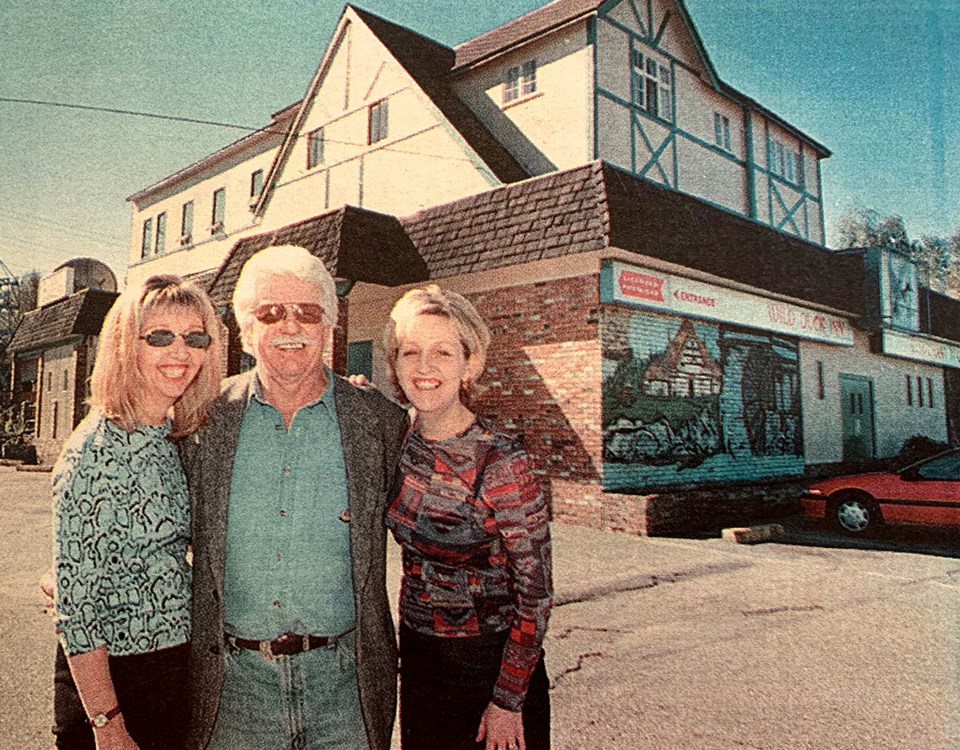
For better or worse, the Wild Duck Inn was a local landmark.
Tucked next to the Lougheed Highway where it meets the Mary Hill Bypass in Port Coquitlam, the Tudor-style tavern was notorious for its exotic dancers and sometimes less-than-reputable customers. It was used to film a brutal rape scene in the 1988 Jodie Foster film, The Accused.
Other Hollywood stars who alighted its interior for various productions included Gwyneth Paltrow, Melissa Gilbert and Sean Penn, who scouted it as a potential set for a project he was working on with Jack Nicholson.
Using the money he’d made renting the facility to film crews, Kogler set out to reimagine The Wild Duck as an Irish pub and restaurant to be called Dublin Docks.
“We want to change the image of the pub,” Kogler told the Tri-City News, adding the makeover would honour his wife’s Irish heritage.
Instead of a brass pole atop a stage, Kogler said he planned theme nights and live music, as well as an upgraded menu.
“We’re going to get rid of the dancers,” he said. “We are missing 50 per cent of our population right now.”
By December, the last stripper had twirled around The Duck’s brass pole and many of its fixtures, like the giant map of Pitt Lake that had occupied a place of honour behind the bar for 20 years, were auctioned off.
In 2008 the pub was demolished to accommodate construction of the new Pitt River Bridge.
Protesters denounce the use of animals in a traveling circus visiting Coquitlam in 1995.
TRI-CITY NEWS FILE PHOTO/COQUITLAM ARCHIVES
Circus tigers and elephants attract animal rights protesters to Coquitlam
The circus came to town in the summer of 1995.
So did animal rights protesters.
“The only exercise they get is when they perform,” a director of the Vancouver Humane Society told the Tri-City News, adding the animals are often chained or in cages, standing in their own feces and urine.
But a tiger keeper for the circus said its six big cats, plus two lions, are well-cared for.
“If this animal was mistreated, he would be cowering now,” Chris Kilpatrick said of one of the tigers lolling in a cage outside the arena.
“I’ve had this guy since he was a day old. He’s like a member of my family.”
Kilpatrick said the tigers travel and perform for five months of the year and get two days off a week. They spend the rest of their time at a ranch in southern California where the better-behaved cats are allowed to road free.
But the protesters said such assertions are little comfort.
They said they planned to lobby Coquitlam council to ban circus animals in the community and pressure operators to send them to sanctuaries to live out their lives.
“I’m convinced as more and more municipalities stop these shows, these facilities will be made available to animals,” said one.
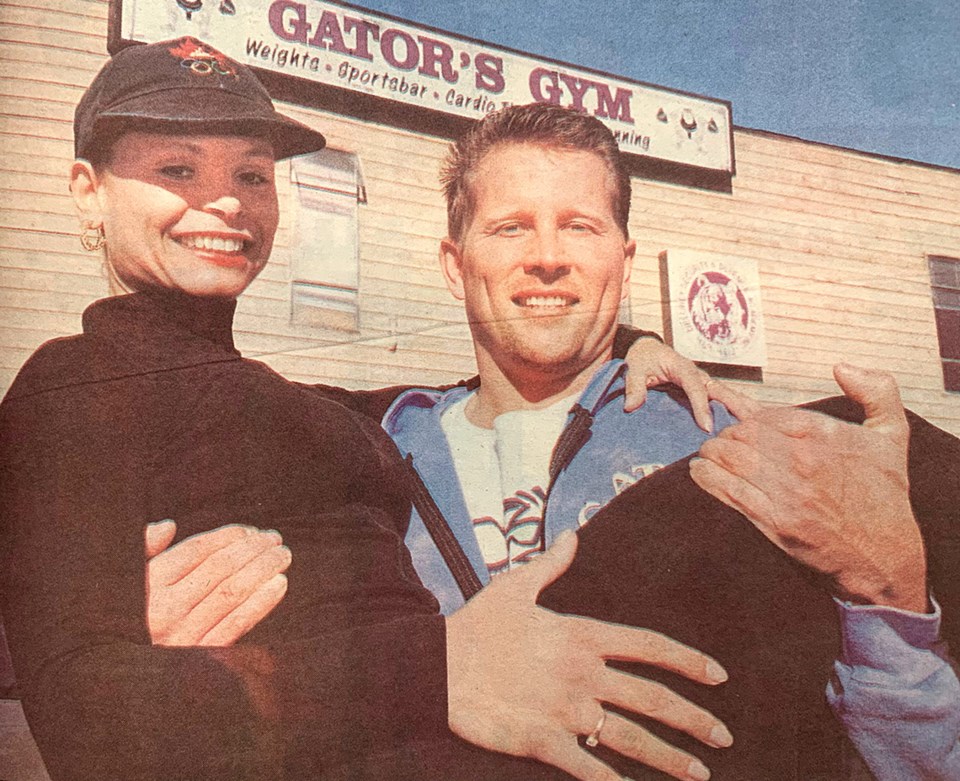
Gator’s Gym owner Kai Heinonen and personal trainer Monalee Blu chased down a would-be thief who tried to lift some personal effects from lockers in March, 1997.
TRI-CITY NEWS FILE PHOTO/COQUITLAM ARCHIVES
Don’t mess with Port Moody’s repetition man (and woman)
A would-be thief might have been reconsidering his career and lifestyle choices after trying to abscond with some personal effects from a Port Moody gym in March, 1997.
The out-of-shape bandit faced several charges and his parole from a previous conviction was revoked after he was chased down by the owner of Gator’s Gym, Kai Heinonen, and one of its personal trainers, Monalee Blu.
The alleged thief was trying to get away with keys and a wallet he’d pilfered from Blu’s locker.
Blu had just finished an hour-long cardio workout when the incident occurred.
While Heinonen was tending to a prospective client who may actually have been a decoy, the suspect secreted into the locker room area, cut a lock and lifted Blu’s fanny pack that contained her car keys and wallet then left with his accomplice.
Blu noticed the theft immediately. She advised Heinonen. They saw her car was still parked out front, but with a stranger in the driver’s seat, trying to get it started.
Blu ran out to confront the thief, and when he tried to flee, she kneed him in the groin, causing him to drop the keys. As she went to pick them up, the suspect hightailed it on foot.
Heinonen, who was watching the scene play out from inside the gym, immediately gave chase, joined by Blu.
They quickly caught their winded quarry and pinned him to the ground until police arrived.
“If I had to chase him to Timbuktu, I would have,” Blu told the Tri-City News.
“It was pretty wild,” said Heinonen.
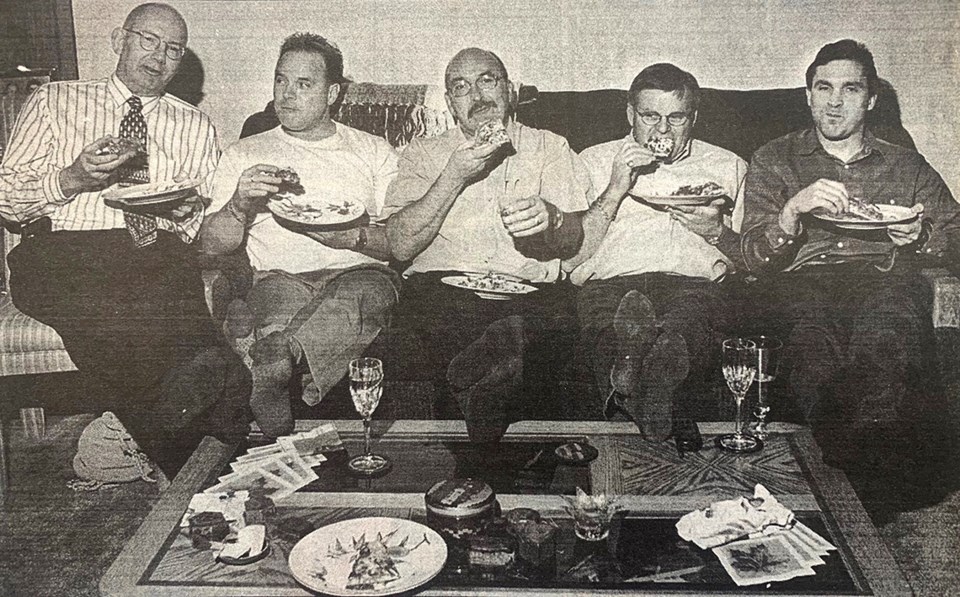
Contestants for the Mr. Millennium pageant kick their training into high gear.
TRI-CITY NEWS FILE PHOTO/COQUITLAM ARCHIVES
Fundraiser for Port Moody hospice project turns the tables on beauty pageants
Stuffing slices of pizza and drinking beer may not be a part of the training regimen for most pageant contestants.
But the seven local businessmen vying to be named “Mr. Millennium” were doing their best to increase their girth — er, worth — prior to the unique fundraiser event for the Crossroads Hospice Society, which, in 2000, was in the planning stages for construction of its new $1.5 million-facility near Port Moody’s Eagle Ridge Hospital.
The contestants — three of them single — would compete in fashion modelling, beach and formal wear, impromptu questioning and talent, with the winner representing Crossroads at local functions through 2001.
“The guys are really excited about this,” said Linda Kozina, Crossroads’ executive director.
“They’re training to get in shape. And we’ve already got a waiting list for next year’s pageant.”
A commuter ferry service that transported passengers from Rocky Point Park in Port Moody to the Sea Bus terminal in Vancouver lasted less than a month in 1994.
TRI-CITY NEWS FILE PHOTO/COQUITLAM ARCHIVES
The commuter ferry service from Port Moody to Vancouver that didn’t last a month
Long before SkyTrain and West Coast Express carried commuters from the Tri-Cities into Vancouver, the owners of a 60-foot tunnel-hulled ship called Pride of Vancouver were getting ready to launch their own private service.
James MacMillan and Vancouver doctor William Chan proposed twice daily sailings between the pier at Port Moody’s Rocky Point Park and the SeaBus terminal. The 55-minute journeys would depart at 7 a.m. in the morning and return for Port Moody at 5:30 p.m. The trips would cost $4.50 each way, or $165 for a monthly pass.
In a presentation to Port Moody council, MacMillan said the service needed 50 passengers each way to break even, but he hoped to attract up to 150. He said he planned to launch on Jan. 24, 1994.
But some councillors weren’t so keen on passing a bylaw that would grant the Pride of Vancouver permission to use the pier and set docking fees for the craft and parking rates for passengers. They were concerned the commercial enterprise wouldn’t be an appropriate use for the public park.
Others — led by then-Mayor John Northey — said the effort to provide an alternative way for commuters to get to Vancouver and ease traffic congestion was laudable and worth granting the company use of the facility for a trial run lasting into May.
The bylaw ultimately passed on Jan. 24, and a week later the ship had its maiden commuter voyage with only 12 passengers and a contingent of reporters, photographers and camera operators from several media outlets.
Slowed by an incoming tide, the craft arrived in Vancouver 16 minutes late.
It may have been an ominous omen.
A week later MacMillan was offering free rides and adjusting his schedule to get passengers into Vancouver and back to Port Moody earlier.
“Everybody has said our times are wrong,” he told the Tri-City News.
But even those adjustments weren’t enticing enough to get commuters out of their cars.
MacMillan lowered the fare to $3.50 each way and even threw in a free B.C. Transit transfer in an effort to build traffic.
Less than a month after it launched, though, the commuter ferry service was sunk.
Its last voyage carried 26 passengers — more than the average load of seven a sailing it carried in its final week, but far less than the craft’s capacity of 200.
The following story was scheduled to appear in the Tri-City News.
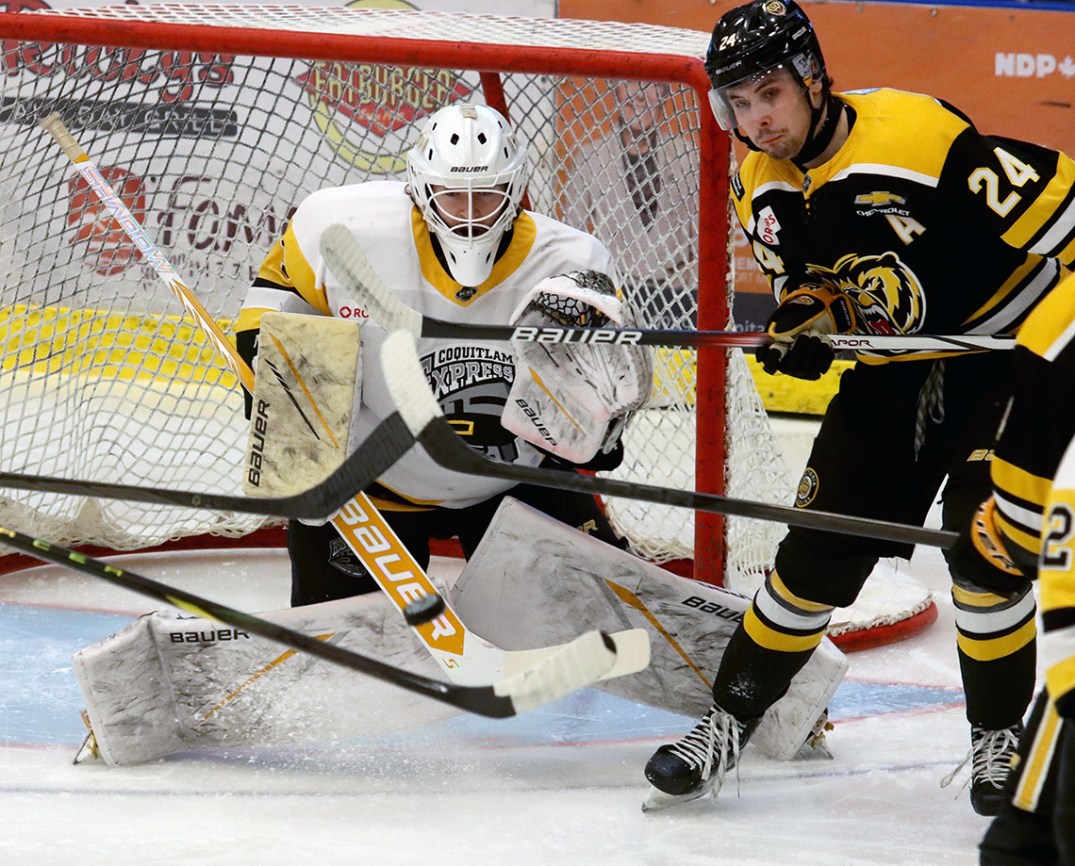
Despite exiting the first round of the BC Hockey League playoffs for the fourth consecutive season, there’s no time for Coquitlam Express general manager Tali Campbell to wallow in disappointment.
Even as players head home for the summer following Sunday’s 5-1 loss to the Victoria Grizzlies that eliminated the Express from the post season in six games, Campbell is putting together a busy schedule that includes further building out of the program’s development teams, attending spring evaluation camps, managing more renovations to its off-ice training and lounge facilities across from the Poirier Sport and Leisure Complex, meetings with scouts, as well as potential recruits and their families.
“The work never stops anymore,” Campbell said.
This summer, though, presents some new challenges.
A recent decision by the NCAA to accept players from the Canadian Hockey League into its Div. 1 programs beginning Aug. 1 has significantly altered the junior hockey landscape.
The allure of preparing players for lucrative scholarship opportunities at American universities to continue developing on the ice while getting an education was once the BCHL’s ace-in-the-hole over the Western, Ontario and Quebec Maritime Junior hockey leagues, which the NCAA had considered professional because of the stipend players get to help them cover expenses while living away from home.
Play to strengths
With that advantage now gone, Campbell said the Express and the rest of the BCHL teams must play to their strength of giving young men the time, space and tools to develop and mature as players and individuals ready to take the next step in their hockey journey, whether that’s college programs at U.S. or Canadian schools, or even turning pro or semi-pro.
“Our league has always been the long runway league,” Campbell said.
Already that approach has paid dividends with a commitment from potential 2026 NHL draft prospect Cole Bieksa, the son of beloved former Vancouver Canucks defensemen Kevin Bieksa.
“I think the reputation of our program just gets boosted by something like that,” Campbell said, adding the 18-year-old forward, whose Fairmont Prep Academy team in California just missed out winning the Chipotle-USA Hockey national 3A high school championship, will still have to earn his place on the Express come September.
Home-grown talent
Campbell said the increased competition for players also boosts the importance for BCHL teams to cultivate home-grown talent through their own developmental pathway.
“The feeder system is critical to the lifeline of our program,” said Campbell of the Coquitlam HC program that’s partnered with School District 43 to give local players as young as 13 a chance to hone their game in an intensive hockey environment while going to school at nearby Centennial and Port Moody secondary schools.
“We need to get families and kids into our programs at a young age, show them exactly what we offer over the course of three to four years.”
Still, Campbell said, with several players who were key to the Express’s run to the playoffs graduating out of the BCHL, including goaltender Andrew Ness, forwards James Shannon, Joseph Odyniec, Andrej Kovacivic and Mason Kesselring, along with defensemen David Brandes and Sam Frandina, uncertainty about what the team will look like come September abounds.
With more options available, players and their families are unlikely to make quick decisions about where to play until training camp is nigh.
Toughen up
“Every player is going to try their best option,” Campbell said, adding he’s targeting those who do choose the Express to be bigger and more willing to go to the wall for their teammates when the going gets tough.
We have to set the expectation that from Day One, you’re going to have to give a hit, you’re gonna have to get into a lane to block a shot,” Campbell said. “We owe more to our fans, we owe more to our corporate partners and the community.”
Express announce soccer partnership
The Expess is making tracks in soccer.
The BCHL team has announced a strategic partnership with Coquitlam Metro-Ford Soccer Club’s new Evolution FC program that competes in the semi-pro League1 BC.
The league positions itself as a bridge from high-performance youth soccer to the sport’s elite professional and amateur leagues like the Canadian Premier Soccer League and the new women’s Northern Super League.
Campbell said the arrangement will create opportunities for cross-promotion and marketing of the hockey and soccer teams while allowing Evolution FC to draw upon the expertise the Express already have in place for public relations, game day management and ticketing.
“This partnership is about more than just sports,” said Campbell in a news release. “It’s about united two organizations that are passionate about community, youth development, and creating unforgettable experiences.”
The Evolution FC team already has a win and a draw in its first two matches in the nine-team men’s league while the women’s side has a win and a loss. Both teams are based at Coquitlam’s Town Centre Stadium.
This story originally appeared in the Tri-City News
After Carson McGinley learned he’d been traded to the Coquitlam Express from the Sherwood Park Crusaders on Dec. 30, he and his dad, Mike, loaded up his car and drove 13 hours from Alberta to his third hockey destination in five months.
Several other players have been similarly uprooted as Express general manager Tali Campbell and head coach Jeff Wagner refine the BC Hockey League (BCHL) team’s lineup for the stretch run to the playoffs. Goaltender Andrew Ness was acquired by Coquitlam from the Penticton Vees in late November. Defenseman Jack Sullivan joined the Express from the Blackfalds Bulldogs a week later.
In the past two weeks, the team has also added Kazakhstan junior national player Nikita Sitnikov and forward Dane Pyatt, who’d been injured most of his rookie season with the Western Hockey League’s Spokane Chiefs.
Wagner said the upheavals can be unsettling for everyone involved — the new players coming in and the group already established in the dressing room.
“The business of junior hockey is that moves are made and you can’t take anything for granted,” said Wagner, who’s in his first season running the Express bench.
Easing a player’s transition into a new situation that not only includes a new coach and new teammates, but also a new living situation with an unfamiliar billet family and a new community to navigate, is all about making sure management has done its homework, keeping open the lines of communication and having trust in the dressing room’s leadership group, said Wagner.
“We lean on our leadership group to make sure that they’re integrated well and put into a good situation.”
MARIO BARTEL/TRI-CITY NEWS
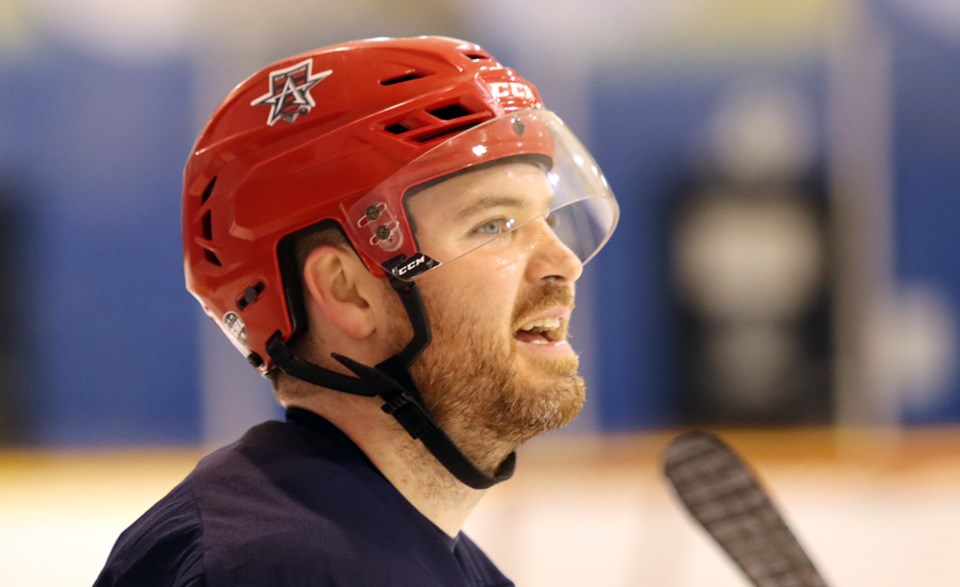
Coquitlam Express forward Carson McGinley lays it out during a timed skating session during a team practice.
McGinley, who’s originally from Phoenix, Ariz., said he felt instantly welcome when he arrived in Coquitlam. His new teammates and billet family helped him settle in and showed him around town so he could keep his focus on what he needs to do on the ice.
“It was a very easy transition,” he said.
It’s showed in McGinley’s performance. In the four games he’s played since joining the Express, he’s scored eight points.
The instant payoff pleases Wagner as he and Campbell continue to search for the bits and pieces that will produce a winning formula for Coquitlam.
That process includes keeping an eye on other players around the BCHL and elsewhere, assessing their situations and sharing information.
After starting the season in Vernon, McGinley was moved to Sherwood Park so the Vipers could acquire a defensemen to help fill some holes in its lineup. But the Crusaders proved a poor fit, so the move to the Express was welcome, said the 18-year-old right winger.
Placed on a line with offensive spark plugs Mason Kesselring, who has 31 points in 32 games, and rookie Thomas Zocco who has 28 points, McGinley said his confidence has been restored.
“It’s just building chemistry with your linemates. They’re two unbelievable players and they’re really easy to play with.”
Wagner said the latest roster moves have come at an opportune time.
The two-week break around the BCHL’s all-star weekend festivities in Salmon Arm provides ample practice time to work the new players into the lineup, get them settled into their environs and forge bonds in the dressing room.
“The extra time helps get them integrated with the systems and get to know the guys in the room,” Wagner said, adding it also provides a bit of a buffer to soothe any shock players felt from the departure of a teammate or friend.
With three wins in the four games the Express has played since the holiday break, Wagner said the team is headed in the right direction after a November swoon saw them slide down the Coastal Conference standings following a hot start to the season.
“We’re fairly happy with our group and we believe in what they can do.”
But, he added, the tinkering never really ends — especially if injuries occur.
“It just makes our decisions a little bit more difficult moving forward.”
I first started telling Wade MacLeod’s story in 2018, when friends launched a GoFundMe campaign to help support his young family as he tried to battle a Grade 3 glioblastoma tumour in his brain. In the years since, we’ve checked in periodically to document his ongoing health challenge and his effort to keep his professional hockey career going. What follows are a few of those stories, all of which originally appeared in the Tri-City News.The first appeared in March, 2019. The second was published in August, 2021, and the third is from January, 2025.
Port Moody hockey player stays positive after third clash with cancer
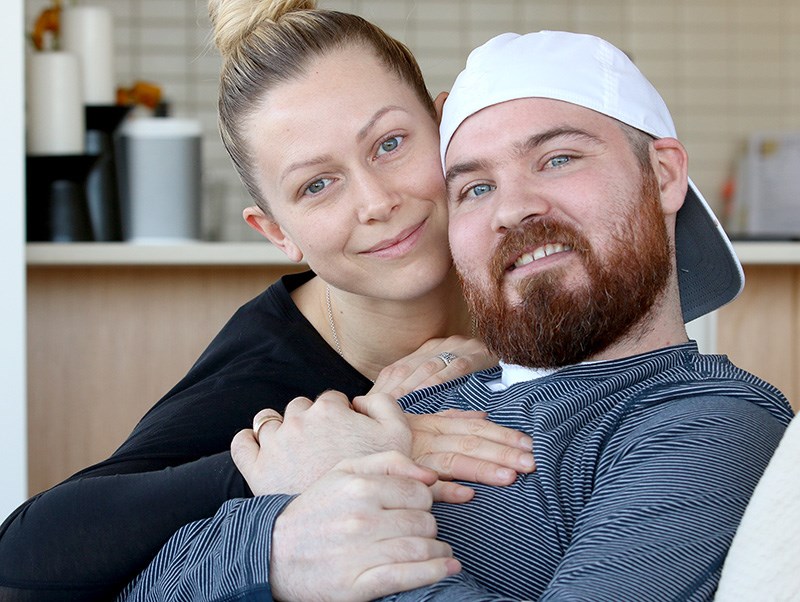
Wade MacLeod loves the view from the Port Moody condo he shares with his wife, Karly, and their 17-month-old daughter, Ava James.
Looking out the expansive windows of their living room to the snow-peaked mountains and the twinkling water of Burrard Inlet far below is thearaputic, MacLeod says. But it’s not where he should be in the waning weeks of winter.
MacLeod and his young family were supposed to be back in Germany, where the 32 year-old Coquitlam native was looking to build on the point-a-game pace he was scoring last year as a professional hockey player with the Frankfurt Lions.
But two surgeries within two months last summer derailed that dream. Doctors removed a Grade 3 Glioblastoma tumour in his brain for a third time.
MacLeod hopes he can get his playing career back on track, and the results of his latest MRI showed no further growth of the disease. That has only fuelled his optimism.
In fact, it’s that positive outlook that helped get MacLeod back on the ice after two previous encounters with the disease, said Karly, who’s also from Coquitlam.
“No matter how many times he’s knocked down, he’ll get up again and go for it,” she said.
MacLeod’s tumour was first diagnosed after he collapsed on the ice during a game in Springfield, Mass., where he was playing his second season as a pro after competing for four years with Norheastern University in Boston. Doctors removed a golf-ball sized non-cancerous tumour from the left side of his brain and he lost the ability to speak.
Returning to the ice Speech therapy got that back, and extensive rehab allowed MacLeod to return to the ice, this time with a team in the ECHL, a rung down hockey’s minor-professional ladder. He knocked around various outposts, from Indiana to Idaho, including a 34-game stint with the Toronto Marlies of the American Hockey League, just below the NHL. Then he headed to Germany.
It was after a 61-point season with the Rosenheim Star Bulls, a second-division pro team, that the disease reasserted itself. MacLeod underwent a second surgery in September, 2016, then worked his way back to the ice the following March, with another ECHL in Allen, Texas. He scored 13 points in 13 games, and, in September, 2017, he signed with Frankfurt.
‘Everything changed’ Going back to Germany, this time to Dresden with their newborn daughter, was supposed to be the time of their lives, Karly said. “Then everything changed.”
MacLeod took the latest diagnosis in stride.
“It is what it is,” he said, then set about doing whatever he had to do to get better again and return to the ice. Currently in the midst of a six-month course of chemotherapy treatment, MacLeod hooked up with Port Moody Integrated Health to plot a holistic path back to health that includes speech therapy — last summer’s operations again affected his ability to speak — occupational and physical therapy. He changed his diet to eliminate refined sugar and reduce his intake of carbohydrates. Several times a week he gets special hyperthermia treatment that tries to kill cancer cells with high temperatures.
Both Wade and Karly visit with a sports psychologist to deal with the mental and emotional challenges of his disease.
Community support A fundraising campaign launched on the crowdsourcing website gofundme.com last August by MacLeod’s friend, Mike Armstong, has raised more than $124,000 so far, making much of the supplementary care possible.
More importantly, MacLeod said, the messages of support that continue to get posted on the site from every waystation on his journey through hockey, even as far back as his minor days at the Burnaby Winter Club, and from Merritt where he played for the BC Hockey League’s Centennials, propel him forward.
“It drives my strength and positivity more than you can imagine,” MacLeod said, adding his whole family was brought to tears when they first started seeing the donations and messages come in as he recovered from his fourth surgery.
While some treatment days can be long and gruelling, sapping MacLeod’s strength and confining him to the couch to take in the view from a special massage pad Karly got him for Christmas, he said he’s been able to gain a new appreciation for life’s small moments, playing catch with his daughter (“She has a wicked spiral,” he said), or the beauty around him during walks along the Shoreline trail.
MacLeod was last on the ice in December, at a stick-and-puck session with his brother and brother-in-law. He said the feeling of holding the stick in his hands, gliding around the ice, chasing down the puck, was “unbelieveable.”
He can’t wait to get that feeling back. Again.
Wade MacLeod has already scored the biggest win of his life
In preparation for his return to professional hockey, Wade MacLeod has been working every weekday with his trainer, Kai Heinonen. MARIO BARTEL/TRI-CITY NEWS
Even if Wade MacLeod doesn’t score a goal with his new Manchester Storm hockey team, he’s already achieved the biggest victory of all.
The 34-year-old left winger from Port Moody beat cancer – not once, not twice, but three times.
And when MacLeod’s doctor gave him the all-clear last November, that the Grade 3 Glioblastoma tumour that had recurred in his head for a third time was completely gone, he knew what he had to do.
“I said from the very beginning that cancer wasn’t going to be the reason I retire from professional hockey,” MacLeod said after a recent workout at Coquitlam’s Planet Ice with his trainer Kai Heinonen and veteran NHLer Brad Hunt.
The fact MacLeod is able to share the ice and keep up with the newly-signed defenceman for the Vancouver Canucks is a testimony to the dedication of getting his career, and life, back on the rails.
Three years ago, MacLeod had to relearn how to walk and speak again after two surgeries to remove a recurring tumour that had reformed in his brain as he prepared to play a third professional season in Germany with Dresden Eislowen.
When MacLeod was diagnosed after having seizures as he moved from Frankfurt, where he’d scored 49 points in 49 games for the second division Lions, he, his wife Karly, and their young daughter, Ava, headed back to Canada for surgery. Two months later, the tumour returned for a third time, and he was under the knife again, to be followed by radiation and chemotherapy treatments.
A GoFundMe fundraising campaign to help the young family get through the tough time raised more than $100,000 from donations wherever MacLeod’s skates had taken him — from Merritt where he played junior hockey with the BC Hockey League’s Centennials, to Northeastern University in Boston, Mass., to minor league teams in Springfield, Mass., Evansville, Ind., Toronto, Boise, Idaho, Allen, Texas, as well as Rosenheim and Frankfurt in Germany.
Return to health Some of the money went to MacLeod’s return to health and rehabilitation that was coordinated through Port Moody Integrated Health. Dietary changes, occupational and physical therapy, as well as hyperthermia treatment to kill lingering cancer cells with high heat, all contributed to his battle against the disease that first presented itself in 2013 when he collapsed on the ice during an American Hockey League game in Springfield.
A four-hour operation removed a golf-ball sized tumour from the left side of MacLeod’s brain and, after extensive rehab, he was able to get back on the ice the next season, splitting his time between the Springfield Falcons and the ECHL’s Evansville IceMen.
Three lost years But the double recurrence of the tumour in 2018 has cost three prime years of MacLeod’s hockey career. Getting back to a place where he feels he can compete again on the ice has taken a lot of work with Heinonen, whose background includes martial arts. The two are together for hours every weekday, either on the ice or in the gym. They use karate to sharpen hand speed, balance and peripheral vision, circuit and core training, as well as visualization.
MacLeod said he feels in the best shape of his life. Earlier this summer, he told his agent he was ready to play again.
Limited opportunities But opportunities for an aging minor leaguer who’s been out of the game for three years were limited. Norway or France were possibilities, MacLeod’s agent told him.
It was the Storm of Great Britain’s Elite Ice Hockey League that expressed the most interest. The team’s coach, Alberta native Ryan Finnerty, also has a young family and was familiar with MacLeod’s story.
“It all worked out,” MacLeod said of the process that landed him a contract, adding he’ll head to England in about mid-September, then his family that now includes a newborn sister to Ava, will follow a few weeks later.
MacLeod said he’s excited about getting back into a dressing room with teammates, then hitting the ice again with fans in the stands.
‘Never give up on your dreams’ “It’s going to be so unreal,” he said. “The biggest thing is never give up on your dreams and always stay positive.”
While MacLeod is hopeful the opportunity he’s being given in Manchester might lead to bigger and better things, he said he already feels he’s accomplished so much.
“I beat cancer.”
‘Desperate for a solution’: Uncertainty clouds future of Port Moody hockey player
A glioblastoma tumour finally forced Port Moody’s Wade MacLeod to retire from his hockey career. MARIO BARTEL/TRI-CITY NEWS FILE PHOTO
A Port Moody hockey player battling Grade 4 brain cancer is girding for another round of radiation treatment. In an update to a GoFundMe page raising money to support Wade MacLeod’s treatment of a glioblastoma tumour, Karly MacLeod said a sixth operation in November allowed doctors to remove “a huge portion” of the growth.
But uncertainty about her husband’s future remains.
“Since Wade’s surgery, we have been in limbo with treatment but desperate for a solution,” Karly MacLeod said.
Wade MacLeod, who grew up in Port Moody and played for the Merritt Centennials in the BC Hockey League before attending Northeastern University, was playing for the Springfield Falcons in the American Hockey League when he first fell ill in 2013 after collapsing during a game.
Doctors found a non-cancerous tumour the size of a golf ball in the left side of MacLeod’s brain. After it was removed, and following extensive physical and speech therapy, he resumed his playing career in the ECHL and 34 games with the AHL’s Toronto Marlies before heading to Europe.
MacLeod scored 61 points in 50 games for the second-division Rosenheim Star Bulls in Germany and was preparing to return overseas for a second season when he had a second seizure.
This time MacLeod was diagnosed with a cancerous glioblastoma.
Back on the ice Six months later though, he was back on the ice with the ECHL’s Allen Americans in Texas, then signed with the Frankfurt Lions in Germany the following season.
A third seizure felled MacLeod in September 2018.
Doctors removed a Grade 3 glioblastoma tumour. Several months of chemotherapy followed, along with speech, physical and occupational therapy as well as dietary changes and special hyperthermia treatments that use high temperatures to kill cancer cells.
In November 2020, MacLeod got the go-ahead to resume training and the following August he told the Tri-City News he was in the best shape of his life as he prepared to join the Manchester Storm in Great Britain’s Elite Ice Hockey League.
“The biggest thing is never give up on our dreams and always stay positive,” MacLeod said following an on-ice workout at Planet Ice in Coquitlam.
MacLeod played seven games in Manchester, scoring one point, then signed with the Narvik Arctic Eagles in Norway.
Turning the page on hockey But in June 2023, MacLeod said his hockey journey was over.
“I gave all my life to hockey and now it is time to turn the page,” he wrote on his Facebook page.
A fifth brain surgery in December 2023, confirmed the worst fears of MacLeod’s family, that includes two young daughters; his glioblastoma tumour was now Grade 4 — the most serious and aggressive form of the disease.
A heavy toll In her most recent update, posted by Karly MacLeod on Jan. 18, 2025, she said Wade’s battle and sixth surgery have exacted a toll: Changes to his motor and speech skills have necessitated alterations to their home and the couple accelerated a longstanding plan to renew their vows on the tenth anniversary of their wedding so they could celebrate with their daughters.
“We’ve learned the importance of living in the moment and taking everything one day at a time,” Karly MacLeod said, adding she’s also dialing back her work as an interior designer to help care for husband and manage his upcoming treatment plan that includes four weeks of radiation along with hyperthermia, drug and dietary therapies as well as some alternative medicine approaches.
That means some of the almost $142,000 that has been raised so far through the GoFundMe campaign will go towards supporting MacLeod’s family as well as covering medical expenses that aren’t insured, Karly MacLeod said.
“Some days can be beautiful and some days can be hard,” she said. “We feel the love and it has helped us immensely to continue taking each foot forward and never giving up.”
I learned this morning a photo I’d shot last year was recognized by the Canadian Community Newspapers Association as the top feature photo of 2023. Normally I don’t pay much heed to such things. At the behest of my editor, I dutifully compile some possible entries, submit the required information and then forget about them. But this one hit a bit differently. Not only did this photo involve one of my favourite people, Chris Wilson, whom I’ve covered at different stages of his career since I first arrived at the Tri-City News in 1991 when he was an Olympic wrestler, then as a Coquitlam city councillor and now an advocate for youth sports, but it’s also a bit of a swan song for our existence as a print newspaper. How the various community newspaper associations manage their annual awards programs as more and more newspapers move exclusively online is still a bit of an unknown. But as so many papers have closed, and staffs diminished, so has the level of competitiveness to win awards. Especially when it comes to photos. There’s now so few full-time photographers still employed at newspapers, the cream quickly rises to the top. And while there’s still some decent photos captured by reporters doing double duty, the quality of entries across the board is not like it was when there were so many more photojournalists plying their trade at chains like Metroland in Ontario, Black Press and Postmedia in the Lower Mainland as well as pockets of larger community papers in Alberta and Quebec. The shift of papers to digital has also widened the gulf. As much as the digital realm can bring advantages like immediacy and opportunities for engagement, most news websites don’t do photos well. Templated designs tend to demand uniform sizes and formats for photos; RIP the vertical photo. There’s also so many stories crowded onto home pages, photos run small; a thumbnail just doesn’t have the same impact as a five column image across the top of a story. And linear photo galleries completely dismiss the role editing and design play in visual storytelling. It wasn’t supposed to be like this. In the early 2000s, I can remember many conversations over beers with my colleagues during which we mused the internet would be our time to shine. We were already doing most of our editing and production work on the computer and our photos looked great on a Mac monitor. Plus who doesn’t like looking at good photos and with the unlimited capacity of the web, we could share so much more of our takes with readers. Design programs like Macromedia Flash also made it possible to add music, commentary and other visual elements to a photo presentation to create true multimedia storytelling. But such efforts are labour-intensive, something our declining industry says it can no longer afford. The Toronto Star’s visually-rich tablet-based Touch initiative died less than a year after it was launched, a victim of its high cost to produce. Even giants like the New York Times and the Washington Post have reduced the volume and sophistication of their online visual storytelling in the time I’ve been a subscriber. And with fewer photojournalists flying the flag for quality photos, editors are only too happy to run poor-quality submitted photos or — worse — generic stock photos, just so long as stories get posted online as quickly as possible. It’s a death spiral that further diminishes our connection to our communities and lowers the standard of the product we provide. And flies in the face of what awards are supposed to represent.
































 MARIO BARTEL