Port Moody cycling studio helps cyclists go Zwifter

This story first appeared in the Tri-City News on April 12, 2019

At 70 years-old, Frank Quigg’s dreams of racing his bike in the peloton at the Tour de France are long behind him.

But, Quigg discovered, he can get a flavour of that experience by plugging his indoor trainer into one of several virtual training apps that can plant a cyclist in the midst of a group ride through French countryside, up and down the Dolomite mountains in Italy or around the roads of Central Park in New York City.

And now the retired auto importer has turned his winter training regime into the Lower Mainland’s first virtual cycling studio in a loft area above a fitness gym on Port Moody’s Spring Street.

Quigg’s endeavour, Zwift Cycling Club, features four Tacx Neo 2 smart trainers that are each paired with a virtual training app by Zwift and connected to individual 40-inch monitors. Each station even has a remote-controlled fan that simulates a cooling breeze out on the road.

Cyclists can bring their own bike to mount on the trainer, or use one of the Specialized bikes Quigg has available.

A leap ahead

Quigg took up cycling when he was 59 to improve his health and fitness and now logs more than 8,000 kms on the road a year. He said the virtual riding experience is a leap ahead from the mental drudgery of grinding out hours of spinning parked in front of a TV watching Vancouver Canucks’ hockey games or binging on episodes of House of Cards on Netflix.

Instead, the app can plop Quigg on one of several fictional courses in a mystical land called Watopia, where the roads are always closed to car traffic, or other routes modelled after the 2012 Olympic circuit in London, England, the 2015 world championship course in Richmond, West Virginia, or even the weekend warrior mayhem of New York’s Central Park.

Other apps like Sufferfest incorporate workouts into licensed footage from famous cycling stage races like the Tour de France, Giro d’Italia and one-day events like Milan-San Remo or Paris-Roubaix.

Like a video game

Quigg said Zwift’s virtual world is like bringing his bike into a computerized video game where he can just ride to explore the course and scenery, or elevate his heart rate by racing for personal training goals or against other cyclists hooked into the program from all over the world. The trainer alters the pedalling resistance according to the terrain on the screen, so it gets harder to climb hills and easier to glide down the other side, while the monitor tracks his effort and gives him an idea of how he’s doing compared to the other virtual cyclists on the course.

Quigg, who suffered a bad crash two years ago while riding in a pack along Marine Drive in Vancouver, said virtual training apps also offer a safe environment for riding in a group without the fear of touching wheels with a neighbouring cyclist or crashing into obstacles like barriers and signs that can be hard to spot when in the midst of a fast-moving peloton. Even the social aspect of group rides is preserved, as cyclists signed into the app can communicate with others on the digital road, set up challenges like sprints or organize events like races with their friends.

About the only thing missing is the traditional mid-ride coffee stop, although Port Moody’s Brewery Row is only a short coast away.

Busy year ’round

Quigg said while indoor riding is usually a winter activity cyclists use to maintain their conditioning, he anticipates his stations will be kept busy during the summer months by riders following a structured training regime to prepare for a specific event like a race, gran fondo or triathlon. Groups of friends can also challenge each other in a social setting.

And while it’s possible to get a virtual cycling experience at home, a proper station can cost more than $3,000 — not including the bike — plus the space to leave it set up.

“You get to live out some of your Walter Mitty fantasies,” Quigg said, adding several European and North American pros like Roman Bardet, Mark Cavendish, Michael Woods and Evelyn Stevens have been known to sign in to a Zwift ride.

Climate change challenges Tri-Cities’ mountain bike community

This story first appeared in the Tri-City News on Nov. 17, 2022

Extended droughts that dry out trails, atmospheric rivers that wash them away and intense windstorms that blow down trees are among the climate change challenges facing the local mountain biking community.

So members of the Tri-Cities Off Road Cycling Association (TORCA) are adapting the way they build and maintain trails, as well as how they ride them.

Karaleen Gioia, a director of the group that comprises more than 750 members, said a typical trail on Burke Mountain that 10 years ago was little more than a dirt path — snaking through the towering trees — must now be armoured with logs and rocks, bridged with hand-built wooden spans to allow for drainage in heavy rains, and contoured with little rolling hills to slow riders who could otherwise speed erosion.

“It’s not just getting out and shredding the trails anymore,” Gioia said. “Climate change is another factor to consider.”

Drought followed by big rainstorms can be especially damaging to trails.

Gioia said the former strips all the moisture from the ground that binds the trail beds, threatening their structural integrity, while the latter results in washouts as rainfall in unprecedented volumes is forced to travel in unfamiliar places.

Having both in quick succession can be disastrous.

“The result is that more work is required to make trails sustainable,” Gioia said. “More labour up front means less work in the long run.”

Most of that labour is supplied by a corps of dedicated volunteers over the course of several organized “trail days” throughout the year, as well as individual privateer efforts to stay on top of repairs.

“We’re pretty proactive.”

Gioia said most local mountain bikers are tuned into the privileged position they enjoy with so many trails so close to home. Many file trail reports to document any problems or areas of concern they identify as they roll up or down the mountains.

Gioia said keeping the trails in good shape benefits all users, including hikers, dog walkers and trail runners. That’s been especially important since the advent of the COVID-19 pandemic that sent more people outdoors for their recreational pursuits as activity helped reduce their stress and kept them healthier.

Gioia said education of proper trail use etiquette and trail building technique is an ongoing process. TORCA liaises frequently with other user groups, as well as land managers, to devise solutions to problems as they arise.

“We’re learning as we go,” she said.

In fact, a report conducted for Parks Canada by the Calgary-based Miistakis Institute that looked at the ecological impacts of mountain biking said that’s the case for most user groups, as there’s been very little empirical research.

“Specific effects associated with mountain biking activity and infrastructure characteristic of the other types of use have emerged as a considerable gap in the research literature,” concluded the review.

Gioia said land managers and user groups are gaining a greater appreciation that bolstering trails will help keep mountain biking viable even as weather extremes intensify.

“It makes it enjoyable for all the users,” she said.


Saving local news

The closure of the Tri-City News, Burnaby Now and New Westminster Record has left a hole in our communities.

In April, I joined forces with some colleagues who had also been displaced by the closure of our publications to form a co-operative effort to bring local news coverage back to the communities corporate ownership had just abandoned.

Over the past several months we’ve been learning about co-operative governance, sketched out a vision for community-based non-profit local news coverage and launched a campaign to help us raise funds to make it happen.

The latter has been supported by a social media campaign that asks community leaders how local news is important to them. As well as building awareness and support for our campaign, the question challenges the community to think about the implications of this sudden loss of local news, building engagement.

Here are a few:

Giant First Nations canoe completes a special healing journey

This story first appeared in the Tri-City News on May 24, 2024

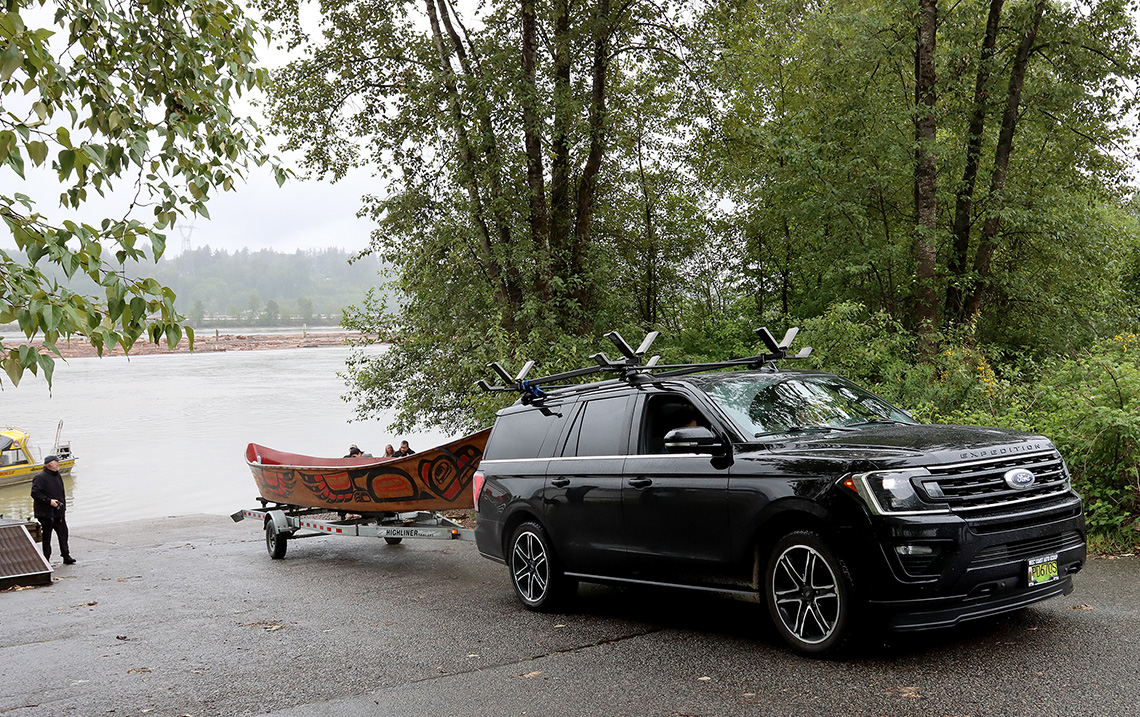
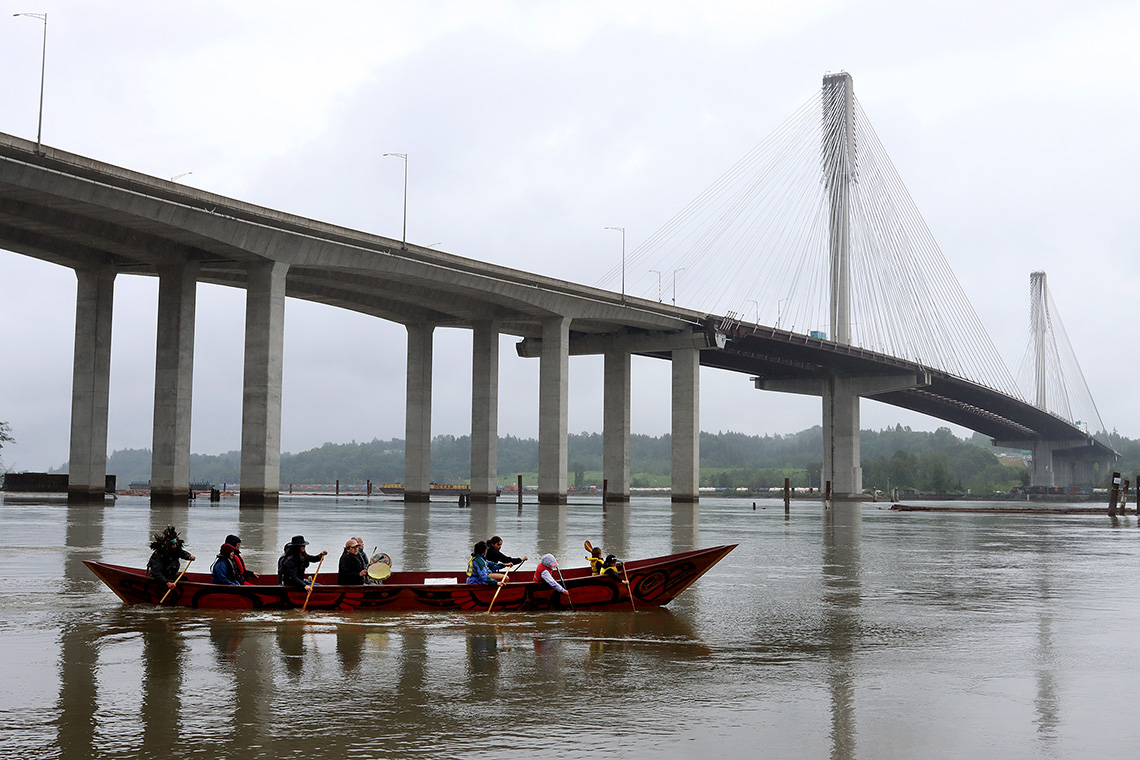
A giant Haida canoe departed Coquitlam’s Maquabeak Park early Friday afternoon, May 24, to complete the final leg of its years-long journey down the Fraser River from Spences Bridge to Sapperton Landing in New Westminster.

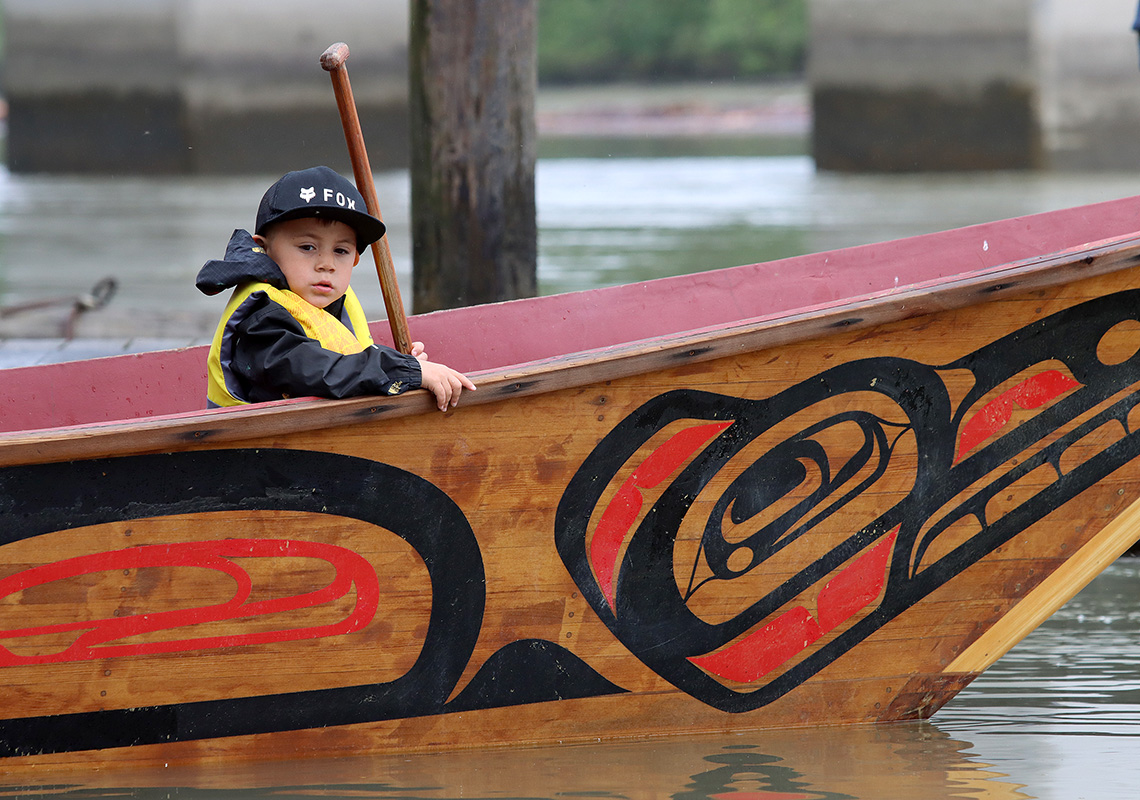
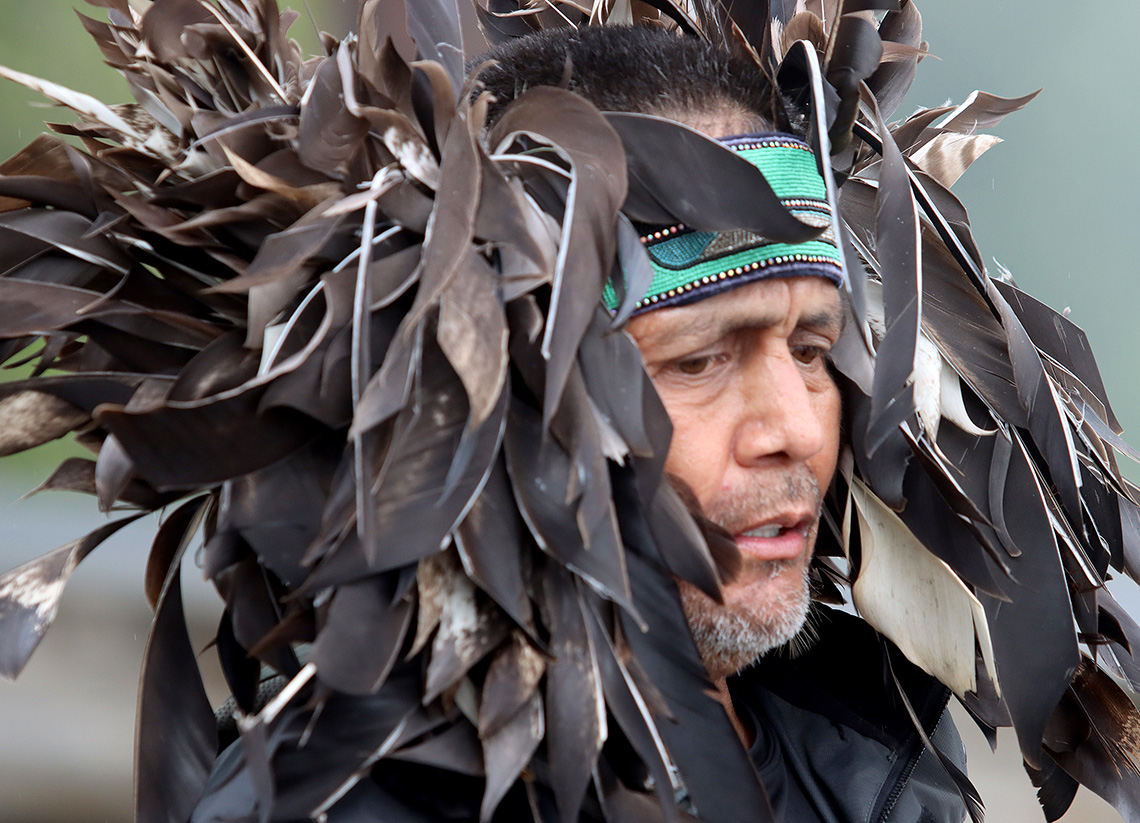
Aboard the Grandmothers Healing Journey were three generations of paddlers representing First Nations communities from across British Columbia.

Their mission: to deliver a special community elements chest filled with artwork, stories and poems contributed 17 artists that will be on display at the New Westminster Museum and Archives in the Anvil Centre (777 Columbia St.) until Dec. 15.

The canoe’s journey replicates the migration of salmon with stops at various First Nations along the way to collect more letters, tokens, messages and reminiscences of healing and reconnection with ancestral lands.

In four years, it will head back up the river, just as the fish return to their birthplace to spawn.

One of the project’s artists, Rita Wong, said it was an honour to have her poems included in the wooden chest that is carried in a place of honour at the centre of the canoe.

She said the project bolsters the connection between First Nations communities and their ancestors, much of which has undermined by centuries of colonialism.

“There’s been an incredible cultural resurgence,” Wong said. “There’s so many stories.”

‘Like a hug from a mother’: Port Moody museum exhibit swaddles visitors with sounds of First Nations’ languages

This story first appeared in the Tri-City News on May 30, 2022

British Columbia’s 203 First Nations speak 34 distinct languages.

Several exist only orally and as elders who know them pass away, they’re at risk of disappearing entirely.

A few already have.

The effort to ensure Indigenous languages survive and even flourish is the subject of a travelling exhibit from the Royal BC Museum that’s being featured at Port Moody Station Museum from June 1 to Sept. 10.

The exhibit, entitled Our Living Languages First Peoples’ Voices in BC, is comprised of information panels and interactive stations that tell the history of those languages, the threats to their continued existence and the work that’s being done to document them so they can be passed on to future generations.

Language is a vital component of First Nations’ culture, said Kate Kerr, coordinator of the travelling exhibit.

“Language is unifying,” she said. “It gives you a sense of history and a sense of place.”

But colonial pressures like assimilation, residential schools and even diseases such as smallpox and measles that were introduced to Indigenous communities by white settlers have diminished many First Nations’ languages, undermining their culture.

Bringing those languages back to life has been a bit of a hodgepodge effort over the years, championed by dedicated researchers making audio and video recordings of conversations with elders. Digitizing the tapes has been an ongoing project at Royal BC, Kerr said.

The work is also important to reconciliation, she added.

Language can help build bridges to empathy and awareness, Kerr said. Witness recent initiatives to resurrect Indigenous names for places like Belcarra Regional Park, now təmtəmíxʷtən in the language of the Tsleil-Waututh, or səmiq̓wəʔelə, the Kwikwetlem title for the Riverview lands in Coquitlam.

Brianne Egeto, the manager/curator at Station Museum, said she reached out to learn about the language program that the Tsleil-Waututh community is doing.

“The Port Moody Heritage Society is committed to taking steps towards reconciliation,” she said. “We hope this exhibit will get people wanting to learn more about all the other initiatives taking place within the communities.”

Kerr said the display has the potential to open the ears and hearts of visitors, especially when they take a seat in the specially-constructed “cradleboard theatre” that envelopes listeners in recordings of conversations in Indigenous languages, many of them with children.

The effect is intentional, she said, as a cradleboard is a portable carrier woven or built of wood that is used by many First Nations to transport infants in their first few months of life.

“It swaddles the listener,” Kerr said. “We want it to feel like a hug from a mother.”

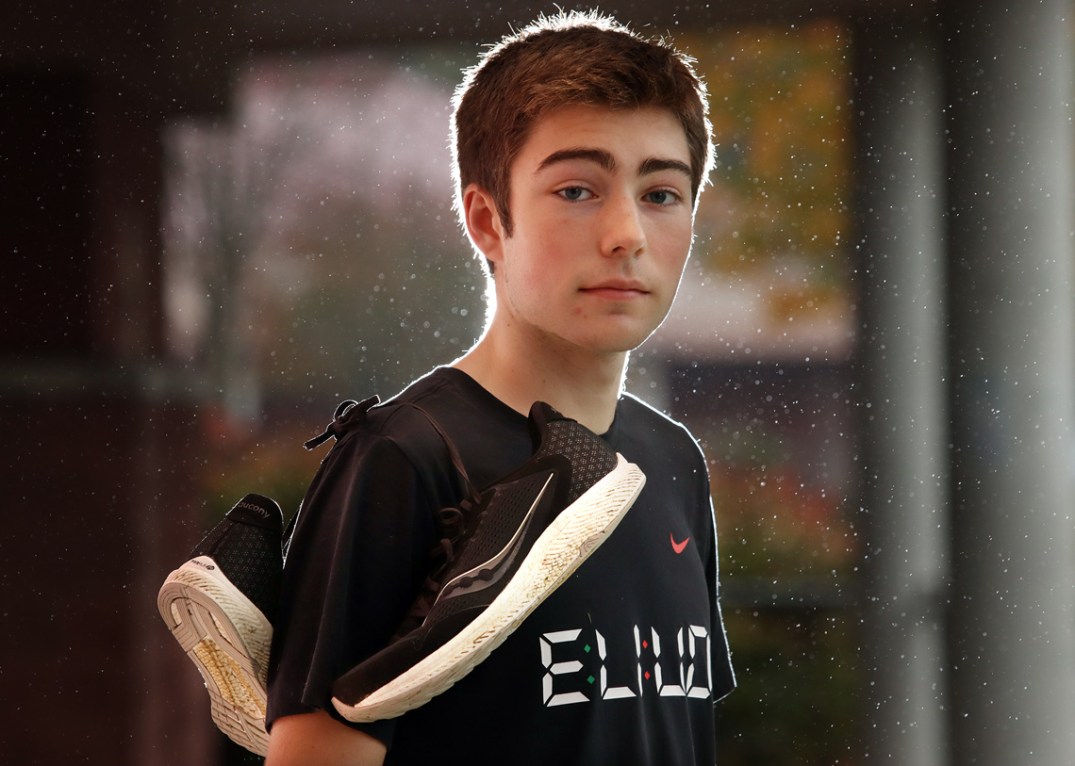
Coquitlam student follows a new path through running

This story first appeared in the Tri-City News on Oct. 31, 2021

Cycling’s loss is running’s gain.

Adam Crespi, a senior at Gleneagle Secondary, was trying to figure out an activity he could immerse himself in for four months as part of the school’s Talons outdoor leadership program; he wanted to do cycling, but getting a road bike would be an expensive investment.

To run, though, all he needed was a pair of shoes.

Less than two years later, he’s the Fraser North District senior boy’s cross-country champion and, on Saturday (Nov. 6), he’ll be competing at the provincial championships in Vancouver’s Jericho Park.

Crespi’s also had success running middle distances on the track, including winning gold medals in the U15 provincial championships for the 1500m and 800m races, and a victory at the BC Endurance Challenge last July in Victoria.

Crespi said until economics set him on a running path, he’d never considered the sport.

Now it’s his passion that’s even opened up some unexpected post-secondary possibilities.

“I just really enjoy it,” Crespi said of the initial challenge he set himself to train for a half marathon.

That was just before the onset of the COVID-19 pandemic.

As his school and life routines were disrupted by closures and public health restrictions, heading up to Coquitlam’s Mundy Park or out to Bert Flinn Park in Port Moody for a run amidst the trees proved a balm in uncertain times.

“Running provided consistency,” Crespi said. “It made me feel better every day.”

In fact, Crespi added, he loved running so much, when the school year ended he kept going.

He joined the Coquitlam Cheetahs to connect with other runners his age who shared his passion. “Everyone is so driven,” he said of his teammates at the track club. “It pushes you to the next level.”

But where that level was remained largely a mystery through Crespi’s first season as a competitive runner. The pandemic resulted in the cancellation of all meets in 2020. His only measure of progress was against the clock in virtual competitions.

Still, the results were encouraging.

Crespi ramped up his training, running six or seven days a week. He started going to the gym to increase his strength and refined his diet to boost his energy. He hiked up mountains, including the rugged 47-kilometre Juan de Fuca Trail on Vancouver Island that he completed in eight hours.

Crespi said his natural inclination to run comes from his years playing youth soccer.

“Each game you’re running,” he said. “It really builds your leg muscles.”

But, Crespi said, the team sport never really provided the community he’s found in running.

“If someone you meet is a runner, you can instantly start a conversation,” he said. “You’re on the same page.”

Crespi said he’s not sure what to expect at his first provincials. Most of his competitors will be unfamiliar, as will the grassy route at Jericho — the majority of the trails he runs competitively at Mundy Park are gravel or dirt.

He said.his strategy will be to sprint to the front and then try to control the race from there.

“You have to be aware of your pace. In cross-country, the race can easily get away from you.”

No matter where Crespi places though, he’s thankful for the course his decision to start running has taken him. Next fall, that could even mean heading south of the border.

Crespi said his academic aspirations had him eyeing the engineering program at the University of British Columbia. But some encouraging feedback from American schools with well-regarded cross-country and middle distance running programs, like Brown University and MIT, have expanded his educational options.

“It’s really opened up some possibilities,” Crespi said. “If I told myself a year ago what I was going to be doing now, I wouldn’t have believed me.”

Chris Wilson wants you to buy his balls

This story first appeared in the Tri-City News on Feb. 25, 2023

Chris Wilson has balls.

Many balls. In a variety of sizes, shapes and textures.

But before this story descends any further into a classic Saturday Night Live sketch, it might be helpful to note Wilson wants to sell you his balls – cheap.

In fact, balls are among the least costly items you’ll find at the annual spring KidSport used equipment sale that runs Saturday (March 4), from 10 a.m. to 1 p.m., at Riverside Secondary (2215 Reeve St.).

For instance, you can get 10 golf balls that went astray from their owners for $1.

Wilson, the chair of KidSport Tri-Cities who’s been running the twice-yearly sale since 2007, said there will be lots of great, gently-used gear from virtually every sport available at bargain basement prices. Proceeds help pay registration fees for the athletic activities for kids whose families might not be otherwise able to afford them.

Many of those activities centre around a ball.

Over the years, Wilson said he’s seen pretty much every kind of ball come through the sale, from football and rugby, soccer and cricket, bocce and basketball, to lacrosse and croquet, bowling and beach.

There’s been buckets of golf balls, boxes of baseballs, bags of tennis balls and laundry baskets filled with softballs.

But Wilson couldn’t say if he’s ever sold a round football that’s used in Gaelic football or a sliotar from the Irish sport of hurling.

One year, a local business donated 1,500 soccer balls commemorating a World Cup tournament and there’s still a few left.

In fact, Wilson said, so many balls have been part of the sale, sometimes he just ends up donating them to local associations to free up storage space.

While most shoppers are on the hunt for bargains on big-ticket items like bicycles and hockey equipment, Wilson said it’s important not to overlook the value of the humble ball.

“It’s the fundamental tool of a lot of sports,” he said.

Even athletes who play sports that don’t involve balls often develop a relationship with them. During Wilson’s wrestling days, he said, he incorporated balls into his training for strength and reflexes.

Wilson said balls are often the entry point into a sport.

Just the simple act of kicking, chasing, throwing or catching one can lead to a lifelong affinity.

“It all starts with the ball,” he said. “It’s the starting point for so many good things that come out of sport.”

Well, the student volunteers from Riverside who will be tasked to inflate the balls the day before the sale to ensure they’re looking their most enticing may have a different take.

Fortunately, said Wilson, they have an air compressor.

Parkour pastor delivers skateboarding sermons at his new Port Coquitlam church

This story first appeared in the Tri-City News on April 3, 2024

A Port Coquitlam pastor is bringing a new angle to spreading his messages of faith and community — upside down or hanging 45 degrees from a vertical climbing wall.

Dave Jonsson has set up his new church in the Momentum Ninja gym at 1961 MacLean Ave., Port Coquitlam.

Every Sunday, for the next year at least, visitors can fuel their soul at a service that runs from 9:30 to 10:30 a.m. while their kids are able to burn off energy on the climbing wall or expansive selection of parkour boxes, giant truck tires and aerial rigs.

Jonsson, a pro skateboarder whose own journey to faith was sparked by a close call in a plane crash near Squamish, said the unique arrangement is an apt calling card for his belief that a church and spiritual guidance should be open and available to everyone.

It’s also a reflection of a growing need for churches to be able to adapt and innovate if they’re to stay relevant, Jonsson believes.

“It’s imperative for churches to think outside the box,” he said. “Church should be enjoyed, not endured.”

A former associate pastor at the massive Riverside Community Church in Port Coquitlam’s Dominion Triangle area, Jonsson said he approached the Ninja gym about using their facility after he saw how much his own son enjoyed attending lessons there, swinging from the rings, navigating obstacles and hoisting himself up climbing apparatus.

Fortunately, the facility is closed Sunday mornings, so Jonsson negotiated a year-long arrangement. Volunteers move some of the equipment aside and set up about 70 chairs for the service while another group of volunteer parents and older kids supervise activities in the gym area.

Jonsson said in total, the space can accommodate about 200 people if some don’t mind sitting on boxes, mats or the hulking tires. He said he hopes the unusual environs will attract people who otherwise might not be inclined to go through the doors of a traditional church.

“This is a new approach to an ancient tradition,” Jonsson said. “We want to create an atmosphere where people can put their feet up.”

Life and death of the photo essay

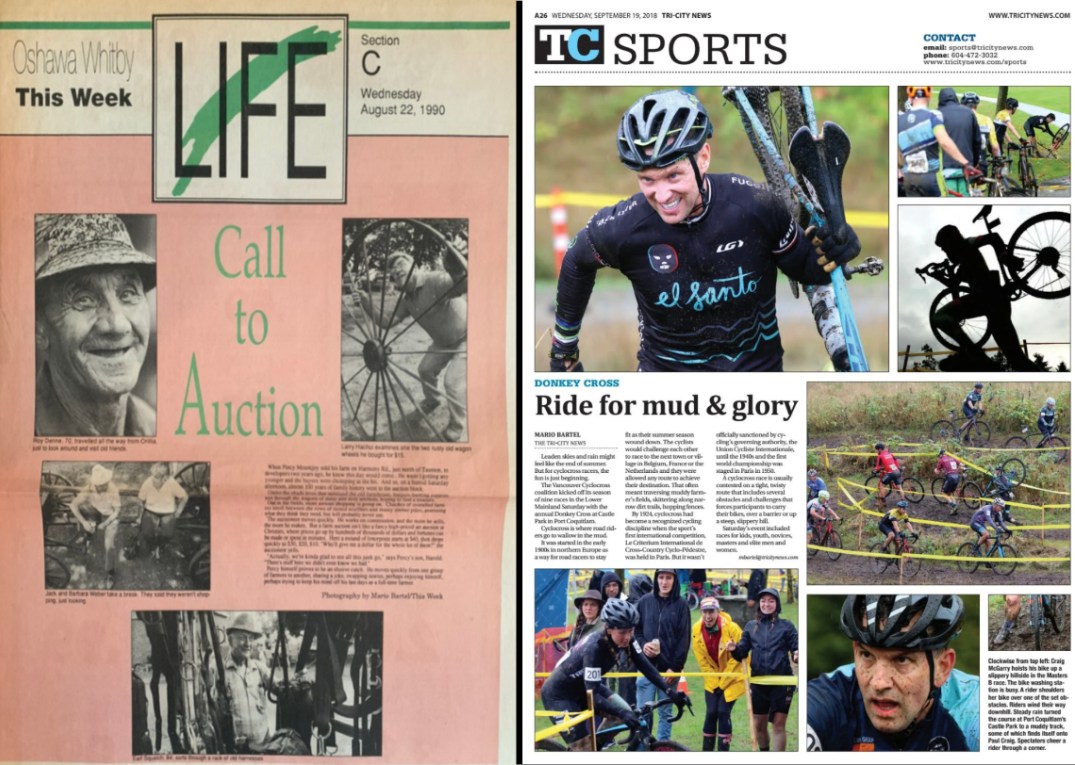
The diminishment and demise of newspapers has all but killed the photo essay, and the role of its design in storytelling.

Getting the annual guide to the Best in Newspaper Design used to be a red-letter day at the office.

Once the editor digested its content to glean potential ideas, the rest of us would secret it to our desks to bask in the glow of creative page designs and photo layouts put together by some of the best newspaper graphic designers in the world.

We were inspired by their use of fonts, colour and graphic elements to complement and support the stories being told by the journalists in words or photos.

We marvelled at the way photos were chosen and displayed together to lead us through the story, take us to its very heart.

Reading a newspaper is like taking a journey; each page promises a new destination that can ignite our imagination or just fuel us up to get us to the next page.

A well-designed and thoughtfully-constructed destination page, like section fronts or double-trucks inside, invite the reader to linger, invest the time to read the story then move on to further pages to see what other goodies might be in store.

When I broke into the business in the mid-1980s, USA Today was regarded as the pinnacle of newspaper design.

Editors loved its multitude of stories launching off the front page, giving readers several entry points into the rest of the paper.

Its liberal use of boxes, colour washes, graphics, bullet points and explainers made it feel vibrant, fun and accessible.

Of course limited resources at the lower end of the newspaper industry meant our efforts to emulate the USA Today look were usually half-baked — it was the thought that counted.

Laying out a photo page or section front was one of the many things I missed when it was decided the Tri-City News should go digital-only.

When I was shooting a story with good photo possibilities, I did so with an eye to pitching it to the editor to run as a spread; that meant I needed a variety of photos to help drive the narrative — wide-angle establishing shots to set the scene, tight detail shots, close-ups, reactions, maybe a silhouette, and a strong vertical or two to help with the layout.

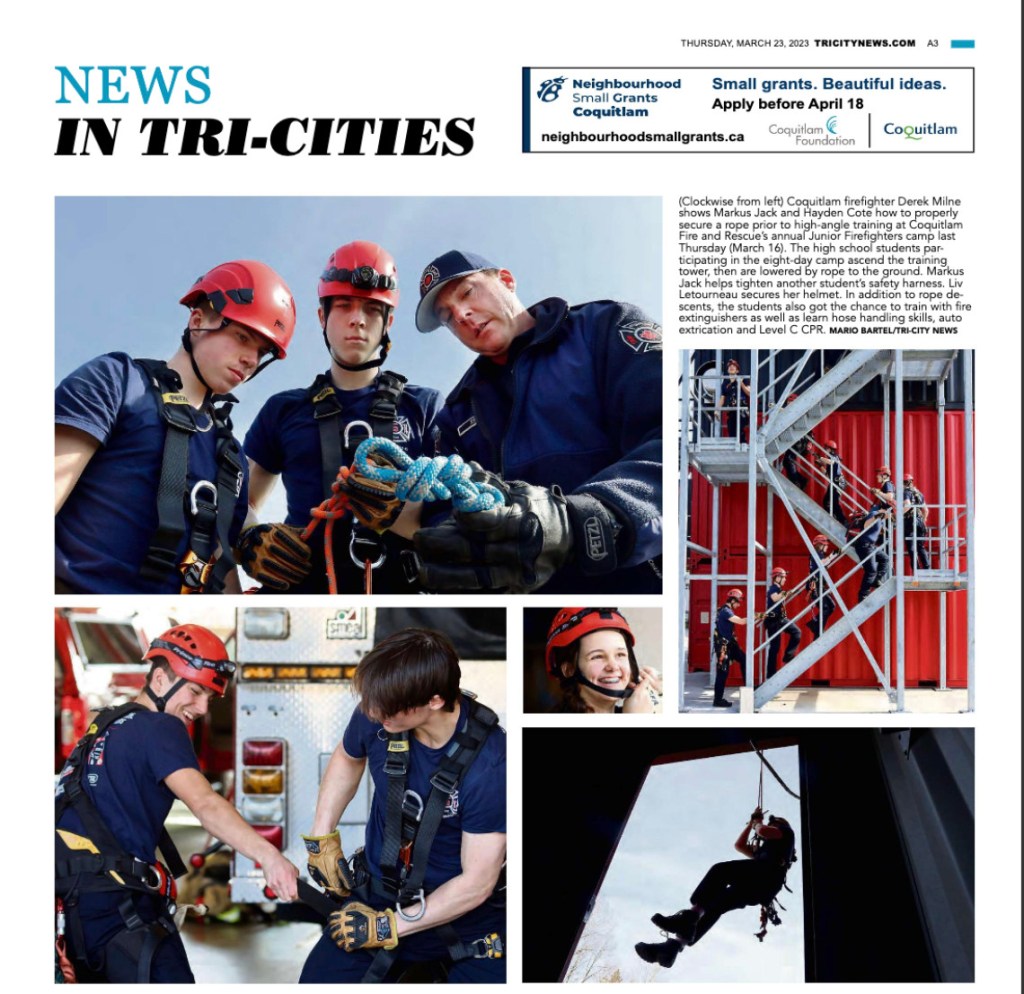
A photo package I shot, edited and designed in 2023 about a group of high school students learning the ropes of a potential career as firefighters.

Editing a take of 15 or 20 photos down to five or six that best captured the essence of the story could be an anguishing process, as was deciding which photo to run largest, and whether to put captions under each individual photo or grouped together.

Sometimes those decisions meant a favourite photo, or one that took a lot of work or forethought to get, wouldn’t make the cut.

A story, told in words and photos, about a local men’s group that offers support to other men through building and fixing things.

If a photo didn’t serve the story, or work with the other photos, maybe it wasn’t that great to begin with.

But, just as newspaper executives deemed photojournalists expendable once they realized everyone with a smartphone could shoot a photo of a car accident, house fire, or ribbon cutting, page designers also became an expensive luxury. Templated designs and centralized production protect profits.

Digital-first then digital-only further sap the creative presentation of news. Content management systems for web upload demand uniformity.

For the most part, online photo galleries favour quantity over quality. Their design is linear, with readers clicking through from one photo to the next until their fingers wear out or their interest wanes; their only narrative usually doesn’t get beyond “the photographer showed up.”

Some publications have made an effort to transfer the design of storytelling to the digital realm.

The New York Times and Washington Post do interesting things on their websites from time-to-time, and I’m sure there are others with the staffing, expertise and resources.

A decade ago, the Toronto Star invested heavily in its Star Touch app for tablets. Its early iterations had some wonderfully ingenious and playful presentations that took advantage of the technology to help drive stories — like an explanation of a lunar eclipse set against an image of a full moon that slowly went into eclipse as you scrolled through the text.

I loved it so much, I stayed up until 11 p.m. PST every night so I could read the next day’s edition on my iPad when it dropped at 2 a.m. EST.

“This is the future for our industry,” I thought.

But the cost for such innovation proved too high.

Within months of Star Touch‘s launch the clever animations started to dwindle as staff and contractors were cut. Soon it became little more than just another website, and within two years of its genesis, it was gone.

Real life disaster is a stark reminder for Port Moody emergency drill

This story first appeared in the Tri-City News on Feb. 9, 2023

An earthquake half a world away is bringing an extra sense of urgency to Port Moody’s own preparation to handle a natural disaster.

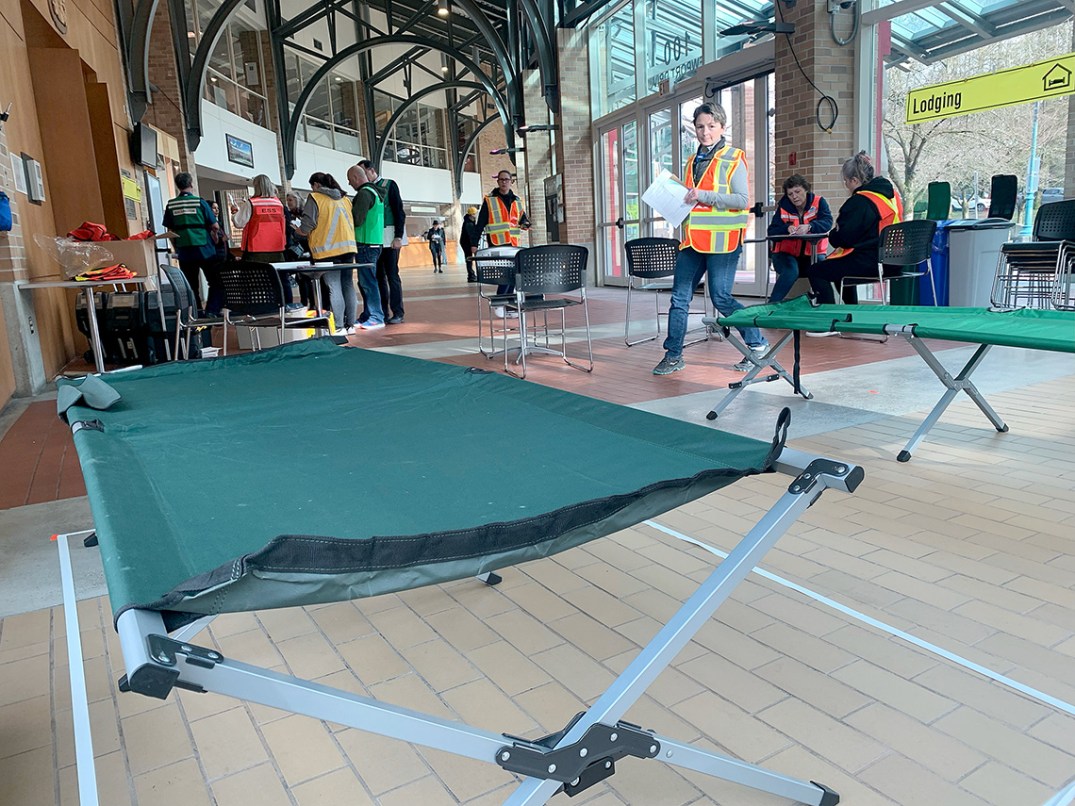
On Wednesday (Feb. 8), more than 50 staff, representing a range of city departments from fire and police to finance and human resources, participated in a province-wide exercise to test its response capabilities to a simulated catastrophe five days earlier.

Port Moody was the largest municipality in the scenario, which also involved agencies from the federal and provincial governments as well as Metro Vancouver.

Kirk Heaven, deputy chief at Port Moody Fire Rescue, said the earthquake Monday (Feb. 6) that devastated parts of Turkey and Syria brought home the reality of a disaster that could strike B.C.’s South Coast at any time.

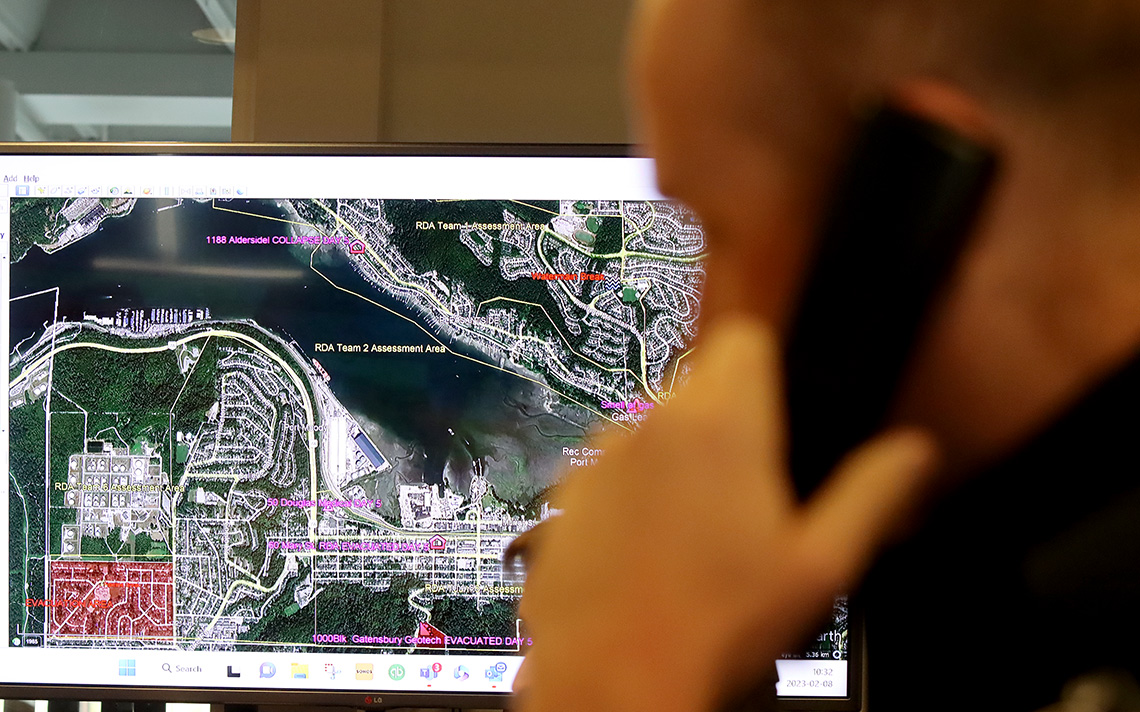
“It adds impetus,” Heaven said, adding live news coverage from Turkey playing on monitors in the city’s emergency response centre set up in a boardroom on the fourth floor of the Inlet Fire Hall provided a reminder that Wednesday’s simulation was “about learning.”

Heaven said planning for the exercise started last September with the goal of furthering knowledge city staff have gained from previous simulations as well as recent real-world scenarios like the heat dome and atmospheric rivers of 2021 and the annual threat of wildfires.

Wednesday, Port Moody was already in recovery mode five days after a 6.8 magnitude earthquake in the Juan de Fuca Strait. That meant rescue efforts were now shifting to support, making sure displaced residents and their pets have someplace safe to stay, as well as access to food and water, and getting critical infrastructure like water, sewage and electricity, along with transportation, back up and running.

Getting back to normal

“It’s about trying to get back to normal and getting people back to their homes,” Heaven said.

Such an effort presents huge logistical challenges, from just getting around to ensuring there’s enough staff available to cover shifts at facilities like emergency shelters to making sure everyone gets paid.

Coordinating all those myriad details and the communication efforts required to run a recovery effort smoothly takes lots of practice, so when a real disaster hits, wheels are set in motion quickly and automatically.

“It’s imperative we keep it up,” Heaven said. “You have to know your strengths and identify your gaps.

Huge learning curve

Joji Kumagai, Port Moody’s manager of economic development, said the exercise forces him to look at the city “through a different lens.

“You have to understand who is responsible for what so you can act quickly.”
Kumagai said though Wednesday’s exercise was his fourth, the learning curve is huge.

“You really start to understand what a concerted effort it takes,” he said.

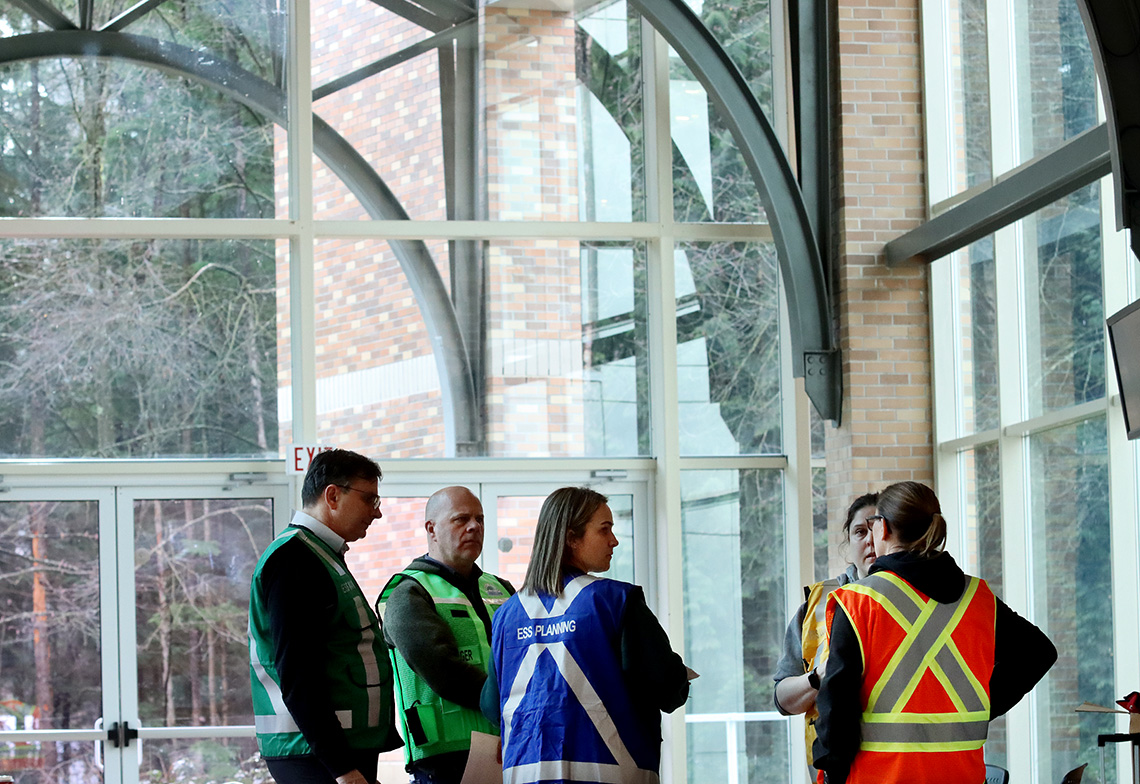
In addition to the emergency operations centre packed with people coordinating Port Moody’s recovery effort, a smaller group of about 12 was in another office in the fire hall planning for the next steps of getting the city back on its feet, like bringing in equipment to clear rubble and where to put it.

Over at the Inlet Theatre and galleria, another team was responsible for registering displaced residents and getting them into temporary shelter at the Recreation Complex next door.

Caring for animals and emotions

Even representatives and volunteers from Canadian Animal Disaster Response Team were available to care for pets, although they did forget to pack a bowl for the stuffed Nemo awaiting refuge on a window ledge.

In an alcove, comfortable chairs were set up where traumatized victims could get emotional support.

Heaven said the exercise is funded by a grant from the Union of BC Municipalities (UBCM). But bringing together all the disparate players in Port Moody’s disaster response effort is invaluable.

“We don’t want to meet people at the party, we want to see them before the party.”