This story first appeared in the Tri-City News on Aug. 2, 2018
Accounting’s loss has been Coquitlam’s gain.
For 50 years.
That’s how long Ted Bordeleau has been cutting hair at Plaza Hairstyling and Barbers in the old Burquitlam Plaza on Clarke Road, an occasion he marked Wednesday with snacks and refreshments for his customers and $2 haircuts — but only if they showed up with an actual $2 bill because that’s what he charged when he first started in the business Aug. 1, 1968.
And if a customer didn’t have a $2 bill, since it’s been out of circulation since 1996, Bordeleau said he’d be happy to sell them one of his — “for $25.”
In Ted’s venerable shop, every story has a punchline.
Even the one about the elderly customer who expired in his chair back when he was learning his trade at Moller’s Barber School on Hastings Street in Vancouver.
After perfecting his straight-edge shaving skills first on a bottle, then a balloon, then other trainee barbers, Ted had finally graduated to giving shaves to real, live customers, many of them elderly or impoverished who put their necks on the line for the young apprentices in exchange for cut-rate haircuts. When one of those customers failed to flinch after Ted nicked him, he called over his instructor, who checked if the client was breathing, then confirmed the worst.
“I cut him three times,” Ted recalled. “No wonder he didn’t bleed.”
Ted almost didn’t become a barber. He loved numbers and was studying accounting when his grandfather urged him to pick up clippers because, he told Ted, “We need barbers.”
Ted trained at Moller’s for six months, then embarked on a two-year apprenticeship, as per the requirements to obtain a provincial barbering license at the time. He said he would have stayed another six months at barber school but he couldn’t afford the bandages.
Again with the punchlines.
Over the years, Ted has cut hair for generations of families as customers whose locks he first tended when they were kids bring in their kids and, eventually, their grandkids. He has trimmed politicians’ pates, CEOs’ sideburns and manes of people who’ve walked out of his shop without paying.
Some of his longtime customers travel hours out of their way to keep getting their hair cut by Ted. And when they walk through his door, there’s no guarantee they’ll be served right away because Ted doesn’t take appointments.
Ted met his wife, Jean, in front of his barbershop. She drove by in a bright pink 1957 Buick with fins, and Ted loves cars, so he ran out the door to ask for the driver’s phone number.
“She wasn’t quick enough to give me the wrong number,” Ted said.
He’s also found love for some of his customers, matching them up with female friends, acquaintances or just regular visitors who passed by as they shopped at the once bustling plaza.
Oh yeah, there’s that.
As the big city caught up to the suburbs, Burquitlam Plaza lost much of its bustle. The butcher shop left, so did the video store. SkyTrain severed part of the sprawling parking lot and the Safeway grocery store moved into the first two stories of a gleaming new condo tower on the corner. Many of the storefronts between the Dollarama and Value Village are dark.
The neighbourhood has changed, too, Ted said. Fewer families can afford to live there as small apartment blocks and modest mid-century bungalows are gobbled up by new development, so he’s not giving as many first haircuts to tentative toddlers.
But Ted perseveres, propelled by stories exchanged, friendships made and the knowledge that, while everyone may not need the services of an accountant, everyone at some point needs their hair cut.
In 2018, happenstance reconnected me with one of my favourite stories of my career. A local historian had acquired a vintage letterpress that had once belonged to a renowned typographer in New Westminster whom I had photographed back when I worked at the NewsLeader. I did two takes on the story; a personal recollection of that reconnection for the New Westminster Record, the paper I once competed against, and this more general feature for the Tri-City News.
These words you’re reading were crafted by the reporter then turned into digital zeros and ones before being printed on paper or uploaded to the internet.
Not so many years ago, the craft of printing words on paper was a much more involved, laborious task that involved dozens of skilled journeymen and tons of heavy machinery.
Each word, paragraph and story committed by the writer to paper had to be assembled into frames with cast lead dies, letter-by-letter, punctation mark-by-punctuation mark.
Those heavy frames, or chases, were then placed into large presses where rollers inked the raised metal letters and then pressed paper to them to create a printed page.
But like so many arduous processes borne of the Industrial Age, manual typesetting and printing is becoming a craft lost to the speed, efficiency and cleanliness offered by computers.
“There is a problem when we go too fast,” said Markus Fahrner a Port Moody graphic artist who’s also the coordinator at the city’s Station Museum.
So, in an effort to slow the process of printing down and reconnect with the skills he first learned as a boy growing up in Germany where his mother was a book designer, Fahrner acquired a Colt Armoury press that was likely built by the gun manufacturer in 1914.
But this is no ordinary old press.
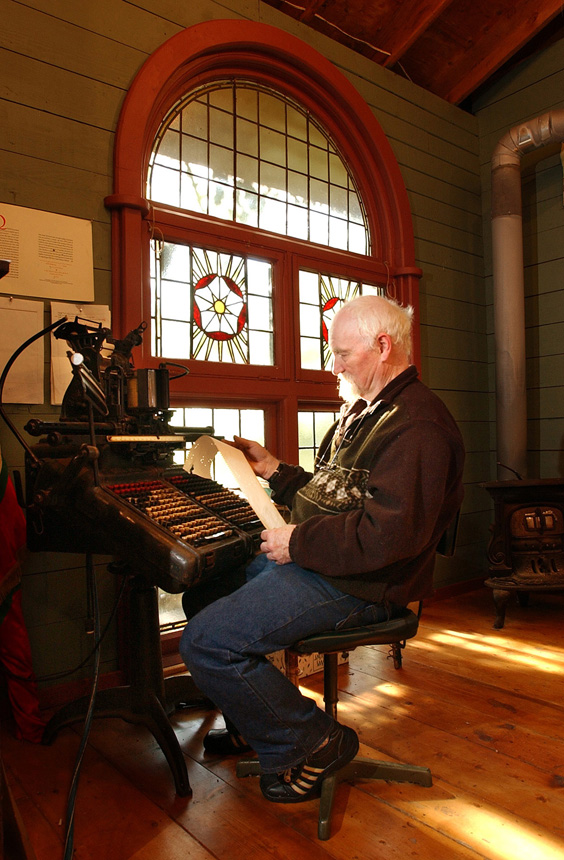
It was once owned and carefully maintained in working order by Jim Rimmer, a world-renowned typographer and letterpress printer who kept the old-world craft alive from a studio behind his New Westminster home until he died in 2010.
MARIO BARTEL/THE TRI-CITY NEWS
The late Jim Rimmer at work on one his vintage typesetters in the studio of his New Westminster home in 2004. Rimmer was a world-renowned typographer who salvaged and restored old printing press machinery and then used them to create fonts and print limited edition posters and books that were coveted by collectors.
The stained glass lit studio and Rimmer’s basement were crammed with old letterpresses, typesetters and spare parts salvaged from print shops that had moved on in technology. He restored the machines and designed dozens of typefaces in metal for printing limited edition books, posters and one-sheets that were coveted by collectors around the world.
Shortly after his death, he was awarded the Robert R. Reid award for lifetime achievement or extraordinary contributions to the book arts in Canada by the Alcuin Society, a volunteer society dedicated to the artistic side of printing books.
Fahrner said he couldn’t believe the good fortune of his find.
While much of Rimmer’s printed works, printers’ dummies, manuscripts and type design work was acquired by the Simon Fraser University library after his passing, the fate of his collection of heavy machinery was less certain.
Fahrner said it’s important to keep the old machines running rather than have them end up as decorative curios in restaurants or antique shops.
“I really admire the craft,” Fahrner said. “I love the way it forces you to slow down.”
In fact, a poster that might take Fahrner a couple of hours to design on a computer can take days to assemble and print on the letterpress.
“It’s slow and precise,” he said. “You suddenly have so much to know about the process, like the way the ambient temperature of the room affects the ink, the type of paper you’re using, how heavy an impression you want to make on the paper.”
The end product, Fahrner said, has a depth and life that can’t be produced digitally.
“There’s an intrinsic love and energy in the things you produce,” he said.
And an eternal connection to a craft whose purpose hasn’t changed since Johannes Gutenberg invented the printing press in the 15th century, even as its technology evolves.
This story first appeared in the Tri-City News on Dec. 1, 2017
It may not have the girth and renown of Stanley Park’s Hollow Tree but Dave Menzies and his wife, Nola, think a centuries-old cedar stump on Burke Mountain is worth saving as development encroaches ever closer.
Menzies, 77, found the stump when he was exploring the woods near the couple’s Burke Mountain home, where they’ve lived since the 1970s. The retired firefighter and fire inspector makes frequent forest forays with his metal detector to root out artifacts from the mountain’s logging past, hiking along old, grown-over trails that were once used by shake-splitters for transporting cedar logs.
It was along just such a trail he encountered the big old hollow stump, its interior charred likely decades ago from — Menzies surmises — a forest fire that swept across the mountain in 1914. The trunk of the tree fell over and was absorbed into the forest floor years ago, possibly weakened by the fire, as he can find no evidence that it had been logged.
Menzies recalled his first impression of the stump, which is big enough that up to 10 people could stand in its hollowed interior: “I was in awe.”
Over the years, he and Nola have brought their children and grandchild to visit the stump and marvel at its history.
Menzies estimates the stump could be 500 years old — maybe as old as 1,000 years — and it probably soared 200 or 300 feet into the air at the peak of its health.
“You don’t get to see them this close anymore,” he said. “I can sense it has the history.”
But its days may be numbered.
Developers are moving into the area. Roads have been built, trees have been tagged. The wild mountain is being tamed by subdivisions of expansive homes.
“Everything is just turning into progress,” said Nola Menzies, 75.
She’d like to see the stump saved, protected from the march of bulldozers through the woods or maybe even uprooted and moved to where it can become an educational monument to what the mountain once was.
“It’s real, it’s natural,” she said.
But first, people have to know about it, which is why the Menzies have pulled on their gumboots and stomped across the loamy, rain-saturated forest floor to show it to a reporter.
Said Dave Menzies, peering up through the hollowed stump towards the sky: “This is amazing.”
The story of the COVID-19 pandemic is still being written. While the immediate fear and uncertainty of the public health scare has faded into the background of our memories, its impact on our daily lives endures. The first story, about a pair of local athletes preparing to represent Canada at the World Ultimate Championships, was actually ready to go into the Tri-City News when the pandemic hit. A quick rewrite of the lede accounted for the unknown we were all facing at that time while still sharing their journey. Of course, the pandemic turned out to be more than just a minor speed bump, and three years later I was able to connect with the same athletes to reflect on how it had shaped their lives and aspirations and their own plans to move forward.
A pair of Ultimate players from the Tri-Cities will have to wait a little longer to get to know their teammates on Canada’s national U20 team.
A special four-day training camp that was scheduled to be held at Coquitlam’s Gleneagle secondary school March 19 to 22 has been postponed because of the COVID-19 pandemic.
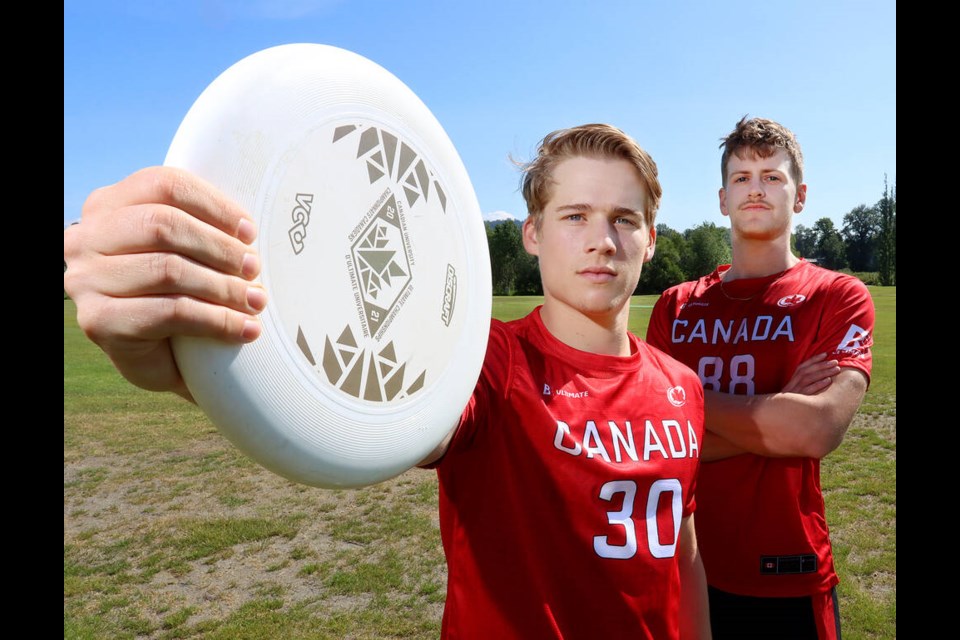
Coquitlam’s Devon Bringeland and Port Coquitlam’s Ricky McLeod are among the 28 Ultimate athletes who will compete for Canada at the 2020 World Junior Ultimate Championships in Malmo, Sweden, July 18 to 25.
Bringeland, who turns 19 this week, said it was Ultimate’s supportive, nurturing spirit that attracted him to the sport when he was in Grade 6 at Stratford Hall, an independent school in Vancouver.
“In Ulitmate, we’re all in it together,” said Bringeland, who’s now studying kinesiology at the University of British Columbia.
McLeod, who’s also 19, said the community vibe of Ultimate is a marked contrast to the negativity he experienced when he was playing competitive soccer.
“Being nice to your opponent is part of this sport,” said McLeod, who finally made the national team after he failed to make in his first attempt a few years ago.
MARIO BARTEL/TRI-CITY NEWS
Ricky McLeod and Devon Bringeland get ready to play for Canada at the World Ultimate Championships in Sweden in 2020.
Not that players’ competitive zeal is diminished by their collegial attitude, that’s been a touchstone of the sport since it was invented at a high school in New Jersey in 1968, said the national team’s head coach, Michael Fung.
To get named to Canada’s roster, athletes first had to catch the eye of coaches responsible for selection camps in each of the sport’s regional hubs in Canada — Vancouver, Winnipeg, Metro Toronto and the Ottawa-Gatineau area. Prospective players were tested for their fitness and then run through various drills and scrimmages to showcase their skills. Those who made the cut then attend two training camps prior to worlds to get to know each other and learn how to work together.
“Chemistry is huge in Ultimate,” Fung said, adding each part of the country approaches the sport and its strategies a little differently.
Turning disparate athletes into a cohesive unit when everyone is mostly apart, doing their own thing on club or school teams is an ongoing challenge, he said. Players stay in touch via a Facebook group, they review game recordings and strategy sessions together online, and they share fitness challenges.
“We have to create a platform for them to get to know each other,” Fung said, adding the training camps, that are often based out of someone’s home, can be especially beneficial to achieve that as players have to live, cook, and eat together in close quarters.
He said routine tasks like navigating meal times, cleaning up and sharing bathrooms, as well as planned bonding activities like ping pong and video game tournaments can help develop the synchronicity and communications skills that are vital to success in actual games. It also helps save money as, aside from some small sponsorship to pay for uniforms, everyone on the team pays their own way.
Bringeland said the sacrifices are worth it, especially as the sport’s popularity grows beyond its power base in the United States and Canada; 30 teams will compete in Sweden.
“It’s the next level,” he said of competing at the worlds, which are contested every two years. “It’s what everyone in the sport is driving for, to represent their country.”
Tri-City Ultimate athletes getting a second chance to represent Canada
MARIO BARTEL/TRI-CITY NEWS
Three years after they were denied their opportunity to compete for Canada at the World Ultimate Championship because of the COVID-19 pandemic, Ricky McLeod and Devon Bringeland are getting a second chance.
There’s nothing like having something snatched away to motivate you to want it even more.
Port Coquitlam’s Ricky McLeod and Coquitlam’s Devon Bringeland were about to participate in a special training camp for Canada’s national Ultimate team heading to the U20 world championships in Malmo, Sweden, three years ago when the global COVID-19 pandemic yanked away their dream.
This year, they’re back as members of the U24 national side that will be one of 15 teams competing in the open division at the 2024 championships in Nottingham, England, July 2–8.
In between, McLeod and Bringeland had to soothe the sting of missing their chance to compete at the 2020 worlds and embarked on busy studies at the University of Victoria and the University of British Columbia, respectively, recommitted to their training and stepped up their game playing for Canada’s top men’s club: the Vancouver Furious George.
All with their eyes firmly fixed on the prize of being the best in the world.
MARIO BARTEL/TRI-CITY NEWS
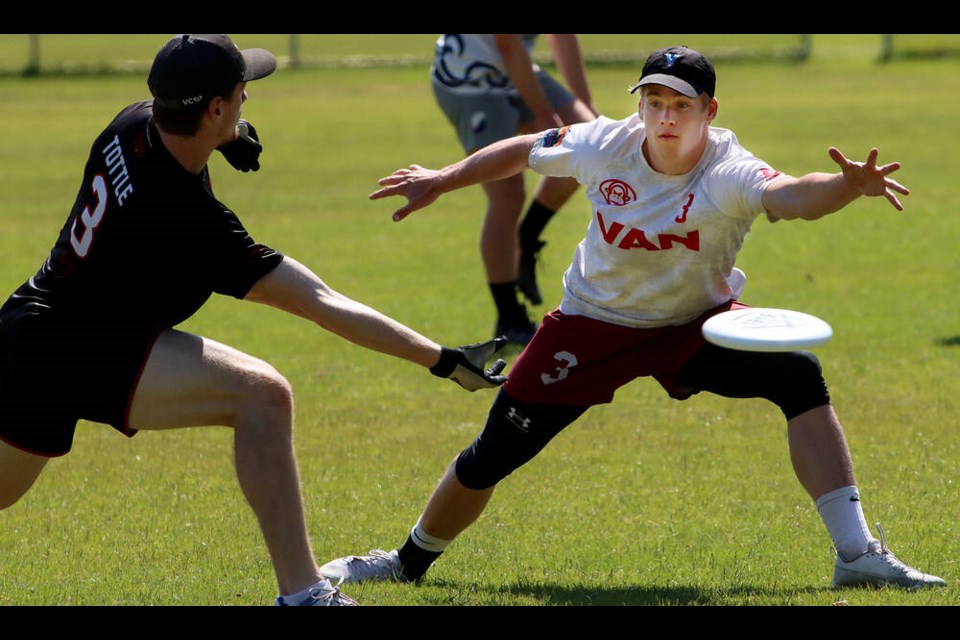
Port Coquitlam’s Ricky McLeod stretches to make a defensive play during a recent training camp in Burnaby for Canada’s national U24 Ultimate team.
Bringeland said getting robbed of the worlds in 2020 was “an emotional roller coaster” that took him a while to ride out.
“It was heartbreaking,” he said. “Making Team Canada was something I’d dreamed about.”
McLeod said the COVID-19 shutdown in the spring and early summer of 2020 put his Ultimate aspirations at a crossroads.
“You could quit, or you could work even harder.”
By late summer, as public health restrictions eased and sporting activities resumed, the fire to compete had reignited in McLeod and Bringeland.
“I was missing it,” McLeod said. “As soon as I got a taste of it, I was hungry for the future.”
Bringeland said the competitive progression from U19 to U24 is significant. Speed, intensity, athleticism, skill and strategy are all kicked up a notch.
“It’s a huge step up from juniors,” added McLeod.
In anticipation of their next opportunity to play for Canada, McLeod and Bringeland hit the gym to develop their strength, power and explosiveness.
They ran 10 X 400 m laps around the track for endurance.
They honed their fitness to prevent injury and to sharpen their competitive instincts, they tried out — and made — the Furious George side that has won 11 Canadian championships.
They also play for their respective university teams that are part of U.S.-based leagues.
Bringeland said at its top level, Ultimate is no longer about the good-time vibes and tie-dye shirts that come from the sport’s hippie roots, although games are still self-refereed that commands a high level of respect and communication between opposing players.
“It’s a pure level of competition,” McLeod said. “But you don’t yell at people.”
Aside from the physical preparation to compete on the world stage, there’s also a playbook of set offensive and defensive strategies to learn — much like football — and money to be raised.
Canada’s national Ultimate program doesn’t receive government funding, so the athletes have to pay their own way to competitions — about $5,000 for the season. That means bunking down en masse at someone’s family home during training camps, carpooling to and from the fields and cooking communal meals.
It also obligates team members to launch personal GoFundMe campaigns and hit up corporate contacts for whatever support they can muster.
All while keeping up with their studies and part-time jobs.
“It’s a lot of late nights,” said Bringeland.
But the payoff will be worth the sacrifices, said McLeod.
“We take it very seriously,” he said. “Our goal is to dominate.”
This story first appeared in the Tri-City News on Feb. 28, 2021
There may be no “I” in team, but a Port Moody teen is learning there’s a whole lot of support and love, especially when the chips are down.
Dec. 13, Hailey Kress and her family were displaced from their Glenayre home in the middle of the night by a fire that destroyed their garage and deck, heavily damaged an adjoining bedroom and inflicted lots of smoke and water on the rest of the structure including the basement.
That’s where Kress, 13, stored her hockey equipment.
Nobody — including the family dog — was hurt in the 3:15 a.m. blaze. But the emotional toll of that night has been especially difficult on Hailey, said her mom, Monica.
As the family moved in with relatives, then to an Airbnb, and finally to a rental home on the opposite side of Burrard Inlet, Hailey struggled in class at Banting middle school. She said she’d have panic attacks, feeling frozen and overwhelmed by the enormity of that night’s events and the impact it was having on her routines and sense of security.
“It was important to get back to normal,” said Monica. “We needed to somehow concentrate on something other than the fire, get her mind off the negative.”
Hockey is Hailey’s other.
The day after the fire, Monica received an email from Heather Fox, the president of the Tri-City Predators female hockey association where Hailey has been playing for three years, reassuring her that efforts were already in motion to ensure her daughter could keep playing.
Back on the ice
Two weeks later, Hailey was back on the ice. All of her equipment was brand new, courtesy of The Hockey Shop, in Surrey. Her new Predators bag, socks, pants and even hockey tape were donated by Rocket Rod’s at Planet Ice in Coquitlam.
n a season that’s been all about disruption because of public health restrictions to temper transmission of the coronavirus that causes COVID-19, Hailey said practising with her teammates made her feel normal, that everything was going to be OK.
“It was really fun to be with my friends again,” she said. “It made me forget about everything for an hour.”
Hailey, who’s also played baseball, jiu jitsu and acro-gymnastics, started playing hockey after a sleepover at a cousin’s house meant she also had to attend that cousin’s game the next day.
She said she liked what she saw.
“It looked super fun,” she said, adding she especially enjoyed hockey’s aggressive nature.
Monica said she was initially taken aback when Hailey expressed an interest in playing hockey herself. But the positive benefits of being part of a team and forming new relationships outweighed the downsides of the sport’s expense and sitting on cold arena benches.
“It makes for a really well-rounded kid,” she said.
Values camaraderie
Hailey said she enjoys the challenge and responsibility of playing defence, including learning how to skate backwards. But she most values the camaraderie of her teammates and coaches.
“It’s like always having people around you who care about you,” Hailey said.
That care was delivered even before Hailey returned to the ice, as her teammates put together a package for her family of food and personal items like blankets and skin care products.
Monica Kress said she’s been overwhelmed by the outpouring of support from Hailey’s team and the Predators’ hockey community.
“You always think you pay a lot of money for these sports, you think you’re just a number to them,” she said. “But it’s such a good group of kids and parents.”
Hailey said the experience has given her an appreciation for the importance of having sport and teammates in her life. It’s also made her more determined to keep getting better at her game.
“Everything that they’ve done makes me want to try harder to show I’m grateful.”
This story first appeared in the Tri-City News on Sept. 12, 2021
You can’t call an Uber from the new phone booth installed at Port Moody’s Pioneer Park, but you may be able to chat with your favourite Nana who passed away in 2015.
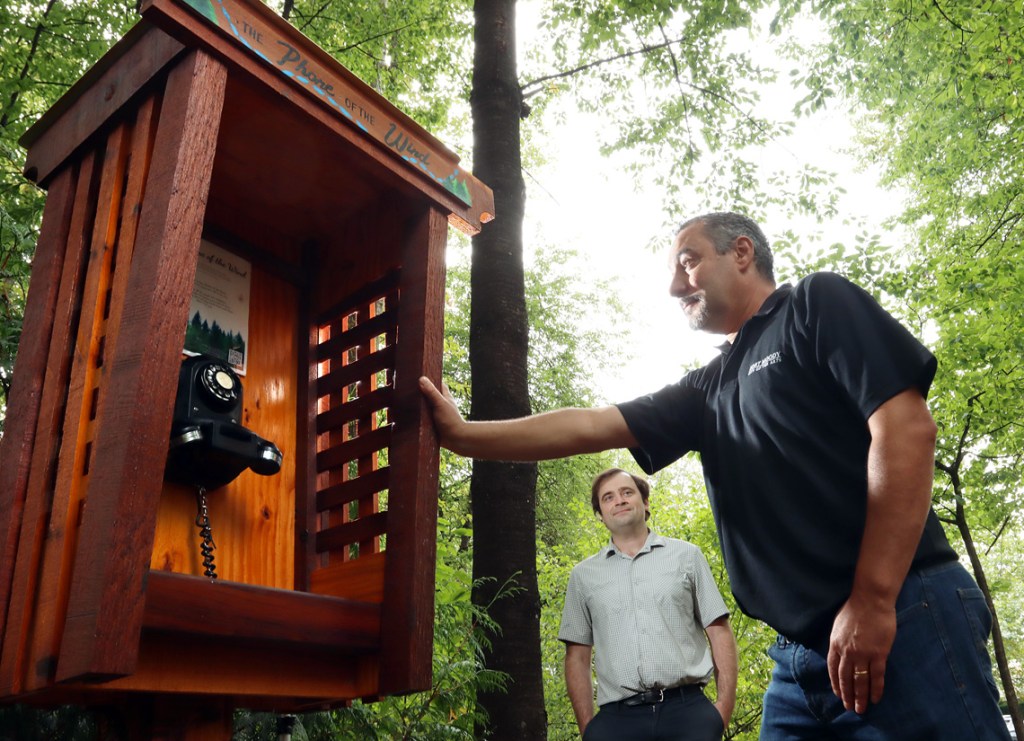
The Phone of the Wind is an initiative of the Crossroads Hospice Society that gives visitors to the park an opportunity to work through some of their grief at losing a loved one by placing a call to them from the vintage rotary-dial wall phone mounted in a wonderfully stained and lacquered wooden booth.
And while the phone doesn’t have a special line to the afterlife, the act of picking up the handset and talking into the mouthpiece can be comforting in a time of loss and sorrow, said Amelie Lambert, the adult bereavement coordinator at Crossroads’ nearby hospice facility on Noons Creek Drive.
“It helps people not feel crazy all the time when they’re grieving,” she said.
“It helps to normalize grief,” added Brittany Borean, the bereavement service coordinator who helped bring the phone project to life after a volunteer let her know about a similar effort in Washington.
The first Phone of the Wind was erected in 2010 in Otsuchi, Japan when a landscape designer named Itaru Sasaki installed an old phone booth in his garden shortly after a beloved cousin died of cancer. In a 2017 article in Bloomberg, he said the phone offered him a way to maintain a relationship with his departed cousin.
In 2011, Sasaki’s private installation became a kind of public shrine after an earthquake and tsunami destroyed dozens of coastal communities including Otsuchi and people who lost loved ones in the disaster made their way to his garden to seek comfort by placing calls from his booth.
Since then, wind phones have been built in places like: Oakland, Calif., to commemorate the 36 people who perished in a warehouse fire; Dublin, Ireland; Marshall, North Carolina; and Aspen, Colorado.
The concept has also caught the imagination of novelists and filmmakers who’ve incorporated it into stories of love and loss.
To realize Port Moody’s Phone of the Wind, Borean enlisted the help of the city’s superintendent of parks, Robbie Nall, and carpenter Roy Balbino, who took his inspiration to craft the booth from an old-style phone booth he happened to spy one day while driving along St. John’s Street.
MARIO BARTEL/THE TRI-CITY NEWS
Port Moody’s superintendent of parks, Robbie Nall, and carpenter Roy Balbino helped bring the Crossroads Hospice Society’s vision for a phone of the wind to life in Pioneer Park.
Some of the wood is reclaimed from old memorial benches in the adjacent labyrinth healing garden, while the vintage black wall phone was discovered on Facebook Marketplace.
Lambert said having the Phone of the Wind in a public setting helps bring the grieving process out from the shadows where western society has tended to lock it away as a very private process.
“We don’t acknowledge grief,” she said. “We don’t have to hide it.”
In fact, Borean added, accepting grief can help ease some of the pain that comes from losing a loved one.
“It sends a message that it’s okay to grieve,” she said. “It’s not about ‘time will heal all wounds.’”
The phone can also provide a way for families to bridge generations.
Lambert said since the phone was installed in August, families have brought their kids to talk with members who may have passed before they were born or were too young to remember.
“It drives connections,” Borean said. “It creates a sense of community that you’re not alone.”
This story first appeared in the Tri-City News on Dec. 10, 2021
A Coquitlam city councillor is taking the phrase “boots-on-the-ground politician” to heart.
Except she’s wearing sneakers.
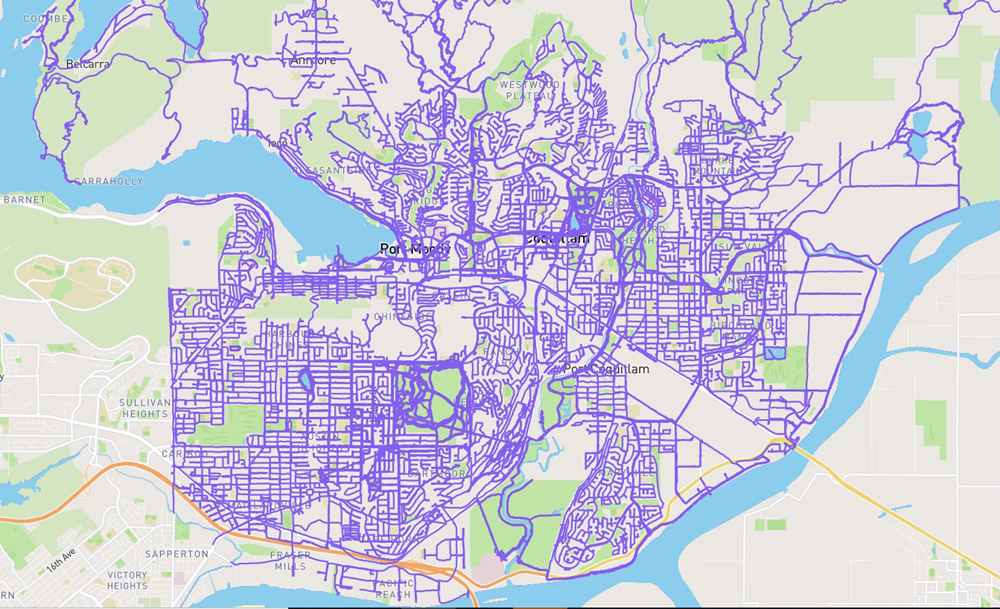
Teri Towner recently finished running every street in the Tri-Cities — including Anmore and Belcarra. The quest took her more than 12 months. She ran on 1,943 streets, covering about 2,000 km. She wore out four pairs of shoes.
The quest started when Towner read an article in the Tri-City News about Pamela Clarke’s conquest of every street in Port Coquitlam last year when the onset of the COVID-19 pandemic cancelled a marathon she’d planned to run in Berlin.
Towner, an avid runner since she was a teen, set out to run every street in Coquitlam.
But when she finished that, she said she was having so much fun she just kept going.
SUBMITTED
A map of all the streets Coquitlam councillor Teri Towner ran in her year-long quest to run all the streets in the Tri-Cities.
Her last street was Marpole Avenue in Port Coquitlam, where a congratulatory reception and beverage reward awaited at Patina Brewing.
Along the way, Towner said she learned things about her community and the rest of the Tri-Cities she knew at an abstract level but had never experienced in a real, visceral way.
Like the diversity of the region’s neighbourhoods that took her from trailer parks to high-rises, from mansions up on Westwood Plateau to blueberry farms out in Minnekhada.
She saw llamas and horses.
“It energized me,” Towner said. “I always felt like I learned something or found something I didn’t know existed.”
It also increased her awareness of issues like illegal dumping, pedestrian accessibility and safety, street lighting, signage and parking.
SUBMITTED
During her runs of all 1,943 streets in the Tri-Cities, Anmore and Belcarra, Coquitlam councillor Teri Towner came across all kinds of unusual finds, like a large spring on Winter Crescent.
Towner said she must have driven Coquitlam’s engineering department nuts with all her calls and messages about trash, missing signs and burnt out street lamps.
But overall, she said, the city is very clean.
Planning her routes on the social activity app Strava to link streets as efficiently as possible, Towner became acutely aware of which neighbourhoods were designed with pedestrians in mind, and which prioritized cars.
City planning has evolved over the years, but planners still have work to do to create truly walkable communities, she said.
Most importantly, Towner said, she came to appreciate the communities’ spirit.
As the pandemic’s second wave rolled through last fall, she noted the colourful rocks in gardens painted with messages of hope, the signs thanking essential workers in windows.
During the holiday season, she timed her runs for the evening hours so she could enjoy the twinkle lights and decorated trees.
SUBMITTED
Coquitlam councillor Teri Towner said she especially like running at night during the Christmas season so she could enjoy all the lights and decorations.
“There’s a lot of positivity,” Towner said.
Her running journey wasn’t always smooth sailing, though.
Shortly after Towner embarked on her mission, she was knocked off course for about a month when she was concussed by a low-flying drone while riding her bike through Mundy Park.
And she had to take more time off last September to recover from a month-long Coquitlam Crunch challenge.
Of course, some runs were easier than others.
Among the more difficult legs, Towner made room in her pain cave for the hills of Anmore and Westwood Plateau that she’d both ascend and descend.
She gained a new affection for the flatlands of Port Coquitlam.
Her conquest of hometown streets and sites complete, Towner said her next running challenges will be further afield — a half marathon in Las Vegas next February and the full 42 km pull at the 50th BMO Vancouver Marathon in May.
“It frees my mind,” she said of her love for the sport.
This story first appeared in the Tri-City News on Nov. 23, 2023
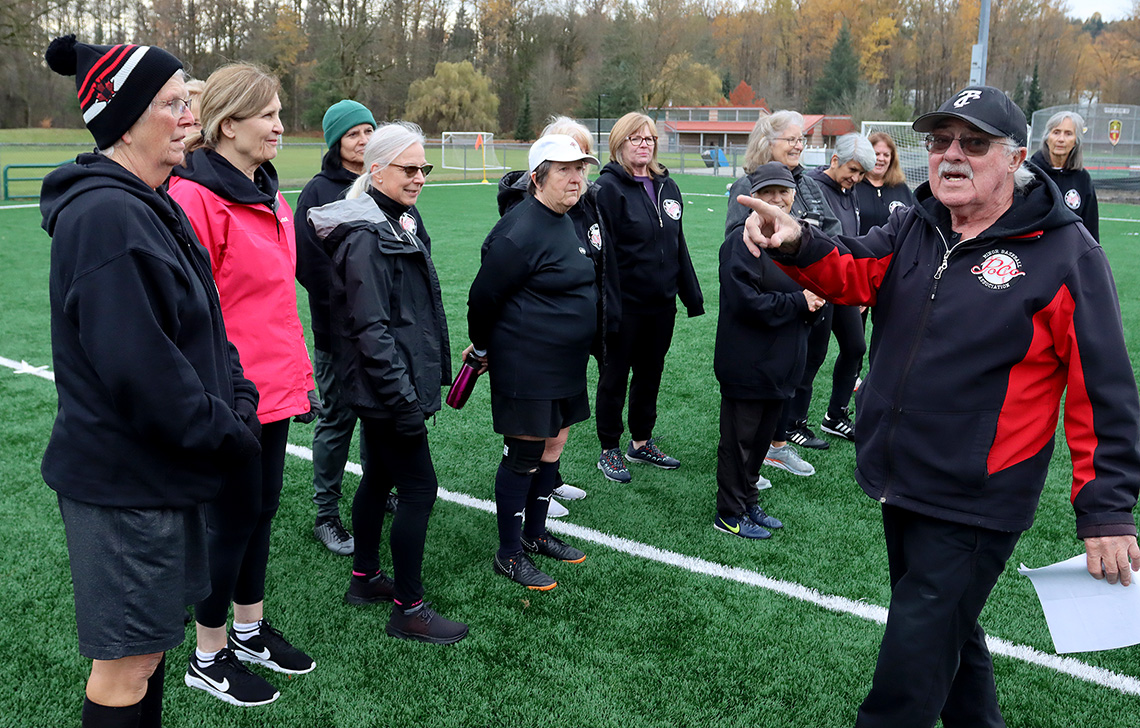
The Tri-City Walking Soccer Club is proof in the pudding: you can take the players out of soccer, but you’ll never take the soccer out of the players.
The club started several years ago as an adjunct to the Dartmen, an affiliation of weekend warriors who’ve grown old together playing sports like traditional running soccer as well as baseball and hockey.
As members started to hit their mid-50s, many realized they were losing their stride. But instead of giving up sport altogether, they just decided to slow it down.
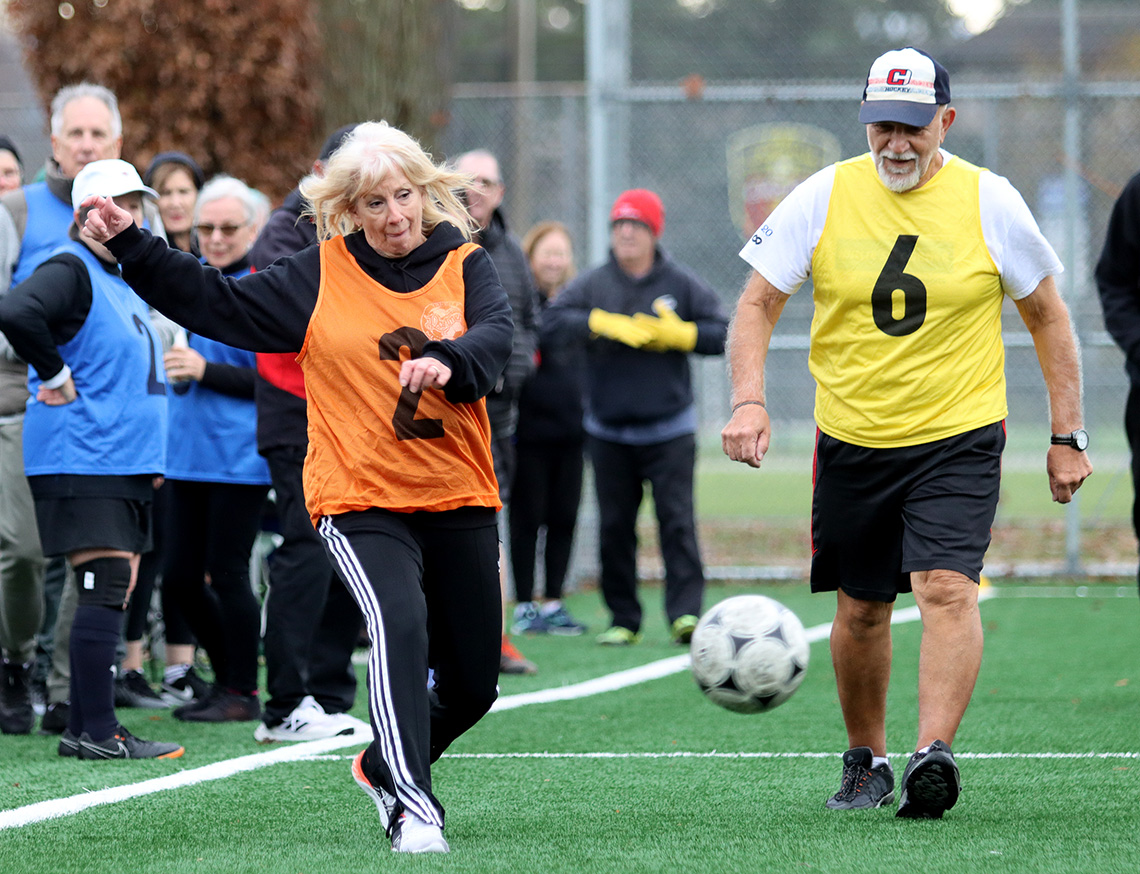
Walking soccer is just like it sounds, a modified version of “the beautiful game” without contact and played at a pace more comfortable for aging knees and joints.
It’s also played seven-aside on a smaller pitch — about half the size of a regular soccer field — at Port Coquitlam’s Gates Park.
Making new friends
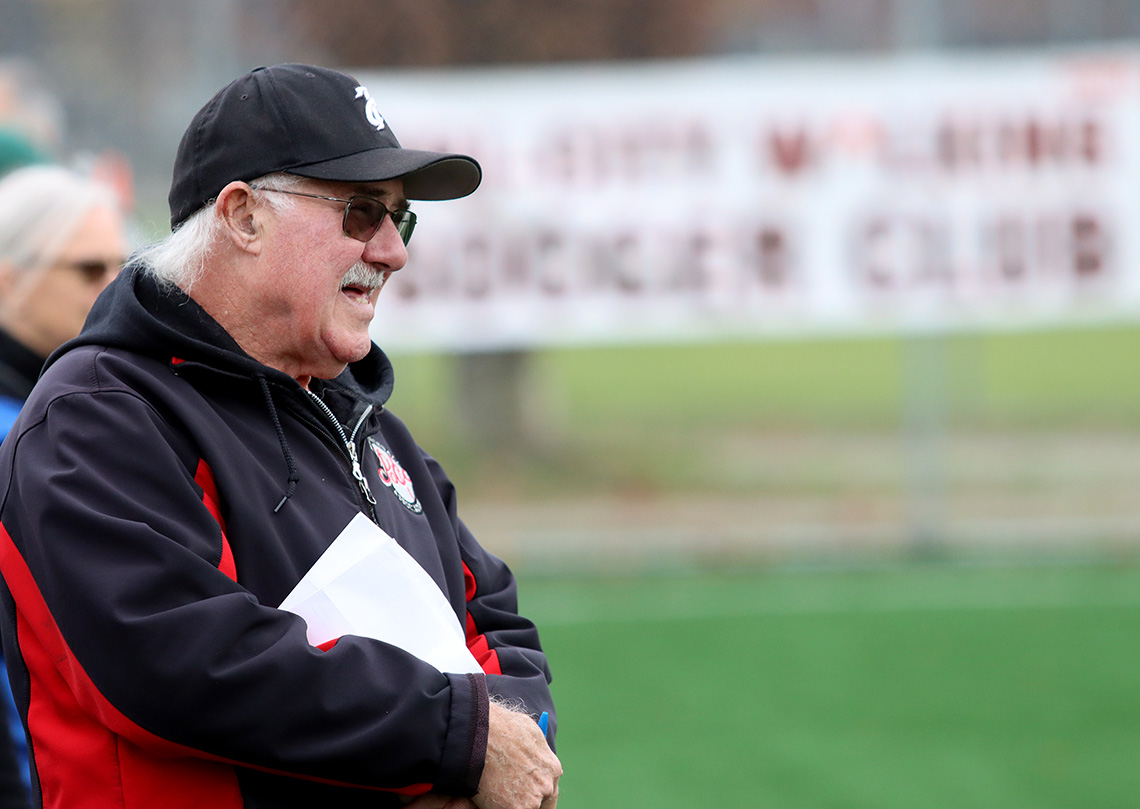
Jim Swelander, who started the Dartmen in Burnaby back in 1969, said as the group has embraced their golden years, the social aspect of their sporting endeavours has taken precedence over competition.
“It’s about making new friends and staying in contact with old ones,” he said.
When the group, which ranges in age from 55 to over 70, invited women to start playing in their soccer matches the camaraderie and post-game revelry kicked up a notch with organized get-togethers every week at the Cat & Fiddle pub and other social events.
Denise Spletzer, 68, said she first attended a walking soccer match as a spectator but quickly decided the club needed a female touch even though she’d never played soccer before.
“I like to get exercise,” she said.
Spletzer invited some of her friends from her fitness class and from an initial contingent of seven just a couple of years ago, there’s now 43 women participating in the club’s mixed division alongside its male membership of 93, some of whom stick around for the more competitive men’s division afterwards.
Swelander said not everyone in the club comes out at once, of course.
Players come and go for the regular Tuesday matches that run year round (the league heads indoors to a facility in New Westminster during December and January) and new teams of seven players are created every week from those who do show up to play in the 25-minute halves.
Stoke competitive fire
Sue McInnes said the soccer matches are a way to bring back some of the competitive fire she last felt when she used to play field hockey in her younger days. But it’s the new friendships she treasures most.
“It’s fun,” she said. “The social aspect is the best.”
Swelander, who leads all the players through various warm-up exercises and skill drills for about an hour before the matches begin and then coaches from the sidelines once the opening whistle blows, said it can be a bit of a challenge keeping everyone on the straight and narrow given the wide range of soccer experience and ability on the pitch.
“It’s okay, as long as you have patience,” he said. “You’ve just got to remember you’re here for fun.”
This story first appeared in the Tri-City News on April 2, 2024
Wendy Kinloch’s realtor questioned her sanity 34 years ago when she and her husband purchased the run-down rancher at 120 Windsor Dr. In Port Moody’s Coronation Park neighbourhood.
The single-storey home with a round fireplace in the middle of the living room had seen better days. But it offered more space to raise a family than their cramped townhouse in North Vancouver
“We knew it needed a lot of love,” said Kinloch.
Over the years, it got just that.
Almost every interior wall was rebuilt. The sundeck out back was replaced. The kitchen and bathrooms were renovated.
The house with green wood siding returned that love.
The Kinlochs raised two children there, and the myriad of their friends and visitors, who climbed the growing trees in the neighbourhood, ran through the sprinkler in the yard, drew with chalk on the street out front. They made connections with their neighbours, got involved in the community at Coronation Park School nearby.
“We looked out for each other,” Kinloch said. “It was just the greatest neighbourhood.”
So when Kinloch attended a special ceremony Tuesday, April 2, in front of her old home, which will be one of 10 from Coronation Park being sent by truck and barge to a second life for families in the shishalh Nation near Sechelt, she was sure to pack plenty of tissues.
MARIO BARTEL/TRI-CITY NEWS
Wendy Kinloch gets emotional as she talks to councillors from the shishalh Nation near Sechelt that will be the new home for 10 homes from the old Coronation Park neighbourhood in Port Moody, including hers.
The homes are in the way of a new development project by Vancouver-based Wesgroup Properties that will transform the 14.8-acre neighbourhood into a dense, urban community with six residential high-rises up to 31 stories, three six-storey buildings and a four-storey office building.
While 49 homes will be demolished, a deal to save some of the homes was brokered by a company called Renewal Development in conjunction with Wesgroup and Maple Ridge-based Nickel Bros. that has more than 50 years experience moving buildings.
Kinloch, who relocated to a new home in Anmore last October, said knowing her home has received a second lease on life made it easier to return to her former neighbourhood where several houses have already been cleared and many trees removed.
She said it’s like a circle of life. “I didn’t want to come back to this neighbourhood to see it demolished.”
Renewal Development’s Glyn Lewis, said the transportation of the first two homes scheduled to take place overnight tonight is the closure of one chapter and the opening of the next.
“It’s a beautiful story.”
Lewis has been working on his plan to reclaim and repurpose homes in the way of redevelopment for about seven years. He said with the increasing cost of new construction and the environmental toll of demolition, it makes sense to recycle structurally sound buildings.
After a couple of successful projects moving a home from Coquitlam to Upper Gibsons and an old single-room schoolhouse from Vancouver’s Kitsilano neighbourhood to the Squamish Nation where it’s been converted into a children’s education centre, it was time to scale up and put the lessons learned through those two ventures into practice. He said he’s hopeful the project will help change the fate of the approximately 2,700 homes that are demolished in Metro Vancouver every year.
“Intention and thoughtfulness can shape the direction of change,” Lewis said.
Lenora Joe, the chief of the shishalh Nation, said her community is excited to be at the leading edge of that change.
MARIO BARTEL/TRI-CITY NEWS
Members of the shishalh Nation near Sechelt give their thanks for 10 homes that are being moved to their community from Port Moody’s old Coronation Park neighbourhood.
Almost half the 1,600 people that comprise the shishalh aren’t able to live in the community because of its dearth of suitable and affordable housing; 200 families are on a waiting list to get new homes.
Reclaiming and moving homes is 30 to 70 per cent cheaper than constructing them new. And robust mid-century construction materials and techniques ensure the homes the shishalh are getting will last for generations to come, Joe said.
That continuity is important, she added.
“For us, it’s a new place,” Joe said. “But we’re also able to honour the history of the homes and respect that process.”
Darlene Hadden, whose home at 109 Windsor is another on the move to the shishalh Nation, said being able to see it welcomed elsewhere helps ease the emotional sting of leaving it behind.
Hadden said the house her family called home for almost 40 years was the epicentre for Christmas, birthday and wedding celebrations. Its walls contain memories of her two kids stealthily jumping out their windows so they could play in the expansive yard and forbidden skateboard adventures up and down the street.
“A house we loved, someone else will be able to love,” she said. “It means everything.”
This story first appeared in the Tri-City News on June 5, 2022
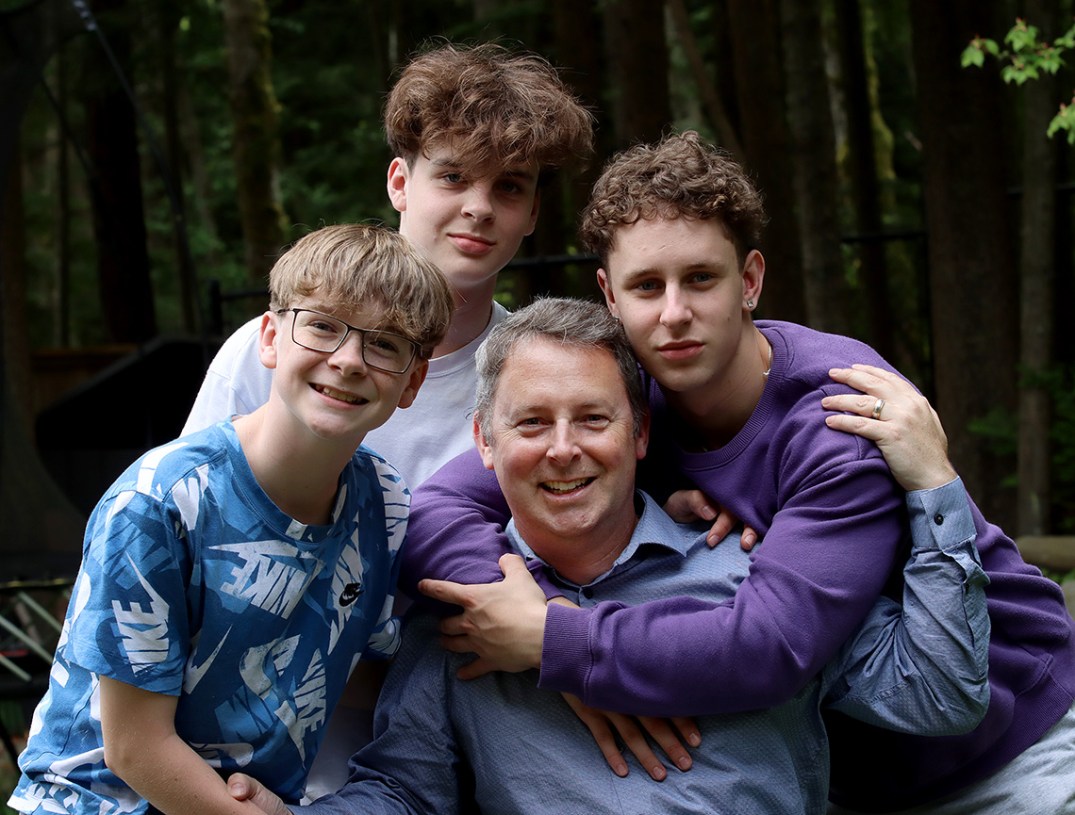
Paul Carter beamed with more than just pride when his sons, Adam and Matthew, recently received rescue awards of merit from the Lifesaving Society.
The life they saved was his.
The Carters, along with his wife, Andrea, and their younger son, Daniel, 12, were with family friends enjoying a day at the beach at Haywire Bay in Powell Lake near Powell River on Aug. 1, 2021, when the boys decided to swim out about 100 metres to explore a nearby island.
Adam, who’s now 16, had recently received his National Lifeguarding certification and swims competitively with the Coquitlam Sharks. Matthew, 14, and Daniel also belong to the Sharks. So for them, the distance and cold water presented little challenge.
Left all alone on the hot beach, as his wife wandered off elsewhere, Paul could see across the bay to the island where his boys, their friends and dad seemed to be having a lot of fun.
“Why am I here all by myself?” he thought before wading into the water to begin the swim to join them.
Who’s at risk from drowning?
According to the Lifesaving Society, there’s an average 458 deaths by drowning every year in Canada. A quarter of them are between the ages of 50 and 64, almost 80 per cent are male, 34 per cent occur in lakes or ponds and two-thirds take place between the months of May and September.
Carter was right in the statistical wheelhouse. He just didn’t know it. Yet.
Halfway to the island, Carter began to realize the distance and cold water were more than his 50-year-old body and recreational swimming ability could handle. He’d gone out too fast and now he was paying for his hubris.
Carter paused to catch his breath, treading water for a minute or so.
Determined to reach the island, he resumed swimming. But 10 metres later he was exhausted.
‘I started panicking’
Carter tried to make up his mind whether he should continue going forward or turn back when a wave hit him square in the face. He swallowed a mouthful of water and began coughing violently, further depleting his waning energy.
Carter’s breathing quickened. His arms and legs slowed.
“That’s when I started panicking,” he recalled. “I did the calculation that I wouldn’t be able to get anywhere where I was safe.”
The eldest boy, who attends Heritage Woods Secondary School in Port Moody, said he just happened to be on the beach on the island’s leeward side when he heard his dad call out. While his friend’s father thought Carter was just messing around, Adam said his dad’s shout had a tone “I’ve never heard used before.”
In trouble
When Adam looked across the water, he could see Carter wasn’t moving much.
The instinctive drowning response, in which humans close to drowning focus all their attention on keeping their mouth above water to the exclusion of any useful effort to save themselves or attract attention, had taken over.
“I knew deep down he was in trouble,” Adam said of his father.
He jumped into the water and let his lifeguard training take over.
Reaching his dad, Adam rolled him onto his back and used his chest to elevate Carter out of the water. He told his dad he was going to be OK, implored him to kick his feet to help propel them back toward the safety of the beach.
By then, Matthew was also in the water.
‘We’ve got to do this’
“I knew it was an emergency,” he said.
When Matthew reached his dad and brother, Adam told him, “We’ve got to do this.”
He wrapped Carter’s arm around his shoulder and the three paddled to shore.
Carter said the whole incident took about five minutes to play out, but “in the moment it seemed a lot longer.”
Back on land, coughing out more of the water he’d swallowed, Carter became a parent again and checked on his boys.
They “looked exhausted,” he said. “You feel bad about the situation you put your kids in.”
Andrea, who was now back on the scene after being alerted by others about what was going on, transported the trio to the hospital to make sure they were OK.
The good scenario
It was during the drive Adam started to come to grips with what had just transpired.
“We just saved our dad from dying,” he said, adding he thought about all the different scenarios that could have happened, but “we got the good one.”
Carter said he was thankful he and his wife had encouraged their boys to take up swimming at a young age.
“You never know when it’s going to be important,” he said.
Young Daniel, who’d watched the whole event play out before him, said, “It’s just a good thing for everyone to learn.”
Since then, Carter said, the family’s often reflected on what happened. Sometimes, he said, he’s wracked with guilt.
“What if my family had lost me?” he said. “How tragic would that have been.”
Adam’s take is a little more pragmatic. “It felt like it was something I should have done.”
Daniel’s nonplussed.
“It could have been the worst day of my life, but now it was just a thing that happened.”
Still, Carter said, there are valuable lessons to be learned, especially as summer approaches and people begin heading to beaches to cool off.
“I made a few bad decisions,” he said. “Drowning doesn’t look like when you see it on TV.”



















 MARIO BARTEL