This story first appeared in the Tri-City News on Oct. 13, 2024
The COVID-19 pandemic may have had a silver lining, says a Coquitlam psychologist.
Denis Boyd says the public health crisis that shuttered people indoors for months at a time and created trepidation about mixing with large crowds was a big “wake-up call” to some of the everyday stresses to which we’d become complacent.
Boyd is the first presenter in Coquitlam Rotary’s new mental health speaker series that launches Oct. 29, 7 to 8:30 p.m., at Douglas College in Coquitlam. He will be speaking about the signs and causes of stress, as well as the kinds of tools that can be used effectively to manage it.
Boyd said the COVID-19 pandemic raised stress levels “a notch or five.”
He said the daily news reports of deaths and hardships brought people face-to-face with their mortality and often sparked a re-evaluation of life’s priorities.
Suddenly freed by employers to do their jobs from home, many people coped by finding a better balance between the demands of work and the opportunities of life. Cooped up, they went outdoors more to take a walk in the park, commune with their natural surroundings. They whittled their social circles down to those most important to them.
“It was sobering to have everything shut down,” Boyd said.
But as memories of those darkest days dim, old habits and routines are returning. Employers are demanding employees return to the office. Doom scrolling through social media feeds has become endemic, isolating.
Boyd said it’s important society doesn’t abandon the lessons learned through the pandemic.
“We have to always make sure we balance our work life with our personal life,” he said, adding it’s critical we constantly cultivate our relationships with others.
“The most impactful thing we can do is improve our relationships, share our journeys with each other.”
Boyd said the realities of modern living, like residing in large condo developments where getting to know your neighbours can be difficult, and the temptations of social media and video gaming as proxies to real in-person interactions can present challenges for cultivating connections.
“Our conveniences have made us more isolated,” Boyd said, adding the anxiety that comes from such isolation exacts a toll as it builds.
“When you load up and reach your capacity of stress, you’re going to get sick.”
How to attend
Admission to Coquitlam Rotary’s mental health speaker series if free, but pre-registration is required.
The second event, on Nov. 26, will feature psychologist Tamara Williams talking about the use of modern neuroscience to help caregivers and children manage emotions together. Further speakers will be announced in the new year.
According to Hockey Canada, only one in 4,000 kids playing hockey in this country will ever have a career in the National Hockey League. That’s .025%. Port Coquitlam’s Brady Leavold was on the cusp of beating those odds. But childhood demons and addiction snuffed his dream and sent him spiralling to the streets and petty crime.
Brady Leavold has been in the Tri-City News before.
But the gritty forward from Port Coquitlam wasn’t featured as he became a fan favourite with the Swift Current Broncos in the Western Hockey League, or in a front page story covering his hoped-for triumphant first NHL game.
In 2016 Leavold was in the court blotter, after he was sentenced in Vancouver to 21 months in jail for theft, possession of stolen property, resisting a peace officer and several other charges.
Four years later, he’s trying to atone for that, maybe even help others wrung out by a sport that values players more as a commodity than as human beings.
Now 33, Leavold is living in Morrisburg, Ont., and running a skate-sharpening business. He’s slowly putting his life back together again and launching a podcast to shine a light in some of hockey’s darkest corners.
He’s trying to come to terms with a system that recognized his talent and ambition but didn’t see the demons that drove him to excel on the ice. Or maybe didn’t want to see.
In love with hockey
Leavold grew up in Port Coquitlam’s south side, where he attended Kilmer Elementary and then Citadel Heights Middle schools. He played hockey in the PoCo Pirates minor system, often on teams with boys older than him because he was so good and played “with an edge.”
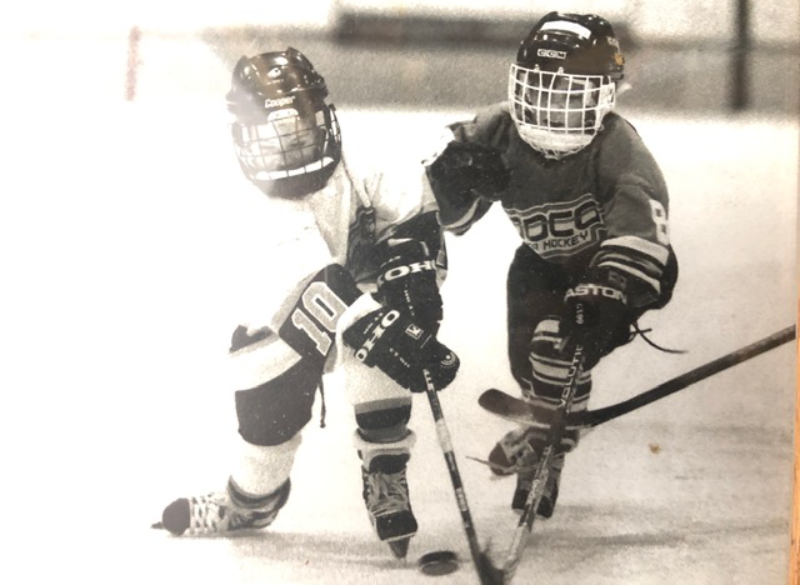
SUBMITTED PHOTO Brady Leavold, right, chases down an opponent in a minor hockey game in Port Coquitlam in 1993.
Leavold said he couldn’t get enough of the game. When his firefighter dad, Brian, was coaching other teams, he’d spend hours in the corner of the old Blue Rink at PoCo Rec — where the nets were stored — knocking a ball or puck around with his stick. He dreamed of someday playing in the Pirates’ annual spring bantam tournament.
After hockey season was over, Leavold and his buddies, including Zach Hamill who went on to a pro career in the NHL and Europe, would rollerblade down to Ikea in Coquitlam and play two-on-two ball hockey in the expansive parking lot until the wee hours of the morning.
“That was our life,” Leavold said. “We had such a good group of guys playing hockey.”
But his friends didn’t know Leavold had a secret.
He said his all-consuming love for hockey was an escape from childhood sexual abuse that filled him with anger and shame every waking moment.
“I just wanted to be accepted, I wanted to be sure of myself,” Leavold said. “Hockey did that for me.”
Sabotaging success
As good as Leavold was, though, every tryout was fraught with anxiety that he’d get cut, that he wasn’t good enough.
Once, when he had a chance to make an elite team, he attended a skating session then faked an illness. He said he wanted to control his own destiny.
“Every good thing in my life, I’ve sabotaged it,” Leavold said.
Still, coaches wanted him on their teams, his energy on the ice. So they’d give him a second or even third chance.
When Leavold was 16, he played a game for the Western Hockey League’s Broncos, then was the team’s rookie of the year the following season.
Off the ice, though, Leavold struggled. He experimented with drugs like ecstasy. Then, seven games into his sophomore season in Swift Current, he walked away from the Broncos and returned to Port Coquitlam to live with his dad and attend Riverside Secondary.
Quickly Leavold discovered his hockey pedigree — flaunted by wearing his Broncos jacket everywhere — shielded him from accountability. He said he didn’t have to work as hard in school as other students to get a passing grade. He’s convinced he passed his driver’s test because the examiner was a fan and talked more about hockey than noting his mistakes.
When the Broncos traded Leavold to the Everett Silvertips, he didn’t report.
Instead, he signed with the nearby Burnaby Express of the BC Hockey League, where he scored nine points in his first three games playing on a line with future NHLer Kyle Turris.
But away from Copeland Arena, Leavold continued to party. He showed up for games with little sleep, if he showed at all.
The team got him counselling, tested him for drugs.
For a time, it worked.
Then Leavold hurt his Achilles tendon and he stopped going to the rink.
Weary of his erratic behaviour, Leavold’s dad kicked him out of the house. His girlfriend’s family took him in, made him feel at home, afforded some stability.
Another chance
That summer, Leavold called his old coach in Swift Current, Dean Chynoweth, and asked for another chance.
He got it.
But his life away off the ice continued to be a mess. He got a local girl pregnant. He started missing practices. The Broncos wanted to suspend him, but teammates came to his support. They said they needed him for the playoffs.
When the team was eliminated by the Regina Pats, Leavold headed back to Port Coquitlam, leaving his pregnant girlfriend to figure things out for herself.
Leavold said that decision was a tipping point.
“I was scared,” he said. “Maybe it was just going to go away.”
Back home, Leavold reunited with his old girlfriend. But when he got her pregnant too, she gave him an ultimatum to choose who he wanted to be with. He stayed put.
“I knew it was wrong,” he said of turning his back on his girlfriend and unborn child in Saskatchewan. “I knew it was going to affect me.”
Traded away
Hoping to dodge a roiling scandal in the small Prairie city, the Broncos sent Leavold to the Kelowna Rockets early in the next season.
But the new environs didn’t offer much of an escape for the 20-year-old player. During the Rockets first visit to Swift Current, an angry friend of his Saskatchewan girlfriend chased him in the arena’s lobby and his teammates had to hustle him onto the team bus with no idea what was going on.
On the ice, though, things were going much better.
Paired with future NHLer Jamie Benn, Leavold was the Rockets’ second leading scorer with 70 points and led the team in fights and penalty minutes.
NHL scouts took notice.
Leavold was signed as a free agent to the farm team of the Tampa Bay Lightning and he was invited to the big team’s prospect camp later that summer. With some money in his pocket for the off-season and his future looking bright, he got his own place in PoCo. His NHL dream was tantalizingly close.
At the Lightning’s prospect camp in Traverse City, Mich., Leavold was pencilled in to skate on a line with the league’s first overall draft pick, Steve Stamkos.
But poor choices in roommates and friends in the summer of 2008 put Leavold back on a self-destructive path.
Instead of getting into shape for the camp, Leavold said he binged on cocaine. The night before his big chance, he smoked pot and snorted coke.
Having blown his NHL opportunity, Leavold tried to cobble together a career in the backwaters of minor pro hockey: He lasted four games with the Lightning’s top minor league team in Norfolk, Va., then was sent down a rung to the ECHL’s Victoria Salmon Kings. He signed a contract with a team in the Netherlands but lasted only two games there before returning to Victoria where he played two more games then fell off hockey’s map for more than two years.
Hooked on opioids
Adrift and dealing with pain from hockey injuries, Leavold got hooked on Oxycontin, a powerful painkiller.
“It felt like a hug from my mom,” he said of the opioid.
At one point, Leavold tried to get clean at a rehab facility in Maple Ridge. He signed a contract with a team in Wichita, KS, but didn’t show up, then got another chance in Texas, with the Rio Grande Valley Killer Bees in the Central Hockey League. He scored 18 points in 22 games, accumulated 91 minutes in penalties. It’s the last line on his pro hockey résumé.
Back home in the Lower Mainland for the off season, Leavold fell back into a familiar pattern. He started injecting heroin. To pay for his addiction he held up liquor stores. He even stole a cab that resulted in his face showing up on a Crime Stoppers notice.
Eventually Leavold ended up on the streets of Vancouver’s Downtown Eastside. That’s where the police caught up to him and he was sent to jail, including a stretch at the North Fraser Pre-Trial Centre in Port Coquitlam, just down the street from his childhood hockey haunt.
But again, Leavold’s hockey background got him favoured treatment.
“You get away with everything,” he said. “There was a time I couldn’t get it out of my mouth fast enough that I was a hockey player and the benefits would come my way.”
A fresh start in Ontario
Upon his release, Leavold headed to Ontario to gain distance from his past and get clean again. He landed in Orillia, got a job. But when he was caught trying to drive a stolen truck on his way out of town to Vancouver, he was returned to jail.
Leavold hit bottom, his options had run out.
Until he happened to answer a phone call meant for another inmate.
The voice on the other end eventually became his girlfriend and his reason to straighten out his life.
“I knew I needed something to drive me and keep me going,” said Leavold, who moved in with his new partner in the basement of her parents’ home when he was released.
A new adventure
With nothing but time on his hands as they rode out the early weeks of the COVID-19 shutdown last spring, Leavold decided to share his story.
He got a microphone, plugged it into a borrowed laptop computer and started talking. He invited his best friend growing up, Kevin Pedersen, who’s now a scout for the Arizona Coyotes, to join him for his first stab at creating a podcast.
Leavold said Pedersen’s support meant the world.
“I didn’t have a plan. When he agreed to do that, it was a huge reason my life turned around.”
Leavold’s now more than 60 episodes into his new adventure that he calls Hockey 2 Hell and Back . Some of his guests are from his own hockey past. Many have skirted the sport’s fringes, like himself. A few, like Theo Fleury, Brent Sopel and Sheldon Kennedy, overcame their own challenges to achieve success.
Leavold said the podcast has reconnected him with the hockey community that promised him much as a player but delivered him little as a young man. But for one or two exceptions, most adults he’d dealt with in his time in the sport opted to kick his problems down the road by trading him elsewhere or cutting him outright rather than facilitating he get the help he needed.
Leavold said he hopes the stories he shares might help affect change in hockey’s culture.
“There’s a lot that can be done off the ice that can make it better for the kids,” he said. “It can give them mental training, training for life, coaching them to be the best human beings they can be.”
SUBMITTED PHOTO Former NHL prospect, Brady Leavold, began his journey back to hockey by working as a skate sharpener.
Supporting others
Recently, Leavold created Puck Support, a foundation to provide resources for players and coaches dealing with mental health and addiction issues. Several — from all levels of hockey — have been enlisted as ambassadors. They include former Detroit Red Wing Darren McCarty; Dody Wood, who played with the San Jose Sharks and New Jersey Devils; and Canadian national sledge hockey team player Paul Rosen.
“It’s given me purpose,” Leavold said of the new initiative.
Personally, Leavold said he’s in a much better place. He’s been clean for 11 months. His dad has been a guest on his podcast.
Though estranged from his child in Saskatchewan, he hopes to mend some fences so he can be in the lives of the two children he fathered with his Port Coquitlam girlfriend.
On Oct. 15, Leavold and his current partner became parents to little Vada.
Back on the ice
Leavold’s also back on the ice for the first time in eight years, playing on the fourth line of the Maxville Mustangs, a senior A men’s team in Eastern Ontario.
It’s not an achievement that’s likely to get noted by Leavold’s hometown paper, but, he said, he’s okay with that.
“I’m so out of shape, but I’m going to push through it,” Leavold said. “Everything bad happened for a reason to get me to this point.”



 MARIO BARTEL