Coquitlam student follows a new path through running

This story first appeared in the Tri-City News on Oct. 31, 2021

Cycling’s loss is running’s gain.

Adam Crespi, a senior at Gleneagle Secondary, was trying to figure out an activity he could immerse himself in for four months as part of the school’s Talons outdoor leadership program; he wanted to do cycling, but getting a road bike would be an expensive investment.

To run, though, all he needed was a pair of shoes.

Less than two years later, he’s the Fraser North District senior boy’s cross-country champion and, on Saturday (Nov. 6), he’ll be competing at the provincial championships in Vancouver’s Jericho Park.

Crespi’s also had success running middle distances on the track, including winning gold medals in the U15 provincial championships for the 1500m and 800m races, and a victory at the BC Endurance Challenge last July in Victoria.

Crespi said until economics set him on a running path, he’d never considered the sport.

Now it’s his passion that’s even opened up some unexpected post-secondary possibilities.

“I just really enjoy it,” Crespi said of the initial challenge he set himself to train for a half marathon.

That was just before the onset of the COVID-19 pandemic.

As his school and life routines were disrupted by closures and public health restrictions, heading up to Coquitlam’s Mundy Park or out to Bert Flinn Park in Port Moody for a run amidst the trees proved a balm in uncertain times.

“Running provided consistency,” Crespi said. “It made me feel better every day.”

In fact, Crespi added, he loved running so much, when the school year ended he kept going.

He joined the Coquitlam Cheetahs to connect with other runners his age who shared his passion. “Everyone is so driven,” he said of his teammates at the track club. “It pushes you to the next level.”

But where that level was remained largely a mystery through Crespi’s first season as a competitive runner. The pandemic resulted in the cancellation of all meets in 2020. His only measure of progress was against the clock in virtual competitions.

Still, the results were encouraging.

Crespi ramped up his training, running six or seven days a week. He started going to the gym to increase his strength and refined his diet to boost his energy. He hiked up mountains, including the rugged 47-kilometre Juan de Fuca Trail on Vancouver Island that he completed in eight hours.

Crespi said his natural inclination to run comes from his years playing youth soccer.

“Each game you’re running,” he said. “It really builds your leg muscles.”

But, Crespi said, the team sport never really provided the community he’s found in running.

“If someone you meet is a runner, you can instantly start a conversation,” he said. “You’re on the same page.”

Crespi said he’s not sure what to expect at his first provincials. Most of his competitors will be unfamiliar, as will the grassy route at Jericho — the majority of the trails he runs competitively at Mundy Park are gravel or dirt.

He said.his strategy will be to sprint to the front and then try to control the race from there.

“You have to be aware of your pace. In cross-country, the race can easily get away from you.”

No matter where Crespi places though, he’s thankful for the course his decision to start running has taken him. Next fall, that could even mean heading south of the border.

Crespi said his academic aspirations had him eyeing the engineering program at the University of British Columbia. But some encouraging feedback from American schools with well-regarded cross-country and middle distance running programs, like Brown University and MIT, have expanded his educational options.

“It’s really opened up some possibilities,” Crespi said. “If I told myself a year ago what I was going to be doing now, I wouldn’t have believed me.”


Port Moody player plucked in first round of PWHL draft

Port Moody hockey fans won’t have to travel far to see one of the city’s own make her debut in the Professional Women’s Hockey League.

Jenna Buglioni, who was also a top field hockey player when she attended Gleneagle Secondary School in Coquitlam, was selected eighth overall by the new Seattle team in the league’s 2025 entry draft.

That’s seven places higher than the Hockey News’ assessment of top prospects last February.

Buglioni, who scored 164 points in 167 games during her five seasons at Ohio State University, said she’s looking forward to the next step in her hockey career.

“I’m so excited to see the fans rockin’ it at Climate Pledge Arena,” Buglioni said on Instagram, adding she “can’t wait to get to work in November.”

Buglioni was actually eligible to be selected in the PWHL’s 2024 entry draft, but she opted instead to play a fifth season at Ohio State while earning a Master’s degree in sport management.

Buglioni said the additional season would also better prepare her for the rigours of turning pro.

“I have gotten that extra time to work on skills and get more game experience,” she said.

Buglioni won two conference and two national championships at Ohio State, although her final season ended in heartbreak when the Buckeyes were defeated in overtime by the University of Wisconsin Badgers in the NCAA Frozen Four championship final on March 30.

“We were so close to getting that outcome we wanted and it almost felt stripped away,” Buglioni said of the result that came after the Badgers tied the game on a penalty shot with less than 19 seconds left in the third period.

Individually, Buglioni set school records for career and single-season game-winning goals and she tied the program’s record for career short-handed goals.

Buglioni was also the Buckeyes’ captain in her final season and she even sang the national anthem prior to her final regular season game at Ohio State.

Seattle joins Vancouver as the PWHL’s first expansion teams. Neither has yet to announce a nickname.

Vancouver selected veteran Finnish national team forward Michelle Karvinen seventh overall in the entry draft, which took place in Ottawa.

The PWHL is expected to release its schedule later in the summer.

Massive Anmore development proposal put on hold at the last minute

A proposed development that would almost triple Anmore’s population has been put on hold.

Less than 15 minutes prior to Monday’s scheduled public hearing into an application by Icona Properties to amend the village’s official community plan so its proposal could proceed, Greg Moore, the company’s CEO, announced on social media it’s taking a break.

“We’ve made the decision to withdraw our current application for Anmore South,” said Moore on Facebook. “This break will allow us to explore a path forward that brings more unity than discord.”

cona was seeking approval to construct 1,750 new townhouses, low-rise apartments and single-family homes on 150 acres of property the company owns near the corner of 1st Avenue and Sunnyside Road.

On June 10, Anmore council voted 5-1 to send the proposal to a public hearing that was scheduled to begin at 6 p.m., Monday, June 23.

The development plan has drawn consternation from residents of the bucolic village of 2,200 residents, as well as the neighbouring communities of Port Moody and Belcarra.

A group called the Anmore Neighbours Community Association (ANCA) said Icona’s plan poses “significant financial risks” to the village.

ANCA’s Rod Rempel and Harriette Chang said a consulting company’s estimate it would cost the developer $30 million to construct services like water, sewer and storm drainage could end up leaving Anmore taxpayers on the hook.

Residents also expressed concerns about increased traffic, higher costs for policing and fire services, as well as public safety because the two access roads into and out of the village could become blocked or overwhelmed in an emergency like a wildfire.

Port Moody and Belcarra shared similar trepidation.

In a letter sent to Anmore council in May, Port Moody Mayor Meghan Lahti said neither the village nor developer had yet to initiative discussions about utility upgrades, most of which would be routed through its urban neighbour.

“If the village is interested in partnering on this infrastructure, time is of the essence,” she said.

Belcarra Mayor Jamie Ross said traffic and construction activity during the development’s 25-year built-out would also be a hardship on his village.

Anmore councillor Doug Richardson, who cast the only dissenting vote to move Icona’s proposal forward, said the project “is not needed.”

But supporters on council countered the village needs to do its part to address Metro Vancouver’s housing crisis by providing “more affordable” options.

Anmore Mayor John McEwen said development of the property is inevitable.

“Change is happening and we want to have a say in how it gets developed.”

In his statement, Moore acknowledged the division his company’s plan has incited.

“This was never our intent,” he said. “In fact, it’s the opposite of what we set out to do.”

Moore said Icona wants to create “a people-first community” that’s “more connected and more compassionate.”

Chris Wilson wants you to buy his balls

This story first appeared in the Tri-City News on Feb. 25, 2023

Chris Wilson has balls.

Many balls. In a variety of sizes, shapes and textures.

But before this story descends any further into a classic Saturday Night Live sketch, it might be helpful to note Wilson wants to sell you his balls – cheap.

In fact, balls are among the least costly items you’ll find at the annual spring KidSport used equipment sale that runs Saturday (March 4), from 10 a.m. to 1 p.m., at Riverside Secondary (2215 Reeve St.).

For instance, you can get 10 golf balls that went astray from their owners for $1.

Wilson, the chair of KidSport Tri-Cities who’s been running the twice-yearly sale since 2007, said there will be lots of great, gently-used gear from virtually every sport available at bargain basement prices. Proceeds help pay registration fees for the athletic activities for kids whose families might not be otherwise able to afford them.

Many of those activities centre around a ball.

Over the years, Wilson said he’s seen pretty much every kind of ball come through the sale, from football and rugby, soccer and cricket, bocce and basketball, to lacrosse and croquet, bowling and beach.

There’s been buckets of golf balls, boxes of baseballs, bags of tennis balls and laundry baskets filled with softballs.

But Wilson couldn’t say if he’s ever sold a round football that’s used in Gaelic football or a sliotar from the Irish sport of hurling.

One year, a local business donated 1,500 soccer balls commemorating a World Cup tournament and there’s still a few left.

In fact, Wilson said, so many balls have been part of the sale, sometimes he just ends up donating them to local associations to free up storage space.

While most shoppers are on the hunt for bargains on big-ticket items like bicycles and hockey equipment, Wilson said it’s important not to overlook the value of the humble ball.

“It’s the fundamental tool of a lot of sports,” he said.

Even athletes who play sports that don’t involve balls often develop a relationship with them. During Wilson’s wrestling days, he said, he incorporated balls into his training for strength and reflexes.

Wilson said balls are often the entry point into a sport.

Just the simple act of kicking, chasing, throwing or catching one can lead to a lifelong affinity.

“It all starts with the ball,” he said. “It’s the starting point for so many good things that come out of sport.”

Well, the student volunteers from Riverside who will be tasked to inflate the balls the day before the sale to ensure they’re looking their most enticing may have a different take.

Fortunately, said Wilson, they have an air compressor.

Parkour pastor delivers skateboarding sermons at his new Port Coquitlam church

This story first appeared in the Tri-City News on April 3, 2024

A Port Coquitlam pastor is bringing a new angle to spreading his messages of faith and community — upside down or hanging 45 degrees from a vertical climbing wall.

Dave Jonsson has set up his new church in the Momentum Ninja gym at 1961 MacLean Ave., Port Coquitlam.

Every Sunday, for the next year at least, visitors can fuel their soul at a service that runs from 9:30 to 10:30 a.m. while their kids are able to burn off energy on the climbing wall or expansive selection of parkour boxes, giant truck tires and aerial rigs.

Jonsson, a pro skateboarder whose own journey to faith was sparked by a close call in a plane crash near Squamish, said the unique arrangement is an apt calling card for his belief that a church and spiritual guidance should be open and available to everyone.

It’s also a reflection of a growing need for churches to be able to adapt and innovate if they’re to stay relevant, Jonsson believes.

“It’s imperative for churches to think outside the box,” he said. “Church should be enjoyed, not endured.”

A former associate pastor at the massive Riverside Community Church in Port Coquitlam’s Dominion Triangle area, Jonsson said he approached the Ninja gym about using their facility after he saw how much his own son enjoyed attending lessons there, swinging from the rings, navigating obstacles and hoisting himself up climbing apparatus.

Fortunately, the facility is closed Sunday mornings, so Jonsson negotiated a year-long arrangement. Volunteers move some of the equipment aside and set up about 70 chairs for the service while another group of volunteer parents and older kids supervise activities in the gym area.

Jonsson said in total, the space can accommodate about 200 people if some don’t mind sitting on boxes, mats or the hulking tires. He said he hopes the unusual environs will attract people who otherwise might not be inclined to go through the doors of a traditional church.

“This is a new approach to an ancient tradition,” Jonsson said. “We want to create an atmosphere where people can put their feet up.”

Port Coquitlam defenceman plays on despite crippling, painful disease

This story first appeared in the Tri-City News on Sept. 4, 2022

Nature doesn’t just call for Justin Hill. It screams.

Last summer, the 13-year-old hockey, baseball, soccer and soon-to-be football player was diagnosed with Crohn’s disease, a chronic inflammation of the gastrointestinal tract that can cause debilitating pain and cramps, as well as sudden, urgent needs to head to the washroom.

Hill was an active young athlete hoping to land a spot as a defenceman on the Port Coquitlam Pirates A1 rep team for his age group when he started feeling pains in his stomach.

The discomfort drained his energy.

At hockey practice, Hill would have to rest for five minutes after each drill.

Sometimes, he’d have to rush from the bench to the washroom.

Instead of playing rep, he was slotted on to a house league team.

Last summer, after doctors finally figured out what was wrong, Hill was put on a liquid diet for two months. He drank up to 15 Boost shakes a day, as well as soup broths. Clear fizzy drinks like Sprite were the only treat he was allowed.

With another hockey season looming, Hill fretted about his ability to play.

“I was worried I’d have to stay at home all day and do nothing.”

But monthly infusions of medication at BC’s Children’s Hospital to suppress Hill’s abnormal immune response that triggers inflammations have helped to stabilize his condition so he can look forward to getting back on the ice.

More importantly, having a coach confide in Hill that he too suffered from a chronic bowel disease helped him cope with the mental and emotional toll of his affliction, which can often leave its sufferers feeling alone and embarrassed.

“It was nice to hear that I’m not the only one who has to run for my life to the bathroom,” Hill said. “It makes me feel like I’m not singled out.”

Hill’s mom, Melissa, said as Justin returned to his sporting activities, the family initiated discussions ahead of time with his coaches to let them know of some of the unique challenges he could face, and how they could support him.

“The biggest thing you learn as a parent is you’re the only one advocating for him,” she said.

In June, Justin received a courage award at the Port Coquitlam Hall of Fame and Sports Awards. He used the opportunity to talk publicly about his disease to help people realize how tough it can be to live with.

He said sharing his struggles helps to give him the drive to overcome them, to show he can persevere and succeed.

This summer, Hill was on the ice up to three times a day preparing for tryouts to make the Pirates U15 A1 team. This fall, he’s planning to sign up for touch football at Minnekhada Middle School where he’ll be attending Grade 8.

Hill said sports are his refuge: When he’s on the ice or the field, he’s able to park the stresses and uncertainties that come with his disease.

“Sports are the thing that make me forget,” he said. “It’s nice to have that.”

Life and death of the photo essay

The diminishment and demise of newspapers has all but killed the photo essay, and the role of its design in storytelling.

Getting the annual guide to the Best in Newspaper Design used to be a red-letter day at the office.

Once the editor digested its content to glean potential ideas, the rest of us would secret it to our desks to bask in the glow of creative page designs and photo layouts put together by some of the best newspaper graphic designers in the world.

We were inspired by their use of fonts, colour and graphic elements to complement and support the stories being told by the journalists in words or photos.

We marvelled at the way photos were chosen and displayed together to lead us through the story, take us to its very heart.

Reading a newspaper is like taking a journey; each page promises a new destination that can ignite our imagination or just fuel us up to get us to the next page.

A well-designed and thoughtfully-constructed destination page, like section fronts or double-trucks inside, invite the reader to linger, invest the time to read the story then move on to further pages to see what other goodies might be in store.

When I broke into the business in the mid-1980s, USA Today was regarded as the pinnacle of newspaper design.

Editors loved its multitude of stories launching off the front page, giving readers several entry points into the rest of the paper.

Its liberal use of boxes, colour washes, graphics, bullet points and explainers made it feel vibrant, fun and accessible.

Of course limited resources at the lower end of the newspaper industry meant our efforts to emulate the USA Today look were usually half-baked — it was the thought that counted.

Laying out a photo page or section front was one of the many things I missed when it was decided the Tri-City News should go digital-only.

When I was shooting a story with good photo possibilities, I did so with an eye to pitching it to the editor to run as a spread; that meant I needed a variety of photos to help drive the narrative — wide-angle establishing shots to set the scene, tight detail shots, close-ups, reactions, maybe a silhouette, and a strong vertical or two to help with the layout.

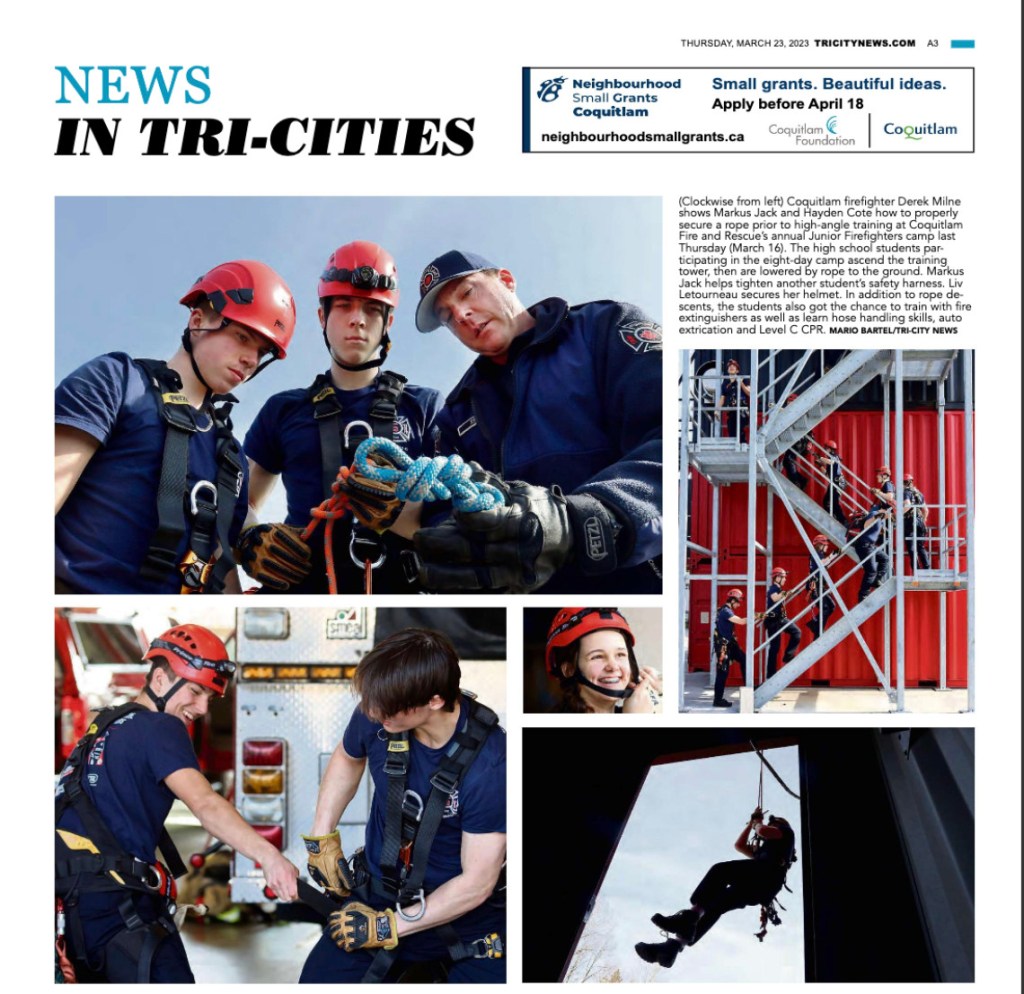
A photo package I shot, edited and designed in 2023 about a group of high school students learning the ropes of a potential career as firefighters.

Editing a take of 15 or 20 photos down to five or six that best captured the essence of the story could be an anguishing process, as was deciding which photo to run largest, and whether to put captions under each individual photo or grouped together.

Sometimes those decisions meant a favourite photo, or one that took a lot of work or forethought to get, wouldn’t make the cut.

A story, told in words and photos, about a local men’s group that offers support to other men through building and fixing things.

If a photo didn’t serve the story, or work with the other photos, maybe it wasn’t that great to begin with.

But, just as newspaper executives deemed photojournalists expendable once they realized everyone with a smartphone could shoot a photo of a car accident, house fire, or ribbon cutting, page designers also became an expensive luxury. Templated designs and centralized production protect profits.

Digital-first then digital-only further sap the creative presentation of news. Content management systems for web upload demand uniformity.

For the most part, online photo galleries favour quantity over quality. Their design is linear, with readers clicking through from one photo to the next until their fingers wear out or their interest wanes; their only narrative usually doesn’t get beyond “the photographer showed up.”

Some publications have made an effort to transfer the design of storytelling to the digital realm.

The New York Times and Washington Post do interesting things on their websites from time-to-time, and I’m sure there are others with the staffing, expertise and resources.

A decade ago, the Toronto Star invested heavily in its Star Touch app for tablets. Its early iterations had some wonderfully ingenious and playful presentations that took advantage of the technology to help drive stories — like an explanation of a lunar eclipse set against an image of a full moon that slowly went into eclipse as you scrolled through the text.

I loved it so much, I stayed up until 11 p.m. PST every night so I could read the next day’s edition on my iPad when it dropped at 2 a.m. EST.

“This is the future for our industry,” I thought.

But the cost for such innovation proved too high.

Within months of Star Touch‘s launch the clever animations started to dwindle as staff and contractors were cut. Soon it became little more than just another website, and within two years of its genesis, it was gone.

Anmore residents’ group concerned as massive development proposal goes to public hearing

A group opposed to a proposed development in South Anmore says even a scaled-down version of the project still isn’t realistic.

Rod Rempel and Harriette Chang, of the Anmore Neighbours Community Association (ANCA), said the plan by Port Moody-based Icona Properties to build 1,750 new homes on 150 acres of property the company owns near the corner of 1st Avenue and Sunnyside Road presents “significant financial risks” to the village and its 2,200 residents.

Tuesday, June 10, Anmore council voted 5-1 to send the proposal to a public hearing on Monday, June 23, prior to its consideration the next night of third reading for an amendment to the village’s official community plan bylaw required for the development to proceed.

The extraordinary scheduling is in anticipation of a long night that could stretch to council’s regular meeting on June 24.

It’s also a month later than originally envisioned by Anmore Mayor John McEwen in April when council approved a timetable that included a community survey, workshops with various village committees, and an open house.

McEwen said council wanted to collect “as much feedback as we can” about the project, which the developer had slimmed down from 2,200 homes on May 27.

Those economies were achieved by trimming the number of standalone apartment buildings up to six storeys tall from 22 to 10 while adding another 200 ground-oriented townhomes from the original 760.

The project would also include a small strip of commercial units as well as a smaller 16,000 sq. ft. recreation centre, a 9.3-acre park and four kilometres of nature trails and greenways.

Too much

Rempel and Chang said it’s still too much.

They said a consulting company’s estimate that it will cost Icona $30 million to extend services like water, sewer and storm drainage to the development isn’t achievable and could leave Anmore taxpayers on the hook for any budget increases, especially given Port Moody’s objections to constructing any of that infrastructure along Ioco Road or through Bert Flinn Park, the two closest corridors to the proposed development.

In a letter sent to Anmore council in May, Port Moody Mayor Meghan Lahti said the city has yet to have any discussions with the village about accommodating possible utility upgrades.

“If the village is interested in partnering on this infrastructure, time is of the essence.”

Lahti said Port Moody also won’t entertain any thoughts of widening Ioco Road in anticipation of increased traffic to and from the new development.

“Without a realistic and coordinated transportation strategy, the Icona development risks overwhelming the existing network in the area,” she said.

Belcarra also concerned

Neighbouring Belcarra expressed similar concerns about construction management and transportation plans in a letter sent to Anmore on April 1.

Mayor Jamie Ross said Icona hasn’t addressed the impact its proposal would have on Bedwell Bay Road, Belcarra’s only road access point, nor has it provided a plan to manage stormwater during construction and once the development is completed.

Rempel and Chang said the scale of the project and its infrastructure requirements could quickly overwhelm Icona.

“This developer has never delivered a project of this scale in British Columbia,” they said. “Anmore citizens want to ensure we are not being unilaterally committed to future risks and costs.”

‘A complete Anmore’

But Paul Fenske, a principal of Placemark Design and Development, that’s working with Icona, said the proposal for Anmore South will provide the village with more diverse housing options and expanded tax base.

“It’s a vision for a complete Anmore,” he said.

Planning consultant Tim Savoie, who was formerly Port Moody’s city manager, said Icona’s plan “offers a unique opportunity to develop this site.”

Still, Coun. Doug Richardson said, “it’s not needed.”

In casting the only vote against moving the proposal forward, he added Icona’s proposal flies against Metro Vancouver planning guidelines to concentrate dense development around mass transit stations.

Richardson said the developer also doesn’t adequately address increased costs for police, fire and recreation services the village could face as its population more than doubles.

“I can’t support this in any way,” he said.

Coun. Paul Wevering, however, said Anmore has to do its part to address the region’s housing crisis by providing “more affordable” options.

“We’ve got a strategic plan that talks about different forms of housing, but we don’t really do anything about it,” he said, adding Icon’s plan offers “a future vision for this community.”

The June 23 public hearing will begin at 6 p.m. at Anmore’s Community Hub (2697 Sunnyside Rd.).

Real life disaster is a stark reminder for Port Moody emergency drill

This story first appeared in the Tri-City News on Feb. 9, 2023

An earthquake half a world away is bringing an extra sense of urgency to Port Moody’s own preparation to handle a natural disaster.

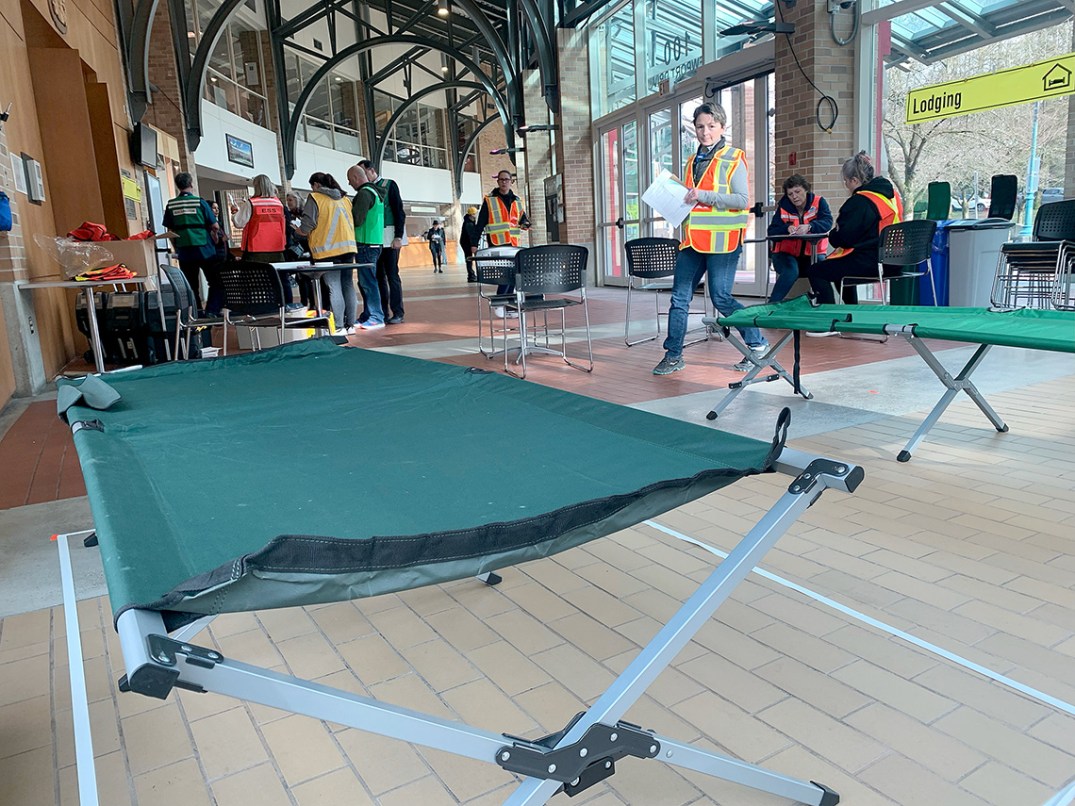
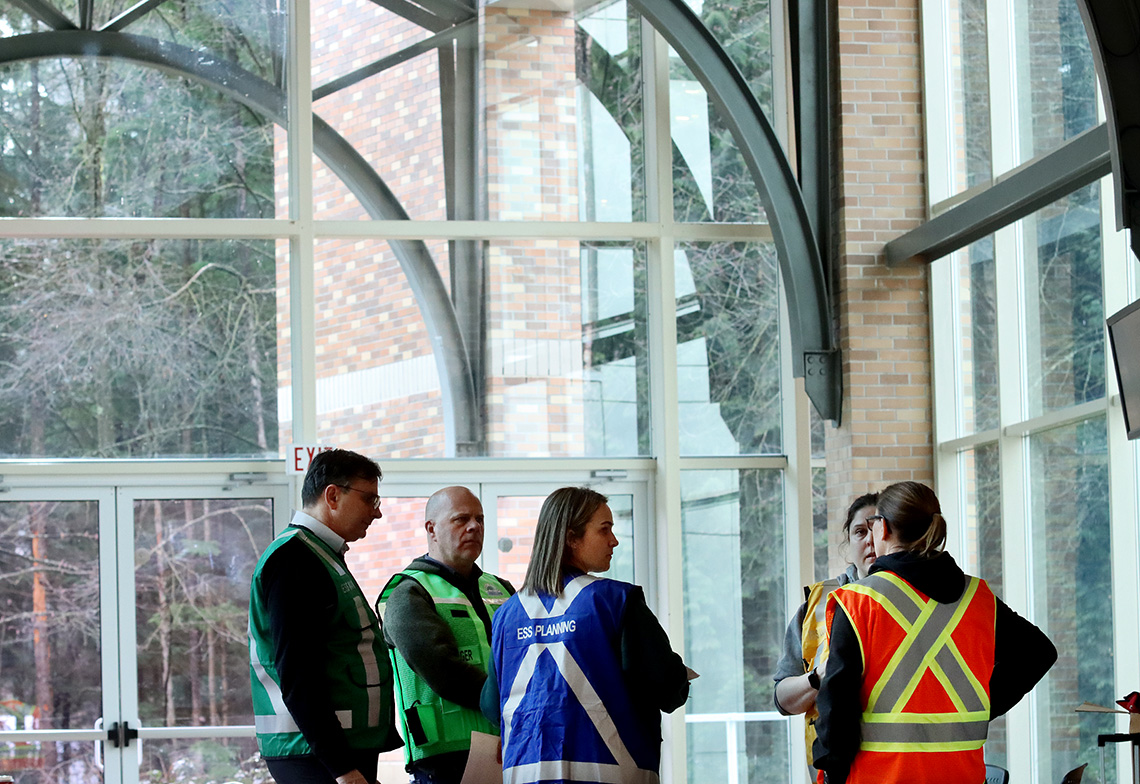
On Wednesday (Feb. 8), more than 50 staff, representing a range of city departments from fire and police to finance and human resources, participated in a province-wide exercise to test its response capabilities to a simulated catastrophe five days earlier.

Port Moody was the largest municipality in the scenario, which also involved agencies from the federal and provincial governments as well as Metro Vancouver.

Kirk Heaven, deputy chief at Port Moody Fire Rescue, said the earthquake Monday (Feb. 6) that devastated parts of Turkey and Syria brought home the reality of a disaster that could strike B.C.’s South Coast at any time.

“It adds impetus,” Heaven said, adding live news coverage from Turkey playing on monitors in the city’s emergency response centre set up in a boardroom on the fourth floor of the Inlet Fire Hall provided a reminder that Wednesday’s simulation was “about learning.”

Heaven said planning for the exercise started last September with the goal of furthering knowledge city staff have gained from previous simulations as well as recent real-world scenarios like the heat dome and atmospheric rivers of 2021 and the annual threat of wildfires.

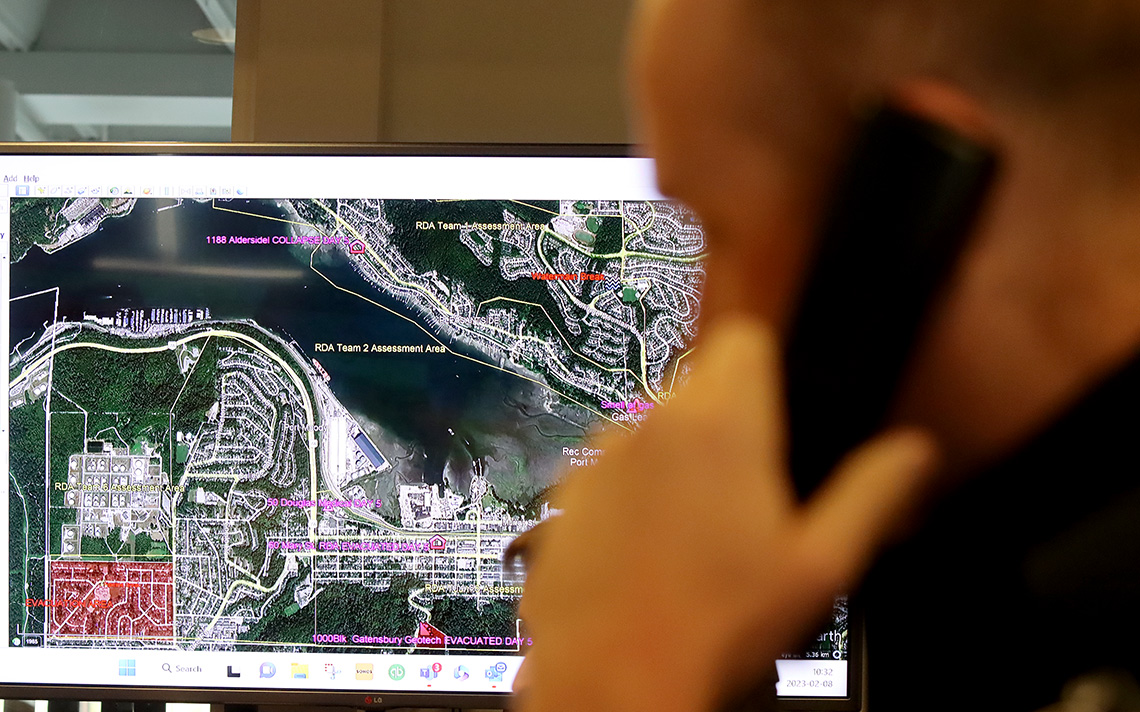
Wednesday, Port Moody was already in recovery mode five days after a 6.8 magnitude earthquake in the Juan de Fuca Strait. That meant rescue efforts were now shifting to support, making sure displaced residents and their pets have someplace safe to stay, as well as access to food and water, and getting critical infrastructure like water, sewage and electricity, along with transportation, back up and running.

Getting back to normal

“It’s about trying to get back to normal and getting people back to their homes,” Heaven said.

Such an effort presents huge logistical challenges, from just getting around to ensuring there’s enough staff available to cover shifts at facilities like emergency shelters to making sure everyone gets paid.

Coordinating all those myriad details and the communication efforts required to run a recovery effort smoothly takes lots of practice, so when a real disaster hits, wheels are set in motion quickly and automatically.

“It’s imperative we keep it up,” Heaven said. “You have to know your strengths and identify your gaps.

Huge learning curve

Joji Kumagai, Port Moody’s manager of economic development, said the exercise forces him to look at the city “through a different lens.

“You have to understand who is responsible for what so you can act quickly.”
Kumagai said though Wednesday’s exercise was his fourth, the learning curve is huge.

“You really start to understand what a concerted effort it takes,” he said.

In addition to the emergency operations centre packed with people coordinating Port Moody’s recovery effort, a smaller group of about 12 was in another office in the fire hall planning for the next steps of getting the city back on its feet, like bringing in equipment to clear rubble and where to put it.

Over at the Inlet Theatre and galleria, another team was responsible for registering displaced residents and getting them into temporary shelter at the Recreation Complex next door.

Caring for animals and emotions

Even representatives and volunteers from Canadian Animal Disaster Response Team were available to care for pets, although they did forget to pack a bowl for the stuffed Nemo awaiting refuge on a window ledge.

In an alcove, comfortable chairs were set up where traumatized victims could get emotional support.

Heaven said the exercise is funded by a grant from the Union of BC Municipalities (UBCM). But bringing together all the disparate players in Port Moody’s disaster response effort is invaluable.

“We don’t want to meet people at the party, we want to see them before the party.”

Flow device will make beavers feel at home

This story first appeared in the Tri-City News on Nov. 28, 2018

As the city of Port Moody works to create a strategy to manage beavers that take up residence in its waterways, a group of advocates for the industrious rodents is helping make one furry family feel right at home.

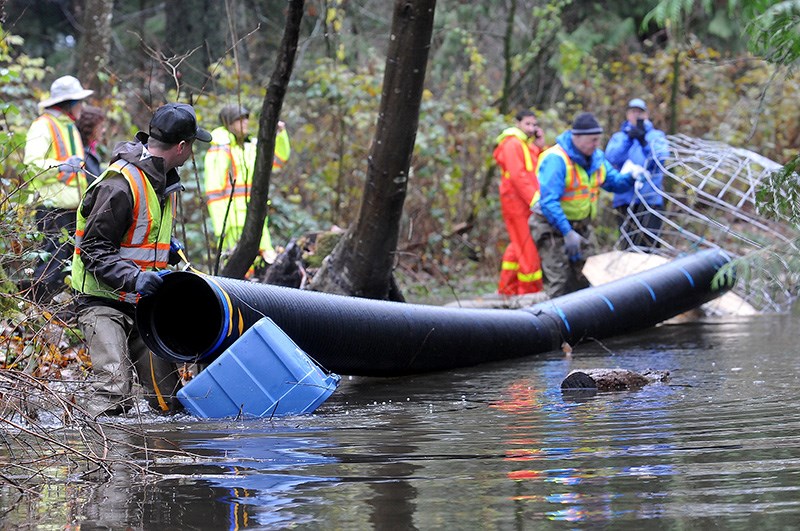
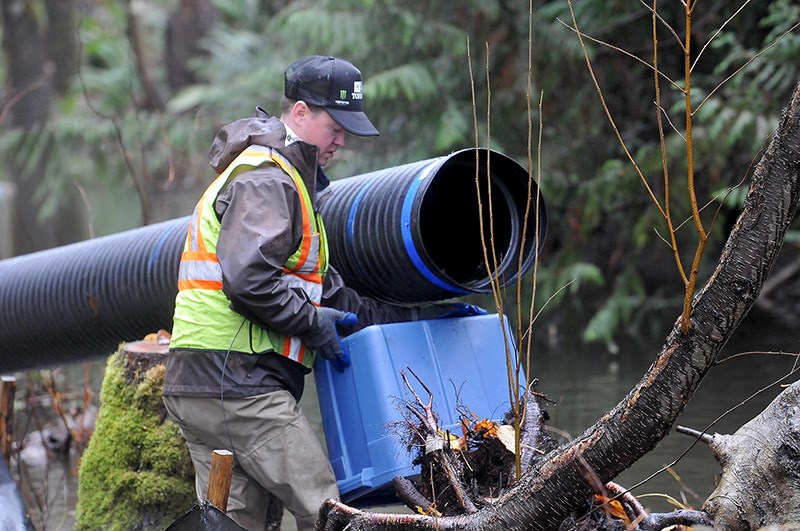
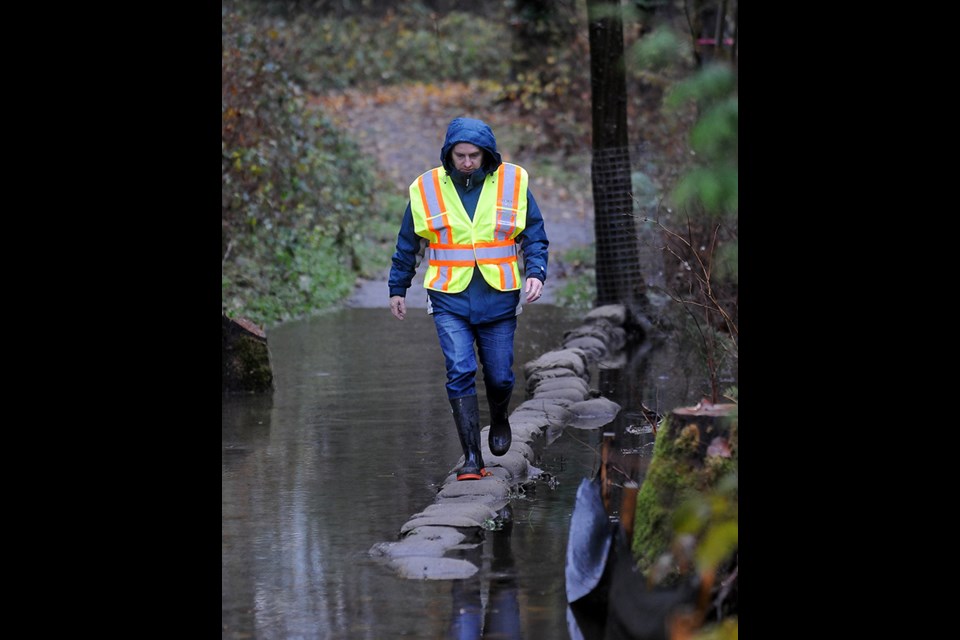
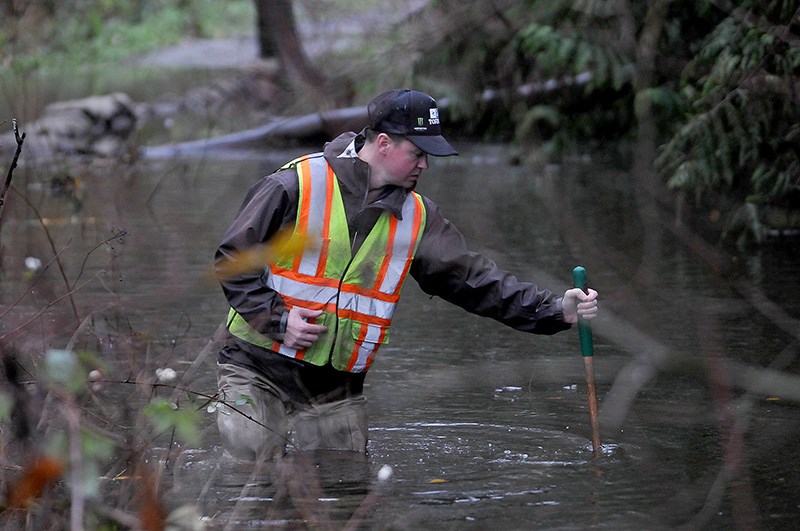
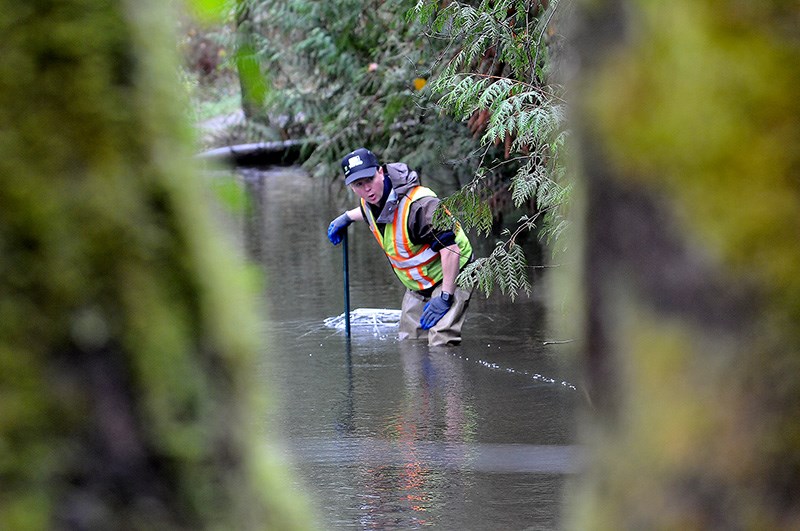
Volunteers from The Fur-Bearers along with local supporters like Jim Atkinson and his partner, Judy Taylor-Atkinson, were immersed in Suter Brook Creek last Friday, installing a device that regulates the level of water in the pond that has been created by a family of beavers between city hall and the public works yard.

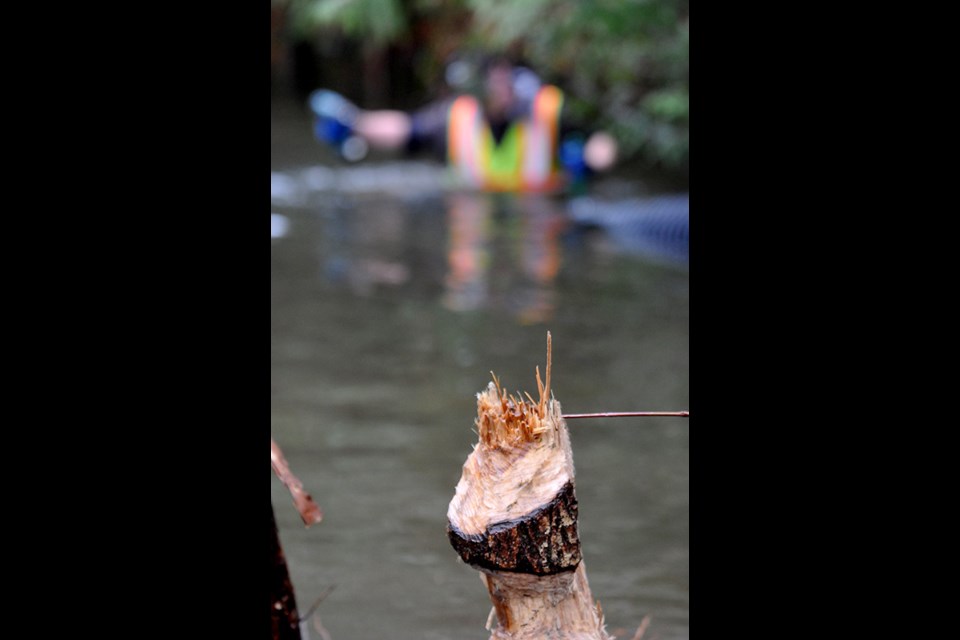
The beavers moved there after they were displaced from their previous home in nearby Pigeon Creek when an attempt by the city to evict them from a drainage pipe went awry and a young kit was drowned.

Taylor-Atkinson said the flow device will drain water from the pond — formed when the beavers built a dam — to ease flooding while still maintaining a level high enough for the animals to feel safe.

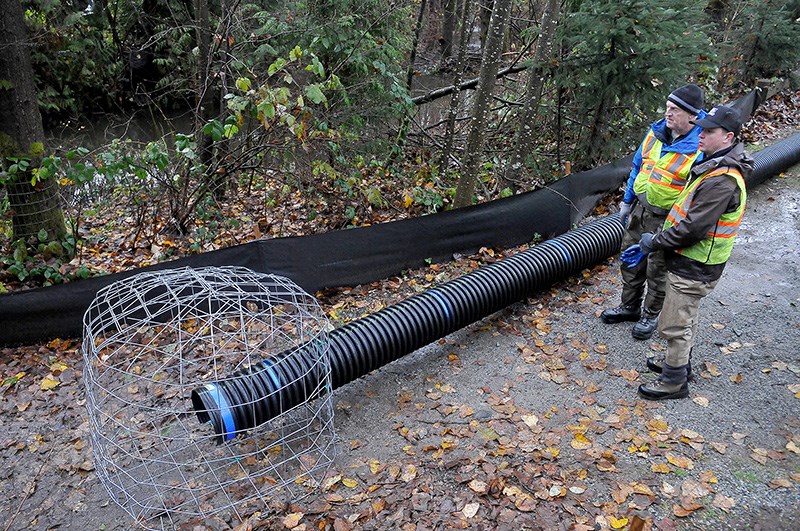
The device consists of a 40-foot length of double-wall, 12-inch culvert pipe with holes drilled into it so it can be sunk to the bottom of the pond. One end of the pipe is protected by a galvanized steel cage so the beavers can’t get in while the other end is inserted through the dam.

Taylor-Atkinson explained the effect is like punching a hole through the dam but the beavers can’t rebuild the structure or plug the pipe. She said after some initial curiosity, they will get used to the pipe and carry on with their lives.

“They need to have the water at a certain level to protect their home and family,” she said. “They’ll do whatever they have to do.”

The device was installed with the city’s blessing and several employees, including city manager Tim Savoie, stopped by to observe the work.

“This is a big step in the city’s beaver management plan,” Taylor-Atkinson said, adding she hopes interpretive signage can be installed to explain to visitors walking along the path that runs along the creek about what is happening. “I think the beavers will be fine.”