Port Moody’s land use committee will recommend whether a proposal to add a fast food fried chicken restaurant to a gas station is a finger-lickin’ good idea.
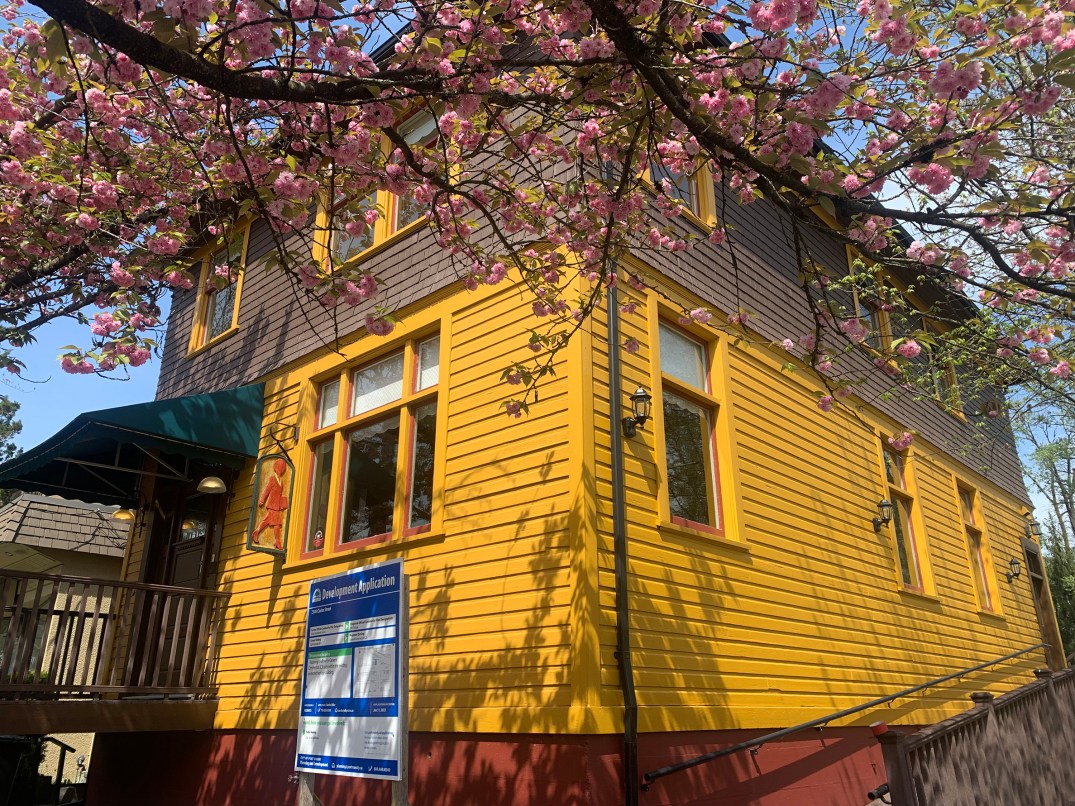
The owner of the Petro-Canada station at 3102 St. Johns Street wants to add a KFC restaurant on the 32,098 sq. ft. lot between Buller Street and Electronic Avenue.
The application requires the property be rezoned for comprehensive development because its current C4 designation prohibits retail food services.
In a report, development planner Sarah Bercu said the proponent also wants to expand the gas station’s existing convenience store by about 300 sq. ft. and relocate it to the southeast corner of the lot, as well as increase the number of parking spots from 18 to 23 — eight of those are at the gas pumps.
The changes would require the removal of eight trees and two hedges and the existing westbound bus stop in front of the station would have to be relocated slightly east.
Bercu said while the property is within the Moody Centre transit-oriented-development area that recommends greater height and density for residential development, “the proposal to renew the commercial building is seen as an interim development until the property owner is prepared to fully develop the site to the highest and best use.”
Bercu said the proposal will also require a review by Port Moody’s architect and landscape architect consultants. She added modernizing the gas station and expanding its commercial component “is a positive advancement for the site.”
The land use committee next meets on Sept. 8. It is comprised of representatives from Port Moody’s various neighbourhoods who are able to review development applications to comment and offer advice on whether they’re an appropriate use of land prior to council’s consideration.
A version of this story was first published in the Tri-City News on April 8, 2024
An Anmore wrestler is a step closer to realizing his Olympic dream.
On Sept. 3, Peiman Biabani was named to Canada’s national wrestling team that will compete at the senior world championships in Zagred, Croatia, Sept. 13-21.
Biabani will wrestle in the 65 kg weight class. He’d previously won silver and bronze medals for Canada at the Pan-American championships and in 2016 he was the junior world champion in the 60 kg weight class when he was still living and training in Tehran, Iran.
There, Biabani was a superstar in that country’s national sport.
Prior to becoming world junior champion, Bianbani won the junior Asian championships in 2015, just three years after taking up wrestling.
SUBMITTED PHOTO Anmore wrestler Pieman Biabani was a champion in Iran before coming to Canada to pursue better opportunties to realize his Olympic dream.
To continue his development, Biabani attended a special sports academy that allowed him to train full-time 15 days out of 20 while also getting an education. All his expenses were paid for, as was his travel to competitions in countries like Bulgaria, Ukraine, Russia and Georgia.
But when decisions within Iran’s wrestling federation got in the way of Biabani’s further advancement, he knew it was time to forge another path to glory.
A chance discussion at a meet in Siberia with Dave McKay, of the Burnaby Mountain Wrestling Club, pointed Biabani to Canada. He talked to his family, who gave their blessing. Wrestling’s governing body in Iran also agreed to the move.
Then the COVID pandemic hit.
Biabani was forced to stay put for another year, training, staying optimistic but rarely competing at important meets like the 2021 world championships.
“It was real hard for me,” Biabani said of his delayed dream.
Meanwhile, in Canada, McKay worked diligently to secure the paperwork that would allow the young Iranian to live, train and compete in his chosen destination. He reached out to the close-knit community of wrestlers across the country to help fund Biabani’s move, find him a place to live and get him settled when he arrived.
“There was a lot of things to set up,” McKay said, including the hiring of lawyers to help Biabani navigate the tricky and lengthy process of attaining the proper visas as well as an international transfer from Iran to Canada in his sport.
When Biabani arrived in Canada on a visitor’s visa in late 2021, he didn’t know any English, and without status to compete for his new country, he had no funding to support himself.
But, said McKay, he knew the common language of the wrestling community.
An old contact of the coach found Biabani a family in Anmore where he could live. He volunteered to help out with coaching between his training sessions at Burnaby Mountain, as well as at other wrestling clubs at Coquitlam’s Pinetree Community Centre and in the Fraser Valley. To support himself and pay his expenses to get to competitions he took on labour jobs like flooring and construction.
“I don’t have any choice but to push myself,” said Biabani of the juggling required to stay on course with his training while managing the day-to-day challenges of life in a new country.
Results started to happen, at meets like the SFU Open.
In October 2023, Biabani achieved permanent residency and in January, 2024, he finally secured the international transfer that allows him to compete for Canada.
Biabani promptly won a silver medal at the 2024 Pan Am championships but he was injured just prior to the final so couldn’t compete for gold.
But Biabani was denied his dream of competing at the 2024 Summer Olympics in Paris because he hadn’t yet attained Canadian citizenship.
Biabani said it was a tough pill to swallow, but it’s only reinforced his resolve to keep working hard so he can represent his new country at the 2028 Games in Los Angeles.
“Four more years is nothing,” Biabani said, adding the challenges of the past few years have given him the mental fortitude and patience to stick with his program.
“I moved here for my dream.”
McKay has every confidence his protégé will be successful.
“He didn’t have the chance, but now he has the chance,” he said, adding wrestlers usually reach the peak of their form when they’re in their early 30s; Biabani will be 31 in 2028.
“His time is now,” McKay said. “Every day counts to make it better for his wrestling.”
• Biabani is one of five athletes from the Burnaby Mountain Wrestling Club who will be competing for Canada in Zagreb. The other four are:
This story first appeared in the Tri-City News on June 3, 2023
Denis Wood remembers the time he was startled awake by a loud thunk on the wall of his second-floor bedroom.
He became even more alarmed when he heard voices outside, so he ran to roust his dad, Robert, who immediately tried to reach Port Moody’s police chief.
The Wood family, you see, lived above the city’s first Royal Bank branch on Clarke Street, and n’er-do-wells skulking around with a ladder in the pre-dawn hours of a warm spring morning in 1953 might have had more nefarious plans than a simple cat burglary.
PHOTO COURTESY DENIS WOOD A young Denis Wood outside the Royal Bank branch in Port Moody that was also his family’s home.
While the bank branch moved elsewhere long ago, and the building is on Port Moody’s heritage registry, its current owners are hoping to ensure its character inside and out lives on — by applying for rezoning from light industrial use, so the interior can’t be gutted by any future owners.
For Denis, the building was home.
He was seven years old when his dad became the bank’s manager in 1948 and moved the family into the living quarters on the second floor.
Now living on an acreage south of Vanderhoof after retiring from a career that included several years in the banking industry himself, Wood said growing up above a bank felt important.
But it also came with a weight of responsibility as he and his siblings — brothers Ken and John along with their sister, Roberta — had to be constantly reminded by their mom, Kathleen, not to make too much noise to disturb the business going on a floor below.
PHOTO COURTESY DENIS WOOD Kathleen Wood relaxes in the living room of her family’s home above the Royal Bank branch in Port Moody in 1953.
Wood said the short commute down a set of stairs on the eastern side of the building meant the family could enjoy breakfast together before Robert Wood pulled on his suit jacket and tightened his necktie to head down to open the bank at 8:30 a.m., the kids headed off to school or play and Kathleen Wood tended to the home or volunteered at the United Church on St. Johns Street.
As a banker, Robert Wood was a pillar of the community: A former flight control officer in England when he served in the Air Force prior to joining Royal Bank, he managed a staff of eight to 10, including a stenographer who wrote his letters to customers by hand.
“She had beautiful handwriting,” recalled Denis.
PHOTO COURTESY DENIS WOOD Staff at the Port Moody branch of the Royal Bank celebrate Christmas in 1953.
Among Robert Wood’s duties was ensuring the security of the bank’s two vaults: A big time-locked unit on the main floor and a smaller one in the basement, where he once offered to store a customer’s winning ticket in the old — and then illegal — Irish Sweepstakes, until he could file for his prize.
Also in the basement was the coal furnace that Robert Wood had to stoke himself to keep the building warm.
“I was often amazed the place never burned down,” Denis said, as the tall chimney could easily become choked with soot.
In the mid-20th century, Clarke Street was Port Moody’s thriving commercial core. There was a hotel kitty-corner from the bank, a dry goods store next door, a liquor store nearby and the railway tracks were busy with freight trains pulled by hulking steam engines.
“It was a good town to grow up in,” Denis said.
And while the family moved up to a new home on Gatensbury Avenue in 1956 when the Royal Bank opened a new branch on St. Johns Street, Robert Wood continued to serve as its manager until he retired.
Since then, the building has had various commercial tenants, including a Sears outlet shop for a stretch.
Denis said he still occasionally drives by when he’s in the Lower Mainland to visit his son, who lives in Coquitlam.
As for the possible heist that was foiled by his light sleep, Denis said the men down below were so shocked when his dad leaned his head out the window to yell at them, they scrambled into the bushes along the railway tracks, leaving their ladder behind.
This story first appeared in the Tri-City News on Nov 5, 2024
Lisa Beecroft was so sad and mad with the way some of the staff at her Port Moody bakery have been treated by customers, she took to Facebook to express her frustration.
The response, however, has reaffirmed Beecroft’s belief in the kindness and decency of most people and bolstered her commitment to creating employment opportunities for all.
More than a third of the workers at Beecroft’s Gabi & Jules bakery on Clarke Street, and a second location in North Burnaby, self-identify as having a disability.
Most are on the autism spectrum, but, Beecroft said, some don’t disclose their disability at all; they just know they’ve found an inclusive place to work that makes them feel safe and valued.
Since the COVID-19 pandemic, though, Beecroft said some of that sense of safety has been eroded by the rudeness and impatience of some of the shops’ customers.
“It’s a range of things, the tone and the aggression that’s coming across,” Beecroft said. “People are not saying ‘hello,’ they’re not looking people in the eye.”
When a manager recently brought the demoralizing nature of such customer interactions to Beecroft’s attention, she said she was crestfallen and frustrated.
“It’s just not OK,” Beecroft said. “We can’t normalize this is the way it’s going to be.”
Beecroft decided to share her thoughts on the bakery’s Facebook page.
“It honestly breaks my heart to have to post this (long) message,” she wrote. “In recent months, we have seen an increase in the mistreatment of some of our team members by some of our customers. There’s become frequent occurrences of rudeness, impatience and, in some cases, just blatant hostility towards our team.”
Beecroft said while some may dismiss such interactions as just a part of being in the customer service business, “it absolutely should not be.”
“Everyone deserves to come to work and feel safe, included and valued.”
She added, “We do our utmost to create that environment for our team members and we expect our customers to do the same.”
The response, Beecroft said, has been immediate, overwhelming and “really emotional.”
Words of support and encouragement poured into the post’s replies, many from customers, some from people who work with the neuro-diverse community, others from like-minded employers who are also making the effort to be inclusive.
“What you are doing there is inspiring and should be held up as the example of what good leadership and good businesses do,” said one.
“Thank you for standing up for your staff,” said another. “We should all remember to treat others as we would have them treat us, with kindness.”
For Beecroft, who printed out copies of her post and affixed them to the walls of her bakery’s Port Moody and Burnaby locations as a reminder to customers to check their hostility at the door, the responses from the community also hit close to home.
She and her husband, Patrick, set out on their journey to make Gabi & Jules an inclusive workplace because their eldest daughter, Juliana, has autism. They had to deconstruct every task in the bakery and front shop to determine how someone with unique qualifications might fit into the daily workflow while still making sense for the business’ bottom line.
The effort has paid off, though.
Employees with even the most repetitive tasks, like washing dishes or folding boxes, tend to stick around longer — some have been at the bakery for six or seven years already.
“We’ve attracted people to the business because they want to work here,” Beecroft said. “They feel safe in the space.”
Maintaining that safe feeling is paramount as their employer, she added.
“I feel an obligation because I’m putting them in this situation,” Beecroft said, “The staff just wants to make sure they’re doing a good job.”
In the midst of a late-summer heat wave, it’s time for some cooling images.
I shot these photos in January, 2024. We’d had several days of very cold days and nights, and I’d been monitoring the ice forming on a local lake in anticipation someone would eventually skate on it.
On a clear, crisp Sunday afternoon, my patience was rewarded.
We don’t get the opportunity to skate on frozen lakes and ponds very often in this part of the world, so it’s very special when it does happen.
This story first appeared in the Tri-City News on Feb. 10, 2020
A small piece of the four Oscars won Sunday night by the Korean film Parasite was forged in the Tri-Cities.
Choi Woo-shik, the 29-year-old actor who plays the grifting son of a struggling Korean family that uses his avocation as an English tutor to infiltrate a wealthy household with bizarrely tragic consequences, grew up in Coquitlam. His family immigrated to the Tri-Cities from Korea when he was 10 years old and he graduated from Pinetree secondary school in 2008.
Colleen Lee, who teaches Japanese at Pinetree, said she remembers Choi — called Eddy by classmates — when he took her classes in Grades 10 and 11.
Lee said Choi was a “pretty good student” who was “a pleasure to work with in class,” although she had no idea of his acting aspirations at the time.
Lee said she was watching the Oscar telecast Sunday because she’s a fan of Parasite and the film’s director, Bong Joon-ho, so she was thrilled when she saw a familiar face on stage at the Dolby theatre in Los Angeles.
“It’s a bit surreal to see someone you actually know on screen — and it was a great movie,” Lee said, adding her current students are “incredibly impressed they are studying Japanese in the same room that [Choi] did.”
In an interview Choi did on Korean television in 2012, he said he had some challenges getting used to a new culture and school system in Canada, not the least of which was his mom’s inclination to pack him kimchi, a pungent Korean staple of fermented vegetables, for lunch.
He said when he opened the lid of his lunch container, “it was like a bomb” in the lunchroom and he told his mom to never send him to school with kimchi again.
Choi said he found comfort and camaraderie in a tight-knit group of fellow Korean students. The 14-strong contingent called themselves FF14 (Friends Forever 14).
But, Choi added, his struggles to fit into Canadian culture also made him more adaptable to be able to pursue his childhood dream of becoming an actor, even if he had no idea how he could make that happen.
It was during Choi’s first year as an arts student at Simon Fraser University in Burnaby that an acting opportunity presented itself. He signed up online to audition for a role in Korea, then dropped all his classes. He said his parents weren’t thrilled at his sudden change in career path but eventually loaned him the money to fly to Korea.
The audition didn’t go well.
“I wasn’t prepared,” Choi said. “I had really poor clothing and I had no idea how to speak in front of the camera.”
Still, he showed well enough to get some encouraging words that fuelled his determination to endure more auditions as he studied Asian culture at Chung-Ang University in South Korea, because, he said, his parents wouldn’t let him take drama courses. Some of those auditions paid off in roles in Korean TV series like Living in Style and The Duo.
Choi started acting full-time in 2012, mostly in support roles, but in 2014, he started getting noticed for some of his work on the big screen, including an award for actor of the year at the 19th Busan International Film Festival for his role in the coming-of-age film Set Me Free. The same role earned him nominations and wins from several other critics and film awards the following year, as well as the popular actor award at the 2015 Korea Film Actors’ Association Awards.
Choi’s role in Parasite was also recognized with nominations as best actor at the 24th Chunsa Film Art awards and 28th Buil Film Awards. Earlier this year, the entire cast of Parasite won a Screen Actors Guild award for outstanding performance.
Sunday, Parasite won the biggest prize at the 92nd Academy Awards as best picture. It also won best international film as well as Oscars for best director and best original screenplay.
This story first appeared in the Tri-City News on March 16, 2023
If you happen to spy Coquitlam Express forward Mateo Dixon checking his phone on the players bench during a game, he’s not calling his family back in Toronto about his latest goal, or texting his buddies.
He’s checking the level of his blood sugars.
Dixon has Type 1 diabetes.
Diagnosed when he was 13 years old, Dixon says he hasn’t let the autoimmune disease hold him back from attaining his athletic goals.
In fact, having Type 1 may have even accelerated his development as a hockey player.
Now 20 and in his final season of junior hockey, Dixon is having a career year, scoring 45 points in 49 games.
Not that his journey through the sport has been easy.
When your pancreas is working as it should, you don’t think about it.
Constant calculations
The elongated gland that sits in your upper abdomen tucked behind your stomach magically produces the enzymes that help you digest food and the hormones that keep the amount of sugars in your blood on an even keel.
But when your pancreas suddenly stops functioning, you can’t not think about it.
While the days of restrictive diets for people living with diabetes are long gone, every time Dixon eats or reaches for a bottle of energy drink after a shift on the ice, he has to make a mental calculation about the amount of carbohydrates he’s ingesting.
He also has to check his blood sugar levels with an app on his phone that’s connected to a sensor plugged into his body, then determine the dose of insulin a small pump he wears 24/7 injects into his body to offset that sugar boost.
It’s not always an exact science.
Exercise, stress, anxiety and excitement can throw even the most precise calculation out of whack.
Overshoot your insulin dose and your blood sugars can drop, sapping you of energy, depleting your ability to focus or make quick decisions.
Underestimate, and your soaring blood sugars can make you nauseous and tired, and bring on a pounding headache.
Neither outcome is ideal for a high-performance athlete who has to be at the top of their game and ready at any moment to jump on the ice.
Dixon said his disease has brought on no shortage of aggravations.
“It can be so random” he said. “So many micro things can affect it.”
‘A sense of responsibility’
But, Dixon added, living with Type 1 has also put him more in tune with his body.
He said he’s hyper-aware of everything he eats and drinks and the importance of maintaining a healthy lifestyle to better manage his blood sugars.
Dixon’s off-ice training regimen doesn’t just get him ready for the rigours of the hockey season, it also helps smooth out the effects of the highs and lows he’ll inevitably endure.
Express coach Patrick Sexton said Dixon’s maturity is beyond his years.
“He has a sense of responsibility,” he said. “He knows exactly how he’s feeling and how to address the situation.”
Sexton said he’d played with teammates who have Type 1, like Luke Kunin, now a defenceman for the NHL’s San Jose Sharks.
But this is his first experience coaching a young athlete with the disease.
He said it’s important to maintain open lines of communication so he can understand why Dixon might not be able to immediately take a shift because he’s dealing with a low, or why he’s looking at his phone and wolfing down a candy bar on the bench instead of manning the power play on the ice.
“My job is to support him,” Sexton said.
Invisible disease
Dixon said one of biggest challenges of diabetes is its invisibility.
The advent of technology, like the small insulin pump that plugs directly into his abdomen or thigh and the digital glucose monitor that connects by Bluetooth to his smartphone, has eliminated the very public displays of pricking his finger to draw a drop of blood to dab on a test strip plugged into a handheld meter or injecting a dose of insulin with a hypodermic needle.
That can make it hard for his teammates and coaches to immediately recognize why he might be a little off his game, or why he has to cut short a workout.
So, he takes care to bring them into his world as best he can to build an understanding of his disease and the challenges it can present.
“I look at it as a growth opportunity,” Dixon said of living and competing with Type 1. “It’s not limiting at all. It can literally be the opposite.”
This story first appeared in the Tri-City News on Sept. 21, 2021
Port Moody has plenty of housing getting built or in the process of being approved to meet projected regional growth targets.
But the city needs more diversity of housing options to keep it affordable for families, single people, low income earners, immigrants and people with disabilities, says a study by community planning and development consultant, CitySpaces Consulting.
According to the study, which is to be presented to council Sept. 21, the gap between what households can afford to pay for housing in Port Moody and the housing that is available is growing.
Since 2013, the median sales prices of single-detached homes and townhouses have nearly doubled. Rents have also skyrocketed at a similar pace, and the vacancy rate for units with three or more bedrooms is currently 0 per cent. As a result, one in five residents are spending more than 30 per cent of their income on housing costs, a level that is considered a standard measure of affordability.
“Housing is becoming more expensive and fewer residents are able to enter the home ownership market,” said the report, adding Port Moody’s housing situation isn’t about a lack of dwellings to be built, or land where they can be located. Rather, there isn’t enough diversity of housing, including more affordable housing options, as well as accessible and family-friendly units.
Renters, who comprise one-quarter of city residents, are also struggling with higher costs and less availability, said the report. The median rent in Port Moody is now more than $1,000 per month while the vacancy rate for all units is between 0.5 per cent and 1.9 per cent — a healthy vacancy rate is between one and three per cent.
“Some households may be able to find a rental unit for less than $1,000 a month, but this typically comes with trade-offs such as being in poorer quality condition, further away from public transit and amenities and may not be suitable to meet their needs,” said the report.
But as Port Moody strains under the same market forces that afflict the entire Tri-Cities area, there are still ways to turn the tide.
“For Port Moody, the number of units being developed is keeping pace with demand,” said the report. “However, consideration to adjust the mix and secure rental housing and affordable units is a key area of opportunity.”
According to CitySpaces, zoning bylaws in Port Moody often don’t mesh with land designations, creating challenges to build viable developments without expensive lot consolidations, and some areas of the city are falling short of their potential to accommodate new, more diverse housing. Developers, the consultant said, require certainty and standardized policy in development expectations and incentives, as well as expedited processes to move approvals along.
And that could require more staff, said the report.
“It appears that the local government may need to scale-up staffing levels to match the scale of development to not only move projects through the process in a timely manner, but to also ensure that opportunities to capture units for affordability is not missed.”
The study was commissioned by Port Moody in 2020 to fulfill new regulations under the provincial Local Government Act for municipalities to complete housing needs reports by 2022, and then subsequent reports every five years after that. The consulting company used data from various sources including Statistics Canada, BC Assessment and BC Housing, as well as an online survey, virtual workshops, interviews and a workshop with city staff.
This story first appeared in the Tri-City News on Feb. 13 2025
A rent-to-own program meant to help first-time buyers afford a home in a new Port Moody condo project proved to do just the opposite.
But the developer is hoping it can revive the plan with new parameters.
Tim Schmitt, the director of development for Langley-based Marcon Development, said only one possible purchaser of 190 applicants was able to take advantage of the company’s program, that allows eligible purchasers to rent their unit for a period of time with the money going towards their down payment. Purchasers must also agree to occupy their new home as their primary residence.
In a letter to Port Moody council, Schmitt said the maximum household income threshold of $150,000 as set by the Canada Mortgage and Housing Corporation’s First Time Home Buyer Incentive (FTHBI) program that the company was using to qualify potential purchasers proved too low to allow them to get a mortgage for even the most affordable one-bedroom apartment in the Hue, a 222-unit condo building nearing completion on the site of the old Barnet Hotel.
Further, CMHC’s incentive program that provided first-time home buyers with a loan of five or 10 per cent of a home’s purchase price to help increase the size of a down payment was discontinued in 2024.
Schmitt said that means the threshold is no longer being updated to account for higher housing prices.
Schmitt said it’s created a kind of Catch-22 situation; buyers who could qualify for a mortgage under rules that set a maximum loan-to-income ratio of 4.5 times have to earn at least $160,000 to afford a $630,000 one-bedroom apartment at Hue, beyond the threshold to be able to participate in the rent-to-own program.
“The purchase price of homes in the current market is out of sync with the FTHBI program that was created over five years ago,” Schmitt said, adding the company still wants to proceed with some sort of rent-to-own program for the remaining nine homes it had originally set aside.
Tuesday, Port Moody councillors agreed to amend the city’s housing agreement with the developer to allow that to happen.
The developer will convene a second round of applicants for the program but their maximum household income cannot exceed $190,000 if they’re purchasing a one-bedroom apartment or $270,000 for a two-bedroom unit. As well, they’ll be tiered, with first consideration going to first-time homebuyers who are either Port Moody residents who have lived in city for at least a year or they’re front line workers like firefighters or police officers. The second tier will comprise all other first-time homebuyers followed by any other qualified applicants.
If any of the rent-to-own units remain unpurchased after going through all the qualified applicants, they’ll be released for general sale.
Port Moody Mayor Meghan Lahti said Marcon’s rent-to-own conundrum is “unfortunate,” as it was a major component of the company’s pitch to get the project approved.
“It was one of the most positive aspects of that application.”
Coun. Kyla Knowles said the dilemma is a symptom of communities’ ongoing struggle to secure affordable housing for their residents.
“We need senior levels of government to step up,” she said.
Port Moody senior planner Doug Allan said the new rules make the best of an unfortunate situation.
“They address Marcon’s challenges in selling the 10 RTO strata lots, reduce the barriers to program participation, and support moderate income households by updating income thresholds,” he said.
This story first appeared in the Tri-City News on March 8, 2024
Lelainia Lloyd says she finally feels a sense of belonging.
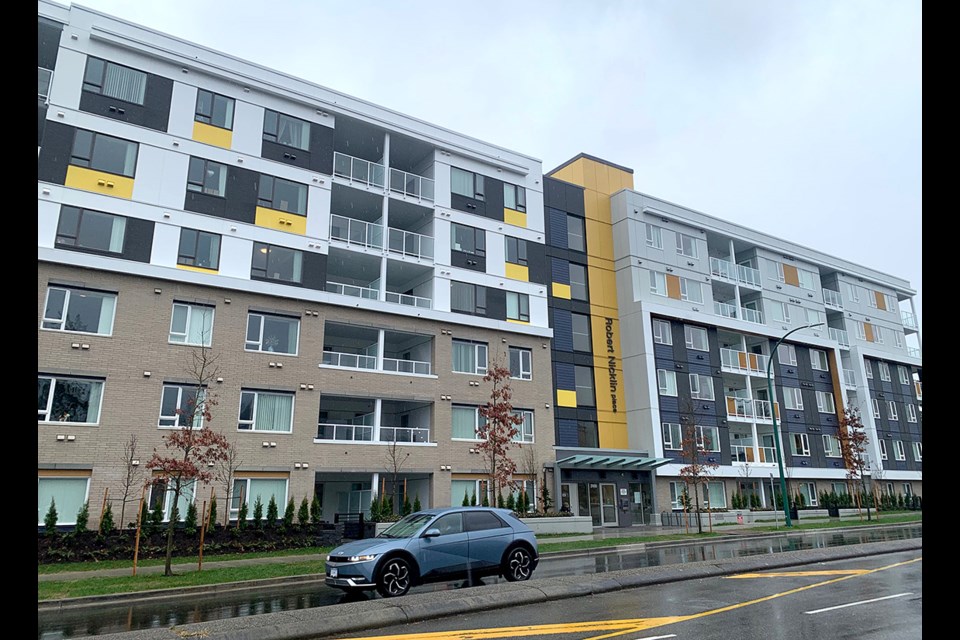
Scooting around the rain-drenched courtyard at Robert Nicklin Place in her motorized wheelchair, Lloyd said living in one of 35 fully-accessible apartments in a new 164-unit rental complex in Coquitlam has given her the time and energy to help build a community around her.
“You don’t realize the energy it takes to live in inaccessible buildings,” Lloyd said. “It’s a game-changer.”
The six-storey wood-frame building, located at 3100 Ozada Ave., was officially opened Friday, March 8. It’s named for the longtime CEO of the Affordable Housing Society (AHS) who died in 2016.
Fittingly then, 74 of the units are affordable, of which 16 are deeply subsidized for households with very low incomes, and 36 have their rent geared to income.
Kevin Nicklin officially opens a new 164-unit rental complex in Coquitlam that features 74 affordable apartments. The building is named for Kevin’s father, Robert Nicklin, who was CEO of the Affordable Housing Society for 27 years until he died in 2016. MARIO BARTEL/TRI-CITY NEWS
Nicklin’s oldest son, Kevin, said seeing his father’s name above the building’s entrance and on a special plaque in its lobby makes his family “extremely proud” of the 27 years he worked to help build and secure affordable housing throughout the Lower Mainland.
“This is an important step in the right direction,” he said of the complex that welcomed its first residents in January, adding his father’s effort to increase affordable housing options will be felt “for years to come.”
It’s also a testimony to what can be achieved when several levels of government work together, said Stephen Bennett, the current CEO of AHS.
Six years in the making, Robert Nicklin Place was built with an $8.1-million contribution from BC Housing’s Community Housing Fund which will also provide $110,000 in annual operation funds, as well as a forgivable loan of $1.9 million along with a $44.2-million low-interest, repayable loan, from the Canada Mortgage and Housing Corporation, $3.3 million from the City of Coquitlam and the waiver of $869,000 in development cost charges from Metro Vancouver, TransLink and School District 43.
Ravi Kahlon, B.C.’s Minister of Housing, said the new homes are “designed to be the kind of sustainable homes that give people stable, affordable housing in a housing crisis.”
The new Robert Nicklin Place apartment complex in Coquitlam is named after Robert Nicklin, who was the CEO of the Affordable Housing Society for 27 years until he died in 2016. MARIO BARTEL/TRI-CITY NEWS
Representing the federal government, Ken Hardie, the MP for Fleetwood–Port Kells, said the “new living environment will allow residents to remain in their community, close to their loved ones.”
Coquitlam Mayor Richard Stewart said one of Nicklin’s driving forces was his dedication and love for family and the importance stable, affordable housing can play in keeping families together.
“It’s vital to the success of communities and families,” he said.
And more affordable housing is in the pipeline.
On Feb. 9, Stewart announced $25 million from the federal government’s Housing Accelerator Fund will fast-track the construction of 650 new housing units over the next three years.


















 MARIO BARTEL