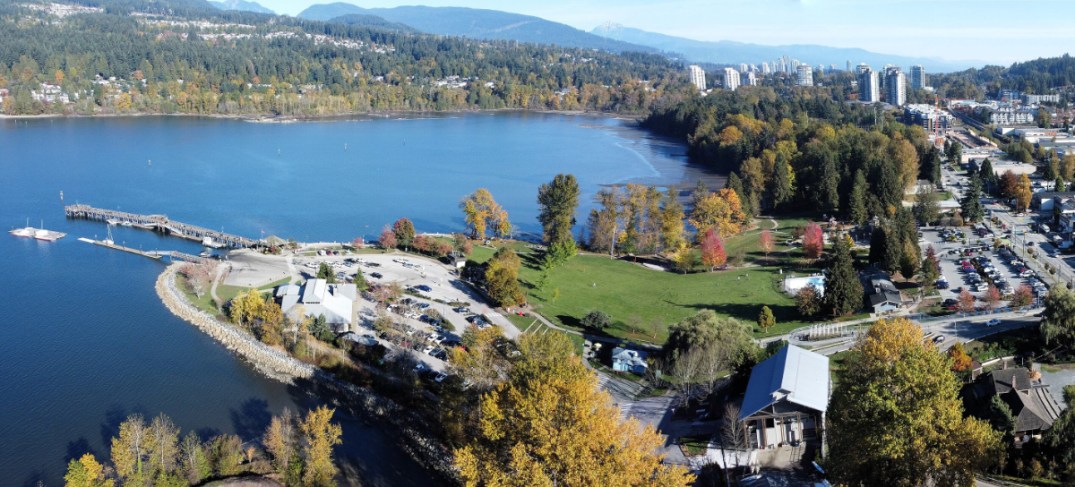
Port Moody councillors say they will continue to advocate for more support from senior levels of government to construct infrastructure like schools and recreation facilities as the city faces increasing pressure to meet housing targets imposed by the province.
But that did little to ease the concerns of residents speaking at a special town hall about Port Moody’s new draft official community plan (OCP) held at the Inlet Theatre on Monday, Sept. 15.
Several said they fear what Port Moody will look like as its population continues to swell to more than 74,000 by 2050.
“We might not have the infrastructure to accommodate that growth,” said one.
“Port Moody isn’t ready for this much density,” said another.
Some residents fretted about insufficient roads and parking spaces, while one offered even transit won’t be able to keep pace with demand.
‘Unrecognizable’
Former councillor Steve Milani said though the draft document falls short in addressing the city’s economic needs. He said the plan will “transform Port Moody into something unrecognizable.”
The draft OCP is a roadmap for the city’s growth and aspirations for the next 25 years. It guides planning and land use decisions and policies as well as the provision of services and infrastructure.
A community’s OCP must be updated every five years.
Port Moody initiated its current draft update in 2020 with a series of virtual visioning workshops followed by an initial community survey in January, 2021.
Since then, there has been three more surveys as well as several workshops and open houses. A previous town hall held in April attracted 50 attendees, prompting a call from Coun. Haven Lurbiecki for a subsequent gathering with councillors in attendance along with support from senior staff.
Not set in stone
Coun. Samantha Agtarap said none of the provisions in the OCP are set in stone.
“This is an idea of what the city might look like 20 years into the future,” she said. “It doesn’t mean it’s going to happen. Things can and do change.”
Coun. Diana Dilworth said it will be incumbent upon council to work with the provincial government to ensure amenities keep pace with population growth.
“We’ve heard a lot of concerns about infrastructure,” she said. “This gives 25 years for whoever sits at this council table to demand the provincial government provide those things if they want housing.”
Coun. Callan Morrison agreed.
“We continue to advocate to higher levels of government for the best interests of our residents,” he said.
OCP vision
Port Moody’s draft OCP update envisions a vibrant community that is safe, inclusive, resilient and carbon neutral. Its unique and complete neighbourhoods are connected by an active transportation network and the city’s residents value its natural environs, heritage character, arts and culture.
To achieve those goals, said the document, Port Moody must promote sustainable transportation, compact, energy-efficient development, protect and restore its urban forests and other environmentally sensitive areas. The city must also expand its parkland supply while providing residents a range of housing options, including rental stock, that is well-served by transit, cycling and pedestrian infrastructure, as well as amenities like schools, civic facilities, commercial spaces and employment opportunities.
Some of the draft OCP’s substantive updates include:
- building heights from 26 to 39 storeys in the neighbourhood immediately around the Moody Centre transit station
- expansion of the Inlet Center neighbourhood to Dewdney Trunk Road
- the establishment of three new special study areas to better identify the impacts and opportunities of their growth:
- south of St. Johns Street, from the Coquitlam border to Clarke Road
- the Suncor lands
- industrial properties along Murray Street
- increasing the city’s tree canopy coverage from 29 to 31 per cent
- collaboration with neighbouring communities to address wildlife conflict
- greater consideration for dog amenities to be a component of new development
Mayor Meghan Lahti said the document is “the culmination of several years of input” from the community.
Residents alienated
But Lurbiecki worried the relatively low turnout at the two town halls indicates residents are feeling alienated from the process.
“This plan doesn’t reflect their vision and they’re not engaged,” she said.
In a report, Port Moody’s manager of policy planning, Mary De Paoli, said the document will be considered by the city’s land use committee in early October before returning to council for first and second readings by the middle of that month.
It will then be referred to external agencies like Metro Vancouver for further comment before a public hearing in December.
De Paoli said if nothing distracts from that timeline, final adoption could occur by March, 2026.
 MARIO BARTEL