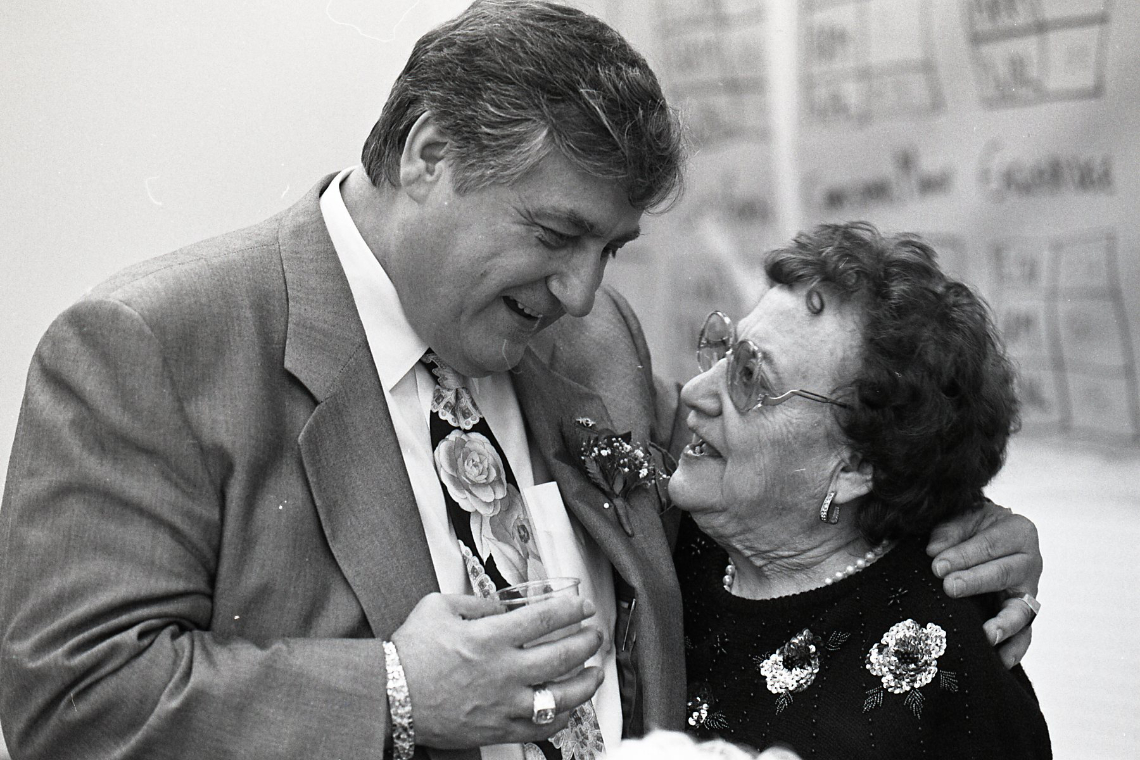
Cutting hair and cracking jokes for 50 years

This story first appeared in the Tri-City News on Aug. 2, 2018

Accounting’s loss has been Coquitlam’s gain.

For 50 years.

That’s how long Ted Bordeleau has been cutting hair at Plaza Hairstyling and Barbers in the old Burquitlam Plaza on Clarke Road, an occasion he marked Wednesday with snacks and refreshments for his customers and $2 haircuts — but only if they showed up with an actual $2 bill because that’s what he charged when he first started in the business Aug. 1, 1968.

And if a customer didn’t have a $2 bill, since it’s been out of circulation since 1996, Bordeleau said he’d be happy to sell them one of his — “for $25.”

In Ted’s venerable shop, every story has a punchline.

Even the one about the elderly customer who expired in his chair back when he was learning his trade at Moller’s Barber School on Hastings Street in Vancouver.

After perfecting his straight-edge shaving skills first on a bottle, then a balloon, then other trainee barbers, Ted had finally graduated to giving shaves to real, live customers, many of them elderly or impoverished who put their necks on the line for the young apprentices in exchange for cut-rate haircuts. When one of those customers failed to flinch after Ted nicked him, he called over his instructor, who checked if the client was breathing, then confirmed the worst.

“I cut him three times,” Ted recalled. “No wonder he didn’t bleed.”

Ted almost didn’t become a barber. He loved numbers and was studying accounting when his grandfather urged him to pick up clippers because, he told Ted, “We need barbers.”

Ted trained at Moller’s for six months, then embarked on a two-year apprenticeship, as per the requirements to obtain a provincial barbering license at the time. He said he would have stayed another six months at barber school but he couldn’t afford the bandages.

Again with the punchlines.

Over the years, Ted has cut hair for generations of families as customers whose locks he first tended when they were kids bring in their kids and, eventually, their grandkids. He has trimmed politicians’ pates, CEOs’ sideburns and manes of people who’ve walked out of his shop without paying.

Some of his longtime customers travel hours out of their way to keep getting their hair cut by Ted. And when they walk through his door, there’s no guarantee they’ll be served right away because Ted doesn’t take appointments.

Ted met his wife, Jean, in front of his barbershop. She drove by in a bright pink 1957 Buick with fins, and Ted loves cars, so he ran out the door to ask for the driver’s phone number.

“She wasn’t quick enough to give me the wrong number,” Ted said.

He’s also found love for some of his customers, matching them up with female friends, acquaintances or just regular visitors who passed by as they shopped at the once bustling plaza.

Oh yeah, there’s that.

As the big city caught up to the suburbs, Burquitlam Plaza lost much of its bustle. The butcher shop left, so did the video store. SkyTrain severed part of the sprawling parking lot and the Safeway grocery store moved into the first two stories of a gleaming new condo tower on the corner. Many of the storefronts between the Dollarama and Value Village are dark.

The neighbourhood has changed, too, Ted said. Fewer families can afford to live there as small apartment blocks and modest mid-century bungalows are gobbled up by new development, so he’s not giving as many first haircuts to tentative toddlers.

But Ted perseveres, propelled by stories exchanged, friendships made and the knowledge that, while everyone may not need the services of an accountant, everyone at some point needs their hair cut.

The best of times, the worst time: My journey with the Tri-City News

I first alighted at the Tri-City News 34 years ago almost to the day, a refugee from the 1990 Ontario recession that had cost my job of five years as a photojournalist at a paper in Oshawa.

An industry contact told me to talk to Craig Hodge and happenstance brought him to a conference in Toronto.

He told me if I came west, there would be work.

So I turned down an offer at a paper in Sydney, Nova Scotia, and pointed my red Toyota in the opposite direction.

The Tri-City News in 1991 was as close to a daily paper you could get without publishing six or seven days a week.

Under the guidance of Hodge, we were a department of six photographers, an office manager and assorted freelancers. The newsroom upstairs was similarly staffed.

We had a studio, full colour darkroom and we were all connected with pagers (!) and two-way radios. We covered stories seven days a week from 8 a.m. to 10 p.m., from Boundary Road to eastern Maple Ridge.

Travel budget

Occasionally, there was budget to go out of town, to the BC Winter and Summer Games, the Canada Summer Games in Kamloops, the Commonwealth Games in Victoria, to Miami to cover the IndyCar debut of local racer Greg Moore. During provincial elections, someone was sent into Vancouver to cover the big celebration for the winning party.

MARIO BARTEL/TRI-CITY NEWS
Greg Moore heads home from the track at Homestead, Florida, at the end of IndyCar spring training in 1996.

One year, the company chartered a plane to fly several of us to Spokane, Wash., for a photojournalism conference. We took great delight in telling others we had to cut out of Happy Hour because our plane was warming up its engines at the airport.

Around the light table where we gathered at the end of every shift to edit our negatives and debrief the day, we speculated it was only a matter of time we’d become a daily. The news was out there, the papers were robust, filled with ads and flyers.

On April 17, the Tri-City News went dark after more than 40 years, although it was already diminished from its former self in August, 2023, when the decision was made to end the actual print publication to exist solely online.

The plummet of local news has been precipitous and painful.

While organizational changes had sent me to the Burnaby and New Westminster NewsLeader for 15 years until they were closed in 2015, I remained connected to the Tri-City News, occasionally sending stories that might be of interest, often sharing photos when a team or athlete from Coquitlam, Port Coquitlam or Port Moody was playing in a tournament or provincial championship at the Burnaby Lake Sports Complex, Copeland or Queen’s Park arenas.

When former TCN editor Richard Dal Monte had an opening in 2017, I jumped at it after 18 months wandering the wilds of freelancing, riding my bike and producing digital content for a realtor. You can take the boy out of the News, but you’ll never take the News out of the boy.

I came back with eyes wide open; our industry has been precarious for years.

Stories to be told

But there were still so many stories to be told.

So we put our heads down and forged ahead, even as we went from publishing twice a week to just once. Even as newsroom vacancies started to go unfilled. Even as the COVID-19 pandemic scattered us to our homes, conducting interviews over the phone or making arrangements to meet in open spaces like parks, driving deserted streets looking for photos that captured the weird vibe of that extraordinary time.

Heading to an assignment with a few minutes to spare; I searched for a shot that would somehow capture the feelings of isolation many were enduring during the first weeks of the COVID-19 pandemic as businesses closed and people stayed apart.

Our coverage of those early months of fear and uncertainty was some of the best I’d ever been a part of. Along with keeping up with the frenetic pace of event cancellations and societal changes brought on by the public health crisis, we found unique features of people persevering: the Shriners band playing for isolated seniors; an Elvis impersonator giving drive-by concerts; businesses trying new ideas to keep money coming in when their customers were staying home; the challenges faced by young student athletes with no sports to play.

It took a pandemic to revive Elvis. Darren Lee reignited his career as an Elvis tribute performer by driving to various neighbourhoods to entertain people shut in by the COVID-19 pandemic.

But even as we put in long hours in trying conditions to keep readers informed of all that was changing during the pandemic, the die was being cast for our ultimate demise.

Businesses trying to hang onto every penny to stay afloat themselves stopped advertising; many never came back. Readers’ habits changed, perhaps conditioned by hours of doomscrolling on social media platforms to keep up with the moment-by-moment developments during the pandemic.

Even going online exclusively, sparing the expenses of newsprint, ink, distribution and, eventually, a physical office, couldn’t turn the tide.

Tough times

The months since that decision haven’t been easy. Spending hours covering a contentious council debate about a major development proposal that barely registers a couple of hundred page views while a five-minute effort to recast a press release about a new donut shop coming to town goes off the scale can be dispiriting.

So can watching editors churn and colleagues depart.

But through it all we’ve tried to keep our communities informed and connected by sharing their stories.

I guess the void ahead will be the true test of whether that even matters anymore in an age when the first thing people do in the morning is scroll their Facebook feed rather than open the local paper and algorithms direct people into a perpetual feedback loop affirming their darkest inclinations.

It’s truly has been the best of times. It is the worst of times.

A selection of photos I’d shot in my first couple of years working in the photo department at the Tri-City News. They, and many more, have been carefully preserved and digitized by the City of Coquitlam Archives.