
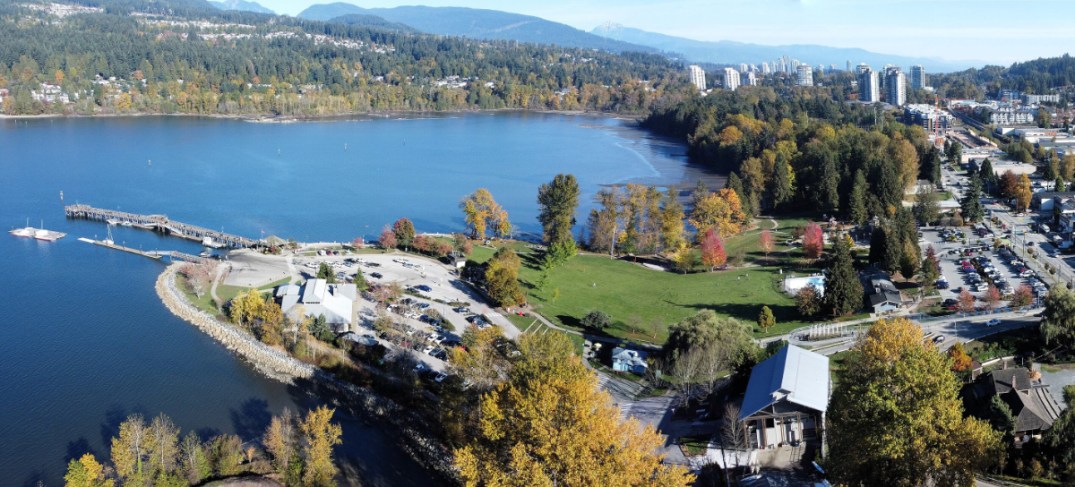
A 31-acre site on Port Moody’s waterfront won’t be set aside for a park.
But the city will look at implementing a requirement any future development of the property immediately west of Rocky Point Park include “a large, contiguous” park space.
Port Moody Mayor Meghan Lahti said including such a requirement in the city’s new official community plan (OCP) will send a message to potential developers of the property that building “a bunch of small pocket parks” won’t pass muster.
“I do think we should be articulating what we want to see down there in terms of park,” Lahti said during a special meeting of council Tuesday, Oct. 7, that passed first reading of the draft OCP.
The document maps Port Moody’s growth and aspirations by guiding its planning and land use decisions and policies for the next 25 years.
Coun. Diana Dilworth said a motion to designate as a “special study area” the waterfront property where the Flavelle cedar sawmill formerly operated for more than 100 years would essentially re-litigate a decision made by council on 2018 allowing its redevelopment into a high-density, mixed-use neighbourhood for more than 7,000 residents.
“I don’t see the value in rehashing this now,” Dilworth said of the former industrial property that had been a special study area prior to its 2018 redesignation. “We have the opportunity to negotiate with the owner, and I do believe that’s a better option than downzoning the property to park.”
Redevelopment plans since 2015
Flavelle’s owner, Surrey-based AP Group, had championed redevelopment of the mill site since 2015 but has yet to act on any of its plan that includes 11 towers ranging from 16 to 38 storeys, a low-rise rental building, retail, office and light industrial spaces as well as the future possibility of a hotel and congregate care facility. The company also pledged to dedicate almost a quarter of the site to public park space, including a boardwalk along the shore linked to Rocky Point Park.
AP Group closed the sawmill in 2020 and quickly dismantled its industrial structures. Since then the vacant property has been used for various film and TV productions, including the acclaimed Shogun limited series that won several Emmy Awards in 2024.
Coun. Haven Lurbiecki, who introduced the motion, said rather than laying fallow, the old sawmill property should become an extension of the 9.5-acre Rocky Point Park, especially as Port Moody’s population grows.
“Let us go back to the community to come up with a plan that better meets the needs of the community,” Lurbiecki said.
But Coun. Kyla Kowles said such a strategy is already in the works after council approved a new master plan for the city’s iconic waterfront park last November that makes its expansion a priority.
“This council has stated clearly over and over again that expansion of Rocky Point Park is a major priority and that has not changed,” she said.
Coun. Amy Lubik said the park’s expansion to the west is a work in progress.
“We haven’t seen a development application yet and I think we’ll see lots of changes,” she said. “Expanding Rocky Point Park will be a part of the site’s redevelopment.”
Tower heights stay maxed at 39 storeys

Meanwhile, another motion introduced by Lurbiecki to scale back development plans in the draft OCP for the neighbourhood immediately surrounding the Moody Centre SkyTrain station also failed to gain traction.
Lurbiecki said formalizing a maximum tower height of 39 storeys for the neighbourhood in the document “invites land speculation” and restricts the city’s ability to negotiate with developers for enhanced amenities like daycare spaces in exchange for allowing higher density.
Lurbiecki said a maximum of up to 20 storeys as outlined in provincial housing legislation mandating the construction of high-density development around mass transit stations should suffice.
“These heights exceed provincial legislation requirements,” she said. “No-one is buying these condos. We’re sitting in a market where thousands of these are sitting empty.”
But Port Moody’s manager of policy planning, Mary De Paoli, said council has already set the bar at 39 storeys with the development framework it had previously adopted to help create a true city core and reducing it to 20 storeys would limit the city’s ability to achieve any amenities in the neighbourhood. Recently, Vancouver-based PCI Development started site preparation for two 39-storey rental towers next to the SkyTrain station that were approved by council in April.
Dilworth said ultimately the market will decide appropriate density.
“If condos aren’t going to sell, buildings won’t get built,” she said.
Podiums to be studied
An additional motion to remove a requirement towers in the Moody Centre neighbourhood be constructed atop podiums of three to six storeys did, however, find mixed favour amongst councillors. While such podiums won’t be required in the new OCP, staff will study the implications of mandating their height requirements.
De Paoli cautioned removing the podium requirement presents “a significant shift” that would likely result in taller towers.
“There will be pressure to put density somewhere,” she said, adding podiums are also an attractive landing spot for amenities like retail and commercial spaces.
Knowles said the decision to build atop a podium should be left to the developer.
“Wouldn’t we want to remain open to a developer coming forward with a new design?” she said.
Dilworth agreed.
“This provides some flexibility,” she said.
Other tweaks to be integrated into the draft OCP prior to second reading later this fall include:
- removing several aging townhomes on the south side of Dewdney Trunk Road between St. Johns Street and Viewmount Drive from a special study area that covers the entirety of St. Johns’ south side from Clarke Road to the Coquitlam border
- designating the site currently occupied by Port Moody Elementary school to be parkland when construction of the new elementary school further east on St. Johns Street is completed
OCP process started in 2020
The process to craft Port Moody’s new OCP began in 2020 but had to be paused in 2024 to allow staff to integrate elements of new provincial housing requirements. A revised first draft was presented to council in July.
One said it’s imperative recreation facilities like ice rinks keep pace with anticipated growth while another feared Port Moody would become “a city of towers, from one end of St. Johns to the other, tower after tower and tower.”
A third speaker cautioned council its decisions around the OCP will “define the identity of Port Moody for generations to come.”
Once the draft document passes second reading, it will be referred to external agencies like Metro Vancouver for further comment prior to a public hearing expected some time in December.
Final adoption could occur by March, 2026, said De Paoli.
 MARIO BARTEL