Port Moody cycling studio helps cyclists go Zwifter

This story first appeared in the Tri-City News on April 12, 2019

At 70 years-old, Frank Quigg’s dreams of racing his bike in the peloton at the Tour de France are long behind him.

But, Quigg discovered, he can get a flavour of that experience by plugging his indoor trainer into one of several virtual training apps that can plant a cyclist in the midst of a group ride through French countryside, up and down the Dolomite mountains in Italy or around the roads of Central Park in New York City.

And now the retired auto importer has turned his winter training regime into the Lower Mainland’s first virtual cycling studio in a loft area above a fitness gym on Port Moody’s Spring Street.

Quigg’s endeavour, Zwift Cycling Club, features four Tacx Neo 2 smart trainers that are each paired with a virtual training app by Zwift and connected to individual 40-inch monitors. Each station even has a remote-controlled fan that simulates a cooling breeze out on the road.

Cyclists can bring their own bike to mount on the trainer, or use one of the Specialized bikes Quigg has available.

A leap ahead

Quigg took up cycling when he was 59 to improve his health and fitness and now logs more than 8,000 kms on the road a year. He said the virtual riding experience is a leap ahead from the mental drudgery of grinding out hours of spinning parked in front of a TV watching Vancouver Canucks’ hockey games or binging on episodes of House of Cards on Netflix.

Instead, the app can plop Quigg on one of several fictional courses in a mystical land called Watopia, where the roads are always closed to car traffic, or other routes modelled after the 2012 Olympic circuit in London, England, the 2015 world championship course in Richmond, West Virginia, or even the weekend warrior mayhem of New York’s Central Park.

Other apps like Sufferfest incorporate workouts into licensed footage from famous cycling stage races like the Tour de France, Giro d’Italia and one-day events like Milan-San Remo or Paris-Roubaix.

Like a video game

Quigg said Zwift’s virtual world is like bringing his bike into a computerized video game where he can just ride to explore the course and scenery, or elevate his heart rate by racing for personal training goals or against other cyclists hooked into the program from all over the world. The trainer alters the pedalling resistance according to the terrain on the screen, so it gets harder to climb hills and easier to glide down the other side, while the monitor tracks his effort and gives him an idea of how he’s doing compared to the other virtual cyclists on the course.

Quigg, who suffered a bad crash two years ago while riding in a pack along Marine Drive in Vancouver, said virtual training apps also offer a safe environment for riding in a group without the fear of touching wheels with a neighbouring cyclist or crashing into obstacles like barriers and signs that can be hard to spot when in the midst of a fast-moving peloton. Even the social aspect of group rides is preserved, as cyclists signed into the app can communicate with others on the digital road, set up challenges like sprints or organize events like races with their friends.

About the only thing missing is the traditional mid-ride coffee stop, although Port Moody’s Brewery Row is only a short coast away.

Busy year ’round

Quigg said while indoor riding is usually a winter activity cyclists use to maintain their conditioning, he anticipates his stations will be kept busy during the summer months by riders following a structured training regime to prepare for a specific event like a race, gran fondo or triathlon. Groups of friends can also challenge each other in a social setting.

And while it’s possible to get a virtual cycling experience at home, a proper station can cost more than $3,000 — not including the bike — plus the space to leave it set up.

“You get to live out some of your Walter Mitty fantasies,” Quigg said, adding several European and North American pros like Roman Bardet, Mark Cavendish, Michael Woods and Evelyn Stevens have been known to sign in to a Zwift ride.
Coquitlam climbs set the stage for Tour de France glory

This story first appeared in the Tri-City News on June 19, 2018

Alex Stieda owes everything he achieved in bike racing to Coquitlam. Or rather, the city’s hills.

So it’s only appropriate on Thursday he’ll be inducted into the Coquitlam Sports Hall of Fame at the Poirier Sport and Leisure Centre, located about midway between two of the climbs he regularly ascended on his 10-speed he’d acquired from a high school buddy to improve his fitness in advance of the Juvenile hockey season.

It was an unlikely beginning to a career that would make him the first North American cyclist to wear the Yellow Jersey as the leader of the Tour de France as well as compete for Canada at international events like the 1982 Commonwealth Games, 1983 Summer Universiade and the 1984 Summer Olympics.

Stieda’s grinds up Blue Mountain Street and Mariner Way caught the attention of a neighbour two doors down from his parents’ home on Gatensbury, near Como Lake. Harold Bridge was a dedicated randonneur, an eclectic breed of cyclists that enjoy rides of 200 km or more in a day; his wife, Joan, happened to be the president of Cycling BC at the time.

Bridge took Stieda under his wing, showed him how to ride in a group and draft behind other riders to save energy. And when the long, languid rambles of the randonneurs didn’t seem challenging enough for his young protégé, he passed Stieda on to Larry Ruble, who led a group of faster cyclists out of his Maple Ridge bike shop for rides to Mission or Fort Langley, and back.

More often than not, it was Stieda who took the lead and did the most work of their small peloton of 10 or 12 more experienced cyclists.

So Ruble suggested Stieda head to the roads around the University of British Columbia, where veteran racers competed to be the fastest in time trial races against the clock every Thursday evening.

Of course, Stieda cycled there, making the long ride out along 41st Avenue to UBC after school, post his time on the five-mile time trial course, then ride all the way home, pounding his way back up Blue Mountain in the fading twilight.

“When you’re at the end of your rope after riding 100 km, you just do everything to get home,” Stieda recalled from Edmonton, where he’s an account executive for an IT company. “Living in Coquitlam made me stronger.”

Strong enough that he started winning races at the old China Creek velodrome in Vancouver, then eventually a victory in the Canadian track cycling championships that earned him a trip to the junior worlds in Buenos Aries, Argentina.

‘I wanted to do more’

“This is super cool,” Stieda said. “I was smitten. I wanted to do more.”

Stieda started honing his road racing skills with local teams like Gunners and Carleton. Eventually he hooked up with a crew sponsored by a local Rotorooter franchise; they’d train and race through the summer, then unclog drains in the winter.

In 1981, Stieda realized to take his cycling to the next level, he’d have to travel to the sport’s spiritual home in Belgium where hardened European neopros banged handlebars, cut deals and maybe got noticed by bigtime pro teams, in kermesse races that could be found almost every afternoon or evening in small towns or villages across the country.

Stieda’s dad secured a $500 grant that paid for a flight to Ottawa, where he dragged along a home-built Fibreglas case holding his steel Marinoni racing bike to a military base in Trenton, Ont., to catch a Royal Canadian Forces flight to Lahr, West Germany and then on to Frankfurt, Germany and Ghent, Belgium, by train.

Stieda, 20 at the time, had no idea what he was getting himself into.

“The guys at the base probably got a kick out of me,” he said.

Midnight arrival

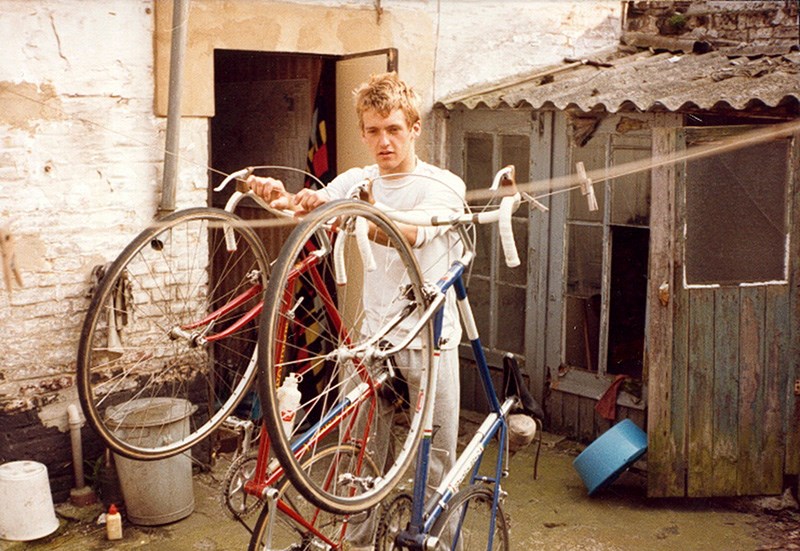
Deposited at Ghent’s train station at midnight, Stieda bounced his bike box over the dark, cobbled streets to find Staf Boone, a sort of Godfather of the local cycling scene who managed a number of  apartments in the area that he let out to visiting foreign cyclists pursuing their dreams.

Stieda roomed with an Australian cyclist. Their “cold-water flat” had no hot water, a propane hotplate for a stove, and they went to the bathroom in a shack out back.

“It was definitely a hard life,” Stieda said. “But I was just living in the moment.” 

Out on the road, Stieda learned some hard lessons as well. Semi-professional bike racing in Northern Europe has its own culture, its own code of rules and ways of breaking them in the name of survival.

“I didn’t have an opportunity to get intimidated,” Stieda said. “If you weren’t tough mentally, it was over.”

Stieda’s trial by cobblestone got noticed by the newly-formed American team, 7-Eleven, that was built around famed Olympic speedskater Eric Heiden who raced bikes as part of his off-season training, and included another Canadian cyclist, Ron Hayman. 

The team invited Stieda to enter some races in North America in the fall when he returned from Europe, and in 1982 he was offered a contract.

No illusions

Stieda said he had no illusions of glory. He didn’t have the lean build of a Grand Tour rider who could rack up big kilometres and recover to do it again the next day for the three weeks of a race like the Tour de France or Giro d’Italia, nor did he have the explosive power to win sprints. He was a domestique, a worker who could sacrifice himself for the team’s leader, haul water bottles, be there if a wheel needed to be swapped out.

That was to be Stieda’s role when 7-Eleven, now a big league professional team on a mission to popularize bike racing in the New World, was invited to the 1986 Tour de France, after two of its members stunningly won stages at the Giro d’Italia the year before. 

But somehow, the early stages of the 21-day race around France played to Stieda’s strength of being able to ride away from opponents for 80 or 100 km, just like those rides out to Mission and back home up Mariner Way. Add in some time bonuses he earned along the way, and midway through the Tour’s second day, after an 85-km road stage in the morning  that would be followed by a team time trial he barely survived in the afternoon, Stieda climbed atop the podium, got kisses on his cheeks from the podium girls and pulled on cycling’s most famous prize.

“It was really more of a strategic play rather than being the strongest rider,” Stieda said. “I had to figure out how to use my energy in the right way.”

Learning lessons

But Stieda couldn’t bask in his glory, as there were more lessons to be learned the next day. That’s when a veteran Dutch cyclist from another team told him on the road it wasn’t enough to wear the Yellow Jersey, he had to honour it by actually finishing the Tour.

“That hit me like a ton of bricks,” Stieda said. “So I just followed him around every day.”

Stieda did finish the race, in 120th position. But what amounted to his lunch hour in Yellow set the table for an era of North American glory in cycling’s biggest race, including overall victory in the ’86 Tour by American Greg Lemond — his first of three Tour wins — and more Yellow Jerseys worn by fellow Canadian Steve Bauer in 1988.

“It was just an amazing time, we were breaking new ground,” Stieda said, adding the old 7-Eleven teammates still gather for a reunion every five years or so.

• Stieda will not be able to attend the induction ceremonies on June 21. But he is sending a replica of his Yellow Jersey that will be mounted in a display in the lobby of the Poirier Sports and Leisure Complex.


Legendary Port Coquitlam cyclist remembered as a ‘tough old guy’

This story first appeared in the Tri-City News on Jan. 15, 2021

Dan McGuire was small in stature; but in British Columbia’s quirky community of long distance cyclists, the longtime Port Coquitlam resident was larger than life.

McGuire died Dec. 12 at the Lakeshore Care Centre in Coquitlam. He was 88.

His daughter, Tara, posted on social media that he died from COVID-19 — only three days after he was diagnosed.

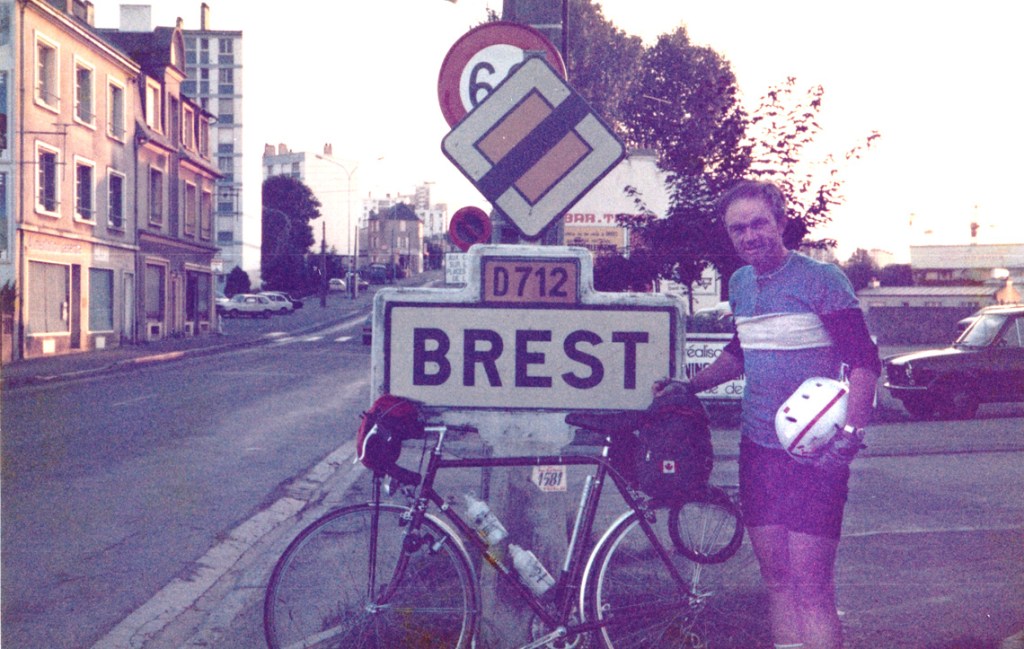
Born in Saskatchewan, McGuire was one of the founding members of the BC Randonneurs, a group of cyclists dedicated to logging long days on two — and sometimes three — wheels. He was part of a contingent of riders that organized a series of long-distance events ranging from 200 to 1,000 km in 1979 that would qualify them to participate in the famed Paris-Brest-Paris brevet, a 1,200-km endurance event in France that is held every four years.

B.C. RANDONNEURS
Dan McGuire helped form the B.C. Randonneurs cycling club so he and like-minded cyclists could prepare to take on the 1,200 km Paris-Brest-Paris brevet that is held once every four years.. He went on to complete the event three times.

McGuire went on to ride it three times. He also travelled to the event on several more occasions to support other riders from the club.

Garry Pareja, a member of the old Vancouver Bicycle Club that spun off the collection of hard-core riders that became the BC Randonneurs, said the group prepared by riding to Mt. Baker and back, or completing ascents of Cypress Bowl, Mt. Seymour and Burnaby Mountain all in one day.

“This branch of the club became the ‘Hard Riders,’” Pareja wrote on the BC Randonneur’s historical timeline.

But it was McGuire’s determination to keep pedalling even after his mobility diminished because of Parkinson’s disease that really cemented his status among the sport’s giants as well as an inspiration to show others living with the degenerative affliction what’s possible.

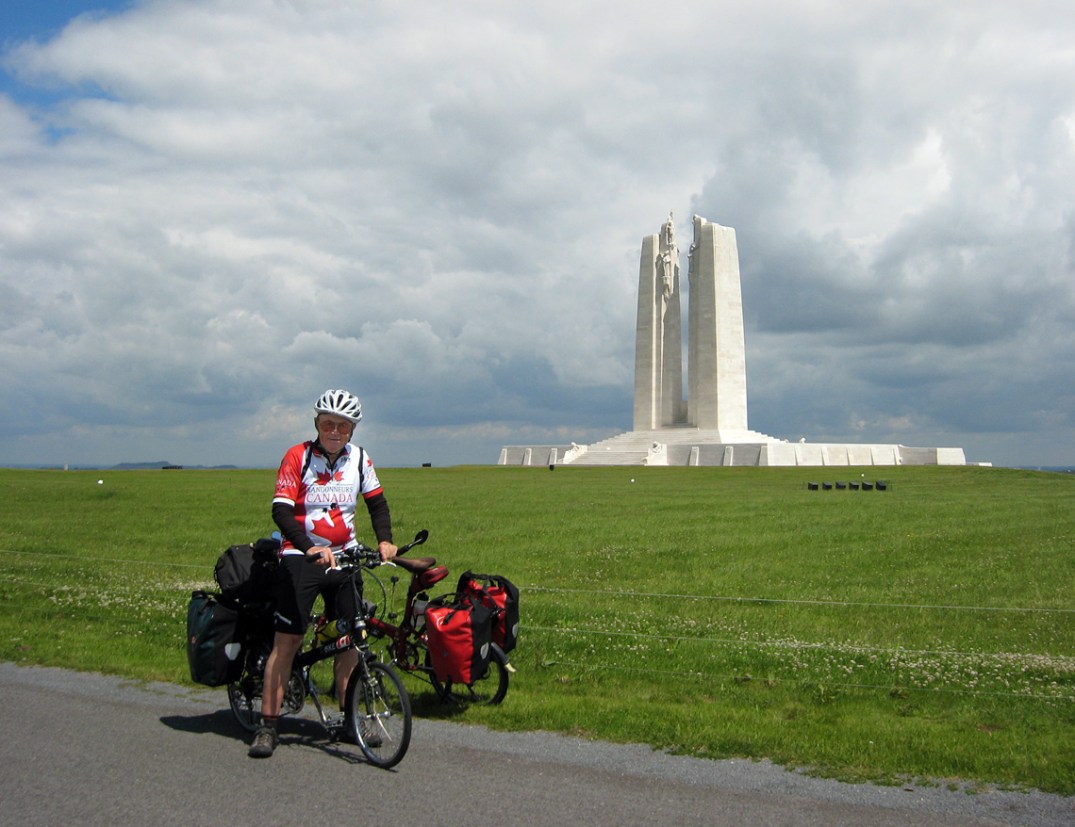
McGuire, who discovered cycling when he was about 40, had ridden across Canada a few times.

But at the age of 80, and coping with various ailments like arthritic knees and hands, scoliosis in his spine, macular degeneration in his eyes and the onset of Parkinson’s, he decided he wanted to pedal his bike to the four corners of the country — a journey of about 10,000 km.

By then, wrote Tara in a blog post, the disease and medication had so diminished her father, when he’d occasionally fall asleep at the dinner table “he’d look very much like a skinny grieving question mark.”

There was no questioning his determination to realize his cycling dream, though.

“Dan could focus intensely on an idea and the tasks that lay ahead,” wrote Leo Boon, another of the sport’s pioneers in B.C., in a memoriam on the Randonneurs’ website.

“He was just so stubborn,” Tara said.

McGuire’s journey to Canada’s most westerly, northerly, southerly and easterly points took him two years, with a break in between to rest his ailing back.

When he resumed in the summer of 2014, he’d switched from a two-wheeled bicycle to a three-wheeled recumbent to ease some of the aches of his aging body and keep him from tipping over.

As well, Tara said, it allowed him to pull to the side of the road whenever he pleased to just bow his head for a bit of a snooze. He had no organized support team, no motorhome to which he could retire when he wearied.

Instead, Tara said, her father relied on the kindness of strangers to look out for him.

“Dad’s confidence in the positivity, general all-around goodness of the human race, was a gamble he was willing and pleased to take.”

That spirit was infectious.

Fellow randonneur Ralph Maundrell wrote in tribute, “Dan had the ability to install confidence in people,” adding McGuire inspired his own pursuits in long-distance cycling and even marathon running.

“We have lost a wonderful human being, a tough old guy, a great cyclist,” said Boon.

“He could be gruff, but he was also very generous,” said fellow cyclist Deirdre Arscott.

Tara said it’s been heartwarming to hear the impact her father had on so many cyclists.

“He really worked hard to get people cycling,” she said. “We were always kind of impressed with his accomplishments.”

Climate change challenges Tri-Cities’ mountain bike community

This story first appeared in the Tri-City News on Nov. 17, 2022

Extended droughts that dry out trails, atmospheric rivers that wash them away and intense windstorms that blow down trees are among the climate change challenges facing the local mountain biking community.

So members of the Tri-Cities Off Road Cycling Association (TORCA) are adapting the way they build and maintain trails, as well as how they ride them.

Karaleen Gioia, a director of the group that comprises more than 750 members, said a typical trail on Burke Mountain that 10 years ago was little more than a dirt path — snaking through the towering trees — must now be armoured with logs and rocks, bridged with hand-built wooden spans to allow for drainage in heavy rains, and contoured with little rolling hills to slow riders who could otherwise speed erosion.

“It’s not just getting out and shredding the trails anymore,” Gioia said. “Climate change is another factor to consider.”

Drought followed by big rainstorms can be especially damaging to trails.

Gioia said the former strips all the moisture from the ground that binds the trail beds, threatening their structural integrity, while the latter results in washouts as rainfall in unprecedented volumes is forced to travel in unfamiliar places.

Having both in quick succession can be disastrous.

“The result is that more work is required to make trails sustainable,” Gioia said. “More labour up front means less work in the long run.”

Most of that labour is supplied by a corps of dedicated volunteers over the course of several organized “trail days” throughout the year, as well as individual privateer efforts to stay on top of repairs.

“We’re pretty proactive.”

Gioia said most local mountain bikers are tuned into the privileged position they enjoy with so many trails so close to home. Many file trail reports to document any problems or areas of concern they identify as they roll up or down the mountains.

Gioia said keeping the trails in good shape benefits all users, including hikers, dog walkers and trail runners. That’s been especially important since the advent of the COVID-19 pandemic that sent more people outdoors for their recreational pursuits as activity helped reduce their stress and kept them healthier.

Gioia said education of proper trail use etiquette and trail building technique is an ongoing process. TORCA liaises frequently with other user groups, as well as land managers, to devise solutions to problems as they arise.

“We’re learning as we go,” she said.

In fact, a report conducted for Parks Canada by the Calgary-based Miistakis Institute that looked at the ecological impacts of mountain biking said that’s the case for most user groups, as there’s been very little empirical research.

“Specific effects associated with mountain biking activity and infrastructure characteristic of the other types of use have emerged as a considerable gap in the research literature,” concluded the review.

Gioia said land managers and user groups are gaining a greater appreciation that bolstering trails will help keep mountain biking viable even as weather extremes intensify.

“It makes it enjoyable for all the users,” she said.


How this former Coquitlam resident found herself on an epic bike ride in Canada’s far north

This story first appeared in the Tri-City News on Feb. 22, 2024

Some cyclists find fitness. Others find their destination.

Mahshid Hadi found herself.

The young Iranian woman who lived in Coquitlam for a year after fleeing her homeland has documented her search for identity aboard a bike in a short film, Escape and Embrace, that premieres Saturday, Feb. 24, at the Vancouver International Mountain Film Festival (VIMFF24).

Hadi, 32, said cycling adventures were a forbidden pleasure when she was a girl growing up in the central Iranian city of Isfahan.

While Hadi was able to taste freedom on two wheels when she was very young, she said once she turned nine, everything changed. That’s when Iranian law and religious rules begin to treat girls as women and their lives become very restricted.

Hadi could be as free and animated as she liked within the confines of her own family’s home, but once she walked out the door every aspect of her life and interactions with other people were dictated. She had to sit and walk a certain way, wear certain clothes, talk to boys in only very defined circumstances.

And though there was no specific rule forbidding her from riding her bike, authorities made it clear it wasn’t an acceptable activity.

Hadi’s life, once so free and adventurous, suddenly became very confining.

“I wanted to be a free-spirited girl, I wanted to do everything I had the potential to do as a girl,” she said. “I couldn’t be who I wanted to be.”

The trauma within her built up.

So, at 19, Hadi got out, secreted away by friends and associates to Türkiye (formerly known as Turkey).

There, Hadi said, she had freedom but not comfort. She couldn’t work officially, so she cobbled together a living teaching English to other refugees.

With the money Hadi was able to save, she bought a bike to be able to visit students in other refugee camps.

“Bit by bit, I left all my traumas on the road,” she said.

When Hadi’s application to immigrate to Canada was accepted, her love for cycling came with her.

In her new home, Hadi rode everywhere, Partly because she didn’t have a car, partly as an expression of her newfound liberty.

“It was a dream come true,” she said. “I felt this is a road and nobody can stop me from riding it. I don’t have to explain my riding.”

Iranian-Canadian filmmaker Mahshid Hadi has been on a journey of self-discovery with her bike since she arrived in Canada after fleeing her homeland to a refugee camp in Türkiye when she was 19 years old. MAHSHID HADI/INSTAGRAM

Last fall, Hadi said she felt a pull to push her cycling journey of self-discovery to a higher level and to share her story. She knew it needed to be a difficult trip, where the obstacles were not societal rules and religious edicts but the weather and terrain.

“I needed to feel vulnerable,” Hadi said. “But I wanted it to be my choice.”

Hadi pedalled the Dempster Highway from Dawson City towards Inuvik, about as far north as you can go on rubber tires.

And while a storm prevented her from reaching the road’s terminus, Hadi said the journey gave her a sense of finality to her past.

“This was the end of the road from all those restrictions I felt in Iran,” she said. “It was just me and the land.”

Hadi said the four-day trip may be over, but her journey toward self-discovery aboard her bike continues, She said her LIV gravel bike is her buddy, her port in the storm of life’s twists, turns and uncertainties.

“Any difficult time I go through, I know I can get on my bike and just let everything go.”

Hadi’s film, which documents the meaning of her ride along the Dempster Highway, is part of Bike Night at VIMFF24 where it will be screened with six other cycling films at Centennial Theatre in North Vancouver.

Moray Street traffic calming gets changes, more expensive

The plastic lane delineators creating chicanes to slow traffic on Port Moody’s Moray Street could soon be gone.

In their place, new curb bulges will be built at Pinda Drive and Brookmount Avenue, along with new lane markings and crosswalks. But a planned bike lane on the east side of Moray Street will have to wait.

Tuesday, May 20, Port Moody council’s initiatives and planning committee will consider spending an additional $353,000 to construct the new, permanent elements. That’s on top of the previous budget of $795,000 that had been approved in 2022.

Since then, though, construction costs have risen, additional design work was required and $187,000 will be allocated to a new multi-use path on the west side of Moray, resulting in a total budget of $1.248 million, said a staff report; $100,000 of that will be covered by the city’s street lighting relocation program, and another $155,000 will come from a TransLink grant.

A pilot project to slow traffic using Moray Street that was implemented in the summer of 2022 resulted in a 5-6 km/h reduction of speeds on the busy connector route to Coquitlam, according to the report.

But some residents said the temporary measures, that included the plastic lane delineators, new markings on the pavement to configure curb bulges at intersections and a temporary sidewalk on Moray’s west side, actually made the situation worse.

“It may have calmed traffic on the east side, but they’re going faster on the west side,” said one resident prior to a meeting last June when council decided the traffic calming measures should be made permanent.

Subsequent feedback from residents following a public information session earlier this year revealed further concerns like the loss of several on-street parking spots, worries about pedestrian safety from cyclists speeding down a northbound bike lane and turns lanes at the St. Johns Street intersection too short to accommodate the volume of vehicles.

As a result, said the report, further refinements have been made to the permanent calming plan, including:

  • the addition of eight new on-street parking spots on the east side of Moray, between Brookmount Avenue and Portview Place
  • the removal of the northbound cycling lane on the east side of Moray; instead, cyclists heading down the hill will be directed to use Brookmount Avenue and Clearview Drive while staff consider further options
  • additional curb bulges to be built at the intersection of Moray and Brookmount, as well as a new marked crosswalk on the north leg
  • adjustments to the lane geometry at Moray and St. Johns to extend the turning lanes so they can accommodate more vehicles

The report said the permanent changes should be in place by the end of the year.