Coquitlam Express scrambling for a new training facility

The general manager of the Coquitlam Express is hoping some city councillors will reconsider their decision to deny the hockey club a temporary use permit to use a vacant warehouse space at 1750 Hartley Ave. as a gym facility.

Tali Campbell said the five councillors who voted against the team’s application to use the industrial space for up to three years may not have had a full understanding of its request.

Some of the councillors during Monday’s debate said allowing a gym in a building zoned for industrial use would set a bad precedent.

Coun. Robert Mazzarolo said the city needs to protect its dwindling industrial areas and the jobs they bring to the community.

“The activity can be accommodated in other places with appropriate zoning.”

Mayor Richard Stewart added, “If we approve a project like this, we would end up with the floodgates open.”

Couns. Asmundson and Trish Mandewo expressed concerns about limited parking at the location that had been formerly occupied by an electronics manufacturer.

Campbell said the Express organization, which now numbers 130 young players in various academy programs as well as the BC Hockey League junior team, has outgrown its current training facility in a warren of rooms in the basement of a city-owned building across the street from the Poirier Sport and Leisure Complex. He said organizations located on the second floor are also complaining about the noise.

“Everything is crammed,” Campbell said. “We make do, but we get complaints every day from our upstairs neighbours.”

Campbell said the Express spent more than eight months looking for a suitable location to move its gym facilities, and the warehouse space behind the Home Depot on United Boulevard fit the bill.

“The size was good, the price was good,” Campbell said, adding the location just down the hill from Poirier would just be a “stop-gap” until the Express can secure a permanent solution. He said the temporary gym would be used exclusively by the players, who would be bused in groups to and from their scheduled training sessions.

Coquitlam’s senior manager of economic development, Eric Kalnins, said commercial spaces suitable for a gym facility are “hard to find” in the city.

Coun., Craig Hodge, one of four councillors who supported the Express’ application, said the nature of industrial use is changing and the club does provide employment.

“It’s not industrial, but it does provide jobs and create growth,” Hodge said.

Coun. Dennis Marsden agreed.

“This is supporting a local business,” he said of the gym plan.

Campbell said changes in NCAA eligibility rules that now allow players from the Canadian Hockey League to attain scholarships to Div. 1 programs have increased competition to attract them to Junior A leagues like the BCHL. Giving players a good experience on and off the ice to continue their development is a prime consideration.

“You have to provide a state-of-the-art facility in junior hockey these days,” Campbell said. “It’s the fabric of our organization.”

In the meantime, the Express has dismantled its current training facility and players will be able to work out at a local commercial gym, OT Performance, for the next three weeks. Beyond that, though, remains uncertain, Campbell said.

“If council doesn’t reconsider, we’ll have to go back to the drawing board.”

Port Moody butcher to lead Olympian effort

A Port Moody butcher is leading Canada’s team looking to win gold at the “Olympics of Meat.”

Taryn Barker, of The Little Butcher in NewPort Village, will captain six butchers and two alternates competing at the 2028 World Butchers’ Challenge.

Barker was co-captain of Butchery Team Canada that finished fifth at this year’s challenge held in Paris in March. But the placing was just 1.5 points shy of France’s gold-medal effort.

Barker said preparation for the 2028 competition is already underway, with the five members committed to the team so far heading to a chefs’ camp in Pemberton next week to process an entire cow.

“I want to start building the team relationships, getting to know each other and how we work,” Barker said.

The World Butchers’ Challenge is held every three years. It pits teams of top meat cutters from around the world to transform sides of beef and pork, as well as whole lamb and several chickens, into about 70 different value-added products. Their efforts are judged for presentation and flavour.

Barker, who participated in her first Challenge in 2022, said each competition is a learning experience.

“We’ve learned it’s a very serious competition. The teams practise with intent and they compete with intent.”

To raise their own game, Barker plans to bring her team of butchers, who come from across Canada, together several times over the next few years to determine the roles each will play on competition day, plan their cuts and presentation, and hone their communication skills.

“We have to walk as a team and talk as a team,” Barker said, adding the butchers will also work with coaches who can provide feedback and help decipher what the judges might want to see.

And now as the team’s captain, ensuring all those elements come together falls on Barker.

It’s a weighty responsibility, she said.

“There’s more pressure to make sure everyone is participating in practices and preparing at home.”

But with two stabs at the competition already under her apron, Barker said she’s up for the challenge.

“I think the more you do it, the more confident you get,” Barker said. “But you know the other teams feel the same way.”

Fundraising garden party

Barker has organized a special Butcher’s Garden Party fundraiser to support Butchery Team Canada’s preparation for 2028.

The party, to be held Sept. 14, from 7 to 10 p.m., at OpenRoad Toyota (3166 St. Johns St., Port Moody), features canapés, desserts and beverages prepared by top chefs and bakers from across British Columbia and as far away as Ontario. There will also be goody bags, a silent auction and a cornhole tournament.

Tickets are $110 and can be purchased here.


‘It’s just not OK’: How a Port Moody bakery is fighting back against rude customers

This story first appeared in the Tri-City News on Nov 5, 2024

Lisa Beecroft was so sad and mad with the way some of the staff at her Port Moody bakery have been treated by customers, she took to Facebook to express her frustration.

The response, however, has reaffirmed Beecroft’s belief in the kindness and decency of most people and bolstered her commitment to creating employment opportunities for all.

More than a third of the workers at Beecroft’s Gabi & Jules bakery on Clarke Street, and a second location in North Burnaby, self-identify as having a disability.

Most are on the autism spectrum, but, Beecroft said, some don’t disclose their disability at all; they just know they’ve found an inclusive place to work that makes them feel safe and valued.

Since the COVID-19 pandemic, though, Beecroft said some of that sense of safety has been eroded by the rudeness and impatience of some of the shops’ customers.

“It’s a range of things, the tone and the aggression that’s coming across,” Beecroft said. “People are not saying ‘hello,’ they’re not looking people in the eye.”

When a manager recently brought the demoralizing nature of such customer interactions to Beecroft’s attention, she said she was crestfallen and frustrated.

“It’s just not OK,” Beecroft said. “We can’t normalize this is the way it’s going to be.”

Beecroft decided to share her thoughts on the bakery’s Facebook page.

“It honestly breaks my heart to have to post this (long) message,” she wrote.
“In recent months, we have seen an increase in the mistreatment of some of our team members by some of our customers. There’s become frequent occurrences of rudeness, impatience and, in some cases, just blatant hostility towards our team.”

Beecroft said while some may dismiss such interactions as just a part of being in the customer service business, “it absolutely should not be.”

“Everyone deserves to come to work and feel safe, included and valued.”

She added, “We do our utmost to create that environment for our team members and we expect our customers to do the same.”

The response, Beecroft said, has been immediate, overwhelming and “really emotional.”

Words of support and encouragement poured into the post’s replies, many from customers, some from people who work with the neuro-diverse community, others from like-minded employers who are also making the effort to be inclusive.

“What you are doing there is inspiring and should be held up as the example of what good leadership and good businesses do,” said one.

“Thank you for standing up for your staff,” said another. “We should all remember to treat others as we would have them treat us, with kindness.”

For Beecroft, who printed out copies of her post and affixed them to the walls of her bakery’s Port Moody and Burnaby locations as a reminder to customers to check their hostility at the door, the responses from the community also hit close to home.

She and her husband, Patrick, set out on their journey to make Gabi & Jules an inclusive workplace because their eldest daughter, Juliana, has autism. They had to deconstruct every task in the bakery and front shop to determine how someone with unique qualifications might fit into the daily workflow while still making sense for the business’ bottom line.

The effort has paid off, though.

Employees with even the most repetitive tasks, like washing dishes or folding boxes, tend to stick around longer — some have been at the bakery for six or seven years already.

“We’ve attracted people to the business because they want to work here,” Beecroft said. “They feel safe in the space.”

Maintaining that safe feeling is paramount as their employer, she added.

“I feel an obligation because I’m putting them in this situation,” Beecroft said, “The staff just wants to make sure they’re doing a good job.”

Housing prices squeezing families, seniors and immigrants: study

This story first appeared in the Tri-City News on Sept. 21, 2021

Port Moody has plenty of housing getting built or in the process of being approved to meet projected regional growth targets.

But the city needs more diversity of housing options to keep it affordable for families, single people, low income earners, immigrants and people with disabilities, says a study by community planning and development consultant, CitySpaces Consulting.

According to the study, which is to be presented to council Sept. 21, the gap between what households can afford to pay for housing in Port Moody and the housing that is available is growing.

Since 2013, the median sales prices of single-detached homes and townhouses have nearly doubled. Rents have also skyrocketed at a similar pace, and the vacancy rate for units with three or more bedrooms is currently 0 per cent. As a result, one in five residents are spending more than 30 per cent of their income on housing costs, a level that is considered a standard measure of affordability.

“Housing is becoming more expensive and fewer residents are able to enter the home ownership market,” said the report, adding Port Moody’s housing situation isn’t about a lack of dwellings to be built, or land where they can be located. Rather, there isn’t enough diversity of housing, including more affordable housing options, as well as accessible and family-friendly units.

Renters, who comprise one-quarter of city residents, are also struggling with higher costs and less availability, said the report. The median rent in Port Moody is now more than $1,000 per month while the vacancy rate for all units is between 0.5 per cent and 1.9 per cent — a healthy vacancy rate is between one and three per cent.

“Some households may be able to find a rental unit for less than $1,000 a month, but this typically comes with trade-offs such as being in poorer quality condition, further away from public transit and amenities and may not be suitable to meet their needs,” said the report.

But as Port Moody strains under the same market forces that afflict the entire Tri-Cities area, there are still ways to turn the tide.

“For Port Moody, the number of units being developed is keeping pace with demand,” said the report. “However, consideration to adjust the mix and secure rental housing and affordable units is a key area of opportunity.”

According to CitySpaces, zoning bylaws in Port Moody often don’t mesh with land designations, creating challenges to build viable developments without expensive lot consolidations, and some areas of the city are falling short of their potential to accommodate new, more diverse housing. Developers, the consultant said, require certainty and standardized policy in development expectations and incentives, as well as expedited processes to move approvals along.

And that could require more staff, said the report.

“It appears that the local government may need to scale-up staffing levels to match the scale of development to not only move projects through the process in a timely manner, but to also ensure that opportunities to capture units for affordability is not missed.”

The study was commissioned by Port Moody in 2020 to fulfill new regulations under the provincial Local Government Act for municipalities to complete housing needs reports by 2022, and then subsequent reports every five years after that. The consulting company used data from various sources including Statistics Canada, BC Assessment and BC Housing, as well as an online survey, virtual workshops, interviews and a workshop with city staff.

Port Moody inventor makes it easy to get your beer home by bike

This story first appeared in the Tri-City News on Nov. 21, 2021

For Nathan Thomson, necessity was indeed the mother of invention.

Along with a thirst for craft beer.

The 26-year-old criminology graduate who works in government said he’s never designed or built anything, nor had any entrepreneurial inclinations.

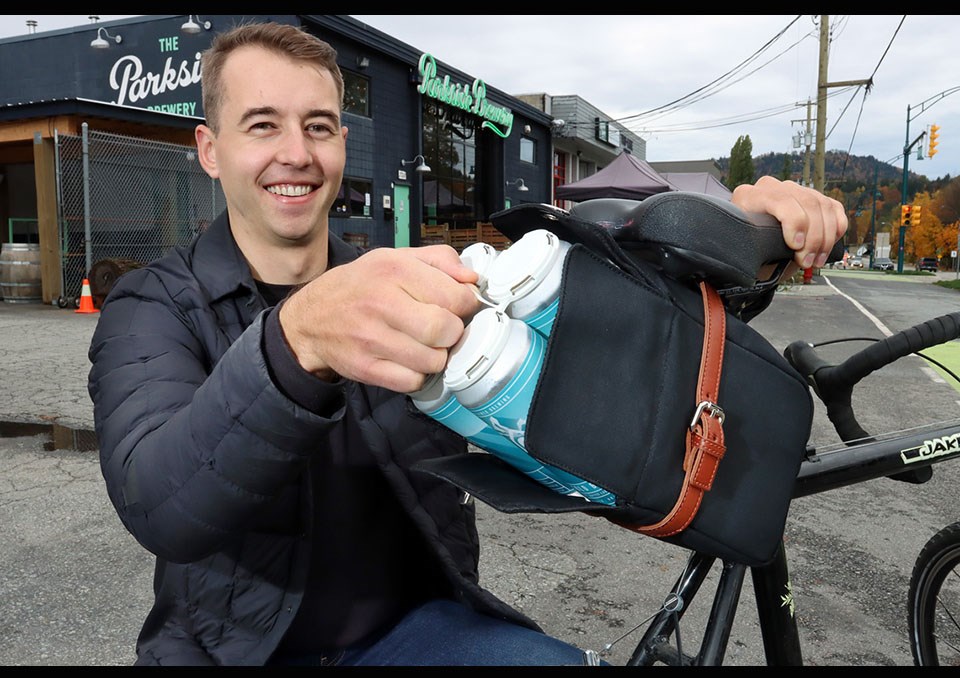
But riding his Kona bike two blocks from his Port Moody home to the city’s renowned Brewers Row to meet friends and enjoy the latest offerings at its five craft breweries changed that.

Frustrated by the challenge and inconvenience of toting a pack of a newly discovered beer he really liked home on his bike, Thomson developed the To Go bag. It’s a canvas cube-shaped sack that tucks underneath the saddle of his Jake the Snake bike and is large enough to accommodate four tall cans.

It sounds like an obvious idea, but after Thomson had his light-bulb moment last spring, he discovered no such saddle bag existed.

So he started sketching out ideas and sampling materials to build a prototype.

Creating a beer conveyance for cyclists, it turns out, isn’t as easy as it sounds at first blush.

Thomson said the bag had to be large enough to hold the four cans, but not too bulky to be an annoyance on the bike. It had to be strong, but not overly heavy.

And it had to be easy to use, without complicated flaps or straps, but still secure.

“I didn’t want it to throw you off balance,” he said.

Using mock-ups Thomson created out of cardboard, friends were enlisted to try his designs and provide feedback.

Angle proved to be the key factor.

Thomson said by finding the right pitch to suspend the bag, it wouldn’t sway from side-to-side or interfere with the cyclist’s pedalling motion.

Material was another challenge. Nylon was too flimsy, leather too heavy and expensive.

Instead, a canvas exterior with nylon lining offered the optimal combination of strength, durability, weight and insulation. The straps that secure the bag to the seat rails and seat post are made of synthetic leather.

Thomson said the development process took several months, but by July, he’d enlisted a manufacturer and was ready to go to market.

Online sales have placed Thomson’s bags under bums across Canada and into New York State and Minnesota. They’re also on the swag shelves of a couple of Metro Vancouver craft breweries: Container in East Vancouver and Five Roads in Langley.

He said he’s had discussions with others, even explored co-branding opportunities.

Thomson said he’s continuing work on more refinements, like adding side pockets and more colours.

He said there seems to be a natural connection between cycling and beer that makes his ToGo bag the right product at the right time.

And considering its genesis on Port Moody’s Brewers Row, the right place as well.

Port Moody woman primed for Canada’s debut at butcher Olympics

This story first appeared in the Tri-City News on July 17, 2022

A Port Moody woman is primed to show Canada’s butchers are a cut above the rest of the world.

Taryn Barker, of The Little Butcher in NewPort Village, is part of Butchery Canada, a team of six butchers set to represent the country at the World Butcher Challenge, Sept. 2 and 3 in Sacramento, Calif.

The competition — a kind of Olympics for some of the best butchers in the world — was supposed to happen two years ago, but it was put on ice by the COVID-19 pandemic.

That’s given Barker and her teammates more time to sharpen their skills and carve their creativity that will be required to transform sides of beef and pork, a whole lamb and five chickens into about 70 different flavourful and visually-enticing value-added cuts and products.

This is the first time Canada is sending a team to the international event, held every two years.

On the floor of the Golden One Centre, home to the Sacramento Kings of the National Basketball Association (NBA), 16 teams will have three hours and 15 minutes to carve, concoct and present elaborate drool-worthy displays that include garnishes, pastries, produce and dishes, all of which have to be acquired locally or shipped beforehand.

Among other elements, their efforts will be judged on how well they represent the unique characteristics of their country’s cuisine.

Barker will be one of two “finishers” on Canada’s team, responsible for making the handiwork of the carvers look its absolute best for the judges and spectators in the stands or watching online.

She said she’s been able to use the extra prep time to mine the internet for new ideas, experiment with ingredients and presentation and forge a stronger connection with her teammates, who come from Ontario, Alberta and one other from B.C.

The team was only able to meet virtually because of travel restrictions during the early stages of the pandemic, but as those have eased, they’ve been gathering in person every month.

They brainstorm products, practice their responsibilities and refine their efficiency as any cut of meat that’s left behind means a deduction of points.

Barker said as a newcomer to the competition, Canada will be up against countries where butchery techniques and presentation have evolved decades longer. But what they may lack in experience, they hope to make up with innovation.

“Teams that have been together for a long time will have the efficiency, but I don’t know how creative they’ll be,” said Barker, who’s previously competed at individual events in Australia, New Zealand and Brazil.

With the weeks counting down to the competition, Barker said Canada’s practices have been getting more intense.

And just like sports teams, each is followed by a thorough debrief to determine better ways members can work together so not a moment is wasted and everyone is able to operate at the top of their game.

“It’s down to the crunch,” Barker said, adding the team has even invited observers to its most recent practices to simulate the kind of scrutiny under pressure they’ll be facing in the arena.

In the days leading up to the competition, the team will ship a pallet of implements and accoutrements to Sacramento — many of them contributed by sponsors like Carmello Vadacchino of Cook Up — and, once they’re on site, they’ll be heading to local shops and farmers markets for the produce and other products that will be integrated into their final displays.

Barker said while the nerves and excitement are starting to build, she’s looking forward to waving Canada’s culinary flag and hopefully inspire young people to take up the trade.

“There’s cool things you can do as a butcher.”

Massive Anmore development proposal put on hold at the last minute

A proposed development that would almost triple Anmore’s population has been put on hold.

Less than 15 minutes prior to Monday’s scheduled public hearing into an application by Icona Properties to amend the village’s official community plan so its proposal could proceed, Greg Moore, the company’s CEO, announced on social media it’s taking a break.

“We’ve made the decision to withdraw our current application for Anmore South,” said Moore on Facebook. “This break will allow us to explore a path forward that brings more unity than discord.”

cona was seeking approval to construct 1,750 new townhouses, low-rise apartments and single-family homes on 150 acres of property the company owns near the corner of 1st Avenue and Sunnyside Road.

On June 10, Anmore council voted 5-1 to send the proposal to a public hearing that was scheduled to begin at 6 p.m., Monday, June 23.

The development plan has drawn consternation from residents of the bucolic village of 2,200 residents, as well as the neighbouring communities of Port Moody and Belcarra.

A group called the Anmore Neighbours Community Association (ANCA) said Icona’s plan poses “significant financial risks” to the village.

ANCA’s Rod Rempel and Harriette Chang said a consulting company’s estimate it would cost the developer $30 million to construct services like water, sewer and storm drainage could end up leaving Anmore taxpayers on the hook.

Residents also expressed concerns about increased traffic, higher costs for policing and fire services, as well as public safety because the two access roads into and out of the village could become blocked or overwhelmed in an emergency like a wildfire.

Port Moody and Belcarra shared similar trepidation.

In a letter sent to Anmore council in May, Port Moody Mayor Meghan Lahti said neither the village nor developer had yet to initiative discussions about utility upgrades, most of which would be routed through its urban neighbour.

“If the village is interested in partnering on this infrastructure, time is of the essence,” she said.

Belcarra Mayor Jamie Ross said traffic and construction activity during the development’s 25-year built-out would also be a hardship on his village.

Anmore councillor Doug Richardson, who cast the only dissenting vote to move Icona’s proposal forward, said the project “is not needed.”

But supporters on council countered the village needs to do its part to address Metro Vancouver’s housing crisis by providing “more affordable” options.

Anmore Mayor John McEwen said development of the property is inevitable.

“Change is happening and we want to have a say in how it gets developed.”

In his statement, Moore acknowledged the division his company’s plan has incited.

“This was never our intent,” he said. “In fact, it’s the opposite of what we set out to do.”

Moore said Icona wants to create “a people-first community” that’s “more connected and more compassionate.”

Anmore residents’ group concerned as massive development proposal goes to public hearing

A group opposed to a proposed development in South Anmore says even a scaled-down version of the project still isn’t realistic.

Rod Rempel and Harriette Chang, of the Anmore Neighbours Community Association (ANCA), said the plan by Port Moody-based Icona Properties to build 1,750 new homes on 150 acres of property the company owns near the corner of 1st Avenue and Sunnyside Road presents “significant financial risks” to the village and its 2,200 residents.

Tuesday, June 10, Anmore council voted 5-1 to send the proposal to a public hearing on Monday, June 23, prior to its consideration the next night of third reading for an amendment to the village’s official community plan bylaw required for the development to proceed.

The extraordinary scheduling is in anticipation of a long night that could stretch to council’s regular meeting on June 24.

It’s also a month later than originally envisioned by Anmore Mayor John McEwen in April when council approved a timetable that included a community survey, workshops with various village committees, and an open house.

McEwen said council wanted to collect “as much feedback as we can” about the project, which the developer had slimmed down from 2,200 homes on May 27.

Those economies were achieved by trimming the number of standalone apartment buildings up to six storeys tall from 22 to 10 while adding another 200 ground-oriented townhomes from the original 760.

The project would also include a small strip of commercial units as well as a smaller 16,000 sq. ft. recreation centre, a 9.3-acre park and four kilometres of nature trails and greenways.

Too much

Rempel and Chang said it’s still too much.

They said a consulting company’s estimate that it will cost Icona $30 million to extend services like water, sewer and storm drainage to the development isn’t achievable and could leave Anmore taxpayers on the hook for any budget increases, especially given Port Moody’s objections to constructing any of that infrastructure along Ioco Road or through Bert Flinn Park, the two closest corridors to the proposed development.

In a letter sent to Anmore council in May, Port Moody Mayor Meghan Lahti said the city has yet to have any discussions with the village about accommodating possible utility upgrades.

“If the village is interested in partnering on this infrastructure, time is of the essence.”

Lahti said Port Moody also won’t entertain any thoughts of widening Ioco Road in anticipation of increased traffic to and from the new development.

“Without a realistic and coordinated transportation strategy, the Icona development risks overwhelming the existing network in the area,” she said.

Belcarra also concerned

Neighbouring Belcarra expressed similar concerns about construction management and transportation plans in a letter sent to Anmore on April 1.

Mayor Jamie Ross said Icona hasn’t addressed the impact its proposal would have on Bedwell Bay Road, Belcarra’s only road access point, nor has it provided a plan to manage stormwater during construction and once the development is completed.

Rempel and Chang said the scale of the project and its infrastructure requirements could quickly overwhelm Icona.

“This developer has never delivered a project of this scale in British Columbia,” they said. “Anmore citizens want to ensure we are not being unilaterally committed to future risks and costs.”

‘A complete Anmore’

But Paul Fenske, a principal of Placemark Design and Development, that’s working with Icona, said the proposal for Anmore South will provide the village with more diverse housing options and expanded tax base.

“It’s a vision for a complete Anmore,” he said.

Planning consultant Tim Savoie, who was formerly Port Moody’s city manager, said Icona’s plan “offers a unique opportunity to develop this site.”

Still, Coun. Doug Richardson said, “it’s not needed.”

In casting the only vote against moving the proposal forward, he added Icona’s proposal flies against Metro Vancouver planning guidelines to concentrate dense development around mass transit stations.

Richardson said the developer also doesn’t adequately address increased costs for police, fire and recreation services the village could face as its population more than doubles.

“I can’t support this in any way,” he said.

Coun. Paul Wevering, however, said Anmore has to do its part to address the region’s housing crisis by providing “more affordable” options.

“We’ve got a strategic plan that talks about different forms of housing, but we don’t really do anything about it,” he said, adding Icon’s plan offers “a future vision for this community.”

The June 23 public hearing will begin at 6 p.m. at Anmore’s Community Hub (2697 Sunnyside Rd.).

Port Moody ice cream maker fuelled by fitness

This story first appeared in the Tri-City News on Oct. 2, 2018

If your idea of a post-workout treat is a high-protein shake or thick fruit smoothie, you’re not Hamid Haji.

He heads for the freezer to scoop himself some ice cream.

In fact, the karate sensei and yoga instructor who runs Pro-Fit Boot Camp in Port Moody with his wife, Kelly Pearce, loves the frozen desert so much he embarked on a mission to make his own.

Fitness and indulgence don’t have to be mutually exclusive, said Haji, who has been part of the city’s fitness scene for 20 years.

“You limit yourself but you don’t have to cut yourself off,” he said. “Limitation makes the rewards sweeter.”

Two years ago, Haji set out to make the best ice cream he could. He and Pearce toured artisanal ice cream shops around the Lower Mainland, sampling their wares, chatting with staff and customers, trying to deconstruct their secrets. Then the couple would put their findings and intuition to work in their kitchen and share the results with clients at their gym.

“They were our guinea pigs,” Pearce said.

Armed with their feedback, they’d head back on the road to source local, natural ingredients and return to the kitchen to experiment with new flavours and conquer new challenges, like concocting a vegan ice cream that doesn’t skimp on creaminess despite its lack of, well, cream.

At some point, Haji’s quest outgrew their counter and freezer space at home, so he and Pearce decided to convert a storage area at the back of their St. Johns Street gym into a white-tiled, stainless steel ice cream factory. Several weeks ago, they christened it Vashti Rose, after their eight-year-old daughter, and started offering the frozen fruits of their labour to the public, one or two scoops at a time.

For now, the ice cream shop is only open on weekends as health regulations don’t allow Haji and Pearce to operate it at the same time people are sweating their workout in the adjoining gym. But kids are free to burn off some of their ice cream-fuelled energy on the matted floor while their parents savour a scoop of salted caramel or cookies and cream at the expansive white countertop.

Haji said he and Pearce have developed more than 100 flavours but they put only 11 of them in rotation at a time. And they’re open to requests, which have already included toasted marshmallow, mint flake and even saffron.

Cutting hair and cracking jokes for 50 years

This story first appeared in the Tri-City News on Aug. 2, 2018

Accounting’s loss has been Coquitlam’s gain.

For 50 years.

That’s how long Ted Bordeleau has been cutting hair at Plaza Hairstyling and Barbers in the old Burquitlam Plaza on Clarke Road, an occasion he marked Wednesday with snacks and refreshments for his customers and $2 haircuts — but only if they showed up with an actual $2 bill because that’s what he charged when he first started in the business Aug. 1, 1968.

And if a customer didn’t have a $2 bill, since it’s been out of circulation since 1996, Bordeleau said he’d be happy to sell them one of his — “for $25.”

In Ted’s venerable shop, every story has a punchline.

Even the one about the elderly customer who expired in his chair back when he was learning his trade at Moller’s Barber School on Hastings Street in Vancouver.

After perfecting his straight-edge shaving skills first on a bottle, then a balloon, then other trainee barbers, Ted had finally graduated to giving shaves to real, live customers, many of them elderly or impoverished who put their necks on the line for the young apprentices in exchange for cut-rate haircuts. When one of those customers failed to flinch after Ted nicked him, he called over his instructor, who checked if the client was breathing, then confirmed the worst.

“I cut him three times,” Ted recalled. “No wonder he didn’t bleed.”

Ted almost didn’t become a barber. He loved numbers and was studying accounting when his grandfather urged him to pick up clippers because, he told Ted, “We need barbers.”

Ted trained at Moller’s for six months, then embarked on a two-year apprenticeship, as per the requirements to obtain a provincial barbering license at the time. He said he would have stayed another six months at barber school but he couldn’t afford the bandages.

Again with the punchlines.

Over the years, Ted has cut hair for generations of families as customers whose locks he first tended when they were kids bring in their kids and, eventually, their grandkids. He has trimmed politicians’ pates, CEOs’ sideburns and manes of people who’ve walked out of his shop without paying.

Some of his longtime customers travel hours out of their way to keep getting their hair cut by Ted. And when they walk through his door, there’s no guarantee they’ll be served right away because Ted doesn’t take appointments.

Ted met his wife, Jean, in front of his barbershop. She drove by in a bright pink 1957 Buick with fins, and Ted loves cars, so he ran out the door to ask for the driver’s phone number.

“She wasn’t quick enough to give me the wrong number,” Ted said.

He’s also found love for some of his customers, matching them up with female friends, acquaintances or just regular visitors who passed by as they shopped at the once bustling plaza.

Oh yeah, there’s that.

As the big city caught up to the suburbs, Burquitlam Plaza lost much of its bustle. The butcher shop left, so did the video store. SkyTrain severed part of the sprawling parking lot and the Safeway grocery store moved into the first two stories of a gleaming new condo tower on the corner. Many of the storefronts between the Dollarama and Value Village are dark.

The neighbourhood has changed, too, Ted said. Fewer families can afford to live there as small apartment blocks and modest mid-century bungalows are gobbled up by new development, so he’s not giving as many first haircuts to tentative toddlers.

But Ted perseveres, propelled by stories exchanged, friendships made and the knowledge that, while everyone may not need the services of an accountant, everyone at some point needs their hair cut.