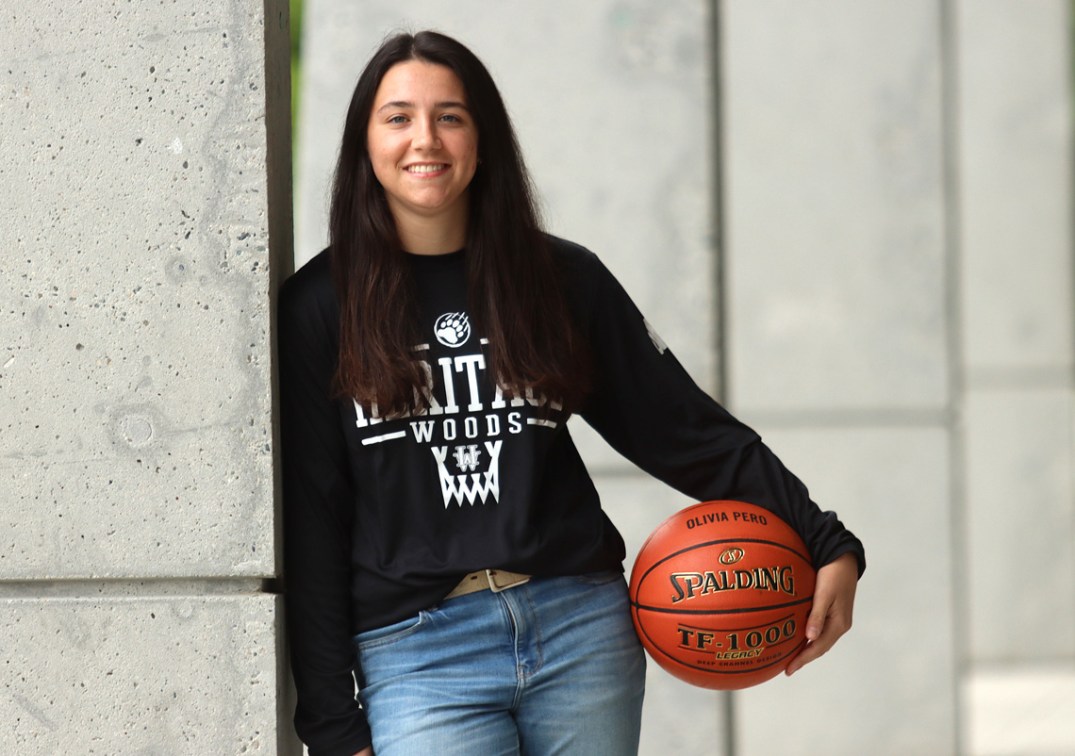
This story first appeared in the Tri-City News on June 13, 2021
Playing a game in front of a gym full of raucous, cheering fans is a highlight for most high school basketball players.
For Olivia Pero, it’s kryptonite.
The Heritage Woods secondary school senior is deaf, and though she has cochlear implants that allow her to have normal, verbal conversations, a loud gymnasium with sounds and vibrations reverberating off the walls, hardwood floor and ceiling can be overwhelming.
That hasn’t held Pero back, though. In fact, she said, it’s made her more resilient, competitive and prepared to advocate for her disability.
Pero’s deafness was diagnosed when she was just six months old. She received her first cochlear implant — a small electronic device that delivers sound signals directly into a person’s auditory nerve — shortly thereafter.
As the only deaf person in her family, Pero said it was important everyone have the ability to communicate normally, although she also knows American Sign Language (ASL).
But, she explained, the implants don’t deliver a perfect experience. Ambient noise fuzzes up the system so she has to be in close proximity and she also supplements the electronic signals that create a sense of sound by reading lips.
Achieving both of those in the frantic action up and down the basketball court, with teammates all around calling for the ball and the coach shouting plays and positioning from the bench can be a challenge, she said.
“I really can’t hear on the basketball court.”
So Pero’s adopted various coping mechanisms and worked to educate her teammates and coaches on how they can adjust to her unique needs. Some of those include getting them to enunciate very clearly and look directly her way when speaking to her. Her coach at Heritage Woods, Ross Tomlinson, uses cue cards and colour-codes plays on his iPad so she can process them visually rather than aurally.
“Yelling out plays was not an option,” said Tomlinson, who’s coached Pero since she was in Grade Five — a year after she picked up the sport at a Steve Nash camp.
“Your visual response and body language when communicating with a player is just as important as what you are saying verbally.”
Pero said her hearing disability has been both a blessing and a curse, on and off the court. The focus she’s had to learn to be able to follow conversations or absorb lessons in the classroom can serve her well in the chaos of moving bodies and waving arms during a basketball game.
But all that concentration can be wearying. By the end of a busy day at school, she’s ready to remove her implants and just settle in silence to read a book.
Pero said not being able to finish out her high school basketball career because of the COVID-19 pandemic that put the brakes on all school sports since March, 2020, has been difficult. The team continued to practice through the winter, but, she admitted, motivation sometimes flagged.
Instead, Pero said she channelled her competitive energy into her studies and she started a support group for other deaf and hard of hearing students called CoCo.
Invisible disability
She said because deafness is an invisible disability, it can be hard to get the hearing world to understand and empathize with the challenges deaf people face daily.
Connecting with other students in the school district and providing a sounding board for them to share their experiences has been an important outlet.
Pero said one challenge that’s been unique to the past year is the face-masks everyone is required to wear in school and out and about in the community because of the pandemic. They may help keep everyone safe by limiting airborne spread of the virus, but they also hide lips and facial expressions that are vital components of communication for the deaf.
Another was online learning where teachers giving lessons to a mix of live students and those watching from home still wore masks and sounds echoed around the classrooms so Pero sometimes couldn’t tell who was talking.
Starting anew
In the fall, Pero heads to Trinity Western University in Langley to study biology, play basketball and begin anew the process of educating her classmates, teachers, teammates and coaches about how best they can communicate with her.
She said the school’s reputation for small classes and inclusivity should smooth the process.
“My motto is ‘nothing is going to stop me, I’ll just find a way to make it work,’” Pero said.
“It’s my way of living in the world.”


 MARIO BARTEL