In the glory days of radio, this woman helped start a massive Port Moody electronics company

This story first appeared in the Tri-City News on April 10, 2021

The matriarch of a family that put Port Moody on the leading edge of electronics manufacturing for a decade in the 1950s and 60s has died.

Isabelle Chisholm passed away recently, at the age of 98. She was the widow of Edward Chisholm, who built a state-of-the-art manufacturing plant for radios and televisions sets in Port Moody in 1954. She was also the keeper of some of the company’s secrets.

As the chief purchasing agent for Vancouver Radio Laboratories Ltd., Isabelle Chisholm’s tasks included travelling to Ottawa to clear secret components for radio receiver sets used by the Canadian armed forces during WWII that were invented by Edward, and manufactured in his first plant, on Vancouver’s Main Street.

When the war ended, the company’s name was changed to Chisholm Industries Ltd., and it shifted production to table-top radios and phonographs as well as a fancy new technology — black-and-white televisions.

Edward Chisholm’s factory was the only such manufacturer west of Toronto, and Isabelle became the first female electronics salesperson.

“She was a dynamo of energy and conviviality who knew how to make a sale,” said Isabelle Chisholm’s obituary. “She was widely known for her ability to successfully connect with the public through telephone calls.”

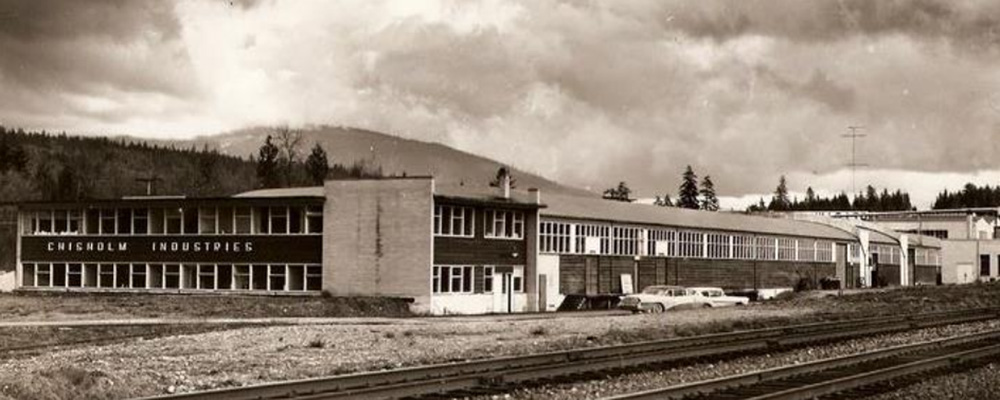
In 1947, the 12,000 sq. ft. plant in Vancouver was damaged by fire, and the Chisholm’s began casting about for space to build a larger facility. They found it in Port Moody, purchasing 23 acres along Murray Street, and construction began in 1954 on a new 56,000 sq. ft. state-of-the-art factory that also contained offices, a warehouse as well as sheet metal and tool and die shops.
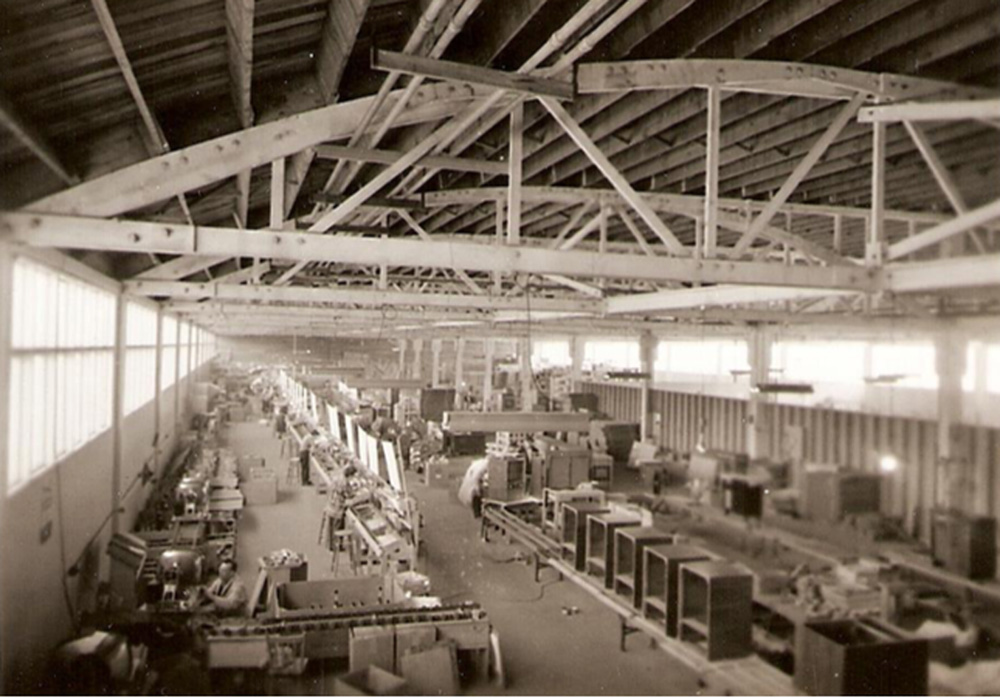
CANADIAN VINTAGE RADIO The factory floor at the old Chisholm Industries plant on Murray Street in Port Moody.

The new home for Chisholm Industries Ltd. opened the next year.

The sprawling main plant was 100 ft. wide and 14 ft. high. The assembly line for radios and TVs was 400 ft. long. There was a large baking oven to fuse paint to the metal surfaces and a cabinetry section to manufacture and finish the high-quality wood boxes that held the radios and TVs. All the engineering and design for products was done in-house.

At peak capacity, the plant could produce 200 units a day.

Chisholm’s products were renowned for their quality. They were sold at furniture stores like Wosks and department stores like Eatons, Woodwards, Sears and Hudson’s Bay.

But the advent of colour television changed the industry. The cost of retooling the plant for the new technology was too high, and more and more electronic goods were being engineered and constructed offshore, in countries like Japan.

By 1963, the factory floor at Chisholm Industries was mostly manufacturing wooden cabinets for other electronics companies like Bell and Packard. The following year, Edward Chisholm closed the plant, with much of its machinery going to his son, James, so he could start Glenayre Electronics in Burnaby.
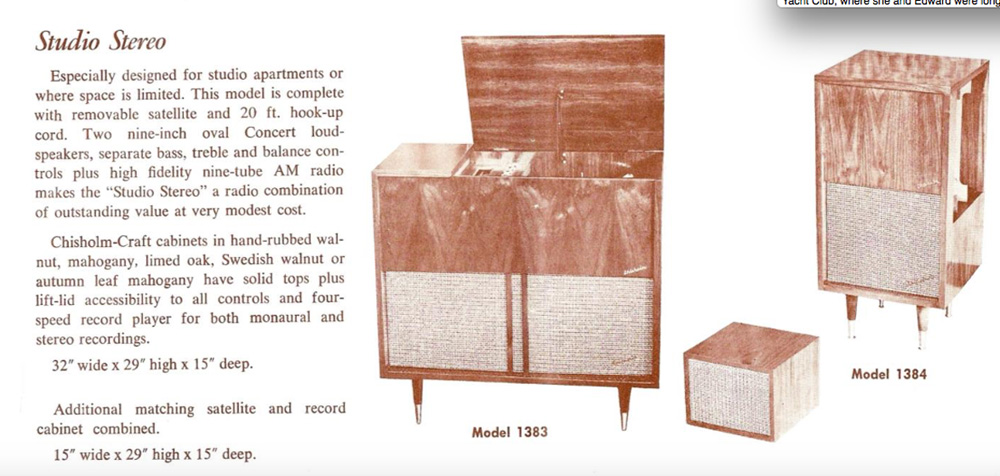
CANADIAN VINTAGE RADIO A catalogue listing for one of the home hifi systems built by Chisholm Industries in Port Moody.

The sprawling plant in Port Moody was rented to various industrial and commercial tenants, as well as artists, until it was demolished in 2010.

In 1967, Isabelle and Edward Chisholm retired to Victoria and began growing hydroponic tomatoes on an acreage they’d purchased, selling much of their produce to the Empress Hotel and Woodwards.

After Edward died in 1968, Isabelle became a successful realtor and joined boards of directors for several organizations like the PNE, ICBC, the Boys and Girls Club and the C.H.I.L.D. Foundation. She was also politically active with the Social Credit party in B.C., as well as the federal Reform, Canadian Alliance and Conservative parties.

According to her obituary, Isabelle Chisholm’s ashes will be scattered near the Royal Vancouver Yacht Club, where she and Edward were longtime members, and his ashes were also distributed.

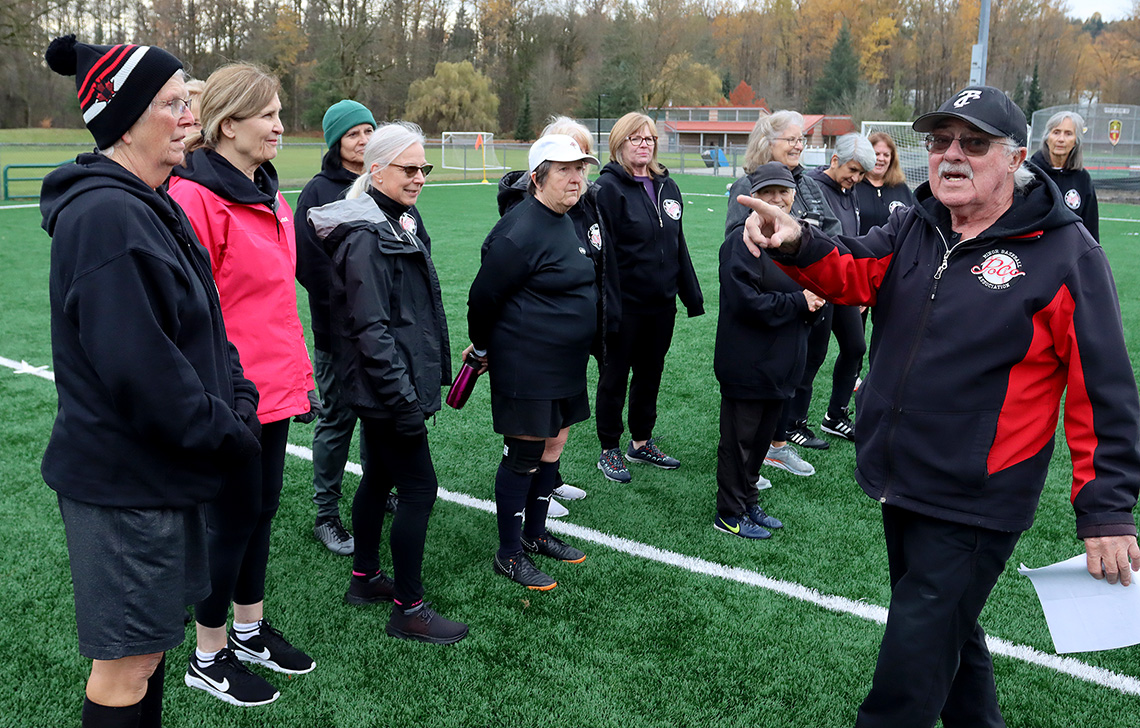
Even at a slower pace, these Tri-City soccer players still have a love for the game

This story first appeared in the Tri-City News on Nov. 23, 2023

The Tri-City Walking Soccer Club is proof in the pudding: you can take the players out of soccer, but you’ll never take the soccer out of the players.

The club started several years ago as an adjunct to the Dartmen, an affiliation of weekend warriors who’ve grown old together playing sports like traditional running soccer as well as baseball and hockey.

As members started to hit their mid-50s, many realized they were losing their stride. But instead of giving up sport altogether, they just decided to slow it down.

Walking soccer is just like it sounds, a modified version of “the beautiful game” without contact and played at a pace more comfortable for aging knees and joints.

It’s also played seven-aside on a smaller pitch — about half the size of a regular soccer field — at Port Coquitlam’s Gates Park.

Making new friends

Jim Swelander, who started the Dartmen in Burnaby back in 1969, said as the group has embraced their golden years, the social aspect of their sporting endeavours has taken precedence over competition.

“It’s about making new friends and staying in contact with old ones,” he said.

When the group, which ranges in age from 55 to over 70, invited women to start playing in their soccer matches the camaraderie and post-game revelry kicked up a notch with organized get-togethers every week at the Cat & Fiddle pub and other social events.

Denise Spletzer, 68, said she first attended a walking soccer match as a spectator but quickly decided the club needed a female touch even though she’d never played soccer before.

“I like to get exercise,” she said.

Spletzer invited some of her friends from her fitness class and from an initial contingent of seven just a couple of years ago, there’s now 43 women participating in the club’s mixed division alongside its male membership of 93, some of whom stick around for the more competitive men’s division afterwards.

Swelander said not everyone in the club comes out at once, of course.

Players come and go for the regular Tuesday matches that run year round (the league heads indoors to a facility in New Westminster during December and January) and new teams of seven players are created every week from those who do show up to play in the 25-minute halves.

Stoke competitive fire

Sue McInnes said the soccer matches are a way to bring back some of the competitive fire she last felt when she used to play field hockey in her younger days. But it’s the new friendships she treasures most.

“It’s fun,” she said. “The social aspect is the best.”

Swelander, who leads all the players through various warm-up exercises and skill drills for about an hour before the matches begin and then coaches from the sidelines once the opening whistle blows, said it can be a bit of a challenge keeping everyone on the straight and narrow given the wide range of soccer experience and ability on the pitch.

“It’s okay, as long as you have patience,” he said. “You’ve just got to remember you’re here for fun.”

Port Moody home relocation means more memories can be built

This story first appeared in the Tri-City News on April 2, 2024

Wendy Kinloch’s realtor questioned her sanity 34 years ago when she and her husband purchased the run-down rancher at 120 Windsor Dr. In Port Moody’s Coronation Park neighbourhood.

The single-storey home with a round fireplace in the middle of the living room had seen better days. But it offered more space to raise a family than their cramped townhouse in North Vancouver

“We knew it needed a lot of love,” said Kinloch.

Over the years, it got just that.

Almost every interior wall was rebuilt. The sundeck out back was replaced. The kitchen and bathrooms were renovated.

The house with green wood siding returned that love.

The Kinlochs raised two children there, and the myriad of their friends and visitors, who climbed the growing trees in the neighbourhood, ran through the sprinkler in the yard, drew with chalk on the street out front. They made connections with their neighbours, got involved in the community at Coronation Park School nearby.

“We looked out for each other,” Kinloch said. “It was just the greatest neighbourhood.”

So when Kinloch attended a special ceremony Tuesday, April 2, in front of her old home, which will be one of 10 from Coronation Park being sent by truck and barge to a second life for families in the shishalh Nation near Sechelt, she was sure to pack plenty of tissues.

MARIO BARTEL/TRI-CITY NEWS Wendy Kinloch gets emotional as she talks to councillors from the shishalh Nation near Sechelt that will be the new home for 10 homes from the old Coronation Park neighbourhood in Port Moody, including hers.

The homes are in the way of a new development project by Vancouver-based Wesgroup Properties that will transform the 14.8-acre neighbourhood into a dense, urban community with six residential high-rises up to 31 stories, three six-storey buildings and a four-storey office building.

While 49 homes will be demolished, a deal to save some of the homes was brokered by a company called Renewal Development in conjunction with Wesgroup and Maple Ridge-based Nickel Bros. that has more than 50 years experience moving buildings.

Kinloch, who relocated to a new home in Anmore last October, said knowing her home has received a second lease on life made it easier to return to her former neighbourhood where several houses have already been cleared and many trees removed.

She said it’s like a circle of life. “I didn’t want to come back to this neighbourhood to see it demolished.”

Renewal Development’s Glyn Lewis, said the transportation of the first two homes scheduled to take place overnight tonight is the closure of one chapter and the opening of the next.

“It’s a beautiful story.”

Lewis has been working on his plan to reclaim and repurpose homes in the way of redevelopment for about seven years. He said with the increasing cost of new construction and the environmental toll of demolition, it makes sense to recycle structurally sound buildings.

After a couple of successful projects moving a home from Coquitlam to Upper Gibsons and an old single-room schoolhouse from Vancouver’s Kitsilano neighbourhood to the Squamish Nation where it’s been converted into a children’s education centre, it was time to scale up and put the lessons learned through those two ventures into practice. He said he’s hopeful the project will help change the fate of the approximately 2,700 homes that are demolished in Metro Vancouver every year.

“Intention and thoughtfulness can shape the direction of change,” Lewis said.

Lenora Joe, the chief of the shishalh Nation, said her community is excited to be at the leading edge of that change.

MARIO BARTEL/TRI-CITY NEWS Members of the shishalh Nation near Sechelt give their thanks for 10 homes that are being moved to their community from Port Moody’s old Coronation Park neighbourhood.

Almost half the 1,600 people that comprise the shishalh aren’t able to live in the community because of its dearth of suitable and affordable housing; 200 families are on a waiting list to get new homes.

Reclaiming and moving homes is 30 to 70 per cent cheaper than constructing them new. And robust mid-century construction materials and techniques ensure the homes the shishalh are getting will last for generations to come, Joe said.

That continuity is important, she added.

“For us, it’s a new place,” Joe said. “But we’re also able to honour the history of the homes and respect that process.”

Darlene Hadden, whose home at 109 Windsor is another on the move to the shishalh Nation, said being able to see it welcomed elsewhere helps ease the emotional sting of leaving it behind.

Hadden said the house her family called home for almost 40 years was the epicentre for Christmas, birthday and wedding celebrations. Its walls contain memories of her two kids stealthily jumping out their windows so they could play in the expansive yard and forbidden skateboard adventures up and down the street.

“A house we loved, someone else will be able to love,” she said. “It means everything.”

‘I knew deep down he was in trouble’: How two Coquitlam brothers saved their dad from drowning

This story first appeared in the Tri-City News on June 5, 2022

Paul Carter beamed with more than just pride when his sons, Adam and Matthew, recently received rescue awards of merit from the Lifesaving Society.

The life they saved was his.

The Carters, along with his wife, Andrea, and their younger son, Daniel, 12, were with family friends enjoying a day at the beach at Haywire Bay in Powell Lake near Powell River on Aug. 1, 2021, when the boys decided to swim out about 100 metres to explore a nearby island.

Adam, who’s now 16, had recently received his National Lifeguarding certification and swims competitively with the Coquitlam Sharks. Matthew, 14, and Daniel also belong to the Sharks. So for them, the distance and cold water presented little challenge.

Left all alone on the hot beach, as his wife wandered off elsewhere, Paul could see across the bay to the island where his boys, their friends and dad seemed to be having a lot of fun.

“Why am I here all by myself?” he thought before wading into the water to begin the swim to join them.

Who’s at risk from drowning?

According to the Lifesaving Society, there’s an average 458 deaths by drowning every year in Canada. A quarter of them are between the ages of 50 and 64, almost 80 per cent are male, 34 per cent occur in lakes or ponds and two-thirds take place between the months of May and September.

Carter was right in the statistical wheelhouse. He just didn’t know it. Yet.

Halfway to the island, Carter began to realize the distance and cold water were more than his 50-year-old body and recreational swimming ability could handle. He’d gone out too fast and now he was paying for his hubris.

Carter paused to catch his breath, treading water for a minute or so.

Determined to reach the island, he resumed swimming. But 10 metres later he was exhausted.

‘I started panicking’

Carter tried to make up his mind whether he should continue going forward or turn back when a wave hit him square in the face. He swallowed a mouthful of water and began coughing violently, further depleting his waning energy.

Carter’s breathing quickened. His arms and legs slowed.

“That’s when I started panicking,” he recalled. “I did the calculation that I wouldn’t be able to get anywhere where I was safe.”

The eldest boy, who attends Heritage Woods Secondary School in Port Moody, said he just happened to be on the beach on the island’s leeward side when he heard his dad call out. While his friend’s father thought Carter was just messing around, Adam said his dad’s shout had a tone “I’ve never heard used before.”

In trouble

When Adam looked across the water, he could see Carter wasn’t moving much.

The instinctive drowning response, in which humans close to drowning focus all their attention on keeping their mouth above water to the exclusion of any useful effort to save themselves or attract attention, had taken over.

“I knew deep down he was in trouble,” Adam said of his father.

He jumped into the water and let his lifeguard training take over.

Reaching his dad, Adam rolled him onto his back and used his chest to elevate Carter out of the water. He told his dad he was going to be OK, implored him to kick his feet to help propel them back toward the safety of the beach.

By then, Matthew was also in the water.

‘We’ve got to do this’

“I knew it was an emergency,” he said.

When Matthew reached his dad and brother, Adam told him, “We’ve got to do this.”

He wrapped Carter’s arm around his shoulder and the three paddled to shore.

Carter said the whole incident took about five minutes to play out, but “in the moment it seemed a lot longer.”

Back on land, coughing out more of the water he’d swallowed, Carter became a parent again and checked on his boys.

They “looked exhausted,” he said. “You feel bad about the situation you put your kids in.”

Andrea, who was now back on the scene after being alerted by others about what was going on, transported the trio to the hospital to make sure they were OK.

The good scenario

It was during the drive Adam started to come to grips with what had just transpired.

“We just saved our dad from dying,” he said, adding he thought about all the different scenarios that could have happened, but “we got the good one.”

Carter said he was thankful he and his wife had encouraged their boys to take up swimming at a young age.

“You never know when it’s going to be important,” he said.

Young Daniel, who’d watched the whole event play out before him, said, “It’s just a good thing for everyone to learn.”

Since then, Carter said, the family’s often reflected on what happened. Sometimes, he said, he’s wracked with guilt.

“What if my family had lost me?” he said. “How tragic would that have been.”

Adam’s take is a little more pragmatic. “It felt like it was something I should have done.”

Daniel’s nonplussed.

“It could have been the worst day of my life, but now it was just a thing that happened.”

Still, Carter said, there are valuable lessons to be learned, especially as summer approaches and people begin heading to beaches to cool off.

“I made a few bad decisions,” he said. “Drowning doesn’t look like when you see it on TV.”

He’s one of the greatest villains in Canadian sports history. But this Coquitlam historian has a new take

This story first appeared in the Tri-City News on April 2, 2023

A Coquitlam historian is shining a new light on one of the greatest villains in Canadian sports lore.

Cedric Bolz, who graduated from Centennial Secondary School and is now the head of the history department at Douglas College, has published an alternate view of the famous 1972 Canada–Russia hockey Summit Series as it was seen through the eyes of Josef Kompalla, one of its referees.

Kompalla and fellow West German Franz Baader were among eight officials that also included four Americans, a Swede and a Czech, who were assigned to work the historic eight-game showdown between hockey’s two greatest superpowers at the time.

But Canadians old enough to remember the grainy live TV pictures from Moscow’s Luzhniki Ice Palace beamed into their living rooms and even classrooms that September 51 years ago likely recall Kompalla as Public Enemy No. 1.

Even those who’ve only experienced the series second hand through subsequent memoirs and documentary films have come to vilify Kompalla, said Bolz.

Authors and filmmakers have perpetuated the narrative that the amateur referee was out of his depth arbitrating games between hockey’s greatest professional players and the mighty Soviets.

Or worse, they surmised, he was a complicit East German.

Until now.

Historical oversight

Bolz’s book, The September He Remembers, flips Kompalla’s story and his role in the Summit Series on its head.

It is, Bolz said, “the first step in correcting a major historical oversight and adding a new chapter in the Summit Series’ growing, mutable legacy.”

Bolz said he first heard of Kompalla through his stepfather, who’d played professional hockey in Germany for several years before moving his family to Canada.

The veteran referee officiated more than 2,000 games including several world championships.

He was revered in Europe and even earned a place in the International Ice Hockey Federation’s (IIHF) Hall of Fame.

But in Canadian hockey lore, Kompalla is a reviled figure who seemed determined to derail the NHLers from affirming their superiority on the ice over the Soviet Union.

J.P. Parise physically attacked him after he’d been assessed a penalty.

He bore the wrath of a frustrated Alan Eagleson who threatened to pull the Canadian players from Game 8 when Kompalla drew the refereeing assignment for the decisive match and then threw chairs on the ice after Parise was penalized.

He was chased down hallways by players and team officials incensed by some of the calls he’d made.

Even after the series was decided, Kompalla was harassed by Canadian players on a flight to Prague for an exhibition game against the Czech national team.

A quiet life of retirement

When Bolz heard Kompalla was still alive and living a quiet life of retirement in Krefeld, Germany, he reached out, determined to reconcile the conflicting images of a pivotal character in hockey’s greatest drama who seemed to have been left behind by its history.

“I’m a historian,” Bolz said. “My job is to document voices and this was a voice.”

SUBMITTED PHOTO Douglas Collage history instructor Cedric Bolz (right) visits with German referee Josef Kompalla while working on a book about his role in the 1972 Summit Series. Behind them is a photo of Kompalla being attacked by Canada’s J.P. Parise after he was called for a penalty.

Over the course of three years of phone interviews and personal visits, Bolz constructed a picture of a modest man who still loves hockey but can’t understand how he’d become one of the sport’s most notorious characters.

“It was always baffling to him,” Bolz said.

Road blocks

Along the way, Bolz ran into road block after road block in his efforts to gain an understanding of how Kompalla had become so despised.

Players still alive like Red Berenson and Wayne Cashman wouldn’t talk to him.

Even Ken Dryden, the Hall of Fame goaltender renowned for his thoughtful ruminations about the sport and the author of two memoirs about the series, wouldn’t return his calls.

“A narrative had been crafted,” Bolz said. “Legend continues to trump the way things actually were.”

Bolz believes Kompalla was collateral damage, a convenient foil, in a hockey drama that was supposed to be a friendly cultural exchange in the spirit of detente that had started to warm the Cold War in the early 1970s, but quickly devolved into an athletic expression of the great divide that still existed between East and West when the Canadian NHLers realized their opponents wouldn’t be the pushovers as some observers had billed them.

Time is running out

Kompalla is now 87 and Bolz is all too aware time is running out to set the record straight and reform the referee’s legacy.

He hopes his book, academically annotated and cross-referenced through multiple sources, will help facilitate that.

Some who’ve helped shape the story of the Super Series over the past 51 years have taken notice and made overtures to correct the historical record, like the popular misconception that Kompalla was from East Germany when in fact he’d fled communist rule in Poland and settled in Germany’s democratic West.

As for the aging referee who continues to travel the German countryside to attend hockey games as a spectator, Bolz said he still holds out hope his contribution to the series will be recognized in a more positive light.

“He’s always wondered why he’s never been invited to any of the series’ anniversaries,” Bolz said of Kompalla. “It’s important to see him get some sort of closure.”

Toyota vs. Ferrari: A Coquitlam race engineer could soon be a part of motorsports history

This story first appeared in the Tri-City News on May 29, 2023

Deft thumbs at the video game controller has steered a Coquitlam man to one of the most storied car races in the world at one of the sport’s most famous tracks.

Ryan Dingle parlayed a childhood passion for the Gran Turismo video racing game to a career as a race engineer, first in Japan and now in Europe, where he’ll lead Toyota Gazoo Racing’s World Endurance Championship (WEC) Hypercar team at the 100th running of the 24-Hours of Le Mans, June 10–11.

It’s a daunting responsibility, said Dingle in an email interview. In addition to managing the team of engineers and technicians charged with preparing Toyota’s GR010 Hybrid Hypercar for race weekend and then keep it performing optimally for qualifying and 24 straight hours of racing at Le Mans, Toyota is the five-time defending champion at the event. And this year it will be up against an expanded grid that also includes new factory efforts from Porsche, Ferrari, Cadillac and Peugeot.

There’s “a lot of pressure now,” said Dingle, who’s in his first season in the WEC where most races are six to 24 hours long after cutting his teeth in the smaller Super Formula and Super GT race series in Japan.

“It is my first experience outside of Japan so most of the circuits are new to me,” Dingle said. “Working in a much larger team with more well-defined roles can also be challenging.”

PHOTO SUBMITTED Coquitlam’s Ryan Dingle started his career as a race engineer in Japan.

Dingle, a graduate of Dr. Charles Best Secondary School, headed to Japan after obtaining his engineering degree at the University of British Columbia and post-graduate studies in motorsport engineering at Oxford Brookes University in the UK.

Fuelled by his childhood love for Gran Turismo that evolved into an obsessive interest in Formula 1 and Endurance racing, Dingle identified Japan as his best opportunity to get work in the industry.

Trial by fire

With only one beginner class in Japanese at UBC, and the support of his family and his future wife — who happens to be from Japan — Dingle landed a gig in the all-Japan Formula 3 open wheel racing series.

It was, Dingle said, a bit of a trial by fire.

“The working style in Japan is quite different from the west, as is communication in general,” he said. “People often get frustrated and give up. I got frustrated too, but I guess I had the determination.”

Over the course of his nine-year career in Japan, Dingle managed to work for both Toyota and Honda, fierce competitors at the track and in consumer showrooms.

He said while such vacillation between Japan’s two car giants might be frowned upon in the country’s corporate world, it’s more accepted in motorsport.

“I think it’s been advantageous for me to see how both companies work,” Dingle said. “I like to approach each new place with an open mind and try to learn.”

Driven to succeed

No matter the badge on the car, though, the drive to succeed is universal.

“It’s not a career path where you feel at ease often,” Dingle said. “But when you get it right, you see the fruits of your labour rather quickly and it’s satisfying.”

Now that he’s based in Europe, Dingle said he’s excited to work at some of the race circuits, like Spa-Francochamps in Belgium and Monza in Italy, that he revered back in his video game racing days and when he was studying in England. But being able to compete at Le Mans is special.

“It means a lot to be a competitor in one of the most famous races in the world, and the 100th year,” he said.

“In a way, it’s a validation of the choices that got me to here. It’s a good feeling.”

Union says B.C. premier can help end the ‘crapification’ of local news

A union that represents journalists at several British Columbia media outlets says the provincial government needs to do more to prevent the spreading of news deserts as publications are closed.

Lana Payne, the national president of Unifor, and its western regional director, Gavin McGarrigle, said in a letter to B.C. Premier David Eby that great swaths of the country are being left without a local news source, hurting democracy.

They’re urging Eby to help reverse that trend by committing a portion of the provincial government’s advertising budget to support local news.

Last summer, Ontario Premier Doug Ford directed crown corporations like the Liquor Control Board of Ontario and the Ontario Lottery and Gaming Corporation to spend at least 25 per cent of their advertising budgets at news outlets based in that province.

Since 2021, New York City has required its agencies to direct 50 per cent of their advertising budgets to community and multicultural media outlets, including print, digital, radio and television.

Losing ‘scarce’ ad dollars

In their letter, Payne and McGarrigle said a similar directive by the provincial government “would immediately get badly needed revenue to news businesses who are losing scarce ad dollars to American and Chinese Big Tech firms” without spending additional taxpayer dollars.

In February, 2024, Eby called out “corporate vampires” for overseeing “the crapification of local news by laying off journalists” during an announcement in Coquitlam hours after Bell Media announced job cuts and the cancellation of several local newscasts.

Eby said media companies have a “corporate responsibility” to “ensure people get accurate, reliable information in this age of social media craziness.”

On April 17, Glacier Media — now called Lodestar Media — closed the Tri-City News, Burnaby Now and New Westminster Record, leaving more than 600,000 people without a robust, trustworthy source of local news.

Publisher Lara Graham said the publications, that had informed their communities for more than 40 years, were no longer sustainable due to “the industry’s ongoing financial challenges.”

The closures came 20 months after all three publications ceased their weekly print editions to exist only online.

Two days earlier, Port Moody council approved an expenditure of $50,000 this year and an $85,000 budget item next year to bolster its communications resources to help fill the growing “information gap” in the community and counter disinformation spread on social media channels.

Cross-Canada closures

According to the Public Policy Forum, more than 340 communities across Canada have lost local news providers since 2008.

An annual injection of $100 million for each of the next five years from online search engine Google as a result of Canada’s Online News Act that was passed in June, 2023, by the federal Liberal government with support from the NDP hasn’t done much to prevent closures either.

Two weeks after Glacier Media’s closed its three publications, the Canadian Journalism Collective that is responsible for disbursing the funds announced the company had received an instalment of almost $400,000 based upon the number of staff dedicated to the production of news it had on its payroll in 2023. Metroland Media Group in Ontario received more than $1.9 million despite filing for bankruptcy protection in Sept., 2023, and ceasing production of all 70 of its weekly community newspapers to move them exclusively online; 605 employees lost their jobs.

During a visit to Port Moody campaigning for April’s federal election, former NDP leader Jagmeet Singh conceded the Online News Act could use further refinement.

The legislation “did not have the teeth” to prevent more media closures, said Singh. “I want to see more protections in place against web giants that are taking up all the space.”

Unifor, which represents workers at Glacier’s recently shuttered publications, said B.C.’s Extended Producer Responsibility fees that make producers of plastics and packaging pay for their recycling also stacks the deck against local news outlets.

“The only catch is that newspapers are not packaging,” said Payne and McGarrigle in their letter to Eby. “They are the product — an important product that is already the most widely and most successful recycling material.”

The union said B.C. should follow the lead of Ontario, which exempted newspapers from the fee in 2022.

“The extra burden of this program on newspaper publishers will only create costs that cannot be afforded by an industry already stretched and facing so many obstacles,” said Payne and McGarrigle.

The struggle for affordable housing and what it meant when a Coquitlam woman found it

This story was originally published in the Tri-City News Nov. 10, 2024

Frances Stone had never lived in a home that requires a security fob or a building that has an elevator.

Recently, she and her teenage daughter moved into a gleaming two-bedroom-plus-den condo in Anthem Properties’ new SOCO project just off North Road in Coquitlam.

How Stone got there is a study in transformational importance of securing safe, affordable housing.

Stone and her daughter were living in a walk-up rental building in uptown New Westminster when her landlord informed her she needed to move so a family member could move in.

Stone, an addictions counsellor, considered uprooting to Alberta where the provincial government is offering financial incentives to newcomers and rents are much cheaper.

Then a friend told her about a partnership between the Affordable Housing Society and Vancouver-based developer Anthem Properties that would make 18 rental homes in two new condo towers in Coquitlam available at rates geared to tenants’ income.

According to the Canada Mortgage and Housing Corp.(CMHC), that means a tenant pays 30 per cent or less of their gross income for rent.

Secure future

Stone said since moving into her new home in August, it’s the first time in her adult life she’s felt secure about her future.

So much so, Stone said she’s in the final stages of adopting a rescue dog to add to her family, something she’s wanted to do for years but failed to pursue because of her ongoing housing uncertainty.

That’s music to the ears of Stephen Bennett, CEO of the Affordable Housing Society.

He said being able to live in a safe, affordable home impacts every aspect of a person’s life.

“We don’t understand what a lack of choice means for people,” he said. “Because it’s so unaffordable out there, people are stuck.”

Best interests of the community

As municipalities across B.C. strive to attain housing targets recently mandated by the provincial government, they’re also wrestling with the challenge of ensuring those homes can be accessed by a broad spectrum of residents.

“We still have to predicate all of our decisions based on what is in the best interest of our community as a whole,” said Port Moody Mayor Meghan Lahti about the pressure to approve the construction of more homes.

Bennett said affordability can only be achieved when all levels of government work together to provide necessary funding because the cost of constructing homes has spiralled so high. He said without subsidies and grants from programs through agencies like BC Housing, BC Builds and CMHC, rent for apartments could be as much as $5,000 a month.

‘It can often be a tightrope’

Melissa Howey, Anthem’s vice-president of development, said companies like hers are feeling the pressure as well, as they look to deliver housing stock that meets communities’ needs.

“It is balancing the costs, the availability of density,” she said. “It can often be a tightrope to walk.”

Howey said inflationary pressures and constraints on capital are making that tightrope even tauter.

Inclusionary zoning policies and negotiations for additional density can help spur developers to find creative solutions that will allow them to include affordable units in their projects, but the long process to get approvals means the landscape is always shifting.

“Every municipality operates differently,” Howey said, adding the navigation of those varying procedures comes with more layers of expense.

“It can be a challenge to deliver the other forms of housing in a project at somewhat affordable rates.”

In fact, Anthem recently had to scale back a plan to designate half the 128 units in a rental building its seeking to build in Port Moody to just 13. The company said its original intent proved “financially unviable.”

Complicated process

Bennett said his society is always working to devise new models to help fund affordable units, sometimes pooling financial contributions from several agencies.

But, he said, “to pull all those pieces together is exceedingly complicated and it takes a lot of work.”

Stone said she’s keenly aware of the challenge to provide enough affordable housing.

Prior to losing her apartment in New Westminster, she’d been on the BC Housing waiting list for five years. She said she’d also applied to every co-op in Metro Vancouver but “nothing was available.”

“It was pretty hopeless,” Stone said.

Now that she’s settled in her new home, though, Stone is starting to take advantage of her building’s host of luxurious amenities, like its indoor basketball/badminton court, the games and community room that features a full kitchen, a gym and yoga studio as well as an outdoor garden atop the parkade with seating areas, play structures and several gas barbecues. She said she’s keen to start a podcast that she can record in the building’s special sound room as well.

It’s a lifestyle Stone never imagined for herself.

“I would never have been able to work hard enough to live in a building like this,” she said. “It changes your perception of yourself.”

‘I took a leap of faith’: From the Coquitlam Express to the Stanley Cup finals

This story originally appeared in the Tri-City News June 4, 2024

A former member of the Coquitlam Express will be part of the Florida Panthers’ effort to win the Stanley Cup when their final series against the Edmonton Oilers begins Saturday, June 8 — by making sure every seat in the team’s Amerant Bank Arena is filled.

But Taralynn Reburn won’t be electrifying the packed house with ice-length rushes or thundering hits on Oilers’ superstar Connor McDavid.

As the Panthers’ vice president of ticket sales and service, Reburn relies on good customer service and building relationships with new fans to help grow hockey culture in South Florida. It’s a tall order in a part of the world where most people’s connection to ice is to keep their margaritas cold.

Fickle market

“This market can be quite fickle,” Reburn said. “Fans traditionally go in the direction of the team who’s winning.”

Fortunately for the BCIT grad who started her career as the director of sales and marketing for the Express from 2009-12, the Panthers have been doing a lot of that; this is the team’s second straight appearance in the Stanley Cup finals and they follow a run of three straight by Florida’s other NHL team, the Tampa Bay Lightning.

“We’re proving to the NHL that this is a hockey state with competitive teams and we’re a destination franchise that players want to be with,” Reburn said.

Following her stint with the Express, Reburn spent almost two years in sales roles with the Vancouver Whitecaps soccer team and more than eight years with the Vancouver Canucks. She said connections she made within the industry led her to Florida in 2022 even though she’d never been there before.

“I took a leap of faith and it has been great ever since,” Reburn said.

It’s also been a lot of work.

Engaging fans

Reburn said engaging fans in Florida requires a constant commitment to make them feel like they’re a valued part of the team’s success with perks like access to the Panthers’ new practice facility in downtown Fort Lauderdale and the organization’s involvement in youth hockey.

“Once people get into the building and see a game for the first time, they’re hooked and love the speed of the game compared to other sports,” she said.

Two consecutive years of Stanley Cup finals has also energized the market, Reburn said.

Panthers’ flags are draped on condo balconies, signs are planted on front lawns, restaurants and bars are tuning in their TV’s to the games.

“There’s a visible increased interest in the team,” Reburn said. “I overhear more conversations in the grocery store now about the Panthers than I ever have before.”

Even though Florida’s opponent is from north of the border, the ex-pat Canadian said she’s all-in to see the Cup remain in America, where it’s been ensconced since 1994.

“I’m 100 per cent Panthers on this one and have even converted a few from the west coast to cheer us on, too,” Reburn said.

But what if the cards had fallen slightly differently and it was her former employer, the Vancouver Canucks, that prevailed in the seventh game of its quarter-final series against the Oilers and then defeated the Dallas Stars?

“I was hoping for a Florida-Vancouver final,” Reburn said. “It would have been an exciting and unique opportunity. It’s just the beginning for this new core of the Canucks and their time will come.”

Port Moody man sets a world record — at 87 years old

This story first appeared in the Tri-City News on Oct. 6, 2023

A Port Moody man is proof you’re never too old to chase a dream.

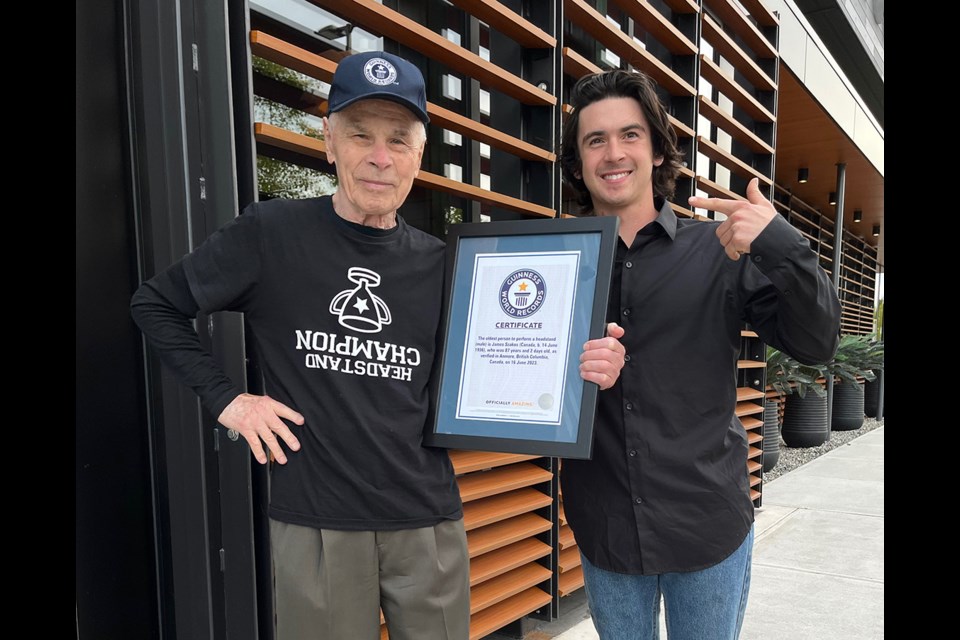
James Szakos is the oldest person to achieve a headstand. He’s 87, and he recently received confirmation of his status from the Guinness Book of World Records.

It’s not an accomplishment Szakos’ daughter, Andrea, ever imagined for her father, who hurt his back while removing a tree from the yard of the family’s home more than 40 years ago and was told by his doctor he’ll “never be the same.”

But it was just that dour prognosis that set Szakos on his journey to Guinness fame.

Andrea Szakos said her father took it as a challenge and when a physiotherapist recommended a rigorous regime of daily exercise might move him back to full health, he embraced it fully.

“He really believes in daily exercise every morning,” she said. “He’s in incredible shape.”

James Szakos said he didn’t feel he had any other choice.

He walks everywhere, cycles, swims and does exercises on the floor of his Suter Brook home.

He’s also pretty good at executing headstands, Andrea said. In fact, he’s even done them on a paddleboard in the water —when he was 80 years old.

So when a family friend noticed an online article about an 86-year-old senior who’d just claimed the world record for oldest headstander, James was enthralled.

“You know I can do it,” he said. “I want to set the world record.”

Szakos, who came to Canada after fleeing the Hungarian revolution in 1956 and built his family in Ontario before heading west four years ago, trained for two months while Andrea researched the process and procedures for claiming a world record.

She discovered her father would have to refine his technique, supporting his headstand with the palms of his hands rather than his fingertips as he’d been doing for so many years. He’d also have to hold his legs straighter.

When the big day came June 16, a crew of independent witnesses gathered in an Anmore home to document Szakos’ attempt. A yoga instructor was on hand to verify his technique, a phys-ed teacher was enlisted to operate the stopwatch and even a police officer was invited to add an air of authority to the proceeding, that was also recorded and photographed.

“It was very exciting,” Andrea said. “We knew he could do it.”

In fact, Szakos crushed it.

While Guinness required a successful headstand to last only 15 seconds, he held his for one minute and 13 seconds because he doesn’t want to see his feat eclipsed by some upstart 90-year-old.

“I could have gone longer,” Szakos said. “But my daughter said that was enough. She thought I was going to get dizzy or something.”

Andrea said her father is always trying to set a good example for his children and grandchildren.

“He encourages people to be their best,” she said.

Szakos recently received his certificate from Guinness authenticating his record, more than three months after Andrea had submitted all the required documentation. He said opening the envelope brought tears to his eyes. He treated his whole family to a celebratory dinner.

“I would never have dreamed I would be in the World Book of Records,” Szakos said. “This is a great feeling.”

But not just for him, added Andrea.

“At 87 to set a goal and work towards it, we’re very proud of him,” she said. “He’s like a local celebrity now.”