Flow device will make beavers feel at home

This story first appeared in the Tri-City News on Nov. 28, 2018

As the city of Port Moody works to create a strategy to manage beavers that take up residence in its waterways, a group of advocates for the industrious rodents is helping make one furry family feel right at home.

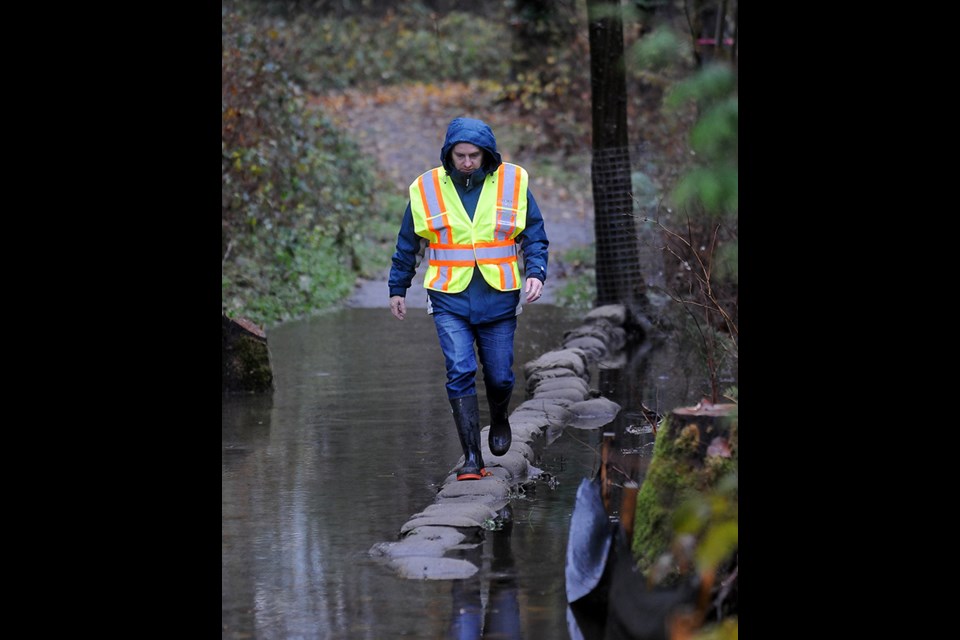
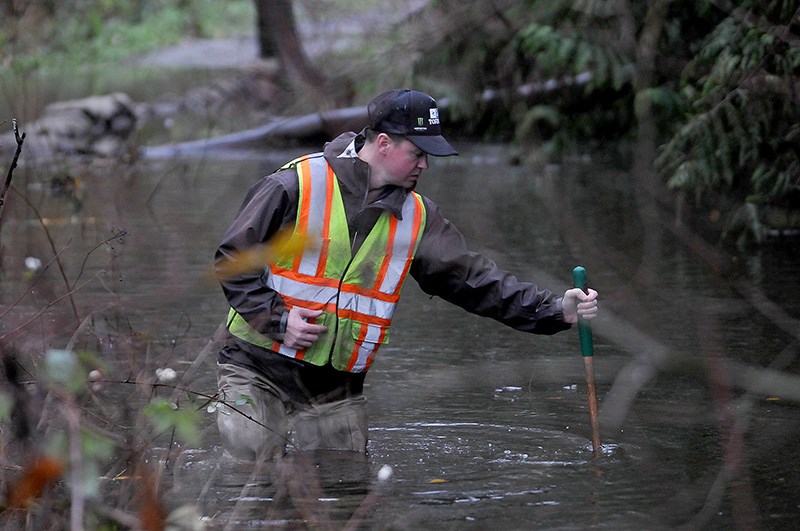
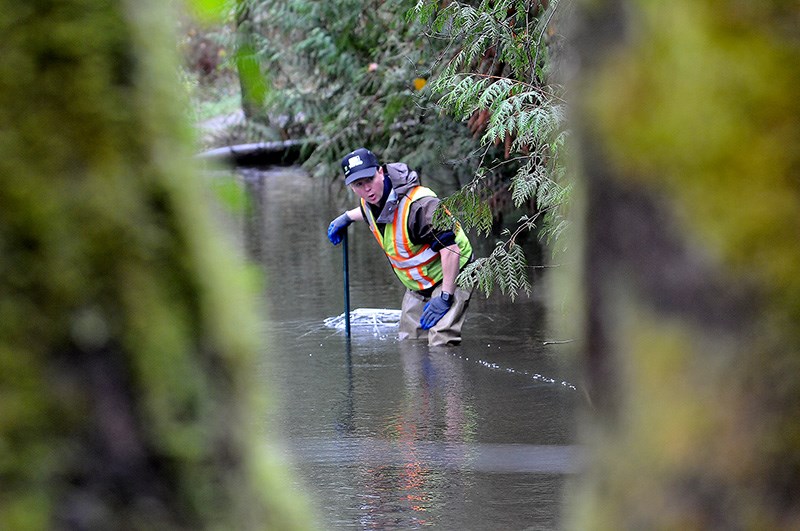
Volunteers from The Fur-Bearers along with local supporters like Jim Atkinson and his partner, Judy Taylor-Atkinson, were immersed in Suter Brook Creek last Friday, installing a device that regulates the level of water in the pond that has been created by a family of beavers between city hall and the public works yard.

The beavers moved there after they were displaced from their previous home in nearby Pigeon Creek when an attempt by the city to evict them from a drainage pipe went awry and a young kit was drowned.

Taylor-Atkinson said the flow device will drain water from the pond — formed when the beavers built a dam — to ease flooding while still maintaining a level high enough for the animals to feel safe.

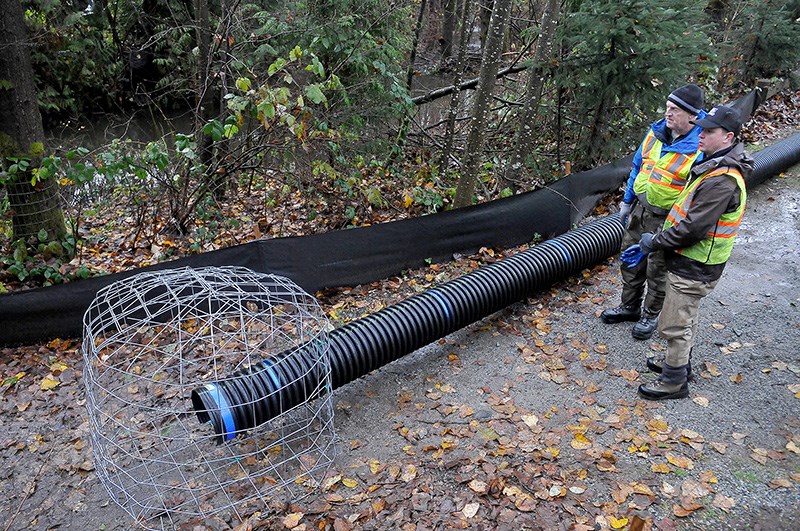
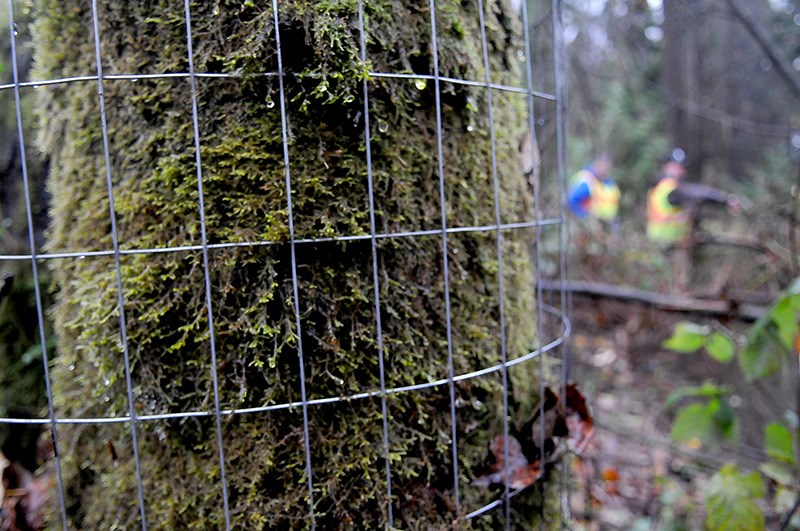
The device consists of a 40-foot length of double-wall, 12-inch culvert pipe with holes drilled into it so it can be sunk to the bottom of the pond. One end of the pipe is protected by a galvanized steel cage so the beavers can’t get in while the other end is inserted through the dam.

Taylor-Atkinson explained the effect is like punching a hole through the dam but the beavers can’t rebuild the structure or plug the pipe. She said after some initial curiosity, they will get used to the pipe and carry on with their lives.

“They need to have the water at a certain level to protect their home and family,” she said. “They’ll do whatever they have to do.”

The device was installed with the city’s blessing and several employees, including city manager Tim Savoie, stopped by to observe the work.

“This is a big step in the city’s beaver management plan,” Taylor-Atkinson said, adding she hopes interpretive signage can be installed to explain to visitors walking along the path that runs along the creek about what is happening. “I think the beavers will be fine.”

World Series still chills Little League players 35 years later

This story first appeared in the Tri-City News on June 7, 2019

A 35 year-old memory still makes the hairs on Brad Robinson’s arm stand up.

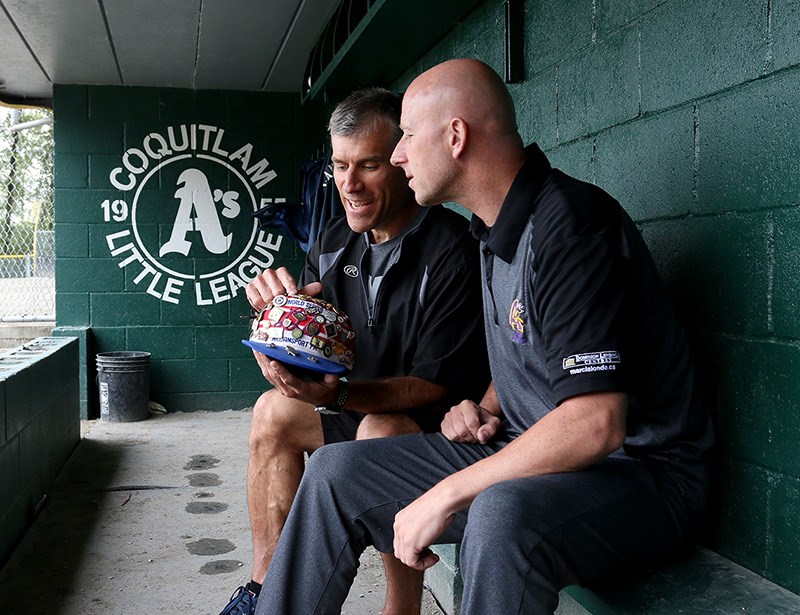
So the former Coquitlam Little League baseball player and current coach expects there will be plenty of chills when he and his teammates from the 1984 team that won a Canadian championship and went on to play in the Little League World Series in Williamsport, Penn., are honoured June 15 with a plaque installed at their home ballpark, Mackin Yard.

The passage of time hasn’t diminished the excitement a 12-year-old Robinson felt when the team’s bus pulled up to the famed stadium in Williamsport, aglow with lights in the August night. Or when they received telegrams of encouragement from hockey stars Wayne Gretzky. and Paul Coffey.

“O my god,” he said. “This is unbelievable.”

A teammate, Chad Hanson, said the experience of playing in the world famous tournament that, even back then, was broadcast live on network television, was “the closest I got to playing pro sports.”

In fact, Hanson’s experience even included an interview by one of television’s most famous broadcasters, the late Howard Cosell.

Although the reason he suspects he was singled out for Cosell’s ABC microphone may not have been so illustrious.

Hanson said he caused a bit of a stir in his team’s first game of the tournament, against Belgium, when he fell for the ol’ hidden ball trick in which a baseman feigns throwing the ball back to the pitcher, then secrets it into his glove and waits for the runner to step off the bag so he can be tagged out.

Hanson said, despite his embarrassing gaffe, that magical summer, in which the team from Coquitlam first bested powerhouse teams from Whalley Little League and Windsor, Ont., to win the Canadian championship in Moose Jaw, Sask., then went on to finish fourth in Williamsport, still resonates.

“It gave you confidence to meet new people through sports,” he said.

CONTRIBUTED PHOTO A team photo of the Coquitlam A’s team that represented Canada at the 1984 Little League World Series in Williamsport, Penn. They are: Front (l-r) Scott Leroux, Ryan Seminoff, Jason Lapierre, Chad Hanson, Brad Purdie, Glenn Wright and Greg mein. Back, Sandy Purdie (coach), Jason Hartshorne, Carl Sheehan, Chad Boyko, John Pollock, Bob McDonald, Brad Robinson, Greg Heximer and Lionel Bilodeau (manager).

A lot of those early connections were forged in barracks where all the kids from the eight teams were bunked through the course of the five-day event, eating their meals together, hanging out and playing between games.

“We were just kids,” Robinson said. “We were lucky enough to win some games and get there.”

While the team’s induction into Coquitlam’s Sports Hall of Fame in 2013 exposed their story to a new generation, Robinson said he tries to inform his approach to coaching his own Little League team with the lessons learned by his 12-year-old self.

“I definitely think it’s given me the experience to share with kids what can happen if you put the work in,” he said. “It just transfers over.”

Hanson said seeing how that team brought so many families together, including his dad who paraded around in a chicken suit as the team’s unofficial mascot, instilled in him a lifelong desire to share and give back through sport, which he still does as equipment manager for the Coquitlam Jr. Adanacs lacrosse team.

“It taught me to be the man I am today,” he said.

Though several players from the 1984 team have moved away, or will be unavailable to attend Saturday’s festivities, Robinson said most stay in contact, checking in through email or the occasional get-together. Their bond will endure, he said, especially as the 1984 team has so far been the only team from Coquitlam to ever get to Williamsport.

“It does make it special,” he said.

I was in a plane crash and lived to tell about it

Journalists share stories.

We also have our own.

A few months into my career, I got a call from the editor of the Burlington Post, where I was pulling weekend photo and relief reporting shifts.

“You wanna go up in a plane?” he asked. “It’s the best assignment of the year.”

The annual Hamilton Air Show was a couple of weeks away and the Canadian Warplane Heritage Foundation was offering a seat in one of its vintage WWII Harvard training aircraft to get photos of some of its other historic planes flying in formation to promote the upcoming event.

When I checked in at the Mount Hope airport, I was escorted to a hanger and introduced to my pilot, who showed me how to strap on my parachute in case anything went wrong and we had to bail out.

He also told me what to expect during our flight, how to communicate my needs to get the photos I required and to hang on very tightly to my film, because if I dropped it, the canisters would roll down into the back of the hollow fuselage.

As I recall, it was a beautiful August afternoon. The flight was smooth, if a little noisy, especially when I slid the canopy back to aim my lens at the neighbouring planes.

On our way back to the airport, I settled in to enjoy the scenery, as I maintained a death grip on the three or four rolls of Ektachrome and B&W film I’d shot.

Passing over the farms that surround the airport, I noticed the vehicles passing on the roads beneath us seemed a little large considering our distance to the runway. A herd of cows, their markings easily distinguishable, barely stirred as we passed overhead.

And still the runway seemed far off.

We cleared the airport’s perimeter fence, barely.

Then, our excursion got really bumpy. Dust billowed up into the cockpit area.

We shuddered to a stop, the runway still a couple of hundred metres distant.

In my headphones, the pilot calmly advised we should probably climb out. Once safely away from the aircraft, he explained the single engine had quick during the return leg of our flight and when it became apparent we couldn’t make it to the runway, he left the landing gear up so the bumpy landing on the field wouldn’t end up flipping us over onto our heads.

The pilot said he hadn’t told me any of this beforehand, so I wouldn’t panic.

A veteran captain for Air Canada, he was a little concerned about the plane’s bent prop and any possible damage to its undercarriage; it was his own aircraft.

I was just relieved I was still in one piece. And that I’d managed to hang onto all my rolls of film.

Port Moody ice cream maker fuelled by fitness

This story first appeared in the Tri-City News on Oct. 2, 2018

If your idea of a post-workout treat is a high-protein shake or thick fruit smoothie, you’re not Hamid Haji.

He heads for the freezer to scoop himself some ice cream.

In fact, the karate sensei and yoga instructor who runs Pro-Fit Boot Camp in Port Moody with his wife, Kelly Pearce, loves the frozen desert so much he embarked on a mission to make his own.

Fitness and indulgence don’t have to be mutually exclusive, said Haji, who has been part of the city’s fitness scene for 20 years.

“You limit yourself but you don’t have to cut yourself off,” he said. “Limitation makes the rewards sweeter.”

Two years ago, Haji set out to make the best ice cream he could. He and Pearce toured artisanal ice cream shops around the Lower Mainland, sampling their wares, chatting with staff and customers, trying to deconstruct their secrets. Then the couple would put their findings and intuition to work in their kitchen and share the results with clients at their gym.

“They were our guinea pigs,” Pearce said.

Armed with their feedback, they’d head back on the road to source local, natural ingredients and return to the kitchen to experiment with new flavours and conquer new challenges, like concocting a vegan ice cream that doesn’t skimp on creaminess despite its lack of, well, cream.

At some point, Haji’s quest outgrew their counter and freezer space at home, so he and Pearce decided to convert a storage area at the back of their St. Johns Street gym into a white-tiled, stainless steel ice cream factory. Several weeks ago, they christened it Vashti Rose, after their eight-year-old daughter, and started offering the frozen fruits of their labour to the public, one or two scoops at a time.

For now, the ice cream shop is only open on weekends as health regulations don’t allow Haji and Pearce to operate it at the same time people are sweating their workout in the adjoining gym. But kids are free to burn off some of their ice cream-fuelled energy on the matted floor while their parents savour a scoop of salted caramel or cookies and cream at the expansive white countertop.

Haji said he and Pearce have developed more than 100 flavours but they put only 11 of them in rotation at a time. And they’re open to requests, which have already included toasted marshmallow, mint flake and even saffron.

Could the Shoreline Shuttle roll back into Port Moody?

Port Moody’s Shoreline Shuttle could be making a comeback.

Mayor Meghan Lahti says the free service that connected the city’s Inlet Centre area to Rocky Point Park, Brewers Row and the downtown heritage district for the summer in 2018 but then was deemed too expensive, could be paid for with revenue from paid parking.

Council will debate Lahti’s motion to revive the service at its meeting on Tuesday, June 10.

In a report, the mayor said the shuttle service would reduce traffic congestion, improve safety for pedestrians and improve air quality.

“Perhaps more important though,” said Lahti, “ensuring that transportation to the busy area is accessible to everyone, regardless of economic status, will promote inclusivity and enhance community engagement.”

Lahti said money from the city’s parking reserve fund could be used to relaunch the service, As of Dec., 2024, that amounted to $72,500.

The pilot shuttle program in 2018 was budgeted to cost $50,000, including the cost of contracting a 20-passenger bus and the installation of signs for its 13 stops. The service ran every 30 minutes on weekend afternoons and evenings until midnight on Fridays and Saturdays and 10 p.m. on Sundays. Adjustments were made to accommodate extra demand during events like RibFest, Canada Day and car-free day.

Despite a $20,000 subsidy from Richmond-based developer Panatch Group to operate the shuttle, council decided in 2019 it was too expensive to continue the pilot. A report estimated the 3,700 rides ended up costing $13.50 per passenger.

Rob Vagramov, Port Moody’s mayor at the time, said it would have been cheaper to put every passenger in a taxi or limo instead.

“Not every idea pans out exactly as we’d hoped,” he said.

Lahti said now that the city is charging for parking in busy areas like Rocky Point Park, along Murray Street and around Eagle Ridge Hospital, a portion of revenues could support relaunching the shuttle service.

“By utilizing pay parking revenue for this shuttle, the community directly benefits from the fees paid by users,” she said in her report. “It creates a sense of accountability and transparency about how the funds are being used.”

According to the report, the pay parking stations generated $158,120.70 in gross revenue since they were implemented midway through Sept., 2024 through March, 2025.

Cutting hair and cracking jokes for 50 years

This story first appeared in the Tri-City News on Aug. 2, 2018

Accounting’s loss has been Coquitlam’s gain.

For 50 years.

That’s how long Ted Bordeleau has been cutting hair at Plaza Hairstyling and Barbers in the old Burquitlam Plaza on Clarke Road, an occasion he marked Wednesday with snacks and refreshments for his customers and $2 haircuts — but only if they showed up with an actual $2 bill because that’s what he charged when he first started in the business Aug. 1, 1968.

And if a customer didn’t have a $2 bill, since it’s been out of circulation since 1996, Bordeleau said he’d be happy to sell them one of his — “for $25.”

In Ted’s venerable shop, every story has a punchline.

Even the one about the elderly customer who expired in his chair back when he was learning his trade at Moller’s Barber School on Hastings Street in Vancouver.

After perfecting his straight-edge shaving skills first on a bottle, then a balloon, then other trainee barbers, Ted had finally graduated to giving shaves to real, live customers, many of them elderly or impoverished who put their necks on the line for the young apprentices in exchange for cut-rate haircuts. When one of those customers failed to flinch after Ted nicked him, he called over his instructor, who checked if the client was breathing, then confirmed the worst.

“I cut him three times,” Ted recalled. “No wonder he didn’t bleed.”

Ted almost didn’t become a barber. He loved numbers and was studying accounting when his grandfather urged him to pick up clippers because, he told Ted, “We need barbers.”

Ted trained at Moller’s for six months, then embarked on a two-year apprenticeship, as per the requirements to obtain a provincial barbering license at the time. He said he would have stayed another six months at barber school but he couldn’t afford the bandages.

Again with the punchlines.

Over the years, Ted has cut hair for generations of families as customers whose locks he first tended when they were kids bring in their kids and, eventually, their grandkids. He has trimmed politicians’ pates, CEOs’ sideburns and manes of people who’ve walked out of his shop without paying.

Some of his longtime customers travel hours out of their way to keep getting their hair cut by Ted. And when they walk through his door, there’s no guarantee they’ll be served right away because Ted doesn’t take appointments.

Ted met his wife, Jean, in front of his barbershop. She drove by in a bright pink 1957 Buick with fins, and Ted loves cars, so he ran out the door to ask for the driver’s phone number.

“She wasn’t quick enough to give me the wrong number,” Ted said.

He’s also found love for some of his customers, matching them up with female friends, acquaintances or just regular visitors who passed by as they shopped at the once bustling plaza.

Oh yeah, there’s that.

As the big city caught up to the suburbs, Burquitlam Plaza lost much of its bustle. The butcher shop left, so did the video store. SkyTrain severed part of the sprawling parking lot and the Safeway grocery store moved into the first two stories of a gleaming new condo tower on the corner. Many of the storefronts between the Dollarama and Value Village are dark.

The neighbourhood has changed, too, Ted said. Fewer families can afford to live there as small apartment blocks and modest mid-century bungalows are gobbled up by new development, so he’s not giving as many first haircuts to tentative toddlers.

But Ted perseveres, propelled by stories exchanged, friendships made and the knowledge that, while everyone may not need the services of an accountant, everyone at some point needs their hair cut.

Patient and saviour reconnect after Coquitlam Crunch heart attack

This story started when we heard about a sign affixed to some fencing alongside a popular uphill hiking trail. It first appeared in the Tri-City News on May 10, 2018.

Tanya Leibel had just witnessed evidence of humanity at its worst when she received a very personal reminder of humanity at its best.

Last month, 66-year-old Port Moody woman was in her hotel room in Krakow, Poland after visiting the Auschwitz concentration camp, where more than 1.1 million prisoners were exterminated during the Second World War, when she got an unexpected call on her cellphone.

That call would connect her to the person who had saved her life.

A year before Leibel took a bucket list tour of Europe that also included stops to see the Churchill War Rooms museum in London and Anne Frank’s home in Amsterdam, she was just another Tri-City resident hiking the Coquitlam Crunch. It was a dreary spring day and her son-in-law, Chris Langridge, had just passed her on the stairs, dialled into the music on his headphones, when she suddenly felt dizzy.

‘I knew I was in trouble’

Leibel had been climbing the Crunch’s stair section three times a week for about a year, so she was confident her fitness wasn’t flagging.

Then she felt pressure on her chest and her arm went numb.

“I knew I was in trouble,” Leibel said this week.

She called to Langridge up ahead but he couldn’t hear her because of the headphones. She waved her arms and he happened to glance back, seeing her distress.

He sprinted down to Leibel and called 911.

She sat on a rock, then passed out.

Just below them on that day, Tammy Bryant, 58, was on an exercise break from her job driving school buses for First Student Canada, chatting and solving the world’s problems with a friend, when she saw Leibel slip from her perch. The women ran up to her.

Quick action

Bryant, who just two days earlier had completed her CPR re-certification program as required by her job, leaped into action. She placed her favourite foul-weather jacket on the ground to protect Leibel from the rain-soaked earth, then began assessing her unexpected patient.

“I thought she was having a seizure,” Bryant said.

But when Langridge told her he thought his mother-in-law was having a heart attack, Bryant said she “put into motion what we had just learned.”

She applied steady, rhythmic compressions to Leibel’s chest as she hummed the Bee Gees’ disco hit “Staying Alive” because that’s what her instructors had advised.

“I had the cadence and rhythm, and that’s all I concentrated on,” Bryant said.

After about 12 minutes, first responders from Coquitlam Fire and Rescue arrived and took over. BC Ambulance paramedics arrived and applied a defibrillator twice, then loaded Leibel into their ambulance.

That was the last Bryant saw of the woman she knew only as Tanya.

Search for closure

Subsequent calls to Eagle Ridge and Royal Columbian hospitals, as well as Coquitlam RCMP, failed to turn up any information about Leibel’s fate because of privacy laws.

Bryant and her friend often chatted about that day on their subsequent hikes but they eventually became resigned to the likelihood they would never know whether Leibel had survived. They just resolved that she had lived and that was that, Bryant said, adding, “It was over and forgotten about and seldom mentioned again.”

Until this spring.

Bryant’s son and his girlfriend were halfway up the Crunch when they spied a handwritten sign affixed to some construction fencing just below Lansdowne Drive.

It read: “Did you save my life with CPR here? Please call me. Would love to thank you.”

Confusion

After she passed out on the rock, Leibel has no memory of what happened next. She was transported to RCH in New Westminster, where Dr. Albert Chan, a cardiologist, installed two stents to overcome blockages in her coronary arteries. She recovered from surgery in the hospital’s intensive care unit. Family gathered, her son flew in from Iraq, where he works in the oil fields.

“I was confused by all these people around my bed,” Leibel said.

Five or six days later, she went home, where her daughter lives in the basement suite and was able to care for her as well as take over tending to Leibel’s husband, who has dementia.

Leibel reflected on the circumstances that got her back to familiar environs, back to the embrace of her family.

“It was a master class in organization, precision and professionalism,” Leibel said. “Everyone did everything perfectly.”

When Leibel was able, she visited the fire hall to thank the Coquitlam firefighters who’d tended to her. She thanked Dr. Chan, too.

“But nobody knew who the lady was who saved me,” she said.

Filling in the blanks

Life carried on. Then, as the first anniversary of her second chance approached, Leibel reinvigorated her effort to fill in the blanks of her survival story.

She put up the sign just before embarking on her European trip because “it’s a big deal to save someone’s life.”

“It really centres you and focuses you on what’s important,” she said of her brush with mortality and the rush of circumstances that brought her back.

“Kindness has always been the ultimate gift — it has a ripple effect.”

Afraid to call

Bryant said when her son and his girlfriend told her about the sign and its location, she knew she was the person its author was seeking. But she was too afraid to make the call herself and kept putting it off.

It was her son’s girlfriend who was on the other end of the line when Leibel picked up her phone in that hotel room in Poland.

Once the details were confirmed, they arranged a connection for when Leibel returned from her trip. The patient and her rescuer met in person recently at the Tim Horton’s not far from the base of the Crunch.

“It was very emotional, overwhelming,” Leibel said.

“It’s up there with the birth of your first child,” Bryant said. “It was wonderful.”

For Leibel, her gratitude knows no bounds: Bryant not only saved her life but also spared her family the pain and heartache of her absence, she said.

For Bryant, meeting Leibel not only means the story of that day continues happily but it also confirms the importance of knowing a life-saving skill like CPR.

“I needed to know whether it worked,” she said. “I needed the affirmation. It was easy to save a life.”

Old-world press has a famous connection

In 2018, happenstance reconnected me with one of my favourite stories of my career. A local historian had acquired a vintage letterpress that had once belonged to a renowned typographer in New Westminster whom I had photographed back when I worked at the NewsLeader.
I did two takes on the story; a personal recollection of that reconnection for the New Westminster Record, the paper I once competed against, and this more general feature for the Tri-City News.

These words you’re reading were crafted by the reporter then turned into digital zeros and ones before being printed on paper or uploaded to the internet.

Not so many years ago, the craft of printing words on paper was a much more involved, laborious task that involved dozens of skilled journeymen and tons of heavy machinery.

Each word, paragraph and story committed by the writer to paper had to be assembled into frames with cast lead dies, letter-by-letter, punctation mark-by-punctuation mark.

Those heavy frames, or chases, were then placed into large presses where rollers inked the raised metal letters and then pressed paper to them to create a printed page.

But like so many arduous processes borne of the Industrial Age, manual typesetting and printing is becoming a craft lost to the speed, efficiency and cleanliness offered by computers.

“There is a problem when we go too fast,” said Markus Fahrner a Port Moody graphic artist who’s also the coordinator at the city’s Station Museum.

So, in an effort to slow the process of printing down and reconnect with the skills he first learned as a boy growing up in Germany where his mother was a book designer, Fahrner acquired a Colt Armoury press that was likely built by the gun manufacturer in 1914.

But this is no ordinary old press.

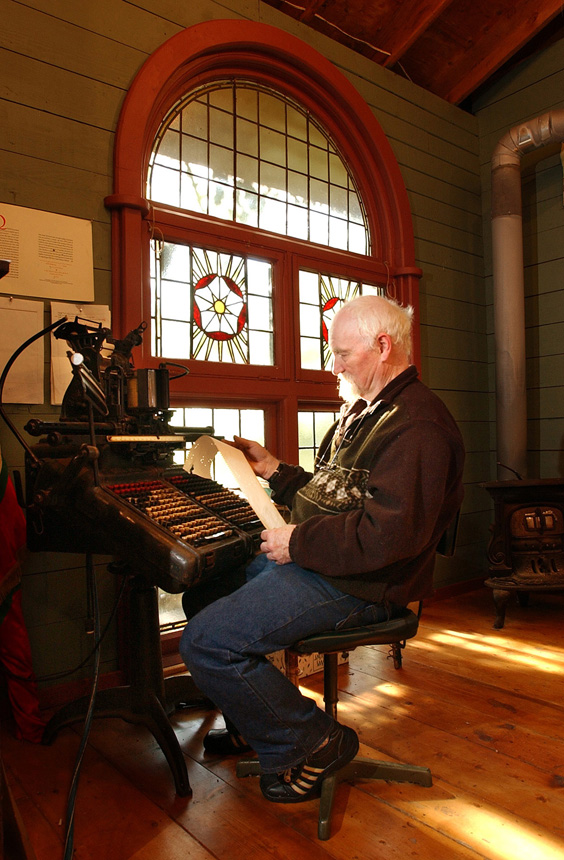
It was once owned and carefully maintained in working order by Jim Rimmer, a world-renowned typographer and letterpress printer who kept the old-world craft alive from a studio behind his New Westminster home until he died in 2010.

MARIO BARTEL/THE TRI-CITY NEWS The late Jim Rimmer at work on one his vintage typesetters in the studio of his New Westminster home in 2004. Rimmer was a world-renowned typographer who salvaged and restored old printing press machinery and then used them to create fonts and print limited edition posters and books that were coveted by collectors.

The stained glass lit studio and Rimmer’s basement were crammed with old letterpresses, typesetters and spare parts salvaged from print shops that had moved on in technology. He restored the machines and designed dozens of typefaces in metal for printing limited edition books, posters and one-sheets that were coveted by collectors around the world.

Shortly after his death, he was awarded the Robert R. Reid award for lifetime achievement or extraordinary contributions to the book arts in Canada by the Alcuin Society, a volunteer society dedicated to the artistic side of printing books.

Fahrner said he couldn’t believe the good fortune of his find.

While much of Rimmer’s printed works, printers’ dummies, manuscripts and type design work was acquired by the Simon Fraser University library after his passing, the fate of his collection of heavy machinery was less certain.

Fahrner said it’s important to keep the old machines running rather than have them end up as decorative curios in restaurants or antique shops.

“I really admire the craft,” Fahrner said. “I love the way it forces you to slow down.”

In fact, a poster that might take Fahrner a couple of hours to design on a computer can take days to assemble and print on the letterpress.

“It’s slow and precise,” he said. “You suddenly have so much to know about the process, like the way the ambient temperature of the room affects the ink, the type of paper you’re using, how heavy an impression you want to make on the paper.”

The end product, Fahrner said, has a depth and life that can’t be produced digitally.

“There’s an intrinsic love and energy in the things you produce,” he said.

And an eternal connection to a craft whose purpose hasn’t changed since Johannes Gutenberg invented the printing press in the 15th century, even as its technology evolves.

Todd Labranche has been booed by lacrosse fans, players and coaches for 21 years. He’s loved every minute of it

This story first appeared in the Tri-City News on April 13, 2022

Todd Labranche decided pretty quickly that an ongoing problem with shin splints would limit his lacrosse aspirations as a player.

So the former PoCo Saint pulled on a striped referee’s jersey.

On Saturday (April 16), Labranche will officiate his 400th National Lacrosse League game, between the Vancouver Warriors and Calgary Roughnecks at Rogers Arena.

He’s one of only two referees in the pro league to reach the milestone.

Labranche, who grew up in Port Coquitlam but moved to Red Deer, AB, in 2014, said he fell in love with the speed and athleticism of lacrosse the minute he picked up a stick and ball when he was nine years old.

A few years later — as soon as he was allowed — he supplemented his passion by refereeing mini-tyke games.

Wear and tear

Labranche played in the Saints system through junior. But the sport’s quick starts and stops, turns and cuts across the floor pained his shins so much he could never finish a game. Referees, however, move mostly in straight lines.

So Labranche put away his lacrosse stick and devoted himself to officiating, working his way up through the ranks until he was hired at the age of 22 as one of three part-time referees at the time in the Western Lacrosse Association.

As the “new kid” with a whistle, Labranche opened his ears to learn all he could from senior officials in the league like future Hall-of-Famer Ron Crosato and Ray Durante.

Labranche said they taught him how to carry himself on the floor, how to talk to players and coaches so each would walk away feeling like they got a fair shake.

They showed him the importance of developing thick skin and a short memory because no referee is ever perfect and they can’t afford to dwell on past mistakes.

Don’t take it personally

Most importantly, Labranche said, he learned how not to take things that happen in a lacrosse game personally.

“Lacrosse is so subjective,” he said. “Not always is everybody going to agree with your opinion.”

A chance encounter with lacrosse legend Chris Gill at Coquitlam Centre mall in 2001 led Labranche to apply for a referee post at the NLL, just as the pro league awarded a franchise to the Vancouver Ravens.

Now, instead of being the bad guy in front of several hundred people in dark, local barns like the old PoCo Rec Centre or New Westminster’s Queen’s Park Arena, he would bear the scorn of 10,000 or more fans, with his every error or missed call replayed on the giant video scoreboards overhead and potentially inciting even more wrath.

Labranche said he also had to wrap his head around the multitude of rule differences between the way lacrosse is regulated by the Canadian Lacrosse Association and by the pro game, as well as making himself heard over the constant din of loud music that plays through games in the big league arenas.

Still, when Labranche was standing on the floor of the Marine Midland Arena in Buffalo with 19,000 fans singing the national anthems prior to the NLL’s championship game in 2008, he said the hair stood up on his neck with the thrill of it all.

Players are getting quicker

Over the course of his 21 years as an NLL official, Labranche said he’s seen the players get quicker and more skilful.

“Everyone can score goals, everyone can play defence,” he said. “The pace has increased dramatically.”

Labranche said the secret to his longevity has been coming to terms with his role.

“It’s really just a feeling of how you managed the game,” he said. “We know we’re not going to get everything; there’s some calls that will be left out there. But you have to make sure the players are safe.”

Now 57, Labranche figured 400 pro games would be his ultimate achievement in lacrosse.

But two seasons lost to the COVID-19 pandemic bought him time to build a gym in his basement so he could be in shape to shoot for 500.

“The league is getting younger and I’m not,” Labranche said.

But, he added quickly, “I love the game.”

Revised Port Moody proposal still poses problems: report

A proposal to construct a six-storey commercial building on the south side of St. Johns Street next to the Spacca Napoli restaurant has now become a mixed-use project that includes 52 residential units with commercial and retail spaces on the ground floor.

But challenges remain.

According to a report by Port Moody senior planner, Dejan Teodorovic, concerns about the viability, height and massing of the project’s previous incarnation after it was reviewed by the city’s advisory design panel, land use committee and council’s committee of the whole, caused the proponent to withdraw their application for zoning amendments and begin anew.

The 52 residential units in the revised version that is also designed by Mara + Natha Architecture, include six affordable apartments that would be available at below-market rents.

But, said Teodorovic in his report, that’s still below the 15 per cent required by Port Moody’s inclusionary zoning policy.

Also, said Teodorovic, the new proposal doesn’t address worries about the future of a mature red oak tree — one of the oldest in the city — at the rear of the property, as well as several other trees that would have to be removed to accommodate construction.

“There is not planned tree retention or room for future mature trees that will mitigate the urban heat island effects and canopy coverage challenges in the St. Johns Street corridor.”

The planner also noted the number of units is a lot to cram onto two single-family lots, “which impact the ability of the development to achieve urban design and livability standards.”

Teodorovic suggested the proponent acquire a third property to lessen the building’s density. The property to the east is currently occupied by a single-family home, while a commercial building with the pizzeria, a butcher shop and the Block 8 Academy child care and education centre is to the west.

Port Moody’s land use committee will get its chance to review the revised application on June 2.