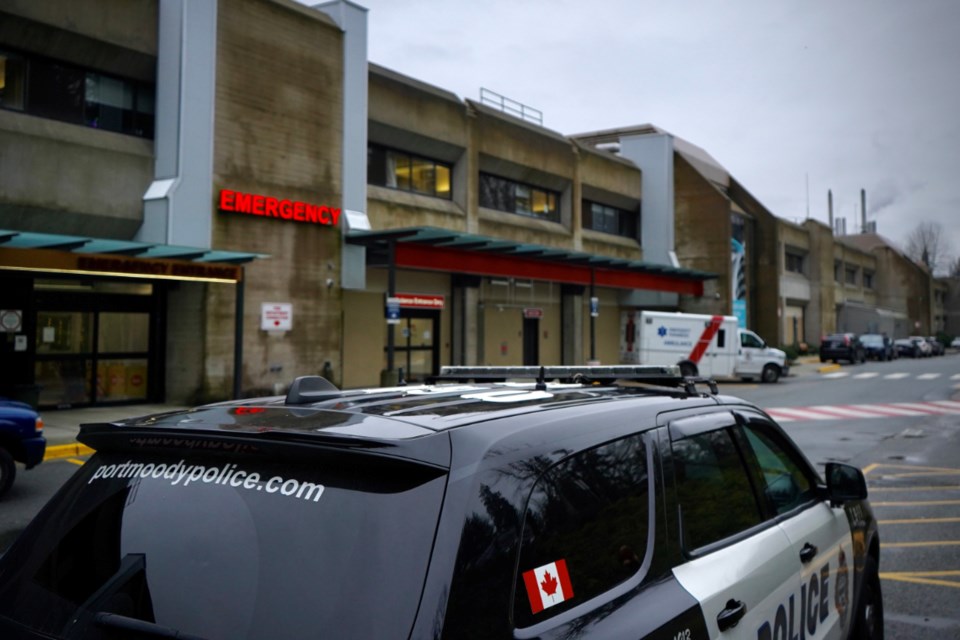
Fraser Health says it’s bolstered security at Port Moody’s Eagle Ridge Hospital after three assault incidents since last November.
But the union representing nurses says that’s not enough.
A spokesperson for the health authority that administers Eagle Ridge said it’s increased security staffing at the hospital and is conducting “refreshed training for site security” as well as coaching to “ensure all personnel are fully equipped to manage violent incidents when they occur.”
The latest of those incidents was last Thursday, March 27, when Port Moody police were called just before 8:30 p.m. for a report of a man assaulting a medical staff member.
On Jan. 14, staff at Eagle Ridge were advised to seek a safe escape route when a man started waving a machete “in a threatening manner” inside the hospital’s emergency ward. And last Nov. 20, a 41-year-old man was arrested and charged after a nurse sustained serious injuries in an alleged assault by a discharged patient.
Alarming trend
Tristan Newby, the vice-president of the BC Nurses’ Union, said the run of incidents at Eagle Ridge is alarming, adding it “isn’t the environment that nurses should be expected to provide care and patients shouldn’t have to be concerned about being exposed to violence.”
Newby said a program that places at least two special “relational security officers” around the clock at busy hospitals like Burnaby and Royal Columbian in New Westminster should be expanded. The officers are trained in de-escalation techniques and are qualified to restrain violent patients.
“They’re fully integrated with the care team, they’re not reactive,” Newby said. “Nurses really appreciate that extra support.”
Newby said a recent survey of the union’s membership indicates 34 per cent of nurses in British Columbia are exposed to weapons at least once a month and 81 per cent have experienced verbal or emotional abuse while on duty. He said the problems are exacerbated by understaffing.
“People are coming in stressed,” Newby said. “The stress is compounded because we have a nursing shortage and the emergency department is larger.”
Constant contact
Fraser Health said it is maintaining constant contact with the Port Moody Police Department to debrief on the recent incidents and staff at Eagle Ridge have access to the health authority’s critical incident stress management team.
“When distressing incidents occur, we will reach out to the impacted individuals to offer support,” said the spokesperson.
As well, all hospital sites maintain joint occupational health and safety committees that work with unions to review workplace violence incidents and suggest improvements.
Other measures include: • integrated security to support staff and medical personnel • a regional workplace violence committee • violence risk assessments for all sites • training in Code White procedures • provincial workplace violence training for all staff to de-escalate and minimize threats • advance team response training for key hospital units on the handling of physical violence from patients
Newby said violent incidents like those that occurred at Eagle Ridge compound problems like the nursing shortage.
“We can train up as many nurses as we have capacity, but in the absence of a safe working environment, people are going to choose where they know they can go home safe.”
One of the great rewards of working in community journalism is being able to tell stories before they get wider attention. Sometimes it’s our stories that spark that spotlight. I first told our readers about Jenna Buglioni in 2017 when she was getting attention as a top ice and high school field hockey player. Since then, we’ve caught up to her efforts playing for Canada at IIHF U18 women’s world championship, the start of her collegiate career at Ohio State University in the middle of the COVID-19 pandemic and various other minor updates about her triumphs and disappointments. But alas, the Tri-City News — where this story first appeared — won’t be around to share Buglioni’s next chapter, as she prepares to go pro and help grow women’s hockey.
Port Moody hockey fans could soon be cheering for another pro player.
Jenna Buglioni has declared her availability for June’s Professional Women’s Hockey League draft.
In the Hockey News’ mid-season rankings in January, she was rated 15th of 72 top prospects.
Buglioni was actually eligible for the league’s 2024 draft, but she opted to return to Ohio State for a fifth season with the Buckeyes while she completed her Master’s degree in sports management. She was also the team’s captain.
Buglioni, who started her hockey journey playing with NHLer Kent Johnson in Port Moody Minor Hockey, won two conference and two national championships at Ohio State along with a cabinet full of individual playing and academic awards. She scored 164 points in 167 games and set a school record for career and single season game-winning goals. She also tied the program’s record for career short-handed goals.
To top it off Buglioni even sang the national anthem prior to her final regular season series for the Buckeyes.
Buglioni told the Tri-City News her decision to play an additional year of collegiate hockey has better prepared her for the anticipated rigours of the PWHL.
“I have gotten that extra time to work on skills and get more game experience that will be needed to make the jump to the next level,” she said.
More importantly, Buglioni’s academic pursuits have laid a foundation that will put her in a position to help grow women’s hockey even beyond her playing days.
“It is incredibly important that women are in leadership positions within our sport and sports in general,” she said, adding she hopes to coach in the NCAA when she hangs up her blades. “This helps show everyone that women are capable of filling those roles and making a difference.”
Ohio State came within 18.9 seconds of winning a third national championship — and second in a row — during Buglioni’s tenure when Wisconsin’s Kirsten Simms scored on a penalty shot to tie their Frozen Four championship final on March 30 then scored again 2:49 into overtime to wrest the title for the top-ranked Badgers.
Buglioni said the loss was “devastating.”
“We were so close to getting that outcome we wanted and it almost felt stripped away,” she said. “It’s what we work towards all season so to have the year and my collegiate career end like that was heartbreaking.”
Still, as the Buckeyes’ captain, it fell to Buglioni to comfort her teammates through her own disappointment.
“It was tough,” she said. “Obviously everyone was upset and there usually isn’t words that can take away that feeling. I just tried to provide support and tell the girls how proud I was of them.”
One of those girls is Coquitlam’s Jordan Baxter, a sophomore.
Buglioni said she and Baxter played together for the Greater Vancouver Comets when they were in high school and spending the past two years as teammates at Ohio State has brought their friendship and camaraderie full circle. She said she hopes their shared experience also inspires other female hockey players in the Tri-Cities.
“There are so many opportunities for girls to play hockey collegiately and I hope that they know they can do it.”
This story originally appeared in the Tri-City News
After Carson McGinley learned he’d been traded to the Coquitlam Express from the Sherwood Park Crusaders on Dec. 30, he and his dad, Mike, loaded up his car and drove 13 hours from Alberta to his third hockey destination in five months.
Several other players have been similarly uprooted as Express general manager Tali Campbell and head coach Jeff Wagner refine the BC Hockey League (BCHL) team’s lineup for the stretch run to the playoffs. Goaltender Andrew Ness was acquired by Coquitlam from the Penticton Vees in late November. Defenseman Jack Sullivan joined the Express from the Blackfalds Bulldogs a week later.
In the past two weeks, the team has also added Kazakhstan junior national player Nikita Sitnikov and forward Dane Pyatt, who’d been injured most of his rookie season with the Western Hockey League’s Spokane Chiefs.
Wagner said the upheavals can be unsettling for everyone involved — the new players coming in and the group already established in the dressing room.
“The business of junior hockey is that moves are made and you can’t take anything for granted,” said Wagner, who’s in his first season running the Express bench.
Easing a player’s transition into a new situation that not only includes a new coach and new teammates, but also a new living situation with an unfamiliar billet family and a new community to navigate, is all about making sure management has done its homework, keeping open the lines of communication and having trust in the dressing room’s leadership group, said Wagner.
“We lean on our leadership group to make sure that they’re integrated well and put into a good situation.”
MARIO BARTEL/TRI-CITY NEWS
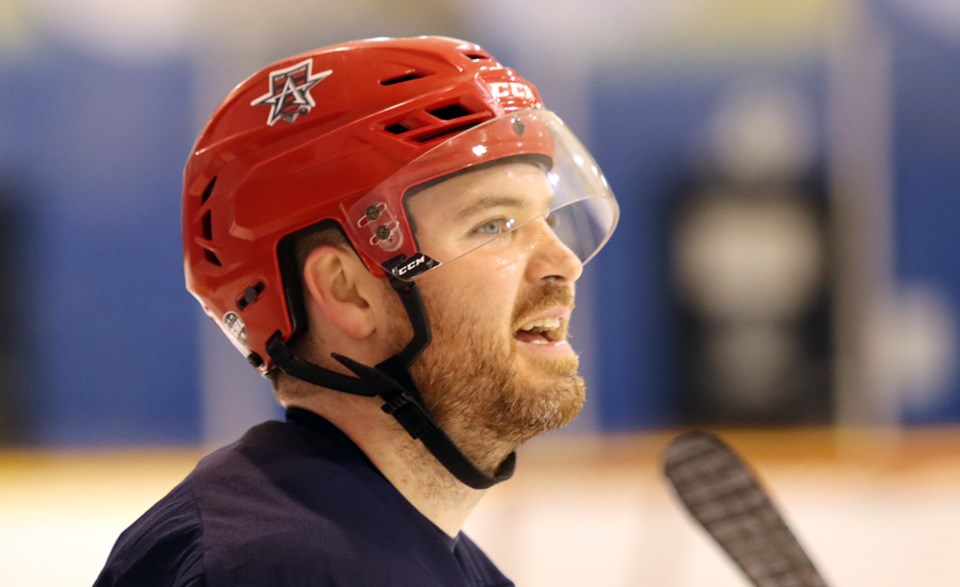
Coquitlam Express forward Carson McGinley lays it out during a timed skating session during a team practice.
McGinley, who’s originally from Phoenix, Ariz., said he felt instantly welcome when he arrived in Coquitlam. His new teammates and billet family helped him settle in and showed him around town so he could keep his focus on what he needs to do on the ice.
“It was a very easy transition,” he said.
It’s showed in McGinley’s performance. In the four games he’s played since joining the Express, he’s scored eight points.
The instant payoff pleases Wagner as he and Campbell continue to search for the bits and pieces that will produce a winning formula for Coquitlam.
That process includes keeping an eye on other players around the BCHL and elsewhere, assessing their situations and sharing information.
After starting the season in Vernon, McGinley was moved to Sherwood Park so the Vipers could acquire a defensemen to help fill some holes in its lineup. But the Crusaders proved a poor fit, so the move to the Express was welcome, said the 18-year-old right winger.
Placed on a line with offensive spark plugs Mason Kesselring, who has 31 points in 32 games, and rookie Thomas Zocco who has 28 points, McGinley said his confidence has been restored.
“It’s just building chemistry with your linemates. They’re two unbelievable players and they’re really easy to play with.”
Wagner said the latest roster moves have come at an opportune time.
The two-week break around the BCHL’s all-star weekend festivities in Salmon Arm provides ample practice time to work the new players into the lineup, get them settled into their environs and forge bonds in the dressing room.
“The extra time helps get them integrated with the systems and get to know the guys in the room,” Wagner said, adding it also provides a bit of a buffer to soothe any shock players felt from the departure of a teammate or friend.
With three wins in the four games the Express has played since the holiday break, Wagner said the team is headed in the right direction after a November swoon saw them slide down the Coastal Conference standings following a hot start to the season.
“We’re fairly happy with our group and we believe in what they can do.”
But, he added, the tinkering never really ends — especially if injuries occur.
“It just makes our decisions a little bit more difficult moving forward.”
I first started telling Wade MacLeod’s story in 2018, when friends launched a GoFundMe campaign to help support his young family as he tried to battle a Grade 3 glioblastoma tumour in his brain. In the years since, we’ve checked in periodically to document his ongoing health challenge and his effort to keep his professional hockey career going. What follows are a few of those stories, all of which originally appeared in the Tri-City News.The first appeared in March, 2019. The second was published in August, 2021, and the third is from January, 2025.
Port Moody hockey player stays positive after third clash with cancer
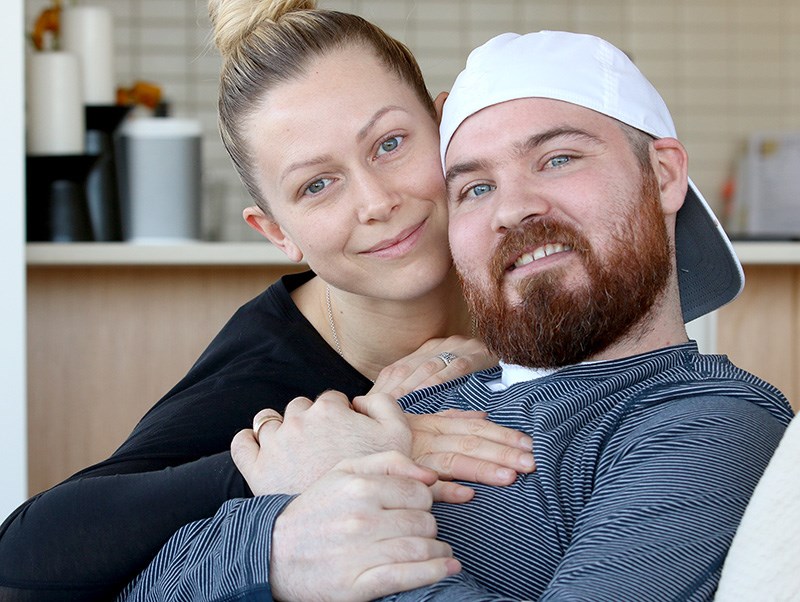
Wade MacLeod loves the view from the Port Moody condo he shares with his wife, Karly, and their 17-month-old daughter, Ava James.
Looking out the expansive windows of their living room to the snow-peaked mountains and the twinkling water of Burrard Inlet far below is thearaputic, MacLeod says. But it’s not where he should be in the waning weeks of winter.
MacLeod and his young family were supposed to be back in Germany, where the 32 year-old Coquitlam native was looking to build on the point-a-game pace he was scoring last year as a professional hockey player with the Frankfurt Lions.
But two surgeries within two months last summer derailed that dream. Doctors removed a Grade 3 Glioblastoma tumour in his brain for a third time.
MacLeod hopes he can get his playing career back on track, and the results of his latest MRI showed no further growth of the disease. That has only fuelled his optimism.
In fact, it’s that positive outlook that helped get MacLeod back on the ice after two previous encounters with the disease, said Karly, who’s also from Coquitlam.
“No matter how many times he’s knocked down, he’ll get up again and go for it,” she said.
MacLeod’s tumour was first diagnosed after he collapsed on the ice during a game in Springfield, Mass., where he was playing his second season as a pro after competing for four years with Norheastern University in Boston. Doctors removed a golf-ball sized non-cancerous tumour from the left side of his brain and he lost the ability to speak.
Returning to the ice Speech therapy got that back, and extensive rehab allowed MacLeod to return to the ice, this time with a team in the ECHL, a rung down hockey’s minor-professional ladder. He knocked around various outposts, from Indiana to Idaho, including a 34-game stint with the Toronto Marlies of the American Hockey League, just below the NHL. Then he headed to Germany.
It was after a 61-point season with the Rosenheim Star Bulls, a second-division pro team, that the disease reasserted itself. MacLeod underwent a second surgery in September, 2016, then worked his way back to the ice the following March, with another ECHL in Allen, Texas. He scored 13 points in 13 games, and, in September, 2017, he signed with Frankfurt.
‘Everything changed’ Going back to Germany, this time to Dresden with their newborn daughter, was supposed to be the time of their lives, Karly said. “Then everything changed.”
MacLeod took the latest diagnosis in stride.
“It is what it is,” he said, then set about doing whatever he had to do to get better again and return to the ice. Currently in the midst of a six-month course of chemotherapy treatment, MacLeod hooked up with Port Moody Integrated Health to plot a holistic path back to health that includes speech therapy — last summer’s operations again affected his ability to speak — occupational and physical therapy. He changed his diet to eliminate refined sugar and reduce his intake of carbohydrates. Several times a week he gets special hyperthermia treatment that tries to kill cancer cells with high temperatures.
Both Wade and Karly visit with a sports psychologist to deal with the mental and emotional challenges of his disease.
Community support A fundraising campaign launched on the crowdsourcing website gofundme.com last August by MacLeod’s friend, Mike Armstong, has raised more than $124,000 so far, making much of the supplementary care possible.
More importantly, MacLeod said, the messages of support that continue to get posted on the site from every waystation on his journey through hockey, even as far back as his minor days at the Burnaby Winter Club, and from Merritt where he played for the BC Hockey League’s Centennials, propel him forward.
“It drives my strength and positivity more than you can imagine,” MacLeod said, adding his whole family was brought to tears when they first started seeing the donations and messages come in as he recovered from his fourth surgery.
While some treatment days can be long and gruelling, sapping MacLeod’s strength and confining him to the couch to take in the view from a special massage pad Karly got him for Christmas, he said he’s been able to gain a new appreciation for life’s small moments, playing catch with his daughter (“She has a wicked spiral,” he said), or the beauty around him during walks along the Shoreline trail.
MacLeod was last on the ice in December, at a stick-and-puck session with his brother and brother-in-law. He said the feeling of holding the stick in his hands, gliding around the ice, chasing down the puck, was “unbelieveable.”
He can’t wait to get that feeling back. Again.
Wade MacLeod has already scored the biggest win of his life
In preparation for his return to professional hockey, Wade MacLeod has been working every weekday with his trainer, Kai Heinonen. MARIO BARTEL/TRI-CITY NEWS
Even if Wade MacLeod doesn’t score a goal with his new Manchester Storm hockey team, he’s already achieved the biggest victory of all.
The 34-year-old left winger from Port Moody beat cancer – not once, not twice, but three times.
And when MacLeod’s doctor gave him the all-clear last November, that the Grade 3 Glioblastoma tumour that had recurred in his head for a third time was completely gone, he knew what he had to do.
“I said from the very beginning that cancer wasn’t going to be the reason I retire from professional hockey,” MacLeod said after a recent workout at Coquitlam’s Planet Ice with his trainer Kai Heinonen and veteran NHLer Brad Hunt.
The fact MacLeod is able to share the ice and keep up with the newly-signed defenceman for the Vancouver Canucks is a testimony to the dedication of getting his career, and life, back on the rails.
Three years ago, MacLeod had to relearn how to walk and speak again after two surgeries to remove a recurring tumour that had reformed in his brain as he prepared to play a third professional season in Germany with Dresden Eislowen.
When MacLeod was diagnosed after having seizures as he moved from Frankfurt, where he’d scored 49 points in 49 games for the second division Lions, he, his wife Karly, and their young daughter, Ava, headed back to Canada for surgery. Two months later, the tumour returned for a third time, and he was under the knife again, to be followed by radiation and chemotherapy treatments.
A GoFundMe fundraising campaign to help the young family get through the tough time raised more than $100,000 from donations wherever MacLeod’s skates had taken him — from Merritt where he played junior hockey with the BC Hockey League’s Centennials, to Northeastern University in Boston, Mass., to minor league teams in Springfield, Mass., Evansville, Ind., Toronto, Boise, Idaho, Allen, Texas, as well as Rosenheim and Frankfurt in Germany.
Return to health Some of the money went to MacLeod’s return to health and rehabilitation that was coordinated through Port Moody Integrated Health. Dietary changes, occupational and physical therapy, as well as hyperthermia treatment to kill lingering cancer cells with high heat, all contributed to his battle against the disease that first presented itself in 2013 when he collapsed on the ice during an American Hockey League game in Springfield.
A four-hour operation removed a golf-ball sized tumour from the left side of MacLeod’s brain and, after extensive rehab, he was able to get back on the ice the next season, splitting his time between the Springfield Falcons and the ECHL’s Evansville IceMen.
Three lost years But the double recurrence of the tumour in 2018 has cost three prime years of MacLeod’s hockey career. Getting back to a place where he feels he can compete again on the ice has taken a lot of work with Heinonen, whose background includes martial arts. The two are together for hours every weekday, either on the ice or in the gym. They use karate to sharpen hand speed, balance and peripheral vision, circuit and core training, as well as visualization.
MacLeod said he feels in the best shape of his life. Earlier this summer, he told his agent he was ready to play again.
Limited opportunities But opportunities for an aging minor leaguer who’s been out of the game for three years were limited. Norway or France were possibilities, MacLeod’s agent told him.
It was the Storm of Great Britain’s Elite Ice Hockey League that expressed the most interest. The team’s coach, Alberta native Ryan Finnerty, also has a young family and was familiar with MacLeod’s story.
“It all worked out,” MacLeod said of the process that landed him a contract, adding he’ll head to England in about mid-September, then his family that now includes a newborn sister to Ava, will follow a few weeks later.
MacLeod said he’s excited about getting back into a dressing room with teammates, then hitting the ice again with fans in the stands.
‘Never give up on your dreams’ “It’s going to be so unreal,” he said. “The biggest thing is never give up on your dreams and always stay positive.”
While MacLeod is hopeful the opportunity he’s being given in Manchester might lead to bigger and better things, he said he already feels he’s accomplished so much.
“I beat cancer.”
‘Desperate for a solution’: Uncertainty clouds future of Port Moody hockey player
A glioblastoma tumour finally forced Port Moody’s Wade MacLeod to retire from his hockey career. MARIO BARTEL/TRI-CITY NEWS FILE PHOTO
A Port Moody hockey player battling Grade 4 brain cancer is girding for another round of radiation treatment. In an update to a GoFundMe page raising money to support Wade MacLeod’s treatment of a glioblastoma tumour, Karly MacLeod said a sixth operation in November allowed doctors to remove “a huge portion” of the growth.
But uncertainty about her husband’s future remains.
“Since Wade’s surgery, we have been in limbo with treatment but desperate for a solution,” Karly MacLeod said.
Wade MacLeod, who grew up in Port Moody and played for the Merritt Centennials in the BC Hockey League before attending Northeastern University, was playing for the Springfield Falcons in the American Hockey League when he first fell ill in 2013 after collapsing during a game.
Doctors found a non-cancerous tumour the size of a golf ball in the left side of MacLeod’s brain. After it was removed, and following extensive physical and speech therapy, he resumed his playing career in the ECHL and 34 games with the AHL’s Toronto Marlies before heading to Europe.
MacLeod scored 61 points in 50 games for the second-division Rosenheim Star Bulls in Germany and was preparing to return overseas for a second season when he had a second seizure.
This time MacLeod was diagnosed with a cancerous glioblastoma.
Back on the ice Six months later though, he was back on the ice with the ECHL’s Allen Americans in Texas, then signed with the Frankfurt Lions in Germany the following season.
A third seizure felled MacLeod in September 2018.
Doctors removed a Grade 3 glioblastoma tumour. Several months of chemotherapy followed, along with speech, physical and occupational therapy as well as dietary changes and special hyperthermia treatments that use high temperatures to kill cancer cells.
In November 2020, MacLeod got the go-ahead to resume training and the following August he told the Tri-City News he was in the best shape of his life as he prepared to join the Manchester Storm in Great Britain’s Elite Ice Hockey League.
“The biggest thing is never give up on our dreams and always stay positive,” MacLeod said following an on-ice workout at Planet Ice in Coquitlam.
MacLeod played seven games in Manchester, scoring one point, then signed with the Narvik Arctic Eagles in Norway.
Turning the page on hockey But in June 2023, MacLeod said his hockey journey was over.
“I gave all my life to hockey and now it is time to turn the page,” he wrote on his Facebook page.
A fifth brain surgery in December 2023, confirmed the worst fears of MacLeod’s family, that includes two young daughters; his glioblastoma tumour was now Grade 4 — the most serious and aggressive form of the disease.
A heavy toll In her most recent update, posted by Karly MacLeod on Jan. 18, 2025, she said Wade’s battle and sixth surgery have exacted a toll: Changes to his motor and speech skills have necessitated alterations to their home and the couple accelerated a longstanding plan to renew their vows on the tenth anniversary of their wedding so they could celebrate with their daughters.
“We’ve learned the importance of living in the moment and taking everything one day at a time,” Karly MacLeod said, adding she’s also dialing back her work as an interior designer to help care for husband and manage his upcoming treatment plan that includes four weeks of radiation along with hyperthermia, drug and dietary therapies as well as some alternative medicine approaches.
That means some of the almost $142,000 that has been raised so far through the GoFundMe campaign will go towards supporting MacLeod’s family as well as covering medical expenses that aren’t insured, Karly MacLeod said.
“Some days can be beautiful and some days can be hard,” she said. “We feel the love and it has helped us immensely to continue taking each foot forward and never giving up.”
This story originally appeared in the Tri-City News
A Coquitlam student who’s endured cancer three times is hoping some of her darkest moments will help light the way for other young people going through a similar health challenge.
Julia Dawson, a Grade 12 student at Dr. Charles Best Secondary School, has created a workbook for cancer patients and their families embarking upon Car T-cell therapy to treat their disease.
It’s a new regimen that uses a patient’s own T-cells to identify and destroy cancer cells with the help of genetic engineering.
Dawson had already beaten leukemia twice when doctors determined her third round with the disease was resistant to conventional chemotherapy.
Instead, they recommended removing T-cells — a type of white blood cell that fights infection — from Dawson’s body and retraining them to attack cancer cells before reinjecting them back into her bloodstream. While Car T-cell therapy has been in clinical trials at Seattle Children’s Hospital since 2018, it was still new at BC Children’s Hospital.
Few resources
Dawson would be among its first candidates for the procedure. She said she didn’t know much about the unique therapy going in. Nor did her family, and the all the research they did on the internet just turned up highly technical articles from medical journals. Even her doctors weren’t quite sure what to expect for things like side or long-term effects.
“There was not a lot of resources,” said Dawson. “I was scared, but the doctors were optimistic.” To remove her T-cells, Dawson was hooked up for four hours to a large device that “looked like a washing machine” by a tube inserted in her neck. Several weeks later the engineered cells were reinjected through a port in her chest. Then she had to stay in isolation in the hospital for a month rebuilding her immune system.
During that time, Dawson said she asked the nurses and doctors a lot of questions. She made notes of how she was feeling, the fevers and loss of memory and occasional anger and fear she endured. Dawson said the experience was “like going through a bad flu.”
But she also knew what she was experiencing could be invaluable to someone else about to undergo the same treatment asking the same questions she’d had.
“I want to make sure others have the information so they don’t feel totally alone,” Dawson said. Back at school and feeling better, Dawson pitched the idea of the workbook as her senior year Capstone project. It includes pages with information about the Car T-cell therapy, its side effects and symptoms, a pain chart and various activity exercises to help manage feelings of anger and frustration.
Dawson said she vetted the more clinical elements of the workbook with her doctors and nurses to ensure the information was accurate.
‘It really helps’
She said putting it together helped ease her own journey.
“It really helps by just putting it into words,” Dawson said, adding it also kept her positive and hopeful. “You realize things you’re going through are normal.”
Dawson said she prepared workbooks for youth counsellors at Camp Goodtimes, a special summer camp for young people living with cancer. BC Children’s is also including copies in a special welcome package for new Car T-cell patients and the hospital is in the process of securing grants to print more copies and distribute them to other institutions across Canada offering the therapy.
Dawson said the project has fuelled her determination to pursue a career in health care that begins when she heads to Simon Fraser University next fall to study health sciences.
“I want to help others know it’s going to be OK.”.
This story originally appeared in the Tri-City News
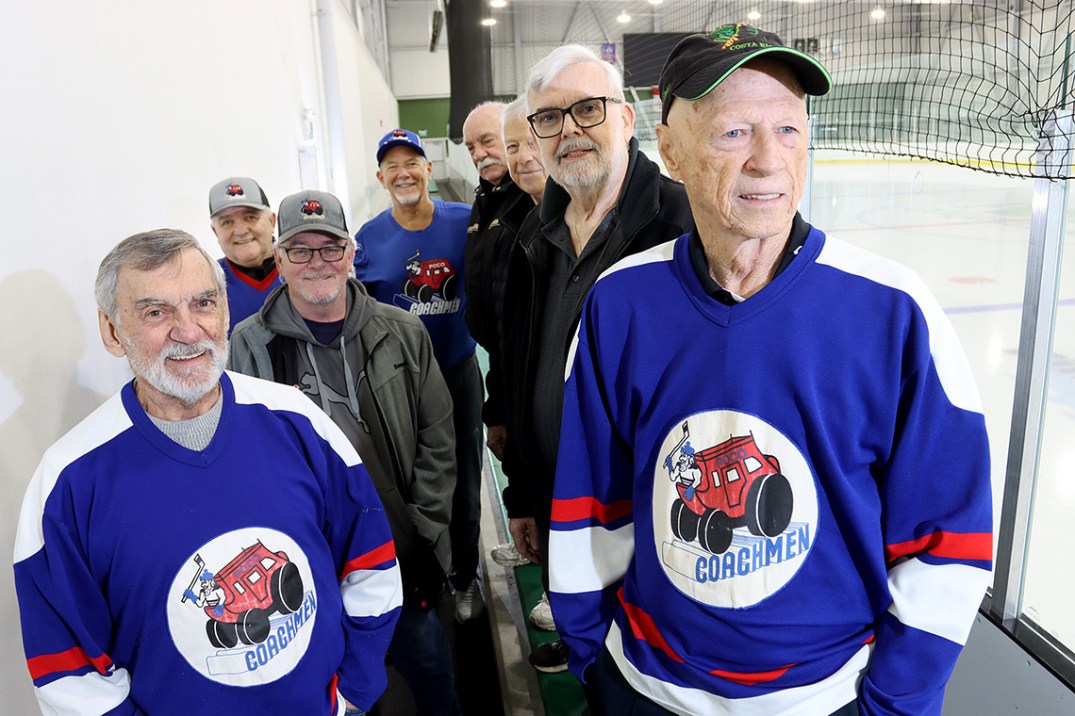
What began as four minor hockey coaches taking advantage of some unused ice time at the old Port Coquitlam Rec Centre to stretch their own legs is celebrating its 50th anniversary on March 15. The PoCo Coachmen have never been part of an organized league. Rather, the loose collection of players aged 35 and over has gathered weekly to get some exercise, make friends, swap stories and drink beer. The game was always incidental, said 82-year-old Don Sanbourin, one of a dwindling handful or original Coachmen who total about 150 through the years. “The group has always emphasized having a good time.” The games the Coachmen play are informal affairs with the weekly turnout of about 30 splitting into two squads to knock the puck around for an hour or so. One player from each side is tasked to keep score and if the game is tied when their ice session expires, it’s next goal wins. There’s no body contact and slap shots are forbidden. “We all have to go to work on Monday,” Sanbourin said.
Tournament tests The group does travel annually to places like 100 Mile House, Hope, Seychelt, Chilliwack and Ashcroft to test themselves in tournaments with more organized beer leaguers, but as far as any of the Coachmen can remember, they’ve won very few games. The competitions that coincided with a women’s curling bonspiel are especially memorable, said one. “They sure know how to party.” Sanbourin said over the years, the Coachmen have hailed from diverse backgrounds, from tradesmen to professionals, from newcomers in town looking for a game to millionaires. They’re equalized by nicknames like “Frog,” “Bedbug,” “Fossil” and “Green Hornet.” “In the dressing room, everyone is the same,” Sanbourin said.
Fitting in Every Coachman serves a one-year “apprenticeship” to ensure they fit in with the group, which votes at its annual post-season meeting to determine whether a rookie can stay. As far as Sanbourin can remember, only two prospective Coachmen never made the cut. Victor Kryzanowski, 63, said the Coachmen have given him the same sense of small-town camaraderie he felt growing up in Saskatchewan. Friendships form quickly on the ice and in the dressing room and with such a broad range of players, there’s always someone with a skill or trade who can help out a teammate in need, whether it’s with carpentry, plumbing or bookkeeping affairs. “The hockey was almost an afterthought,” Kryzanowski said. Phil Gallagher, 72, said he still attends all the Coachmen’s social gatherings like the annual alumni pizza night even though he stopped playing at the onset of the COVID-19 pandemic in 2020. Gallagher said from the time he joined the team in 2003, he knew he’d found his tribe. “Right away you made friends here,” he said. “You identify as a Coachmen.”
Pandemic challenge Sanbourin said the pandemic and the consequent shutdown of sports facilities because of public health restrictions was a test for the Coachmen. He said the group kept paying for its regular ice time even though the rinks were closed and they couldn’t play because they knew if they ever lost their regular slot on Wednesday nights at 9:30 p.m., they’d have a hard time getting it back. Stuart MacInnes, 69, said the physical and mental health benefits of the weekly games are immeasurable. A Coachmen since 1998, he said getting on the ice takes him back to his younger days playing hockey in Ontario but the real fun occurs before the opening faceoff and after the final whistle. “It’s a joyous change room,” MacInnes said. “It’s so nice to hear what is going on in everyone’s life and commiserate with each other.” Sanbourin said as with any group that’s grown old together for so long, some players have finished their ride on life’s Zamboni. The absences are duly noted on the reams of annual lineups he keeps safeguarded in clear plastic sleeves stored in a manilla folder, a reminder of the strength and ultimate fragility of the bonds they’ve formed. “It’s a community,” said Kryzanowski. “It’s a privilege,” added Gallagher.
Churning out three or four stories a day to feed the web beast can be a grind. You bust a hump crafting a feature that quickly gets buried by a rewritten press release announcing the opening of a new doughnut shop. Some days it’s a struggle to stay motivated. If we’re not writing about doughnut shops, is anybody even paying attention? But then, along comes an opportunity to share something really unique and fun and it reinforces why we got into this business in the first place and the important role local news plays in building community. This story, about a Port Moody family that set out to make a Christmas movie together, started as an email with a link, asking if we’d be interested. How would we not, even if it doesn’t involve doughnuts.
Most families looking for a holiday season activity to do together might go to a tree lot to pick out their Christmas tree for the living room. Or build a gingerbread house.
The Ortiz family from Port Moody made a movie.
Their production, Saving Christmas, is now available on digital platforms like iTunes, Vimeo, Amazon and Google Play as well as cable providers, Bell, Rogers and Shaw.
How it got there is a “like a Christmas miracle” in itself, said Luiza Ortiz, one of the film’s writers.
The idea started as a fanciful notion by her dad, Marcelo, who works as a digital animator in the film industry. He said he’d always been curious about the craft of live-action filmmaking since he first saw Star Wars as a child growing up in Brazil.
“I threw out the idea to the family to make a movie,” Marcelo said. “It would be doable.”
His wife, Beatriz, was receptive.
Their son, Ricardo, is an actor and she’d accompanied him to sets when he was younger so she knew her way around the business and had forged numerous contacts who could help guide them in the right direction.
And Luiza has taken a couple of elective courses in screenwriting while studying English literature and political science at the University of British Columbia.
The family batted around ideas. They considered a drama or horror film but their budget was small and the bulk of the filming had to be done in and around their Ioco Road home.
A small, heartfelt Christmas story seemed the best fit for the family’s skills, budget and Marcelo’s ambitions. Pre-production involved months of script writing and refining, casting 25 actors, scouting locations in Port Moody and Maple Ridge, arranging for equipment and permits, along with assembling a crew of 30-50 — most of them extended family, friends in the industry as well as students from Vancouver Film School and the film program at Capilano University.
SUMBITTED PHOTO On the set of Saving Christmas at Heritage Woods Secondary School in Port Moody.
Marcelo said what anyone lacked in experience or in-depth knowledge, they more than made up with passion and enthusiasm.
“We had such a phenomenal crew,” said Luiza.
Three weeks of filming was scheduled in December, 2022.
Beatriz said that’s usually a quiet time for the film industry locally so pro members of their crew could be readily available.
But a snowstorm almost derailed the first two of 15 shooting days.
Other setbacks also popped up.
Arranging insurance for the production took longer than expected.
A scene in a grocery store had to be rewritten when an actual grocery store couldn’t be secured at a price the production could afford.
“It was a little bit crazy,” said Marcelo. “Problems will come every day and you have to stay positive to find solutions.”
“There’s no time to complain,” added Beatriz.
But, said Luiza, the speed bumps created a kind of “brothers-in-arms” vibe on the set, pulled everyone closer together to find a way to see the project through to its conclusion.
“It really forced us to be creative,” she said. “That made the movie better.”
SUBMITTED PHOTO Ricardo Ortiz plays NIck, a 16-year-old teen who unwittingly cancels Christmas then must find a way to restore the holiday in his family’s film production, Saving Christmas.
Post production of the film took the better part of a year.
Marcelo watched YouTube videos to learn how to use the software required to craft 24 terabytes of digital footage into a 104-minute film. A friend did the colour correction. Another did the sound mixing and an old friend from Brazil composed the sound track.
Getting the film done was only half the battle though. Ensuring it gets seen presented another challenge.
Marcelo researched distributors on the Internet Movie Database Pro (IMDB) website. He sent out dozens of emails, talked to about 50 companies, delivered several copies of the movie. Many inquiries went nowhere. But there were offers and an executive producer finalized a deal with California-based Vision Films. Saving Christmas premiered two weeks ago at Vancouver Film School.
It was the first time much of the cast and crew were together again in almost two years.
Marcelo said his heart filled with pride to see the fruits of their little family project projected on a big screen.
“It looks like more than we expected,” he said of the film. “Everybody put a little love into it.”
I learned this morning a photo I’d shot last year was recognized by the Canadian Community Newspapers Association as the top feature photo of 2023. Normally I don’t pay much heed to such things. At the behest of my editor, I dutifully compile some possible entries, submit the required information and then forget about them. But this one hit a bit differently. Not only did this photo involve one of my favourite people, Chris Wilson, whom I’ve covered at different stages of his career since I first arrived at the Tri-City News in 1991 when he was an Olympic wrestler, then as a Coquitlam city councillor and now an advocate for youth sports, but it’s also a bit of a swan song for our existence as a print newspaper. How the various community newspaper associations manage their annual awards programs as more and more newspapers move exclusively online is still a bit of an unknown. But as so many papers have closed, and staffs diminished, so has the level of competitiveness to win awards. Especially when it comes to photos. There’s now so few full-time photographers still employed at newspapers, the cream quickly rises to the top. And while there’s still some decent photos captured by reporters doing double duty, the quality of entries across the board is not like it was when there were so many more photojournalists plying their trade at chains like Metroland in Ontario, Black Press and Postmedia in the Lower Mainland as well as pockets of larger community papers in Alberta and Quebec. The shift of papers to digital has also widened the gulf. As much as the digital realm can bring advantages like immediacy and opportunities for engagement, most news websites don’t do photos well. Templated designs tend to demand uniform sizes and formats for photos; RIP the vertical photo. There’s also so many stories crowded onto home pages, photos run small; a thumbnail just doesn’t have the same impact as a five column image across the top of a story. And linear photo galleries completely dismiss the role editing and design play in visual storytelling. It wasn’t supposed to be like this. In the early 2000s, I can remember many conversations over beers with my colleagues during which we mused the internet would be our time to shine. We were already doing most of our editing and production work on the computer and our photos looked great on a Mac monitor. Plus who doesn’t like looking at good photos and with the unlimited capacity of the web, we could share so much more of our takes with readers. Design programs like Macromedia Flash also made it possible to add music, commentary and other visual elements to a photo presentation to create true multimedia storytelling. But such efforts are labour-intensive, something our declining industry says it can no longer afford. The Toronto Star’s visually-rich tablet-based Touch initiative died less than a year after it was launched, a victim of its high cost to produce. Even giants like the New York Times and the Washington Post have reduced the volume and sophistication of their online visual storytelling in the time I’ve been a subscriber. And with fewer photojournalists flying the flag for quality photos, editors are only too happy to run poor-quality submitted photos or — worse — generic stock photos, just so long as stories get posted online as quickly as possible. It’s a death spiral that further diminishes our connection to our communities and lowers the standard of the product we provide. And flies in the face of what awards are supposed to represent.
I spent much of last week covering the Minto Cup national junior lacrosse championship in Coquitlam. For months, it was touch and go whether I would even bother putting in the extra time.
Since the Tri-City News ended its print newspaper a year ago to exist exclusively in the digital realm, the message from management has been to produce stories that will drive eyeballs to our website.
And according to Google Analytics, those stories tend to be about donut shop openings, crime and tragedy, like a fatal car accident or fire.
But those kinds of stories don’t happen every day.
So we dutifully go about our business trying to keep our community informed about civic affairs, as well as local social issues and events that affect readers’ lives and bring people together and hope somebody reads them.
But with analytics breathing down our necks every time we click the PUBLISH button on our website’s content management system, we’re often forced into making uncomfortable decisions about what we choose to cover and how to manage our time, based not on a story’s newsworthiness or potential impact on readers’ lives but its ability to drive page views.
A story about a community-altering development project coming before city council can take hours to develop — reading and distilling the staff report and recommendations, maybe talking to the proponent for further background and comment, watching the actual council meeting — and it might move the hit-o-meter on the website a few views.
But spend 10 minutes spinning an Instagram post about the upcoming grand opening of a new donut shop in town, bolstered with a bit of background, and reader response goes off the charts.
Maybe it was always this way in the print days.
Maybe we’d been devoting time and resources to deep stories editors deemed important to the community to fill the front end of the newspaper only to have readers fly right past them to the fluff pieces buried further into its pages. We just had no way of knowing.
Whither the sports page?
Sports coverage has been a particular casualty of Google-driven journalism.
Sports has always had a specific audience and now that we can measure exactly what it is, many publications have deemed it no longer worthy of the investment of time and manpower.
Sports reporters have become the new photographers, cast off by their employers to the unemployment lines in the never-ending purge of newsroom resources deemed expendable in the name of retaining profits.
A colleague who’s worked at the downtown daily for 20+ years has seen his sports department diminished to just three, all on orders to cover the local NHL team because they’re the only stories that move the needle on the website.
Other publications have removed the Sports tab from their website entirely.
Since being retrenched to the newsroom from the darkroom in my own career, I’ve always tried to keep sports coverage alive by doing it off the side of my desk. I think it’s one of the cornerstones of community journalism, plus it’s fun to do.
That’s meant chasing features that can be easily fit around my other responsibilities but also have a greater chance of finding readers that otherwise wouldn’t be inclined to spend time with a game report. Besides, anyone interested in the outcome of a game these days will likely already know the score and what happened by the time I can file a story about it.
That championship feeling
The only time I stray from that formula is championships.
Those are a chance to practice deadline journalism that gives readers more than they’ll ever get from an Instagram post and, with a bit of planning and precise execution, even before there is a post on Instagram.
The Minto Cup presented just such an opportunity.
After shooting the opening period of a couple of preliminary-round games earlier in the week and keeping our readers apprised with quick-and-dirty stories written from the boxscores, They achieved the expected 150 or so page views each.
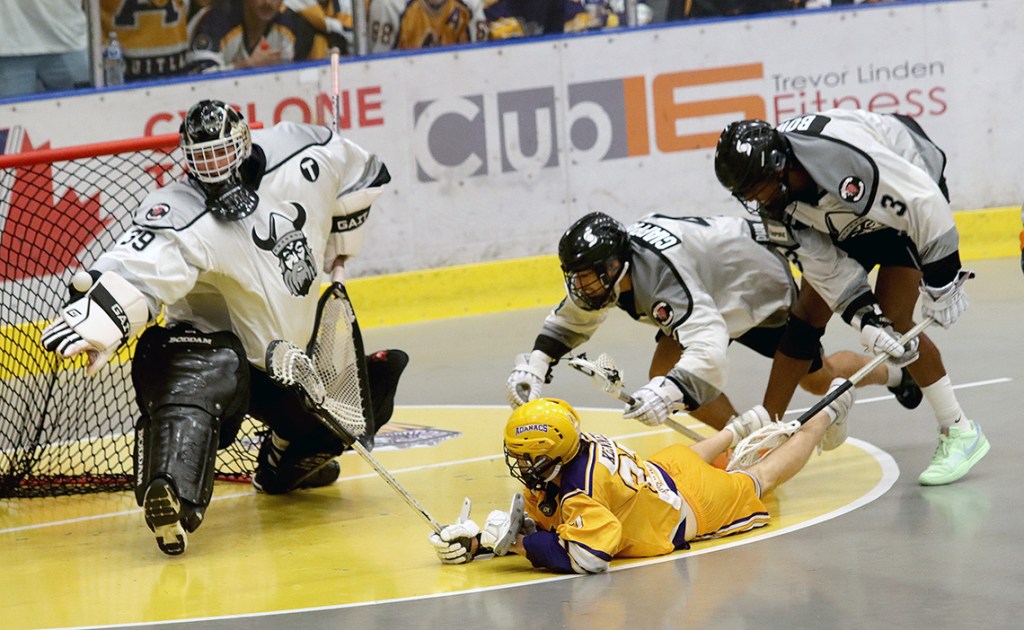
MARIO BARTEL/TRI-CITY NEWS Coquitlam Adanacs forward Cole Kennett is stopped by Orangeville Northmen goalie Connor O’Toole in the third period of their second game in the Minto Cup best-of-three junior national lacrosse championship series, Friday at the Poirier Sport and Leisure Complex.
But the second game of the best-of-three final would get the full-court treatment, as it could be the championship-decider. That meant getting to the arena an hour early to secure a workplace for my laptop, ensure the WiFi was in working order and create a placeholder on our CMS as well as write a boilerplate portion for photo captions to speed production later in the evening.
When the game started, I shot the first period from the concourse, then used the second period to download, process, caption and upload a first run of photos for the deadline story.
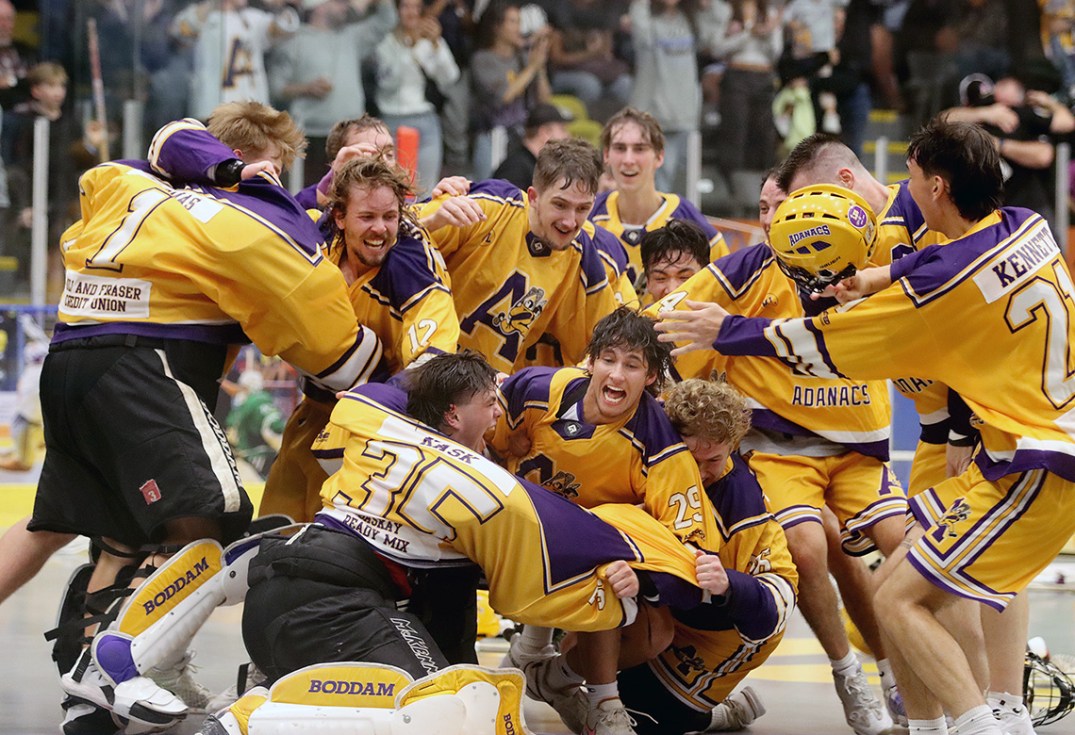
With the game still in the balance early in the third period, I again started on the concourse, then, as the result became more and more apparent, moved down to a better position to catch the immediate celebration and easily get onto the floor for the trophy presentation as well as coral a few comments for my story. The party was still in full swing when I retreated back to my workspace.
Forty minutes after the final buzzer, I had the story and first photo run up on our website, then a few more photos from the celebration about 20 minutes after that. By the time I was able to pack up my laptop to head home, it was five hours since I’d first arrived at the arena. That was on top of my full shift earlier in the day.
Was the investment worth it?
The next day, our coverage of the final peaked at the No. 2 spot in our “Trending Stories.” But it never could pass the rewrite of a cop press release about a theft bust I’d knocked offer earlier in about 15 minutes.
Even in this day of analytics-driven journalism that rewards page views more than fullsome reporting, most journalists still feel a responsibility to tell stories that are important as best we can, even to a small portion of our communities. Because all those stories taken together contribute to our sense of community, one of the most important roles local news can play.
Donut shops come and go, but community endures.
MARIO BARTEL/TRI-CITY NEWS The Coquitlam Jr. Adanacs and their fans celebrate a third period goal in the second game of their best-of-three Minto Cup championship series, Friday at the Poirier Sport and Leisure Complex.
Early in the COVID-19 pandemic, I wrote a story about a local woman who was one half of the Room Raters, a Twitter account that went viral with its witty and sometimes cutting commentary about decor and the backgrounds of Zoom and Skype interviews on TV with pundits, politicians, experts and commentators on cable and network news stations like MSNBC, CNN, FOX and ABC. We were all feeling isolated and fearing the future. But the Room Raters brought some light to the darkness. It also brought its perpetrators a measure of internet fame and eventually a book deal. Recently, though, I found out about an unexpected twist to their story.
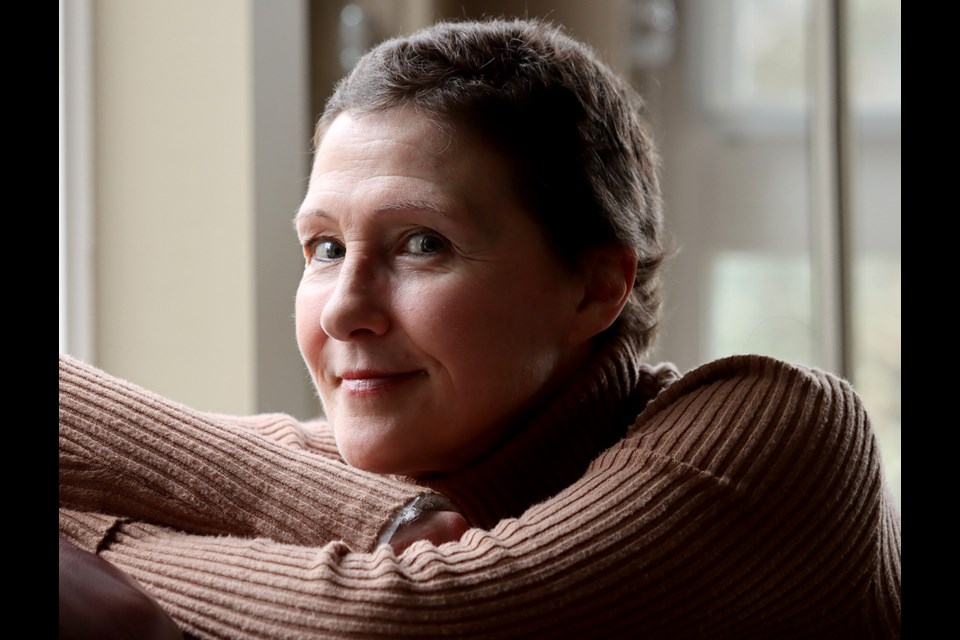
A Port Moody author is crediting her cat with possibly saving her life.
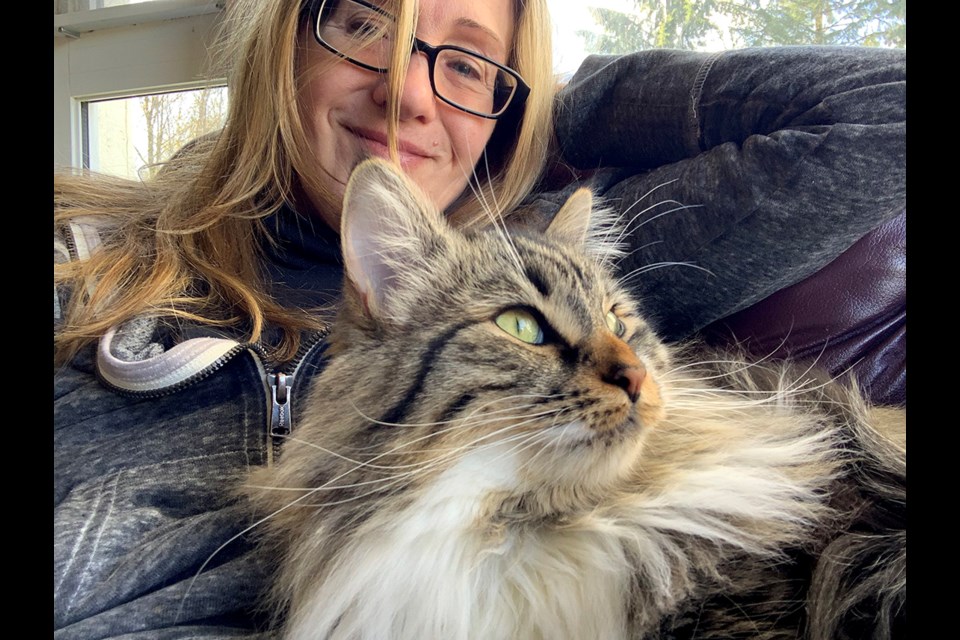
Jessie Bahrey says the insistent cuddling and kneading at her chest by her two-year old cat, Ella, helped alert her something wasn’t quite right as life events kept delaying her biennnial appointment for a mammogram. But when her left arm started to inexplicably ache she procrastinated no longer.
Sure enough, the scan showed two tumours in Bahrey’s left breast, exactly where Ella had been “making biscuits.”
Bahrey said she has no history of breast cancer in her family, and her own regular self-examinations revealed nothing untoward. But when she told her doctor of Ella’s role in fuelling her concern, they expedited the biopsy that would be needed to diagnosis the nature of the tumours and plot a strategy for their treatment.
Bahrey said she was taken aback by the sudden reversal in her life that had been an unlikely whirlwind for much of the previous three years.
Pandemic phenomenon goes viral
Bahrey, who’s an office manager at a Port Coquitlam garden centre, was at the nexus of a cultural phenomenon birthed by the onset of the COVID-19 pandemic.
Bahrey and Claude Taylor, who runs a left-leaning Political Action Committee (PAC), started putting their commentaries online, posting their observations, criticisms and suggestions on an X account (formerly Twitter) they called Room Raters.
Bahrey and Taylor’s targets ranged from musician John Legend and former First Ladies Michelle Obama and Hillary Clinton, to British Prime Minister Boris Johnson as well as commentators like Washington Post journalist Carl Bernstein and legal analyst Neal Katyal. Even the late Queen Elizabeth caught their attention.
Quickly, the Room Raters attracted more than 400,000 followers and sometimes their subjects quipped back, decrying a poor score, vowing to improve next time, celebrating a top rating or looking for tips to make their backgrounds look better.
The online attention led to a book deal.
When How to Zoom Your Room: Room Raters’ Ultimate Style Guide was released in June 2022, Bahrey and Taylor hit the promotion circuit, doing appearances on American and Canadian television and radio, being interviewed by the Washington Post and several podcasts.
It was, Bahrey said, “a lot of blood, sweat and tears.”
Winding down from the Room Rater whirlwind
When the hubbub died down, Bahrey went on holiday in Italy to decompress. Then her father entered hospice care and she said the impetus to schedule her mammogram appointment kept getting shuffled down her priority list. After all, she thought, she felt fine, she was running 40 kms a week and she had nothing to pique her concern.
Until feisty, aloof Ella suddenly became a cuddling comforter who always nudged her way up to Bahrey’s chest.
A 2016 study published in the veterinary medical journal, Frontiers in Veterinary Science, said dogs’ acute sense of smell can detect pathogens in humans like viruses and even cancers of the lungs, colon and breast. Some have been trained to sniff them out.
And while there’s been no formal research on the cancer-sniffing capabilities of cats, there’s no shortage of anecdotal evidence being shared on the internet.
A dour diagnosis
Bahrey said none of her doctors dismissed her story about Ella’s role in the eventual diagnosis of her triple negative breast cancer.
“It’s the bad one,” she added of the illness, referring to its predilection to grow aggressively and recur readily because the cancer cells lack estrogen or progesterone receptors and don’t make any, or very little, of a protein called HER2.
Bahrey calls 2023 her “cancer year.” She spent much of it recuperating from surgery, recovering from a super bug she caught along the way, getting radiation and chemotherapy treatment, trying to stay focused on the job of getting better.
Just before Christmas, Bahrey was able to ring the bell after her check up, the symbolic pronouncement that she was clear of cancer.
She said sometimes her mind reels at all that she’s experienced in the past few years — from the heady days of seeing her Room Rater posts retweeted by their famous subjects or referenced on national television to the dark days of uncertainty and feeling ill from the medicines that were hopefully killing her cancer.
“It was almost too much to have in my head,” Bahrey said, adding her Room Raters experience helped her weather some of those storms as people who’d received their critiques or were just fans checked in on her. One, MSNBC medical correspondent Dr. Vin Gupta, even acted as her second opinion, deciphering test results, offering his thoughts on her course of treatments.
“My sadness turned to gratitude for the relationships I’ve nurtured,” she said.
Drawing strength
Bahrey said she was able to draw strength and confidence from being interviewed by media personalities and interacting with them online to advocate for her own care.
Room Raters is now mostly in Bahrey’s past. She still touches base with Taylor, who’s taken over posting the majority of the critiques and political barbs. But Ella has become the star of her own social media posts.
“She’s a force of nature,” Bahrey said, adding since she got the all-clear from her doctors, the feline has returned to her former distant demeanour.







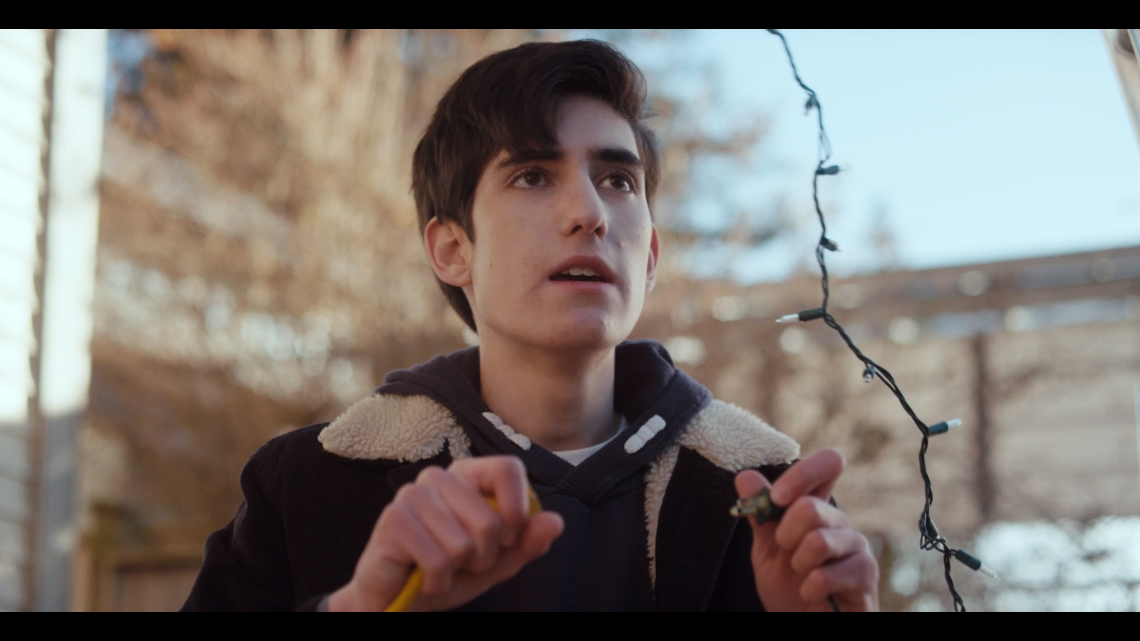 SUBMITTED PHOTO Ricardo Ortiz plays NIck, a 16-year-old teen who unwittingly cancels Christmas then must find a way to restore the holiday in his family’s film production, Saving Christmas.

 MARIO BARTEL