This story was originally scheduled to appear in the Tri-City News
Dinner and a new home?
That unlikely combination for an afternoon or evening out will soon become possible as the developers of a major new project that will eventually comprise 9 towers, including a 27-storey office and hotel building, at the southeaster corner of the Lougheed and Barnet highways launch a new sales centre that includes a restaurant and coffee shop.
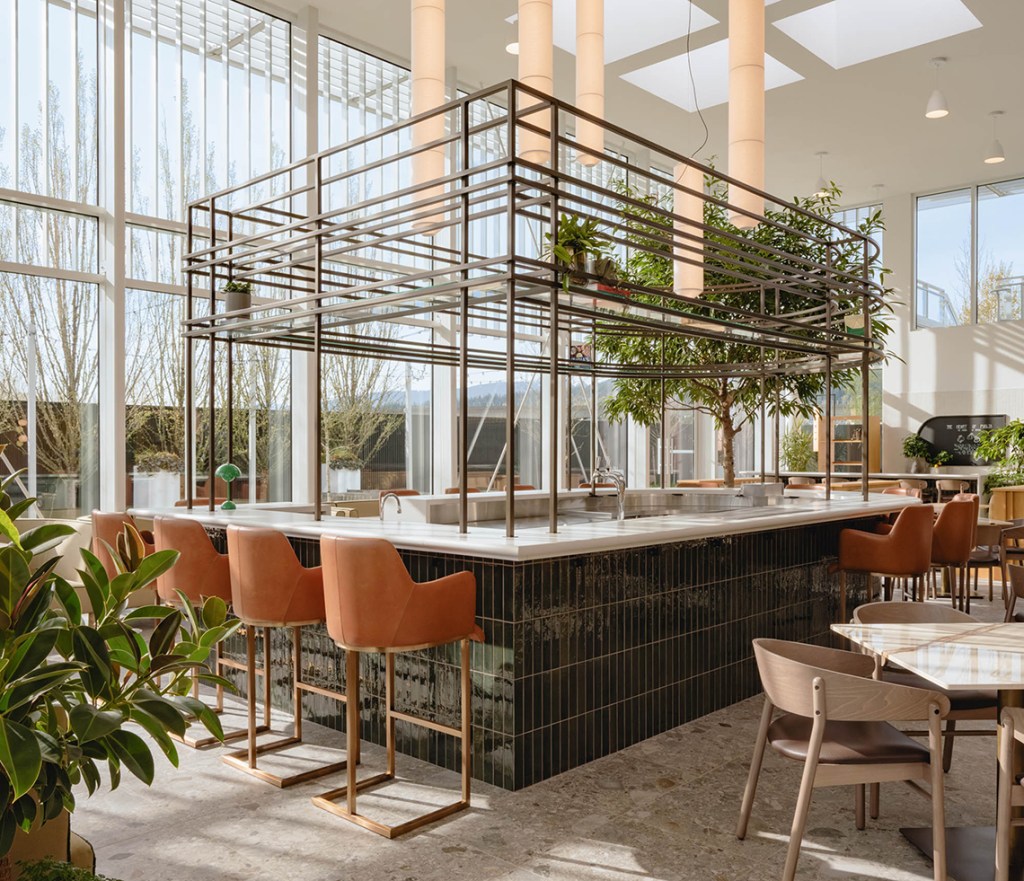
The TriCity Pavilion, at 2968 Christmas Way, will feature a sales gallery for Tri-City Central, a new mixed-use development project by Langley-based Marcon and QuadReal Property Group, along with Gigi’s by Ask For Luigi, a high-end Italian restaurant featuring fresh pasta, pizza, Italian wines and cocktails, as well as a new Nemesis coffee shop.
This is Marcon’s third multi-faceted pop-up sales centre and community hub.
In 2022 the developer opened Outpost at 3001 St. Johns St. In Port Moody. It’s sales centre in a strip mall’s parking lot has marketed several projects since, while the adjacent coffee shop offers offers a selection of hot and cold beverages, including craft beers, sandwiches and snacks, as well as showcase space for local products like olive oils from Olive the Best in NewPort Village.
In January, the new Surrey Pavilion featuring a Nemesis coffee shop, opened in the City Centre area.
Marcon’s executive vice-president, Nic Paolella, said the pavilion concept offers a taste of what’s to come in emerging neighbourhoods.
“It’s a living expression of the community we’re building,” he said in a news release.
SUBMITTED Some of the baked goods that will be available at the Nemesis café in the new TriCity Pavilion in Coquitlam.
Nemesis’ 50-seat Coquitlam location will be its fifth since first opening in Vancouver’s Gastown in 2017. Founder and CEO, Jess Reno, said it’s an opportunity for the company to bring its “coffee creating culture” to a new, growing city.
“The Tri-Cities is one of Metro Vancouver’s fastest growing regions, and we look forward to working with Marcon once again to bring a new community hub to life with TriCity Pavilion.”
Gigi’s by Ask For Luigi is the first venture in the Metro Vancouver area east of Boundary Road for the Kitchen Table hospitality group that also operates Italian restaurants like Bacaro, Carlino, Di Beppe, as well as Gionvanie Caffé with two locations in Vancouver and another in Toronto, two Mercato di Luigi Italian grocers, and Motoretta gelateria.
SUBMITTED The interior of the new Gigi’s by Ask For Luigi Italian restaurant that will be part of the TriCity Pavilion and pop-up sales centre in the new TriCity Central project at the southeastern corner of Lougheed and Barnet highways.
Its menu will be designed by culinary director, Chanthy Yen, a former winner on the TV reality show Top Chef Canada, along with head chef Lloyd Taganahan.
“We’re bringing the same heart and hospitality that our Vancouver restaurants are known for to the Tri-Cities,” said Kitchen Table co-founder, Jennifer Rossi.
When Tri-City Central is completed in 10-15 years, it will feature more than 4,000 new condo and rental homes, a park, retail, office and cultural spaces, a childcare facility and possibly a 150-room hotel and conference centre. It will be linked to the nearby Coquitlam Central transit hub by a new pedestrian/cyclist overpass. The project was approved by Coquitlam council in September, 2022.
The TriCity Pavilion is expected to open later this spring, with the sales centre to follow at a later date.
This story originally appeared in the Tri-City News
On a field trip to the Vancouver Aquarium, Edward Chen noticed many of his classmates averting their eyes as their bus navigated the hardscrabble streets of the Downtown Eastside.
“It’s not something I’ve been in contact with too much,” he said of the neighbourhood’s tent encampments and homeless residents slumped in alleys and on sidewalks. “Living in the Tri-Cities, homelessness is less visible.”
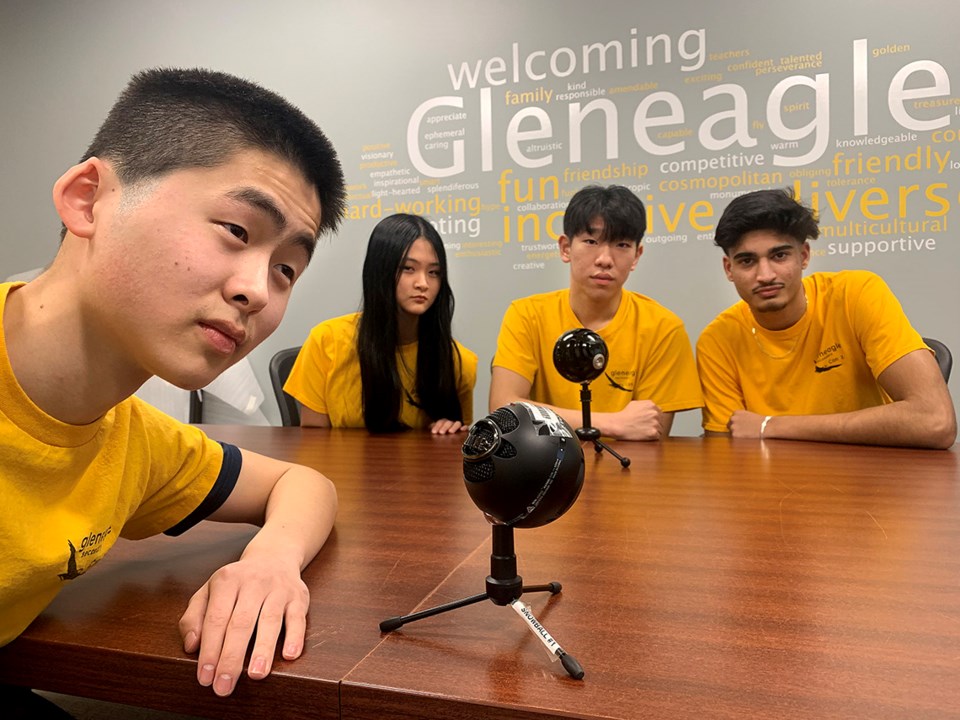
Chen and four classmates in the Con X Leadership program at Coquitlam’s Gleneagle Secondary are using technology and social media to foster empathy and compassion among their peers for people struggling with homelessness.
They’ve created The Blue Shed Podcast to share stories of people who’ve lived through homelessness and come out the other side, as well as community members working on the front lines of the homelessness issue in the Tri-Cities.
Chen said the group, that also includes Grade 12 students Mahtab Khangura and Matthew Jang, as well as Olivia Vasquez and Marisa Bassetto who are in Grade 11, originally wanted to construct a special blue shed where they could collect first-hand interviews from people experiencing homelessness, but they were advised that might not be the safest approach.
‘Be more creative’
Chen said the pivot forced them to reevaluate their own ideas about homelessness and goals for their project.
“We had to be more creative.”
For the first episode of their podcast, the group connected with a pair of outreach workers at the Hope For Freedom Society, Amanda and Aaron. They had survived their own experiences with addiction and homelessness and are now working to support those still enduring struggles.
Jang said their stories help humanize the issue of homelessness but also offer a glimmer of hope that hard work and perseverance can pay off.
“It’s important to make the issue feel personal and relevant. It opens doors to realizing the issue can’t be pushed to the side,” he said.
A future episode will visit with Macarthy Whyzel, a student at Douglas College in Coquitlam who’s created the Uplifting Group that distributes bottled water, nutritious snacks and other comforts like toiletries and socks to people struggling to survive on the streets of the Tri-Cities.
Vasquez said sharing such stories helps raise awareness of the work that is going on to help ease the homelessness issue in the area, often in the shadows.
Reach a younger generation
Khangura said the group’s work so far has helped build up his own understanding of homelessness.
Chen said the group decided a podcast would be the best way to reach their peers as most of their friends are avid podcast consumers. They’re also able to break out clips to post on , broadening the reach of their message.
“Our aim is to reach the younger generation,” added Khangura.
Because, said Jang, “even at our age you can make an impact.”
I first alighted at the Tri-City News 34 years ago almost to the day, a refugee from the 1990 Ontario recession that had cost my job of five years as a photojournalist at a paper in Oshawa.
An industry contact told me to talk to Craig Hodge and happenstance brought him to a conference in Toronto.
He told me if I came west, there would be work.
So I turned down an offer at a paper in Sydney, Nova Scotia, and pointed my red Toyota in the opposite direction.
The Tri-City News in 1991 was as close to a daily paper you could get without publishing six or seven days a week.
Under the guidance of Hodge, we were a department of six photographers, an office manager and assorted freelancers. The newsroom upstairs was similarly staffed.
We had a studio, full colour darkroom and we were all connected with pagers (!) and two-way radios. We covered stories seven days a week from 8 a.m. to 10 p.m., from Boundary Road to eastern Maple Ridge.
Travel budget
Occasionally, there was budget to go out of town, to the BC Winter and Summer Games, the Canada Summer Games in Kamloops, the Commonwealth Games in Victoria, to Miami to cover the IndyCar debut of local racer Greg Moore. During provincial elections, someone was sent into Vancouver to cover the big celebration for the winning party.
MARIO BARTEL/TRI-CITY NEWS Greg Moore heads home from the track at Homestead, Florida, at the end of IndyCar spring training in 1996.
One year, the company chartered a plane to fly several of us to Spokane, Wash., for a photojournalism conference. We took great delight in telling others we had to cut out of Happy Hour because our plane was warming up its engines at the airport.
Around the light table where we gathered at the end of every shift to edit our negatives and debrief the day, we speculated it was only a matter of time we’d become a daily. The news was out there, the papers were robust, filled with ads and flyers.
On April 17, the Tri-City News went dark after more than 40 years, although it was already diminished from its former self in August, 2023, when the decision was made to end the actual print publication to exist solely online.
The plummet of local news has been precipitous and painful.
While organizational changes had sent me to the Burnaby and New Westminster NewsLeader for 15 years until they were closed in 2015, I remained connected to the Tri-City News, occasionally sending stories that might be of interest, often sharing photos when a team or athlete from Coquitlam, Port Coquitlam or Port Moody was playing in a tournament or provincial championship at the Burnaby Lake Sports Complex, Copeland or Queen’s Park arenas.
When former TCN editor Richard Dal Monte had an opening in 2017, I jumped at it after 18 months wandering the wilds of freelancing, riding my bike and producing digital content for a realtor. You can take the boy out of the News, but you’ll never take the News out of the boy.
I came back with eyes wide open; our industry has been precarious for years.
Stories to be told
But there were still so many stories to be told.
So we put our heads down and forged ahead, even as we went from publishing twice a week to just once. Even as newsroom vacancies started to go unfilled. Even as the COVID-19 pandemic scattered us to our homes, conducting interviews over the phone or making arrangements to meet in open spaces like parks, driving deserted streets looking for photos that captured the weird vibe of that extraordinary time.
Heading to an assignment with a few minutes to spare; I searched for a shot that would somehow capture the feelings of isolation many were enduring during the first weeks of the COVID-19 pandemic as businesses closed and people stayed apart.
Our coverage of those early months of fear and uncertainty was some of the best I’d ever been a part of. Along with keeping up with the frenetic pace of event cancellations and societal changes brought on by the public health crisis, we found unique features of people persevering: the Shriners band playing for isolated seniors; an Elvis impersonator giving drive-by concerts; businesses trying new ideas to keep money coming in when their customers were staying home; the challenges faced by young student athletes with no sports to play.
It took a pandemic to revive Elvis. Darren Lee reignited his career as an Elvis tribute performer by driving to various neighbourhoods to entertain people shut in by the COVID-19 pandemic.
But even as we put in long hours in trying conditions to keep readers informed of all that was changing during the pandemic, the die was being cast for our ultimate demise.
Businesses trying to hang onto every penny to stay afloat themselves stopped advertising; many never came back. Readers’ habits changed, perhaps conditioned by hours of doomscrolling on social media platforms to keep up with the moment-by-moment developments during the pandemic.
Even going online exclusively, sparing the expenses of newsprint, ink, distribution and, eventually, a physical office, couldn’t turn the tide.
Tough times
The months since that decision haven’t been easy. Spending hours covering a contentious council debate about a major development proposal that barely registers a couple of hundred page views while a five-minute effort to recast a press release about a new donut shop coming to town goes off the scale can be dispiriting.
So can watching editors churn and colleagues depart.
But through it all we’ve tried to keep our communities informed and connected by sharing their stories.
I guess the void ahead will be the true test of whether that even matters anymore in an age when the first thing people do in the morning is scroll their Facebook feed rather than open the local paper and algorithms direct people into a perpetual feedback loop affirming their darkest inclinations.
It’s truly has been the best of times. It is the worst of times.
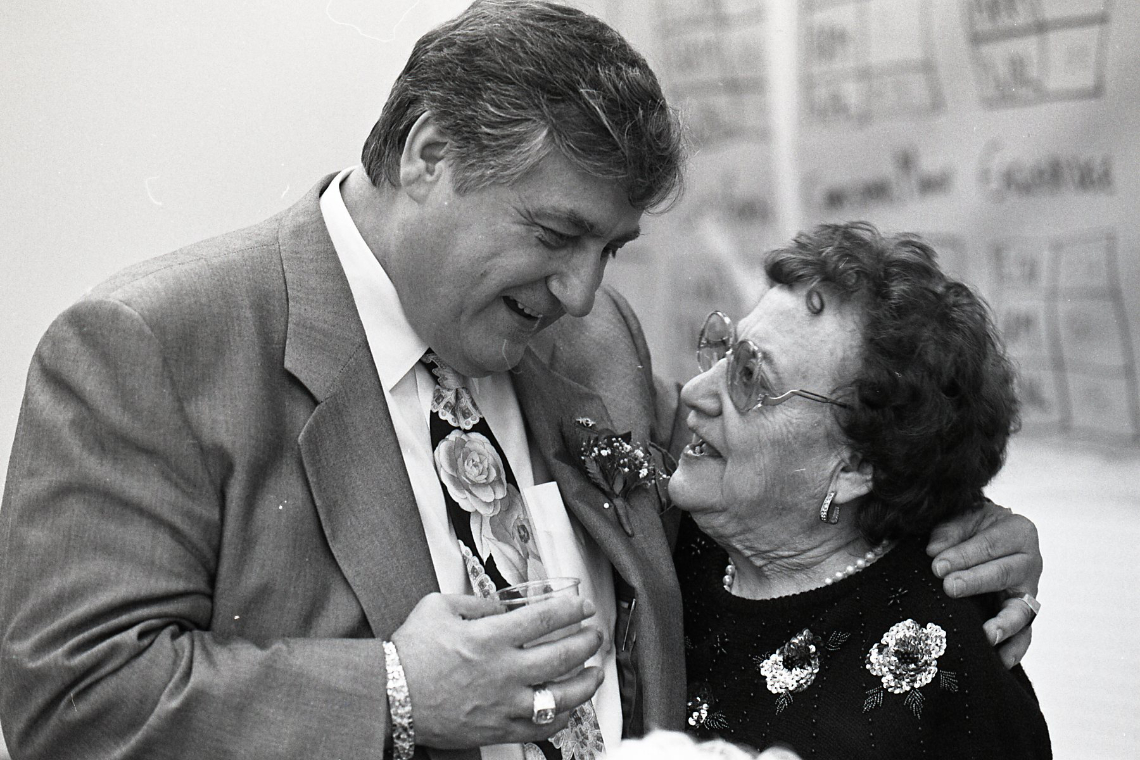
A selection of photos I’d shot in my first couple of years working in the photo department at the Tri-City News. They, and many more, have been carefully preserved and digitized by the City of Coquitlam Archives.
In 2023, my former colleague at the Tri-City News, Diane Strandberg, launched a weekly history feature that could easily plug a hole in the back pages of the paper and generate some traffic to our website. Headlines from the Past looks back at stories we’d covered in the publication’s 40 years. When Strandberg retired in Sept., 2023, she asked if I wanted to continue the feature. I’d launched a similar retrospective series in the final years of the Burnaby and New Westminster NewsLeader before it was closed in 2015, so I enthusiastically picked up the mantle. The stories aren’t just a fun opportunity to leaf through yellowing back issues of the paper and remember some of the stories I’d covered as a photographer, they’re also a reminder of the breadth of features and news we were able to bring to readers when we had the resources. As well, they highlight the important role newspapers play in documenting change and evolution in their communities, along with some of the quirky and remarkable happenings. Many thanks to the staff at Coquitlam Archives who’ve taken on the task of preserving back issues of the Tri-City News, as well as thousands of negatives and photos. Here is a small collection of some of my favourite Headlines from the Past features.
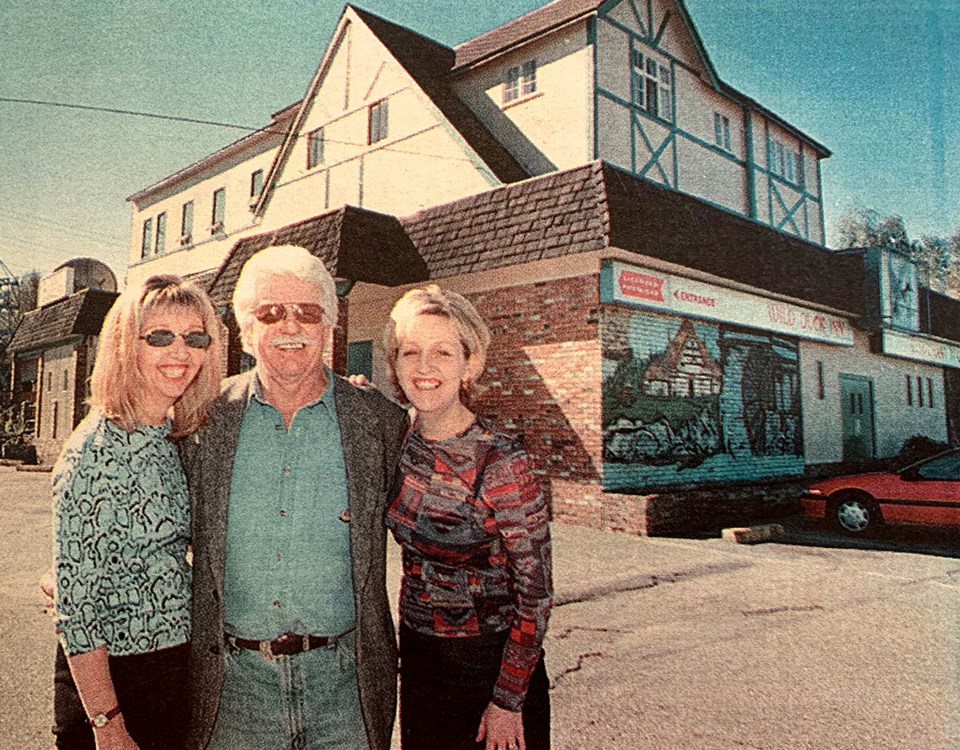
Wild times come to an end at this notorious Port Coquitlam inn
For better or worse, the Wild Duck Inn was a local landmark.
Tucked next to the Lougheed Highway where it meets the Mary Hill Bypass in Port Coquitlam, the Tudor-style tavern was notorious for its exotic dancers and sometimes less-than-reputable customers. It was used to film a brutal rape scene in the 1988 Jodie Foster film, The Accused.
Other Hollywood stars who alighted its interior for various productions included Gwyneth Paltrow, Melissa Gilbert and Sean Penn, who scouted it as a potential set for a project he was working on with Jack Nicholson.
Using the money he’d made renting the facility to film crews, Kogler set out to reimagine The Wild Duck as an Irish pub and restaurant to be called Dublin Docks.
“We want to change the image of the pub,” Kogler told the Tri-City News, adding the makeover would honour his wife’s Irish heritage.
Instead of a brass pole atop a stage, Kogler said he planned theme nights and live music, as well as an upgraded menu.
“We’re going to get rid of the dancers,” he said. “We are missing 50 per cent of our population right now.”
By December, the last stripper had twirled around The Duck’s brass pole and many of its fixtures, like the giant map of Pitt Lake that had occupied a place of honour behind the bar for 20 years, were auctioned off.
In 2008 the pub was demolished to accommodate construction of the new Pitt River Bridge.
Protesters denounce the use of animals in a traveling circus visiting Coquitlam in 1995.
TRI-CITY NEWS FILE PHOTO/COQUITLAM ARCHIVES
Circus tigers and elephants attract animal rights protesters to Coquitlam
The circus came to town in the summer of 1995.
So did animal rights protesters.
“The only exercise they get is when they perform,” a director of the Vancouver Humane Society told the Tri-City News, adding the animals are often chained or in cages, standing in their own feces and urine.
But a tiger keeper for the circus said its six big cats, plus two lions, are well-cared for.
“If this animal was mistreated, he would be cowering now,” Chris Kilpatrick said of one of the tigers lolling in a cage outside the arena.
“I’ve had this guy since he was a day old. He’s like a member of my family.”
Kilpatrick said the tigers travel and perform for five months of the year and get two days off a week. They spend the rest of their time at a ranch in southern California where the better-behaved cats are allowed to road free.
But the protesters said such assertions are little comfort.
They said they planned to lobby Coquitlam council to ban circus animals in the community and pressure operators to send them to sanctuaries to live out their lives.
“I’m convinced as more and more municipalities stop these shows, these facilities will be made available to animals,” said one.
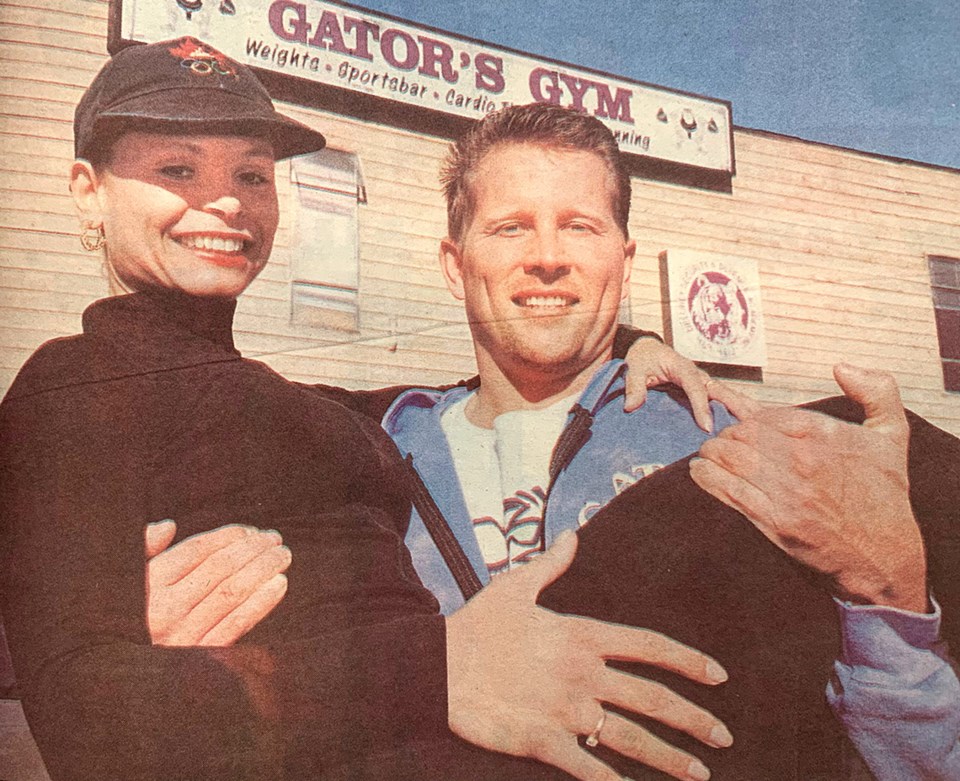
Gator’s Gym owner Kai Heinonen and personal trainer Monalee Blu chased down a would-be thief who tried to lift some personal effects from lockers in March, 1997.
TRI-CITY NEWS FILE PHOTO/COQUITLAM ARCHIVES
Don’t mess with Port Moody’s repetition man (and woman)
A would-be thief might have been reconsidering his career and lifestyle choices after trying to abscond with some personal effects from a Port Moody gym in March, 1997.
The out-of-shape bandit faced several charges and his parole from a previous conviction was revoked after he was chased down by the owner of Gator’s Gym, Kai Heinonen, and one of its personal trainers, Monalee Blu.
The alleged thief was trying to get away with keys and a wallet he’d pilfered from Blu’s locker.
Blu had just finished an hour-long cardio workout when the incident occurred.
While Heinonen was tending to a prospective client who may actually have been a decoy, the suspect secreted into the locker room area, cut a lock and lifted Blu’s fanny pack that contained her car keys and wallet then left with his accomplice.
Blu noticed the theft immediately. She advised Heinonen. They saw her car was still parked out front, but with a stranger in the driver’s seat, trying to get it started.
Blu ran out to confront the thief, and when he tried to flee, she kneed him in the groin, causing him to drop the keys. As she went to pick them up, the suspect hightailed it on foot.
Heinonen, who was watching the scene play out from inside the gym, immediately gave chase, joined by Blu.
They quickly caught their winded quarry and pinned him to the ground until police arrived.
“If I had to chase him to Timbuktu, I would have,” Blu told the Tri-City News.
“It was pretty wild,” said Heinonen.
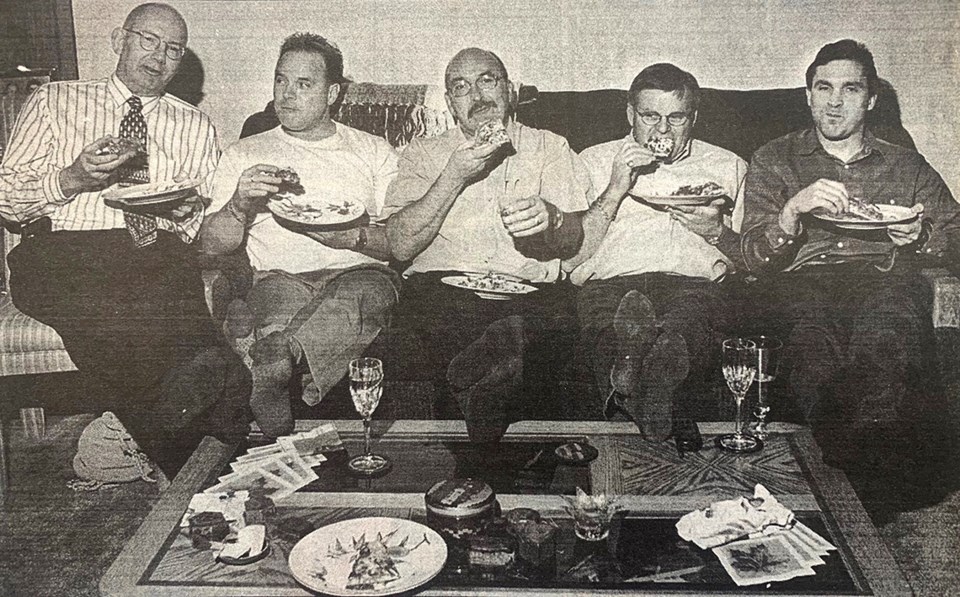
Contestants for the Mr. Millennium pageant kick their training into high gear.
TRI-CITY NEWS FILE PHOTO/COQUITLAM ARCHIVES
Fundraiser for Port Moody hospice project turns the tables on beauty pageants
Stuffing slices of pizza and drinking beer may not be a part of the training regimen for most pageant contestants.
But the seven local businessmen vying to be named “Mr. Millennium” were doing their best to increase their girth — er, worth — prior to the unique fundraiser event for the Crossroads Hospice Society, which, in 2000, was in the planning stages for construction of its new $1.5 million-facility near Port Moody’s Eagle Ridge Hospital.
The contestants — three of them single — would compete in fashion modelling, beach and formal wear, impromptu questioning and talent, with the winner representing Crossroads at local functions through 2001.
“The guys are really excited about this,” said Linda Kozina, Crossroads’ executive director.
“They’re training to get in shape. And we’ve already got a waiting list for next year’s pageant.”
A commuter ferry service that transported passengers from Rocky Point Park in Port Moody to the Sea Bus terminal in Vancouver lasted less than a month in 1994.
TRI-CITY NEWS FILE PHOTO/COQUITLAM ARCHIVES
The commuter ferry service from Port Moody to Vancouver that didn’t last a month
Long before SkyTrain and West Coast Express carried commuters from the Tri-Cities into Vancouver, the owners of a 60-foot tunnel-hulled ship called Pride of Vancouver were getting ready to launch their own private service.
James MacMillan and Vancouver doctor William Chan proposed twice daily sailings between the pier at Port Moody’s Rocky Point Park and the SeaBus terminal. The 55-minute journeys would depart at 7 a.m. in the morning and return for Port Moody at 5:30 p.m. The trips would cost $4.50 each way, or $165 for a monthly pass.
In a presentation to Port Moody council, MacMillan said the service needed 50 passengers each way to break even, but he hoped to attract up to 150. He said he planned to launch on Jan. 24, 1994.
But some councillors weren’t so keen on passing a bylaw that would grant the Pride of Vancouver permission to use the pier and set docking fees for the craft and parking rates for passengers. They were concerned the commercial enterprise wouldn’t be an appropriate use for the public park.
Others — led by then-Mayor John Northey — said the effort to provide an alternative way for commuters to get to Vancouver and ease traffic congestion was laudable and worth granting the company use of the facility for a trial run lasting into May.
The bylaw ultimately passed on Jan. 24, and a week later the ship had its maiden commuter voyage with only 12 passengers and a contingent of reporters, photographers and camera operators from several media outlets.
Slowed by an incoming tide, the craft arrived in Vancouver 16 minutes late.
It may have been an ominous omen.
A week later MacMillan was offering free rides and adjusting his schedule to get passengers into Vancouver and back to Port Moody earlier.
“Everybody has said our times are wrong,” he told the Tri-City News.
But even those adjustments weren’t enticing enough to get commuters out of their cars.
MacMillan lowered the fare to $3.50 each way and even threw in a free B.C. Transit transfer in an effort to build traffic.
Less than a month after it launched, though, the commuter ferry service was sunk.
Its last voyage carried 26 passengers — more than the average load of seven a sailing it carried in its final week, but far less than the craft’s capacity of 200.
Port Moody could soon become the first municipality in British Columbia to compel new grocery stores participate in a local food recovery program.
Tuesday, April 22, council will consider a motion by Mayor Meghan Lahti that staff report back with a city policy requiring all new grocery stores partner with a recovery program to distribute food that would otherwise be thrown away to local charities and non-profit organizations.
Currently, participation by grocery stores in such food recovery efforts with organizations like the Food Link Society is largely voluntary.
Lahti said with three new grocery stores planned as part of major development projects in Port Moody — downtown, the Inlet District and Portwood — the time is right to get them on board.
“From a municipal perspective, these programs are best initiated at the outset through policy,” she said in a report. “It will be important to implement this policy as soon as possible to ensure that this requirement is understood prior to negotiation with any potential grocery store provider.”
Lahti said food recovery programs help reduce food waste, increase food security, save grocery stores money on their disposal costs and reduce greenhouse gases.
One million kilograms of rescued food
Igor Bjelac, the director of the Food Link Society, said his group currently serves 11 communities from 29 distribution points around the Lower Mainland. Last year it rescued a million kilograms of edible food that otherwise would have been sent to a landfill.
He said a policy making new grocery stores in Port Moody participate in food recovery programs would be a huge boost.
“It would reduce the time and effort we currently spend persuading stores to come on board,” Bjelac said. “Instead, we could focus our energy on expanding services — like increasing the number of families we serve, boosting meal production in community kitchens, and supplying even more food to schools and housing facilities.”
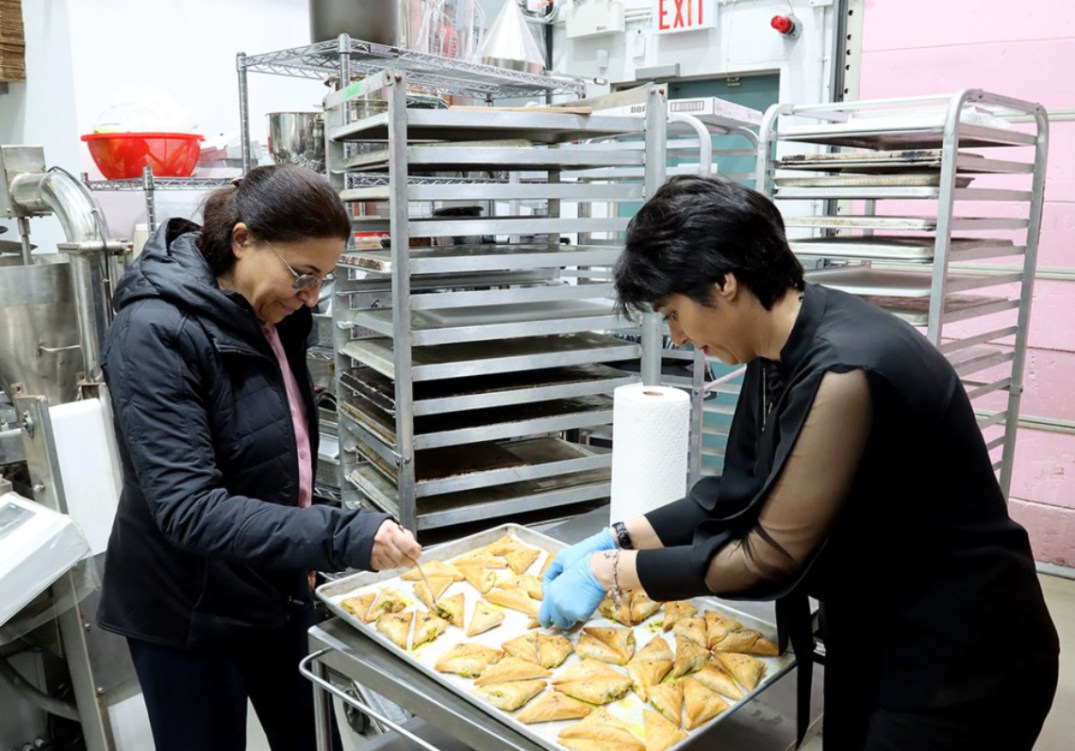
In February, Food Link opened a community kitchen facility in a Coquitlam industrial park that will allow volunteers and professional staff to transform imperfect vegetables and fruit, as well as other staples nearing their best before date, into healthy meals, appetizers and snacks to be distributed to local families in need.
Cassie Neigum said she’s seen first-hand the benefits food recovery programs can have in the Coquitlam middle school community where she teaches.
“You can’t teach kids if they’re hungry,” she said, adding the number of families at her school who receive hampers of food items recovered from local grocery stores increased from 32 to 52 in just the past year.
“Kids can’t learn in class if they’re concerned about where their next meal is coming from.”
This story was first published by the Tri-City News
Port Moody’s Brewers Row is getting smaller.
But the number of individual craft breweries will stay the same.
Brave Brewing and Twin Sails are merging.
The Site B community space and The Fountainhead Network co-working space will also operate under the same umbrella.
Tech entrepreneur Chris Peacock, who’s part of a group that owns Brave and Site B, said the consolidation will to build community through the business partnerships.
“Our reason for being has always been about community and community thrives when the desire to buy, support and say local is paramount,” he said.
Twin Sails’ Clay Allmin said joining forces with Brave is better than the alternative, as the craft brewing industry in British Columbia faces challenges like higher costs and changing consumer tastes. Several breweries have closed in recent years, such as Studio in Burnaby and Broadway in Port Coquitlam, while others like PoCo’s Taylight and Train Wreck on St. Johns Street have changed ownership.
“This consolidation allows us to push forward and scale our ability to offer high quality, locally crafted places and products to our community,” Allmin said.
He added Twin Sails will use Brave’s excess brewing capacity to launch new products while its sales team will be able to help promote and improve distribution of its new sister brewery’s beers.
“This opportunity allows both breweries to get back to their roots of creativity and providing customers a unique experience every time they come to our tasting rooms,” Allmin said.
Mike Arboit, co-founder of The Fountainhead Network, said tightening his alliance with the breweries and the Site B event space with which he shares a warehouse on Murray Street, strengthens the collaborative eco-system he’s been trying to build where work, play and community engagement co-exist and help boost each other.
“This merger will create the time, resources and confidence to grow,” said Arboit, who’s also promoted professional wrestling events at Site B.
The event space was recently granted a three-year extension of its temporary use permit by the City of Port Moody and several members of council said the concept has been such a success hosting gatherings like holiday sales, weightlifting competitions, long-table dinners, wedding receptions and even roller derby, they’d like to see the arrangement made permanent.
Peacock, who co-founded tech start-up Traction Demand that grew to more than 1,000 employees before it was acquired by Salesforce Professional Services, said he’d like to bring the concept to other communities.
This story was scheduled to appear in the Tri-City News.
A changing media landscape, including the demise of the Tri-City News, has the City of Port Moody scrambling to find new ways to share factual information with residents and counter disinformation spread on social media.
Tuesday, April 15, council approved an expenditure of $50,000 this year, and an $85,000 budget item in 2026, to boost the city’s communication resources.
The money will be spent to help fill an “anticipated information gap on timely information” about council decisions, as well as other general city news, good news stories, details about city services and programming along with calls to action.
The information will be posted on the city’s redesigned website, which is expected to be ready to launch in June, through a newsfeed that would trigger emails to subscribers or possibly even an e-newsletter, said Port Moody’s manager of communications and engagement, Lindsay Todd, in a presentation.
Todd said with the closure of the Tri-City News, which its parent company Glacier Media announced Feb. 21 (and subsequently occurred April 17), “a gap will emerge in information being pushed out to residents.”
The News has covered civic affairs and other happenings in Port Moody, as well as Coquitlam, Port Coquitlam and the villages of Anmore and Belcarra for more than 40 years. It ceased its print publication in Aug., 2023 to exist exclusively online, a model the company said has proved “unsustainable.”
Another publication that also covered the Tri-Cities, the Coquitlam Now, closed in 2015.
Todd said having the city take more control of disseminating its own information and sharing its good news stories will “improve trust and transparency.”
Coun. Diana Dilworth said the rise of social media and demise of traditional media is making it challenging to ensure residents get factual information about what the city is up to.
“There’s got to be a better way to do something different and better.”
Coun. Amy Lubik agreed.
“I think it’s really important we’re being proactive, especially with the loss of local media,” she said. “Humans are storytelling creatures and if there’s a gap in information, we fill it.”
More often than not, she added, that gap is filled with misinformation or disinformation spread on social media that polarizes residents.
“I hope we can use this as a tool to bring people together.”
But a journalism instructor at Langara College and former editor of the Tri-City News, Rich Dal Monte, said it can be challenging for an institution with a vested interest to gain trust that it’s disseminating a fulsome set of facts.
“For better or for worse, since the COVID-19 pandemic, there’s a lot more mistrust of institutions,” said Dal Monte. “There’s always going to be people who don’t believe what they’re being told.”
Dal Monte said an independent news entity, however, has no vested interest when reporting on civic affairs. “Whatever they do, we’re going to cover it.”
Coun. Haven Lurbiecki, the only councillor to vote against the motion, said no amount of message massaging by the city can counter unsubstantiated misinformation residents may read on social media or the way they feel about council decisions.
“I’m just wondering what the problem is we’re trying to address,” she said.
The following story was scheduled to appear in the Tri-City News.
Despite exiting the first round of the BC Hockey League playoffs for the fourth consecutive season, there’s no time for Coquitlam Express general manager Tali Campbell to wallow in disappointment.
Even as players head home for the summer following Sunday’s 5-1 loss to the Victoria Grizzlies that eliminated the Express from the post season in six games, Campbell is putting together a busy schedule that includes further building out of the program’s development teams, attending spring evaluation camps, managing more renovations to its off-ice training and lounge facilities across from the Poirier Sport and Leisure Complex, meetings with scouts, as well as potential recruits and their families.
“The work never stops anymore,” Campbell said.
This summer, though, presents some new challenges.
A recent decision by the NCAA to accept players from the Canadian Hockey League into its Div. 1 programs beginning Aug. 1 has significantly altered the junior hockey landscape.
The allure of preparing players for lucrative scholarship opportunities at American universities to continue developing on the ice while getting an education was once the BCHL’s ace-in-the-hole over the Western, Ontario and Quebec Maritime Junior hockey leagues, which the NCAA had considered professional because of the stipend players get to help them cover expenses while living away from home.
Play to strengths
With that advantage now gone, Campbell said the Express and the rest of the BCHL teams must play to their strength of giving young men the time, space and tools to develop and mature as players and individuals ready to take the next step in their hockey journey, whether that’s college programs at U.S. or Canadian schools, or even turning pro or semi-pro.
“Our league has always been the long runway league,” Campbell said.
Already that approach has paid dividends with a commitment from potential 2026 NHL draft prospect Cole Bieksa, the son of beloved former Vancouver Canucks defensemen Kevin Bieksa.
“I think the reputation of our program just gets boosted by something like that,” Campbell said, adding the 18-year-old forward, whose Fairmont Prep Academy team in California just missed out winning the Chipotle-USA Hockey national 3A high school championship, will still have to earn his place on the Express come September.
Home-grown talent
Campbell said the increased competition for players also boosts the importance for BCHL teams to cultivate home-grown talent through their own developmental pathway.
“The feeder system is critical to the lifeline of our program,” said Campbell of the Coquitlam HC program that’s partnered with School District 43 to give local players as young as 13 a chance to hone their game in an intensive hockey environment while going to school at nearby Centennial and Port Moody secondary schools.
“We need to get families and kids into our programs at a young age, show them exactly what we offer over the course of three to four years.”
Still, Campbell said, with several players who were key to the Express’s run to the playoffs graduating out of the BCHL, including goaltender Andrew Ness, forwards James Shannon, Joseph Odyniec, Andrej Kovacivic and Mason Kesselring, along with defensemen David Brandes and Sam Frandina, uncertainty about what the team will look like come September abounds.
With more options available, players and their families are unlikely to make quick decisions about where to play until training camp is nigh.
Toughen up
“Every player is going to try their best option,” Campbell said, adding he’s targeting those who do choose the Express to be bigger and more willing to go to the wall for their teammates when the going gets tough.
We have to set the expectation that from Day One, you’re going to have to give a hit, you’re gonna have to get into a lane to block a shot,” Campbell said. “We owe more to our fans, we owe more to our corporate partners and the community.”
Express announce soccer partnership
The Expess is making tracks in soccer.
The BCHL team has announced a strategic partnership with Coquitlam Metro-Ford Soccer Club’s new Evolution FC program that competes in the semi-pro League1 BC.
The league positions itself as a bridge from high-performance youth soccer to the sport’s elite professional and amateur leagues like the Canadian Premier Soccer League and the new women’s Northern Super League.
Campbell said the arrangement will create opportunities for cross-promotion and marketing of the hockey and soccer teams while allowing Evolution FC to draw upon the expertise the Express already have in place for public relations, game day management and ticketing.
“This partnership is about more than just sports,” said Campbell in a news release. “It’s about united two organizations that are passionate about community, youth development, and creating unforgettable experiences.”
The Evolution FC team already has a win and a draw in its first two matches in the nine-team men’s league while the women’s side has a win and a loss. Both teams are based at Coquitlam’s Town Centre Stadium.
But he’s still six years away from getting his driver’s licence.
Molnar, a Grade 4 student at Central Elementary School in Port Coquitlam, recently qualified to compete in the FIM MiniGP, an international road racing series for kids 10-14 that culminates with the top competitors from 22 countries earning their way to the world championship in Spain in November.
Tommy’s destiny to pull on racing leathers and throw a leg over a 160cc Ohvale racing motorcycle was pretty much bred in the bone.
His dad, Tom, raced in his native Hungary for 20 years and ascended to compete in the European championships. His uncle and grandfather were also racers.
Tommy’s grandmother bought him his first pocket motorbike even before he born. At three, he learned to ride it, tottering down a back alley while his father and grandfather ran alongside to catch him if he fell over.
“It was pure joy,” recalled Tom Molnar of that moment.
Not that he particularly wanted his young son to follow in his tracks.
“It comes with a lot of sacrifices,” Tom Molnar said. “It comes with a lot of injury.”
In fact, any further thoughts of motorcycling took a back seat when the family immigrated to Canada during the first wave of the COVID-19 pandemic.
Three years later, Tommy started dirt biking but quickly expressed his preference to ride around a road track.
His dad got him his first racing bike and he practised in the parking lot of a nearby school before entering his first race at the Greg Moore Raceway in Chilliwack.
Tommy finished third.
“It shocked and surprised me,” Tom Molnar said. “He just figured things out.”
To take measure of Tommy’s commitment, the family set goals for lap times; if he attained them, they’d carry on for another season.
SUBMITTED PHOTO Tommy Molnar, 10, with some of the trophies he’s won racing motorcycles.
Young Tommy was more than game.
“At the end of the day, he has the mindset of a racer,” said Tom Molnar of his son. “We go to a competition to race, not just ride a motorbike.”
Tommy said he loves the adrenaline rush of attaining speeds up to 120 km/h. But mostly, he said, he enjoys the collegial atmosphere of the track.
“Everybody is nice to each other,” he said. “If one person has a problem, everybody helps out.”
Graduating to the FIM MiniGP series means Tommy will be competing against racers who are up to four years older. They also have more experience and strength to lean the 130-pound bikes through the corners.
To get ready for the races that will take place at tracks in Ontario and Quebec from July through September, Tommy practises in the parking lot at a Richmond shopping mall with several other racers who’ve secured permission to use the area, as well as an overflow car park in South Surrey. Some track time at Mission Raceway is also a possibility, along with regional events at Cariboo Raceway Park in Quesnel and tracks in Alberta.
Physically, Tommy’s dad has designed a workout regimen to build his strength and stamina and he does Tae Kwon Do three times a week.
“It does take a lot of energy,” said Tom Molnar of motorcycle racing’s demands.
Mentally, Tommy said he just tries to focus on the task at hand. There’s no room in his thoughts for fear of crashing.
“If you think about it, it’s going to happen,” he said. “You just have to hold your breath and just do it.”
Tom Molnar’s not quite as dismissive of the sport’s dangers. In fact, he said the easiest way to soothe his qualms for his son’s safety is to get on his own bike and join him on the track.
“Somehow it feels less scary than standing stationary and waiting for something to happen.”
Tommy said he’s looking forward to the challenges of the upcoming season.
“Everything is brand new,” he said. “I feel very happy that I can do this.”
When I returned to the Tri-City News in 2017, I was assigned to cover civic affairs in Port Moody, with occasional dips into the neighbouring villages of Anmore and Belcarra. They’re the three smallest communities in our coverage area. But they’ve proved to be anything but sleepy. For four years, Port Moody was governed by a mayor under the cloud of a sexual assault charge. There was a raw sewage crisis on the grounds of a school at the border between Port Moody and Anmore. Development pressures have sparked division. And now, in the twilight of our publication, a war of words is percolating. This story first appeared in the Tri-City News.
A request by Port Moody for more time to comment on a massive development proposal in Anmore has drawn a sharp rebuke from the village’s mayor.
John McEwen said the village has already gone above and beyond by extending an invitation to its municipal neighbour to provide input on a proposal by Icona Properties to build 2,200 new homes on a 150-acre property the company owns at the corner of 1st Avenue and Sunnyside Road.
He said similar consideration wasn’t extended to Anmore when Port Moody made the decision in 2020 to remove the David Avenue right-of-way through Bert Flinn Park, eliminating the possibility of building a third road connection to the village.
As well, McEwen said, the city has never asked Anmore about the potential impacts to its traffic from several new developments near the Moody Centre and Inlet Centre SkyTrain stations that could bring more visitors to təmtəmíxʷtən/Belcarra Regional Park and the Buntzen Lake recreational area.
“I’ve always said we look forward to broader regional development, but what about hearing from Port Moody about the traffic impacts to Anmore of its development?”
In a letter dated March 26, Port Moody Mayor Meghan Lahti said city staff hadn’t yet had a chance to review several technical studies examining the proposed development’s impact on traffic, transportation infrastructure, sewer and storm water systems as well as surrounding watersheds and ecosystems so they could provide comment by Anmore’s March 26 deadline.
She then highlighted several areas of potential concern the city has about the development proposal, including:
the need for a new agreement to connect the new development as well as the rest of Anmore to the regional sewer system that currently ends in Port Moody
clarification on how the new development will receive water and potential impacts on a 2018 agreement that connects Anmore to the city’s water system
traffic congestion on Ioco and East roads and the possible effects on Port Moody master transportation plan to reduce the dependence on cars to get around
impact to environmentally sensitive areas, fish habitats, wetlands, wildlife corridors as well as neighbouring steams and forests
In February, Anmore council approved an engagement plan for Icona’s proposal. It includes consultation with neighbouring communities, First Nations, TransLink, Metro Vancouver, Fraser Health, BC Ambulance, RCMP, the Vancouver Fraser Port Authority, as well as village residents.
Planning consultant Tim Savoie, who recently retired as Port Moody’s longtime city manager, said it’s still early days for such consultations and all interested parties will have several opportunities to provide “detailed technical analysis.”
Savoie said the majority of the technical studies have been submitted to village staff and are currently being reviewed before being made publicly available.
He added Port Moody is welcome to attend future open houses about the development proposal as well as provide official responses during a public hearing or during referral to Metro Vancouver should it get that far.
“It’s just one of the first opportunities to provide comment.”
McEwen said Lahti’s letter pretty much made Port Moody’s feelings about Icona’s development proposal be known already.
“I’ve never seen a letter of this detail.”
Anmore Couns. Kim Trowbridge and Polly Krier agreed.
“They seem to be getting overly involved in Anmore’s business,” said Trowbridge.
“We can’t let another municipality drive our decisions,” added Krier. “It’s important for us to stay in our lane and a neighbouring municipality stay in their lane.”
But Coun. Doug Richardson, whose motion to grant Port Moody the 60-day extension didn’t even get a seconder, said it’s important the communities remain “good neighbours,” adding the city will likely feel the greatest impact should the village eventually decide to let Icona’s development proposal proceed.
Anmore council then voted to receive Lahti’s letter for information.


















 MARIO BARTEL