This is an update of a story first published in the Tri-City News on Oct. 15, 2021
A former Terry Fox Ravens soccer player has signed his first pro contract — with the Toronto Argonauts of the Canadian Football League.
The Argonauts announced Monday, May 5, it’s signed kicker and punter Dawson Hodge, who recently completed a successful collegiate career with the Wilfrid Laurier Golden Hawks that culminated with the school’s appearance in the USports Vanier Cup national championship last December.
Hodge will report to the Argos’ spring rookie training camp on Tuesday.
Hodge didn’t put on a football helmet and shoulder pads until his senior year of high school. And then only after he was coaxed by his twin brother, Brandon.
But after a few good practice kicks Dawson tried out and made the Ravens football team, helping Terry Fox reach the semi-finals of the 2018 Subway Bowl provincial championships, where they were defeated by the New Westminster Hyacks, 33-0.
Sitting in the locker room at BC Place afterward, Hodge said he realized he didn’t want his brief dalliance with football to be over.
As it happens, former BC Lions kicker Lui Passaglia is a neighbour.
Hodge worked with him to find his form, then headed to a high performance kicking camp in the United States to refine it. He won the field goal competition there, and finished second in kick-offs among some of the best high school kickers in America.
“This motivated me to pursue football and master the craft of kicking,” Hodge said.
More experience
Looking to gain more experience before taking a run at possibly being recruited by a post-secondary program, Hodge enrolled in an additional year of high school at a football academy in Toronto that plays exclusively against top American teams.
“They were really good teams, full of college prospects, so the tough competition made us better,” Hodge said, adding the experience of playing under the lights on Friday nights in packed little stadiums south of the border was enthralling.
The seasoning of his game paid off. A half dozen Ontario universities plus Simon Fraser University in Burnaby enquired about joining their programs.
After touring each, Hodge said he was attracted to Wilfrid Laurier in Waterloo that’s produced kickers who’ve gone on to play in the Canadian Football League in the past, including Ronnie Pfeffer, who won Grey Cups with the Argonauts and Ottawa Redblacks and also played for the Calgary Stampeders.
“I knew the team would utilize the kicking game,” Hodge said. “If I could prove myself, I’d have a good chance to be a starter in my rookie year.”
Pandemic pause
Alas, the COVID-19 pandemic kicked that dream to the curb.
Instead of lifting punts into the crisp fall Ontario air, Hodge worked out in a gym his parents set up in the garage of their Coquitlam home and studied Geography on his computer. Twice a week he ventured over to Town Centre Stadium to boot balls through the uprights, recording his workouts for online reviews with his coach in Waterloo, Darcy Segin.
Still, Hodge said, staying sharp was a challenge.
“The best way to stay motivated was being optimistic,” he said. “Knowing that one day we will get back out on the field encouraged me to keep kicking and working out.”
Hodge’s dedication paid off.
In four seasons with the Golden Hawks, he was successful n 63 of his 68 field goal attempts and his 255 punts sailed an average 41.3 yards.
Hodge was also Laurier’s rookie of the year in 2021 and he was named an Ontario University Athletics all-star and second team All-Canadian in 2022.
Hodge said his soccer background helped his success on the football field.
This story first appeared in the Tri-City News on Oct. 13, 2024
The COVID-19 pandemic may have had a silver lining, says a Coquitlam psychologist.
Denis Boyd says the public health crisis that shuttered people indoors for months at a time and created trepidation about mixing with large crowds was a big “wake-up call” to some of the everyday stresses to which we’d become complacent.
Boyd is the first presenter in Coquitlam Rotary’s new mental health speaker series that launches Oct. 29, 7 to 8:30 p.m., at Douglas College in Coquitlam. He will be speaking about the signs and causes of stress, as well as the kinds of tools that can be used effectively to manage it.
Boyd said the COVID-19 pandemic raised stress levels “a notch or five.”
He said the daily news reports of deaths and hardships brought people face-to-face with their mortality and often sparked a re-evaluation of life’s priorities.
Suddenly freed by employers to do their jobs from home, many people coped by finding a better balance between the demands of work and the opportunities of life. Cooped up, they went outdoors more to take a walk in the park, commune with their natural surroundings. They whittled their social circles down to those most important to them.
“It was sobering to have everything shut down,” Boyd said.
But as memories of those darkest days dim, old habits and routines are returning. Employers are demanding employees return to the office. Doom scrolling through social media feeds has become endemic, isolating.
Boyd said it’s important society doesn’t abandon the lessons learned through the pandemic.
“We have to always make sure we balance our work life with our personal life,” he said, adding it’s critical we constantly cultivate our relationships with others.
“The most impactful thing we can do is improve our relationships, share our journeys with each other.”
Boyd said the realities of modern living, like residing in large condo developments where getting to know your neighbours can be difficult, and the temptations of social media and video gaming as proxies to real in-person interactions can present challenges for cultivating connections.
“Our conveniences have made us more isolated,” Boyd said, adding the anxiety that comes from such isolation exacts a toll as it builds.
“When you load up and reach your capacity of stress, you’re going to get sick.”
How to attend
Admission to Coquitlam Rotary’s mental health speaker series if free, but pre-registration is required.
The second event, on Nov. 26, will feature psychologist Tamara Williams talking about the use of modern neuroscience to help caregivers and children manage emotions together. Further speakers will be announced in the new year.
According to Hockey Canada, only one in 4,000 kids playing hockey in this country will ever have a career in the National Hockey League. That’s .025%. Port Coquitlam’s Brady Leavold was on the cusp of beating those odds. But childhood demons and addiction snuffed his dream and sent him spiralling to the streets and petty crime.
Brady Leavold has been in the Tri-City News before.
But the gritty forward from Port Coquitlam wasn’t featured as he became a fan favourite with the Swift Current Broncos in the Western Hockey League, or in a front page story covering his hoped-for triumphant first NHL game.
In 2016 Leavold was in the court blotter, after he was sentenced in Vancouver to 21 months in jail for theft, possession of stolen property, resisting a peace officer and several other charges.
Four years later, he’s trying to atone for that, maybe even help others wrung out by a sport that values players more as a commodity than as human beings.
Now 33, Leavold is living in Morrisburg, Ont., and running a skate-sharpening business. He’s slowly putting his life back together again and launching a podcast to shine a light in some of hockey’s darkest corners.
He’s trying to come to terms with a system that recognized his talent and ambition but didn’t see the demons that drove him to excel on the ice. Or maybe didn’t want to see.
In love with hockey
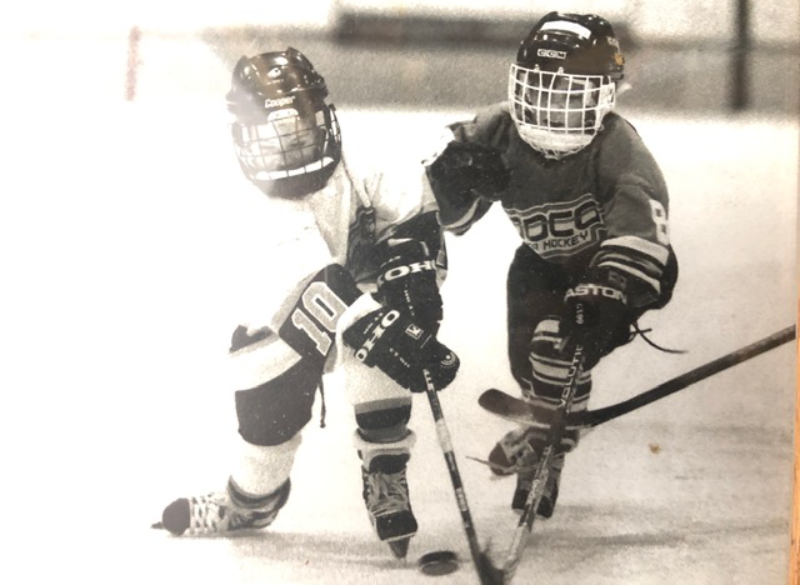
Leavold grew up in Port Coquitlam’s south side, where he attended Kilmer Elementary and then Citadel Heights Middle schools. He played hockey in the PoCo Pirates minor system, often on teams with boys older than him because he was so good and played “with an edge.”
SUBMITTED PHOTO Brady Leavold, right, chases down an opponent in a minor hockey game in Port Coquitlam in 1993.
Leavold said he couldn’t get enough of the game. When his firefighter dad, Brian, was coaching other teams, he’d spend hours in the corner of the old Blue Rink at PoCo Rec — where the nets were stored — knocking a ball or puck around with his stick. He dreamed of someday playing in the Pirates’ annual spring bantam tournament.
After hockey season was over, Leavold and his buddies, including Zach Hamill who went on to a pro career in the NHL and Europe, would rollerblade down to Ikea in Coquitlam and play two-on-two ball hockey in the expansive parking lot until the wee hours of the morning.
“That was our life,” Leavold said. “We had such a good group of guys playing hockey.”
But his friends didn’t know Leavold had a secret.
He said his all-consuming love for hockey was an escape from childhood sexual abuse that filled him with anger and shame every waking moment.
“I just wanted to be accepted, I wanted to be sure of myself,” Leavold said. “Hockey did that for me.”
Sabotaging success
As good as Leavold was, though, every tryout was fraught with anxiety that he’d get cut, that he wasn’t good enough.
Once, when he had a chance to make an elite team, he attended a skating session then faked an illness. He said he wanted to control his own destiny.
“Every good thing in my life, I’ve sabotaged it,” Leavold said.
Still, coaches wanted him on their teams, his energy on the ice. So they’d give him a second or even third chance.
When Leavold was 16, he played a game for the Western Hockey League’s Broncos, then was the team’s rookie of the year the following season.
Off the ice, though, Leavold struggled. He experimented with drugs like ecstasy. Then, seven games into his sophomore season in Swift Current, he walked away from the Broncos and returned to Port Coquitlam to live with his dad and attend Riverside Secondary.
Quickly Leavold discovered his hockey pedigree — flaunted by wearing his Broncos jacket everywhere — shielded him from accountability. He said he didn’t have to work as hard in school as other students to get a passing grade. He’s convinced he passed his driver’s test because the examiner was a fan and talked more about hockey than noting his mistakes.
When the Broncos traded Leavold to the Everett Silvertips, he didn’t report.
Instead, he signed with the nearby Burnaby Express of the BC Hockey League, where he scored nine points in his first three games playing on a line with future NHLer Kyle Turris.
But away from Copeland Arena, Leavold continued to party. He showed up for games with little sleep, if he showed at all.
The team got him counselling, tested him for drugs.
For a time, it worked.
Then Leavold hurt his Achilles tendon and he stopped going to the rink.
Weary of his erratic behaviour, Leavold’s dad kicked him out of the house. His girlfriend’s family took him in, made him feel at home, afforded some stability.
Another chance
That summer, Leavold called his old coach in Swift Current, Dean Chynoweth, and asked for another chance.
He got it.
But his life away off the ice continued to be a mess. He got a local girl pregnant. He started missing practices. The Broncos wanted to suspend him, but teammates came to his support. They said they needed him for the playoffs.
When the team was eliminated by the Regina Pats, Leavold headed back to Port Coquitlam, leaving his pregnant girlfriend to figure things out for herself.
Leavold said that decision was a tipping point.
“I was scared,” he said. “Maybe it was just going to go away.”
Back home, Leavold reunited with his old girlfriend. But when he got her pregnant too, she gave him an ultimatum to choose who he wanted to be with. He stayed put.
“I knew it was wrong,” he said of turning his back on his girlfriend and unborn child in Saskatchewan. “I knew it was going to affect me.”
Traded away
Hoping to dodge a roiling scandal in the small Prairie city, the Broncos sent Leavold to the Kelowna Rockets early in the next season.
But the new environs didn’t offer much of an escape for the 20-year-old player. During the Rockets first visit to Swift Current, an angry friend of his Saskatchewan girlfriend chased him in the arena’s lobby and his teammates had to hustle him onto the team bus with no idea what was going on.
On the ice, though, things were going much better.
Paired with future NHLer Jamie Benn, Leavold was the Rockets’ second leading scorer with 70 points and led the team in fights and penalty minutes.
NHL scouts took notice.
Leavold was signed as a free agent to the farm team of the Tampa Bay Lightning and he was invited to the big team’s prospect camp later that summer. With some money in his pocket for the off-season and his future looking bright, he got his own place in PoCo. His NHL dream was tantalizingly close.
At the Lightning’s prospect camp in Traverse City, Mich., Leavold was pencilled in to skate on a line with the league’s first overall draft pick, Steve Stamkos.
But poor choices in roommates and friends in the summer of 2008 put Leavold back on a self-destructive path.
Instead of getting into shape for the camp, Leavold said he binged on cocaine. The night before his big chance, he smoked pot and snorted coke.
Having blown his NHL opportunity, Leavold tried to cobble together a career in the backwaters of minor pro hockey: He lasted four games with the Lightning’s top minor league team in Norfolk, Va., then was sent down a rung to the ECHL’s Victoria Salmon Kings. He signed a contract with a team in the Netherlands but lasted only two games there before returning to Victoria where he played two more games then fell off hockey’s map for more than two years.
Hooked on opioids
Adrift and dealing with pain from hockey injuries, Leavold got hooked on Oxycontin, a powerful painkiller.
“It felt like a hug from my mom,” he said of the opioid.
At one point, Leavold tried to get clean at a rehab facility in Maple Ridge. He signed a contract with a team in Wichita, KS, but didn’t show up, then got another chance in Texas, with the Rio Grande Valley Killer Bees in the Central Hockey League. He scored 18 points in 22 games, accumulated 91 minutes in penalties. It’s the last line on his pro hockey résumé.
Back home in the Lower Mainland for the off season, Leavold fell back into a familiar pattern. He started injecting heroin. To pay for his addiction he held up liquor stores. He even stole a cab that resulted in his face showing up on a Crime Stoppers notice.
Eventually Leavold ended up on the streets of Vancouver’s Downtown Eastside. That’s where the police caught up to him and he was sent to jail, including a stretch at the North Fraser Pre-Trial Centre in Port Coquitlam, just down the street from his childhood hockey haunt.
But again, Leavold’s hockey background got him favoured treatment.
“You get away with everything,” he said. “There was a time I couldn’t get it out of my mouth fast enough that I was a hockey player and the benefits would come my way.”
A fresh start in Ontario
Upon his release, Leavold headed to Ontario to gain distance from his past and get clean again. He landed in Orillia, got a job. But when he was caught trying to drive a stolen truck on his way out of town to Vancouver, he was returned to jail.
Leavold hit bottom, his options had run out.
Until he happened to answer a phone call meant for another inmate.
The voice on the other end eventually became his girlfriend and his reason to straighten out his life.
“I knew I needed something to drive me and keep me going,” said Leavold, who moved in with his new partner in the basement of her parents’ home when he was released.
A new adventure
With nothing but time on his hands as they rode out the early weeks of the COVID-19 shutdown last spring, Leavold decided to share his story.
He got a microphone, plugged it into a borrowed laptop computer and started talking. He invited his best friend growing up, Kevin Pedersen, who’s now a scout for the Arizona Coyotes, to join him for his first stab at creating a podcast.
Leavold said Pedersen’s support meant the world.
“I didn’t have a plan. When he agreed to do that, it was a huge reason my life turned around.”
Leavold’s now more than 60 episodes into his new adventure that he calls Hockey 2 Hell and Back . Some of his guests are from his own hockey past. Many have skirted the sport’s fringes, like himself. A few, like Theo Fleury, Brent Sopel and Sheldon Kennedy, overcame their own challenges to achieve success.
Leavold said the podcast has reconnected him with the hockey community that promised him much as a player but delivered him little as a young man. But for one or two exceptions, most adults he’d dealt with in his time in the sport opted to kick his problems down the road by trading him elsewhere or cutting him outright rather than facilitating he get the help he needed.
Leavold said he hopes the stories he shares might help affect change in hockey’s culture.
“There’s a lot that can be done off the ice that can make it better for the kids,” he said. “It can give them mental training, training for life, coaching them to be the best human beings they can be.”
SUBMITTED PHOTO Former NHL prospect, Brady Leavold, began his journey back to hockey by working as a skate sharpener.
Supporting others
Recently, Leavold created Puck Support, a foundation to provide resources for players and coaches dealing with mental health and addiction issues. Several — from all levels of hockey — have been enlisted as ambassadors. They include former Detroit Red Wing Darren McCarty; Dody Wood, who played with the San Jose Sharks and New Jersey Devils; and Canadian national sledge hockey team player Paul Rosen.
“It’s given me purpose,” Leavold said of the new initiative.
Personally, Leavold said he’s in a much better place. He’s been clean for 11 months. His dad has been a guest on his podcast.
Though estranged from his child in Saskatchewan, he hopes to mend some fences so he can be in the lives of the two children he fathered with his Port Coquitlam girlfriend.
On Oct. 15, Leavold and his current partner became parents to little Vada.
Back on the ice
Leavold’s also back on the ice for the first time in eight years, playing on the fourth line of the Maxville Mustangs, a senior A men’s team in Eastern Ontario.
It’s not an achievement that’s likely to get noted by Leavold’s hometown paper, but, he said, he’s okay with that.
“I’m so out of shape, but I’m going to push through it,” Leavold said. “Everything bad happened for a reason to get me to this point.”
An independent review says a technical study commissioned by developer Icona Properties underestimates the impact the company’s proposal to build 2,200 new homes on 150 acres of property it owns in south Anmore will have on traffic along Ioco and East roads.
The study, by Vancouver-based Bunt & Associates, is one of several technical reports recently submitted by Icona as part of its application for amendments to Anmore’s official community plan (OCP) bylaw that would be required for the project, that could triple the village’s population, to proceed.
Alon Weinberger, the founder and principal of Port Coquitlam transportation engineering company Evolve, said Icona’s development proposal could generate up to 1,328 vehicle trips during peak hours on weekday afternoons. That compares to an estimate of 750-850 new vehicle trips in the Bunt & Associates’ study.
Weinberger completed his review on behalf of the Anmore Neighbours Community Association that was recently formed to reflect “a desire for residents to have a clear, coordinated voice” in the future of the village. The group is hosting its own town hall about Icona’s development proposal on Thursday, May 8, from 6 to 8 p.m., at Anmore Elementary School (30 Elementary Rd.).
Weinberger said Bunt’s study also doesn’t account for high traffic volumes on warm summer weekends when visitors flock to Buntzen Lake and Belcarra Regional Park nor does it consider the increased number of cars using East Road on weekday afternoons when parents pick up their kids from Eagle Mountain Middle and Heritage Woods Secondary schools at Anmore’s border with Port Moody.
Active transportation options unrealistic
Weinberger said an assumption by Bunt’s report that some of the increased traffic generated by Icona’s proposed development could be eased with better active transportation options is overly optimistic.
Weinberger said while Bunt’s study claims peak weekend traffic volumes along Bedwell Bay Road occur in the fall, a previous count completed in 2020 for the City of Port Moody and Metro Vancouver indicates the connector from Ioco Road to Belcarra Regional Park and Sunnyside Road on to Buntzen Lake is busiest on Saturdays and Sundays in June, July and August, with as many as 11,700 vehicles travelling between Crystal Creek Drive and White Pine Beach Road on August Sundays. The count was part of a study examining congestion, parking violations and safety concerns along the narrow, winding route.
A report presented to Port Moody council in June, 2022, recommended construction of a separated multi-use path along one side of Bedwell Bay Road and First Avenue, converting the intersection at White Pine Beach into a mini-roundabout as well as the implementation of a small on-street parking area with pedestrian access to the floatwalk across Sasamat Lake and dedicated parking for emergency vehicles.
According to the report, the improvements would cost about $10 million. They’ve yet to be built.
In his review, Weinberger said the lack of safe pedestrian facilities, Anmore’s hilly topography and size, along with the village’s remoteness and absence of street lighting make it unlikely active transportation options would mitigate vehicle use by much.
“I do not agree that any vehicle trip reduction made for active transportation will be achievable in Anmore,” he said, adding a small reduction of about 10 per cent might occur as some residents stay local to take advantage of amenities like a small commercial strip and new recreation centre that are part of Icona’s development proposal.
Roads not used equally
Weinberger said the traffic report submitted by Icona also assumes an equal distribution of vehicles using Ioco and East roads to get to and from Anmore.
But with the former the most direct and quickest route to Port Moody’s services, shopping and mass transit connections, that’s also largely free of stop signs and speed bumps, Weinberger said a 75-25 split at peak hours is more realistic.
“East Road provides the best access to the middle and high schools, as well as destinations in the northeast area of Coquitlam, but is a slower route from the development to Port Moody,” Weinberger said, adding the eastern-most route is busiest during the school pick-up period between 2-3 p.m. on weekdays and would only get busier as Anmore’s population grows.
In his review, Weinberger said evacuation procedures should also be examined in a separate traffic impact assessment as the forested environs of Anmore, Belcarra, Sasamat and Buntzen lakes are “prone to wildfires with very limited access.”
The village hosted an open house on April 24 to give Anmore residents a chance to review the latest iteration of Icona’s development proposal, as well as its accompanying technical studies on traffic, water and sewage infrastructure, environmental and economic impacts.
A community survey on the development’s preferred land use components is also open to residents until May 4.
May 26 public hearing
A public hearing is scheduled for May 26 and could be extended to the following night if there’s demand, prior to council’s consideration of third reading of the OCP bylaw amendments.
But one Anmore councillor criticized the timeline when it was adopted on April 1.
Doug Richardson said it seemed needlessly accelerated, especially as Icona’s technical reports weren’t available for public scrutiny until days later.
“If this takes until December, who cares,” he said.
“I’ve always said we look forward to broader regional development, but what about hearing from Port Moody about the traffic impacts to Anmore of its development,” said Anmore Mayor John McEwen, adding representatives from the neighbouring community were free to attend the open house or provide an official response during the public hearing.
Added Coun. Kim Trowbridge of Port Moody’s request, “They seem to be getting overly involved in Anmore’s business.”
This story is an amalgam of stories that appeared on consecutive days in December, 2023, after the collapse of a shoring wall at a Coquitlam construction site was caught on video and posted to social media.
An engineering professor says insufficient engineering or sloppy workmanship could have been responsible for the collapse of a temporary shoring wall at a Coquitlam construction site.
But the company building the 41-storey condo project at the corner of Foster Avenue and North Road says it followed proper protocols.
Nobody was injured when the wall cracked and gave way last Wednesday, Nov. 29, sending a torrent of soil and rock cascading into the deep excavation.
Dr. Perry Adebar, a professor of structural engineering at UBC’s department of civil engineering, said he noted the lack of a welded wire mesh that’s used to reinforce such temporary walls when he viewed a video of the failure that was captured by a witness and posted to social media the next day.
Adebar said the shotcrete, which is a form of concrete that’s sprayed into place, may also have been too thin or applied poorly.
Shoring walls are common
Adebar added temporary shoring walls are common at large excavations as they prevent the soil on the sides from collapsing inward.
Stepan Vdovine, the vice-president of executive operations for Vancouver-based developer Amacon, said the shotcrete was supported by a standard eight—guage wire mesh.
He said all the work at the site was done “with appropriate permits, consistent oversight and monitoring,” adding, “the contractors on this project are some of the most experiences trades and engineers in the regions who oversee the vast majority of large scale residential projects.”
Adebar said shoring walls are typically built in stages.
“You excavate a certain depth hole with straight sides and then you work off the ground within the hole to build the shoring walls around the sides of the excavation,” he said.
“Then, you excavate further and repeat. Eventually you have a deep excavation.”
Soil anchors drilled into walls
Adebar said the shoring wall is stabilized by soil anchors, known as “tiebacks” or “soil nails,” that are drilled into the sides of the excavation.
Adebar said a light wire mesh is used to keep the sprayed shotcrete in place against the soil while it’s still wet and steel plates anchor the tiebacks to the shotcrete. He said the apparent lack of such a mesh allowed chunks of concrete to peel off the wall, releasing a large amount of soil into the excavation.
Adebar said at the end of the video, the visible tiebacks still seem to in place, so it’s unlikely the collapse is a result of their failure. He said observations of the first cracks in the wall by workers who were onsite that day may provide clues why it broke away.
WorkSafeBC said its officers attended the site and are conducting an investigation.
Last Friday, Dec. 1, the city of Coquitlam said it’s also requiring the developer hire a third-party geotechnical engineer to supervise repairs.
No more nightly repairs
Monday, the city announced those repairs would no longer continue through the night, although Foster Avenue remains closed between North Road and Whiting Way to allow heavy trucks and equipment to come and go. The 157 transit bus has also been rerouted.
Further alerts for local residents are being posted to a special website the city has launched.
Doug Vance, Coquitlam’s building permits manager, said the city relies on developers to take the lead on issues related to their construction sites.
As well, the construction of temporary shoring walls is not regulated by the BC Building Code.
Engineers and Geoscientists BC (EGBC), the profession’s regulatory body in the province, said it sets standards for the ethical conduct and practices of professional engineers, geoscientists and engineering companies.
If an investigation determines those standards have not been met, said EGBC spokesperson Megan Archibald, the regulator could take action through its own investigation and discipline process.
Sanctions can include suspension of an engineer’s EGBC registration that allows them to practice in the province, a requirement to complete educational courses and a review of their professional practice. Egregious violations can be punished with outright cancellation of EGBC registration along with fines.
UBC’s Adebar said as repairs continue at the site, a geotechnical engineer will be able to estimate how much additional movement of soil could occur and how that might impact nearby properties.
On Friday, city works crews were called in to stop water leaks at the site.
This story first appeared in the Tri-City News Aug. 24, 2024
The “heart and soul” of the Port Moody Panthers doesn’t score game-winning goals or throw thundering checks that have opposing forwards looking over their shoulder.
But, says Panthers’ general manager Brian Wiebe, Reid Demelo’s tireless work ethic, enthusiasm and dedication to his teammates make him vital to the success of the junior “A” hockey team.
Demelo is the Panthers’ equipment manager.
Wiebe said the 23-year-old’s attention to detail laundering jerseys and socks then hanging them neatly in players’ stalls, collecting and sorting sticks, gathering pucks and water bottles, along with a multitude of other tasks, ensure the team’s focus is entirely on what they need to accomplish on the ice, whether in a game or even just at practice.
“He’s such an important part of the team,” Wiebe said.
So much so, the Panthers recently announced it had signed Demelo to a 10-year contract extension.
🚨 NEW SIGNING 🚨
The Panthers have re-signed Equipment Manager Reid Demelo to a 10-year contract!
— Port Moody Panthers Junior A Hockey Club (@PJHLPanthers) August 10, 2024
The move was more of a social media stunt, Wiebe said. But the almost 4,000 views the announcement has generated on the team’s X (formerly known as Twitter) and Instagram accounts is about eight times more than a routine post about a player signing or game result might generate.
“Everyone knows Reid,” Wiebe said.
Demelo lives for sports.
He’s an accomplished Special Olympian who competes in basketball, soccer, swimming, track and field, softball, golf, speed skating and fitness. He was active in athletics at Heritage Woods Secondary School, helping out with varsity programs like basketball. He said he probably spends more time at the Port Moody Recreation Centre, either working out in the gym or working with the Panthers, than he does at home.
“I just love being here,” Demelo said.
Demelo’s relationship with the Panthers began when the team’s head athletic trainer invited him to help out. Along with his duties in the dressing room, he works as a timekeeper during games and mans the gate at warmups to ensure players get off the ice promptly.
Demelo is also the Panthers’ biggest cheerleader — not always an easy task as the team routinely finishes at or near the bottom of the Pacific Junior Hockey League (PJHL) standings.
Demelo said he tries not to let the losses get him down, as the players need all the support they can get.
“It’s my hometown,” Demelo said, adding he’s become friends with several players over the years.
Wiebe said Demelo’s positivity is infectious.
“It rubs off on our players, parents and fans.”
More importantly, Demelo’s role with the Panthers teaches everyone in the organization lessons about acceptance, perseverance and the pay off that comes from working hard.
It’s hard to put a price on that, Wiebe said.
“They see how big a part of the team Reid is. He’s our heart and soul.”
This story first appeared in the Tri-City News on March 15, 2024
A nondescript white panel van is delivering relief to homeless populations in the Tri-Cities, Burnaby, New Westminster and Maple Ridge.
Sometimes it even helps save a life.
During a recent visit to the 3030 Gordon shelter in Coquitlam, medical professionals from the Integrated Homelessness Action Response Team (IHART) mobilized when a man overdosed on the sidewalk.
As his worried street buddies gathered round and coaxed the man to wake up, registered and practical nurses administered naloxone and notified emergency services. After several tense moments he was responsive and sitting up. Minutes later he walked away, getting on with his day as if nothing unusual had occurred.
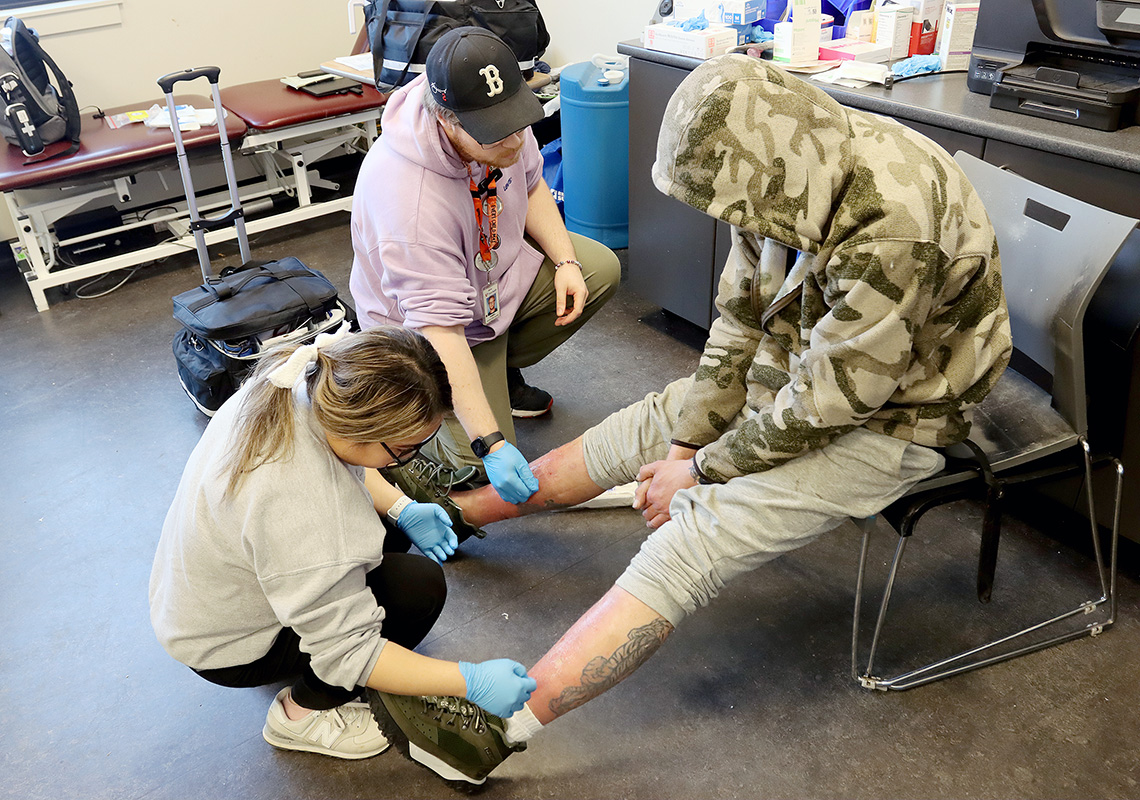
While the IHART program has been operating since 2022, it’s been bringing its suite of health care, mental health and outreach services to the streets in a van since January.
Lower barriers
The program’s co-ordinator, Paolo Palomar, said the idea is to lower barriers to obtaining health care for a population that would otherwise have none.
The mobile team that functions five days a week is comprised of nurses, clinicians, as well as peer support, outreach and social workers.
“We’re able to give wrap-around support,” Palomar said.
Sometimes that means distributing requisitions for blood work.
Sometimes it requires cleaning and dressing infections or providing counselling. Sometimes it’s just handing out a cup of warm coffee.
“We try not to say ‘no’ to anyone who needs help,” Palomar said.
The IHART team travels to homeless encampments, shelters and church parking lots across the northern communities of the Fraser Health district while a second team helps out in eastern communities like Abbotsford, Mission, Chilliwack, Agassiz and Hope. The service is also being extended to Surrey.
Relationship of trust
The vans follow a regular schedule so clients can anticipate their visits, Palomar said.
It also helps them build a relationship of trust, he added.
Twice a month the team offers special foot care clinics as homeless populations often have to deal with a condition called “street feet” because their shoes and socks are wet from the rain and snow.
The frontline care can help alleviate the chronic nature of health disparities the homeless population experience, said Fraser Health clinical operations director Sherif Amara.
“The vans provide an additional tool to bring care further into these remote, often secluded, settings.”
Palomar said it can also be the stepping stone to more comprehensive care and possibly even the start of a journey off the streets.
This story was originally published in the Tri-City News on Dec. 10, 2024. It proved to be one of the most read of the entire year, generating more then 20,000 page views.
Kylie Wright and her daughter went to a Coquitlam Express hockey game Sunday and ended up at the biggest event to hit Vancouver since the 2010 Winter Olympics.
Wright and eight-year-old Saoirse were the winners of a pair of tickets to Sunday’s final concert of Taylor Swift’s monster Eras tour at BC Place.
Their names were randomly drawn from the 1,450 ticket holders to the game between the Express and the Powell River Kings Sunday afternoon at the Poirier Sport and Leisure Complex.
As well, fans could earn extra opportunities to win by donating $20 to the KidSport Tri-Cities or by winning the Chuck-a-Puck contest that’s held between the second and third periods.
Shortly after the Wrights won, Kylie’s husband picked them up from the arena to get them into Vancouver in time for the concert.
Wright said the whole experience was a thrill, especially as it was the first-ever live concert for Saoirse.
“You made an eight-year-old’s dream come true and she will never forget last night,” she commented on the hockey team’s Facebook page on Monday.
Express general manager Tali Campbell said the promotion that was sponsored by Sussex Insurance was equally exciting for the team.
He said more than 87.5 per cent of the ticket holders to Sunday’s game were new customers and the buzz of fans dressed up, crafting signs and singing to the Taylor Swift music that played during breaks in the play carried all the way to Edmonton where he was with the U14 Coquitlam Hockey Club team for a tournament.
“It was the talk of the arena from teams all across BC and Alberta about the unique promotion we were running,” Campbell said, adding the event also brought in $2,160 for KidSport Tri-Cities.
“As a one-time campaign, this was probably our most successful.”
Swift’s show on Sunday was the last of three sold-out concerts at BC Place and capped the artist’s record-breaking tour that comprised 149 sold-out events spanning five continents over two years.
The Express also ended up winners, 2-1, over the Kings. It was the team’s second straight win after a 4-3 overtime victory over the Chilliwack Chiefs on Saturday
This story originally appeared in the Tri-City News on March 5, 2025
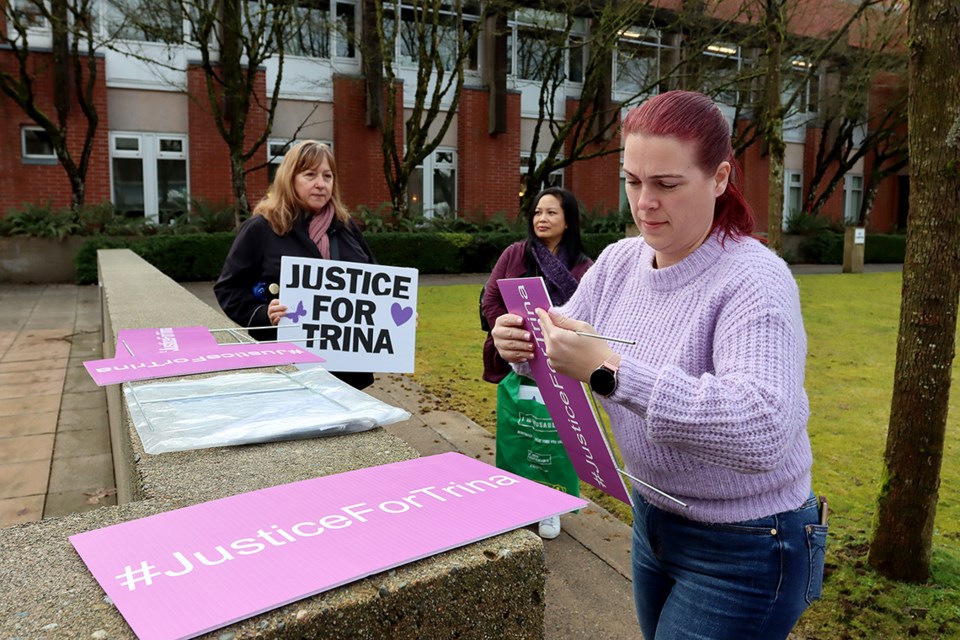
Stephanie Ibbott says she wasn’t about to let a court delay deter her and about 30 supporters from expressing their frustration with the justice system in its handling of the murder of her cousin-in-law, Trina Hunt.
Wednesday morning, March 5, the group gathered on the lower steps in front of BC Provincial Court in Port Coquitlam, despite a last-minute delay in court proceedings to April 23 for Hunt’s husband, Iain, who’s been charged with indignity to human remains in connecting with her death in January 2021.
Many of the group held hand-drawn signs or professionally printed placards, calling for the justice system to do better or for the Integrated Homicide Investigation Team (IHIT) to persist a pursuit for more serious charges. Some clutched bunches of purple tulips, Ibbott said were Trina Hunt’s favourite flowers in her favourite colour.
“It’s been four years, we’ve been waiting patiently,” she said, adding the charge laid against Iain Hunt after four years of intense investigation is “not justice.”
“It’s just baffling, infuriating and devastating,” Ibbott said.
Iain Hunt, 52, was charged on Feb. 4, more than four years after he’d reported his wife missing from their Port Moody home on Jan. 18, 2021.
An intense search by police, friends, family, community volunteers and even Coquitlam Search and Rescue, failed to find her until human remains were located near Hope on March 29, 2021, then positively identified as Trina Hunt a month later.
Shortly thereafter, IHIT executed search warrants on two homes, in Port Moody and Mission, and in June, 2022 a man was arrested but later released without charges.
Ibbott said the years since Trina Hunt’s disappearance — which have included the announcement of a $50,000 reward for information about her murder, public vigils and annual reminders from investigators about their efforts to bring charges — have been difficult.
“You hope the justice system will do people right,” she said. “It’s not enough.”
Marla Clark, who organized Wednesday’s rally, said it was important for friends, family, neighbours and co-workers to show their support for Trina Hunt.
“We are going to be here for Trina,” Clark said of her late friend whom she first met when they worked together in 1995.
Clark said the display is also a call to bring attention to the often hidden issue of domestic violence and femicide — the killing of women, usually committed by men.
Port Coquitlam’s Curtis Taylor is the definitive journeyman baseball pitcher. Since being selected in the fourth round of the 2016 MLB draft by the Arizona Diamondbacks, he’s toiled for 18 different teams, including one in Mexico. In February, Taylor signed a minor-league contract with the St. Louis Cardinals, his seventh MLB organization. He’s off to a promising start, with a win, 15 strikeouts and a 3.68 earned run average in seventh appearances for the Memphis Redbirds, the Cardinals’ top AAA affiliate. I talked to Taylor in January, 2019, early in his journey through baseball’s hinterlands. This article originally appeared in the Tri-City News in Feb., 2019.
Port Coquitlam pitcher Curtis Taylor is headed to the Tampa Bay Rays spring training camp in Port Charlotte, Fla., Feb. 13, as a non-roster invite. He’s ranked among the top 50 young prospects for the Major League Baseball team.
That’s a long way, and many degrees warmer than when Taylor’s dad, Wes, used to haul the family’s TV into the garage of their Port Coquitlam home in the fall so he could enjoy watching his beloved New York Yankees battle for the playoffs and then the World Series like he was in the same chill air as Yankee Stadium.
The experience instilled in Curtis a love for the game and set him on a path that may yet let him experience fall baseball in New York City for real. From the pitcher’s mound.
Taylor, 23, was drafted in the fourth round of the 2016 MLB draft by the Arizona Diamondbacks, and he’s been rising through baseball’s minor leagues ever since.
The 6’6” right-hander honed his fastball from atop the mound at Coquitlam’s Mundy Park for the Coquitlam Reds of the BC Premier Baseball League. His 91 mph heater landed him a stellar stint at the University of British Columbia Thunderbirds, where he filled out to 225 lbs and increased his velocity to 96 mph.
Those numbers caught the attention of pro scouts and the Diamondbacks made Taylor the highest draft pick out of UBC since former major league ace Jeff Francis was selected in the first round of the 2002 Major League draft by the Colorado Rockies.
Taylor opted to turn pro instead of returning to UBC for his senior year. He took his first step on the ladder to the Major Leagues in Hillsboro, Ore., where the Hops are the short-season A-League affiliate of the Diamondbacks. He pitched 16.1 innings in 17 games as a reliever, allowing only four runs and earning one win along with three saves.
The next season he was off to Geneva, Ill., to play full-season A-ball with the Kane County Cougars where coaches groomed him to be a starter. In 13 starts he won three games, lost four and allowed an average of 3.32 earned runs a game.
Injury problems
But the expanded role took a toll on Taylor’s shoulder and he missed the last month of the season with an impingement injury, where the rotator muscles get too loose and become trapped between the joint.
It was the first major injury of his career, and Taylor said he was terrified.
“It felt like getting stabbed in the shoulder.”
It was also Taylor’s first taste of the drudgery and hard work of rehab, living in a hotel room near the Diamondbacks’ training facility near Scottsdale, without a car, working in the gym every day to strengthen the joint.
“Rehab is a tough place to be,” Taylor said. “All your focus is on getting your arm better. I worked hard to stay positive.”
Traded
Then, on Nov. 30, 2017, Taylor experienced another first. He was traded to the Tampa Bay Rays for an established big leaguer, Brad Boxberger.
Initially, Taylor said he wasn’t thrilled with the move. But once he got to Tampa, and was able to talk to the coaches who wanted to return him to his customary role as a reliever, he was excited to take the next step in his journey.
That started in Port Charlotte, Fla., where he got three wins and two saves in the eight games he appeared in during the month he was there before getting promoted to the Rays’ AA affiliate in Montgomery, Ala.
In 30 games with the Biscuits, Taylor pitched 60 innings, earning three wins, four losses and six of eight save opportunities. More importantly, he was learning what it takes to be a pro baseball player.
“One of the biggest things is staying calm mentally,” he said. “You can’t get too high or too low. If you pitch bad you have to accept you’ll have bad days.”
He also got a sense of what it means to be a pro baseball player in the Deep South, making appearances in the community on behalf of the team, volunteering for charity work, interacting with fans.
“They’re really into it, they pay attention to the game,” Taylor said of the scrutiny. “You have to carry yourself as a reasonable, nice, kind person.”
Expanding his repertoire
A slight injury to Taylor’s elbow late in the season meant he wasn’t able to play in the Arizona Fall League, a prestigious off-season circuit to which only baseball’s top prospects are invited. But he did get to spend some time at a special pitching camp put on by the Rays in Florida where coaches were able to analyze his pitching with special high-speed cameras that track how the ball spins and moves vertically and horizontally.
Taylor said the experience was invaluable as he works to expand his pitching repertoire beyond his fastball and slider.
“It gives you instant feedback and you can compare it to big leaguers,” he said. “It was the best thing I’ve ever done as a baseball player.”
Taylor spent most of his off-season in the Lower Mainland, working out every day at his old stomping ground at UBC to “get stronger and trim body fat.”
And when the baseball playoffs and World Series were on TV last fall, he watched them from the warm comfort of his living room.
“Watching games on TV, you see guys you’ve played against and it’s exciting,” he said. “Hopefully that will be me in a year or two.”


















 MARIO BARTEL