I was in a plane crash and lived to tell about it

Journalists share stories.

We also have our own.

A few months into my career, I got a call from the editor of the Burlington Post, where I was pulling weekend photo and relief reporting shifts.

“You wanna go up in a plane?” he asked. “It’s the best assignment of the year.”

The annual Hamilton Air Show was a couple of weeks away and the Canadian Warplane Heritage Foundation was offering a seat in one of its vintage WWII Harvard training aircraft to get photos of some of its other historic planes flying in formation to promote the upcoming event.

When I checked in at the Mount Hope airport, I was escorted to a hanger and introduced to my pilot, who showed me how to strap on my parachute in case anything went wrong and we had to bail out.

He also told me what to expect during our flight, how to communicate my needs to get the photos I required and to hang on very tightly to my film, because if I dropped it, the canisters would roll down into the back of the hollow fuselage.

As I recall, it was a beautiful August afternoon. The flight was smooth, if a little noisy, especially when I slid the canopy back to aim my lens at the neighbouring planes.

On our way back to the airport, I settled in to enjoy the scenery, as I maintained a death grip on the three or four rolls of Ektachrome and B&W film I’d shot.

Passing over the farms that surround the airport, I noticed the vehicles passing on the roads beneath us seemed a little large considering our distance to the runway. A herd of cows, their markings easily distinguishable, barely stirred as we passed overhead.

And still the runway seemed far off.

We cleared the airport’s perimeter fence, barely.

Then, our excursion got really bumpy. Dust billowed up into the cockpit area.

We shuddered to a stop, the runway still a couple of hundred metres distant.

In my headphones, the pilot calmly advised we should probably climb out. Once safely away from the aircraft, he explained the single engine had quick during the return leg of our flight and when it became apparent we couldn’t make it to the runway, he left the landing gear up so the bumpy landing on the field wouldn’t end up flipping us over onto our heads.

The pilot said he hadn’t told me any of this beforehand, so I wouldn’t panic.

A veteran captain for Air Canada, he was a little concerned about the plane’s bent prop and any possible damage to its undercarriage; it was his own aircraft.

I was just relieved I was still in one piece. And that I’d managed to hang onto all my rolls of film.
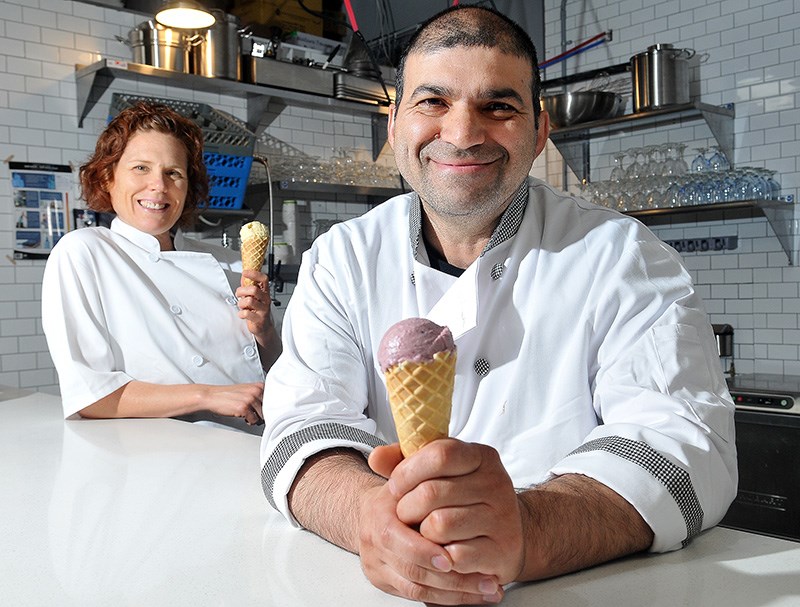
Port Moody ice cream maker fuelled by fitness

This story first appeared in the Tri-City News on Oct. 2, 2018

If your idea of a post-workout treat is a high-protein shake or thick fruit smoothie, you’re not Hamid Haji.

He heads for the freezer to scoop himself some ice cream.

In fact, the karate sensei and yoga instructor who runs Pro-Fit Boot Camp in Port Moody with his wife, Kelly Pearce, loves the frozen desert so much he embarked on a mission to make his own.

Fitness and indulgence don’t have to be mutually exclusive, said Haji, who has been part of the city’s fitness scene for 20 years.

“You limit yourself but you don’t have to cut yourself off,” he said. “Limitation makes the rewards sweeter.”

Two years ago, Haji set out to make the best ice cream he could. He and Pearce toured artisanal ice cream shops around the Lower Mainland, sampling their wares, chatting with staff and customers, trying to deconstruct their secrets. Then the couple would put their findings and intuition to work in their kitchen and share the results with clients at their gym.

“They were our guinea pigs,” Pearce said.

Armed with their feedback, they’d head back on the road to source local, natural ingredients and return to the kitchen to experiment with new flavours and conquer new challenges, like concocting a vegan ice cream that doesn’t skimp on creaminess despite its lack of, well, cream.

At some point, Haji’s quest outgrew their counter and freezer space at home, so he and Pearce decided to convert a storage area at the back of their St. Johns Street gym into a white-tiled, stainless steel ice cream factory. Several weeks ago, they christened it Vashti Rose, after their eight-year-old daughter, and started offering the frozen fruits of their labour to the public, one or two scoops at a time.

For now, the ice cream shop is only open on weekends as health regulations don’t allow Haji and Pearce to operate it at the same time people are sweating their workout in the adjoining gym. But kids are free to burn off some of their ice cream-fuelled energy on the matted floor while their parents savour a scoop of salted caramel or cookies and cream at the expansive white countertop.

Haji said he and Pearce have developed more than 100 flavours but they put only 11 of them in rotation at a time. And they’re open to requests, which have already included toasted marshmallow, mint flake and even saffron.

Could the Shoreline Shuttle roll back into Port Moody?

Port Moody’s Shoreline Shuttle could be making a comeback.

Mayor Meghan Lahti says the free service that connected the city’s Inlet Centre area to Rocky Point Park, Brewers Row and the downtown heritage district for the summer in 2018 but then was deemed too expensive, could be paid for with revenue from paid parking.

Council will debate Lahti’s motion to revive the service at its meeting on Tuesday, June 10.

In a report, the mayor said the shuttle service would reduce traffic congestion, improve safety for pedestrians and improve air quality.

“Perhaps more important though,” said Lahti, “ensuring that transportation to the busy area is accessible to everyone, regardless of economic status, will promote inclusivity and enhance community engagement.”

Lahti said money from the city’s parking reserve fund could be used to relaunch the service, As of Dec., 2024, that amounted to $72,500.

The pilot shuttle program in 2018 was budgeted to cost $50,000, including the cost of contracting a 20-passenger bus and the installation of signs for its 13 stops. The service ran every 30 minutes on weekend afternoons and evenings until midnight on Fridays and Saturdays and 10 p.m. on Sundays. Adjustments were made to accommodate extra demand during events like RibFest, Canada Day and car-free day.

Despite a $20,000 subsidy from Richmond-based developer Panatch Group to operate the shuttle, council decided in 2019 it was too expensive to continue the pilot. A report estimated the 3,700 rides ended up costing $13.50 per passenger.

Rob Vagramov, Port Moody’s mayor at the time, said it would have been cheaper to put every passenger in a taxi or limo instead.

“Not every idea pans out exactly as we’d hoped,” he said.

Lahti said now that the city is charging for parking in busy areas like Rocky Point Park, along Murray Street and around Eagle Ridge Hospital, a portion of revenues could support relaunching the shuttle service.

“By utilizing pay parking revenue for this shuttle, the community directly benefits from the fees paid by users,” she said in her report. “It creates a sense of accountability and transparency about how the funds are being used.”

According to the report, the pay parking stations generated $158,120.70 in gross revenue since they were implemented midway through Sept., 2024 through March, 2025.

Cutting hair and cracking jokes for 50 years

This story first appeared in the Tri-City News on Aug. 2, 2018

Accounting’s loss has been Coquitlam’s gain.

For 50 years.

That’s how long Ted Bordeleau has been cutting hair at Plaza Hairstyling and Barbers in the old Burquitlam Plaza on Clarke Road, an occasion he marked Wednesday with snacks and refreshments for his customers and $2 haircuts — but only if they showed up with an actual $2 bill because that’s what he charged when he first started in the business Aug. 1, 1968.

And if a customer didn’t have a $2 bill, since it’s been out of circulation since 1996, Bordeleau said he’d be happy to sell them one of his — “for $25.”

In Ted’s venerable shop, every story has a punchline.

Even the one about the elderly customer who expired in his chair back when he was learning his trade at Moller’s Barber School on Hastings Street in Vancouver.

After perfecting his straight-edge shaving skills first on a bottle, then a balloon, then other trainee barbers, Ted had finally graduated to giving shaves to real, live customers, many of them elderly or impoverished who put their necks on the line for the young apprentices in exchange for cut-rate haircuts. When one of those customers failed to flinch after Ted nicked him, he called over his instructor, who checked if the client was breathing, then confirmed the worst.

“I cut him three times,” Ted recalled. “No wonder he didn’t bleed.”

Ted almost didn’t become a barber. He loved numbers and was studying accounting when his grandfather urged him to pick up clippers because, he told Ted, “We need barbers.”

Ted trained at Moller’s for six months, then embarked on a two-year apprenticeship, as per the requirements to obtain a provincial barbering license at the time. He said he would have stayed another six months at barber school but he couldn’t afford the bandages.

Again with the punchlines.

Over the years, Ted has cut hair for generations of families as customers whose locks he first tended when they were kids bring in their kids and, eventually, their grandkids. He has trimmed politicians’ pates, CEOs’ sideburns and manes of people who’ve walked out of his shop without paying.

Some of his longtime customers travel hours out of their way to keep getting their hair cut by Ted. And when they walk through his door, there’s no guarantee they’ll be served right away because Ted doesn’t take appointments.

Ted met his wife, Jean, in front of his barbershop. She drove by in a bright pink 1957 Buick with fins, and Ted loves cars, so he ran out the door to ask for the driver’s phone number.

“She wasn’t quick enough to give me the wrong number,” Ted said.

He’s also found love for some of his customers, matching them up with female friends, acquaintances or just regular visitors who passed by as they shopped at the once bustling plaza.

Oh yeah, there’s that.

As the big city caught up to the suburbs, Burquitlam Plaza lost much of its bustle. The butcher shop left, so did the video store. SkyTrain severed part of the sprawling parking lot and the Safeway grocery store moved into the first two stories of a gleaming new condo tower on the corner. Many of the storefronts between the Dollarama and Value Village are dark.

The neighbourhood has changed, too, Ted said. Fewer families can afford to live there as small apartment blocks and modest mid-century bungalows are gobbled up by new development, so he’s not giving as many first haircuts to tentative toddlers.

But Ted perseveres, propelled by stories exchanged, friendships made and the knowledge that, while everyone may not need the services of an accountant, everyone at some point needs their hair cut.