Port Moody phone booth lets you talk with loved ones who’ve passed on

This story first appeared in the Tri-City News on Sept. 12, 2021

You can’t call an Uber from the new phone booth installed at Port Moody’s Pioneer Park, but you may be able to chat with your favourite Nana who passed away in 2015.

The Phone of the Wind is an initiative of the Crossroads Hospice Society that gives visitors to the park an opportunity to work through some of their grief at losing a loved one by placing a call to them from the vintage rotary-dial wall phone mounted in a wonderfully stained and lacquered wooden booth.

And while the phone doesn’t have a special line to the afterlife, the act of picking up the handset and talking into the mouthpiece can be comforting in a time of loss and sorrow, said Amelie Lambert, the adult bereavement coordinator at Crossroads’ nearby hospice facility on Noons Creek Drive.

“It helps people not feel crazy all the time when they’re grieving,” she said.

“It helps to normalize grief,” added Brittany Borean, the bereavement service coordinator who helped bring the phone project to life after a volunteer let her know about a similar effort in Washington.

The first Phone of the Wind was erected in 2010 in Otsuchi, Japan when a landscape designer named Itaru Sasaki installed an old phone booth in his garden shortly after a beloved cousin died of cancer. In a 2017 article in Bloomberg, he said the phone offered him a way to maintain a relationship with his departed cousin.

In 2011, Sasaki’s private installation became a kind of public shrine after an earthquake and tsunami destroyed dozens of coastal communities including Otsuchi and people who lost loved ones in the disaster made their way to his garden to seek comfort by placing calls from his booth.

Since then, wind phones have been built in places like: Oakland, Calif., to commemorate the 36 people who perished in a warehouse fire; Dublin, Ireland; Marshall, North Carolina; and Aspen, Colorado.

The concept has also caught the imagination of novelists and filmmakers who’ve incorporated it into stories of love and loss.

To realize Port Moody’s Phone of the Wind, Borean enlisted the help of the city’s superintendent of parks, Robbie Nall, and carpenter Roy Balbino, who took his inspiration to craft the booth from an old-style phone booth he happened to spy one day while driving along St. John’s Street.
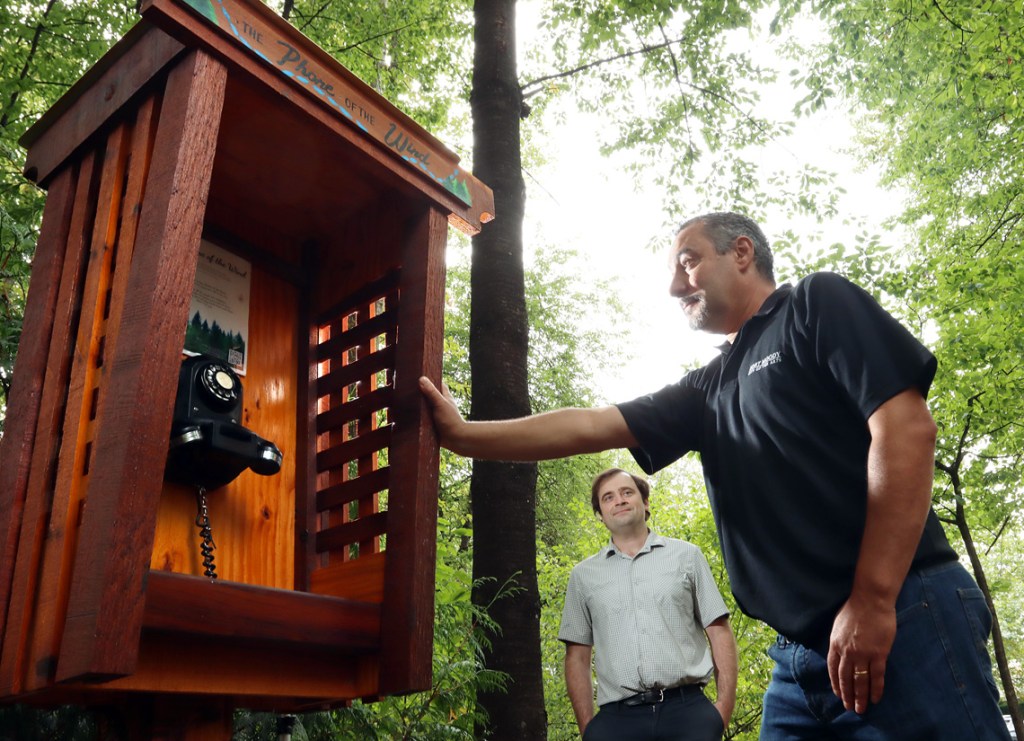
MARIO BARTEL/THE TRI-CITY NEWS Port Moody’s superintendent of parks, Robbie Nall, and carpenter Roy Balbino helped bring the Crossroads Hospice Society’s vision for a phone of the wind to life in Pioneer Park.

Some of the wood is reclaimed from old memorial benches in the adjacent labyrinth healing garden, while the vintage black wall phone was discovered on Facebook Marketplace.

Lambert said having the Phone of the Wind in a public setting helps bring the grieving process out from the shadows where western society has tended to lock it away as a very private process.

“We don’t acknowledge grief,” she said. “We don’t have to hide it.”

In fact, Borean added, accepting grief can help ease some of the pain that comes from losing a loved one.

“It sends a message that it’s okay to grieve,” she said. “It’s not about ‘time will heal all wounds.’”

The phone can also provide a way for families to bridge generations.

Lambert said since the phone was installed in August, families have brought their kids to talk with members who may have passed before they were born or were too young to remember.

“It drives connections,” Borean said. “It creates a sense of community that you’re not alone.”

Coquitlam councillor gets to know her community — one Strava segment at a time

This story first appeared in the Tri-City News on Dec. 10, 2021

A Coquitlam city councillor is taking the phrase “boots-on-the-ground politician” to heart.

Except she’s wearing sneakers.

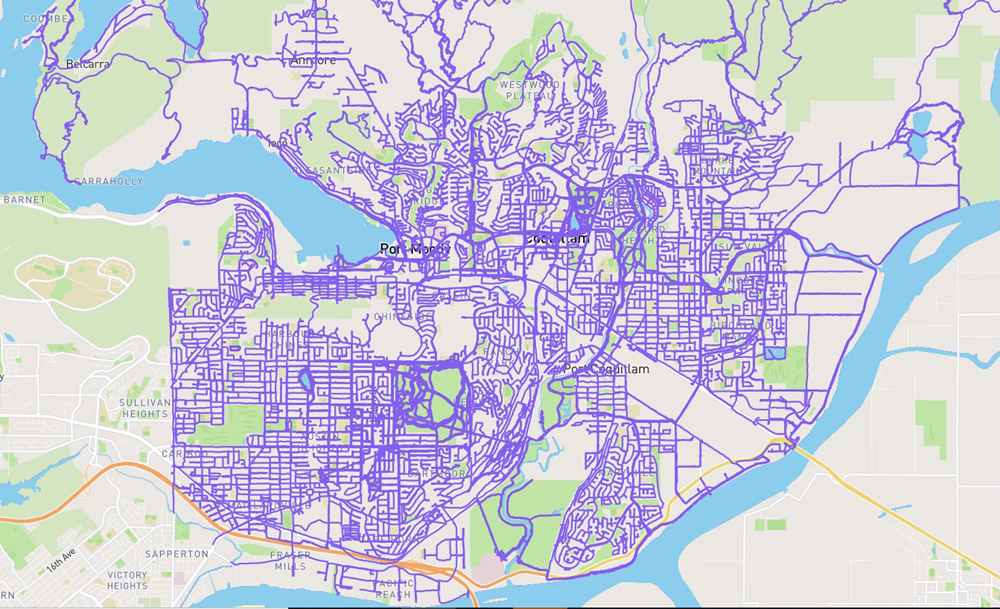
Teri Towner recently finished running every street in the Tri-Cities — including Anmore and Belcarra. The quest took her more than 12 months. She ran on 1,943 streets, covering about 2,000 km. She wore out four pairs of shoes.

The quest started when Towner read an article in the Tri-City News about Pamela Clarke’s conquest of every street in Port Coquitlam last year when the onset of the COVID-19 pandemic cancelled a marathon she’d planned to run in Berlin.

Towner, an avid runner since she was a teen, set out to run every street in Coquitlam.

But when she finished that, she said she was having so much fun she just kept going.

SUBMITTED A map of all the streets Coquitlam councillor Teri Towner ran in her year-long quest to run all the streets in the Tri-Cities.

Her last street was Marpole Avenue in Port Coquitlam, where a congratulatory reception and beverage reward awaited at Patina Brewing.

Along the way, Towner said she learned things about her community and the rest of the Tri-Cities she knew at an abstract level but had never experienced in a real, visceral way.

Like the diversity of the region’s neighbourhoods that took her from trailer parks to high-rises, from mansions up on Westwood Plateau to blueberry farms out in Minnekhada.

She saw llamas and horses.

“It energized me,” Towner said. “I always felt like I learned something or found something I didn’t know existed.”

It also increased her awareness of issues like illegal dumping, pedestrian accessibility and safety, street lighting, signage and parking.

SUBMITTED During her runs of all 1,943 streets in the Tri-Cities, Anmore and Belcarra, Coquitlam councillor Teri Towner came across all kinds of unusual finds, like a large spring on Winter Crescent.

Towner said she must have driven Coquitlam’s engineering department nuts with all her calls and messages about trash, missing signs and burnt out street lamps.

But overall, she said, the city is very clean.

Planning her routes on the social activity app Strava to link streets as efficiently as possible, Towner became acutely aware of which neighbourhoods were designed with pedestrians in mind, and which prioritized cars.

City planning has evolved over the years, but planners still have work to do to create truly walkable communities, she said.

Most importantly, Towner said, she came to appreciate the communities’ spirit.

As the pandemic’s second wave rolled through last fall, she noted the colourful rocks in gardens painted with messages of hope, the signs thanking essential workers in windows.

During the holiday season, she timed her runs for the evening hours so she could enjoy the twinkle lights and decorated trees.

SUBMITTED Coquitlam councillor Teri Towner said she especially like running at night during the Christmas season so she could enjoy all the lights and decorations.

“There’s a lot of positivity,” Towner said.

Her running journey wasn’t always smooth sailing, though.

Shortly after Towner embarked on her mission, she was knocked off course for about a month when she was concussed by a low-flying drone while riding her bike through Mundy Park.

And she had to take more time off last September to recover from a month-long Coquitlam Crunch challenge.

Of course, some runs were easier than others.

Among the more difficult legs, Towner made room in her pain cave for the hills of Anmore and Westwood Plateau that she’d both ascend and descend.

She gained a new affection for the flatlands of Port Coquitlam.

Her conquest of hometown streets and sites complete, Towner said her next running challenges will be further afield — a half marathon in Las Vegas next February and the full 42 km pull at the 50th BMO Vancouver Marathon in May.

“It frees my mind,” she said of her love for the sport.

Port Moody road rage incident leaves car window smashed

An Acura has a smashed rear window and Port Moody police are looking for a suspect after a road rage incident Thursday afternoon.

Port Moody Police Department spokesperson, Cst. Sam Zacharias, said the confrontation occurred at around 4 p.m. in the westbound lanes of St. Johns Street at Moray Street.

He said it’s believed to have started as a verbal exchange several blocks to the east, near the Coquitlam border, then escalated when the suspect allegedly got out of his car and smashed the window with some sort of object.

“We aren’t exactly sure what sparked it,” Zacharias said.

He said the suspect also allegedly pointed a weapon at the Acura’s driver, who wasn’t injured in the altercation.

The suspect is described as a heavier-set Middle Eastern male, in his late-20’s or early-30’s, with black hair and a beard. He fled the scene in a grey Honda sedan.

“We are looking to speak with any witnesses who observed the rush hour altercation,” Zacharias said, adding anyone with further information or even dashcam footage can contact PMPD at 604-461-3456.

Moray Street traffic calming gets changes, more expensive

The plastic lane delineators creating chicanes to slow traffic on Port Moody’s Moray Street could soon be gone.

In their place, new curb bulges will be built at Pinda Drive and Brookmount Avenue, along with new lane markings and crosswalks. But a planned bike lane on the east side of Moray Street will have to wait.

Tuesday, May 20, Port Moody council’s initiatives and planning committee will consider spending an additional $353,000 to construct the new, permanent elements. That’s on top of the previous budget of $795,000 that had been approved in 2022.

Since then, though, construction costs have risen, additional design work was required and $187,000 will be allocated to a new multi-use path on the west side of Moray, resulting in a total budget of $1.248 million, said a staff report; $100,000 of that will be covered by the city’s street lighting relocation program, and another $155,000 will come from a TransLink grant.

A pilot project to slow traffic using Moray Street that was implemented in the summer of 2022 resulted in a 5-6 km/h reduction of speeds on the busy connector route to Coquitlam, according to the report.

But some residents said the temporary measures, that included the plastic lane delineators, new markings on the pavement to configure curb bulges at intersections and a temporary sidewalk on Moray’s west side, actually made the situation worse.

“It may have calmed traffic on the east side, but they’re going faster on the west side,” said one resident prior to a meeting last June when council decided the traffic calming measures should be made permanent.

Subsequent feedback from residents following a public information session earlier this year revealed further concerns like the loss of several on-street parking spots, worries about pedestrian safety from cyclists speeding down a northbound bike lane and turns lanes at the St. Johns Street intersection too short to accommodate the volume of vehicles.

As a result, said the report, further refinements have been made to the permanent calming plan, including:

  • the addition of eight new on-street parking spots on the east side of Moray, between Brookmount Avenue and Portview Place
  • the removal of the northbound cycling lane on the east side of Moray; instead, cyclists heading down the hill will be directed to use Brookmount Avenue and Clearview Drive while staff consider further options
  • additional curb bulges to be built at the intersection of Moray and Brookmount, as well as a new marked crosswalk on the north leg
  • adjustments to the lane geometry at Moray and St. Johns to extend the turning lanes so they can accommodate more vehicles

The report said the permanent changes should be in place by the end of the year.

In the glory days of radio, this woman helped start a massive Port Moody electronics company

This story first appeared in the Tri-City News on April 10, 2021

The matriarch of a family that put Port Moody on the leading edge of electronics manufacturing for a decade in the 1950s and 60s has died.

Isabelle Chisholm passed away recently, at the age of 98. She was the widow of Edward Chisholm, who built a state-of-the-art manufacturing plant for radios and televisions sets in Port Moody in 1954. She was also the keeper of some of the company’s secrets.

As the chief purchasing agent for Vancouver Radio Laboratories Ltd., Isabelle Chisholm’s tasks included travelling to Ottawa to clear secret components for radio receiver sets used by the Canadian armed forces during WWII that were invented by Edward, and manufactured in his first plant, on Vancouver’s Main Street.

When the war ended, the company’s name was changed to Chisholm Industries Ltd., and it shifted production to table-top radios and phonographs as well as a fancy new technology — black-and-white televisions.

Edward Chisholm’s factory was the only such manufacturer west of Toronto, and Isabelle became the first female electronics salesperson.

“She was a dynamo of energy and conviviality who knew how to make a sale,” said Isabelle Chisholm’s obituary. “She was widely known for her ability to successfully connect with the public through telephone calls.”

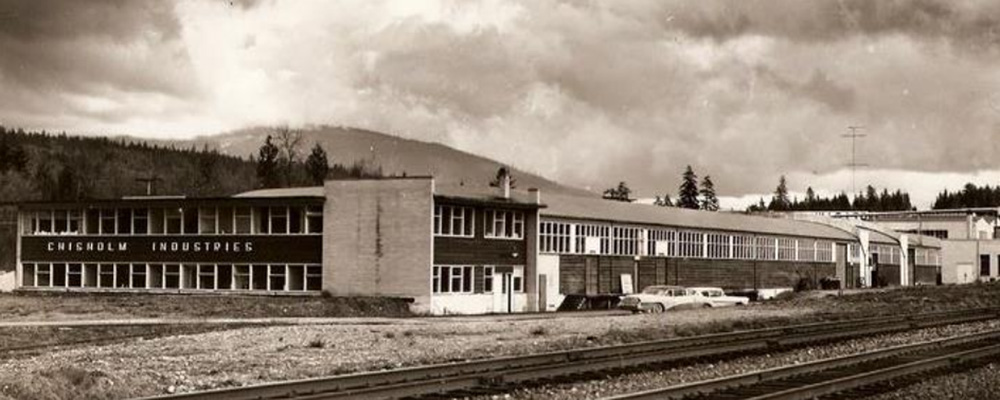
In 1947, the 12,000 sq. ft. plant in Vancouver was damaged by fire, and the Chisholm’s began casting about for space to build a larger facility. They found it in Port Moody, purchasing 23 acres along Murray Street, and construction began in 1954 on a new 56,000 sq. ft. state-of-the-art factory that also contained offices, a warehouse as well as sheet metal and tool and die shops.

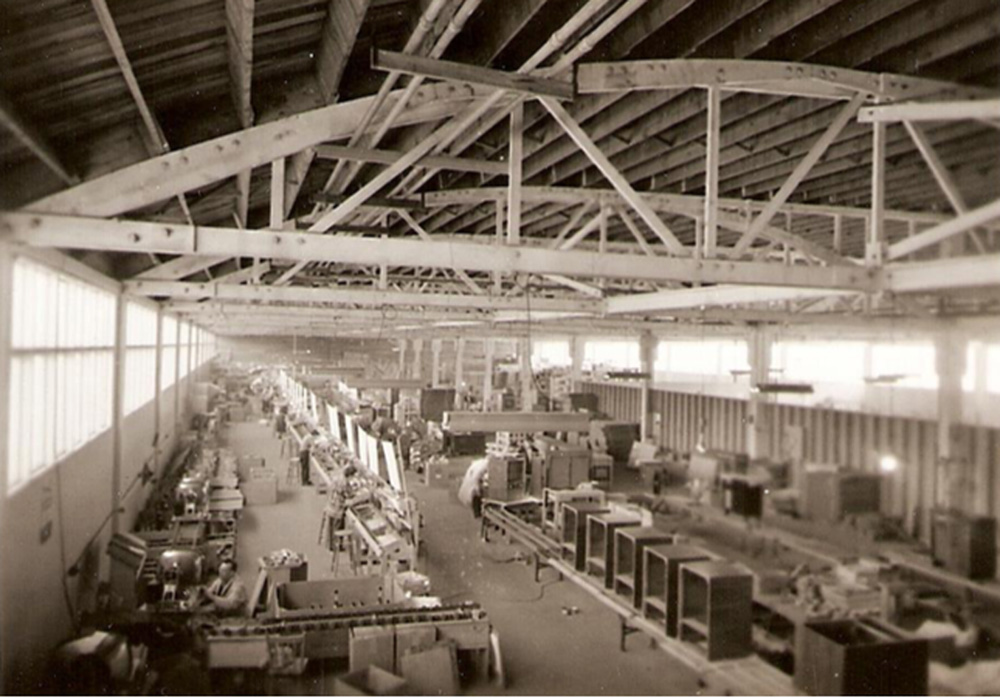
CANADIAN VINTAGE RADIO The factory floor at the old Chisholm Industries plant on Murray Street in Port Moody.

The new home for Chisholm Industries Ltd. opened the next year.

The sprawling main plant was 100 ft. wide and 14 ft. high. The assembly line for radios and TVs was 400 ft. long. There was a large baking oven to fuse paint to the metal surfaces and a cabinetry section to manufacture and finish the high-quality wood boxes that held the radios and TVs. All the engineering and design for products was done in-house.

At peak capacity, the plant could produce 200 units a day.

Chisholm’s products were renowned for their quality. They were sold at furniture stores like Wosks and department stores like Eatons, Woodwards, Sears and Hudson’s Bay.

But the advent of colour television changed the industry. The cost of retooling the plant for the new technology was too high, and more and more electronic goods were being engineered and constructed offshore, in countries like Japan.

By 1963, the factory floor at Chisholm Industries was mostly manufacturing wooden cabinets for other electronics companies like Bell and Packard. The following year, Edward Chisholm closed the plant, with much of its machinery going to his son, James, so he could start Glenayre Electronics in Burnaby.

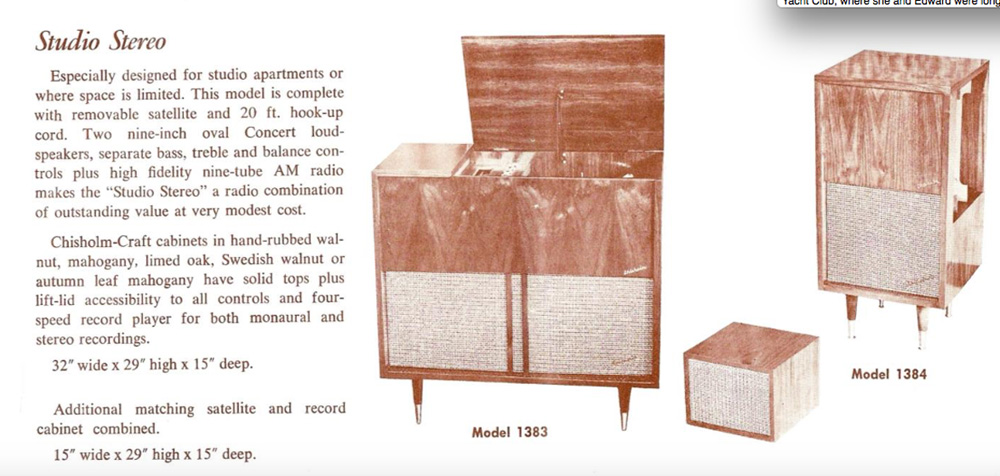
CANADIAN VINTAGE RADIO A catalogue listing for one of the home hifi systems built by Chisholm Industries in Port Moody.

The sprawling plant in Port Moody was rented to various industrial and commercial tenants, as well as artists, until it was demolished in 2010.

In 1967, Isabelle and Edward Chisholm retired to Victoria and began growing hydroponic tomatoes on an acreage they’d purchased, selling much of their produce to the Empress Hotel and Woodwards.

After Edward died in 1968, Isabelle became a successful realtor and joined boards of directors for several organizations like the PNE, ICBC, the Boys and Girls Club and the C.H.I.L.D. Foundation. She was also politically active with the Social Credit party in B.C., as well as the federal Reform, Canadian Alliance and Conservative parties.

According to her obituary, Isabelle Chisholm’s ashes will be scattered near the Royal Vancouver Yacht Club, where she and Edward were longtime members, and his ashes were also distributed.

Even at a slower pace, these Tri-City soccer players still have a love for the game

This story first appeared in the Tri-City News on Nov. 23, 2023

The Tri-City Walking Soccer Club is proof in the pudding: you can take the players out of soccer, but you’ll never take the soccer out of the players.

The club started several years ago as an adjunct to the Dartmen, an affiliation of weekend warriors who’ve grown old together playing sports like traditional running soccer as well as baseball and hockey.

As members started to hit their mid-50s, many realized they were losing their stride. But instead of giving up sport altogether, they just decided to slow it down.

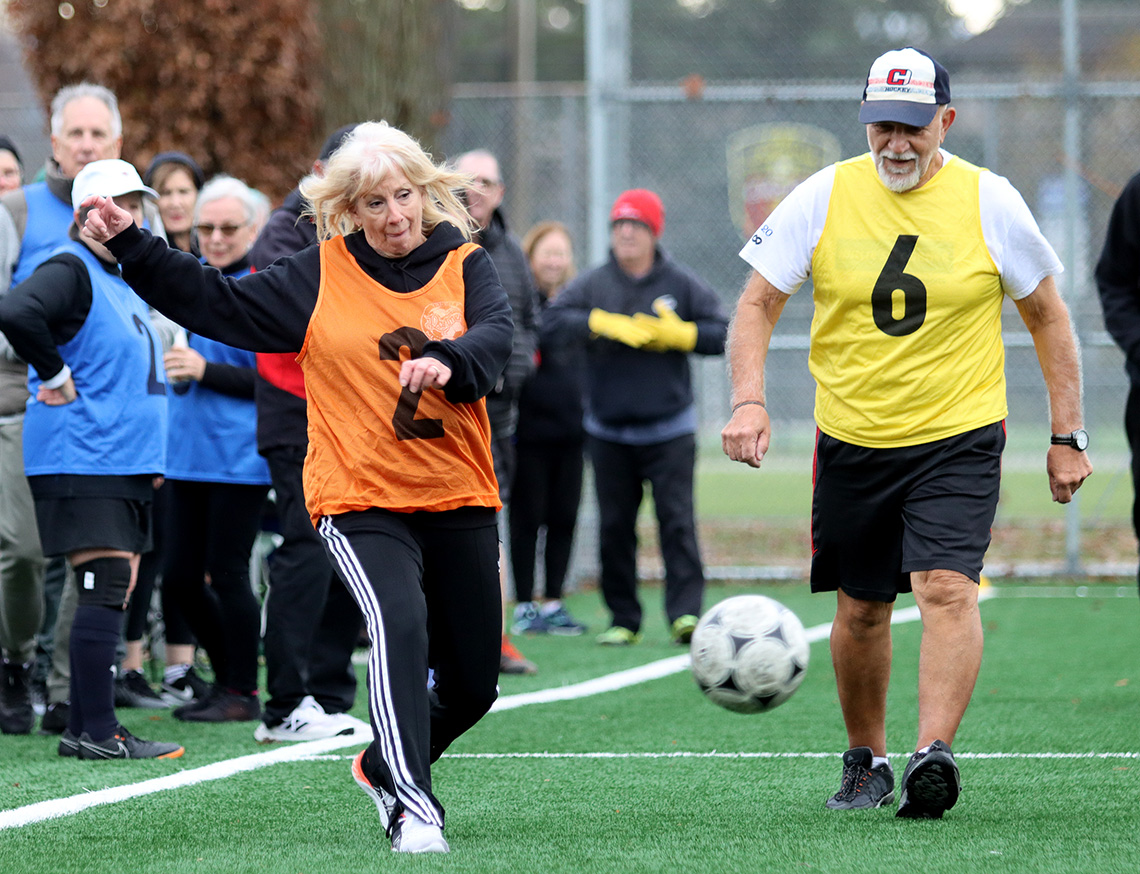
Walking soccer is just like it sounds, a modified version of “the beautiful game” without contact and played at a pace more comfortable for aging knees and joints.

It’s also played seven-aside on a smaller pitch — about half the size of a regular soccer field — at Port Coquitlam’s Gates Park.

Making new friends

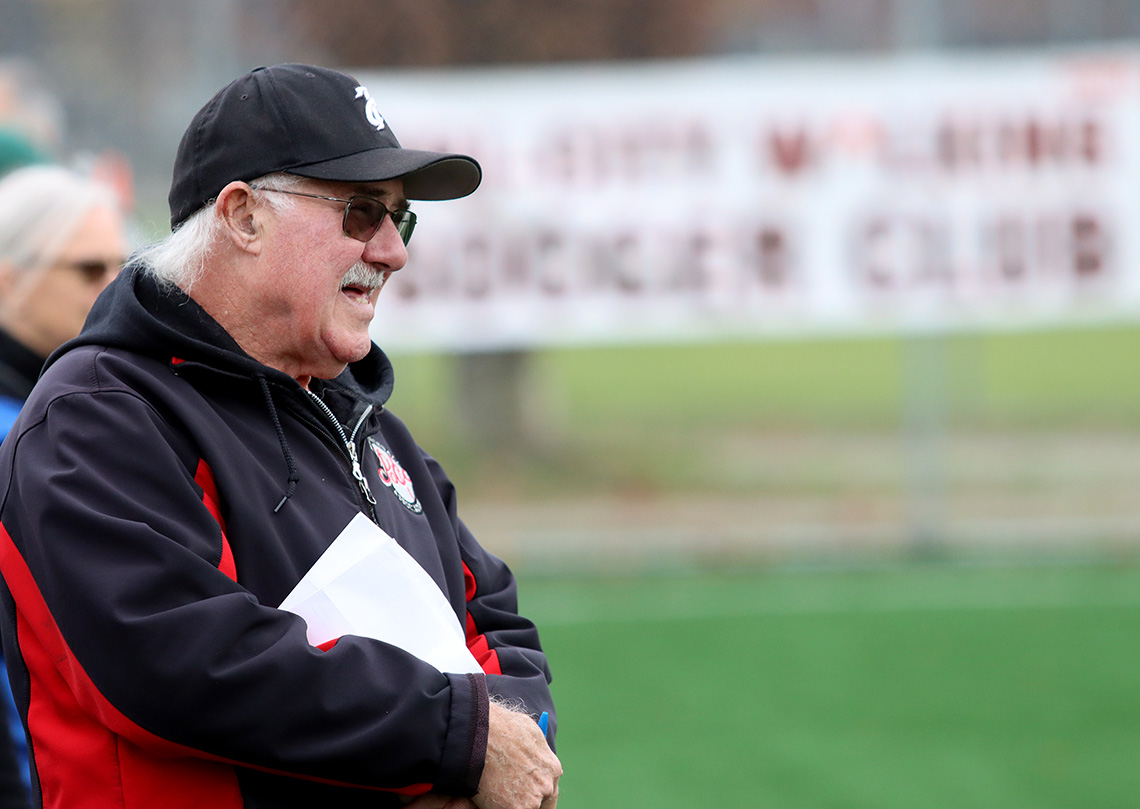
Jim Swelander, who started the Dartmen in Burnaby back in 1969, said as the group has embraced their golden years, the social aspect of their sporting endeavours has taken precedence over competition.

“It’s about making new friends and staying in contact with old ones,” he said.

When the group, which ranges in age from 55 to over 70, invited women to start playing in their soccer matches the camaraderie and post-game revelry kicked up a notch with organized get-togethers every week at the Cat & Fiddle pub and other social events.

Denise Spletzer, 68, said she first attended a walking soccer match as a spectator but quickly decided the club needed a female touch even though she’d never played soccer before.

“I like to get exercise,” she said.

Spletzer invited some of her friends from her fitness class and from an initial contingent of seven just a couple of years ago, there’s now 43 women participating in the club’s mixed division alongside its male membership of 93, some of whom stick around for the more competitive men’s division afterwards.

Swelander said not everyone in the club comes out at once, of course.

Players come and go for the regular Tuesday matches that run year round (the league heads indoors to a facility in New Westminster during December and January) and new teams of seven players are created every week from those who do show up to play in the 25-minute halves.

Stoke competitive fire

Sue McInnes said the soccer matches are a way to bring back some of the competitive fire she last felt when she used to play field hockey in her younger days. But it’s the new friendships she treasures most.

“It’s fun,” she said. “The social aspect is the best.”

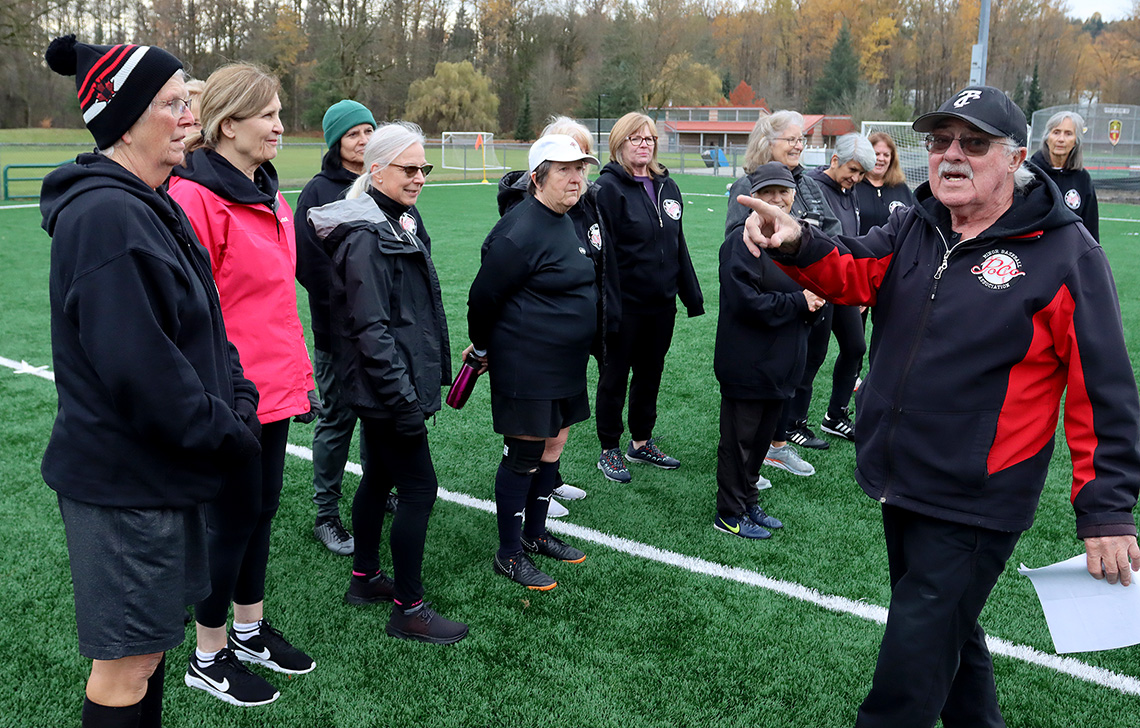
Swelander, who leads all the players through various warm-up exercises and skill drills for about an hour before the matches begin and then coaches from the sidelines once the opening whistle blows, said it can be a bit of a challenge keeping everyone on the straight and narrow given the wide range of soccer experience and ability on the pitch.

“It’s okay, as long as you have patience,” he said. “You’ve just got to remember you’re here for fun.”

Port Moody home relocation means more memories can be built

This story first appeared in the Tri-City News on April 2, 2024

Wendy Kinloch’s realtor questioned her sanity 34 years ago when she and her husband purchased the run-down rancher at 120 Windsor Dr. In Port Moody’s Coronation Park neighbourhood.

The single-storey home with a round fireplace in the middle of the living room had seen better days. But it offered more space to raise a family than their cramped townhouse in North Vancouver

“We knew it needed a lot of love,” said Kinloch.

Over the years, it got just that.

Almost every interior wall was rebuilt. The sundeck out back was replaced. The kitchen and bathrooms were renovated.

The house with green wood siding returned that love.

The Kinlochs raised two children there, and the myriad of their friends and visitors, who climbed the growing trees in the neighbourhood, ran through the sprinkler in the yard, drew with chalk on the street out front. They made connections with their neighbours, got involved in the community at Coronation Park School nearby.

“We looked out for each other,” Kinloch said. “It was just the greatest neighbourhood.”

So when Kinloch attended a special ceremony Tuesday, April 2, in front of her old home, which will be one of 10 from Coronation Park being sent by truck and barge to a second life for families in the shishalh Nation near Sechelt, she was sure to pack plenty of tissues.

MARIO BARTEL/TRI-CITY NEWS Wendy Kinloch gets emotional as she talks to councillors from the shishalh Nation near Sechelt that will be the new home for 10 homes from the old Coronation Park neighbourhood in Port Moody, including hers.

The homes are in the way of a new development project by Vancouver-based Wesgroup Properties that will transform the 14.8-acre neighbourhood into a dense, urban community with six residential high-rises up to 31 stories, three six-storey buildings and a four-storey office building.

While 49 homes will be demolished, a deal to save some of the homes was brokered by a company called Renewal Development in conjunction with Wesgroup and Maple Ridge-based Nickel Bros. that has more than 50 years experience moving buildings.

Kinloch, who relocated to a new home in Anmore last October, said knowing her home has received a second lease on life made it easier to return to her former neighbourhood where several houses have already been cleared and many trees removed.

She said it’s like a circle of life. “I didn’t want to come back to this neighbourhood to see it demolished.”

Renewal Development’s Glyn Lewis, said the transportation of the first two homes scheduled to take place overnight tonight is the closure of one chapter and the opening of the next.

“It’s a beautiful story.”

Lewis has been working on his plan to reclaim and repurpose homes in the way of redevelopment for about seven years. He said with the increasing cost of new construction and the environmental toll of demolition, it makes sense to recycle structurally sound buildings.

After a couple of successful projects moving a home from Coquitlam to Upper Gibsons and an old single-room schoolhouse from Vancouver’s Kitsilano neighbourhood to the Squamish Nation where it’s been converted into a children’s education centre, it was time to scale up and put the lessons learned through those two ventures into practice. He said he’s hopeful the project will help change the fate of the approximately 2,700 homes that are demolished in Metro Vancouver every year.

“Intention and thoughtfulness can shape the direction of change,” Lewis said.

Lenora Joe, the chief of the shishalh Nation, said her community is excited to be at the leading edge of that change.

MARIO BARTEL/TRI-CITY NEWS Members of the shishalh Nation near Sechelt give their thanks for 10 homes that are being moved to their community from Port Moody’s old Coronation Park neighbourhood.

Almost half the 1,600 people that comprise the shishalh aren’t able to live in the community because of its dearth of suitable and affordable housing; 200 families are on a waiting list to get new homes.

Reclaiming and moving homes is 30 to 70 per cent cheaper than constructing them new. And robust mid-century construction materials and techniques ensure the homes the shishalh are getting will last for generations to come, Joe said.

That continuity is important, she added.

“For us, it’s a new place,” Joe said. “But we’re also able to honour the history of the homes and respect that process.”

Darlene Hadden, whose home at 109 Windsor is another on the move to the shishalh Nation, said being able to see it welcomed elsewhere helps ease the emotional sting of leaving it behind.

Hadden said the house her family called home for almost 40 years was the epicentre for Christmas, birthday and wedding celebrations. Its walls contain memories of her two kids stealthily jumping out their windows so they could play in the expansive yard and forbidden skateboard adventures up and down the street.

“A house we loved, someone else will be able to love,” she said. “It means everything.”

‘I knew deep down he was in trouble’: How two Coquitlam brothers saved their dad from drowning

This story first appeared in the Tri-City News on June 5, 2022

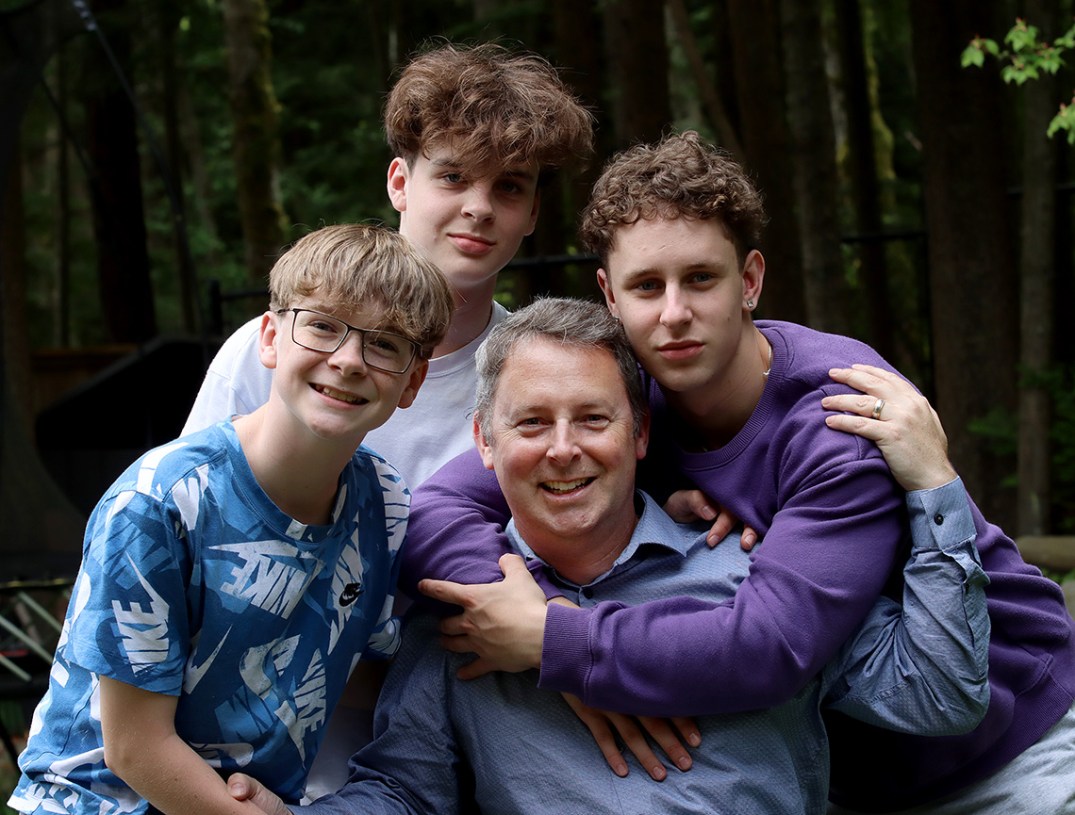
Paul Carter beamed with more than just pride when his sons, Adam and Matthew, recently received rescue awards of merit from the Lifesaving Society.

The life they saved was his.

The Carters, along with his wife, Andrea, and their younger son, Daniel, 12, were with family friends enjoying a day at the beach at Haywire Bay in Powell Lake near Powell River on Aug. 1, 2021, when the boys decided to swim out about 100 metres to explore a nearby island.

Adam, who’s now 16, had recently received his National Lifeguarding certification and swims competitively with the Coquitlam Sharks. Matthew, 14, and Daniel also belong to the Sharks. So for them, the distance and cold water presented little challenge.

Left all alone on the hot beach, as his wife wandered off elsewhere, Paul could see across the bay to the island where his boys, their friends and dad seemed to be having a lot of fun.

“Why am I here all by myself?” he thought before wading into the water to begin the swim to join them.

Who’s at risk from drowning?

According to the Lifesaving Society, there’s an average 458 deaths by drowning every year in Canada. A quarter of them are between the ages of 50 and 64, almost 80 per cent are male, 34 per cent occur in lakes or ponds and two-thirds take place between the months of May and September.

Carter was right in the statistical wheelhouse. He just didn’t know it. Yet.

Halfway to the island, Carter began to realize the distance and cold water were more than his 50-year-old body and recreational swimming ability could handle. He’d gone out too fast and now he was paying for his hubris.

Carter paused to catch his breath, treading water for a minute or so.

Determined to reach the island, he resumed swimming. But 10 metres later he was exhausted.

‘I started panicking’

Carter tried to make up his mind whether he should continue going forward or turn back when a wave hit him square in the face. He swallowed a mouthful of water and began coughing violently, further depleting his waning energy.

Carter’s breathing quickened. His arms and legs slowed.

“That’s when I started panicking,” he recalled. “I did the calculation that I wouldn’t be able to get anywhere where I was safe.”

The eldest boy, who attends Heritage Woods Secondary School in Port Moody, said he just happened to be on the beach on the island’s leeward side when he heard his dad call out. While his friend’s father thought Carter was just messing around, Adam said his dad’s shout had a tone “I’ve never heard used before.”

In trouble

When Adam looked across the water, he could see Carter wasn’t moving much.

The instinctive drowning response, in which humans close to drowning focus all their attention on keeping their mouth above water to the exclusion of any useful effort to save themselves or attract attention, had taken over.

“I knew deep down he was in trouble,” Adam said of his father.

He jumped into the water and let his lifeguard training take over.

Reaching his dad, Adam rolled him onto his back and used his chest to elevate Carter out of the water. He told his dad he was going to be OK, implored him to kick his feet to help propel them back toward the safety of the beach.

By then, Matthew was also in the water.

‘We’ve got to do this’

“I knew it was an emergency,” he said.

When Matthew reached his dad and brother, Adam told him, “We’ve got to do this.”

He wrapped Carter’s arm around his shoulder and the three paddled to shore.

Carter said the whole incident took about five minutes to play out, but “in the moment it seemed a lot longer.”

Back on land, coughing out more of the water he’d swallowed, Carter became a parent again and checked on his boys.

They “looked exhausted,” he said. “You feel bad about the situation you put your kids in.”

Andrea, who was now back on the scene after being alerted by others about what was going on, transported the trio to the hospital to make sure they were OK.

The good scenario

It was during the drive Adam started to come to grips with what had just transpired.

“We just saved our dad from dying,” he said, adding he thought about all the different scenarios that could have happened, but “we got the good one.”

Carter said he was thankful he and his wife had encouraged their boys to take up swimming at a young age.

“You never know when it’s going to be important,” he said.

Young Daniel, who’d watched the whole event play out before him, said, “It’s just a good thing for everyone to learn.”

Since then, Carter said, the family’s often reflected on what happened. Sometimes, he said, he’s wracked with guilt.

“What if my family had lost me?” he said. “How tragic would that have been.”

Adam’s take is a little more pragmatic. “It felt like it was something I should have done.”

Daniel’s nonplussed.

“It could have been the worst day of my life, but now it was just a thing that happened.”

Still, Carter said, there are valuable lessons to be learned, especially as summer approaches and people begin heading to beaches to cool off.

“I made a few bad decisions,” he said. “Drowning doesn’t look like when you see it on TV.”

He’s one of the greatest villains in Canadian sports history. But this Coquitlam historian has a new take

This story first appeared in the Tri-City News on April 2, 2023

A Coquitlam historian is shining a new light on one of the greatest villains in Canadian sports lore.

Cedric Bolz, who graduated from Centennial Secondary School and is now the head of the history department at Douglas College, has published an alternate view of the famous 1972 Canada–Russia hockey Summit Series as it was seen through the eyes of Josef Kompalla, one of its referees.

Kompalla and fellow West German Franz Baader were among eight officials that also included four Americans, a Swede and a Czech, who were assigned to work the historic eight-game showdown between hockey’s two greatest superpowers at the time.

But Canadians old enough to remember the grainy live TV pictures from Moscow’s Luzhniki Ice Palace beamed into their living rooms and even classrooms that September 51 years ago likely recall Kompalla as Public Enemy No. 1.

Even those who’ve only experienced the series second hand through subsequent memoirs and documentary films have come to vilify Kompalla, said Bolz.

Authors and filmmakers have perpetuated the narrative that the amateur referee was out of his depth arbitrating games between hockey’s greatest professional players and the mighty Soviets.

Or worse, they surmised, he was a complicit East German.

Until now.

Historical oversight

Bolz’s book, The September He Remembers, flips Kompalla’s story and his role in the Summit Series on its head.

It is, Bolz said, “the first step in correcting a major historical oversight and adding a new chapter in the Summit Series’ growing, mutable legacy.”

Bolz said he first heard of Kompalla through his stepfather, who’d played professional hockey in Germany for several years before moving his family to Canada.

The veteran referee officiated more than 2,000 games including several world championships.

He was revered in Europe and even earned a place in the International Ice Hockey Federation’s (IIHF) Hall of Fame.

But in Canadian hockey lore, Kompalla is a reviled figure who seemed determined to derail the NHLers from affirming their superiority on the ice over the Soviet Union.

J.P. Parise physically attacked him after he’d been assessed a penalty.

He bore the wrath of a frustrated Alan Eagleson who threatened to pull the Canadian players from Game 8 when Kompalla drew the refereeing assignment for the decisive match and then threw chairs on the ice after Parise was penalized.

He was chased down hallways by players and team officials incensed by some of the calls he’d made.

Even after the series was decided, Kompalla was harassed by Canadian players on a flight to Prague for an exhibition game against the Czech national team.

A quiet life of retirement

When Bolz heard Kompalla was still alive and living a quiet life of retirement in Krefeld, Germany, he reached out, determined to reconcile the conflicting images of a pivotal character in hockey’s greatest drama who seemed to have been left behind by its history.

“I’m a historian,” Bolz said. “My job is to document voices and this was a voice.”

SUBMITTED PHOTO Douglas Collage history instructor Cedric Bolz (right) visits with German referee Josef Kompalla while working on a book about his role in the 1972 Summit Series. Behind them is a photo of Kompalla being attacked by Canada’s J.P. Parise after he was called for a penalty.

Over the course of three years of phone interviews and personal visits, Bolz constructed a picture of a modest man who still loves hockey but can’t understand how he’d become one of the sport’s most notorious characters.

“It was always baffling to him,” Bolz said.

Road blocks

Along the way, Bolz ran into road block after road block in his efforts to gain an understanding of how Kompalla had become so despised.

Players still alive like Red Berenson and Wayne Cashman wouldn’t talk to him.

Even Ken Dryden, the Hall of Fame goaltender renowned for his thoughtful ruminations about the sport and the author of two memoirs about the series, wouldn’t return his calls.

“A narrative had been crafted,” Bolz said. “Legend continues to trump the way things actually were.”

Bolz believes Kompalla was collateral damage, a convenient foil, in a hockey drama that was supposed to be a friendly cultural exchange in the spirit of detente that had started to warm the Cold War in the early 1970s, but quickly devolved into an athletic expression of the great divide that still existed between East and West when the Canadian NHLers realized their opponents wouldn’t be the pushovers as some observers had billed them.

Time is running out

Kompalla is now 87 and Bolz is all too aware time is running out to set the record straight and reform the referee’s legacy.

He hopes his book, academically annotated and cross-referenced through multiple sources, will help facilitate that.

Some who’ve helped shape the story of the Super Series over the past 51 years have taken notice and made overtures to correct the historical record, like the popular misconception that Kompalla was from East Germany when in fact he’d fled communist rule in Poland and settled in Germany’s democratic West.

As for the aging referee who continues to travel the German countryside to attend hockey games as a spectator, Bolz said he still holds out hope his contribution to the series will be recognized in a more positive light.

“He’s always wondered why he’s never been invited to any of the series’ anniversaries,” Bolz said of Kompalla. “It’s important to see him get some sort of closure.”

Toyota vs. Ferrari: A Coquitlam race engineer could soon be a part of motorsports history

This story first appeared in the Tri-City News on May 29, 2023

Deft thumbs at the video game controller has steered a Coquitlam man to one of the most storied car races in the world at one of the sport’s most famous tracks.

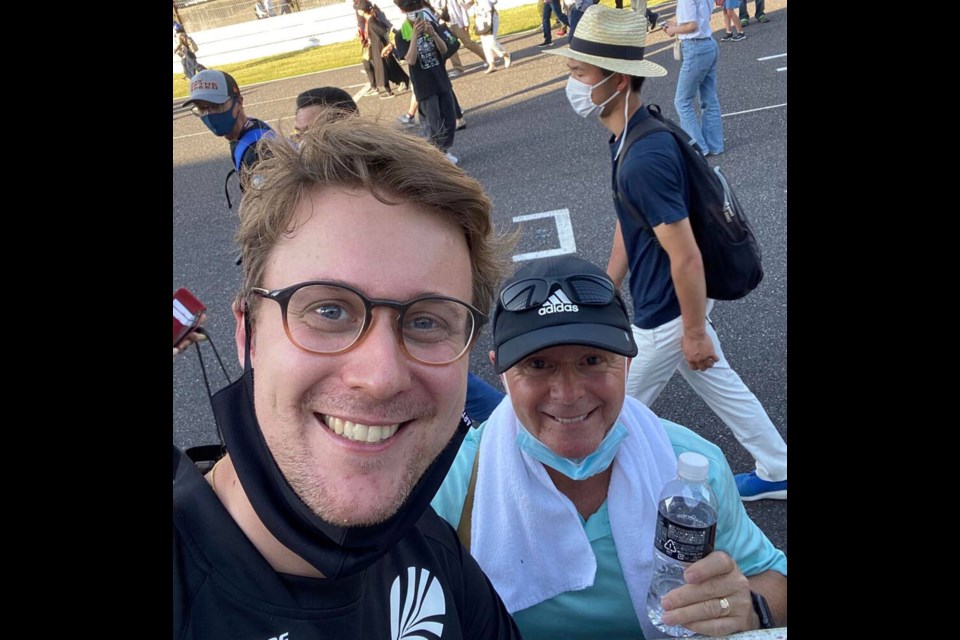
Ryan Dingle parlayed a childhood passion for the Gran Turismo video racing game to a career as a race engineer, first in Japan and now in Europe, where he’ll lead Toyota Gazoo Racing’s World Endurance Championship (WEC) Hypercar team at the 100th running of the 24-Hours of Le Mans, June 10–11.

It’s a daunting responsibility, said Dingle in an email interview. In addition to managing the team of engineers and technicians charged with preparing Toyota’s GR010 Hybrid Hypercar for race weekend and then keep it performing optimally for qualifying and 24 straight hours of racing at Le Mans, Toyota is the five-time defending champion at the event. And this year it will be up against an expanded grid that also includes new factory efforts from Porsche, Ferrari, Cadillac and Peugeot.

There’s “a lot of pressure now,” said Dingle, who’s in his first season in the WEC where most races are six to 24 hours long after cutting his teeth in the smaller Super Formula and Super GT race series in Japan.

“It is my first experience outside of Japan so most of the circuits are new to me,” Dingle said. “Working in a much larger team with more well-defined roles can also be challenging.”

PHOTO SUBMITTED Coquitlam’s Ryan Dingle started his career as a race engineer in Japan.

Dingle, a graduate of Dr. Charles Best Secondary School, headed to Japan after obtaining his engineering degree at the University of British Columbia and post-graduate studies in motorsport engineering at Oxford Brookes University in the UK.

Fuelled by his childhood love for Gran Turismo that evolved into an obsessive interest in Formula 1 and Endurance racing, Dingle identified Japan as his best opportunity to get work in the industry.

Trial by fire

With only one beginner class in Japanese at UBC, and the support of his family and his future wife — who happens to be from Japan — Dingle landed a gig in the all-Japan Formula 3 open wheel racing series.

It was, Dingle said, a bit of a trial by fire.

“The working style in Japan is quite different from the west, as is communication in general,” he said. “People often get frustrated and give up. I got frustrated too, but I guess I had the determination.”

Over the course of his nine-year career in Japan, Dingle managed to work for both Toyota and Honda, fierce competitors at the track and in consumer showrooms.

He said while such vacillation between Japan’s two car giants might be frowned upon in the country’s corporate world, it’s more accepted in motorsport.

“I think it’s been advantageous for me to see how both companies work,” Dingle said. “I like to approach each new place with an open mind and try to learn.”

Driven to succeed

No matter the badge on the car, though, the drive to succeed is universal.

“It’s not a career path where you feel at ease often,” Dingle said. “But when you get it right, you see the fruits of your labour rather quickly and it’s satisfying.”

Now that he’s based in Europe, Dingle said he’s excited to work at some of the race circuits, like Spa-Francochamps in Belgium and Monza in Italy, that he revered back in his video game racing days and when he was studying in England. But being able to compete at Le Mans is special.

“It means a lot to be a competitor in one of the most famous races in the world, and the 100th year,” he said.

“In a way, it’s a validation of the choices that got me to here. It’s a good feeling.”