Patient and saviour reconnect after Coquitlam Crunch heart attack

This story started when we heard about a sign affixed to some fencing alongside a popular uphill hiking trail. It first appeared in the Tri-City News on May 10, 2018.

Tanya Leibel had just witnessed evidence of humanity at its worst when she received a very personal reminder of humanity at its best.

Last month, 66-year-old Port Moody woman was in her hotel room in Krakow, Poland after visiting the Auschwitz concentration camp, where more than 1.1 million prisoners were exterminated during the Second World War, when she got an unexpected call on her cellphone.

That call would connect her to the person who had saved her life.

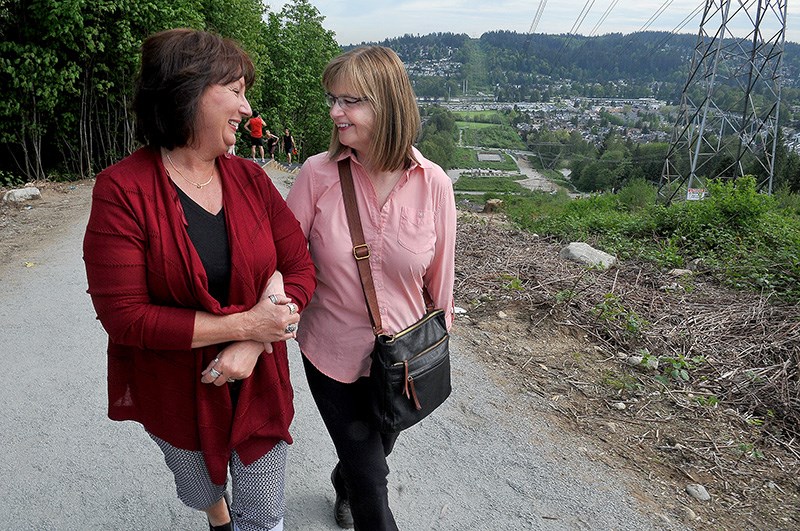
A year before Leibel took a bucket list tour of Europe that also included stops to see the Churchill War Rooms museum in London and Anne Frank’s home in Amsterdam, she was just another Tri-City resident hiking the Coquitlam Crunch. It was a dreary spring day and her son-in-law, Chris Langridge, had just passed her on the stairs, dialled into the music on his headphones, when she suddenly felt dizzy.

‘I knew I was in trouble’

Leibel had been climbing the Crunch’s stair section three times a week for about a year, so she was confident her fitness wasn’t flagging.

Then she felt pressure on her chest and her arm went numb.

“I knew I was in trouble,” Leibel said this week.

She called to Langridge up ahead but he couldn’t hear her because of the headphones. She waved her arms and he happened to glance back, seeing her distress.

He sprinted down to Leibel and called 911.

She sat on a rock, then passed out.

Just below them on that day, Tammy Bryant, 58, was on an exercise break from her job driving school buses for First Student Canada, chatting and solving the world’s problems with a friend, when she saw Leibel slip from her perch. The women ran up to her.

Quick action

Bryant, who just two days earlier had completed her CPR re-certification program as required by her job, leaped into action. She placed her favourite foul-weather jacket on the ground to protect Leibel from the rain-soaked earth, then began assessing her unexpected patient.

“I thought she was having a seizure,” Bryant said.

But when Langridge told her he thought his mother-in-law was having a heart attack, Bryant said she “put into motion what we had just learned.”

She applied steady, rhythmic compressions to Leibel’s chest as she hummed the Bee Gees’ disco hit “Staying Alive” because that’s what her instructors had advised.

“I had the cadence and rhythm, and that’s all I concentrated on,” Bryant said.

After about 12 minutes, first responders from Coquitlam Fire and Rescue arrived and took over. BC Ambulance paramedics arrived and applied a defibrillator twice, then loaded Leibel into their ambulance.

That was the last Bryant saw of the woman she knew only as Tanya.

Search for closure

Subsequent calls to Eagle Ridge and Royal Columbian hospitals, as well as Coquitlam RCMP, failed to turn up any information about Leibel’s fate because of privacy laws.

Bryant and her friend often chatted about that day on their subsequent hikes but they eventually became resigned to the likelihood they would never know whether Leibel had survived. They just resolved that she had lived and that was that, Bryant said, adding, “It was over and forgotten about and seldom mentioned again.”

Until this spring.

Bryant’s son and his girlfriend were halfway up the Crunch when they spied a handwritten sign affixed to some construction fencing just below Lansdowne Drive.

It read: “Did you save my life with CPR here? Please call me. Would love to thank you.”

Confusion

After she passed out on the rock, Leibel has no memory of what happened next. She was transported to RCH in New Westminster, where Dr. Albert Chan, a cardiologist, installed two stents to overcome blockages in her coronary arteries. She recovered from surgery in the hospital’s intensive care unit. Family gathered, her son flew in from Iraq, where he works in the oil fields.

“I was confused by all these people around my bed,” Leibel said.

Five or six days later, she went home, where her daughter lives in the basement suite and was able to care for her as well as take over tending to Leibel’s husband, who has dementia.

Leibel reflected on the circumstances that got her back to familiar environs, back to the embrace of her family.

“It was a master class in organization, precision and professionalism,” Leibel said. “Everyone did everything perfectly.”

When Leibel was able, she visited the fire hall to thank the Coquitlam firefighters who’d tended to her. She thanked Dr. Chan, too.

“But nobody knew who the lady was who saved me,” she said.

Filling in the blanks

Life carried on. Then, as the first anniversary of her second chance approached, Leibel reinvigorated her effort to fill in the blanks of her survival story.

She put up the sign just before embarking on her European trip because “it’s a big deal to save someone’s life.”

“It really centres you and focuses you on what’s important,” she said of her brush with mortality and the rush of circumstances that brought her back.

“Kindness has always been the ultimate gift — it has a ripple effect.”

Afraid to call

Bryant said when her son and his girlfriend told her about the sign and its location, she knew she was the person its author was seeking. But she was too afraid to make the call herself and kept putting it off.

It was her son’s girlfriend who was on the other end of the line when Leibel picked up her phone in that hotel room in Poland.

Once the details were confirmed, they arranged a connection for when Leibel returned from her trip. The patient and her rescuer met in person recently at the Tim Horton’s not far from the base of the Crunch.

“It was very emotional, overwhelming,” Leibel said.

“It’s up there with the birth of your first child,” Bryant said. “It was wonderful.”

For Leibel, her gratitude knows no bounds: Bryant not only saved her life but also spared her family the pain and heartache of her absence, she said.

For Bryant, meeting Leibel not only means the story of that day continues happily but it also confirms the importance of knowing a life-saving skill like CPR.

“I needed to know whether it worked,” she said. “I needed the affirmation. It was easy to save a life.”

Old-world press has a famous connection

In 2018, happenstance reconnected me with one of my favourite stories of my career. A local historian had acquired a vintage letterpress that had once belonged to a renowned typographer in New Westminster whom I had photographed back when I worked at the NewsLeader.
I did two takes on the story; a personal recollection of that reconnection for the New Westminster Record, the paper I once competed against, and this more general feature for the Tri-City News.

These words you’re reading were crafted by the reporter then turned into digital zeros and ones before being printed on paper or uploaded to the internet.

Not so many years ago, the craft of printing words on paper was a much more involved, laborious task that involved dozens of skilled journeymen and tons of heavy machinery.

Each word, paragraph and story committed by the writer to paper had to be assembled into frames with cast lead dies, letter-by-letter, punctation mark-by-punctuation mark.

Those heavy frames, or chases, were then placed into large presses where rollers inked the raised metal letters and then pressed paper to them to create a printed page.

But like so many arduous processes borne of the Industrial Age, manual typesetting and printing is becoming a craft lost to the speed, efficiency and cleanliness offered by computers.

“There is a problem when we go too fast,” said Markus Fahrner a Port Moody graphic artist who’s also the coordinator at the city’s Station Museum.

So, in an effort to slow the process of printing down and reconnect with the skills he first learned as a boy growing up in Germany where his mother was a book designer, Fahrner acquired a Colt Armoury press that was likely built by the gun manufacturer in 1914.

But this is no ordinary old press.

It was once owned and carefully maintained in working order by Jim Rimmer, a world-renowned typographer and letterpress printer who kept the old-world craft alive from a studio behind his New Westminster home until he died in 2010.

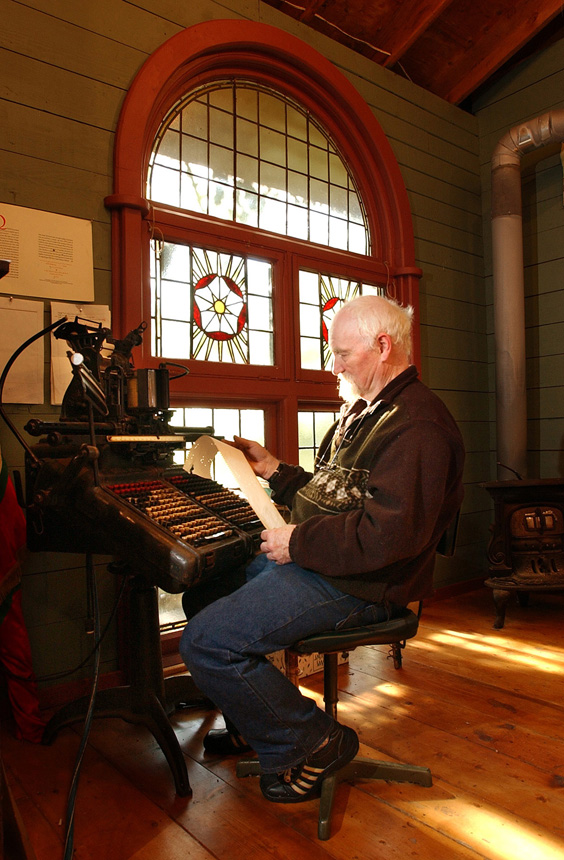
MARIO BARTEL/THE TRI-CITY NEWS The late Jim Rimmer at work on one his vintage typesetters in the studio of his New Westminster home in 2004. Rimmer was a world-renowned typographer who salvaged and restored old printing press machinery and then used them to create fonts and print limited edition posters and books that were coveted by collectors.

The stained glass lit studio and Rimmer’s basement were crammed with old letterpresses, typesetters and spare parts salvaged from print shops that had moved on in technology. He restored the machines and designed dozens of typefaces in metal for printing limited edition books, posters and one-sheets that were coveted by collectors around the world.

Shortly after his death, he was awarded the Robert R. Reid award for lifetime achievement or extraordinary contributions to the book arts in Canada by the Alcuin Society, a volunteer society dedicated to the artistic side of printing books.

Fahrner said he couldn’t believe the good fortune of his find.

While much of Rimmer’s printed works, printers’ dummies, manuscripts and type design work was acquired by the Simon Fraser University library after his passing, the fate of his collection of heavy machinery was less certain.

Fahrner said it’s important to keep the old machines running rather than have them end up as decorative curios in restaurants or antique shops.

“I really admire the craft,” Fahrner said. “I love the way it forces you to slow down.”

In fact, a poster that might take Fahrner a couple of hours to design on a computer can take days to assemble and print on the letterpress.

“It’s slow and precise,” he said. “You suddenly have so much to know about the process, like the way the ambient temperature of the room affects the ink, the type of paper you’re using, how heavy an impression you want to make on the paper.”

The end product, Fahrner said, has a depth and life that can’t be produced digitally.

“There’s an intrinsic love and energy in the things you produce,” he said.

And an eternal connection to a craft whose purpose hasn’t changed since Johannes Gutenberg invented the printing press in the 15th century, even as its technology evolves.

Todd Labranche has been booed by lacrosse fans, players and coaches for 21 years. He’s loved every minute of it

This story first appeared in the Tri-City News on April 13, 2022

Todd Labranche decided pretty quickly that an ongoing problem with shin splints would limit his lacrosse aspirations as a player.

So the former PoCo Saint pulled on a striped referee’s jersey.

On Saturday (April 16), Labranche will officiate his 400th National Lacrosse League game, between the Vancouver Warriors and Calgary Roughnecks at Rogers Arena.

He’s one of only two referees in the pro league to reach the milestone.

Labranche, who grew up in Port Coquitlam but moved to Red Deer, AB, in 2014, said he fell in love with the speed and athleticism of lacrosse the minute he picked up a stick and ball when he was nine years old.

A few years later — as soon as he was allowed — he supplemented his passion by refereeing mini-tyke games.

Wear and tear

Labranche played in the Saints system through junior. But the sport’s quick starts and stops, turns and cuts across the floor pained his shins so much he could never finish a game. Referees, however, move mostly in straight lines.

So Labranche put away his lacrosse stick and devoted himself to officiating, working his way up through the ranks until he was hired at the age of 22 as one of three part-time referees at the time in the Western Lacrosse Association.

As the “new kid” with a whistle, Labranche opened his ears to learn all he could from senior officials in the league like future Hall-of-Famer Ron Crosato and Ray Durante.

Labranche said they taught him how to carry himself on the floor, how to talk to players and coaches so each would walk away feeling like they got a fair shake.

They showed him the importance of developing thick skin and a short memory because no referee is ever perfect and they can’t afford to dwell on past mistakes.

Don’t take it personally

Most importantly, Labranche said, he learned how not to take things that happen in a lacrosse game personally.

“Lacrosse is so subjective,” he said. “Not always is everybody going to agree with your opinion.”

A chance encounter with lacrosse legend Chris Gill at Coquitlam Centre mall in 2001 led Labranche to apply for a referee post at the NLL, just as the pro league awarded a franchise to the Vancouver Ravens.

Now, instead of being the bad guy in front of several hundred people in dark, local barns like the old PoCo Rec Centre or New Westminster’s Queen’s Park Arena, he would bear the scorn of 10,000 or more fans, with his every error or missed call replayed on the giant video scoreboards overhead and potentially inciting even more wrath.

Labranche said he also had to wrap his head around the multitude of rule differences between the way lacrosse is regulated by the Canadian Lacrosse Association and by the pro game, as well as making himself heard over the constant din of loud music that plays through games in the big league arenas.

Still, when Labranche was standing on the floor of the Marine Midland Arena in Buffalo with 19,000 fans singing the national anthems prior to the NLL’s championship game in 2008, he said the hair stood up on his neck with the thrill of it all.

Players are getting quicker

Over the course of his 21 years as an NLL official, Labranche said he’s seen the players get quicker and more skilful.

“Everyone can score goals, everyone can play defence,” he said. “The pace has increased dramatically.”

Labranche said the secret to his longevity has been coming to terms with his role.

“It’s really just a feeling of how you managed the game,” he said. “We know we’re not going to get everything; there’s some calls that will be left out there. But you have to make sure the players are safe.”

Now 57, Labranche figured 400 pro games would be his ultimate achievement in lacrosse.

But two seasons lost to the COVID-19 pandemic bought him time to build a gym in his basement so he could be in shape to shoot for 500.

“The league is getting younger and I’m not,” Labranche said.

But, he added quickly, “I love the game.”

Revised Port Moody proposal still poses problems: report

A proposal to construct a six-storey commercial building on the south side of St. Johns Street next to the Spacca Napoli restaurant has now become a mixed-use project that includes 52 residential units with commercial and retail spaces on the ground floor.

But challenges remain.

According to a report by Port Moody senior planner, Dejan Teodorovic, concerns about the viability, height and massing of the project’s previous incarnation after it was reviewed by the city’s advisory design panel, land use committee and council’s committee of the whole, caused the proponent to withdraw their application for zoning amendments and begin anew.

The 52 residential units in the revised version that is also designed by Mara + Natha Architecture, include six affordable apartments that would be available at below-market rents.

But, said Teodorovic in his report, that’s still below the 15 per cent required by Port Moody’s inclusionary zoning policy.

Also, said Teodorovic, the new proposal doesn’t address worries about the future of a mature red oak tree — one of the oldest in the city — at the rear of the property, as well as several other trees that would have to be removed to accommodate construction.

“There is not planned tree retention or room for future mature trees that will mitigate the urban heat island effects and canopy coverage challenges in the St. Johns Street corridor.”

The planner also noted the number of units is a lot to cram onto two single-family lots, “which impact the ability of the development to achieve urban design and livability standards.”

Teodorovic suggested the proponent acquire a third property to lessen the building’s density. The property to the east is currently occupied by a single-family home, while a commercial building with the pizzeria, a butcher shop and the Block 8 Academy child care and education centre is to the west.

Port Moody’s land use committee will get its chance to review the revised application on June 2.

Centuries-old cedar stump a symbol of Burke Mountain’s past

This story first appeared in the Tri-City News on Dec. 1, 2017

It may not have the girth and renown of Stanley Park’s Hollow Tree but Dave Menzies and his wife, Nola, think a centuries-old cedar stump on Burke Mountain is worth saving as development encroaches ever closer.

Menzies, 77, found the stump when he was exploring the woods near the couple’s Burke Mountain home, where they’ve lived since the 1970s. The retired firefighter and fire inspector makes frequent forest forays with his metal detector to root out artifacts from the mountain’s logging past, hiking along old, grown-over trails that were once used by shake-splitters for transporting cedar logs.

It was along just such a trail he encountered the big old hollow stump, its interior charred likely decades ago from — Menzies surmises — a forest fire that swept across the mountain in 1914. The trunk of the tree fell over and was absorbed into the forest floor years ago, possibly weakened by the fire, as he can find no evidence that it had been logged.

Menzies recalled his first impression of the stump, which is big enough that up to 10 people could stand in its hollowed interior: “I was in awe.”

Over the years, he and Nola have brought their children and grandchild to visit the stump and marvel at its history.

Menzies estimates the stump could be 500 years old — maybe as old as 1,000 years — and it probably soared 200 or 300 feet into the air at the peak of its health.

“You don’t get to see them this close anymore,” he said. “I can sense it has the history.”

But its days may be numbered.

Developers are moving into the area. Roads have been built, trees have been tagged. The wild mountain is being tamed by subdivisions of expansive homes.

“Everything is just turning into progress,” said Nola Menzies, 75.

She’d like to see the stump saved, protected from the march of bulldozers through the woods or maybe even uprooted and moved to where it can become an educational monument to what the mountain once was.

“It’s real, it’s natural,” she said.

But first, people have to know about it, which is why the Menzies have pulled on their gumboots and stomped across the loamy, rain-saturated forest floor to show it to a reporter.

Said Dave Menzies, peering up through the hollowed stump towards the sky: “This is amazing.”

Representing Canada is Ultimate test for disc athletes

The story of the COVID-19 pandemic is still being written. While the immediate fear and uncertainty of the public health scare has faded into the background of our memories, its impact on our daily lives endures.
The first story, about a pair of local athletes preparing to represent Canada at the World Ultimate Championships, was actually ready to go into the Tri-City News when the pandemic hit. A quick rewrite of the lede accounted for the unknown we were all facing at that time while still sharing their journey.
Of course, the pandemic turned out to be more than just a minor speed bump, and three years later I was able to connect with the same athletes to reflect on how it had shaped their lives and aspirations and their own plans to move forward.

A pair of Ultimate players from the Tri-Cities will have to wait a little longer to get to know their teammates on Canada’s national U20 team.

A special four-day training camp that was scheduled to be held at Coquitlam’s Gleneagle secondary school March 19 to 22 has been postponed because of the COVID-19 pandemic.

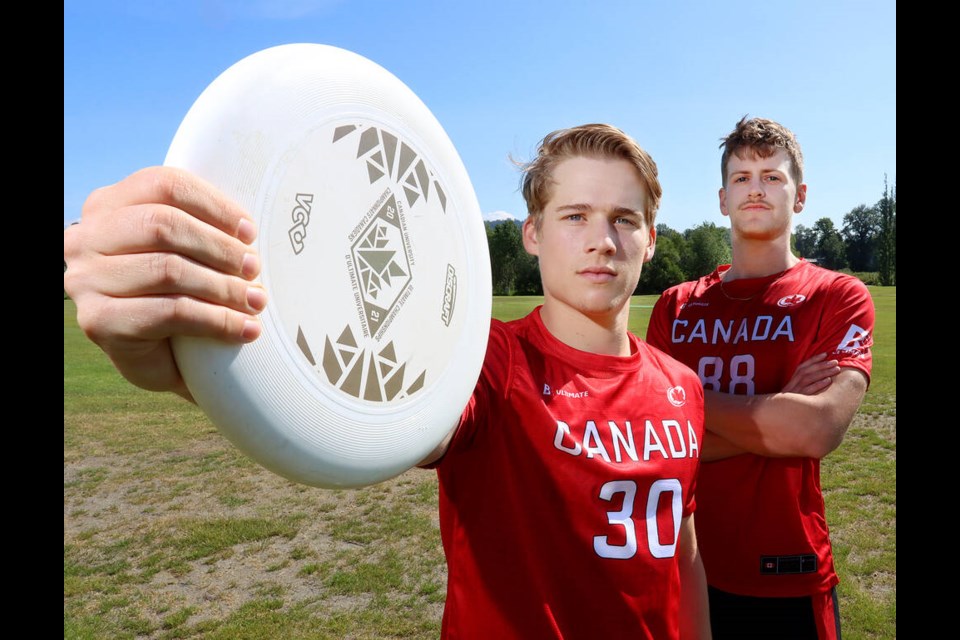
Coquitlam’s Devon Bringeland and Port Coquitlam’s Ricky McLeod are among the 28 Ultimate athletes who will compete for Canada at the 2020 World Junior Ultimate Championships in Malmo, Sweden, July 18 to 25.

Bringeland, who turns 19 this week, said it was Ultimate’s supportive, nurturing spirit that attracted him to the sport when he was in Grade 6 at Stratford Hall, an independent school in Vancouver.

“In Ulitmate, we’re all in it together,” said Bringeland, who’s now studying kinesiology at the University of British Columbia.

McLeod, who’s also 19, said the community vibe of Ultimate is a marked contrast to the negativity he experienced when he was playing competitive soccer.

“Being nice to your opponent is part of this sport,” said McLeod, who finally made the national team after he failed to make in his first attempt a few years ago.

MARIO BARTEL/TRI-CITY NEWS Ricky McLeod and Devon Bringeland get ready to play for Canada at the World Ultimate Championships in Sweden in 2020.

Not that players’ competitive zeal is diminished by their collegial attitude, that’s been a touchstone of the sport since it was invented at a high school in New Jersey in 1968, said the national team’s head coach, Michael Fung.

To get named to Canada’s roster, athletes first had to catch the eye of coaches responsible for selection camps in each of the sport’s regional hubs in Canada — Vancouver, Winnipeg, Metro Toronto and the Ottawa-Gatineau area. Prospective players were tested for their fitness and then run through various drills and scrimmages to showcase their skills. Those who made the cut then attend two training camps prior to worlds to get to know each other and learn how to work together.

“Chemistry is huge in Ultimate,” Fung said, adding each part of the country approaches the sport and its strategies a little differently.

Turning disparate athletes into a cohesive unit when everyone is mostly apart, doing their own thing on club or school teams is an ongoing challenge, he said. Players stay in touch via a Facebook group, they review game recordings and strategy sessions together online, and they share fitness challenges.

“We have to create a platform for them to get to know each other,” Fung said, adding the training camps, that are often based out of someone’s home, can be especially beneficial to achieve that as players have to live, cook, and eat together in close quarters.

He said routine tasks like navigating meal times, cleaning up and sharing bathrooms, as well as planned bonding activities like ping pong and video game tournaments can help develop the synchronicity and communications skills that are vital to success in actual games. It also helps save money as, aside from some small sponsorship to pay for uniforms, everyone on the team pays their own way.

Bringeland said the sacrifices are worth it, especially as the sport’s popularity grows beyond its power base in the United States and Canada; 30 teams will compete in Sweden.

“It’s the next level,” he said of competing at the worlds, which are contested every two years. “It’s what everyone in the sport is driving for, to represent their country.”

Tri-City Ultimate athletes getting a second chance to represent Canada

MARIO BARTEL/TRI-CITY NEWS Three years after they were denied their opportunity to compete for Canada at the World Ultimate Championship because of the COVID-19 pandemic, Ricky McLeod and Devon Bringeland are getting a second chance.

There’s nothing like having something snatched away to motivate you to want it even more.

Port Coquitlam’s Ricky McLeod and Coquitlam’s Devon Bringeland were about to participate in a special training camp for Canada’s national Ultimate team heading to the U20 world championships in Malmo, Sweden, three years ago when the global COVID-19 pandemic yanked away their dream.

This year, they’re back as members of the U24 national side that will be one of 15 teams competing in the open division at the 2024 championships in Nottingham, England, July 2–8.

In between, McLeod and Bringeland had to soothe the sting of missing their chance to compete at the 2020 worlds and embarked on busy studies at the University of Victoria and the University of British Columbia, respectively, recommitted to their training and stepped up their game playing for Canada’s top men’s club: the Vancouver Furious George.

All with their eyes firmly fixed on the prize of being the best in the world.

MARIO BARTEL/TRI-CITY NEWS Port Coquitlam’s Ricky McLeod stretches to make a defensive play during a recent training camp in Burnaby for Canada’s national U24 Ultimate team.

Bringeland said getting robbed of the worlds in 2020 was “an emotional roller coaster” that took him a while to ride out.

“It was heartbreaking,” he said. “Making Team Canada was something I’d dreamed about.”

McLeod said the COVID-19 shutdown in the spring and early summer of 2020 put his Ultimate aspirations at a crossroads.

“You could quit, or you could work even harder.”

By late summer, as public health restrictions eased and sporting activities resumed, the fire to compete had reignited in McLeod and Bringeland.

“I was missing it,” McLeod said. “As soon as I got a taste of it, I was hungry for the future.”

Bringeland said the competitive progression from U19 to U24 is significant. Speed, intensity, athleticism, skill and strategy are all kicked up a notch.

“It’s a huge step up from juniors,” added McLeod.

In anticipation of their next opportunity to play for Canada, McLeod and Bringeland hit the gym to develop their strength, power and explosiveness.

They ran 10 X 400 m laps around the track for endurance.

They honed their fitness to prevent injury and to sharpen their competitive instincts, they tried out — and made — the Furious George side that has won 11 Canadian championships.

They also play for their respective university teams that are part of U.S.-based leagues.

Bringeland said at its top level, Ultimate is no longer about the good-time vibes and tie-dye shirts that come from the sport’s hippie roots, although games are still self-refereed that commands a high level of respect and communication between opposing players.

“It’s a pure level of competition,” McLeod said. “But you don’t yell at people.”

Aside from the physical preparation to compete on the world stage, there’s also a playbook of set offensive and defensive strategies to learn — much like football — and money to be raised.

Canada’s national Ultimate program doesn’t receive government funding, so the athletes have to pay their own way to competitions — about $5,000 for the season. That means bunking down en masse at someone’s family home during training camps, carpooling to and from the fields and cooking communal meals.

It also obligates team members to launch personal GoFundMe campaigns and hit up corporate contacts for whatever support they can muster.

All while keeping up with their studies and part-time jobs.

“It’s a lot of late nights,” said Bringeland.

But the payoff will be worth the sacrifices, said McLeod.

“We take it very seriously,” he said. “Our goal is to dominate.”

Port Moody says proposed Anmore development presents ‘significant concerns’

A proposed development that could triple the population of the village of Anmore will have deleterious impacts on Port Moody’s utilities infrastructure, traffic, environment, wildlife, parks and recreation facilities, says the city’s mayor.

Meghan Lahti says a plan by developer Icona Properties to build 2,200 new homes on 150 acres of property the company owns at the corner of 1st Avenue and Sunnyside Road will even increase the risk of a human-caused wildfire by further expanding into the wildland-urban interface.

The draft assessment, to be considered for endorsement by Port Moody council at its meeting on Tuesday, May 27, expands on a preliminary review of Icona’s development proposal sent by Lahti to Anmore at the end of March, along with a request for more time so city staff could thoroughly evaluate several technical studies that weren’t made publicly available until April 10.

While Anmore council agreed to extend its deadline for Port Moody to submit its comments to April 30, several members were irked.

“We can’t let another municipality drive our decisions,” said Coun. Polly Krier.

“They seem to be getting overly involved in Anmore’s business,” added Coun. Kim Trowbridge.

In the latest assessment, that spans 10 pages, Lahti details a number of “significant concerns” with the proposed project, which requires an amendment to Anmore’s official community plan (OCP) along with agreement from Metro Vancouver to expand the region’s urban containment boundary before it can proceed.

More infrastructure for utilities

They include significant expansion of infrastructure like water, sewer and drainage services in Anmore, much of which would have to be built through Port Moody.

But, said Lahti, the village has yet to engage its neighbour to explore how such construction might proceed, where it could occur and how it would be paid for.

“While coordination with the city could be explored if a coordinating or shared project is identified, no such discussions have taken place to date,” Lahti said.

She added Port Moody is currently upgrading water and sewage infrastructure along Ioco Road and any further work to accommodate growth in Anmore would require full resurfacing of the busy roadway.

“If the village is interested in partnering on this infrastructure, time is of the essence.”

Lahti also said an alternate routing of utility services through Bert Flinn Park is a non-starter because of its designation as a park and the risk to environmentally sensitive areas like Mossom Creek.

“Adding an additional 4,500 residents in close proximity to Bert Flinn Park will add pressure on the natural environmental values of this park,” she said.

Strain on road network

Adding so many new residents would also strain the only two roads — Ioco Road and East Road — that connect Anmore to the rest of Metro Vancouver.

Lahti said the routes could only support about 40 per cent of the anticipated traffic the new development would generate without significant upgrades. But physical constraints like topography, property accesses and limited capacity at some intersection make them unfeasible.

Suggestions put forth in the technical reports to ease traffic along the two-lane roadways, like the construction of bus laybys and increasing transit service also aren’t realistic, said Lahti. The former poses safety and livability concerns while Translink hasn’t confirmed any plans for the latter.

A possible private shuttle service operated to link residents of the new development to transit in Port Moody would also have to run all day to be effective, Lahti said.

“Without a realistic and coordinated transportation strategy, the Icona development risks overwhelming the existing network in the area,” she said.

That assessment echoes an independent review of the proposed development’s traffic impacts conducted by Port Coquitlam transportation engineer Alon Weinberger on behalf of the Anmore Neighbours Community Association.

He said vehicle trips during peak hours on weekday afternoons would be almost double the estimate provided in the technical study commissioned by Icona. And the numbers would only increase further on warm summer weekends when visitors from around the region flock to Buntzen Lake and Belcarra Regional Park.

Environment and wildlife also impacted

Lahti said Port Moody’s environment and wildlife would also be negatively impacted by the proposed development, including the water quality of Schoolhouse Creek’s watershed, increased risk of erosion along its banks, decline in forest health because of changes in light availability and fewer trees and a narrowing of wildlife corridors.

As well, Lahti said, Port Moody will bear the pressure of more residents accessing its parks, playgrounds, sports fields and recreational amenities like its pools and arena as the proposed development includes only one park, a 5 km network of greenways for casual users and a 20,000 sq. ft. community centre that likely won’t include a pool or ice surface.

“The future residents will need to leave Anmore to meet these needs,” Lahti said.

As part of its process to consider Icona’s proposal, Anmore also solicited comments from Belcarra, local First Nations, TransLink, Metro Vancouver, Fraser Health, BC Ambulance, RCMP, the Vancouver Fraser Port Authority and village residents.

Anmore planning consultant Tim Savoie, who recently retired as Port Moody’s city manager, said all interested parties will have more opportunities to provide commentary if the development proposal gets to a public hearing and again if its referred to Metro Vancouver for its approval to expand the urban containment boundary.

Could Port Moody’s biggest-ever development project get even bigger?

The company building Port Moody’s largest-ever development project wants to make it even bigger.

Dean Johnson, the vice-president of development for Vancouver-based Wesgroup Properties, told council’s city initiatives and planning committee Tuesday, May 20, that it will need to add a seventh residential tower to the six already approved as part of its expansive 14.8-acre Inlet District project in the former Coronation Park neighbourhood.

Johnson said the additional density is required to offset recent changes to rules about development cost charges (DCCs) levied by Metro Vancouver that help pay for regional infrastructure like water, sewers and drainage.

He said those changes will cost the company an additional $30 million for its Inlet District development that currently comprises more than 2,500 new homes in six residential towers up to 31 storeys along with three low-rise buildings, a four-storey office building, as well as a grocery store and daycare facility, all built around a 2.5-acre central park.

“This cost is something we have to deal with in this project,” Johnson said, adding it was unforeseen last July, when Wesgroup achieved final approval from council for the zoning amendments required for the development’s first phase to proceed.

Johnson said if the company can’t build an additional tower, it may have to cut back on some of the project’s amenities to help offset its increased costs. Those include:

  • $6 million towards construction of a new pedestrian overpass across Ioco Road to the Inlet Centre SkyTrain station
  • a 186 sq. m. civic facility for community use
  • $4.8 million of public art
  • more than $8 million in community amenity contributions

Johnson said the seventh tower would be part of a future phase of the project’s construction, which is already underway and is expected to take about 25 years to complete.

Johnson’s preliminary pitch rankled at least one Port Moody councillor.

Haven Lurbiecki said it’s “irresponsible” and accused the developer of “moving the goalposts now.”

At one point during the project’s protracted journey through council’s approval process that commenced when Wesgroup finished acquiring the last of 59 mid-century single-family homes that formerly occupied the site in 2019, the company had hurled a similar charge.

In 2022, Wesgroup’s senior development manager, Evan French, expressed frustration at Port Moody’s implementation of a new inclusionary zoning policy that requires at least 15 per cent of units in dense new developments be affordable rentals shortly after it had received approvals for changes to the city’s official community plan so the project could proceed and just as it was preparing to apply for necessary zoning amendments.

And while those zoning amendments were ultimately passed by council in Dec., 2023, without a requirement for affordable housing units, Wesgroup did provide a letter of intent that it would continue working to secure such a component.

Tuesday, Johnson said those efforts have borne some fruit.

He said a program through the Canada Mortgage and Housing Corporation that provides low-cost financing for the construction of affordable apartments could mean all 288 units in the project’s second tower could become rental apartments, with 20 per cent of them available at below-market rates.

Johnson said Wesgroup had previously tapped into the program for projects it built in other communities like Burnaby and New Westminster.

“We are very familiar with this framework and we’re really excited about bringing this to Port Moody.”

But, Johnson added, time is running short and an endorsement letter from the city would speed the process, a request councillors readily granted.

Popular Port Moody concert series gets a financial boost

A popular series of live music concerts at Port Moody’s Inlet Theatre will receive a $5,000 boost from the city.

The art, culture and heritage grant allows promoters Bill Sample and Darlene Cooper to continue booking top touring and local musicians like Shari Ulrich, Roy Forbes and The Paperboys while maintaining affordable ticket prices.

It’s one of $40,000 worth of grants approved by council’s finance committee Tuesday, May 20, for distribution to several local organizations.

Cooper said the concerts have put the city “on the map as a bit of a cultural hub.”

She and Sample, who are both accomplished musicians themselves, launched the series in 2022 after moving to Port Moody from Vancouver and finding the local live music scene somewhat lacking, especially after the demise of Bistro Gallery that burned down in 2019.

Sample said the little bistro on Clarke Street had become a popular performance venue for local and guest musicians, poets, writers and visual artists. But with no place to play, many were bypassing Port Moody while on tour.

“We need music in our lives,” Sample said, of the series that presents up to eight concerts during the fall, winter and spring months in the venue that can seat as many as 208 patrons.

In March, 2024, Port Moody council voted to extend an agreement with Sample and Cooper to waive rental fees at the theatre for two more years to help keep concert costs down.

Devin Jain, who was then the city’s manager of cultural services but recently retired, said the promoters have “brought a consistent and professional music series to the community” which has “filled a gap within the cultural landscape of Port Moody.”

Other organizations awarded grants include:

  • Big Sisters of BC Lower Mainland and Big Brothers of Greater Vancouver will each receive $2,608 community grants to enhance their mentoring and youth leadership programs
  • Crossroads Hospice Society will get a $3,000 community grant to bolster its activities that enhance the quality of care for it patients
  • PoCoMo Meals on Wheels Society will get $3,000 to help keep the price of meals affordable
  • SHARE Family and Community Services also gets a $3,000 community grant to offset the cost of emergency hampers for vulnerable community members
  • The Crisis Intervention and Suicide Prevention Centre also gets $3,000 to boost its operational support for mental health care
  • Port Moody Men’s Shed society’s $1,404 community grant will help its members build community bird houses
  • Port Moody Heritage Society will receive a $5,000 arts, culture and heritage grant to help fund a new exhibit
  • POMO Players will use its $4,500 arts, culture and heritage grant to fund booking of a venue, creative costs and insurance for its production of “A Christmas Carol”
  • The Port Moody Art Association will get $3,000 for room rental, permits and insurance costs
  • Arts Connect gets a $2,500 grant to help it attract top musical acts to Port Moody

As well, five artists will share a total of $4,717 in grants to help them put on exhibitions, open a studio, produce a short film or acquire materials and equipment. They are:

  • Crystal Koskinen
  • Amy Narky
  • Ramin Mohseni
  • Husein Kamrudin
  • Samira Messchian Moghadam

Port Moody Mayor Meghan Lahti said she was pleased by the quality of the recipients.

“They all look like very good applicants,” she said.

According to a staff report, Port Moody received 47 applications for its three grant programs. Each was evaluated by staff and the city’s citizens advisory group based on criteria like:

  • the extent to which the grant will help address a need in the community
  • how the grant will promote the well-being and quality of life of Port Moody residents
  • how much of the money will be spent in the city and benefit the community as a whole
  • the needs of the organization or group requesting the funding
  • how the funds will be directed to support equity, diversity, inclusions and reconciliation initiatives
  • the involvement of volunteers and promotion of community spirit
  • accessibility

Hockey helps Port Moody teen bounce back from fire tragedy

This story first appeared in the Tri-City News on Feb. 28, 2021

There may be no “I” in team, but a Port Moody teen is learning there’s a whole lot of support and love, especially when the chips are down.

Dec. 13, Hailey Kress and her family were displaced from their Glenayre home in the middle of the night by a fire that destroyed their garage and deck, heavily damaged an adjoining bedroom and inflicted lots of smoke and water on the rest of the structure including the basement.

That’s where Kress, 13, stored her hockey equipment.

Nobody — including the family dog — was hurt in the 3:15 a.m. blaze. But the emotional toll of that night has been especially difficult on Hailey, said her mom, Monica.

As the family moved in with relatives, then to an Airbnb, and finally to a rental home on the opposite side of Burrard Inlet, Hailey struggled in class at Banting middle school. She said she’d have panic attacks, feeling frozen and overwhelmed by the enormity of that night’s events and the impact it was having on her routines and sense of security.

“It was important to get back to normal,” said Monica. “We needed to somehow concentrate on something other than the fire, get her mind off the negative.”

Hockey is Hailey’s other.

The day after the fire, Monica received an email from Heather Fox, the president of the Tri-City Predators female hockey association where Hailey has been playing for three years, reassuring her that efforts were already in motion to ensure her daughter could keep playing.

Back on the ice

Two weeks later, Hailey was back on the ice. All of her equipment was brand new, courtesy of The Hockey Shop, in Surrey. Her new Predators bag, socks, pants and even hockey tape were donated by Rocket Rod’s at Planet Ice in Coquitlam.

n a season that’s been all about disruption because of public health restrictions to temper transmission of the coronavirus that causes COVID-19, Hailey said practising with her teammates made her feel normal, that everything was going to be OK.

“It was really fun to be with my friends again,” she said. “It made me forget about everything for an hour.”

Hailey, who’s also played baseball, jiu jitsu and acro-gymnastics, started playing hockey after a sleepover at a cousin’s house meant she also had to attend that cousin’s game the next day.

She said she liked what she saw.

“It looked super fun,” she said, adding she especially enjoyed hockey’s aggressive nature.

Monica said she was initially taken aback when Hailey expressed an interest in playing hockey herself. But the positive benefits of being part of a team and forming new relationships outweighed the downsides of the sport’s expense and sitting on cold arena benches.

“It makes for a really well-rounded kid,” she said.

Values camaraderie

Hailey said she enjoys the challenge and responsibility of playing defence, including learning how to skate backwards. But she most values the camaraderie of her teammates and coaches.

“It’s like always having people around you who care about you,” Hailey said.

That care was delivered even before Hailey returned to the ice, as her teammates put together a package for her family of food and personal items like blankets and skin care products.

Monica Kress said she’s been overwhelmed by the outpouring of support from Hailey’s team and the Predators’ hockey community.

“You always think you pay a lot of money for these sports, you think you’re just a number to them,” she said. “But it’s such a good group of kids and parents.”

Hailey said the experience has given her an appreciation for the importance of having sport and teammates in her life. It’s also made her more determined to keep getting better at her game.

“Everything that they’ve done makes me want to try harder to show I’m grateful.”