This story originally appeared in the Tri-City News
After Carson McGinley learned he’d been traded to the Coquitlam Express from the Sherwood Park Crusaders on Dec. 30, he and his dad, Mike, loaded up his car and drove 13 hours from Alberta to his third hockey destination in five months.
Several other players have been similarly uprooted as Express general manager Tali Campbell and head coach Jeff Wagner refine the BC Hockey League (BCHL) team’s lineup for the stretch run to the playoffs. Goaltender Andrew Ness was acquired by Coquitlam from the Penticton Vees in late November. Defenseman Jack Sullivan joined the Express from the Blackfalds Bulldogs a week later.
In the past two weeks, the team has also added Kazakhstan junior national player Nikita Sitnikov and forward Dane Pyatt, who’d been injured most of his rookie season with the Western Hockey League’s Spokane Chiefs.
Wagner said the upheavals can be unsettling for everyone involved — the new players coming in and the group already established in the dressing room.
“The business of junior hockey is that moves are made and you can’t take anything for granted,” said Wagner, who’s in his first season running the Express bench.
Easing a player’s transition into a new situation that not only includes a new coach and new teammates, but also a new living situation with an unfamiliar billet family and a new community to navigate, is all about making sure management has done its homework, keeping open the lines of communication and having trust in the dressing room’s leadership group, said Wagner.
“We lean on our leadership group to make sure that they’re integrated well and put into a good situation.”
MARIO BARTEL/TRI-CITY NEWS
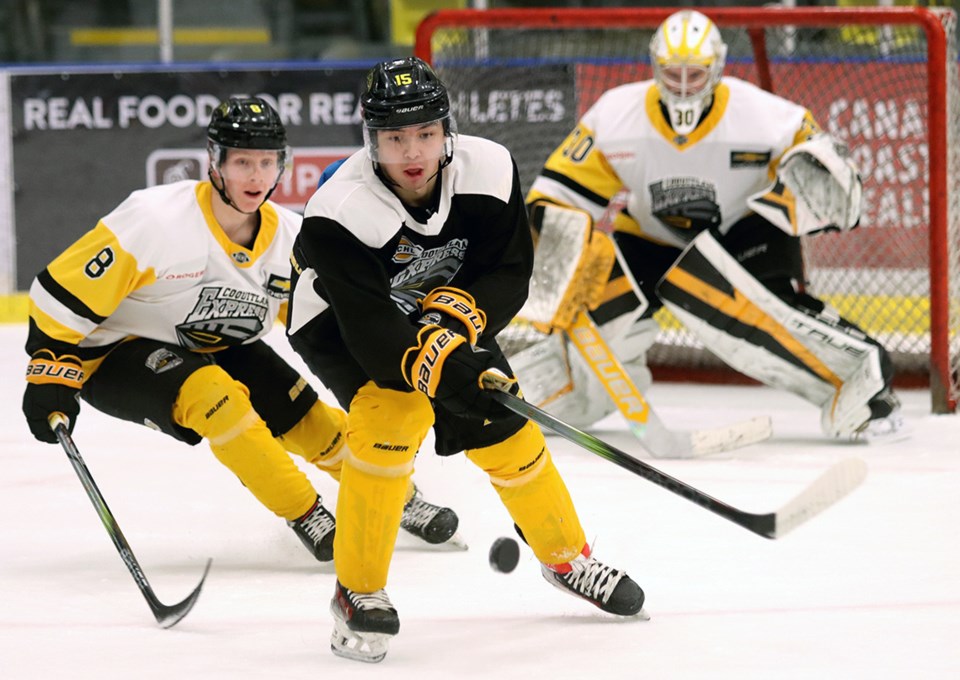
Coquitlam Express forward Carson McGinley lays it out during a timed skating session during a team practice.
McGinley, who’s originally from Phoenix, Ariz., said he felt instantly welcome when he arrived in Coquitlam. His new teammates and billet family helped him settle in and showed him around town so he could keep his focus on what he needs to do on the ice.
“It was a very easy transition,” he said.
It’s showed in McGinley’s performance. In the four games he’s played since joining the Express, he’s scored eight points.
The instant payoff pleases Wagner as he and Campbell continue to search for the bits and pieces that will produce a winning formula for Coquitlam.
That process includes keeping an eye on other players around the BCHL and elsewhere, assessing their situations and sharing information.
After starting the season in Vernon, McGinley was moved to Sherwood Park so the Vipers could acquire a defensemen to help fill some holes in its lineup. But the Crusaders proved a poor fit, so the move to the Express was welcome, said the 18-year-old right winger.
Placed on a line with offensive spark plugs Mason Kesselring, who has 31 points in 32 games, and rookie Thomas Zocco who has 28 points, McGinley said his confidence has been restored.
“It’s just building chemistry with your linemates. They’re two unbelievable players and they’re really easy to play with.”
Wagner said the latest roster moves have come at an opportune time.
The two-week break around the BCHL’s all-star weekend festivities in Salmon Arm provides ample practice time to work the new players into the lineup, get them settled into their environs and forge bonds in the dressing room.
“The extra time helps get them integrated with the systems and get to know the guys in the room,” Wagner said, adding it also provides a bit of a buffer to soothe any shock players felt from the departure of a teammate or friend.
With three wins in the four games the Express has played since the holiday break, Wagner said the team is headed in the right direction after a November swoon saw them slide down the Coastal Conference standings following a hot start to the season.
“We’re fairly happy with our group and we believe in what they can do.”
But, he added, the tinkering never really ends — especially if injuries occur.
“It just makes our decisions a little bit more difficult moving forward.”
I first started telling Wade MacLeod’s story in 2018, when friends launched a GoFundMe campaign to help support his young family as he tried to battle a Grade 3 glioblastoma tumour in his brain. In the years since, we’ve checked in periodically to document his ongoing health challenge and his effort to keep his professional hockey career going. What follows are a few of those stories, all of which originally appeared in the Tri-City News.The first appeared in March, 2019. The second was published in August, 2021, and the third is from January, 2025.
Port Moody hockey player stays positive after third clash with cancer
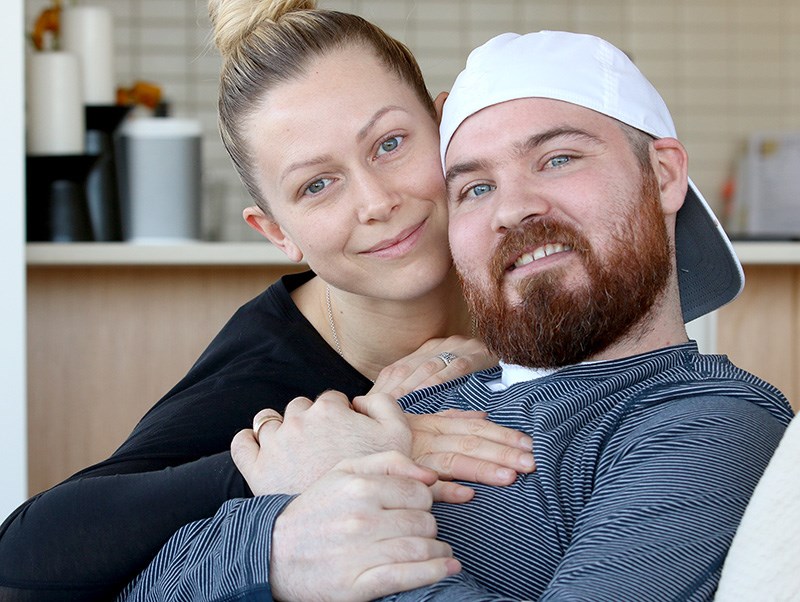
Wade MacLeod loves the view from the Port Moody condo he shares with his wife, Karly, and their 17-month-old daughter, Ava James.
Looking out the expansive windows of their living room to the snow-peaked mountains and the twinkling water of Burrard Inlet far below is thearaputic, MacLeod says. But it’s not where he should be in the waning weeks of winter.
MacLeod and his young family were supposed to be back in Germany, where the 32 year-old Coquitlam native was looking to build on the point-a-game pace he was scoring last year as a professional hockey player with the Frankfurt Lions.
But two surgeries within two months last summer derailed that dream. Doctors removed a Grade 3 Glioblastoma tumour in his brain for a third time.
MacLeod hopes he can get his playing career back on track, and the results of his latest MRI showed no further growth of the disease. That has only fuelled his optimism.
In fact, it’s that positive outlook that helped get MacLeod back on the ice after two previous encounters with the disease, said Karly, who’s also from Coquitlam.
“No matter how many times he’s knocked down, he’ll get up again and go for it,” she said.
MacLeod’s tumour was first diagnosed after he collapsed on the ice during a game in Springfield, Mass., where he was playing his second season as a pro after competing for four years with Norheastern University in Boston. Doctors removed a golf-ball sized non-cancerous tumour from the left side of his brain and he lost the ability to speak.
Returning to the ice Speech therapy got that back, and extensive rehab allowed MacLeod to return to the ice, this time with a team in the ECHL, a rung down hockey’s minor-professional ladder. He knocked around various outposts, from Indiana to Idaho, including a 34-game stint with the Toronto Marlies of the American Hockey League, just below the NHL. Then he headed to Germany.
It was after a 61-point season with the Rosenheim Star Bulls, a second-division pro team, that the disease reasserted itself. MacLeod underwent a second surgery in September, 2016, then worked his way back to the ice the following March, with another ECHL in Allen, Texas. He scored 13 points in 13 games, and, in September, 2017, he signed with Frankfurt.
‘Everything changed’ Going back to Germany, this time to Dresden with their newborn daughter, was supposed to be the time of their lives, Karly said. “Then everything changed.”
MacLeod took the latest diagnosis in stride.
“It is what it is,” he said, then set about doing whatever he had to do to get better again and return to the ice. Currently in the midst of a six-month course of chemotherapy treatment, MacLeod hooked up with Port Moody Integrated Health to plot a holistic path back to health that includes speech therapy — last summer’s operations again affected his ability to speak — occupational and physical therapy. He changed his diet to eliminate refined sugar and reduce his intake of carbohydrates. Several times a week he gets special hyperthermia treatment that tries to kill cancer cells with high temperatures.
Both Wade and Karly visit with a sports psychologist to deal with the mental and emotional challenges of his disease.
Community support A fundraising campaign launched on the crowdsourcing website gofundme.com last August by MacLeod’s friend, Mike Armstong, has raised more than $124,000 so far, making much of the supplementary care possible.
More importantly, MacLeod said, the messages of support that continue to get posted on the site from every waystation on his journey through hockey, even as far back as his minor days at the Burnaby Winter Club, and from Merritt where he played for the BC Hockey League’s Centennials, propel him forward.
“It drives my strength and positivity more than you can imagine,” MacLeod said, adding his whole family was brought to tears when they first started seeing the donations and messages come in as he recovered from his fourth surgery.
While some treatment days can be long and gruelling, sapping MacLeod’s strength and confining him to the couch to take in the view from a special massage pad Karly got him for Christmas, he said he’s been able to gain a new appreciation for life’s small moments, playing catch with his daughter (“She has a wicked spiral,” he said), or the beauty around him during walks along the Shoreline trail.
MacLeod was last on the ice in December, at a stick-and-puck session with his brother and brother-in-law. He said the feeling of holding the stick in his hands, gliding around the ice, chasing down the puck, was “unbelieveable.”
He can’t wait to get that feeling back. Again.
Wade MacLeod has already scored the biggest win of his life
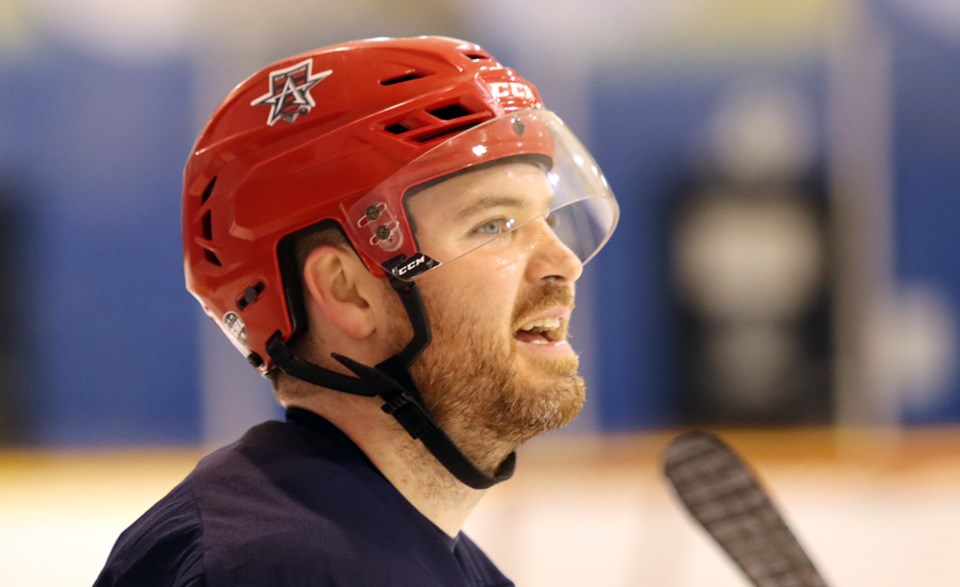
In preparation for his return to professional hockey, Wade MacLeod has been working every weekday with his trainer, Kai Heinonen. MARIO BARTEL/TRI-CITY NEWS
Even if Wade MacLeod doesn’t score a goal with his new Manchester Storm hockey team, he’s already achieved the biggest victory of all.
The 34-year-old left winger from Port Moody beat cancer – not once, not twice, but three times.
And when MacLeod’s doctor gave him the all-clear last November, that the Grade 3 Glioblastoma tumour that had recurred in his head for a third time was completely gone, he knew what he had to do.
“I said from the very beginning that cancer wasn’t going to be the reason I retire from professional hockey,” MacLeod said after a recent workout at Coquitlam’s Planet Ice with his trainer Kai Heinonen and veteran NHLer Brad Hunt.
The fact MacLeod is able to share the ice and keep up with the newly-signed defenceman for the Vancouver Canucks is a testimony to the dedication of getting his career, and life, back on the rails.
Three years ago, MacLeod had to relearn how to walk and speak again after two surgeries to remove a recurring tumour that had reformed in his brain as he prepared to play a third professional season in Germany with Dresden Eislowen.
When MacLeod was diagnosed after having seizures as he moved from Frankfurt, where he’d scored 49 points in 49 games for the second division Lions, he, his wife Karly, and their young daughter, Ava, headed back to Canada for surgery. Two months later, the tumour returned for a third time, and he was under the knife again, to be followed by radiation and chemotherapy treatments.
A GoFundMe fundraising campaign to help the young family get through the tough time raised more than $100,000 from donations wherever MacLeod’s skates had taken him — from Merritt where he played junior hockey with the BC Hockey League’s Centennials, to Northeastern University in Boston, Mass., to minor league teams in Springfield, Mass., Evansville, Ind., Toronto, Boise, Idaho, Allen, Texas, as well as Rosenheim and Frankfurt in Germany.
Return to health Some of the money went to MacLeod’s return to health and rehabilitation that was coordinated through Port Moody Integrated Health. Dietary changes, occupational and physical therapy, as well as hyperthermia treatment to kill lingering cancer cells with high heat, all contributed to his battle against the disease that first presented itself in 2013 when he collapsed on the ice during an American Hockey League game in Springfield.
A four-hour operation removed a golf-ball sized tumour from the left side of MacLeod’s brain and, after extensive rehab, he was able to get back on the ice the next season, splitting his time between the Springfield Falcons and the ECHL’s Evansville IceMen.
Three lost years But the double recurrence of the tumour in 2018 has cost three prime years of MacLeod’s hockey career. Getting back to a place where he feels he can compete again on the ice has taken a lot of work with Heinonen, whose background includes martial arts. The two are together for hours every weekday, either on the ice or in the gym. They use karate to sharpen hand speed, balance and peripheral vision, circuit and core training, as well as visualization.
MacLeod said he feels in the best shape of his life. Earlier this summer, he told his agent he was ready to play again.
Limited opportunities But opportunities for an aging minor leaguer who’s been out of the game for three years were limited. Norway or France were possibilities, MacLeod’s agent told him.
It was the Storm of Great Britain’s Elite Ice Hockey League that expressed the most interest. The team’s coach, Alberta native Ryan Finnerty, also has a young family and was familiar with MacLeod’s story.
“It all worked out,” MacLeod said of the process that landed him a contract, adding he’ll head to England in about mid-September, then his family that now includes a newborn sister to Ava, will follow a few weeks later.
MacLeod said he’s excited about getting back into a dressing room with teammates, then hitting the ice again with fans in the stands.
‘Never give up on your dreams’ “It’s going to be so unreal,” he said. “The biggest thing is never give up on your dreams and always stay positive.”
While MacLeod is hopeful the opportunity he’s being given in Manchester might lead to bigger and better things, he said he already feels he’s accomplished so much.
“I beat cancer.”
‘Desperate for a solution’: Uncertainty clouds future of Port Moody hockey player
A glioblastoma tumour finally forced Port Moody’s Wade MacLeod to retire from his hockey career. MARIO BARTEL/TRI-CITY NEWS FILE PHOTO
A Port Moody hockey player battling Grade 4 brain cancer is girding for another round of radiation treatment. In an update to a GoFundMe page raising money to support Wade MacLeod’s treatment of a glioblastoma tumour, Karly MacLeod said a sixth operation in November allowed doctors to remove “a huge portion” of the growth.
But uncertainty about her husband’s future remains.
“Since Wade’s surgery, we have been in limbo with treatment but desperate for a solution,” Karly MacLeod said.
Wade MacLeod, who grew up in Port Moody and played for the Merritt Centennials in the BC Hockey League before attending Northeastern University, was playing for the Springfield Falcons in the American Hockey League when he first fell ill in 2013 after collapsing during a game.
Doctors found a non-cancerous tumour the size of a golf ball in the left side of MacLeod’s brain. After it was removed, and following extensive physical and speech therapy, he resumed his playing career in the ECHL and 34 games with the AHL’s Toronto Marlies before heading to Europe.
MacLeod scored 61 points in 50 games for the second-division Rosenheim Star Bulls in Germany and was preparing to return overseas for a second season when he had a second seizure.
This time MacLeod was diagnosed with a cancerous glioblastoma.
Back on the ice Six months later though, he was back on the ice with the ECHL’s Allen Americans in Texas, then signed with the Frankfurt Lions in Germany the following season.
A third seizure felled MacLeod in September 2018.
Doctors removed a Grade 3 glioblastoma tumour. Several months of chemotherapy followed, along with speech, physical and occupational therapy as well as dietary changes and special hyperthermia treatments that use high temperatures to kill cancer cells.
In November 2020, MacLeod got the go-ahead to resume training and the following August he told the Tri-City News he was in the best shape of his life as he prepared to join the Manchester Storm in Great Britain’s Elite Ice Hockey League.
“The biggest thing is never give up on our dreams and always stay positive,” MacLeod said following an on-ice workout at Planet Ice in Coquitlam.
MacLeod played seven games in Manchester, scoring one point, then signed with the Narvik Arctic Eagles in Norway.
Turning the page on hockey But in June 2023, MacLeod said his hockey journey was over.
“I gave all my life to hockey and now it is time to turn the page,” he wrote on his Facebook page.
A fifth brain surgery in December 2023, confirmed the worst fears of MacLeod’s family, that includes two young daughters; his glioblastoma tumour was now Grade 4 — the most serious and aggressive form of the disease.
A heavy toll In her most recent update, posted by Karly MacLeod on Jan. 18, 2025, she said Wade’s battle and sixth surgery have exacted a toll: Changes to his motor and speech skills have necessitated alterations to their home and the couple accelerated a longstanding plan to renew their vows on the tenth anniversary of their wedding so they could celebrate with their daughters.
“We’ve learned the importance of living in the moment and taking everything one day at a time,” Karly MacLeod said, adding she’s also dialing back her work as an interior designer to help care for husband and manage his upcoming treatment plan that includes four weeks of radiation along with hyperthermia, drug and dietary therapies as well as some alternative medicine approaches.
That means some of the almost $142,000 that has been raised so far through the GoFundMe campaign will go towards supporting MacLeod’s family as well as covering medical expenses that aren’t insured, Karly MacLeod said.
“Some days can be beautiful and some days can be hard,” she said. “We feel the love and it has helped us immensely to continue taking each foot forward and never giving up.”
This story originally appeared in the Tri-City News
A Coquitlam student who’s endured cancer three times is hoping some of her darkest moments will help light the way for other young people going through a similar health challenge.
Julia Dawson, a Grade 12 student at Dr. Charles Best Secondary School, has created a workbook for cancer patients and their families embarking upon Car T-cell therapy to treat their disease.
It’s a new regimen that uses a patient’s own T-cells to identify and destroy cancer cells with the help of genetic engineering.
Dawson had already beaten leukemia twice when doctors determined her third round with the disease was resistant to conventional chemotherapy.
Instead, they recommended removing T-cells — a type of white blood cell that fights infection — from Dawson’s body and retraining them to attack cancer cells before reinjecting them back into her bloodstream. While Car T-cell therapy has been in clinical trials at Seattle Children’s Hospital since 2018, it was still new at BC Children’s Hospital.
Few resources
Dawson would be among its first candidates for the procedure. She said she didn’t know much about the unique therapy going in. Nor did her family, and the all the research they did on the internet just turned up highly technical articles from medical journals. Even her doctors weren’t quite sure what to expect for things like side or long-term effects.
“There was not a lot of resources,” said Dawson. “I was scared, but the doctors were optimistic.” To remove her T-cells, Dawson was hooked up for four hours to a large device that “looked like a washing machine” by a tube inserted in her neck. Several weeks later the engineered cells were reinjected through a port in her chest. Then she had to stay in isolation in the hospital for a month rebuilding her immune system.
During that time, Dawson said she asked the nurses and doctors a lot of questions. She made notes of how she was feeling, the fevers and loss of memory and occasional anger and fear she endured. Dawson said the experience was “like going through a bad flu.”
But she also knew what she was experiencing could be invaluable to someone else about to undergo the same treatment asking the same questions she’d had.
“I want to make sure others have the information so they don’t feel totally alone,” Dawson said. Back at school and feeling better, Dawson pitched the idea of the workbook as her senior year Capstone project. It includes pages with information about the Car T-cell therapy, its side effects and symptoms, a pain chart and various activity exercises to help manage feelings of anger and frustration.
Dawson said she vetted the more clinical elements of the workbook with her doctors and nurses to ensure the information was accurate.
‘It really helps’
She said putting it together helped ease her own journey.
“It really helps by just putting it into words,” Dawson said, adding it also kept her positive and hopeful. “You realize things you’re going through are normal.”
Dawson said she prepared workbooks for youth counsellors at Camp Goodtimes, a special summer camp for young people living with cancer. BC Children’s is also including copies in a special welcome package for new Car T-cell patients and the hospital is in the process of securing grants to print more copies and distribute them to other institutions across Canada offering the therapy.
Dawson said the project has fuelled her determination to pursue a career in health care that begins when she heads to Simon Fraser University next fall to study health sciences.
“I want to help others know it’s going to be OK.”.



 MARIO BARTEL